The Pulse
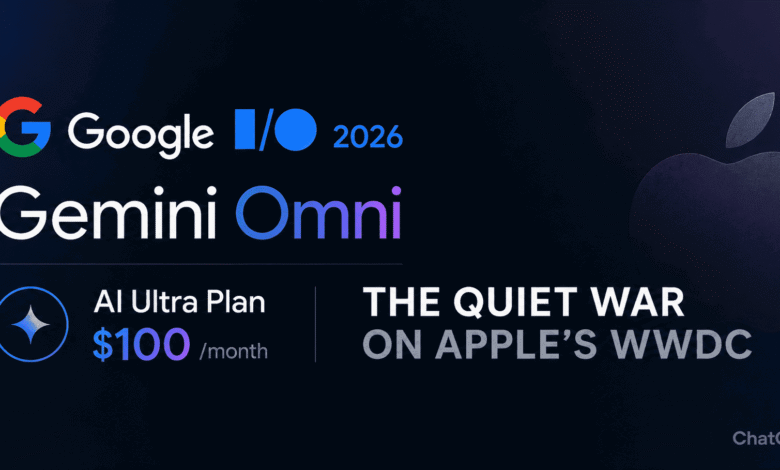
Google held I/O 2026 on May 19, exactly 20 days before Apple’s WWDC on June 8. The timing was not accidental. Sundar Pichai took the stage at Shoreline Amphitheatre and unveiled three new Gemini models, a $100 monthly AI Ultra subscription, AI-powered glasses built with Warby Parker, and Antigravity 2.0, an agent-first development platform that changes how software is built from the ground up.
Every single announcement was designed to set the terms of the AI conversation before Apple could respond. The Google IO 2026 AI announcements mark the clearest statement yet that Google is no longer reacting to competitors. It is forcing them to react to it. For the first time in a decade, Apple will walk onto a stage and demonstrate technology that Google has already shown the world.
Core Significance
Why it matters:
- The Agent Shift Is Now Official: Google declared the era of passive AI chatbots over at I/O 2026. Gemini 3.5 Flash powers multi-step agentic workflows across Search, Gmail, Calendar, and Android. AI Mode in Google Search has surpassed one billion monthly users, with queries doubling every quarter since its May 2025 launch. This is the documented, measured shift from AI that answers questions to AI that executes tasks. Sundar Pichai described it as the move from tools that help us write to agents that help us act.
- The Apple Contract in Plain Sight: Google announced Gemini Intelligence on May 12, one week before I/O, and never mentioned Apple once during the entire keynote. Yet Gemini is the engine that will power Siri 2.0 at WWDC on June 8. Google deliberately set the product narrative and the performance benchmarks before Apple could frame its own announcement. When Apple demonstrates Siri 2.0, every comparison will be made against what Google showed three weeks earlier. That is not a coincidence. It is a distribution agreement that doubles as a competitive positioning strategy.
- Search Is Transforming Faster Than Predicted: Alphabet posted $109.9 billion in Q1 2026 revenue, up 22% year over year, with Google Search revenue growing 19% to $60.4 billion. AI Overviews now reach 2.5 billion monthly active users. The feared scenario where AI search destroyed Google’s ad revenue has not materialised. Instead, ads alongside AI Overviews grew from 3% of SERPs in January 2025 to roughly 40% by late 2025. Google has monetised the AI transition more effectively than any analyst predicted.
Deep Context: Ten Years AI-First and Finally Delivering
Sundar Pichai opened the I/O 2026 keynote by noting it has been exactly ten years since Google declared itself an AI-first company. The decade-long arc is worth understanding. Google invented the Transformer architecture that underlies every large language model in existence. It built the research foundation for the entire industry. Then it watched OpenAI productise that research faster than Google could ship it, losing the first-mover narrative in the public’s perception of AI.
That narrative has been systematically reversed over the past 18 months. The gap between Google’s announcements and its actual shipping dates has collapsed dramatically. At I/O 2025, Veo and Imagen were demonstrated. Both shipped. At I/O 2026, as Google’s official I/O collection confirms, the majority of announced features went live the same day as the keynote. Gemini 3.5 Flash is available today on every product and API, including the free tier.
The Apple relationship adds a layer of strategic complexity that most I/O coverage missed. Google announced Gemini Intelligence on May 12 and framed Gemini as a platform-wide operating layer across phones, browsers, cars, and laptops. Apple then has to walk onto the WWDC stage and announce that this same platform is now the brain of its rebuilt Siri. Google announced first. Apple responds to Google’s framing. Alphabet’s stock has risen 25% year to date, edging toward a $5 trillion market capitalisation. Apple is up considerably less. Wall Street has noticed the gap.
Bank of America’s post-I/O note captured the shift directly: Google has moved from AI laggard to leader in shaping consumer AI experiences. That is a remarkable sentence about a company that was writing the foundational research papers for the entire field a decade ago.
Data Insights
By the numbers:
- $109.9 Billion: Alphabet Q1 2026 revenue, up 22% year over year. Google Cloud surged 63% to $20 billion in the same quarter.
- 1 Billion: Monthly active users of AI Mode in Google Search as of May 2026, with queries doubling every quarter since launch.
- 2.5 Billion: Monthly active users of AI Overviews, per Sundar Pichai’s I/O 2026 keynote.
- 900 Million: Gemini app users, more than double the 400 million reported at I/O 2025 one year earlier.
- 4x: Gemini 3.5 Flash’s token output speed advantage over comparable frontier models at its performance tier.
- 76.2%: Gemini 3.5 Flash score on Terminal-Bench 2.1. The model also outperforms Gemini 3.1 Pro on GDPval-AA (1,656 Elo), MCP Atlas (83.6%), and CharXiv Reasoning (84.2%).
- $100/Month: New AI Ultra subscription plan targeting developers and power users. Includes higher usage limits, expanded storage, and premium AI features.
- 250 Million: Vehicles reached by Android Auto and Google built-in technologies where Gemini now handles navigation and in-car tasks.
Table 1: The Three New Gemini Models from I/O 2026
| Model | Primary Purpose | Availability | Key Capability |
| Gemini 3.5 Flash | Default agentic model across all products | Live today: free and paid tiers | 4x faster than frontier peers, multi-step tool use |
| Gemini Omni Flash | Multimodal creation :text, image, audio to video | Live in Gemini app and Google Flow | Physics-aware video generation from any input type |
| Gemini Spark | 24/7 autonomous background agent | Beta on Antigravity platform | Runs continuously, completes long-horizon cross-device tasks |
| Gemini 3.5 Pro | Frontier reasoning and coding | Internal testing, releasing June 2026 | Designed to compete directly with GPT-5 and Claude 4 |
Table 2: Google I/O 2026 vs Apple WWDC 2026 — The AI Race at a Glance
| Metric | Google (post-I/O 2026) | Apple (pre-WWDC 2026) |
| AI Assistant | Gemini 3.5 Flash: live, agentic, cross-device | Siri 2.0 powered by Gemini, announced Jun 8 |
| AI Search | AI Mode :1B users, live in 200+ countries | Not applicable |
| AI Subscription | $100/month AI Ultra, live today | No equivalent announced |
| AI Glasses | Warby Parker audio glasses — launching 2026 | Vision Pro enterprise focus, $3,499 |
| Developer Platform | Antigravity 2.0: agent-first, live today | Xcode AI tools, WWDC announcement pending |
| Stock Performance (YTD) | Alphabet up 25%, approaching $5T market cap | Apple up significantly less |
The tables frame the Google IO 2026 AI announcements in competitive context. Google is shipping today. Apple will announce on June 8 what ships in September. That three-month gap matters more than any benchmark comparison.
The Business Case: What I/O 2026 Actually Changes
The headline models are real and important. But the three most strategically significant announcements at I/O 2026 are not the models themselves. They are the infrastructure decisions that determine who controls the AI development pipeline for the next five years.
Antigravity 2.0: The Developer Lock-In Play
Antigravity 2.0 is the announcement that will matter most in 18 months. The agent-first development platform lets users manage multiple AI agents simultaneously, build Android apps directly from natural language prompts, and publish directly to Google Play test tracks from within AI Studio. Google has vertically integrated the entire development pipeline under the Gemini umbrella.
The strategic logic is the same as the CUDA ecosystem described in our Nvidia chip competition analysis. Once developers build their workflows inside Antigravity, switching to another platform requires rewriting those workflows. The barrier to exit is not technical. It is accumulated workflow investment. Antigravity 2.0 is Google’s attempt to create the same switching cost in AI development that Nvidia created in AI training.
The platform is free. That is the critical detail. Google is not charging for access because access is not the product. Developer adoption is the product. Every developer who builds inside Antigravity is a developer whose applications run on Google’s infrastructure, consume Google’s API calls, and generate Google’s cloud revenue.
AI Mode in Search: The $60 Billion Revenue Vindication
The feared scenario in 2024 was that AI search would destroy Google’s advertising business. Users would get answers directly from AI and stop clicking on ads. Alphabet’s Q1 2026 results and the I/O 2026 data prove that scenario was wrong.
AI Mode surpassing one billion monthly active users while Google Search revenue grows 19% year over year is not the trajectory of a business being disrupted. It is the trajectory of a business that successfully migrated its users to a new product format before competitors could. Google controls the AI search experience and the ad inventory within it. Ads alongside AI Overviews grew to 40% of SERPs. The monetisation model survived the transition.
As MacRumors’ I/O 2026 roundup noted, Google’s AI features are rolling out today across all products, with the rest planned for later this year. The shipping cadence alone is a competitive signal. When every feature announced today is live by default on a product used by 2.5 billion people, the definition of the baseline changes for every competitor in the market.
The $100 AI Ultra Plan: Google’s Enterprise Signal
The $100 monthly AI Ultra plan is not primarily a consumer product. It is Google’s signal to enterprise procurement teams that Gemini has a premium tier with defined service levels, usage limits, and storage commitments. OpenAI charges $200 per month for ChatGPT Pro. Microsoft Copilot charges add-on fees on top of Microsoft 365 licensing.
By anchoring its premium tier at $100, Google has positioned Gemini as the cost-competitive enterprise AI choice for organisations evaluating Gemini versus OpenAI or Microsoft. The pricing is deliberate. It is not a profit maximisation decision for the Ultra plan itself. It is a market positioning decision for Google’s overall enterprise AI strategy, which runs through Google Cloud’s $20 billion quarterly revenue and $462 billion backlog.
Between the lines:
The most consequential number from I/O 2026 is not a benchmark score or a user count. It is the $35.7 billion in capital expenditure Alphabet committed in Q1 2026 alone. Google is not building AI features. It is building AI infrastructure at a scale that makes the current product announcements look like a preview. The companies that control compute infrastructure set the rules of the AI economy. As we covered in our enterprise AI ROI analysis, the 19.7% of AI projects that succeed are the ones built on infrastructure that was ready before the project started. Google is ensuring its infrastructure is ready before everyone else’s projects start.
Regional Spotlight: What I/O 2026 Means for Pakistani Developers
Google’s I/O 2026 announcements have direct and immediate implications for Pakistan’s technology workforce. Three specific announcements change the practical economics of building software in Pakistan right now.
The Opportunity:
Antigravity 2.0’s ability to build Android apps from natural language prompts removes a significant barrier. A Pakistani developer who previously needed six to twelve months of Android development experience to build a publishable app can now test and publish within days. Combined with the fact that Pakistan is the second-largest freelance developer market globally, this creates a genuine competitive window for Pakistani developers to move upmarket before the skill premium disappears.
Gemini 3.5 Flash’s availability on the free API tier is equally significant. The model that powers Google Search’s AI Mode is now accessible without payment to any developer with a Google account. Pakistani fintech startups, healthtech companies, and enterprise software houses can integrate frontier AI capabilities without the $100 monthly Ultra plan fee. The capability floor for Pakistani AI development just rose significantly at zero additional cost.
The Crisis:
The $100 AI Ultra plan and the $35.7 billion quarterly capex commitment represent a concentration of AI capability in infrastructure that Pakistani developers can access but not influence. Every tool announced at I/O 2026, from Antigravity to Gemini Spark, runs on Google’s servers, generates data that benefits Google’s models, and creates dependency on a platform that operates under US regulatory jurisdiction.
Pakistan’s National AI Policy targets domestic AI infrastructure precisely to reduce this dependency. But as covered in our Pakistan AI economy analysis, the first-year $100 million allocation has not yet produced a single domestic GPU cluster. Until it does, Pakistani developers building on Antigravity and the Gemini API are building on foreign infrastructure, no matter how capable that infrastructure becomes.
Expert Nuance: The WWDC Trap Google Just Set
Every tech journalist covering I/O 2026 focused on the products: the models, the glasses, the subscription tiers. The more important story is the strategic sequence. Google announced Gemini Intelligence on May 12. It held I/O on May 19. Apple holds WWDC on June 8. The 20-day gap between Google’s announcements and Apple’s response is not coincidence. It is calculated positioning.
When Apple’s Phil Schiller or Craig Federighi walks onto the WWDC stage and demonstrates Siri 2.0 powered by Gemini, the first question every reviewer will ask is: how does this compare to what Google showed us three weeks ago? Apple will be demonstrating Google’s technology, and Google will have already set the benchmark against which it is measured. Apple controls the interface. Google controls the intelligence. That is a distribution arrangement that favours Google in every public narrative comparison.
The deeper issue is what this means for Apple’s long-term AI credibility. Apple spent two years building Apple Intelligence internally, shipped features that underperformed user expectations, and is now licensing its core reasoning capability from a direct competitor. Google understood this dynamic precisely. By announcing Gemini Intelligence before WWDC, Google ensured that the story of WWDC 2026 would be partially Google’s story, told with Apple’s stage and Apple’s audience.
Benzinga’s analyst coverage captured this shift: Google has transitioned from AI laggard to leader in shaping consumer AI experiences. That transition did not happen because Google built better models than everyone else. It happened because Google shipped them to more people, across more surfaces, faster than anyone else. I/O 2026 is the proof of concept for that strategy at scale.
Strategic Outlook: What’s Next
Three developments over the next 90 days will determine whether I/O 2026 marks a genuine inflection point or simply another well-executed Google event.
- The WWDC Response Test: June 8 is the first real measure of I/O 2026’s significance. If Apple’s Siri 2.0 demonstration shows on-device capabilities that exceed what Google demonstrated, the narrative shifts back to Apple’s ecosystem advantage. If Siri 2.0 matches or falls short of Gemini’s demonstrated capabilities, Google’s momentum narrative locks in for the second half of 2026 and into 2027. The specific test: can Apple demonstrate that its on-device processing plus Gemini cloud creates a more seamless experience than Gemini running directly on Android? That gap is where the real competition for the next iPhone upgrade cycle will be decided.
- Gemini 3.5 Pro in June: Google is testing 3.5 Pro internally and releasing it next month. This is the model designed to compete directly with GPT-5 and Anthropic’s frontier offerings. The benchmark numbers from 3.5 Pro will define the AI capability narrative through Q3 2026. If 3.5 Pro delivers on the performance trajectory implied by 3.5 Flash’s benchmark improvements, Google will have closed the gap with OpenAI on the metrics that enterprise procurement teams use to make AI platform decisions.
- AI Glasses by Year-End: The Warby Parker audio glasses represent Google’s return to wearable AI, nine years after Google Glass failed commercially due to social acceptance issues, battery constraints, and a $1,500 price point that excluded mainstream consumers. The 2026 version has the advantage of a decade of miniaturisation, significantly lower costs, and a cultural context in which wearing AI-powered devices is normalised through AirPods. If the glasses ship before the holiday season and the audio AI experience is reliable in everyday environments, Google opens a hardware category that Apple’s Vision Pro has not addressed at mass-market prices.
Key Question Answered
What were the biggest announcements at Google I/O 2026 and what do they mean for users?
Google I/O 2026, held on May 19, 2026, introduced three new Gemini models: Gemini 3.5 Flash (live immediately across all products and APIs, including the free tier), Gemini Omni Flash (multimodal video generation from any input type), and Gemini Spark (a 24/7 autonomous background agent in beta). Google also launched Antigravity 2.0, an agent-first development platform that allows developers to build Android apps from natural language prompts. A new $100 monthly AI Ultra subscription plan targets developers and power users. AI Mode in Search surpassed one billion monthly active users, confirming that AI search has reached mainstream scale.
The Google IO 2026 AI announcements were timed precisely 20 days before Apple’s WWDC 2026 on June 8, where Apple is expected to unveil Siri 2.0, powered by Google’s Gemini. Most features announced at I/O are live today. Gemini 3.5 Pro, Google’s most powerful model, is expected in June 2026.
The Takeaway
Google I/O 2026 is not a product launch. It is a strategic statement. Ten years after declaring itself AI-first, Google is shipping AI features to 2.5 billion monthly active users, generating $60 billion per quarter in AI-powered search revenue, and providing the reasoning engine for its primary competitor’s flagship product announcement. The company that invented the Transformer and then appeared to lose the AI narrative to OpenAI has methodically rebuilt its position through one mechanism: shipping.
The Gemini app has grown from 400 million to 900 million users in a single year. AI Mode went from zero to one billion monthly users in twelve months. Alphabet posted its strongest revenue growth in years precisely as AI was supposed to be disrupting its core business. The disruption did not arrive as feared. It arrived as an accelerant.
What I/O 2026 tells the industry is not that Google has won the AI race. It tells the industry that Google has found a way to run the race on a track it controls. Antigravity makes developers build in Google’s ecosystem. AI Mode keeps users inside Google’s search product. Gemini powers Apple’s Siri. The $100 Ultra plan prices out the mid-tier and pulls serious users toward Google’s infrastructure. Every announcement leads in the same direction: more of the AI economy running through Google’s stack. That is the real story of I/O 2026.