The Pulse
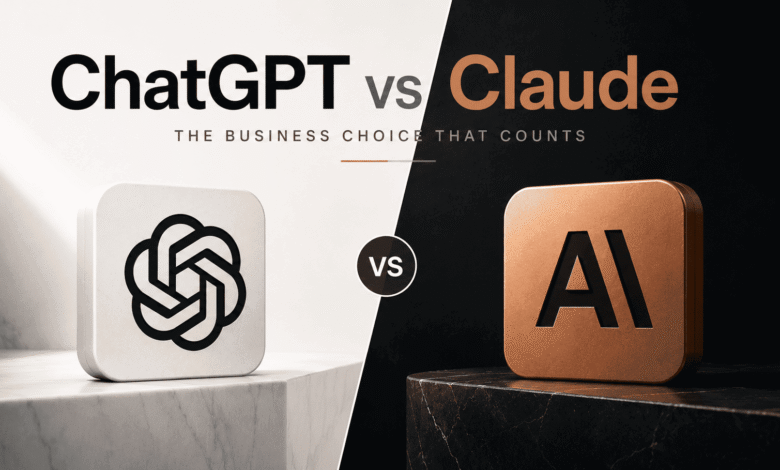
Both cost $20 per month. Both pass the same benchmark tests within a fraction of a percentage point. Both have enterprise tiers, API access, and integrations your team already uses. And yet choosing the wrong one costs months of productivity while your team works around limitations that did not need to exist. The ChatGPT vs Claude for business 2026 comparison is not a quality question anymore.
The gap in raw capability between GPT-5.2 and Claude Opus 4.6 is 0.8 percentage points on SWE-bench Verified, a margin so small it is statistically irrelevant for most real-world tasks. The decision is a workflow question. Claude wins on specific things. ChatGPT wins on specific things. Defaulting to whichever one someone on your team tried first is the most expensive AI decision most businesses are currently making.
Core Significance
Why it matters:
- The Default Assumption Is Costing Teams Months: Until mid-2025, the answer to which AI to use for business was ChatGPT. The 2025 Stack Overflow Developer Survey found that while 81% of developers still use ChatGPT, Claude’s adoption jumped to 43% and is growing significantly faster. Teams that have not re-evaluated their choice since 2024 are working with a two-year-old assumption in a market that has changed dramatically.[Stack Overflow 2025 Developer Survey-Official Press Release]
- The Price Is Identical. The Product Is Not: Claude Pro and ChatGPT Plus both cost $20 per month. ChatGPT Plus includes DALL-E image generation, Sora video creation, and Advanced Voice Mode. Claude Pro includes a 200,000 token context window, significantly larger than ChatGPT’s 128,000 token limit at the same price point. Same price. Fundamentally different feature bundles. The right choice depends entirely on whether your team’s primary workflows are multimodal or text-intensive.
- The Power User Tier Gap Is Enormous: At the standard $20 tier the decision is close. At the power user tier the gap is dramatic. Claude Max costs $100 per month. ChatGPT Pro costs $200 or more per month. For teams where individual professionals need maximum capability, Claude is half the cost for comparable top-tier access. That cost difference compounds at team scale and becomes a budget line that finance teams notice at annual reviews.[Tech-Insider — ChatGPT vs Claude 2026 tested]
Deep Context: Why the Comparison Changed in 2026
For most of 2023 and 2024, the ChatGPT versus Claude comparison had a clear answer for most business use cases: ChatGPT, because it was more capable on more tasks, had more integrations, and had a vastly larger user base that meant more tutorials, more support, and more familiarity for new team members.
Two things changed that calculus in 2025 and 2026. First, Anthropic’s model quality caught up decisively on the tasks that matter most for knowledge work. Legal analysis, financial modelling, long-form content, complex instruction-following, and coding all shifted toward Claude as the preferred tool among professionals who use both regularly. Second, the pricing at the power user tier diverged sharply, with Claude Max at $100 and ChatGPT Pro at $200-plus making Claude the more economical choice for teams needing premium capability.
As PocketCTO’s March 2026 analysis from real-world daily use across both tools confirmed, Claude’s reasoning is noticeably stronger on tasks requiring multiple constraints simultaneously: reviewing a contract against standard terms, analysing a financial model with a dozen assumptions, or writing a document that must maintain formal and conversational tones across different sections. For those specific high-stakes tasks, the quality difference is real and meaningful.
As covered in our OpenAI vs Anthropic Enterprise 2026 analysis, the enterprise-level decision involves additional factors including compliance frameworks, partner networks, and procurement processes. This article addresses the hands-on product decision for teams and individual business users choosing which tool to use daily.
Data Insights
By the numbers:
All data points sourced to primary reports. Stack Overflow stat sourced to official press release.
- $20/$20: Claude Pro and ChatGPT Plus monthly cost at the standard tier. Both teams plans at $25/user/month billed annually. Price parity makes capability and workflow fit the only differentiators.[Mobikasa — Claude vs ChatGPT Business April 2026]
- $100 vs $200+: Claude Max versus ChatGPT Pro at the power user tier. Claude is half the cost for top-tier individual access. For a 10-person team of power users, the annual saving is $12,000.
- $8/month: ChatGPT Go, a budget entry tier with basic capability. Claude has no equivalent lower-priced tier below the $20 Pro plan.
- 200,000 vs 128,000: Claude Pro context window versus ChatGPT Plus at the standard $20 tier. Claude processes significantly longer documents in a single session at the same price point.[GuruSup — Claude vs ChatGPT full comparison 2026]
- 80.8% vs 80.0%: Claude Opus 4.6 versus GPT-5.2 on SWE-bench Verified coding benchmark as of May 2026. A 0.8 percentage point gap that is statistically irrelevant for most real-world tasks. Source has no incentive to pick sides: it routes production API traffic to both models.[MorphLLM — Claude vs ChatGPT benchmarks no-bias source]
- 81% vs 43%: Developer adoption rate for ChatGPT/GPT models versus Claude Sonnet per the 2025 Stack Overflow Developer Survey of 49,000 developers across 177 countries. Claude’s 43% is growing significantly faster year over year.[Stack Overflow — Official 2025 Developer Survey Press Release]
- 70%: Share of developers preferring Claude specifically for coding tasks by early 2026, citing cleaner code, better multi-file project handling, and more honest uncertainty acknowledgement, per industry analysis of developer workflow surveys.
- $3/$15 per million tokens: Claude Sonnet API pricing for input and output tokens. GPT-4o API is $2.50/$10 per million tokens. ChatGPT API is cheaper at high volume. Claude’s stronger instruction-following may reduce retry calls at lower volumes.[Spicy Advisory — Claude vs ChatGPT for Business 2026]
Table 1: ChatGPT vs Claude for Business 2026: Direct Comparison
| Metric | ChatGPT Plus | Claude Pro |
| Monthly Cost | $20/month | $20/month |
| Power User Tier | ChatGPT Pro: $200+/month | Claude Max: $100/month |
| Budget Option | ChatGPT Go: $8/month | No equivalent |
| Team Plan | $25/user/month (annual) | $25/user/month (annual) |
| Context Window | 128,000 tokens | 200,000 tokens |
| Image Generation | Yes — DALL-E included | No |
| Video Generation | Yes — Sora included | No |
| Advanced Voice | Yes — included | No |
| Coding (SWE-bench) | GPT-5.2: 80.0% | Claude Opus 4.6: 80.8% |
| Writing Quality | Strong, faster output | Higher precision, less editing |
| Long Document Analysis | Good | Superior: larger context window |
| Integration Ecosystem | Broadest — 1,000s of plugins | Growing: AWS, Google Cloud, Microsoft |
| Data Privacy | Enterprise tier only | From $20/month Pro tier |
| Developer Adoption | 81% (ChatGPT/GPT models) | 43% and growing faster |
Table 2: Which Tool Wins by Business Use Case
| Use Case | ChatGPT Wins | Claude Wins |
| Image and visual content | Yes: DALL-E, Sora included | No native capability |
| Voice-based workflows | Yes: Advanced Voice Mode | No native capability |
| High-volume structured content | Yes: faster, consistent on templates | Competitive |
| Long document analysis | Competitive | Yes: 200K context, fewer errors |
| Coding and development | Competitive | Yes: 70% developer preference for coding |
| Nuanced long-form writing | Competitive | Yes: less robotic, better tone matching |
| General team productivity | Yes: 900M users, familiar interface | Competitive |
| Complex instruction-following | Competitive | Yes: consistently stronger |
| API cost at high volume | Lower per token | Higher per token |
| Power user cost | $200+/month Pro | $100/month Max |
| Team switching cost | Low: universal familiarity | Higher: 2-4 weeks adjustment |
The tables frame the ChatGPT vs Claude for business 2026 decision by use case rather than by brand preference. For most teams the answer is not one or the other. It is which tool fits your highest-volume workflow.
The Case for Each Tool
Both platforms have genuine strengths that are not closing gaps. The right choice depends on your specific workflow mix, not on which company is winning the AI race.
The Case for ChatGPT: Ecosystem and Multimodal Breadth
ChatGPT’s advantage in 2026 is not model quality. It is breadth. 900 million weekly active users means your team almost certainly already knows the interface. As Jamout AI’s April 2026 business comparison documented, onboarding a new team member to ChatGPT takes minutes while Claude takes longer to reach equivalent proficiency. That switching cost is real and quantifiable in productivity lost during transition.
The multimodal capability is the clearest product advantage and it has not narrowed. A $20 ChatGPT Plus subscription includes DALL-E image generation, Sora video creation, and Advanced Voice Mode. A $20 Claude Pro subscription includes none of these. For a marketing team generating social media images, a content team producing visual mockups, or a sales team using voice note workflows, ChatGPT is the better single-tool value at the standard tier. For multimodal-heavy teams the decision is not close.
For high-volume structured content at scale, ChatGPT’s speed and consistency on templated tasks, product descriptions, FAQs, email sequences, and social copy are genuine advantages. ChatGPT produces output faster and more consistently on tasks with clear templates. For teams running content operations at volume, speed and consistency often matter more than nuance.
The Case for Claude: Precision and Depth on Knowledge Work
Claude’s advantage is precision on the tasks that knowledge workers spend most of their time on. As Gmelius’s April 2026 analysis of developer adoption trends confirmed, 70% of developers reported preferring Claude for coding tasks specifically by early 2026, citing cleaner code, better multi-file project handling, and more honest acknowledgement of uncertainty rather than hallucinating plausible-sounding incorrect answers. Those are qualitative advantages that benchmarks do not fully capture.
The writing quality difference is the most commonly cited real-world advantage among professionals who have used both tools for more than three months. Claude produces writing that needs less editing, follows style guides more reliably, and handles tone shifts within the same document better than ChatGPT. For teams where significant time is spent fixing AI-generated drafts, switching to Claude reduces that rework. The time saved on editing is where the productivity premium actually materialises.
The 200,000 token context window at the standard $20 tier is not a technical specification. It is a use case enabler. Processing a complete legal agreement, an entire codebase review, a full year of customer service transcripts, or a lengthy regulatory filing in a single session without losing context is qualitatively different from what 128,000 tokens supports. For legal teams, financial analysts, and compliance professionals, that context window difference determines whether a task is possible in a single session or requires manual chunking and reassembly.
The API Decision Is Different From the Consumer Decision
The consumer comparison at the $20 tier has a different answer than the API comparison for teams building AI-powered products. As covered in our Best AI Tools for Startups 2026 analysis, Claude Sonnet via API costs $3 per million input tokens and $15 per million output tokens. GPT-4o API costs $2.50 per million input and $10 per million output tokens. At high volume, ChatGPT’s API is cheaper. At lower volume with higher task complexity, Claude’s stronger instruction-following reduces retry calls, which can make the effective cost comparable despite higher nominal pricing.
Between the lines:
The most honest assessment comes from MorphLLM, which routes production API traffic to both models across millions of calls with zero incentive to pick sides. Their conclusion: neither is universally better, the gap is narrowing with every release, and the practical decision is about which trade-offs match your specific workload. Long-context coding sessions favour Claude. Multimodal production and high-volume API spend favour ChatGPT. For most general tasks, both offer comparable quality. That is the most accurate summary available from a source with direct production performance data across both platforms.
Expert Nuance: The Switching Cost Nobody Calculates
Every ChatGPT versus Claude comparison calculates the feature difference. Almost none of them calculate the switching cost. 900 million weekly active users means ChatGPT familiarity is near-universal in professional environments. A team member who has used ChatGPT for 18 months has built prompt habits, workflow integrations, and mental models specific to ChatGPT’s behaviour.
Switching to Claude requires rebuilding those habits. The prompt patterns that produce reliable output from ChatGPT often produce different results from Claude. Integrations connecting ChatGPT to Slack, Notion, HubSpot, and Zapier do not automatically transfer. The team member who was proficient at day one with ChatGPT is a learner again on Claude for the first two to four weeks.
That switching cost is approximately two to four weeks of reduced productivity per team member, which at a loaded cost of $5,000 per week per professional makes the switching decision a $10,000 to $20,000 per person investment. For a team of ten, the switching cost of moving from ChatGPT to Claude is $100,000 to $200,000 in productivity lost during transition. The conclusion is not that switching is never worth it. For teams whose primary workflows are coding, long document analysis, or precision writing, the productivity gains from Claude over 12 months exceed the switching cost by a significant margin. The conclusion is that the switching cost should be calculated before the decision is made.
Strategic Outlook: What Changes in H2 2026
- WWDC June 8 Changes the iOS Comparison: As covered in our WWDC 2026 Apple Intelligence preview, iOS 27’s Extensions framework will make both Claude and ChatGPT available as Siri integrations on every iPhone by September 2026. For business users who rely heavily on mobile AI assistance, this changes the comparison from a desktop-first decision to a cross-device ecosystem decision. Both tools will reach the same 2.5 billion Apple devices simultaneously. The differentiation shifts from distribution to capability and user preference.
- The Multimodal Gap May Narrow: Anthropic has not announced video or audio generation capabilities to date. If Claude adds multimodal capabilities in H2 2026, the single clearest ChatGPT advantage disappears. Watch for any Anthropic product announcements in the weeks following its IPO filing. A company preparing to go public has strong incentives to announce capability expansions that close competitive gaps before the roadshow begins.
- The Trust Gap Is the Real Problem for Both: The 2025 Stack Overflow Developer Survey found that while 84% of developers use AI tools, only 29% trust their accuracy, down from higher levels in prior surveys. 46% actively distrust AI output accuracy. That trust deficit is not a Claude problem or a ChatGPT problem. It is an industry problem that affects both platforms equally. Teams that build measurement and review processes into their AI workflows outperform teams that trust AI output blindly regardless of which tool they use.
Key Question Answered
Which is better for business in 2026: ChatGPT or Claude?
The ChatGPT vs Claude for business 2026 answer depends on your primary use case. Choose ChatGPT Plus if your team needs multimodal capability including image generation, video creation, and voice interaction, values broad ecosystem integrations, or is switching cost-sensitive with team members already proficient on ChatGPT. Choose Claude Pro if your team primarily does long document analysis, precision writing, coding, or complex reasoning tasks, needs a larger context window at the standard price point, or has power users who would otherwise pay $200-plus for ChatGPT Pro and can get comparable capability at Claude Max for $100.
Both cost $20 per month at the standard tier. The benchmark gap is 0.8 percentage points, statistically irrelevant for most real-world tasks. The 2025 Stack Overflow Developer Survey confirmed ChatGPT/GPT models at 81% developer adoption and Claude at 43% and growing faster. 70% of developers prefer Claude specifically for coding tasks. The decision is a workflow match question, not a quality question. Run both on your actual highest-volume tasks for two weeks and measure which produces output that requires less editing and fewer retry attempts.
The Takeaway
The default assumption that ChatGPT is the right business AI tool in 2026 is costing teams that do significant knowledge work an unknown amount of productivity that they have never measured. Claude is not universally better. ChatGPT is not universally better. They are different tools with different strengths that have reached near-parity on benchmark scores while remaining genuinely different on the tasks that matter most for specific workflows.
The two-week test is the only honest evaluation method. Take your actual five highest-volume tasks. Run them through both tools. Count the editing time, the retry rate, and the output quality on each. Make the decision on that data rather than on market share, brand familiarity, or which comparison article your team found first.
The $20 subscription is not the decision. The productivity difference over 12 months is. For multimodal teams the decision is ChatGPT and it is not close. For coding, document analysis, and precision writing teams the decision is Claude and the productivity gains over 12 months are large enough to justify the switching cost. For general productivity teams that need a Swiss Army knife, ChatGPT’s ecosystem breadth and universal familiarity still make it the lower-friction choice. Know which team you are before you decide.