The Pulse
Google’s Gemini is the brain inside Apple’s rebuilt Siri. And yet, starting with iOS 27 this September, iPhone users will be able to bypass Siri entirely and choose Gemini directly as their AI assistant. That paradox is the defining story of Siri 2.0 vs Gemini in 2026. Apple paid Google approximately $1 billion annually for a custom 1.2 trillion parameter Gemini model to power its rebuilt assistant. Google accepted the deal knowing Apple would simultaneously offer Gemini as a competitor to that same rebuilt assistant through the iOS 27 Extensions framework. Both companies decided this arrangement was commercially rational. Understanding why tells you everything about where the AI assistant market is heading.
The standalone Siri chatbot app previewing at WWDC Monday June 8 is Apple’s most ambitious AI product since the original Siri launched in 2011. The Gemini app, with 900 million monthly users and a Daily Brief feature that knows your calendar, inbox, and priorities, is the most capable AI assistant Google has ever shipped. The comparison landing on June 8 is not accidental. It is the moment Apple has spent two years preparing for.
Core Significance
Why it matters:
- Apple Is Competing With Its Own AI Supplier: The $1 billion annual Gemini licence makes Google Apple’s most important AI vendor. The iOS 27 Extensions framework makes Google Apple’s most significant AI competitor on iPhone. That dual relationship has no precedent in the technology industry. It creates specific incentives for both companies: Apple must make the default Siri experience good enough that users never feel compelled to switch to Gemini directly. Google must make the Gemini Extensions experience compelling enough to build direct user relationships inside Apple’s ecosystem.[FelloAI — WWDC 2026 Extensions confirmed May 2026]
- The Standalone App Changes the Comparison Entirely: Previous Siri comparisons were voice assistant comparisons. How well does Siri understand a spoken request versus Gemini? The new standalone Siri chatbot app changes that frame completely. As Technobezz’s June 2026 analysis confirmed, the rebuilt Siri operates like ChatGPT and Gemini with iMessage-style chat bubbles, conversation history, voice mode, and file uploads. This is not a voice assistant upgrade. It is Apple entering the chatbot market directly.
- The Market Share Race Has Never Been Tighter: ChatGPT’s generative AI web traffic market share fell from 77.6% in May 2025 to 53.7% in April 2026. Gemini surged from 7.27% to 26.7% in the same period. Claude tripled to 6%. The AI assistant market is more competitive in June 2026 than at any point in its history. Siri 2.0 launching on 2.5 billion Apple devices in September 2026 will be the largest single distribution event in AI assistant history.
Deep Context: How Both Assistants Got Here
Siri launched in 2011 as the first mainstream voice assistant. For six years it led the category. Then Google Assistant, Amazon Alexa, and eventually ChatGPT arrived with capabilities that made Siri’s limitations increasingly visible. By 2024, Siri had become the punchline of every AI conversation: capable enough for timers and reminders, inadequate for anything requiring actual intelligence. The gap was so visible that Apple’s own marketing team stopped featuring Siri in iPhone ads.
The January 2026 Google partnership was Apple’s acknowledgement that building a competitive AI assistant from scratch would take longer than the market would wait. Rather than spend three more years developing proprietary models while Gemini and ChatGPT captured mindshare, Apple licensed the best available model and spent its engineering effort on the privacy architecture, the system integration, and the design language that makes the experience distinctively Apple. As TechCrunch’s WWDC preview confirmed, this is Apple’s most significant AI bet since 2011.
Gemini’s journey ran in the opposite direction. Google had the AI research capability before anyone. DeepMind, Google Brain, and the original Transformer paper that launched the LLM era were all Google products. What Google lacked was a consumer-facing product that made those capabilities accessible. Gemini launched as Bard in 2023, rebranded to Gemini in 2024, and by 2026 has reached 900 million monthly users through aggressive integration with Google’s existing ecosystem. As covered in our WWDC 2026 Apple Intelligence preview, the Gemini partnership marks the moment Apple chose ecosystem integration over AI independence.
Data Insights
By the numbers:
All data from primary sources. WWDC date confirmed June 8, 2026.
- $1 Billion/year: Apple’s estimated annual payment to Google for the custom 1.2 trillion parameter Gemini model powering Siri 2.0, per Bloomberg’s Mark Gurman. Neither company has confirmed financial terms.
- 900 Million: Gemini’s monthly active users as of June 2026, per Google’s own announcement at Google I/O 2026. Available in 230-plus countries and 70-plus languages.[TechCrunch — Google updates Gemini app June 2026]
- 2.5 Billion: Active Apple devices that Siri 2.0 will reach when iOS 27 ships in September 2026. The largest single distribution event in AI assistant history.
- 2 Million Tokens: Gemini’s maximum context window for large document processing, per Google’s model specifications. 8 times larger than ChatGPT’s standard 128K context window.[Gurusup — Gemini vs ChatGPT comparison May 2026]
- 26.7%: Gemini’s generative AI web traffic market share in April 2026, up from 7.27% in May 2025. ChatGPT fell from 77.6% to 53.7% in the same period.[Memeburn — ChatGPT vs Gemini 2026]
- 3: Third-party AI models available through iOS 27 Extensions: Google Gemini, Anthropic Claude, and OpenAI ChatGPT. Users choose which model handles Siri, Writing Tools, and Image Playground requests.
- June 8, 10am PT: WWDC 2026 keynote time. Siri 2.0 is the headline announcement. iOS 27 Beta 1 ships same day. Full public release: September 2026 with iPhone 18.[Bitcoinworld — WWDC 2026 preview June 5]
- $20/$249.99: Gemini Advanced and Gemini Ultra monthly pricing. Gemini 3.1 Flash free tier provides substantial capability. Siri 2.0 is free with every iPhone, iPad, and Mac running iOS/iPadOS/macOS 27.[AI-toolbox — Gemini vs ChatGPT complete comparison April 2026]
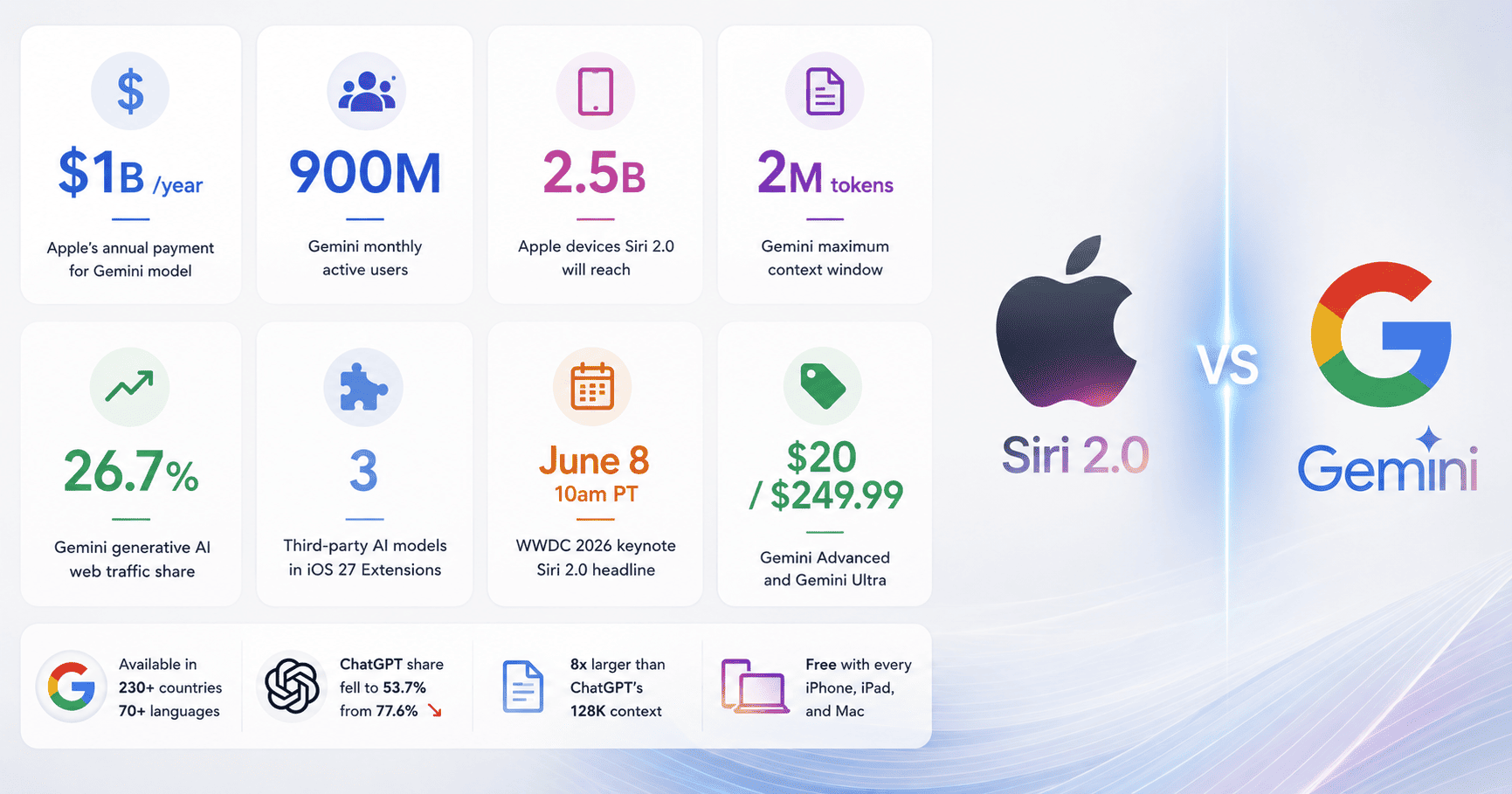
Table 1: Siri 2.0 vs Gemini: Direct Feature Comparison
| Note: Siri 2.0 features are confirmed by Bloomberg/Gurman pre-WWDC. Full feature set will be announced Monday June 8. This comparison reflects confirmed pre-WWDC reporting. |
| Feature | Siri 2.0 (iOS 27) | Google Gemini App |
| Underlying model | Custom Gemini 1.2T parameter (Apple servers) | Gemini 3.1 Pro / Flash (Google servers) |
| Interface | Standalone chatbot app, iMessage-style bubbles | Dedicated Gemini app, chat interface |
| Context window | Varies by model via Extensions | Up to 2 million tokens (Gemini 1.5 Pro) |
| Voice mode | Confirmed: voice mode included | real-time voice with Gemini Live |
| File uploads | Confirmed | images, documents, audio, video |
| Conversation history | Confirmed — syncs via iCloud | persistent memory across sessions |
| Privacy / data | Auto-delete: 30 days, 1 year, indefinitely. Not used to train Google. | Google privacy policy applies. Uses interaction data. |
| Ecosystem integration | Deep: iPhone, iPad, Mac, Watch, AirPods, CarPlay | Deep: Gmail, Drive, Docs, Maps, YouTube, Android |
| AI model switching | Yes — Extensions: choose Claude, ChatGPT, or Gemini | No equivalent — Gemini only |
| Image generation | Yes — Image Playground (Apple models) | Native image generation |
| Video generation | No | Native video generation |
| Cost | Free with iPhone/iPad/Mac on iOS 27 | Free tier + $20/month Advanced + $249.99/month Ultra |
| On-device AI | Yes, Private Cloud Compute | Primarily cloud-based |
| Ships / available | September 2026 (iOS 27) | Available now |
Table 2: Which Assistant Wins by Use Case
| Use Case | Siri 2.0 Wins | Gemini Wins |
| iPhone and Apple ecosystem tasks | Yes — system-level integration, on-device | Competitive via Extensions |
| Google Workspace users | Not applicable | Yes, Gmail, Drive, Docs native integration |
| Privacy-sensitive queries | Yes — auto-delete, Private Cloud Compute | Less configurable data controls |
| Long document processing | Varies by Extension model chosen | Yes, 2M token context native |
| Video generation | No native capability | Yes,native video generation |
| Morning productivity briefing | Competitive | Yes,Daily Brief: calendar, inbox, tasks |
| AI model flexibility | Yes, Extensions: Claude, Gemini, ChatGPT | No, Gemini only |
| Cost-conscious users | Yes, free with every Apple device | Yes,strong free tier |
| Android users | Not available | Yes,primary platform |
| Cross-app task execution | Yes, confirmed for iOS 27 | Limited on iOS |
The tables frame the Siri 2.0 vs Gemini decision. Neither is universally better. The right assistant depends on your primary device, your primary ecosystem, and whether privacy controls matter to your specific use case.
The Case for Each Assistant
Both assistants are making different architectural bets about what an AI assistant should be in 2026. Those bets produce genuinely different products despite sharing the same underlying model architecture.
The Case for Siri 2.0: Privacy, Integration, and Choice
Siri 2.0’s most important advantage is one that Gemini structurally cannot replicate: it knows your iPhone. Personal context awareness means Siri can read your calendar, emails, messages, and files to provide answers that require knowing who you are and what you have been doing. Cross-app execution means Siri can complete multi-step tasks across Apple apps without the user switching between them. These capabilities require system-level integration that Gemini, as a third-party app on iOS, cannot access.
The auto-delete privacy controls deserve more attention than they typically receive. Users can set conversation history to delete after 30 days, one year, or never. Apple’s Private Cloud Compute architecture processes Gemini queries on Apple-controlled servers without sharing data with Google. In a market where AI data practices are increasingly scrutinised, particularly in the EU where the AI Act’s full enforcement lands in August 2026, Apple’s privacy positioning is a genuine commercial advantage for users who are cautious about their data.
The Extensions framework is Siri 2.0’s most counterintuitive strength. By allowing users to choose Claude, Gemini, or ChatGPT as alternatives, Apple admits its default model is not always the best choice. But it simultaneously makes Siri the universal interface for every AI model on iPhone. A user who prefers Claude for writing, Gemini for research, and Apple’s model for system tasks does not need to switch between three apps. They use one interface that routes to whichever model serves the task best. That is a stronger product than any single model can offer.
The Case for Gemini: Capability, Ecosystem, and Availability
Gemini’s primary advantage is that it exists today while Siri 2.0 ships in September. For the next three months, Gemini is the most capable AI assistant available on iPhone through the existing Gemini app. That window matters because AI assistant habits are sticky. Users who build daily workflows around Gemini between June and September 2026 may not automatically switch to Siri 2.0 when iOS 27 launches.
The Daily Brief and Gemini Spark features announced at Google I/O 2026 represent Gemini’s vision for what an AI assistant should be: a personalised agent that knows your calendar, your inbox, and your priorities and surfaces the most important information before you think to ask for it. As TechCrunch’s May 2026 coverage confirmed, Gemini Spark positions as a 24/7 personal AI agent rather than a query-and-response tool. That proactive intelligence model is what Siri originally promised in 2011 and never delivered.
For Google Workspace users, the comparison is not competitive. Gemini’s native integration with Gmail, Drive, Docs, Maps, and YouTube creates productivity workflows that Siri cannot access regardless of its system integration depth. A professional whose daily work happens in Google Workspace will extract significantly more value from Gemini than from Siri 2.0, regardless of which iPhone they carry. The ecosystem dependency matters more than the device dependency for this user profile.
Between the lines:
The most important number in the Siri 2.0 vs Gemini comparison is not a feature score or a benchmark result. It is 2.5 billion. That is the number of Apple devices that will run Siri 2.0 when iOS 27 ships in September. Gemini took three years to reach 900 million monthly users. Siri 2.0 will reach 2.5 billion potential users on day one of general availability. Whether those users actively use the new Siri as a chatbot rather than treating it as the old voice assistant for timers and alarms will determine whether Apple’s WWDC 2026 bet actually pays off. Distribution is not adoption. But at 2.5 billion devices, Apple has more chances to convert passive Siri users into active chatbot users than any other company in the market.
Expert Nuance: The Partnership Paradox
The Gemini-inside-Siri architecture creates a commercial relationship with no precedent in the technology industry. Apple pays Google approximately $1 billion annually for the model that powers its primary AI product. Google receives that revenue while simultaneously competing for users on Apple’s own platform through the Extensions framework.
Apple’s rationale is straightforward. The $1 billion annual fee is small relative to the billions in revenue that a compelling AI assistant protects. If Siri remained genuinely inferior to Gemini and ChatGPT, iPhone users would spend more time in third-party AI apps and less time in Apple’s own ecosystem. Every hour a user spends in the Gemini app rather than the rebuilt Siri app is an hour of engagement data that goes to Google rather than Apple. The licensing fee buys Apple the capability to compete without waiting years for its own models to reach parity.
Google’s rationale is equally straightforward. The $1 billion annual fee represents direct revenue with minimal marginal cost, since the custom Gemini model runs on Apple’s Private Cloud Compute infrastructure rather than on Google’s servers. Apple’s engineering resources building the privacy architecture and system integration effectively improve the product Google is paid to supply. And the Extensions framework creates a path for Google to build direct user relationships inside Apple’s ecosystem without any advertising spend or App Store friction.
The paradox resolves when you recognise that both companies are playing a different game. Apple is competing for device loyalty and ecosystem engagement. Google is competing for AI user relationships and advertising data. Both can win simultaneously from the same architectural arrangement. The only company that loses from the Gemini-inside-Siri deal is OpenAI, which had exclusive third-party AI access on iPhone until iOS 27 and now shares that access with Google and Anthropic.
Strategic Outlook: What to Watch Monday June 8
- Whether Siri 2.0 Demo is Live or Pre-Recorded: Apple will demonstrate the rebuilt Siri on stage Monday. A live demo signals confidence in the product’s stability. A pre-recorded demo signals the opposite. Given the $250 million class action settlement over delayed Apple Intelligence features, Apple’s engineering team will have rehearsed extensively. Watch whether the demo handles an unexpected question or whether it stays strictly on script. The answer tells you how close to shipping the product actually is.
- Gemini’s Response on June 8: Google will be watching every detail of Apple’s Siri announcement. If Apple demonstrates capabilities that exceed what Gemini currently offers on iOS, expect a Gemini app update announcement within 48 hours. Google’s engineering team has been briefed on Apple’s plans through the partnership. They have had months to prepare a competitive response. The Gemini update timeline after WWDC will reveal how seriously Google is treating Siri 2.0 as a threat to its iOS user base.
- The Extensions Framework Adoption Rate: The most important long-term signal from iOS 27 will not be visible on June 8. It will be visible in Search Console data 60 days after iOS 27 ships in September. If iPhone users actively choose Claude or ChatGPT as their Extensions preference, it signals that the default Gemini-powered Siri is not meeting expectations. If users stay with the default, it signals that Apple’s partnership with Google produced a Siri that is genuinely good enough to compete on its own merits.
Key Question Answered
Is Siri 2.0 better than Google Gemini in 2026?
The Siri 2.0 vs Gemini comparison in 2026 is not a quality question but an ecosystem question. Siri 2.0, launching with iOS 27 in September 2026, runs on a custom 1.2 trillion parameter Gemini model processed through Apple’s Private Cloud Compute, with a standalone chatbot app, iMessage-style interface, voice mode, file uploads, auto-delete privacy controls, and the Extensions framework to choose Claude, Gemini, or ChatGPT directly. It reaches 2.5 billion Apple devices on day one.
Google Gemini has 900 million monthly users, a 2 million token context window, native video generation, Daily Brief for proactive productivity, Gemini Spark as a 24/7 personal agent, and deep Google Workspace integration that Siri cannot replicate. Gemini is available now. Siri 2.0 ships in September. For iPhone users who prioritise privacy, system integration, and AI model flexibility, Siri 2.0 is the stronger bet. For Google Workspace users, Android users, or anyone who needs video generation or proactive productivity features today, Gemini leads.
The Takeaway
Siri 2.0 is not the Siri you have been avoiding. It is a rebuilt product with a new architecture, a new interface, and a new commercial bet: that Apple’s privacy infrastructure and system integration are worth more to iPhone users than Gemini’s broader AI capability. Whether that bet is correct will be determined not by the WWDC demo on June 8 but by how many of the 2.5 billion potential users actively open the Siri chatbot app after iOS 27 ships in September.
Gemini’s position is equally complicated. It provides the intelligence layer inside the product that is competing against it. That arrangement earns Google $1 billion annually and gives Google engineering teams real-world deployment data at Apple’s scale. Google is winning commercially from Siri 2.0’s success regardless of whether users choose Gemini as their Extensions preference. The partnership paradox resolves in Google’s favour regardless of which assistant users prefer.
The WWDC Monday June 8 keynote will answer one question that matters above all others: does the rebuilt Siri actually work as demonstrated? Two previous announcements promised the same capabilities and delivered less. If the third announcement delivers, Apple recovers the AI credibility it lost between 2024 and 2026. If it does not, the Extensions framework becomes the escape valve. Users will choose Gemini directly and Apple will collect the $1 billion annual fee either way.