The AI Investment Bubble in 2026: Is a Correction Coming?

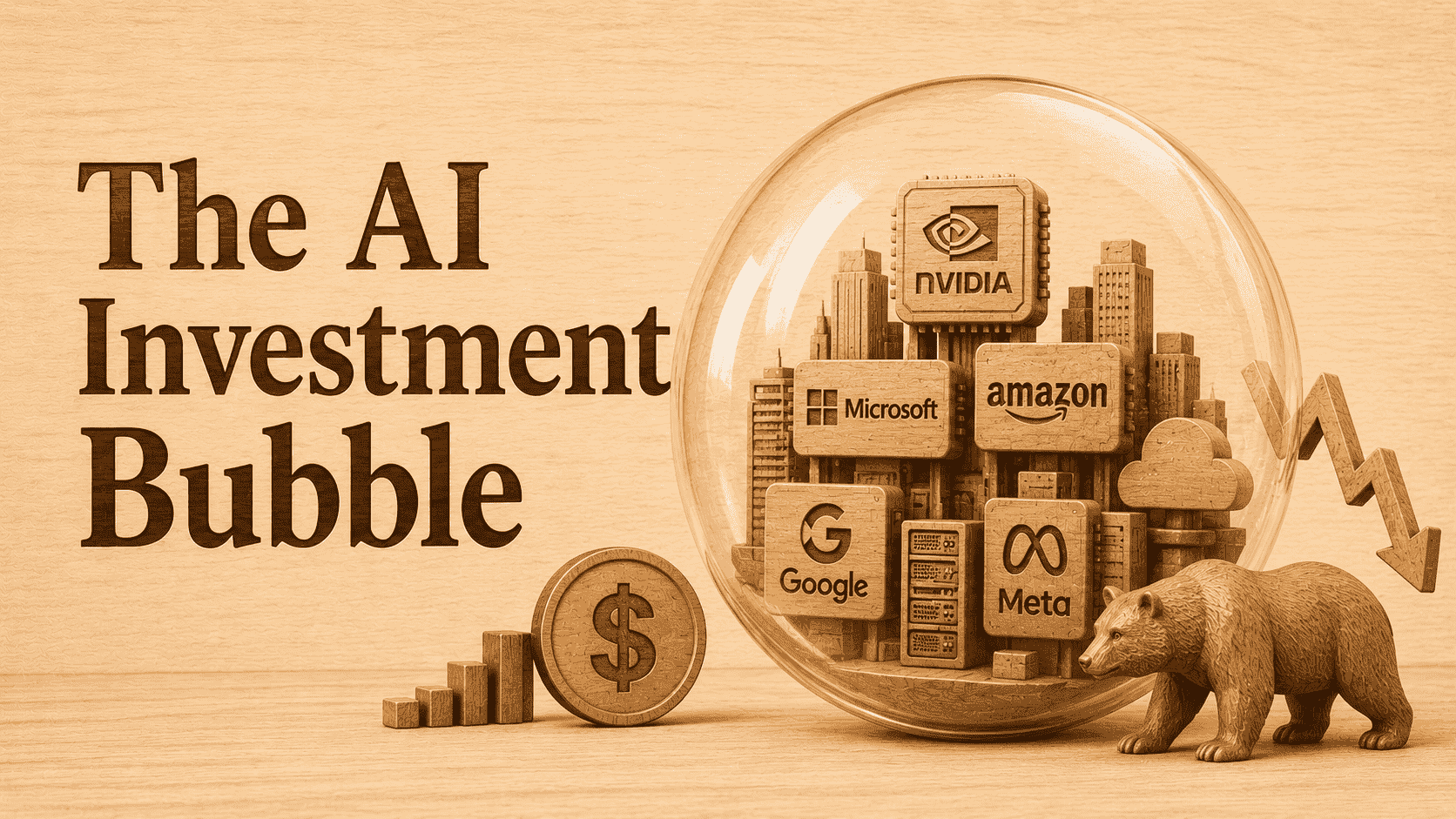
The Brief
The Pulse In Q1 2026, AI startups captured approximately 242 billion dollars, roughly 80% of all global venture capital deployed in a single quarter. Four companies alone absorbed about 65% of every venture dollar invested worldwide that quarter. [Digital Applied AI venture funding 2026 where 242 billion went] Those four companies are OpenAI, which raised […]
Why It Matters
The story matters because it changes how buyers, builders, or policymakers should read the AI Business and Startups market.
Watch Next
Watch whether the signal becomes a budget, procurement, or platform decision in the next cycle.
The Pulse
In Q1 2026, AI startups captured approximately 242 billion dollars, roughly 80% of all global venture capital deployed in a single quarter. Four companies alone absorbed about 65% of every venture dollar invested worldwide that quarter. [Digital Applied AI venture funding 2026 where 242 billion went]
Those four companies are OpenAI, which raised 122 billion dollars at an 852 billion dollar valuation, Anthropic at 30 billion dollars and a 380 billion dollar valuation, xAI at 20 billion dollars, and Waymo at 16 billion dollars. Strip those four rounds out and the remaining 6,000 funded startups shared approximately 54 billion dollars, a figure that looks far more ordinary by comparison.
The question of whether this constitutes a bubble, a boom, or something structurally different from both depends almost entirely on which part of the market you are looking at. The answer is not the same across all three segments for this AI investment bubble 2026.
Core Significance
Why it matters:
- The math requires roughly 2 trillion dollars in AI revenue by 2030 to justify current infrastructure spending, and Bain projects an 800 billion dollar shortfall: Bain and Company estimates that to sustain the generative AI buildout, the industry needs combined revenues of about 2 trillion dollars by 2030, but is likely to come up approximately 800 billion dollars short on current trajectories. [IntuitionLabs AI bubble vs dot-com data-driven comparison]
That gap is not evidence of a bubble by itself. OpenAI generated approximately 13 billion dollars in 2025 revenue and Anthropic reported a run-rate of roughly 14 billion dollars at its February 2026 fundraise, growing at roughly tenfold annually. The question is whether that trajectory closes the gap or whether infrastructure spending accelerates faster than revenue can follow.
- Valuation multiples for frontier labs have already compressed dramatically, which is the opposite of late-bubble behavior: Foundation model companies like OpenAI and Anthropic have seen their valuation multiples compress from 60 to 100 times revenue down to 15 to 50 times, a direction that suggests market maturation rather than speculative excess building.
- But the bubble is real and live in two specific pockets: AI robotics companies like Figure AI are trading at nearly 400 times revenue on demonstration hype alone, while thin AI application wrappers that lack proprietary data or distribution advantages have attracted hundreds of millions in funding at valuations completely detached from any near-term revenue path. [ValueAdd VC AI company valuations 2026 every unicorn ranked]
Deep Context: Why this is not the dot-com bubble and also not entirely safe
The dot-com comparison is irresistible and mostly wrong. At the Nasdaq-100’s March 2000 peak, the forward price-to-earnings ratio reached approximately 60 times. By early 2026, the S&P 500 trades at about 23 times forward earnings, its most stretched since the dot-com era, but nowhere near the same extreme.
More importantly, the companies commanding the largest valuations today actually have revenue. OpenAI reports roughly 25 billion dollars in annualized revenue. Anthropic’s Claude Code product alone exceeded 2.5 billion dollars in run-rate with more than 500 enterprise customers spending over 100,000 dollars annually. Databricks, whose CEO Ali Ghodsi called its own 62 billion dollar valuation in late 2024 a signal of peak AI bubble, has since more than doubled to a 134 billion dollar valuation on real revenue growth.[ExplainX AI bubble 2026 reality check correction not burst]
The structural risk is not that these companies have no revenue. It is that the capital flowing into the market is increasingly concentrated in a handful of winners while the broader ecosystem, thousands of funded AI startups, faces a very different reality. As covered in our CoreWeave news report, the infrastructure layer is also showing signs of overbuilding that could create margin pressure independent of whether AI adoption continues to grow.
The financing model has structurally changed, and that matters for risk assessment
Q1 2026 rounds did not function like traditional venture capital at the top of the market. When GIC and Coatue led Anthropic’s 30-billion-dollar Series G, the mechanics, time horizon, and return expectations resembled a capital-markets infrastructure event more than a fund writing a growth-stage check. [Insights4VC AI captured 80 percent global venture funding]
The four largest rounds of the quarter collectively raised approximately 188 billion dollars, or 65% of all global venture investment, from sovereign wealth funds, strategic corporates, and infrastructure investors rather than from traditional VC funds. That capital has a different loss tolerance, a different time horizon, and a different return profile than the typical GP-LP venture structure that most bubble-analysis frameworks assume.
Data Insights
By the numbers:
All figures from Crunchbase, Bain and Company, OECD data, and named company disclosures cited inline.
- AI captured 61% of all global venture capital in 2025, rising to 80% of Q1 2026 alone: OECD data shows AI firms absorbed 258.7 billion dollars in 2025, representing 61% of all global VC investment, up from 30% in 2022. The concentration rate is accelerating, not stabilizing.
- US AI private investment reached 109 billion dollars, nearly 12 times China’s 9.3 billion and 24 times the UK’s 4.5 billion: The geographic concentration of late-stage AI capital is as extreme as the sector concentration, with the US commanding a dominant majority of every mega-round dollar deployed. [Qubit Capital AI startup funding trends 2026 data rounds]
- Corporate investors are growing more cautious even as headline numbers hit records: Yvonne Lutsch of Lam Capital, whose parent company directly benefits from the AI chip buildout, described software AI valuations as concerning and said that hardware startup valuations above 500 million dollars at early stage trigger natural skepticism. [Global Venturing AI bubble corporate investors cautiously take bets]
The Mira Murati example is the clearest illustration of where caution is warranted. Her Thinking Machines Lab raised a 2 billion dollar seed round before releasing any product, a dynamic that even sympathetic investors describe as betting on reputation and pedigree rather than commercial traction.
Table 1: The AI market is three distinct segments, not one
| Segment | Example companies | Revenue backing | Valuation multiple | Bubble verdict |
| Frontier foundation models | OpenAI, Anthropic, Databricks | Real, growing rapidly | Compressed to 15 to 50x | Not a bubble, elevated but supported |
| AI infrastructure | Nvidia, CoreWeave, Cerebras IPO | Real for infrastructure plays | Varies widely | Selective, watch overbuilding signals |
| AI robotics and demos | Figure AI and peers | Minimal or none | Up to 400x revenue | Partial bubble, demo hype pricing |
| Thin application wrappers | Many undisclosed | None or minimal | Detached from reality | Clear bubble in this segment |
Table 2: What financial leaders actually said about AI bubble risk in 2026
| Who said it | Verdict | Nuance |
| Fed Chair Jerome Powell | Not a classic bubble | These companies have earnings and business models |
| JPMorgan CEO Jamie Dimon, April 2026 letter | Not a bubble | AI will deliver significant benefits |
| Goldman CEO David Solomon | Not a bubble, but volatility likely | Drawdowns possible, that is not a bubble |
| Fed Governor Michael Barr | Scenario risk flagged | Drew explicit parallels to historical overinvestment cycles |
| FOMC October 2025 minutes | Risk acknowledged | Several participants flagged disorderly price fall risk |
The Business Case: How enterprises should interpret AI investment signals
For enterprises making AI technology decisions, the bubble question matters in a practical, not just theoretical, way. A vendor whose valuation is built on demonstration hype rather than real revenue is a higher platform risk, not just an investment risk, because companies valued at 400 times revenue have less margin to survive a funding winter or a market repricing than companies with real revenue compressing toward sustainable multiples.
The more useful question for enterprise AI buyers than whether a bubble exists is whether the specific vendor they are considering has disclosed run-rate revenue figures, and what those figures are. ValueAdd VC identifies the transparency gap explicitly: xAI carries a valuation of approximately 200 billion dollars with no publicly disclosed run-rate revenue, while Anthropic and OpenAI both disclosed real figures at their latest fundraises.
As covered in our Anthropic IPO report, Anthropic’s S-1 filing and its 965-billion-dollar valuation represent the first major public-market test of whether AI-era multiples can survive the scrutiny of institutional equity investors who are not operating from a fear-of-missing-out dynamic the way late-stage private rounds have been.
Expert Nuance: The inference utilization gap is the structural risk most commentary misses
The most substantive risk in the AI investment cycle is not valuation multiples. It is the gap between the infrastructure being built and the inference workloads currently utilizing it. Verdantix has identified this as the inference utilization gap, a situation where data center capacity and GPU clusters are being built for demand projections that assume continued exponential model adoption. [Verdantix market insight AI bubble risk capital cycles]
If enterprise AI adoption continues its current trajectory, that gap closes over time. If it does not, the result is overbuilt infrastructure carrying costs that compress margins across cloud providers, hyperscalers, and colocation operators simultaneously, creating exactly the kind of synchronized earnings pressure that regulators flagged in October 2025 FOMC minutes.
The signal to watch is earnings call language. Verdantix describes a specific pattern: when earnings calls shift from language about unconstrained AI demand toward language about disciplined investment and prioritizing utilization of existing clusters, that shift signals the beginning of expectations being tested rather than carried forward unquestioned.
Strategic Outlook
- Expect 50 to 70% of currently funded AI startups to fail or consolidate by 2028: The dot-com shakeout eliminated roughly 50% of funded companies within three years of peak funding. Analysts project a similar consolidation in the AI application layer over the same horizon, leaving the top 5 to 10 companies with genuine moats standing while the rest fail or get absorbed.
- The Anthropic IPO is the first real public-market pricing event for AI-era valuations: Private mega-rounds are priced by investors with long time horizons and strategic motivations. Anthropic’s planned public listing at roughly 965 billion dollars on 47 billion dollars of ARR is a fundamentally different pricing event, one where institutional public-market investors with quarterly reporting obligations are setting the clearing price without FOMO dynamics.
- Geographic concentration risk is under-discussed relative to sector concentration risk: US private AI investment at 109 billion dollars is 12 times China and 24 times the UK. A single regulatory, trade, or geopolitical event affecting US AI companies would have no precedented buffer from international AI investment flows, since the rest of the world has not built a comparable AI investment ecosystem.
Key Question Answered
Is the AI investment market in 2026 a bubble, and is a correction coming?
The honest answer is that it is two different markets being described by one word. For frontier foundation model companies with real, rapidly growing revenue, current multiples at 15 to 50 times revenue are elevated but not historically unprecedented for high-growth technology companies, and Fed Chair Powell, Jamie Dimon, and Goldman’s David Solomon have all explicitly rejected the bubble characterization for this tier.
For AI robotics companies trading at 400 times revenue on demo hype, thin application wrappers with no proprietary data advantage, and pre-product companies commanding multi-billion-dollar seed rounds on founder reputation alone, a correction is not a question of if but when and how severe. Bain’s 800 billion dollar revenue gap between what infrastructure spending requires and what the industry is projected to generate by 2030 is the most concrete quantification of how much work remains between current investment and justified valuations, and it applies most acutely to the bottom of the market rather than the top.
The Takeaway
The AI investment cycle of 2026 is genuinely different from the dot-com era in the ways that matter most: real revenue at the top, real enterprise adoption, and real infrastructure build rather than pure narrative. Those differences are why the analysts and executives best positioned to assess the risk, Powell, Dimon, Solomon, and Amundi’s research team, have tested and rejected simple bubble narratives.
But the things that are different at the top do not describe what is happening at the bottom. A market where pre-product companies raise at multi-billion-dollar valuations and AI robotics demos command 400 times revenue multiples contains real speculative excess. The bubble is partial and segmented rather than systemic and total, but it is present.
The correction, when it comes, is more likely to look like the consolidation that follows any technology cycle than the sudden collapse that follows a pure speculative mania. Fifty to seventy percent of funded AI startups failing or merging over the next two years is not a crash. It is a market distinguishing between companies that built something real and companies that built a well-timed pitch deck. That distinction is already being made, which is exactly what a functioning market is supposed to do.