Apple Sues OpenAI: Inside the Trade Secret Fight Over AI Hardware

The Pulse
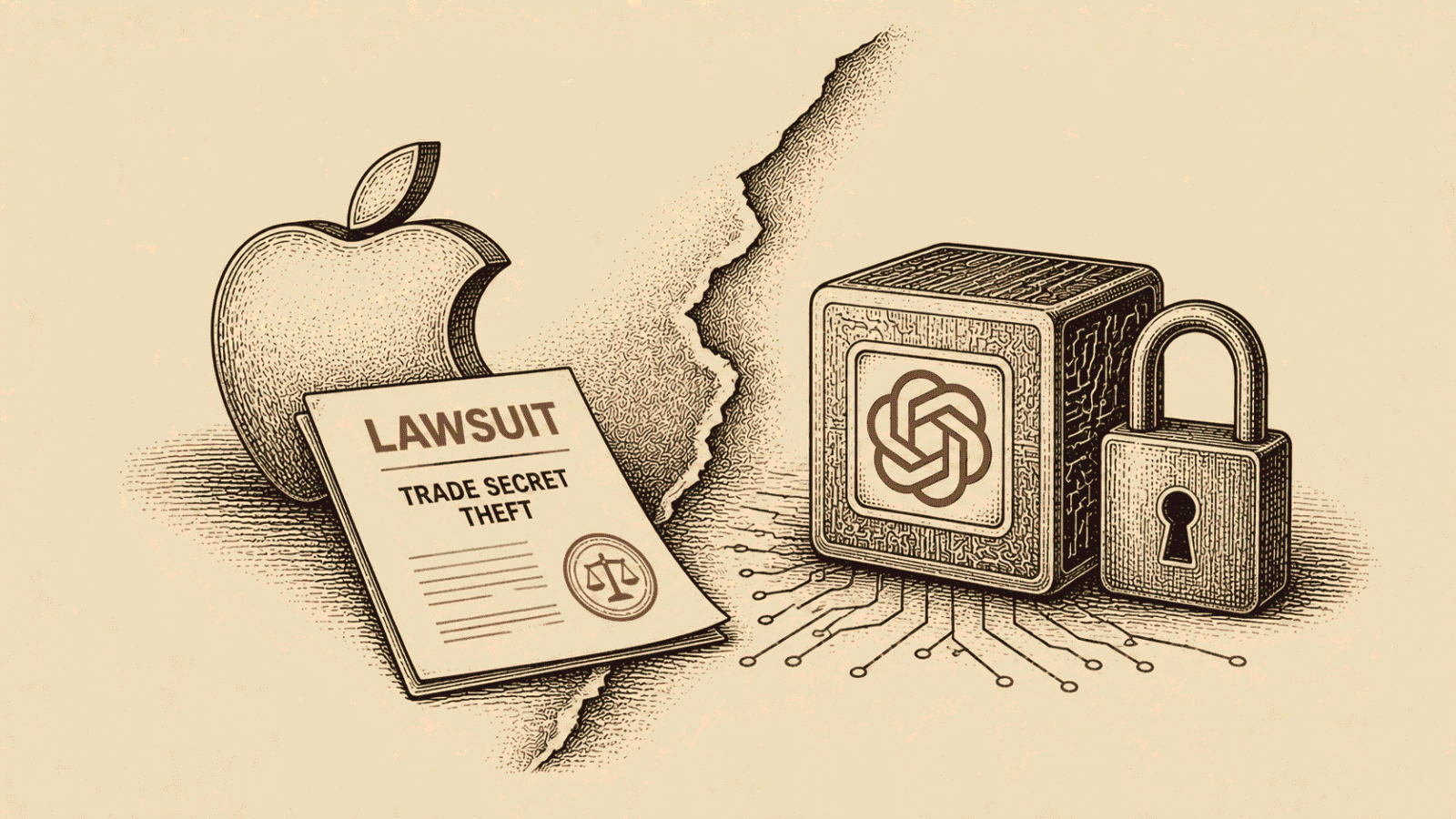
Apple sued OpenAI on Friday, July 10, 2026, in federal court in the Northern District of California, alleging trade secret misappropriation and breach of contract. The complaint states plainly that the alleged scheme operated at every level of OpenAI, from its Technical Staff up to its Chief Hardware Officer, and names two individual defendants: Tang Tan, a 24-year Apple veteran who now leads OpenAI’s hardware division, and Chang Liu, a former Apple electrical engineer who joined OpenAI’s hardware team. [TechCrunch Apple sues OpenAI over alleged trade secret theft]
The filing marks a striking reversal for two companies that announced a high-profile software partnership in 2024, integrating ChatGPT directly into iOS. That relationship has visibly cooled since, and Apple’s revamped Siri, arriving this fall, is built on Google’s Gemini models rather than OpenAI’s technology. The lawsuit adds a hardware dimension to what was already a software rivalry, since OpenAI has spent more than a year building its own consumer device division after acquiring Jony Ive’s startup io. [Bloomberg Apple sues OpenAI trade secret theft blockbuster case]
OpenAI has denied the allegations. A company spokesperson told Axios and other outlets that OpenAI has no interest in other companies’ trade secrets and remains focused on building its own technology. The dispute now heads toward discovery in a case that could shape both OpenAI’s hardware launch timeline and its path toward a widely anticipated public listing.
Core Significance
Why it matters:
- Apple’s complaint centers on allegations that OpenAI’s hardware chief used inside knowledge to systematically extract information from Apple employees during recruiting: Apple alleges Tang Tan, who spent 24 years at Apple most recently as VP of product design for iPhone and Apple Watch, used Apple’s internal project code names during OpenAI’s interview process and directed job candidates still employed at Apple to bring ‘actual parts,’ including batteries, logic boards, and SIPs, to interviews for what the filing describes as show-and-tell sessions. [CNBC Apple OpenAI lawsuit trade secrets at every level]
- The named individual defendant Chang Liu allegedly exploited a security gap after leaving Apple rather than during his employment there: The complaint alleges Liu kept a work-issued Apple laptop after departing, discovered a bug that let him access Apple’s cloud file storage after his exit, and downloaded dozens of confidential files while simultaneously working on hardware for OpenAI, reportedly messaging a former Apple colleague, ‘LOL, I found out I can access the network storage, so funny.’ [Axios Apple sues OpenAI trade secret theft]
- The lawsuit surfaces amid a broader, mutual legal escalation between the two companies rather than a one-sided dispute: Bloomberg reported in May 2026 that OpenAI was separately weighing its own legal action against Apple, alleging breach of contract over claims that Apple had not sufficiently integrated and promoted OpenAI’s products across its devices, meaning both companies had legal complaints against each other building in parallel before Apple filed first. [CNN Business Apple accuses OpenAI stolen trade secrets AI gadgets]
Deep Context: How a 2024 Software Partnership Became a 2026 Hardware Lawsuit
The relationship between Apple and OpenAI began cooperatively. In 2024, the two companies announced a partnership integrating ChatGPT directly into iOS, giving Apple a fast path to generative AI features without building a competing frontier model from scratch. That arrangement positioned OpenAI as Apple’s AI partner at a moment when Apple’s own AI development, branded Apple Intelligence, was widely seen as lagging competitors.
The relationship shifted in May 2025, when OpenAI acquired io, a hardware startup founded by former Apple design chief Jony Ive, in an all-equity deal reported at approximately 6.5 billion dollars, OpenAI’s largest acquisition to date. The deal brought roughly 55 employees into OpenAI, including io co-founders Scott Cannon, Evans Hankey, and Tang Tan, all of whom had previously worked at Apple, with the explicit goal of building OpenAI’s own line of AI-native consumer hardware rather than remaining dependent on distribution through Apple’s and Google’s existing device ecosystems. [Campus Technology OpenAI acquire io consumer AI hardware push]
As covered in our AI Talent War report, the flow of senior engineering and design talent between major AI labs and established tech companies has become one of the defining competitive dynamics of 2026. Apple’s lawsuit reframes that talent flow, at least in this specific case, from an ordinary competitive hiring dispute into an allegation of a coordinated, leadership-directed effort to extract proprietary information through the hiring process itself.
Apple’s Own Account Suggests the Dispute Predates the Public Filing
Apple’s complaint states that the company raised its concerns directly with OpenAI once its internal investigation was in an early stage, but says it never received a response. That detail matters for how the case is likely to be argued: Apple is positioning the lawsuit not as a first resort, but as the outcome of an attempted private resolution that OpenAI allegedly declined to engage with, a framing that could influence how a court views the good-faith conduct of both sides once discovery begins.
Data Insights
By the Numbers:
Figures below are drawn from named financial and technology press reporting cited inline.
- OpenAI’s hardware division, built around the roughly 6.5 billion dollar io acquisition, has been targeting an ambitious initial production run well before this lawsuit surfaced: Reported plans call for 40 to 50 million units of a screenless, voice-first device through manufacturing partner Foxconn, with multiple form factors under development including an earbud-style wearable and a pen-shaped device, and OpenAI’s own leadership describing hardware as one of the company’s major initiatives for the second half of 2026. [Introl OpenAI consumer device Jony Ive screenless hardware 2026]
- CNN’s review of public hiring data found a specific, measurable pattern of talent movement between the two companies: A CNN count of LinkedIn profiles identified at least ten engineers who joined OpenAI directly from Apple in the recent hiring period the lawsuit covers, a volume Apple’s complaint characterizes as part of a deliberate, coordinated recruiting strategy rather than ordinary competitive hiring.
- The lawsuit lands at a moment when both companies face significant, time-sensitive business stakes tied to its outcome: OpenAI’s planned consumer hardware device was already expected later in 2026 before the suit was filed, and the company is separately said to be preparing for a widely anticipated public listing, meaning unresolved litigation alleging systematic trade secret theft could complicate both the product launch timeline and investor due diligence around any IPO process.
Table 1: Timeline From Partnership to Lawsuit
| Date | Event | Companies involved | Significance |
| 2024 | ChatGPT integrated into iOS | Apple, OpenAI | High-profile software partnership announced |
| May 2025 | OpenAI acquires io for approximately 6.5 billion dollars | OpenAI, io, Jony Ive | OpenAI’s largest acquisition, hardware division founded |
| May 2026 | OpenAI reportedly weighs suing Apple | OpenAI, Apple | Bloomberg reports possible breach of contract claim |
| Fall 2026, planned | Apple’s revamped Siri launches on Gemini | Apple, Google | Confirms Apple-OpenAI software relationship has cooled |
| July 10, 2026 | Apple sues OpenAI for trade secret theft | Apple, OpenAI, Tang Tan, Chang Liu | Case filed in US District Court, Northern District of California |
Table 2: What Apple Is Asking the Court to Order
| Relief sought | What it would require | Business impact if granted |
| Injunction | Bar OpenAI from using or disclosing Apple trade secrets | Could directly affect hardware product design and timeline |
| Return of materials | Require OpenAI to return confidential Apple materials | Operational disruption to hardware development |
| Evidence preservation order | Preserve records related to the case | Standard litigation step, signals expectation of lengthy discovery |
| Damages | Monetary compensation for alleged theft | Financial exposure ahead of a reported IPO process |
The Business Case: What the Lawsuit Signals for Enterprises Watching the AI Hardware Race
For enterprises evaluating OpenAI as a long-term technology partner, the practical near-term question is not whether the allegations are true, a matter the court will need to resolve, but whether unresolved litigation of this scale creates operational or reputational risk worth pricing into vendor relationships. A lawsuit alleging systematic, leadership-directed trade secret theft is a materially different risk category than routine competitive hiring friction between two companies.
The lawsuit also illustrates a broader strategic logic worth understanding independent of its outcome: major AI labs are increasingly treating hardware, not just model capability, as a genuine competitive battleground. OpenAI’s decision to build a dedicated device division rather than remain solely dependent on Apple’s and Google’s platforms reflects a calculation that owning the interface layer between users and AI is becoming as commercially important as owning the underlying model.
As covered in our OpenAI vs Anthropic enterprise comparison, enterprises building AI strategy already need to evaluate vendor stability and platform risk as seriously as model capability. A trade secret lawsuit of this scale adds a new and immediate category to that evaluation for any organization with significant OpenAI dependency, particularly one contemplating deeper integration with OpenAI’s forthcoming hardware products specifically.
Expert Nuance: The Case Is as Much About Distribution Strategy as It Is About Any Single Stolen Document
Legal analysis of the original io acquisition offers useful context for why this dispute carries stakes well beyond the specific allegations in the complaint. OpenAI’s core strategic rationale for building hardware was explicitly about escaping dependency on Apple’s and Google’s platforms, since a company building toward advanced AI capability does not want its primary interface to remain someone else’s app icon, subject to someone else’s App Store rules and someone else’s design decisions. [Lee and Thompson long read OpenAI acquires io what has it bought]
That context reframes the lawsuit’s significance. Even if the specific allegations are eventually narrowed or resolved through settlement, the underlying conflict, a frontier AI lab attempting to build direct-to-consumer hardware in direct competition with the company that currently controls the dominant mobile platform its software already depends on, was always going to generate friction. The trade secret allegations give that friction a concrete legal form, but the structural tension predates and extends beyond this specific case.
The practical question for the rest of the AI industry is whether this becomes an isolated dispute between two companies with an unusually entangled history, or an early instance of a pattern other AI labs pursuing their own hardware ambitions will need to navigate as they hire away design and engineering talent from established device makers.
Strategic Outlook
- Watch whether the litigation timeline collides with OpenAI’s planned hardware launch and reported IPO process: With OpenAI’s device reportedly targeted for later in 2026 and the company separately said to be preparing for a public listing, a case alleging systematic trade secret theft moving through discovery on a similar timeline creates genuine scheduling and disclosure pressure that could affect either process regardless of the case’s ultimate merits. [Washington Post Apple sues OpenAI alleging AI company stole trade secrets]
- Expect scrutiny of OpenAI’s hiring practices for hardware and design talent to intensify industry-wide, not just at OpenAI specifically: As more AI labs pursue their own hardware ambitions and compete for the same relatively small pool of experienced consumer device designers and engineers, the specific recruiting practices Apple has alleged, using competitor code names and requesting physical components during interviews, are likely to draw closer attention from other established hardware makers watching how this case unfolds.
- Watch whether OpenAI files its own previously reported breach of contract claim against Apple as a counterclaim or separate action: With Bloomberg having reported in May 2026 that OpenAI was already considering legal action against Apple over software integration and promotion, whether that claim surfaces formally, and how a court might weigh two companies with parallel grievances against each other, will shape how adversarial the overall dispute becomes.
Key Question Answered
Why is Apple suing OpenAI, and what does the lawsuit actually allege?
Apple sued OpenAI on July 10, 2026 in federal court in Northern California, alleging trade secret misappropriation and breach of contract connected to OpenAI’s push into consumer AI hardware. The core allegations center on Tang Tan, OpenAI’s Chief Hardware Officer and a 24-year Apple veteran, whom Apple accuses of directing a recruiting strategy that used Apple’s internal project code names and asked job candidates still employed at Apple to bring physical hardware components to interviews. A second named defendant, former Apple engineer Chang Liu, is separately accused of accessing Apple’s cloud storage system after leaving the company using a security bug and downloading confidential files while working on hardware for OpenAI.
OpenAI has denied the allegations, with a spokesperson stating the company has no interest in other companies’ trade secrets. The lawsuit follows OpenAI’s roughly 6.5 billion dollar acquisition of Jony Ive’s hardware startup io in 2025, and surfaces amid a broader cooling of the companies’ 2024 software partnership, with Apple’s upcoming Siri redesign now built on Google’s Gemini rather than OpenAI’s models. Apple is seeking damages, an injunction barring OpenAI from using its trade secrets, the return of confidential materials, and an order preserving evidence for the case.
The Takeaway
The Apple-OpenAI lawsuit is the clearest sign yet that the AI industry’s competitive battlegrounds have expanded well beyond model benchmarks and enterprise cloud contracts into the far more personal terrain of talent, design, and hardware. A software partnership announced with genuine fanfare in 2024 has, within two years, produced a federal lawsuit alleging that one company’s leadership directed a systematic campaign to extract the other’s most closely guarded product secrets.
Whatever the court ultimately finds, the case confirms a structural reality already visible before it was filed: OpenAI’s ambitions have moved decisively past being a model provider that other companies build products on top of, and toward becoming a direct hardware competitor to the companies whose platforms its software has depended on. That shift was always going to create friction with Apple specifically, given how much of OpenAI’s hardware team, leadership included, was hired directly out of Apple’s own design and engineering organization.
For the broader AI industry, the practical lesson extends past these two companies. As more AI labs chase their own hardware ambitions and compete for the same limited pool of experienced device designers, the recruiting practices this lawsuit puts under a federal microscope are a preview of scrutiny other labs pursuing similar strategies should expect to face as well.