Nvidia AI Chip Rivals 2026: AMD, Cerebras, and What Happened to Groq

The Brief
The Pulse Nvidia still controls somewhere between 80 and 90% of the AI accelerator market heading into the second half of 2026, depending on which research firm is counting and what exactly gets counted. [Techi AMD Meta 60 billion deal Nvidia AI monopoly] That dominance is real, and it is also no longer the whole […]
Why It Matters
The story matters because it changes how buyers, builders, or policymakers should read the AI Infrastructure market.
Watch Next
Watch whether the signal becomes a budget, procurement, or platform decision in the next cycle.
The Pulse
Nvidia still controls somewhere between 80 and 90% of the AI accelerator market heading into the second half of 2026, depending on which research firm is counting and what exactly gets counted. [Techi AMD Meta 60 billion deal Nvidia AI monopoly]
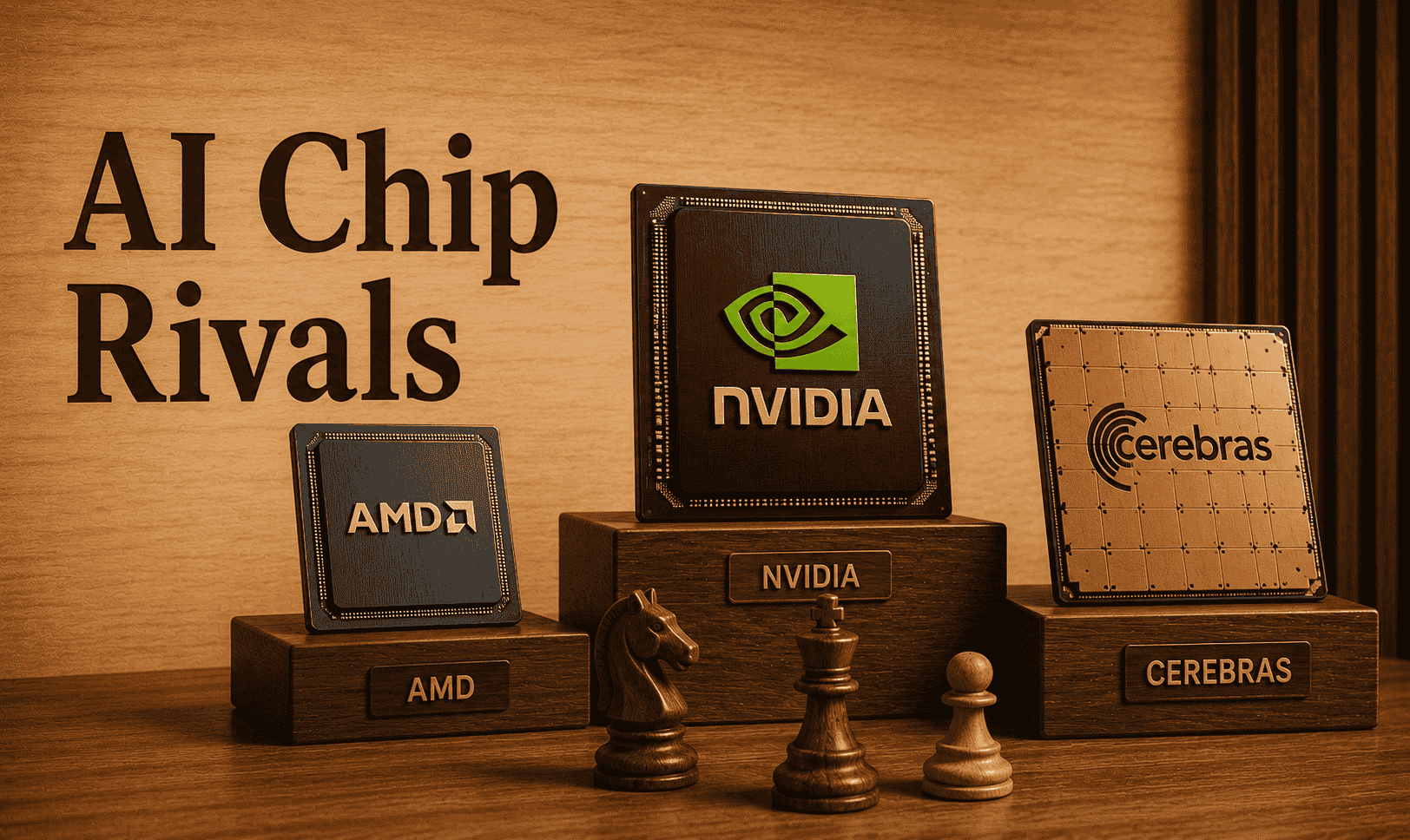
That dominance is real, and it is also no longer the whole story. Three genuinely different things happened to Nvidia’s competitive landscape in the first half of 2026: AMD locked in two of the industry’s most important customers, Cerebras went public in the largest US IPO of the year, and Nvidia itself made its single largest acquisition ever, absorbing one of the sharpest inference challengers rather than simply out-competing it.
That last point matters more than it might first appear. A popular framing going into 2026 was Groq versus Nvidia, two rival approaches to AI chip architecture battling for inference market share. That framing no longer holds. Nvidia bought the rivalry.
Core Significance
Why it matters:
- AMD has converted two of the industry’s biggest AI buyers into committed customers: AMD currently holds roughly 4% of the data center GPU market, double its next closest competitor, and has signed supply agreements with both OpenAI and Meta that include equity warrants tied to shipment milestones. [IndexBox AMD gains ground data center GPU market AI deals 2026]
The Meta agreement alone is a six gigawatt, five year commitment valued at roughly 60 billion dollars, built around a custom MI450 variant co-engineered specifically for Meta’s workloads, the kind of vendor-specific design work that previously only Nvidia received from major hyperscalers.
- Cerebras priced the largest US IPO of 2026 on the strength of a genuinely different chip architecture: Independent benchmarks show the company’s CS-3 system running roughly 21 times faster and at a third of the cost of Nvidia’s B200 GPU on specific inference workloads. [AInvest Cerebras IPO Nvidia inference bottleneck wafer scale]
Cerebras builds wafer-scale chips, using nearly an entire silicon wafer as a single processor rather than networking many smaller GPUs together, a first-principles attempt to eliminate the data movement bottleneck that limits performance in conventional multi-GPU clusters.
- Nvidia’s biggest 2026 competitive move was a 20 billion dollar deal to absorb Groq, not beat it: On December 24, 2025, Nvidia agreed to acquire the core assets, intellectual property, and engineering team of Groq, structured as a non-exclusive licensing and acquihire arrangement rather than a traditional corporate acquisition.[CNBC Nvidia buying AI chip startup Groq assets 20 billion]
Deep Context: Why Groq versus Nvidia is the wrong frame now
Groq spent nearly a decade building Language Processing Unit chips specifically optimized for AI inference, the company’s pitch being that general-purpose GPUs, originally designed for graphics rendering, were never the ideal architecture for running already-trained models at scale.
By late 2025, that pitch had attracted serious attention, including reported acquisition interest from both Amazon and Google as they looked to bolster their own internal silicon efforts. Nvidia moved first, agreeing to a 20-billion-dollar deal, nearly three times Groq’s most recent private valuation of 6.9 billion dollars, just three months after that valuation was set. [IntuitionLabs Nvidia Groq 20 billion acquisition LPU technology]
The deal’s structure is deliberately unusual. Nvidia is not acquiring Groq the company. It is licensing Groq’s inference technology and absorbing Groq’s key people, including founder Jonathan Ross and president Sunny Madra, while Groq nominally continues to exist as an independent entity with its cloud business intact. CEO Jensen Huang was explicit about the distinction: Nvidia is adding talented employees and licensing intellectual property, not acquiring a company.
The structure looks designed to avoid a fight Nvidia did not need to have
A formal acquisition of a direct AI chip competitor by the dominant player in that market would likely draw serious antitrust scrutiny. A non-exclusive technology license paired with a talent acquihire achieves a similar practical outcome, control over the technology and the people who built it, while preserving the appearance of an intact, independent competitor.
As covered in our training vs inference report, inference has become the dominant share of total AI compute cost in 2026, which is exactly the workload Groq’s architecture was built to win. Nvidia’s move reads less like routine consolidation and more like a defensive acquisition of the single technology most likely to erode its inference margins.
Data Insights
By the numbers:
All figures from named industry trackers, company financial disclosures, and IPO filings cited inline.
- Cerebras priced its IPO at 185 dollars per share and closed its first trading day at 311.07 dollars, a 68% gain that gave the company a market capitalization of roughly 66.95 billion dollars: The roadshow was reportedly 20 times oversubscribed, with the price range revised upward twice in the seven days before listing.[TechTimes Cerebras after IPO wafer scale chips challenge Nvidia]
The company’s Wafer-Scale Engine 3 packs 900,000 AI-optimized cores and 44 gigabytes of on-chip memory onto a single chip, roughly 57 times larger than Nvidia’s H100 die, built specifically to keep data movement inside one physical device rather than shuttling it between thousands of networked GPUs.
- AMD’s data center segment generated 4.3 billion dollars in a recent quarter, against Nvidia’s 51.2 billion dollars in the same period: That gap illustrates how early AMD’s AI revenue ramp still is in absolute terms, even as its software stack has matured substantially.[MLQ.ai AI chips research data center revenue ROCm]
AMD’s ROCm software platform, the company’s answer to Nvidia’s CUDA ecosystem, reached version 7.0 in 2025 with what the company describes as day-zero support for major AI models, closing a software maturity gap that had previously been one of AMD’s clearest weaknesses against Nvidia.
- AMD’s confirmed AI deployment commitments now total roughly 12 gigawatts across its OpenAI and Meta agreements combined: The OpenAI partnership alone spans a six gigawatt, multi-generation build around the MI450 platform, with the first gigawatt of capacity scheduled to go live in the second half of 2026.[Investing.com AMD AI deals visibility future revenue 2027]
AMD has also diversified its high-bandwidth memory supply to include Samsung alongside SK Hynix, addressing a memory bottleneck that analysts had identified as a binding constraint on AMD’s ability to actually deliver against these multi-gigawatt commitments on schedule.
Table 1: Nvidia’s three different 2026 AI chip rivals compared
| Company | Architecture | 2026 status | Primary workload | Relationship to Nvidia |
| AMD | Conventional GPU, Instinct line | Public, scaling rapidly via OpenAI and Meta deals | Training and inference, general purpose | Direct competitor, second largest by share |
| Cerebras | Wafer-scale single chip engine | Newly public, largest US IPO of 2026 | Inference, increasingly training too | Direct competitor, IPO investor scrutiny |
| Groq | Language Processing Unit, LPU | Absorbed via licensing and acquihire deal | Low-latency inference specifically | Now effectively part of Nvidia |
Table 2: Market share snapshot by source and metric
| Metric | Nvidia | AMD | Source basis |
| AI accelerator market share | 80 to 90% | Roughly 4 to 7% | Multiple analyst estimates, varies by scope |
| GPU market share, IDC estimate | 81% | Single digits | IDC market tracking data |
| Quarterly data center revenue | 51.2 billion dollars | 4.3 billion dollars | Company financial disclosures, same quarter |
| IMAGE PROMPT BOXPrompt: A clean technical product comparison illustration showing three distinct chip silhouettes side by side, a standard rectangular GPU die, a much larger square wafer-scale chip, and a smaller specialized inference chip, each labeled only by shape and proportion, minimalist engineering style on white background, no readable text needed.Alt text: AI chip architecture comparison 2026 showing GPU wafer scale and inference chip designsPlacement: After Table 2, before The business case section |
The Business Case: What multi-vendor AI hardware means for enterprise buyers
For enterprises planning AI infrastructure procurement in 2026, the practical takeaway from this shifting landscape is that single-vendor dependence on Nvidia is no longer the only credible path, but it remains the safest default for general-purpose workloads.
AMD’s improved ROCm software stack and its high-profile OpenAI and Meta wins make it a genuinely viable second source for large training and inference deployments, particularly for organizations with the engineering capacity to support two separate GPU software ecosystems simultaneously, since CUDA and ROCm still require distinct optimization work.
Cerebras occupies a narrower but potentially higher-value niche, specifically for latency-sensitive inference workloads where its wafer-scale architecture’s benchmark advantages translate into real cost savings, real-time AI agents, live translation, and similarly time-critical applications being the clearest fit. As covered in our power density report, Cerebras’ single-chip approach also sidesteps some of the rack-level cooling complexity that conventional multi-GPU clusters face as density climbs.
Expert Nuance: Nvidia is now competing against the very technology it bought
Cerebras’ own IPO risk disclosures contain a detail that captures the strange new shape of this competitive landscape. Morningstar analyst Brian Colello identified the company’s primary risks as intense competition in AI inference, naming Nvidia specifically, and then specifically naming Nvidia’s Groq business unit as a distinct competitive threat alongside Nvidia itself. [BuildMVPFast Cerebras IPO Nvidia alternative inference 2026]
That phrasing is revealing. Wall Street’s own risk assessment treats Nvidia’s absorbed Groq technology as a separate competitive vector from Nvidia’s core GPU business, which suggests the acquisition did not simply eliminate a rival, it gave Nvidia a second, architecturally distinct product line to compete with Cerebras on inference specifically, while its conventional GPU business continues competing with AMD on everything else.
Cerebras itself has signaled openness to working with whichever chipmaker makes sense for a given deployment, including potentially AMD, framing its wafer-scale chips as a decode accelerator that can pair with GPU-based systems rather than replace them outright. [The Register Cerebras wafer scale AI bet blockbuster IPO]
That positioning hints at a more fragmented future than the old single-winner framing suggested, one where Cerebras supplies a specialized inference layer regardless of which company’s GPUs handle the rest of the workload, rather than a binary contest between two competing architectures.
Strategic Outlook
- Watch whether Nvidia’s market share actually slips to the 75% range analysts project by late 2026: AMD’s 12 gigawatts of confirmed deployment commitments are real, but first shipments only begin in the second half of 2026, meaning the actual market share shift will not be fully visible in the data until early 2027 at the earliest.
- Cerebras’ post-IPO execution will be the real test of the wafer-scale thesis: A 95 times sales valuation prices in near-flawless execution, and gross margin trajectory in upcoming quarterly reports will show whether wafer-scale manufacturing can scale profitably or whether yield sensitivity becomes a persistent drag, as some analysts have warned for any chip built on entire silicon wafers rather than smaller individually-tested dies.
- Expect more inference-focused chip startups to face a choice between Cerebras’ path and Groq’s path: Go public and compete directly, or accept a licensing and talent deal from Nvidia, the dominant player with the cash reserves and customer relationships to make any independent path increasingly difficult to sustain at scale. [Motley Fool Nvidia competitors AI chip alternatives 2026]
Key Question Answered
Who are Nvidia’s real AI chip rivals in 2026, and what happened to Groq?
Nvidia’s two genuine, independent AI chip rivals in 2026 are AMD and Cerebras. AMD holds roughly 4 to 7% of the AI accelerator market, but has converted that into committed, multi-gigawatt supply deals with both OpenAI and Meta worth tens of billions of dollars combined, with first major shipments beginning in the second half of 2026.
Cerebras went public in May 2026 in the largest US IPO of the year, built around a wafer-scale chip architecture that independent benchmarks show running significantly faster than Nvidia’s GPUs on specific inference workloads. Groq is the exception. Rather than continuing as Nvidia’s third major rival, Groq’s core technology, intellectual property, and engineering leadership were absorbed into Nvidia itself through a 20 billion dollar licensing and acquihire deal finalized on December 24, 2025. The Groq versus Nvidia framing that defined 2025 coverage of the inference chip race no longer describes the current market structure.
The Takeaway
The Nvidia competitive landscape in 2026 is more fragmented than the simple narrative of one dominant chipmaker facing scattered challengers suggests, and also more concentrated than the narrative of three roughly equal rivals would imply.
AMD has proven it can win real, large-scale commitments from the two most important AI buyers in the industry, even while still holding a single-digit share of total AI accelerator revenue. Cerebras has proven that a fundamentally different chip architecture can attract serious public market capital on the strength of inference-specific performance claims. And Nvidia has proven that when a third approach looks genuinely threatening, the company’s preferred response is not to out-engineer it but to buy the people and the patents outright, while structuring the deal carefully enough to avoid looking like exactly that.
For anyone tracking this market through 2027, the more useful question may no longer be which company eventually beats Nvidia. It may be how many more inference-specialist startups follow Groq’s path into Nvidia’s balance sheet before Cerebras’ public listing starts to look less like an exception and more like the only realistic alternative left standing.