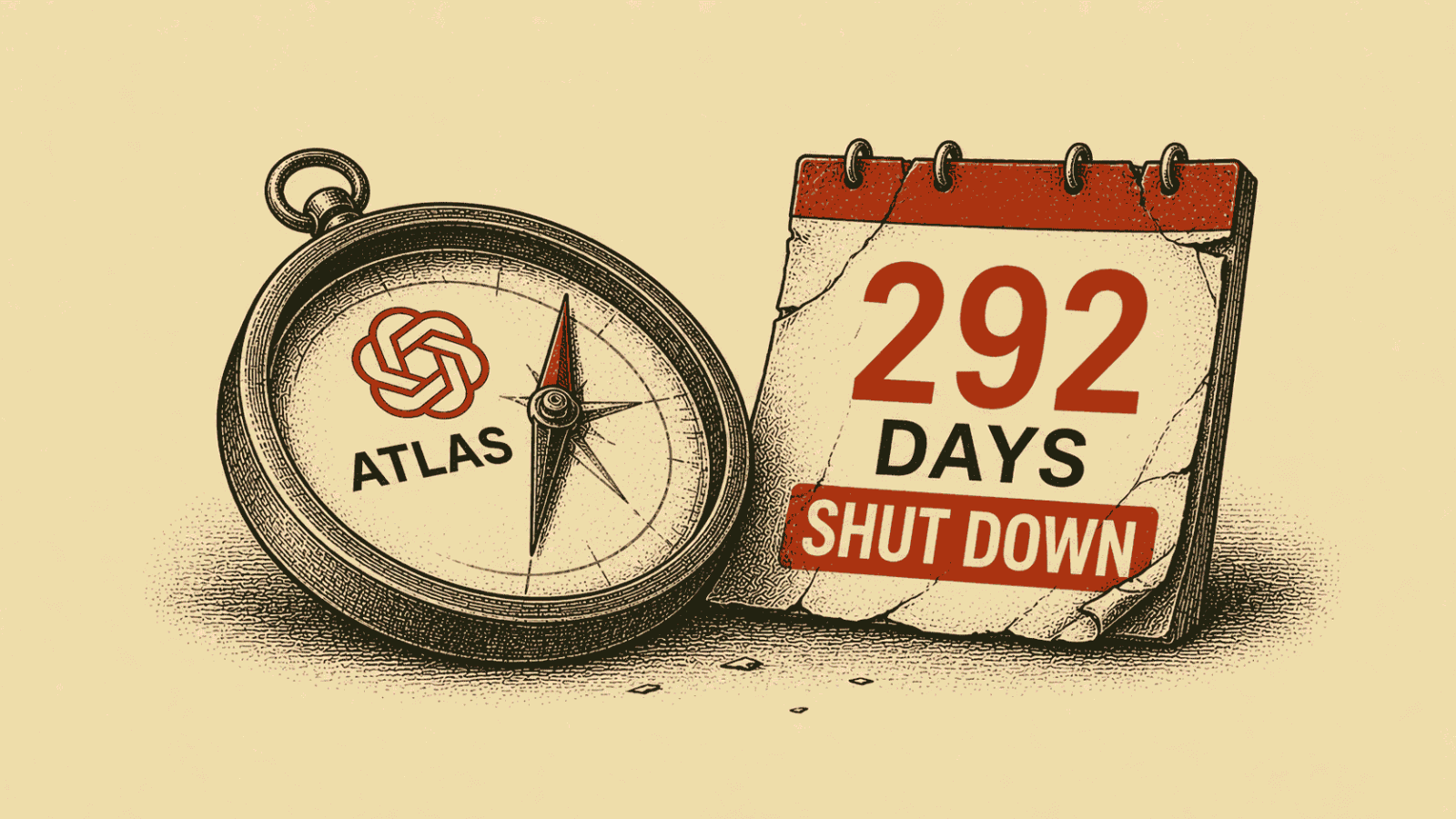
OpenAI Shuts Down Atlas: Why the ChatGPT Browser Lasted Just 292 Days

The Pulse
OpenAI is shutting down ChatGPT Atlas, the standalone AI browser it launched in October 2025. The decision turns what was introduced as a direct challenge to Chrome and Safari into one of OpenAI’s shortest-lived major consumer products, with the browser ending before it reached a full year in market. [CNET OpenAI shutters ChatGPT browser Atlas]
OpenAI says Atlas is scheduled to stop working on August 9, 2026. Bookmarks, open tabs, and browser history will not transfer automatically, while ChatGPT conversation history remains separate and available. The company is moving browser-based agentic capabilities into ChatGPT and Codex, including a stronger browser inside the desktop app and help while browsing through a Chrome extension or sidebar where available. [OpenAI ChatGPT release notes retiring Atlas]
The important strategic point is that OpenAI is not abandoning the web. It is abandoning the idea that users need to replace their existing browser to access an AI agent. Atlas is being retired as a destination, while its core capabilities are being redistributed as a layer across the tools and browsers people already use.
Core Significance
Why It Matters:
• Atlas never achieved the broad distribution implied by its launch promise: OpenAI released Atlas worldwide on macOS and said Windows, iOS, and Android versions were coming soon. The public product remained centered on macOS through its short life, limiting its ability to become a default browsing habit across the devices where Chrome and Safari already had entrenched users. [OpenAI introducing ChatGPT Atlas]
• OpenAI is preserving the valuable part of Atlas while removing the costly product shell around it: The company is moving page understanding, web interaction, and longer agentic tasks into the ChatGPT desktop app and Chrome. TechCrunch framed the shift as a conclusion that the browser is better treated as a capability inside a broader AI workspace than as the final destination users must adopt. [TechCrunch OpenAI shuts down Atlas browser ambitions continue]
• The shutdown is part of a larger effort to consolidate OpenAI products around one work interface: Atlas is ending alongside OpenAI’s push to reduce fragmented products and combine ChatGPT, Codex, browser tools, and longer-running work into a desktop-centered experience. The Verge connected the decision to the company’s earlier plan for a unified superapp and its broader retreat from side projects. [The Verge ChatGPT Atlas browser is already dead]
Deep Context: Why OpenAI’s Browser Bet Collapsed Into a ChatGPT Feature
Atlas launched on October 21, 2025 as an AI-first browser with ChatGPT built directly into navigation. Its pitch was not simply faster search. The browser could read the page in front of the user, answer questions in a sidebar, rewrite selected text, remember browsing context, and use an agent mode to interact with websites on the user’s behalf.
That product design reflected a major strategic ambition. Browsers sit between users and nearly every online service, giving their owners visibility into search intent, shopping behavior, account access, and work activity. By building Atlas, OpenAI was attempting to control more of that interface rather than remaining a chatbot opened in one tab inside a browser controlled by Google, Apple, or Microsoft.
The difficulty was distribution. A browser is not a normal app that users can test without consequence. Switching means moving passwords, bookmarks, extensions, history, default search settings, company policies, and years of learned habits. Even users interested in AI browsing had to accept significant migration friction before experiencing the product’s benefits.
As covered in our ChatGPT vs Claude for Business 2026 comparison, AI competition in 2026 is increasingly decided by workflow fit and distribution rather than small differences in model benchmarks. Atlas ran directly into that reality. Its AI capabilities could be useful without being useful enough to justify changing the browser around them.
Atlas Was a Distribution Experiment, Not Just a Browser Product
The browser gave OpenAI a controlled environment for testing what happens when an AI system can see multiple pages, retain browsing context, interact with logged-in websites, and move from answering questions to completing actions. Those experiments remain strategically valuable even though the consumer product carrying them is ending.
The shutdown therefore looks less like a total product failure and more like a distribution correction. OpenAI can place the same capabilities in the ChatGPT desktop app, expose lighter assistance through Chrome, and run deeper tasks through a cloud browser without asking every user to adopt a new default browser first.
Data Insights
By the Numbers:
Figures below are drawn from named product documentation and technology reporting cited inline.
• 292 days from launch to shutdown: Atlas launched on October 21, 2025 and is scheduled to stop working on August 9, 2026. That gives the standalone browser a lifespan of 292 days, or roughly nine and a half months, making it a rapid reversal for a product introduced as a serious challenge to incumbent browsers. [TechRadar OpenAI shuts down Atlas after less than a year]
• 69.65% of worldwide browser usage still belongs to Chrome: StatCounter’s June 2026 data places Chrome at 69.65%, Safari at 15.31%, and Edge at 5.21%. Together, the three largest browsers account for 90.17% of global usage, showing the distribution wall Atlas faced even before extension ecosystems and workplace policies were considered. [StatCounter browser market share worldwide June 2026]
• Approximately 30 days for users to move their browser data: OpenAI announced the retirement on July 9 and set August 9 as the stop date. Bookmarks, history, and open tabs do not transfer automatically, and active sessions cannot simply be carried into another browser, so users must export or save important data during the wind-down period. [OpenAI Help Center moving off Atlas]
Table 1: Timeline From Atlas Launch to Shutdown
| Date | Event | Products involved | Significance |
|---|---|---|---|
| October 21, 2025 | ChatGPT Atlas launches worldwide on macOS | Atlas, ChatGPT | OpenAI enters the browser market with ChatGPT built into navigation |
| March 2026 | Reports emerge of a unified desktop superapp | ChatGPT, Codex, Atlas | Product strategy shifts toward consolidation rather than separate interfaces |
| July 9, 2026 | OpenAI announces Atlas retirement and ChatGPT Work | Atlas, ChatGPT Work, Codex | Browser capabilities begin moving into a broader work platform |
| August 9, 2026 | Atlas scheduled to stop working | Atlas users | Standalone browser ends after 292 days |
Table 2: What Atlas Users Need to Move Before August 9
| Atlas data or feature | What happens | Required action |
|---|---|---|
| Bookmarks | May not transfer automatically | Export bookmarks as an HTML file and import them into a supported browser |
| Open tabs | Will not reliably transfer | Bookmark important pages or copy the URLs before shutdown |
| Browser history | Will not transfer automatically | Save important pages that may be difficult to recover later |
| Passwords and cookies | Export options are available where supported, but sessions are sensitive and may not import cleanly | Export carefully, verify the destination, and sign in again where required |
| ChatGPT conversations | Stored separately from Atlas browser data | No browser migration is required for existing ChatGPT conversation history |
| Agentic browsing | Moves into ChatGPT, Codex, the desktop app, and Chrome assistance where available | Adopt the supported experience that matches the workflow and device policy |
The Business Case: What Atlas’s Shutdown Means for Enterprises Standardizing on AI Agents
For enterprises, the immediate issue is not whether Atlas won the browser war. It is whether teams stored work-critical browser data or built processes around a product that will no longer receive normal browser support after August 9. Because browsers require continuous security maintenance, remaining on a discontinued client creates a risk that grows quickly rather than gradually.
The migration also forces companies to separate capability from packaging. Browser-based agents remain on OpenAI’s roadmap, but the interface delivering them is changing. Procurement teams evaluating AI agents should therefore ask whether a vendor commits to a durable capability, a durable product surface, or both. Atlas shows that those are not the same promise.
Moving the technology into the ChatGPT desktop app and Chrome may lower deployment friction because employees can stay inside familiar environments. It also changes the security review. IT teams now need to evaluate desktop access to local files and apps, Chrome extension permissions, browser account access, and the separation between local actions and cloud-based browser execution.
As covered in our OpenAI vs Anthropic 2026 enterprise comparison, platform stability and roadmap risk now matter alongside model quality. Atlas adds a concrete example: an enterprise can retain access to the underlying capability while still facing migration work because the vendor changes where that capability lives.
Expert Nuance: Atlas Failed as a Destination, Not Necessarily as an Idea
It is tempting to read a 292-day product life as proof that AI browsers were overhyped. That conclusion is too simple. Atlas tested a real shift in computing: an assistant that can understand the page, remember context across sessions, and take actions instead of waiting for the user to click through every step manually.
The more difficult lesson is that a browser combines unusual levels of technical responsibility and user trust. It holds credentials, payment access, personal history, private work documents, and active sessions across many services. Adding memory and autonomous actions increases the value of the product, but also increases the consequences of a mistaken action, a malicious page, or a confusing permission setting.
Privacy analysis published shortly after Atlas launched highlighted how browser memories could retain sensitive context and how agent access expanded the amount of user activity available to the system. Those concerns did not prove Atlas could not work, but they raised the operating cost of making a browser safe, transparent, and understandable enough to become a daily default.[Washington Post ChatGPT Atlas browser privacy analysis]
OpenAI’s new strategy attempts to keep the action layer while narrowing the product burden. A cloud browser can isolate some agent tasks. A desktop app can request permissions around specific files and applications. A Chrome extension can provide page context without replacing the user’s entire browser. Whether that architecture is safer or simply more convenient will depend on implementation and governance, not branding.
Strategic Outlook
1. Watch whether the migration works cleanly before August 9: The shutdown becomes more damaging if users lose bookmarks, history, sessions, or workflows during the transition. OpenAI has provided a wind-down window, but the quality of export tools and support will determine whether Atlas is remembered as a controlled consolidation or an abrupt product abandonment.
2. Watch which replacement becomes the real center of browser-based work: If most users choose the Chrome extension, OpenAI will have accepted a position as an intelligence layer on top of Google’s browser. If the ChatGPT desktop app becomes the preferred environment, the company may still achieve the broader superapp strategy that Atlas was originally meant to support.
3. Watch whether standalone AI browsers remain a category or become a temporary phase: Perplexity, The Browser Company, Google, and Microsoft are still experimenting with AI-native navigation and agentic features. Atlas’s closure will test whether smaller standalone browsers can build enough differentiation to overcome switching costs, or whether AI browsing ultimately consolidates inside incumbent browsers and general-purpose work apps.
Key Question Answered
Why Is OpenAI Shutting Down ChatGPT Atlas, and What Replaces It?
OpenAI is shutting down ChatGPT Atlas because it is consolidating browser-based AI work into ChatGPT and Codex rather than maintaining a separate browser. Atlas launched on macOS in October 2025, but the product faced the same barrier every new browser faces: users had to move passwords, bookmarks, extensions, defaults, and established habits before they could benefit from its AI features. OpenAI has now chosen to bring those features into environments with larger existing audiences instead.
Atlas is scheduled to stop working on August 9, 2026. Its replacement is not one product with a new name. Deeper browser-based agentic work is moving into the ChatGPT desktop app and Codex, while lighter assistance is available through a Chrome extension or sidebar where supported. Users should export bookmarks, save important tabs and history, and move passwords or cookies carefully before the deadline. Existing ChatGPT conversations remain separate from Atlas browser data.
The Takeaway
ChatGPT Atlas lasted only 292 days, but its shutdown does not mean OpenAI has lost interest in controlling how people work on the web. It means the company has changed its answer to a distribution problem. Instead of asking users to adopt an OpenAI browser, it will place OpenAI’s browser agent inside ChatGPT, Codex, the desktop app, and Chrome.
The strategic lesson is that advanced capability does not automatically create a durable product. Browsers are built on habit, ecosystem depth, security maintenance, and default distribution. Atlas may have offered a more AI-native experience, but OpenAI could not make that experience universal quickly enough to justify maintaining an entire browser around it.
For the wider AI industry, the question now moves from who can build the smartest browser to who can place an agent closest to the user’s existing work without creating unacceptable risk or friction. Atlas is ending, but the browser agent competition is moving into a more consequential phase because it is being embedded inside the software people already use every day.