The Pulse
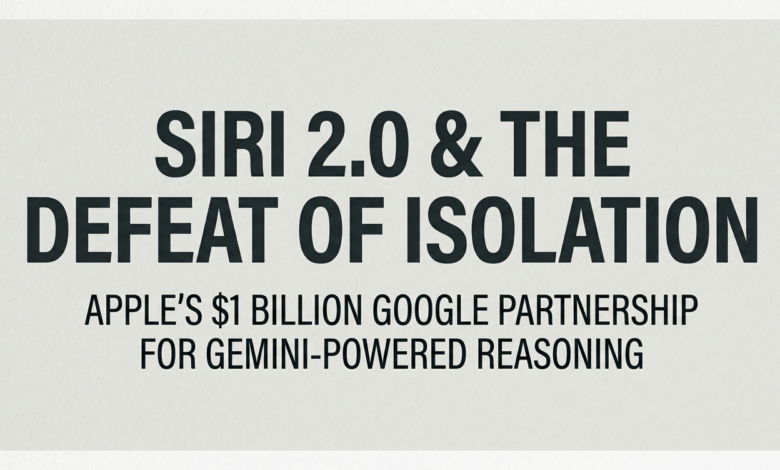
Apple just killed the old Siri. At WWDC 2026, Tim Cook unveiled a $1 billion annual partnership with Google’s Gemini, ending Apple’s go-it-alone AI strategy. This Siri 2.0 WWDC 2026 announcement marks the definitive shift from Apple building AI alone to outsourcing its reasoning engine entirely.
Core Significance
Why it matters:
- The Admission of Defeat: After years of lagging behind ChatGPT and Gemini, Apple is officially outsourcing its reasoning engine. By integrating Gemini Pro for complex queries while keeping Apple Intelligence for on-device tasks, Apple is admitting that even a $3 trillion company cannot build a world-class LLM in isolation.
- The R&D Surge: Apple’s R&D spending hit a record 10.3% of revenue this quarter — the highest in at least 30 years, driven by accelerated investment in AI
- Ecosystem Lockdown: Siri 2.0 is no longer just a chatbot. With On-Screen Awareness, it performs actions across third-party apps without user prompts, raising serious questions for developer competition and data sovereignty.
Deep Context: The 15-Year Winter
For over a decade, Siri was a punchline. While OpenAI and Google raced ahead with Large Language Models, Apple leaned on on-device privacy as a shield for limited capability. That shield shattered this week.
By tapping Gemini for the heavy lifting, Apple is mirroring the early 2000s deal that made Google the default search engine on iPhone. Only this time, the stakes are not a browser tab. It is the entire OS interface. The 2026 R&D surge confirms Apple is no longer playing defense, and as The Verge has tracked across its Big Tech coverage, every major platform is now consolidating around one or two dominant AI providers rather than building independently.
This is not just a feature update. It is a structural pivot that will reshape how 2 billion people interact with their devices every single day.
Data Insights
By the numbers:
- $725 Billion: Total projected AI infrastructure spending by Big Tech in 2026, per Bloomberg Intelligence estimates.
- 10.3%: Apple’s current R&D-to-revenue ratio, the highest in company history.
- 1.2 Trillion: The estimated parameter count of Gemini 2.5 Pro, which Siri 2.0 now leverages, an 8x jump over Apple’s previous internal models.
- $1 Billion: The reported annual access fee Apple pays Google for Gemini, separate from the existing $20 billion search default payment.
- 65%: ChatGPT’s declining traffic share as integrated OS assistants like Siri 2.0 begin to cannibalize standalone AI apps.
| Metric | Old Siri (2025) | Siri 2.0 (2026) |
| Model Type | Basic Intent Mapping | Hybrid LLM (Gemini + Apple) |
| Context Window | Single Turn | 20+ Exchange Dialogues |
| Awareness | Voice Only | Full On-Screen Awareness |
| Actionability | System Settings | Cross-App Agentic Tasks |
| Processing | On-Device (Limited) | Private Cloud Compute (Scalable) |
The table above summarizes the full capability gap the Siri 2.0 WWDC 2026 launch introduced overnight.
The Technical Architecture: How the Hybrid Brain Works
The real risk of Siri 2.0 lies in its dual-core design. Apple built a routing layer that decides, in milliseconds, where your query should go.
- The Local Core (Apple Intelligence): Ask Siri to set a timer, summarize a text, or find a photo from your trip to Karachi. The request stays on your A19 chip. It is fast, private, and uses zero data.
- The Cloud Core (Google Gemini): Ask Siri to optimize your freelance tax returns or draft a research report on regional defense policy. The router sends that request to Google’s Gemini 2.5 Pro via Private Cloud Compute (PCC).
Between the lines:
Apple’s PCC is the trust bridge. It strips identifying information before Google sees the query. Google gets the question, not your Apple ID or location. It is a clever way for Apple to maintain its privacy brand while giving users the power of a model it could not build itself. Whether regulators accept that framing is a separate question entirely.
The Business Case: Why Google Won
While Apple saves its iPhone sales cycle, Google just won the distribution war. By becoming the default brain for 2 billion active Apple devices, Google has boxed out OpenAI and Anthropic from the most valuable consumer base on the planet.
This is not about the $1 billion payment. It is about intent data. Even without knowing who you are, Google now knows what 2 billion premium users are asking for in real time. That feedback loop will make Gemini smarter, faster, and harder to compete with than any standalone app. As Apple’s official WWDC 2026 announcement noted, the partnership is designed to put the most advanced AI directly into the hands of every iPhone user, conveniently omitting that those hands are now feeding Google’s training pipeline.
Regional Spotlight: Pakistan’s AI Leap and the Hardware Tax
For emerging markets like Pakistan, Siri 2.0 arrives as both an opportunity and a hardware tax.
The Opportunity:
With programs like AI Seekho enrolling thousands of young Pakistanis, embedding high-level reasoning into the iPhone turns the device into a genuine educational tool. A student in Lahore can now use Siri to debug code, translate research papers, or navigate complex financial decisions with the nuance of a human tutor.
The Crisis:
The gap is real. Siri 2.0 requires the A19 chip, found only in the iPhone 17 and above, for full functionality. In a country where the iPhone 13 is still a luxury purchase, the divide between the AI-enabled and the AI-excluded is about to widen significantly. As Pakistan races toward its $1 billion digital economy target, locking its citizens out of the next productivity layer is a problem no government policy has addressed yet.
Expert Nuance: The Death of the App Store?
If Siri 2.0 can see your screen and act on your behalf, why do you need to open apps at all?
Imagine saying: Siri, find the cheapest flight to Dubai on Friday and book it through my JazzCash. Siri reads the data across your travel apps, compares prices, and executes the payment. You never saw an ad. You never tapped a button.
This is the Agentic Shift. For developers, it is a nightmare. If users stop opening apps, the traditional ad-revenue model collapses. Apple is effectively becoming the super-app sitting on top of everyone else’s hard work, which is a strange position for the company that built its empire on the App Store.
Expect developer pushback. Expect lawsuits. The EU’s Digital Markets Act already prohibits certain self-preferencing behaviors. Siri 2.0’s architecture will be tested against it within months.
Strategic Outlook: What’s Next
- The Search War: If Siri answers everything, the traditional Google Search app on iPhone becomes redundant. Google is cannibalizing its own search business to secure its AI future, a trade it has apparently decided is worth making.
- The Privacy Backlash: Regulators will probe Private Cloud Compute. The central question is whether de-identified data is truly anonymous, or whether Google can re-identify users through query pattern analysis at scale.
- The Hardware Cycle:Apple is betting the Siri 2.0 WWDC 2026 launch is the first must-have feature since Face ID. If the bet pays off, this triggers the largest iPhone upgrade cycle in a decade and the largest revenue quarter in Apple’s history.
Key Question Answered
What are the specific features of Siri 2.0 in 2026 and which devices are compatible?
Siri 2.0 WWDC 2026 introduces On-Screen Awareness, allowing the assistant to understand and interact with content across all apps. It features Multi-Step Task Execution, enabling complex actions like Find the invoice in my email and pay it. The system runs on a hybrid of Apple Intelligence (on-device) and Google Gemini Pro (cloud). Full features require the A19 chip or M4 silicon, restricting the complete experience to the iPhone 17 series, iPhone 18 series, and M4-powered Macs and iPads. Older devices including the iPhone 15 Pro receive a Lite version with limited cloud-only reasoning.
The Takeaway
Apple did not just update an assistant. It admitted the future of tech is too large for one company to own. The Apple-Google alliance is a $1 billion annual wager that convenience will always beat absolute privacy. For the user, the iPhone just got ten times smarter. For developers, the ground just shifted beneath their feet. And for Google, two billion premium users just became its most valuable data signal, whether they know it or not.