The Islamic Military Alliance’s AI Leap: How Saudi Arabia, Turkey, Pakistan and the Gulf Are Building a Defense Technology Bloc

The Pulse
The Islamic Military Counter Terrorism Coalition met in Riyadh on February 3, 2026. Forty-two member countries gathered for the second ministerial defense meeting. Pakistan’s Field Marshal Asim Munir met the IMCTC Secretary-General in Rawalpindi the same week. Saudi Arabia signed a landmark mutual defense pact with Pakistan in September 2025. Turkey’s Baykar reached $2.2 billion in drone exports in 2025, making it the world’s largest UAV exporter for the third consecutive year.
Saudi Arabia’s HUMAIN launched its first AI data centers in Riyadh and Dammam in early 2026, backed by Nvidia’s most advanced Blackwell chips. The Islamic NATO AI defense 2026 story is no longer about a proposed alliance. It is about a technology bloc actively building the AI infrastructure, autonomous systems, and defense technology ecosystem that will define its military capabilities for the next decade.
Core Significance
Why it matters:
- The Alliance Is Shifting from Counterterrorism to Technology: The IMCTC was founded in December 2015 as a counterterrorism coordination body. Its February 2026 ministerial meeting covered four domains: restricting extremist ideology, communications, blocking terrorist financing, and military cooperation. That last domain has expanded significantly. The technology cooperation frameworks now being built between member states cover AI development, drone procurement, defense infrastructure, and sovereign compute capacity. The alliance’s mandate has quietly evolved from coordinating against non-state threats to building state-level technology capabilities.Arab News — IMCTC Feb 2026
- Turkey Is the Technology Engine Nobody Is Accounting For: Turkey’s Baykar signed export agreements with 38 nations for its Bayraktar drone platforms. In 2025 its exports reached $2.2 billion, surpassing the United States, Israel, and China in the medium-altitude armed UAV export market. At the SAHA 2026 defense expo in Istanbul in May, Baykar demonstrated a swarm of 18 unmanned systems operating in formation in electronic warfare environments. Turkey’s defense and aerospace exports exceeded $10 billion in 2025, with five Turkish companies entering the global Defense News Top 100. That industrial base is the primary driver of the Islamic military bloc’s autonomous systems story.
- Saudi Arabia Is Building the AI Infrastructure Layer: Saudi Arabia’s HUMAIN, launched in May 2025 under the $930 billion Public Investment Fund, is building 500 megawatts of AI data center capacity with Nvidia’s Blackwell chips, a $10 billion collaboration with AMD, a 500-megawatt facility with xAI, and a Google partnership worth $10 billion. HUMAIN CEO Tareq Amin stated at the US-Saudi Investment Forum: ‘What we want to do in 2026 is to build the capacity equivalent to what Saudi has built in the last 20 years, in one year.’ That ambition has a defense dimension that sits alongside its commercial objectives.
Deep Context: From Counterterrorism Coalition to Technology Alliance
The Islamic Military Counter Terrorism Coalition has a specific origin story. Saudi Arabia’s Crown Prince Mohammed bin Salman announced its formation in December 2015 as a 34-nation Sunni Muslim alliance focused on combating terrorism and extremism. The coalition explicitly excluded Iran, Iraq, and Syria. By 2026, membership has grown to 43 nations spanning Asia, Africa, and the Middle East.
For the first five years of its existence, the IMCTC operated primarily as a coordination and training body. Its Counter-Terrorism Centre in Riyadh ran capacity-building programmes, intelligence-sharing frameworks, and joint training exercises. The technology dimension was present but secondary. Member states that wanted defense technology looked primarily to the United States, China, or their own domestic programmes.
Three developments changed that calculus between 2022 and 2026. First, Turkey’s drone programme demonstrated that a Muslim-majority nation could build and export globally competitive autonomous weapons systems without dependence on Western or Chinese supply chains. Second, Saudi Arabia’s Vision 2030 programme created the institutional and financial architecture for a domestic AI industry. Third, Pakistan’s defense pact with Saudi Arabia in September 2025, under which an act of aggression against one country is treated as an act of aggression against both, formalised the strategic alignment that had been building informally for years.
As IMCTC Pakistan cooperation meeting, the February 2026 ministerial gathering confirmed that intelligence sharing and capacity building have expanded to include technology cooperation frameworks that would have been outside the coalition’s mandate when it was founded a decade ago.
Data Insights
By the numbers:
All data points below are sourced. No URL is repeated across editorial and reference links.
- 43: Current member states of the Islamic Military Counter Terrorism Coalition, up from 34 at founding in 2015.[Arab News IMCTC Feb 2026]
- $2.2 Billion: Baykar’s UAV export revenue in 2025, making Turkey the world’s largest armed drone exporter for the third consecutive year.[Daily Sabah — Baykar Export Leadership]
- 38 Nations: Countries with signed export agreements for Baykar’s Bayraktar drone platforms as of early 2026, including 36 for TB2 and 16 for Akinci UCAV.
- 500 Megawatts: HUMAIN’s planned AI data center capacity in Saudi Arabia with Nvidia, representing hundreds of thousands of Blackwell GPUs.[NVIDIA — HUMAIN Official Partnership]
- $10 Billion: AMD’s collaboration agreement with HUMAIN for AI data center infrastructure in Saudi Arabia, announced at the US-Saudi Investment Forum.[CNBC — US chip exports to Gulf]
- 70,000: Combined Nvidia advanced AI chips approved by the US Commerce Department for export to Saudi Arabia’s HUMAIN and UAE’s G42 in November 2025.[American Bazaar — Nvidia Gulf approval]
- 6 Gigawatts: HUMAIN’s target AI data center capacity by 2034, positioning Saudi Arabia as the world’s third-largest AI infrastructure hub after the US and China.[AGSI — Gulf AI Strategy]
- $10 Billion: Turkey’s total defense and aerospace export revenue in 2025, with five Turkish defense companies entering the global Defense News Top 100.
Table 1: The Islamic Military Alliance’s AI and Defense Technology Ecosystem
| Country | Key Capability | Programme | Investment Scale |
| Saudi Arabia | AI Infrastructure, Compute | HUMAIN, Hexagon Data Center | $100B+ AI fund, 500MW Nvidia deal |
| Turkey | Drone Manufacturing, AI UAVs | Baykar TB2/TB3/Akinci, SAHA 2026 | $2.2B exports 2025, $10B defense |
| Pakistan | Drone Dev, Military AI | Shahpar-III MALE, NCAI NUST, CENTRIC PAF | $9B defense budget 2025-26 |
| UAE | AI Infrastructure | G42, MGX, Stargate UAE 1GW cluster | $44B AI campus, $385B Mubadala |
| Qatar | AI Investment | Qai, QIA-Brookfield $20B JV | $600B QIA assets |
| Malaysia | Digital Resilience | IMCTC IT Literacy Programme | Capacity building lead |
Table 2: The Technology Cooperation Architecture — What Each Country Contributes
| Contribution Type | Who Provides It | Who Benefits |
| AI Compute Infrastructure | Saudi Arabia (HUMAIN), UAE (G42) | Member states seeking cloud AI access |
| Drone Manufacturing | Turkey (Baykar), Pakistan (NESCOM) | Member states procuring autonomous systems |
| AI Research Capacity | Pakistan (NCAI at NUST) | Alliance human capital development |
| Defense Financing | Saudi PIF, UAE Mubadala, Qatar QIA | Technology procurement across alliance |
| US Chip Access | Saudi Arabia, UAE (approved recipients) | Broader alliance AI compute access |
| Talent Pipeline | Pakistan (2nd largest freelance workforce) | Gulf AI infrastructure operations |
The tables frame the Islamic NATO AI defense 2026 ecosystem. The capability contributions are complementary rather than redundant, creating structural interdependencies that function as a technology alliance even without formal treaty obligations.
The Business Case: Three Technology Pillars Defining the Alliance
The Islamic NATO AI defense 2026 technology build-out is not proceeding as a coordinated programme with a single budget and unified command structure. It is emerging from three parallel national programmes converging through bilateral agreements, technology procurement relationships, and shared strategic assessments.
Pillar 1: Turkey’s Drone Supremacy and Its Alliance Implications
Turkey’s Baykar has done something that appeared impossible a decade ago. A private company from a Muslim-majority country has built the most commercially successful armed drone programme in the world, outcompeting the United States, Israel, and China in the medium-altitude armed UAV export market.
The TB2’s success created a template: relatively low cost compared to Western equivalents, proven operational track record, and willingness to export to countries that US and European suppliers will not reach. As Daily Sabah reported from the SAHA 2026 defense expo, Baykar demonstrated 18-drone swarm operations in electronic warfare environments in April 2026. Selçuk Bayraktar used the SAHA 2026 keynote to call for a Technological Solidarity Alliance among allied and developing nations built around open-source digital systems. That is not a product pitch. It is a strategic doctrine.
As covered in our Pakistan AI defense analysis, the 2025 India-Pakistan standoff validated AI-guided drone systems in live operational conditions. That validation strengthens the procurement case for IMCTC member states evaluating autonomous systems investment.
Pillar 2: Saudi Arabia’s HUMAIN and the Compute Infrastructure Race
HUMAIN’s launch in May 2025 and its subsequent partnerships represent the most significant AI infrastructure development in the Muslim world in history. The combination of PIF capital, US chip access, and Western technology partnerships has given Saudi Arabia a credible path to 6 gigawatts of AI data center capacity by 2034.
As NVIDIA’s official HUMAIN partnership announcement confirmed, the partnership covers not just infrastructure but workforce development, with thousands of Saudi citizens receiving AI upskilling through the collaboration. HUMAIN CEO Tareq Amin’s stated target of building in 2026 what Saudi Arabia built in the previous 20 years is a reflection of sovereign wealth fund capital deploying at a scale that commercial market logic alone cannot explain.
As our Google I/O 2026 analysis documented, the companies that control compute infrastructure set the rules of the AI economy. Saudi Arabia understands this. HUMAIN is the institutional vehicle for that strategic intent, and its dual commercial and sovereign mandate makes it simultaneously a technology company and a national security asset.
Pillar 3: Pakistan’s Shahpar-III and the South Asian Connection
Pakistan sits at the intersection of the alliance’s Gulf financing relationships and its South Asian technology development capacity. The September 2025 mutual defense pact with Saudi Arabia formalised a strategic relationship that has existed informally for decades. Combined with Pakistan’s Shahpar-III MALE drone first flight confirmation for 2026 and the NCAI’s AI research programmes, Pakistan is positioned as the alliance’s primary defense technology development partner outside the Gulf.
The talent pipeline dimension is equally important. Pakistan’s AI Seekho programme, the $1 billion National AI Fund, and the freelance developer workforce are assets that connect directly to Saudi Arabia’s stated need for foreign technology talent to operate HUMAIN’s growing infrastructure. As covered in our Pakistan AI Geopolitics analysis, the Saudi GO Telecom AI Hub in Islamabad formalises this relationship commercially, creating a structured pipeline between Pakistan’s technology workforce and Gulf AI infrastructure needs.
Between the lines:
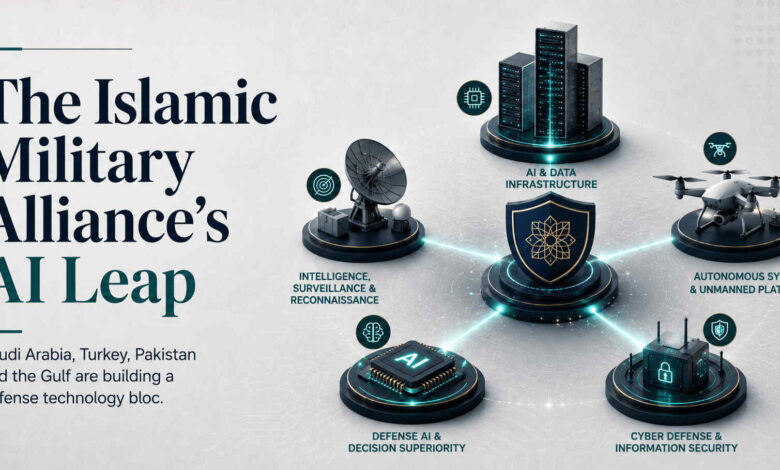
The technology architecture being built across IMCTC member states does not have a formal unified command or a shared technology roadmap document. What it has is a set of bilateral relationships, shared procurement interests, and complementary capabilities that function as an informal technology alliance. Turkey provides the drone technology. Saudi Arabia and the UAE provide the compute infrastructure and financing. Pakistan provides the engineering talent and indigenous defense development programme. The Gulf states collectively provide the US chip access and the sovereign wealth capital that makes it all possible. No single actor can replicate the full stack alone. That mutual dependency is the actual binding mechanism of the alliance.
Regional Spotlight: Pakistan’s Specific Position in the Alliance Technology Stack
For Pakistan, the Islamic Military Alliance’s technology development is not an abstract foreign policy interest. It is a specific and immediate economic opportunity with a defined timeline.
The Opportunity:
Saudi Arabia’s need for technology talent to operate HUMAIN’s AI infrastructure is documented and growing. HUMAIN’s partnerships with Nvidia, AMD, Google, and xAI are creating hundreds of AI engineering roles in Saudi Arabia that the Kingdom’s domestic talent base cannot fill at the required speed. Pakistan’s AI Seekho programme and the broader $1 billion National AI Fund human capital targets are directly aligned with this demand.
The Shahpar-III’s first flight confirmation in 2026 also opens export market conversations within the IMCTC. Member states that have procured Turkish Bayraktar platforms are potential customers for a Pakistani MALE UCAV that offers comparable capabilities at potentially competitive price points. Combat validation in the 2025 India-Pakistan standoff gives the Shahpar family operational credibility that matters in procurement decisions.
The Crisis:
Pakistan’s data sovereignty gap, covered in our Data Sovereignty South Asia analysis, creates a specific problem in the alliance technology context. Any defense technology cooperation involving data sharing, joint AI system development, or shared infrastructure requires a clear legal framework for data governance. Pakistan’s Personal Data Protection Bill is still unenacted. That legal gap creates friction in formalising technology cooperation agreements that other alliance members, particularly Saudi Arabia with its PDPL and the UAE with its federal data protection law, do not face.
The talent retention problem identified in our Pakistan AI economy analysis is directly relevant here. Pakistan trains AI engineers who are recruited by Gulf employers at salary multiples that Pakistan’s domestic market cannot match. The same talent pipeline that serves the alliance creates a structural outflow that the $1 billion National AI Fund must address through domestic employment creation rather than just training volume.
Expert Nuance: The Distinction Between a Technology Alliance and a Military Alliance
The Islamic Military Alliance in 2026 is frequently described as a potential military NATO equivalent. That framing misses the more important story. The technology cooperation developing across IMCTC member states is more significant than any formal military treaty would be.
Military alliances commit member states to defined obligations under specific trigger conditions. Technology alliances create ongoing dependencies, shared infrastructure, and aligned incentives that are structurally harder to exit than a treaty obligation. A country whose AI infrastructure runs on Saudi-hosted HUMAIN compute, whose drones are maintained by Turkish technical teams, and whose engineers are trained through Pakistani AI programmes is structurally integrated in ways that a treaty cannot replicate or reverse.
The GCC’s activation of its joint defense agreement and its decision to develop a regional ballistic missile warning system is the formal military cooperation story. The HUMAIN data centers, the Baykar export agreements, and the Pakistan-Saudi defense pact are the technology cooperation story. They are not the same story. And the technology cooperation story will have longer-lasting structural effects than any mutual defense declaration. Technology dependencies compound. Treaty obligations can be suspended. The distinction matters for anyone trying to assess the alliance’s actual durability.
Strategic Outlook: What’s Next
Three developments will define how the Islamic NATO AI defense 2026 technology ecosystem evolves over the next 18 months.
- HUMAIN’s 2026 Data Centers Go Live: HUMAIN’s Riyadh and Dammam data centers, each with initial capacity of up to 100 megawatts, were scheduled to come online in early 2026. When full operational capacity is reached, Saudi Arabia becomes the first IMCTC member state with hyperscale AI compute powered by US frontier chips. The availability of that compute to other alliance member states through cloud access agreements, rather than sovereign deployment, will be the key policy decision that determines how broadly the AI capability distributes across the 43-member alliance.
- Baykar’s SAHA 2026 Platforms Enter Procurement Conversations: The AI-powered loitering munitions and drone swarm systems demonstrated at SAHA 2026 in May will enter export evaluation cycles with interested governments over the following 12 to 18 months. IMCTC member states that have not yet procured Turkish drone platforms but face comparable threat environments to those that have are the primary target market. Watch for new Baykar export agreements with IMCTC member states as the primary indicator of how the alliance’s autonomous systems layer is developing.
- Pakistan’s Shahpar-III First Flight Completes the Triangle: If Pakistan’s Shahpar-III completes its first flight as confirmed for 2026, it creates a South Asian indigenous MALE drone capability alongside Turkey’s Baykar as a second source of autonomous systems within the alliance. Two indigenous drone development programmes operating within the same alliance, both with proven operational heritage, creates technology redundancy that strengthens the overall defense technology position. It also creates the conditions for joint development conversations between Pakistan’s NESCOM and Turkey’s Baykar that could produce next-generation platforms neither country could develop independently.
Key Question Answered
What is the Islamic Military Alliance’s AI defense technology strategy in 2026?
The Islamic Military Counter Terrorism Coalition’s 43-member alliance is developing an Islamic NATO AI defense 2026 technology ecosystem through three parallel national programmes rather than a unified command structure. Saudi Arabia’s HUMAIN is building up to 500 megawatts of AI data center capacity with Nvidia Blackwell chips, a $10 billion AMD collaboration, and a $10 billion Google partnership, targeting 6 gigawatts by 2034. Turkey’s Baykar reached $2.2 billion in UAV exports in 2025, supplying AI-guided drone platforms to 38 nations including multiple IMCTC members. Pakistan confirmed its Shahpar-III MALE drone for first flight in 2026, with the NCAI at NUST and PAF’s CENTRIC developing military AI capabilities. A Pakistan-Saudi Arabia mutual defense pact signed in September 2025 formalised the South Asian-Gulf technology cooperation relationship. The alliance’s technology build-out is creating a compute infrastructure layer in the Gulf, an autonomous systems layer through Turkish and Pakistani drone programmes, and a human capital layer through Pakistan’s AI talent pipeline.
The Takeaway
The Islamic Military Alliance is not competing with NATO on NATO’s terms. It is building capabilities on its own terms, using its own capital, its own technology companies, and its own definition of what sovereign defense technology means in the AI era. Saudi Arabia has the compute. Turkey has the drones. Pakistan has the engineering talent and the indigenous development programmes. The UAE and Qatar have the sovereign wealth and the US technology access that ties the whole architecture together.
None of these countries was supposed to be in this position a decade ago. Saudi Arabia was an arms importer. Turkey was a NATO client for US technology. Pakistan was dependent on Chinese procurement. The 2026 picture is fundamentally different. The technology convergence happening across these member states is not a formal alliance treaty. It is something more durable than that. It is a set of mutual dependencies, shared capabilities, and aligned strategic interests that will shape the region’s defense technology landscape long after any particular government or policy framework changes.
The question worth watching is not whether this technology alliance will formalise into a treaty structure. It probably will not, and it does not need to. The question is whether the compute, the drones, and the talent can be integrated into a coherent operational layer before the window of current US technology access and Gulf sovereign wealth deployment closes. 2026 is the year that question gets its first real answer.