Data Sovereignty in South Asia 2026: New Laws Compared

The Brief
The Pulse Three countries sharing a subcontinent are simultaneously building three different digital walls. India operationalised its Digital Personal Data Protection Act on November 13, 2025, after a decade of legislative debate. Bangladesh passed its Personal Data Protection Ordinance in late 2025, the country’s first cross-sectoral data protection law. Pakistan’s Personal Data Protection Bill remains […]
Why It Matters
The story matters because it changes how buyers, builders, or policymakers should read the AI Policy and Power market.
Watch Next
Watch whether the signal becomes a budget, procurement, or platform decision in the next cycle.
The Pulse
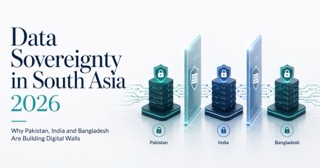
Three countries sharing a subcontinent are simultaneously building three different digital walls. India operationalised its Digital Personal Data Protection Act on November 13, 2025, after a decade of legislative debate. Bangladesh passed its Personal Data Protection Ordinance in late 2025, the country’s first cross-sectoral data protection law. Pakistan’s Personal Data Protection Bill remains stuck in Parliament while its revised 2025 draft introduces some of the strictest data localisation requirements in the region.
The data sovereignty South Asia 2026 story is not a story about privacy rights. It is a story about three governments that have concluded the same thing: whoever controls the data controls the economy, and they do not want foreign entities controlling theirs.
Core Significance
Why it matters:
- The Regulatory Convergence Is Not Coincidental: India, Pakistan, and Bangladesh have all moved toward comprehensive data protection frameworks within a two-year window. That synchronisation reflects a shared recognition that the global AI economy runs on data, that most of the infrastructure processing South Asian data is foreign-owned, and that without legal frameworks data sovereignty remains aspirational rather than operational. Every country that builds a credible data governance framework gains an advantage in attracting AI investment and enterprise contracts from governance-sensitive international clients.
- The AI Dependency Problem Drives Every Decision: As our agentic AI enterprise analysis documented, 70-85% of enterprise operational data sits in systems controlled by foreign cloud providers. For South Asian governments, that figure has a national security dimension that goes beyond GDPR compliance. Every AI system a government agency, bank, or hospital runs on AWS, Google Cloud, or Microsoft Azure means sensitive citizen data is processed on infrastructure subject to US legal jurisdiction under the CLOUD Act. Data sovereignty laws are the policy response to that dependency.
- The Fragmentation Risk Is Real for Business: Three separate legal frameworks with different localisation requirements, different cross-border transfer rules, and different penalty structures create a compliance burden for any company operating across South Asia. A Pakistani fintech company serving Indian customers, a Bangladeshi healthtech startup using Indian cloud infrastructure, or a multinational running shared data infrastructure across the subcontinent faces three separate compliance obligations that do not align. That fragmentation has a measurable cost and it is rising.
Deep Context: Why Data Sovereignty Became a Priority Simultaneously
The roots of South Asia’s data sovereignty push go back further than the legislation. India’s journey started in 2017 when the Supreme Court unanimously declared privacy a fundamental right in the Puttaswamy judgment. That decision created a constitutional obligation for Parliament to legislate data protection. Six years, three drafts, and one withdrawn bill later, the Digital Personal Data Protection Act finally received Presidential assent in August 2023.
The DPDP Rules 2025, notified on November 13, 2025, operationalised the framework. As Hogan Lovells confirmed in their analysis of the DPDP operationalisation, these rules provide detailed operational requirements for consent collection, breach notification, cross-border transfers, and the functioning of the Data Protection Board. India became one of the last major democracies to establish a comprehensive data protection regime, but it arrived with more institutional maturity than most.
Bangladesh’s path was more turbulent. Its Digital Security Act 2018 was widely criticised for criminalising online speech rather than protecting personal data. The successor Cyber Security Act 2023 repeated many of the same problems. The Personal Data Protection Ordinance 2025, enacted by the interim government, represents Bangladesh’s first genuine attempt to treat data privacy as a citizen right rather than a state control mechanism.
Pakistan’s story is the most complex. As The Friday Times documented in December 2025, the Personal Data Protection Bill 2023 was approved by Cabinet in April 2023 but has not received parliamentary assent as of May 2026. Legal analysts warn it has serious flaws including sweeping exemptions for government agencies. The revised 2025 draft strengthened some provisions while maintaining state surveillance carve-outs that civil society has consistently criticised.
The broader context matters here. India hosted the AI Impact Summit in February 2026, explicitly positioning the event around data sovereignty, technology access, and Global South inclusion. Data sovereignty is not just domestic policy in South Asia. It is foreign policy conducted through regulatory frameworks.
Data Insights
By the numbers:
All data points below are sourced. No URL is repeated across editorial and reference links.
- ₹250 Crore (~$30M): Maximum penalty under India’s DPDP Act for serious violations, structured by violation type rather than GDPR’s turnover-based model.[Glocert International]
- November 13, 2025: Date India’s DPDP Rules were operationalised, beginning Phase 1. Phase 2 begins November 13, 2026. Full compliance required by May 2027.[DLA Piper Data Protection India]
- $2 Million: Maximum fine under Pakistan’s Personal Data Protection Bill for significant data violations, approximately equivalent in Pakistani rupees at current exchange rates.[Wikipedia — NCPDP]
- 18 Months: Transitional period given to organisations in Bangladesh after the PDPO 2025’s official gazette publication before full enforcement begins. [The Daily Star Bangladesh]
- $50 Billion: Cloud and AI infrastructure investments pledged to the broader Asian region by hyperscale cloud providers between 2022 and 2025, per the Asia Cloud Computing Association, underscoring the foreign infrastructure dependency these laws are responding to.
- 0: Countries on India’s restricted data transfer list as of February 2026. India uses a negative-list approach, permitting cross-border transfers unless a country is specifically restricted. [Matters.ai DPDP Analysis]
- 3: Countries in South Asia with comprehensive data protection frameworks at various stages: India (operationalised), Bangladesh (enacted, in transition), Pakistan (draft, awaiting parliamentary assent).
Table 1: South Asia Data Sovereignty Frameworks — Side by Side
| Metric | India | Bangladesh | Pakistan |
| Law Name | DPDP Act 2023 + DPDP Rules 2025 | Personal Data Protection Ordinance 2025 | Personal Data Protection Bill 2023 (draft) |
| Status | Operational — Phase 1 since Nov 2025 | Enacted — 18-month transition | Draft — not yet passed by Parliament |
| Enforcement Body | Data Protection Board of India | National Digital Governance Authority | National Commission for Personal Data Protection |
| Max Penalty | ₹250 crore (~$30M) | Administrative fines (TBD) | Up to $2M equivalent |
| Cross-Border Transfer | Negative list — open unless restricted | Requires explicit consent + safeguards | Restricted to politically aligned countries |
| Full Compliance Deadline | May 2027 | 18 months post-gazette | TBD — law not yet passed |
Table 2: What Each Framework Means for Technology Companies and Pakistan’s IT Sector
| Framework | Impact on Global Cloud Providers | Impact on Pakistan IT Exports | Impact on Regional AI Startups |
| India DPDP — Significant Data Fiduciaries | Localise certain data, face audit obligations | Opens compliance consulting market | Must segment India user data from global infra |
| Bangladesh PDPO — 18-month transition | Time to build local data centre capacity | Cloud services partnership opportunity | Must redesign data architecture before enforcement |
| Pakistan PDPB — Country restrictions | Cannot transfer data to India, Israel, Taiwan | Restricts cross-border IT delivery | Cannot use Indian cloud infra for Pakistani users |
| All three combined | Three compliance frameworks, no harmonisation | Higher compliance costs, complex delivery | Raises cost and complexity of building regionally |
The tables frame the data sovereignty South Asia 2026 challenge. The frameworks are converging in structure but diverging in politics, and that divergence has direct operational costs.
The Business Case: What the Frameworks Actually Require
The three frameworks share a common architecture but diverge significantly in their localisation requirements and cross-border transfer rules. Those divergences have direct operational consequences for every technology company active in the region.
India: The Most Advanced, The Most Permissive on Transfers
India’s DPDP Act is the most operationally mature of the three. The Data Protection Board became operational on November 13, 2025, creating the first functioning data protection authority in the subcontinent. The framework’s approach to cross-border transfers is deliberately flexible: personal data can flow to any country unless India specifically adds it to a restricted list. As of May 2026, that list remains empty.
The real teeth are in the Significant Data Fiduciaries provisions. The government has not yet published the official SDF list, but the criteria make clear that large social media platforms, financial services firms, and healthcare providers handling significant volumes of sensitive Indian data will face additional obligations including data localisation mandates. For companies like Meta, Google, and Amazon, this means building compliance infrastructure before the SDF designation arrives rather than after.
The phased timeline is India’s practical concession to industry. Phase 1 established the Board and the penalty framework. Phase 2 in November 2026 adds consent manager registration. Full compliance does not kick in until May 2027. India is giving its technology sector two years to build compliance infrastructure, which is more realistic than GDPR’s rushed timelines but still ambitious given the scale of affected organisations.
Bangladesh: Ambitious Framework, Enforcement Uncertainty
Bangladesh’s PDPO 2025 represents a genuine legislative achievement for a country that spent years under frameworks primarily designed to control online speech rather than protect personal data. The ordinance treats data privacy as a fundamental right connected to individual dignity, national sovereignty, and economic participation.
The 18-month transition period is both practical and necessary. Bangladesh’s digital infrastructure, compliance ecosystem, and legal profession have limited experience with data protection enforcement. The National Digital Governance Authority, established under the ordinance, needs technical capacity, trained staff, and enforcement precedents before it becomes a credible regulatory force. The ordinance’s specific inclusion of significant data fiduciaries mirrors India’s approach, which means the compliance architecture for India’s SDF requirements broadly applies in Bangladesh as well.
Pakistan: The Most Restrictive, The Most Delayed
Pakistan’s framework is the most politically charged of the three. As ITIF’s May 2025 analysis documented, the PDPB’s explicit restriction on data transfers to India means the two largest economies in South Asia cannot freely exchange data through commercial platforms. That restriction is not primarily a privacy protection. It is a foreign policy position expressed through data governance language.
The practical consequence for Pakistan’s technology sector is a legal vacuum. Without an enacted data protection law, Pakistani companies handling European or US client data operate in a compliance grey zone. GDPR requires adequate protection frameworks in recipient countries. Pakistan lacks one. As our Pakistan AI geopolitics analysis documented, this governance gap is one of the primary reasons international enterprise contracts tend to go to markets with clearer regulatory environments.
Between the lines:
The three frameworks are converging in structure but diverging in politics. India, Bangladesh, and Pakistan are all building data protection authorities, consent requirements, and localisation provisions that look similar on paper. The actual compliance environments they create are very different because the political assumptions embedded in each framework reflect different views of who the primary threat to data sovereignty is. An AI company building across all three markets must navigate all three of those threat models at once. No vendor has yet built a South Asia-specific compliance architecture. The first one to do so will own the market.
Regional Spotlight: What This Means for Pakistan’s Tech Sector
The data sovereignty frameworks taking shape across South Asia create specific and urgent challenges for Pakistani technology firms that have not yet received adequate attention in the $1 billion National AI Fund discussions.
The Opportunity:
India’s DPDP Act creates a compliance services market that Pakistani IT firms are positioned to serve for global companies operating in India. The compliance architecture required, data mapping, consent management systems, breach notification protocols, and Data Protection Officer services, is buildable expertise. A Pakistani IT services firm that develops DPDP compliance expertise now has a year before Phase 2 obligations kick in, creating a credible service window before the market becomes crowded.
Bangladesh’s 18-month transition period creates a parallel opportunity. Pakistani developers and IT firms already serve Bangladeshi clients in software development and digital services. Extending those relationships into compliance infrastructure is a natural adjacency. The PDPO 2025’s alignment with India’s framework means the same expertise applies in both markets, reducing the unit cost of building regional compliance service capability.
The Crisis:
Pakistan’s own legal vacuum is the most immediate problem. Without an enacted Personal Data Protection Bill, Pakistani companies cannot credibly tell European or American clients that their data is processed in compliance with adequate legal protections. That inadequacy costs Pakistan enterprise contracts that go instead to Indian, Bangladeshi, or Sri Lankan firms operating under clearer legal frameworks. As our Pakistan AI economy analysis noted, this governance gap is a direct constraint on the $1 billion AI Fund’s commercial ambitions.
The PDPB’s restriction on data transfers to India is also commercially damaging in ways the bill’s drafters appear not to have considered. Pakistani companies depend on AWS’s Mumbai region, Google Cloud’s Delhi region, and Microsoft Azure’s Pune region for low-latency services to Pakistani users. If the PDPB’s localisation requirements are enacted as drafted, Pakistani companies will need to migrate workloads away from the geographically closest cloud infrastructure because of a political data transfer restriction. The compliance cost of that migration has not been publicly estimated. It will be significant.
Expert Nuance: The Harmonisation Gap Nobody Is Addressing
South Asia’s data sovereignty push has a structural problem that none of the three frameworks address: the absence of regional harmonisation.
ASEAN has the Digital Economy Framework Agreement. The EU has GDPR adequacy decisions that create mutual recognition across 27 member states. South Asia has no equivalent regional data governance framework. SAARC, the regional cooperation body, has not addressed data protection in any meaningful way. The result is three national frameworks with no interoperability, no mutual recognition, and no cross-border enforcement cooperation.
For the AI economy, that fragmentation has a specific and measurable cost. Training AI models on regional data requires data from multiple South Asian countries. Under the current framework, that data cannot freely move between India, Pakistan, and Bangladesh without navigating three separate legal regimes and, in the case of India and Pakistan, a bilateral data transfer restriction that has no GDPR-style adequacy pathway.
The Digital Watch Observatory noted in March 2026 that Asia’s digital sovereignty debate has moved beyond the US versus non-US cloud question. The practical challenges organisations face when choosing hosting locations or training AI models across diverse regulatory regimes require more sophisticated analysis than the sovereignty framing typically allows. South Asia needs that sophistication. It does not currently have the regional institutional framework to develop it.
Strategic Outlook: What’s Next
Three developments will define how data sovereignty South Asia 2026 plays out over the next 12 months.
- India’s SDF List Will Define the Market in Q3 2026: The most consequential near-term development is India’s publication of the Significant Data Fiduciaries list, expected in Q3 2026. The companies on that list will face data localisation mandates and enhanced audit obligations. For global cloud providers and large technology platforms, SDF designation triggers infrastructure investment decisions that will be made quickly. For Pakistan’s IT sector, SDF designation creates a compliance services market with a defined client base and a ticking clock. The window between SDF list publication and Phase 2 obligations in November 2026 is a five-month service opportunity.
- Pakistan’s Parliament Must Act Before the Window Closes: Every month Pakistan’s PDPB remains unenacted costs Pakistani technology firms enterprise contracts that go to adequacy-compliant jurisdictions. The $1 billion National AI Fund’s ambition to make Pakistan a global AI services hub is fundamentally compromised by the absence of a data protection framework that international clients can rely on. The Ministry of IT and Telecommunication needs to treat PDPB passage as a prerequisite for the AI fund’s commercial success, not a separate legislative agenda item on a different parliamentary calendar.
- The Regional Harmonisation Conversation Needs to Start: No single government can initiate South Asian data governance harmonisation without a multilateral framework. India, as the region’s largest digital economy and the recent host of the AI Impact Summit, is the natural convener. A South Asian Data Governance Framework creating mutual recognition between national laws would reduce compliance costs for regional businesses, unlock cross-border AI data flows, and strengthen every country’s negotiating position with global cloud providers. That conversation needs to start in 2026 before the three frameworks calcify further apart.
Key Question Answered
What is data sovereignty and why are India, Pakistan and Bangladesh building data protection laws in 2026?
Data sovereignty refers to the principle that data is subject to the laws and governance structures of the country where it is collected or processed. In data sovereignty South Asia 2026, three separate but related legislative efforts reflect a common concern: the majority of South Asian citizens’ data is currently processed on infrastructure owned by foreign technology companies and subject to foreign legal jurisdiction. India operationalised its DPDP Act on November 13, 2025, creating the Data Protection Board and a phased compliance framework with full enforcement by May 2027. Bangladesh enacted the Personal Data Protection Ordinance 2025 with an 18-month transition period. Pakistan’s Personal Data Protection Bill 2023 remains in parliamentary limbo despite Cabinet approval, with a revised 2025 draft introducing stricter localisation requirements. All three frameworks share common architecture: consent requirements, data localisation for sensitive categories, cross-border transfer restrictions, and enforcement authorities. They diverge significantly in political assumptions, localisation thresholds, and the countries to which data transfers are restricted.
The Takeaway
India, Pakistan, and Bangladesh are all trying to solve the same problem: they want the economic benefits of the AI economy without surrendering control of the data that AI runs on. The legislative approaches they have chosen reflect different political priorities, different institutional capacities, and different assessments of where the primary threat to their data sovereignty originates.
India has the most operationally mature framework and the most permissive transfer rules. Bangladesh has the clearest democratic intent but the most uncertain enforcement path. Pakistan has the strictest localisation ambitions and the weakest legal foundation, with a bill that has been in draft for over two years without passing.
What all three lack is each other. A subcontinent of two billion people is building digital walls with no doors between them. The AI economy they are each trying to capture does not respect those walls. The data that trains the models does not stop at borders that the internet was designed to cross. The frameworks are necessary. The harmonisation they are not building is more necessary still.