Tesla FSD v14 in 2026: 10 Billion Miles, Three Texas Cities, and the Longest Road to Unsupervised Driving

The Pulse
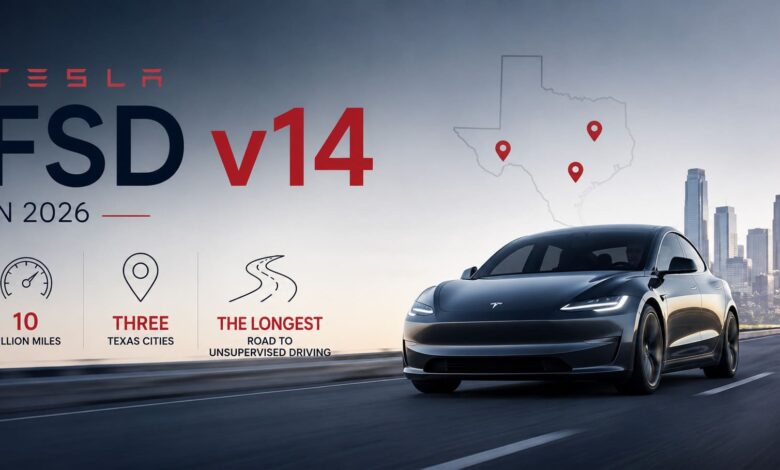
Tesla’s Full Self-Driving fleet crossed 10 billion cumulative supervised miles in early May 2026. That milestone matched the data threshold Elon Musk specified in January 2026 as the volume required for safe unsupervised operation. FSD v14.3 introduced a rewritten AI compiler using MLIR, with Tesla-reported claims of up to 20% faster reaction performance. The Robotaxi service is running commercially in Austin with a meaningful fleet, and single-vehicle pilots launched in Dallas and Houston in April 2026.
The Cybercab has been spotted on public streets in downtown Austin. And yet on the Q1 2026 earnings call, Musk acknowledged the software still produces situations where cars get scared to move or enter infinite loops. The Tesla FSD 2026 story is simultaneously the most widely deployed consumer autonomous driving system in history and a technology still working through documented limitations. Both things are true at the same time.
Core Significance
Why it matters:
- The Data Threshold Has Been Crossed, But Autonomy Has Not: Musk set a public, specific benchmark in January 2026: roughly 10 billion miles of training data would enable safe unsupervised self-driving at scale. As carscoops reported, the fleet hit 10.03 billion miles in early May. Yet consumer cars remain Level 2 systems requiring full driver attention. On the Q1 2026 earnings call, Musk implied consumer vehicle unsupervised deployment would wait for a v15 architecture. The benchmark was met. The promised outcome has been deferred.
- The Safety Data Requires Careful Reading: Tesla’s supervised FSD fleet records one major collision per 5.3 million miles against one per 660,000 miles for average US drivers. Critics, including reporters at Reuters and The Verge, note this comparison is difficult to normalise because FSD is disproportionately used on highways, where crashes are far less frequent than on city streets, and Tesla compares airbag-deployment events to broader federal datasets. The raw number looks impressive. The methodology requires scrutiny.
- The Commercial Footprint Is Real: Tesla’s active FSD subscription base reached 1.28 million by Q1 2026, up 51% year over year. Unsupervised Robotaxi operations are running in Austin at $4.20 flat fares. European Tesla owners drove 10 million kilometres on supervised FSD in just one month following the European launch. The commercial reality is that Tesla is operating at a scale its competitors cannot match, even as the technology continues to mature.
Deep Context: The Architecture Shift That Makes FSD v14 Different
Understanding why FSD v14 is genuinely different from previous versions requires looking at the architectural change rather than the feature list.
Every version of FSD before v14 was built on a hybrid architecture. Computer vision models identified objects. Separate planning modules decided what to do. Separate control modules executed those decisions. The system worked by following thousands of programmed rules. If a pedestrian is detected in this position, apply this braking profile. The rules were sophisticated. They were also brittle. Every scenario the rules did not anticipate was a potential failure.
FSD v14 replaced this with an end-to-end neural network. The system absorbs raw video data from cameras and outputs steering and acceleration commands directly, having learned how to drive by analysing billions of miles of human driving data. There are no intermediate rule layers. The model generalises from experience the same way a human driver does, rather than executing a decision tree.
The v14.3 update introduced a rewritten AI compiler and runtime using MLIR technology. Tesla-reported analyses and release notes claimed up to 20% faster reaction performance from the rewrite, though this figure has not been independently validated through third-party engineering benchmarks. The direction of improvement is consistent with what the architecture change should produce. The specific magnitude should be treated as Tesla-reported rather than independently confirmed.
As Carscoops confirmed from Tesla’s own FSD safety page, the fleet is piling up roughly 29 million miles per day with FSD engaged, accumulating at 71% higher daily rates than at the start of 2026. The architecture change is producing measurable engagement and data accumulation at a scale no simulation environment can replicate.
Data Insights
By the numbers:
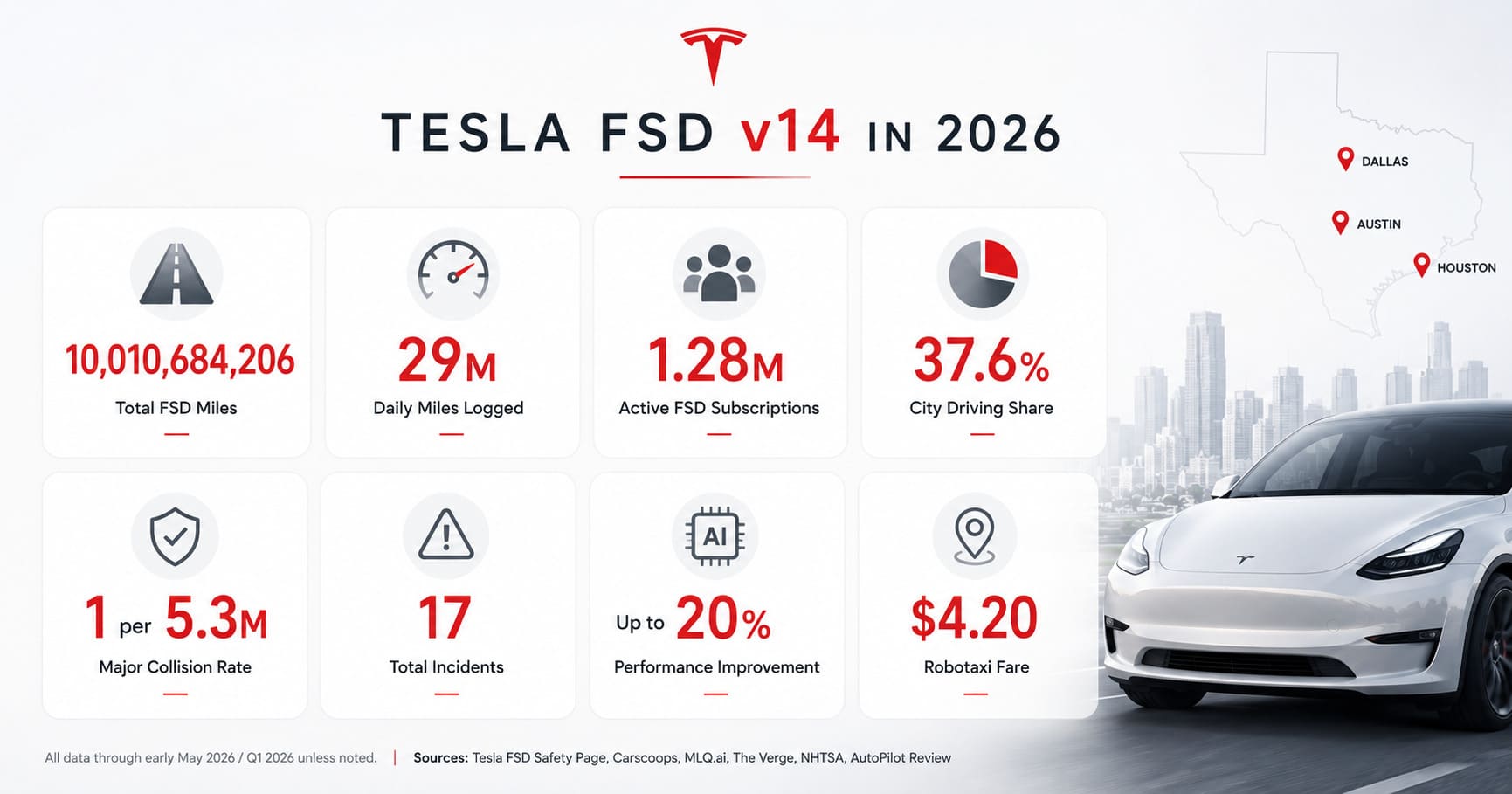
Some important data points are mentioned below, have a look.
- 10,010,684,206: Total cumulative FSD supervised miles crossed in early May 2026, matching Musk’s stated threshold. Tesla’s own figures show vehicles running FSD average 5.5 million miles between major collisions.[Carscoops — Tesla FSD 10B milestone]
- 29 Million: Daily miles currently being logged by the FSD supervised fleet per Tesla’s own FSD safety page, up from 14 million per day at the start of the year.[Carscoops — FSD daily accumulation]
- 1.28 Million: Tesla’s active FSD subscription base at end of Q1 2026, up 51% year over year.[MLQ.ai — Tesla FSD Fleet Analysis]
- 37.6%: Share of the 10 billion mile dataset that is city driving. The remaining 6.25 billion miles were logged on highways. This distribution matters because city driving produces disproportionately more edge case failures.[Carscoops — dataset composition]
- 1 per 5.3 Million: Tesla-reported supervised FSD major collision rate versus 1 per 660,000 for average US drivers. Note: critics including The Verge point out this comparison is skewed because FSD disproportionately accumulates highway miles where crashes are rarer, and the datasets compared are not directly equivalent.[The Verge — Tesla FSD safety caveats]
- 17 Incidents: Total NHTSA-reported events for the Austin Robotaxi fleet through March 2026. Zero major crashes. Only 6 where Tesla ADS was deemed at fault. Several incidents were rear-endings by human drivers hitting the stationary Robotaxi. Tesla initially redacted crash narratives before unredacting them.[We Talk Tesla — NHTSA Robotaxi details]
- Up to 20%: Claimed reaction performance improvement from FSD v14.3’s rewritten MLIR AI compiler and runtime, per Tesla-oriented release note analysis. Not independently validated through third-party benchmarking.[AutoPilot Review — FSD v14.3]
- $4.20: Flat fare for Tesla Robotaxi rides in Austin, Texas. Austin is the primary commercial market. Dallas and Houston each launched with a single vehicle in April 2026.
Table 1: Tesla FSD Version History :The Architecture Evolution
| Version | Release | Key Change | Status |
| FSD v12 | 2024 | First end-to-end neural network elements | HW3, supervised |
| FSD v14.0 | Oct 2025 | Full end-to-end neural network | HW4 vehicles only |
| FSD v14.1 | Nov 2025 | Improved city driving, intersections | HW4 vehicles |
| FSD v14.2 | Dec 2025 | Self-Driving Stats, fleet data integration | HW4 + Robotaxi branch |
| FSD v14.3 | Apr 2026 | MLIR compiler, up to 20% faster reaction (Tesla-reported) | HW4 + Europe launch |
| FSD v14.3.3 | May 2026 | Intervention-free streak counter, unified model | HW4, early access |
| FSD v14 Lite | Q2 2026 (pending) | Feature-limited for HW3 vehicles | Announced, not released |
| FSD v15 | TBD | Consumer unsupervised deployment architecture | Planned |
Table 2: Tesla vs Waymo: The Autonomous Driving Competitive Comparison
| Metric | Tesla FSD 2026 | Waymo |
| Sensor Approach | Vision-only (cameras) | LiDAR + cameras + radar |
| Commercial Cities | Austin (primary), Dallas + Houston (1 vehicle each) | San Francisco, Phoenix, Los Angeles |
| Data Volume | 10B+ supervised miles, 29M miles/day | Tens of millions total |
| Subscription Base | 1.28M active FSD subscribers | No consumer subscription |
| Consumer Vehicle | Yes — existing Tesla fleet | No |
| Autonomy Regulatory Status | Level 2 for consumers, limited unsupervised Robotaxi | Level 4 in designated geofenced areas |
| Fare | $4.20 flat (Austin) | ~$6-12 per mile |
The tables frame the Tesla FSD 2026 competitive position. Tesla leads on data scale and consumer fleet size. Waymo leads on validated Level 4 autonomy in defined geographic areas. These are different products solving different problems.
The Business Case: Three Realities of Tesla FSD in 2026
The Tesla FSD 2026 commercial story is more complex than either its strongest advocates or sharpest critics acknowledge. Three separate realities are all true simultaneously.
Reality 1: The Supervised System Performs Well at Scale
The supervised FSD fleet, where a human is present and can intervene, records one major collision per 5.3 million miles by Tesla’s own reporting. That is a significant safety advantage over the average US driver by Tesla’s methodology, though critics including reporters at Reuters note the comparison is complicated by the highway-heavy distribution of FSD mileage and differences in how crashes are counted.
FSD users on v14.3 are reporting thousands of miles between interventions. The streak counter in v14.3.3 lets users track their longest intervention-free run. European Tesla owners drove 10 million kilometres on supervised FSD in just one month following launch there. These are real deployment signals, not laboratory results. The system performs well for most drivers in most conditions under supervision.
Reality 2: The Robotaxi Safety Picture Is More Nuanced Than Headlines Suggest
The Austin Robotaxi fleet’s NHTSA filing data requires careful reading. As Automotive World’s analysis documented, 14 incidents through January 2026 across approximately 800,000 miles produce a rate of one incident per 57,000 miles when compared against Tesla’s own 229,000-mile human driver benchmark. The more current analysis through March 2026 shows 17 total incidents, zero major crashes, and only 6 where the Tesla ADS was deemed at fault, with several being rear-endings by inattentive human drivers.
Tesla initially redacted all crash narratives before subsequently unredacting them, as confirmed by the We Talk Tesla NHTSA filings analysis. That transparency step allows the fault attribution detail now available. The raw incident count looks alarming. The fault attribution context is more nuanced. The honest assessment is that the Robotaxi fleet is operating with an incident profile that is still being characterised as the dataset grows.
Reality 3: The Robotaxi Business Model Changes Everything
Tesla’s $4.20 flat fare in Austin is not commercially sustainable at current scale. It is a market entry strategy designed to generate commercial data, regulatory precedent, and public familiarity for expansion. The long-term model is millions of Tesla owners adding their vehicles to the Robotaxi fleet when parked, earning passive income while Tesla takes a platform percentage.
A Model Y owner who adds their car to the Austin Robotaxi fleet earns money during the hours it sits unused. Tesla earns a platform fee. The car owner’s depreciating asset generates income. If this model scales, it changes the economics of car ownership more fundamentally than electric drivetrains did. As our Nvidia chip competition analysis noted, the companies that control the most valuable infrastructure at scale set the rules of the technology economy. Tesla’s data moat at 29 million daily miles is the most valuable autonomous driving data asset in existence by volume.
Between the lines:
The most consequential number in the Tesla FSD story is not the 10 billion total miles. It is the 37.6% city driving share. Tesla’s neural network has been trained primarily on highway data. City driving, with unpredictable pedestrians, complex intersections, cyclists, and construction zones, represents a smaller fraction of the training set and produces a disproportionate share of edge case failures. Every subsequent version will shift the training composition toward city miles. The safety performance under unsupervised conditions will improve as that ratio shifts. The question is whether the v14.3 architecture is already good enough or whether v15 architecture is genuinely required to close the gap.
Regional Spotlight: What Tesla FSD 2026 Means for Pakistan’s Tech Sector
Pakistan’s relationship with Tesla FSD is not primarily about buying Teslas. It is about the underlying technology stack and the opportunities that stack creates for Pakistani engineers and policymakers. The following section is analytical rather than evidence-backed reporting — it represents considered assessment of where the technology intersects with Pakistan’s stated AI development priorities.
The Opportunity:
Tesla’s end-to-end neural network architecture for autonomous driving uses the same class of computer vision and deep learning technology as the AI systems Pakistan’s National AI Fund is targeting for agriculture, healthcare, and logistics. Pakistani engineers who build expertise in these domains are not working on automotive curiosities. They are building skills at the centre of the next decade of physical-world AI deployment.
Pakistan’s urban traffic management challenges, particularly in Karachi and Lahore, are plausibly addressable with vision-based AI systems that share architectural DNA with Tesla FSD, though domestic deployment would require regulatory frameworks that do not yet exist. As covered in our agentic AI enterprise analysis, the shift from AI-as-tool to AI-as-autonomous-agent is the defining technology transition of 2026. Understanding how that transition works in physical environments is strategically valuable for any country planning serious AI infrastructure investment.
The Crisis:
Pakistan has no registered Tesla vehicles and no autonomous vehicle regulatory framework as of May 2026. India has established an AV testing framework. The UAE is running autonomous vehicle pilots in Dubai. Pakistan’s draft data protection bill has not been passed. The country lacks the regulatory prerequisites to test, deploy, or build upon autonomous vehicle technology domestically regardless of how rapidly global capabilities advance.
The brain drain problem is directly relevant. Pakistani engineers with computer vision and deep learning expertise are exactly the talent profile that Tesla, Waymo, and autonomous vehicle startups globally recruit aggressively. The $1 billion National AI Fund’s training programmes produce the skills. The domestic opportunity to apply those skills does not yet exist at competitive compensation levels.
Expert Nuance: The 10 Billion Mile Threshold Was Always the Wrong Metric
Musk’s January 2026 statement that roughly 10 billion miles would enable safe unsupervised driving was always a simplification. As The Verge reported, the fleet cleared that threshold and yet unsupervised FSD still does not appear anywhere close to broad consumer reality. The consumer cars remain Level 2 systems. The liability and safety questions are unresolved.
The issue is not total miles. It is the distribution of miles across driving scenarios. Tesla’s 10 billion miles contain 6.25 billion highway miles and only 3.76 billion city miles. The failure modes that make unsupervised driving unsafe are concentrated in city scenarios, not highway scenarios. An autonomous system that has experienced a specific edge case ten thousand times handles it reliably. A system that has seen it twice does not. The tail of rare urban scenarios is longer than the total mileage metric captures.
Waymo’s approach, using LiDAR, radar, and cameras with hand-mapped environments, reduces the scenario space the system needs to handle. Tesla’s vision-only approach without pre-mapped environments requires generalising from experience alone. Those are genuinely different engineering bets. Waymo’s approach scales less broadly but works more reliably in its defined geography. Tesla’s approach scales to any geography but requires more experience in each new environment to achieve comparable reliability.
The streak counter introduced in v14.3.3 is the honest performance metric. It measures intervention-free driving in real conditions. When the average intervention-free streak for city driving reaches several hundred miles consistently across the fleet, the supervised-to-unsupervised safety gap will have materially closed. That moment has not yet arrived.
Strategic Outlook: What’s Next
Three developments will define how Tesla FSD 2026 evolves over the next 12 months.
- FSD v14 Lite for HW3 Vehicles by June 2026: Musk confirmed on the Q1 2026 earnings call that a feature-limited FSD v14 Lite will be released for Hardware 3 vehicles by June 2026. HW3 vehicles represent a large proportion of the Tesla fleet currently running the older v12 stack. The data accumulation rate will accelerate further once HW3 vehicles begin contributing to the v14 training dataset. The city driving share of total miles will also increase as HW3 vehicles operate disproportionately in urban areas.
- China FSD Approval Expected in Q3 2026: Musk stated on the Q1 earnings call that Tesla expects full FSD approval in China by Q3 2026. China approval adds the world’s largest automotive market to the training dataset. Chinese city driving is substantially different from US data in terms of traffic density, intersection complexity, and driver behaviour patterns. The addition of Chinese miles will specifically address the urban scenario gaps that the 37.6% city share leaves underrepresented.
- The v15 Architecture and Consumer Unsupervised Timeline: Consumer unsupervised FSD deployment has been deferred from v14.3 to a future v15 architecture. The Robotaxi service target is unsupervised operations in approximately a dozen states by end of 2026, but consumer vehicle unsupervised FSD requires v15. That framing sets a 2027 realistic timeline for a consumer buying a Tesla today to experience fully unsupervised driving. Tesla’s track record on FSD timelines means that estimate carries significant uncertainty.
Key Question Answered
What is Tesla FSD v14 in 2026 and is it ready for unsupervised driving?
Tesla FSD v14 is the current version of Tesla’s Full Self-Driving software, running on Hardware 4 vehicles. Tesla FSD 2026 has reached version 14.3.3 as of May 2026. The v14 architecture uses an end-to-end neural network processing camera data directly into steering and acceleration commands. The fleet has accumulated over 10 billion supervised miles and adds approximately 29 million miles daily.
Under human supervision, Tesla reports one major collision per 5.3 million miles against a 660,000-mile human average, though critics note the comparison is not straightforwardly equivalent due to the highway-heavy composition of FSD mileage. The Austin Robotaxi fleet recorded 17 NHTSA incidents through March 2026, with zero major crashes and only 6 attributable to the Tesla ADS. Consumer vehicle unsupervised FSD has been deferred to a future v15 architecture. The Robotaxi service Robotaxi remains at limited scale in Texas. Broader consumer rollout is targeted no earlier than 2027.
The Takeaway
Tesla FSD v14 is the most widely deployed consumer autonomous driving system at commercial scale in the world. It is also not yet ready for consumer unsupervised deployment at the scale Musk has promised across multiple years. Both sentences are accurate, and the tension between them is the entire story.
The 10 billion mile threshold was met. The promise attached to that threshold has been deferred. The Robotaxi service in Austin is generating real commercial revenue, real safety data, and real regulatory precedent. The supervised system’s safety performance is strong by Tesla’s own reporting, with legitimate methodological caveats that the Reuters and Carscoops coverage correctly identifies. Tesla is working on the right architecture. It is training on the right data.
The streak counter in v14.3.3 is the honest measure of how close to ready the system actually is. When that counter hits hundreds of miles consistently for city driving, the story changes. That moment has not yet arrived. When it does, the automotive industry’s entire business model changes with it.