The Pulse
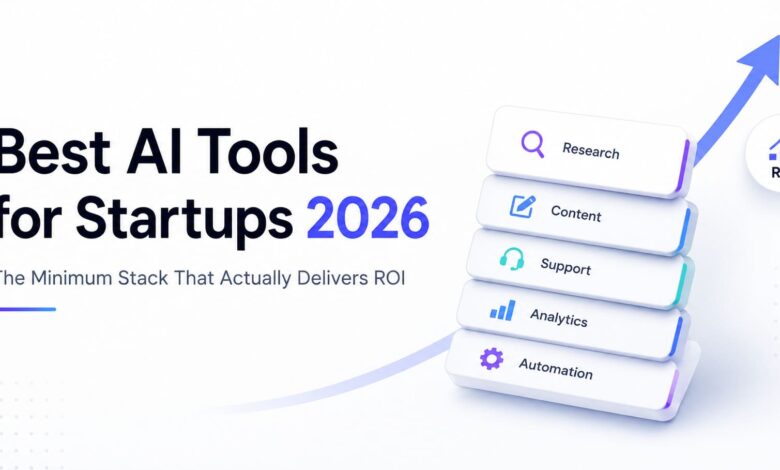
The best AI tools for startups 2026 are not the tools with the loudest demos. They are the tools that remove repeatable work from a specific workflow and prove their value within two weeks. That distinction matters because most AI adoption still fails to reach the P&L. MIT NANDA’s 2025 GenAI Divide report found that only 5% of integrated AI pilots were extracting millions in value, while 95% showed no measurable financial impact.
For startups, the lesson is direct: do not build a giant AI stack. Build a minimum viable AI stack, measure time saved, and cancel anything that does not improve output within two weeks. The winners in 2026 are not the startups with the longest AI subscription list. They are the teams that use one tool per workflow, measure results, and compound the efficiency gains into faster product cycles and lower operational costs.
Core Significance
Why it matters:
- 95% of AI Pilots Show No Measurable P&L Impact: MIT NANDA’s GenAI Divide report is the most important data point in the AI tools conversation that most vendor marketing ignores. Only 5% of integrated AI pilots are extracting real financial value. The other 95% are generating activity without generating returns. For startups where every dollar of burn and every hour of founder time matters, that failure rate is not acceptable. The solution is not better tools. It is better implementation discipline.[MIT NANDA GenADivide 2025 via Fullview]
- Companies Are Doubling AI Spend Regardless of Returns: BCG’s 2026 AI Radar shows companies plan to spend 1.7% of revenue on AI in 2026, more than double the 0.8% in 2025. And 94% of organisations plan to continue AI investment even if it does not deliver returns this year. Startups are spending into the same trap with smaller budgets and less margin for error. The tools market is growing faster than the ability to extract value from it.[BCG — AI Investments Surge CEOs Take Lead 2026]
- The Right Stack Returns $3.70 Per Dollar Invested: When AI tools are implemented correctly — with a defined outcome, a measurement framework, and sequential adoption — the return is real. Enterprise benchmarks show $3.70 returned per $1 invested in AI. The gap between the 5% achieving that return and the 95% achieving nothing is not about which tools they bought. It is about whether they defined success before the first subscription was purchased.[Fullview.io — AI Statistics 2025]
Deep Context: Why the AI Tools Market Is Broken for Startups
The AI tools market in 2026 has a structural problem that affects startups more severely than large enterprises. Large organisations have dedicated IT teams, change management budgets, and the organisational patience to absorb 60 to 90 day implementation timelines before a tool delivers value. Startups have none of those resources.
Every AI tool vendor in 2026 shows the same category of marketing claim: customers save X hours per week, productivity increases by Y%, revenue grows by Z%. Those numbers are drawn from the top quartile of implementations at companies with dedicated implementation support. They are not the median outcome.
As covered in our Enterprise AI ROI analysis, the companies that succeed with AI tools share one characteristic before anything else: they define a specific measurable outcome before subscribing. Not ‘improve productivity.’ Not ‘save time.’ A specific number. A specific workflow. A named person accountable for measuring it.
The minimum viable AI stack concept is the antidote to the budget trap. Rather than buying every tool a competitor mentions, a startup identifies the three to five functions consuming the most team time, finds one tool per function with the shortest path to measurable value, and implements them sequentially rather than simultaneously. One tool. Two weeks. Measure. Then add the next.
Data Insights
By the numbers:
All data points sourced to primary reports.
- 5%: Share of integrated AI pilots extracting millions in measurable value, per MIT NANDA’s 2025 GenAI Divide report. The other 95% show no measurable P&L impact.[MIT NANDA via Fullview — AI Statistics]
- 1.7%: Share of revenue companies plan to spend on AI in 2026, more than double the 0.8% in 2025, per BCG’s 2026 AI Radar.[BCG — AI Investments Surge 2026]
- 94%: Share of organisations planning to continue AI investment in 2026 even if it does not deliver measurable returns, per BCG.[BCG — AI Investments Surge 2026]
- 68%: Share of AI-using employees in the UK and North America saving 4 hours or less per week from AI tools, per the January 2026 Section AI Proficiency Report of 5,000 knowledge workers.[EMARKETER — Section AI Proficiency Report Jan 2026]
- 55.8%: Faster task completion rate for developers using GitHub Copilot in a controlled experiment, per the peer-reviewed arXiv study on Copilot productivity impact. Note: newer research shows AI coding gains can shift work into review and maintenance — measure code quality alongside speed.[arXiv — GitHub Copilot Productivity Study]
- $3.70: Return per $1 invested in AI when implemented with clear outcomes, measurement frameworks, and sequential adoption discipline, per enterprise benchmarks across 2024 to 2025 deployments.[Fullview.io — AI ROI Statistics]
- 42%: Share of companies that abandoned most AI initiatives in 2025, up from 17% in 2024, per S&P Global research.Unosquare — AI Implementation Mistakes 2026]
- 80%: AI project failure rate in 2026, double the failure rate of traditional IT initiatives, per Unosquare’s analysis.Unosquare — AI Implementation Mistakes 2026]
Table 1: The Minimum Viable AI Stack for Startups: Corrected Pricing June 2026
| Pricing noteAll prices verified from official vendor pricing pages as of June 2026. Prices are billed monthly unless noted. Annual billing reduces most tools by 20-40%. |
| Function | Tool | Monthly Cost | Time Saved/Wk | ROI Timeline | Best For |
| Writing | Claude Pro or ChatGPT Plus | $20 | 5-8 hrs | Week 1 | All startups |
| Coding | GitHub Copilot Pro (individual) | $10/dev | 4-6 hrs | Week 2 | Solo devs |
| Coding (teams) | GitHub Copilot Business | $19/user/mo | 4-6 hrs | Week 2 | Dev teams |
| Coding (advanced) | Cursor or Windsurf | $20/mo | 5-8 hrs | Week 2 | Heavy codebase work |
| Meeting notes | Fireflies Pro | $10/seat/mo (annual) | 3-4 hrs | Week 1 | Meeting-heavy teams |
| Meeting notes | Otter.ai Pro | $8.49/user/mo (annual) | 3-4 hrs | Week 1 | Smaller teams |
| Automation | Zapier Professional | $19.99/mo (annual) | 4-8 hrs | Week 3-4 | Ops-heavy teams |
| Research | Perplexity Pro | $20/mo | 2-4 hrs | Week 1 | Market/competitor research |
| Design | Canva AI | $15/mo | 2-3 hrs | Week 1 | Marketing teams |
| CRM/Sales | HubSpot free tier | Free | 3-5 hrs | Month 1 | Early B2B startups |
| Customer support | Intercom Fin or Tidio AI | $39-$49/mo | 4-6 hrs | Month 1-2 | Post product-market fit |
Table 2: AI Tools That Waste Startup Budgets: The Common Traps
| Category | The Trap | Why It Wastes Budget | Better Alternative |
| Enterprise writing suites | Jasper, Copy.ai at scale pricing | ChatGPT or Claude at $20/mo does 90% of the same work | Claude Pro or ChatGPT Plus |
| Multiple AI assistants | ChatGPT + Claude + Gemini simultaneously | 3x cost for overlapping capabilities | Pick one, use it deeply for 30 days |
| Multiple scheduling AIs | Motion + Reclaim + Clockwise | Three tools create three sources of calendar conflict | One tool, two weeks, measure then decide |
| Custom AI model builds | Building bespoke models pre-product-market fit | Months of engineering cost before PMF validation | Use APIs until data justifies custom build |
| AI video generators at early stage | Impressive demos, slow production ROI | Learning curve exceeds time saved for most teams | Loom for async video, Canva AI for static |
| Customer support AI too early | Intercom Fin before meaningful ticket volume | $49+/mo with no volume to automate | HubSpot free tier first, upgrade when volume justifies |
The tables frame the best AI tools for startups 2026 decision. The minimum viable stack costs under $100 per month for most teams and delivers 15 to 25 hours of recovered time weekly when implemented sequentially.
The Business Case: Three Tools With the Clearest ROI Evidence
The tools with the most consistently documented ROI for startups share one characteristic: they integrate directly into existing workflows without requiring process redesign. They also deliver measurable value within the first week of use.
GitHub Copilot: The Most Peer-Reviewed ROI in AI
For any startup with a technical team, GitHub Copilot delivers the most independently validated ROI of any AI tool available. As the peer-reviewed arXiv study on Copilot confirmed, developers completed a controlled coding task 55.8% faster with Copilot active. That is not a marketing claim. It is a controlled experiment with a clear methodology.
The individual Pro plan at $10 per month makes the payback period trivially short. A developer saving even two hours per week at a loaded cost of $50 per hour generates $400 per month in recovered time for $10 of subscription cost. However, a newer arXiv study flagged an important caveat: AI coding assistance can shift work into review and maintenance rather than eliminating it. Startups should track code review time alongside coding speed to ensure the net effect is positive.
For teams working on complex codebases rather than greenfield code, Cursor and Windsurf are increasingly preferred alternatives. Both are AI-native IDEs rather than plugins, which means they have deeper codebase context and produce more coherent output across large files. The right choice depends on workflow: Copilot for existing GitHub and VS Code environments, Cursor or Windsurf for teams doing heavy codebase-level work.
Zapier: The Automation Foundation Every Startup Needs First
Before any startup needs a custom AI agent or a bespoke workflow, it needs Zapier. The automation platform’s AI features allow teams to describe workflows in natural language and have them built automatically. As Zapier’s pricing page confirms, the free tier supports 100 tasks per month. The Professional plan starts at $19.99 per month billed annually. The critical warning for startups: automation-heavy teams can outgrow the entry tier quickly and face significant cost jumps as task volume scales.
The correct implementation approach is to start with one workflow, measure the tasks per month it generates, and project the cost at scale before automating a second workflow. A startup that builds 20 Zapier automations without understanding its task consumption rate will face an unexpected billing increase the month their volume spikes. Build one, measure, then build the next.
Perplexity Pro: The Research Tool Most Startup Lists Miss
Most AI tools roundups focus on writing and coding. They consistently underweight research, which consumes significant founder time in fundraising, market analysis, competitive intelligence, and customer discovery. Perplexity Pro at $20 per month provides source-grounded research results that reduce the time required for a competitive analysis from hours to minutes.
The key distinction from ChatGPT or Claude for research is source grounding. Perplexity pulls from live web sources and cites them inline. For a founder writing an investor update, doing market sizing research, or preparing for a customer call, cited sources are more valuable than fluent text without attribution. The tool does not replace deep research. It eliminates the first two hours of surface research that precedes every deeper analysis.
Between the lines:
The most dangerous AI tools for startups are not the bad ones. The bad ones get cancelled after a trial month. The most dangerous tools are the ones that demonstrate value convincingly in a demo but require six weeks of configuration before delivering that value in production. Notion AI is the clearest example of this pattern. It is genuinely useful, but only if the startup already runs documentation, SOPs, meeting notes, and product planning inside Notion. If the team is not already using Notion, switching the knowledge base just to access Notion AI creates more friction than value. The tool is conditional. Use it if Notion is already your knowledge base. Do not adopt Notion to access Notion AI.
How to Calculate AI Tool ROI Before Buying
The simplest and most overlooked step in AI tool evaluation is the ROI calculation before purchase. Most startups skip this step entirely and make subscription decisions based on demo quality. The calculation takes two minutes.
The formula: Monthly ROI = (Hours saved per month × Hourly cost of the person using it) minus Monthly tool cost
Example 1 — Positive ROI: A founder saves 10 hours per month using a $20 AI writing tool. The founder values their time at $50 per hour. The tool creates $500 of recovered time for $20 of subscription cost. Monthly ROI: $480. Keep it.
Example 2 — Negative ROI: A $99 per month AI analytics tool saves one hour per month for one team member at $40 per hour. The tool generates $40 of recovered time for $99 of cost. Monthly ROI: -$59. Cancel it.
Example 3 — Hidden Cost: A free tier automation tool requires three hours of setup time at $50 per hour. The tool saves one hour per week over 12 weeks before the free tier limits are hit and an upgrade is required. Total value: $600. Total cost: $150 setup + $240 annual upgrade = $390. ROI: $210. Worth it, but only if the upgrade cost was budgeted from the start.
Apply this formula to every tool in the stack quarterly. The tools surviving four quarters of this evaluation have genuinely earned their place in the stack.
Regional Spotlight: The Pakistani Freelancer AI Stack
For Pakistani freelancers and early-stage startups, the best AI tools question has an additional dimension that most global tool comparisons ignore: the payment barrier and the free tier strategy.
The Opportunity:
Pakistan is one of the world’s largest freelance developer markets. As covered in our Pakistan AI economy analysis, the income premium for AI-augmented developers over non-AI developers is measurable and growing. The key point is that the free tier floor for every major AI tool has risen significantly in 2026. Google’s Gemini 1.5 Flash is free at substantial usage limits. GitHub Copilot offers a free tier with 2,000 code completions and 50 chat messages per month. HubSpot’s CRM is permanently free. Otter.ai’s free plan includes 300 monthly transcription minutes.
A Pakistani freelancer can build a productive AI stack at zero direct cost using free tiers alone and upgrade selectively as income from the productivity gains justifies the subscription. The income premium more than covers the subscription costs once earned.
The Payment Access Reality:
For Pakistani freelancers, the AI stack decision is also a payments decision. Many global AI tools bill through international payment cards, while JazzCash and Easypaisa are rarely accepted directly. The practical starting point is therefore free tiers first, followed by selective upgrades through internationally accepted payment options where available. Payment access methods vary by account type, card eligibility, and vendor acceptance policies, and change over time. Verify current acceptance before planning upgrades.
Expert Nuance: The One-Tool-Per-Function Rule
The single most valuable implementation principle for startups evaluating AI tools is one that almost no vendor will highlight because it limits their upsell potential: implement one tool per function and wait two weeks before adding another.
A tool only delivers value when a team member uses it consistently enough to build the habit. Building a habit requires two to three weeks of repetition. A team that subscribes to five tools simultaneously and tries to build five habits at once will build none of them. The cognitive overhead of learning multiple interfaces simultaneously means none of the tools get the adoption depth required to deliver documented benefits.
The minimum ROI threshold is 30 minutes of saved time per week per user. Tools saving less than that rarely justify the subscription cost or the habit change required. If you spend more time editing AI output than writing from scratch, the tool is a net negative regardless of its marketing claims. The quality test is as important as the time test. Apply both for two weeks before deciding.
The category priority for most startups is: writing first, because it delivers value on day one with no configuration. Then coding if the team is technical. Then meeting notes. Then automation. Then research. Customer support AI should be the last tool adopted, not the first, because it requires ticket volume to justify the cost and training data to work effectively. Buying customer support AI before product-market fit is one of the clearest ways to waste startup AI budget.
Strategic Outlook: What’s Next
Three developments will define the best AI tools for startups 2026 landscape over the next 12 months.
- The Free Tier Floor Is Rising Permanently: Google, Anthropic, and OpenAI are all expanding their free tiers in 2026 as the primary mechanism for driving developer adoption and ecosystem lock-in. The competitive dynamic between the three largest AI providers directly benefits startups. What cost $20 per month in 2024 is increasingly available free in 2026. What cost $100 per month in 2024 is increasingly available at $20. Startups that delayed AI adoption because of budget constraints now have access to capabilities that enterprise clients paid thousands per year for two years ago.
- Usage-Based Billing Changes the Cost Structure: GitHub Copilot is moving to usage-based billing, per the company’s own announcement. That shift, from flat seat pricing to per-use pricing, will be replicated across AI tool categories in 2026 and 2027. Usage-based billing is better for low-volume users and worse for high-volume users. Startups benefit in early stages and need to model their usage trajectory before committing to annual contracts on usage-based tools.
- The AI-Native Advantage Compounds: The gap between startups that build AI into their core processes from day one and startups that add AI tools to legacy workflows will widen through 2026 and 2027. The startups starting new ventures today have a choice that the companies that existed before 2023 did not: build every workflow AI-native from the first day. Customer support AI-native. Writing AI-native. Research AI-native. Sales outreach AI-native. The startups making that architectural choice today will have 24 months of compounding efficiency advantage over competitors that retrofit AI into existing workflows in 2027 and 2028.
Key Question Answered
What are the best AI tools for startups in 2026 and which ones actually deliver ROI?
The best AI tools for startups 2026 that consistently deliver measurable ROI are: Claude Pro or ChatGPT Plus ($20/month, 5-8 hours saved weekly on writing), GitHub Copilot Pro ($10/month per individual developer, 55.8% faster coding in controlled experiments), Fireflies Pro ($10/seat/month annually for meeting notes), Zapier Professional ($19.99/month annually for workflow automation), Perplexity Pro ($20/month for source-grounded research), and HubSpot’s free CRM tier for B2B sales.
Per MIT NANDA’s 2025 GenAI Divide report, only 5% of integrated AI pilots extract measurable financial value. The common pattern among successful implementations is: define a specific measurable outcome before subscribing, implement one tool per function sequentially, apply the 30-minute per week minimum ROI threshold, and measure using the formula (hours saved × hourly rate) minus tool cost. Customer support AI should be the final tool adopted, not the first, as it requires ticket volume and training data to deliver value.
The Takeaway
The best AI tools for startups in 2026 are not the ones with the most impressive demos. They are not the ones your investors mention in board meetings. They are the tools that deliver 30 minutes of recovered time per day, per team member, within the first week of use, without requiring a project to implement.
GitHub Copilot Pro, a writing AI, a meeting notes tool, Zapier, and Perplexity will collectively save most startup teams 15 to 25 hours per week at a combined cost of under $90 per month for a team of three. That stack is not exciting. It will not generate a press release. What it will do is give a five-person startup the operational capacity of an eight-person team without adding headcount.
The 5% of startups and companies achieving real AI ROI are not using more tools than the 95% seeing no measurable impact. They are using fewer tools, with more discipline, in workflows where success was defined before the subscription was purchased. That discipline is not a technical capability. It is a decision made before the first credit card is entered.