The Pulse
One week ago Anthropic was the challenger. Today it is filing for an IPO at a $965 billion valuation, ahead of OpenAI on revenue run rate, and leading OpenAI in enterprise business adoption for the first time. The Ramp AI Index, which tracks actual corporate card spending across 50,000 companies rather than surveys, placed Anthropic at 34.4% business adoption share versus OpenAI’s 32.3% in April 2026.
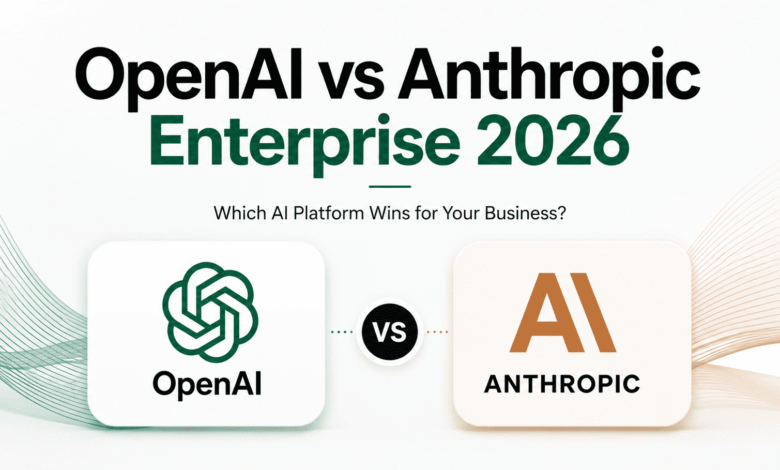
That is a number that would have been dismissed as implausible twelve months ago. The OpenAI vs Anthropic 2026 enterprise question has a more complicated answer than either company’s marketing suggests. OpenAI has 900 million weekly active users, the world’s most recognised AI brand, and the deepest integration ecosystem. Anthropic has 70% of the Fortune 100 as Claude customers, eight of the Fortune 10, and a revenue growth trajectory that has no comparable precedent in enterprise software. The right platform for your business depends entirely on what your business actually needs.
Core Significance
Why it matters:
- The Market Has Shifted Since You Last Checked: Anthropic’s enterprise penetration jumped from 18% in 2024 to 44% in early 2026, the largest single-year enterprise adoption shift of any AI provider in that period. Deloitte opened Claude access to 350,000 associates. Cognizant deployed Claude across 350,000 staff. Accenture trained 30,000 professionals under the Claude Partner Network. These are not pilots. They are infrastructure commitments.
- The Platforms Have Fundamentally Different Philosophies: By 2026, the clearest framing is: OpenAI is a consumer company making enterprise products. Anthropic is an enterprise company that has a consumer product. That philosophical difference shows up in product architecture, pricing structure, safety approach, partnership strategy, and the customer profiles each platform attracts.
- The IPO Context Changes the Procurement Calculus: Anthropic filed its confidential S-1 on June 1, 2026. OpenAI is targeting a Q4 2026 filing. For enterprise procurement teams signing multi-year contracts, public market accountability introduces different incentive structures than private market growth-at-all-costs. As covered in our Anthropic IPO analysis, both companies will be public by end of 2026. Contract structuring should reflect that.
Deep Context: Two Companies, Two Different Bets
OpenAI and Anthropic were both founded by people who believed AI would be the most consequential technology in human history. They disagreed about how to build it responsibly and commercially, and that disagreement is visible in everything both companies have built since.
OpenAI bet on distribution first. ChatGPT reaching 100 million users in two months in early 2023 was not accidental. The Microsoft partnership, which gave OpenAI Azure infrastructure and distributed ChatGPT through Copilot across every Office product, compounded that distribution advantage. By 2026, OpenAI has 900 million weekly active ChatGPT users, 600,000 business customers, and integration with more third-party tools than any competitor.
Anthropic bet on enterprise trust first. Constitutional AI, the training methodology that embeds ethical principles directly into model behaviour, was a commercial positioning strategy as much as a safety research project. The pitch to enterprise buyers: Claude is the model you can deploy in a bank, a hospital, or a government agency without the reputational and regulatory risk that less safety-focused models carry.
As Orbilontech’s enterprise decision framework noted, the trust dimension had a specific inflection point in early 2026. When OpenAI signed a partnership with the US Department of War, ChatGPT uninstalls surged 295% and one-star reviews grew 775%. Anthropic publicly committed against mass domestic surveillance and fully autonomous weaponry. Claude briefly overtook ChatGPT as the number one AI app on the US App Store. In highly regulated industries this distinction matters significantly in procurement conversations.
Data Insights
By the numbers:
All data points sourced to primary reports. Ramp data covers US mid-market and growth-stage companies. Have look at it:
- 34.4% vs 32.3%: Anthropic versus OpenAI business adoption share as of April 2026, per the Ramp AI Index tracking actual corporate card spending across 50,000+ US companies. First time Anthropic has led. Note: Ramp data covers mid-market and growth-stage US companies and may not represent all large enterprise deals or international markets. OpenAI still leads on total revenue.[Ramp AI Index — May 2026 Official]
- 70%: Share of Fortune 100 companies using Claude, with 8 of the Fortune 10 as active customers and over 500 companies spending more than $1 million annually on Anthropic.[AI Consulting Network — Claude Enterprise]
- 600,000: OpenAI business customers versus Anthropic’s 300,000+. OpenAI leads on breadth. Anthropic leads on enterprise depth and revenue per customer.[TechCrunch — Ramp Anthropic OpenAI May 2026]
- 1 Million Tokens: Claude Opus 4.7’s context window as standard. GPT-5.5 also now offers 1 million tokens as of April 2026 — closing the gap that previously gave Claude a structural advantage. Both platforms now match on raw context length.[Tech Insider — Anthropic vs OpenAI tested 2026]
- $45-75/seat/month: ChatGPT Enterprise price range based on buyer disclosures and procurement data. Enterprise pricing is custom and negotiated with a 150-user minimum. The widely cited $60 midpoint is an industry estimate, not a published rate. ChatGPT Business (team plan) dropped to $20/seat/month annual on April 2, 2026.[Inference.net — ChatGPT Enterprise Pricing 2026]
- ~$30/seat/month: Claude Enterprise starting price, with custom pricing at larger volumes. At 1,000 users the annual cost difference versus ChatGPT Enterprise midpoint is approximately $360,000.
- 295%: Surge in ChatGPT uninstalls following OpenAI’s US Department of War partnership announcement in early 2026, per app store data. Anthropic’s safety positioning drove Claude to briefly overtake ChatGPT as the top AI app on the US App Store.[Spicy Advisory — Claude vs ChatGPT 2026]
- 350,000: Employees at both Deloitte and Cognizant with Claude access, representing the two largest single enterprise AI deployments by staff count in 2026.[Felloai — Anthropic vs OpenAI 2026]
Table 1: OpenAI vs Anthropic Enterprise 2026: Direct Comparison
| Pricing noteChatGPT Enterprise is custom-priced. The $45-75/seat range reflects buyer disclosures. ChatGPT Business (team plan) is $20/seat/month annual. Claude Enterprise starts at ~$30/seat/month custom at scale. |
| Metric | OpenAI / ChatGPT Enterprise | Anthropic / Claude Enterprise |
| Enterprise Pricing | $45-75/seat/month (custom, 150-user min) | ~$30/seat/month (custom at scale) |
| Business Customers | 600,000+ | 300,000+ |
| Fortune 100 Penetration | Strong, broad deployment | 70% Fortune 100, 8 of Fortune 10 |
| Context Window | 1M tokens (GPT-5.5, April 2026) | 1M tokens (Claude Opus 4.7, standard) |
| Multimodal Capability | Text, image, audio, video (GPT-5.5) | Text and image (no audio/video) |
| Integration Ecosystem | Broadest, Microsoft 365, Zapier, 1,000s of tools | Growing, AWS, Google Cloud, Microsoft Foundry |
| Data Privacy | Enterprise tier only (no training on data) | From $20/month Pro tier (no training on data) |
| Safety Positioning | Consumer-first, defense partnerships | Enterprise-first, no autonomous weapons commitment |
| IPO Status | Targeting Q4 2026 confidential filing | Confidential S-1 filed June 1, 2026 |
| Revenue Run Rate | ~$24-25B ARR (April 2026) | ~$45-47B ARR (May 2026) |
Table 2: Which Platform Wins by Use Case
| Use Case | OpenAI Wins | Anthropic Wins |
| Legal document analysis | Competitive | Claude: fewer hallucinated citations, 1M context |
| Software engineering | GPT-5.3-Codex, speed and breadth | Claude Code — $2.5B ARR, 80.8% SWE-bench |
| Customer-facing chatbot | ChatGPT: 900M users, consumer familiarity | Competitive |
| Microsoft 365 workflows | ChatGPT: native Copilot integration | Via Microsoft Foundry (Jan 2026) |
| Compliance-sensitive industries | Good | Claude: Constitutional AI, Microsoft subprocessor |
| Image and video generation | ChatGPT: DALL-E, Sora | Not available |
| Healthcare and government | Competitive | Claude: safety positioning resonates with procurement |
| Content creation and writing | Strong | Claude: rated higher for precision and instruction-following |
| Cost at 1,000 users annually | ~$540K-$900K (at $45-75 midpoint) | ~$360K (at $30/seat) |
The tables frame the OpenAI vs Anthropic 2026 decision. Context windows are now matched. The differentiation is ecosystem breadth versus enterprise trust positioning and cost structure.
The Business Case: Where Each Platform Genuinely Wins
OpenAI’s breadth advantage and Anthropic’s depth advantage are both genuine and not converging as fast as either company’s critics suggest. The decision depends on which advantage matters more for your specific organisation.
OpenAI: The Ecosystem Advantage Is Real
900 million weekly active ChatGPT users means your employees already know the interface. Integration with Microsoft 365 through Copilot means ChatGPT is embedded in the tools your organisation already pays for. The plugin ecosystem covering Zapier, Slack, HubSpot, Salesforce, and thousands of other tools means OpenAI has a longer integration runway than any competitor.
For enterprises with significant Microsoft infrastructure investment, the decision is often already made. ChatGPT Enterprise integrated with Azure, operating within Microsoft’s security and compliance framework, is the path of least IT resistance. As Mobikasa’s enterprise comparison confirmed, for organisations that need AI across creative workflows, image generation, voice interaction, and video synthesis simultaneously, OpenAI’s multimodal capability has no current equivalent from Anthropic.
Anthropic: The Enterprise Depth Advantage Is Compounding
Claude becoming an official Microsoft subprocessor in January 2026 removed the primary compliance objection that had previously steered regulated industries toward ChatGPT Enterprise. Operating within Microsoft 365’s security and compliance framework, combined with Constitutional AI’s transparent safety methodology, gives compliance teams in financial services, healthcare, and government a cleaner procurement story than any previous Anthropic position.
The Claude Partner Network launched in March 2026 with $100 million in committed investment and Accenture, Deloitte, Cognizant, and Infosys as anchor partners. As DataCamp’s Anthropic vs OpenAI analysis noted, Anthropic’s enterprise penetration sits at 44% in early 2026, up 25 percentage points since May 2025, the largest gain of any AI provider in that period. A company deploying Claude at 350,000-person scale through Deloitte has access to implementation expertise that makes large-scale deployments lower-risk than they were 18 months ago.
The Hidden Cost Nobody Calculates
The most underappreciated line item in the OpenAI versus Anthropic decision is the cost of running both simultaneously. A typical mid-market company running ChatGPT Enterprise and Claude Enterprise at 500 employees pays a significant premium in licence fees plus duplicated workflow overhead as teams split between platforms. Every internal process requiring AI assistance needs two integrations, two sets of prompts optimised for two different models, and two compliance reviews.
The right enterprise decision is usually not both. It is choosing the platform that serves 80% of your use cases and accepting the gaps, rather than paying twice to cover edge cases that individually occur less than monthly. The pricing difference, approximately $360,000 per year per 1,000 users at midpoint estimates, compounds at enterprise scale into a budget line that procurement teams will increasingly scrutinise at annual reviews.
Between the lines:
The context window parity achieved in April 2026 when GPT-5.5 matched Claude’s 1 million token standard removes what had been Anthropic’s clearest technical differentiator in legal and financial services. Both platforms now handle 500-page documents in a single request. The next battleground is inference speed, multimodal breadth, and agentic workflow reliability. OpenAI leads on multimodal. Anthropic leads on agentic coding through Claude Code. Those two dimensions will drive the next wave of enterprise switching decisions through late 2026 and into 2027.
The Three-Way Race Nobody Is Talking About
Every OpenAI versus Anthropic comparison in 2026 treats the market as a two-horse race. It is not. Google’s Gemini is the third competitor that both companies are actively managing around, and it has structural advantages that neither OpenAI nor Anthropic can easily replicate.
Google supplies the compute infrastructure that Anthropic runs on through a multi-billion dollar TPU deal. Google is simultaneously Anthropic’s largest external investor. And Google ships Gemini, which competes directly with Claude across every enterprise use case. As covered in our Google I/O 2026 analysis, Gemini’s integration into Google Workspace already reaches hundreds of millions of enterprise users at zero incremental cost. That three-way relationship creates a conflict of interest that no enterprise buyer has fully priced into their vendor risk assessment.
For OpenAI, the equivalent structural relationship is Microsoft. Azure is the exclusive cloud for OpenAI’s API calls. Microsoft has committed $250 billion in Azure services over the term of the agreement. Microsoft also ships Copilot, which bundles GPT models into tools that compete with standalone ChatGPT Enterprise deployments. As CNBC confirmed from Microsoft’s Q3 2026 earnings, Microsoft’s AI business is running at a $37 billion annual revenue run rate, meaning Microsoft has powerful financial incentives to shape how OpenAI’s products compete with its own Copilot suite. OpenAI and Microsoft are simultaneously partners, customers, and competitors in the enterprise market.
The practical implication for enterprise buyers is straightforward. Neither Anthropic nor OpenAI is a fully independent vendor. Both have strategic dependencies that will shape their product roadmaps, their pricing decisions, and their long-term availability in ways that their current marketing does not reflect. Enterprise contracts signed in 2026 will be renewed in 2028 inside a market where Google and Microsoft’s influence over both companies may be significantly more visible than it is today. As covered in our Anthropic IPO analysis, Anthropic’s S-1 filing will make its Google and Amazon compute dependencies fully public for the first time, giving enterprise procurement teams data they currently cannot access.
Expert Nuance: The Decision Framework Enterprise Buyers Actually Need
Most OpenAI versus Anthropic comparisons produce a verdict. This one will not, because the verdict depends entirely on three questions only your organisation can answer.
Question 1: What does your primary use case require?
If the answer involves compliance-sensitive industries, extended coding sessions, or processing large documents end to end, Claude’s safety positioning and context handling give it a structural advantage even now that context windows are matched. If the answer involves multimodal workflows, consumer-facing AI, or deep Microsoft 365 integration, ChatGPT’s ecosystem breadth is more important than Claude’s positioning advantages.
Question 2: What is your Microsoft infrastructure dependency?
If your organisation runs substantially on Microsoft 365, Azure, and Teams, ChatGPT’s native Copilot integration reduces total cost of ownership in ways that justify the higher per-seat cost at large scales. If your organisation uses Google Workspace or is cloud-agnostic, Claude’s availability on AWS Bedrock, Google Cloud Vertex AI, and Microsoft Foundry makes platform lock-in less relevant.
Question 3: How does your procurement team handle AI vendor trust?
OpenAI’s defense partnerships are a factor for organisations in healthcare, civil society, international development, or any sector where AI ethics positions are visible to customers or regulators. Anthropic’s public commitment against autonomous weaponry and mass surveillance is a procurement advantage in those contexts. It is irrelevant in others. Run both on your actual workflows for two weeks and measure output quality on the tasks that consume the most team time. Then decide on data.
Strategic Outlook: What’s Next for Both Platforms
- The IPO Effect on Both Platforms: Both Anthropic and OpenAI will be public companies by end of 2026. Public market accountability changes product and pricing dynamics in specific ways. Revenue growth prioritisation may lead to pricing increases. Quarterly earnings pressure may accelerate product shipping beyond what is stable. Enterprise buyers signing multi-year contracts with either company in 2026 should include price protection clauses and exit provisions they might not have negotiated with private companies in 2024 and 2025.
- The Agentic AI Battleground: With context windows now matched, the next capability differentiation battleground is agentic workflow reliability. OpenAI currently leads on multimodal capability. Anthropic leads on agentic coding through Claude Code at $2.5 billion ARR. As covered in our Agentic AI Enterprise analysis, the enterprises that embed agentic AI workflows in 2026 will have compounding efficiency advantages over those that wait. The platform you build those workflows on now has structural switching costs.
- The Google Dimension: Anthropic runs on Google’s TPU infrastructure through a multi-billion dollar compute deal. Google is simultaneously Anthropic’s infrastructure provider, its largest external investor, and the company behind Gemini, which competes directly with Claude. Enterprise buyers who care about vendor concentration risk should understand this dependency before signing long-term Claude contracts, particularly as Anthropic’s IPO prospectus will make these financial relationships fully public for the first time.
Key Question Answered
Which is better for enterprise in 2026: OpenAI or Anthropic?
The OpenAI vs Anthropic 2026 enterprise question does not have a universal answer. For compliance-sensitive industries including legal, financial services, healthcare, and government, Claude is the stronger choice: Constitutional AI safety framework, Microsoft subprocessor status since January 2026, competitive pricing at approximately $30 per user per month versus $45 to $75 for ChatGPT Enterprise, and 70% of Fortune 100 companies already using it. For organisations with heavy Microsoft 365 infrastructure, multimodal workflow requirements, or consumer-facing AI needs, ChatGPT’s deeper Copilot integration, broader plugin ecosystem, and image/audio/video capabilities make it more versatile.
The Ramp AI Index placed Anthropic at 34.4% business adoption share versus OpenAI’s 32.3% in April 2026, the first time Anthropic has led, tracking actual corporate card spending across 50,000 US companies. OpenAI has 600,000 total business customers versus Anthropic’s 300,000, but Anthropic’s revenue run rate of $45 billion exceeds OpenAI’s $24 billion, confirming that Anthropic’s enterprise customers spend significantly more per account. Both platforms now offer 1 million token context windows. The primary differentiators in H2 2026 will be multimodal breadth, agentic workflow capability, and IPO-driven pricing changes.
The Takeaway
OpenAI and Anthropic are not the same product at different price points. They are two different bets on what enterprise AI should be. OpenAI bet on consumer breadth and distribution first. Anthropic bet on enterprise trust first. Both bets are paying off. The market is large enough for both to succeed simultaneously.
The decision for your organisation is not which company will win the AI race. It is which platform serves your specific workflows, fits your existing infrastructure, and aligns with your procurement team’s trust requirements. The pricing difference is real and should be calculated at your actual headcount. The safety positioning difference matters in some industries and is noise in others. The IPO timelines mean both companies will face public market scrutiny before your next annual renewal.
Run both on your actual workflows for two weeks. Measure the output quality difference on the tasks that consume the most team time. Then make the decision on data rather than on which IPO gets more coverage this autumn.