The Pulse
20% of global organisations suffered a data breach last year from shadow AI incidents, according to IBM’s Cost of a Data Breach Report. The average shadow AI breach costs $4.74 million, compared to the $4.07 million average for standard enterprise breaches. 34.8% of what employees type into ChatGPT and similar tools is sensitive data, up from 11% in 2023. And 97% of AI-related breaches occur in organisations that lack proper AI access controls.
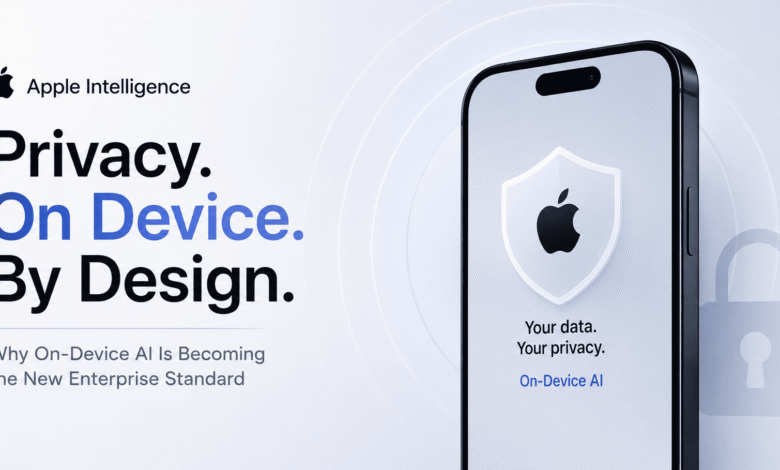
Those numbers explain why Apple Intelligence enterprise privacy has moved from a consumer marketing story to a board-level technology architecture conversation in 2026. Apple’s Private Cloud Compute model, announced at WWDC 2024 and being significantly expanded at WWDC Monday June 8, represents a fundamentally different approach to AI data handling than the cloud-first models used by Microsoft Copilot, Google Gemini, and most enterprise AI platforms. When the EU AI Act’s full enforcement lands in August 2026, that architectural difference will have direct compliance implications for every enterprise running AI on employee devices.
Core Significance
Why it matters:
- Shadow AI Is Already Costing Enterprises Millions: IBM’s 2025 Cost of Data Breach Report found that shadow AI incidents added roughly $670,000 to the average breach cost, pushing affected organisations to $4.74 million per incident. Shadow AI refers to employees using unapproved AI tools without IT oversight, sharing sensitive data with platforms that have not been through enterprise security review. Samsung banned external AI tools company-wide after employees accidentally uploaded proprietary source code and meeting notes to ChatGPT. That incident is now a standard case study in enterprise AI security training.[Index.dev — Enterprise AI Security Risk Statistics 2026]
- On-Device AI Changes the Data Architecture Entirely: The core problem with cloud-based AI from an enterprise security perspective is that data must leave the device to be processed. Even with enterprise agreements that prohibit training on your data, the data still traverses external systems. On-device AI processing eliminates that exposure entirely for the tasks it can handle. Apple’s Private Cloud Compute handles what the device cannot locally, on Apple-controlled hardware with verified privacy architecture that even Apple cannot access.[Apple Security Research Blog — Private Cloud Compute]
- EU AI Act Full Enforcement Is August 2026: The EU AI Act’s mandatory requirements for AI risk management, documentation, and transparency become fully enforceable in August 2026. Enterprises running AI tools across European operations will need demonstrable evidence of data handling controls. Apple’s verifiable transparency model, which publishes cryptographically signed binaries for independent security researcher audit, provides a compliance documentation approach that most cloud AI vendors cannot match. For enterprises with European operations, this architectural difference has direct legal relevance in less than 60 days.
Deep Context: How Enterprise AI Privacy Became a Board-Level Concern
The enterprise AI privacy conversation shifted fundamentally between 2023 and 2026. In 2023, most enterprise AI procurement discussions focused on capability: which platform writes the best emails, summarises documents most accurately, or produces the most useful code. Privacy was a secondary concern addressed by checking a compliance box in the vendor evaluation form.
Three developments changed that calculus. First, the shadow AI breach data became concrete and expensive. IBM’s research documenting the $670,000 premium breach cost for shadow AI incidents gave CISOs a number to bring to the CFO. Second, the Samsung incident and similar cases demonstrated that employee AI use creates real data exposure regardless of enterprise agreements with vendors. Employees do not read data handling policies before pasting meeting notes into ChatGPT. Third, the EU AI Act’s August 2026 enforcement deadline converted a theoretical regulatory risk into an operational reality with specific documentation requirements.
As SimpleMDM’s enterprise security analysis documented, enterprise security runs on proof, not passion. It demands verifiable controls, clear data boundaries, and a solid compliance paper trail. Consumer AI privacy marketing delivers passion. Apple’s Private Cloud Compute architecture delivers proof: cryptographically signed binaries, third-party security researcher verification, and an architecture that even Apple’s own engineers cannot access. Those are evidence standards that enterprise procurement teams can document.
As covered in our WWDC 2026 Apple Intelligence preview, the rebuilt Siri and iOS 27 expand the Private Cloud Compute model significantly. The June 8 announcements will include new capabilities that run on-device by default, with cloud escalation only for tasks requiring larger models, processed on Apple silicon servers, not Google’s or Microsoft’s infrastructure.
Data Insights
By the numbers:
All statistics from primary reports. IBM figures from Cost of a Data Breach 2025. EU AI Act date confirmed August 2026.
- $4.74 Million: Average cost of a shadow AI breach, versus $4.07 million for a standard enterprise breach. The $670,000 premium reflects the difficulty of detecting and containing AI-related incidents. [Index.dev — AI Security Statistics 2026]
- 97%: Share of AI-related breaches occurring in organisations that lack proper AI access controls. Having an AI tool procurement policy is not the same as having AI access controls. [Integrate.io — Enterprise AI Privacy Statistics 2026]
- 34.8%: Share of employee inputs into ChatGPT and similar tools that contain sensitive business data, per 2025 research cited by the LayerX Enterprise AI report. Up from 11% in 2023. A tripling in three years. [EnterpriseMT — AI Data Privacy Business Guide 2026]
- 77%: Share of employees who have pasted company information into AI or LLM services, per the LayerX Enterprise AI and SaaS Data Security Report 2025. Most did not intend to create a security incident. [Infosecurity Magazine — Data Privacy Day AI Risk 2026]
- 225,000: OpenAI and ChatGPT credentials found for sale on dark web markets in 2025, harvested by infostealer malware from employee devices. Not a breach of OpenAI’s systems. A breach of the endpoints used to access them. [EnterpriseMT — AI Data Privacy Business Guide 2026]
- 4x: More budget CIOs allocate to data infrastructure than to AI, per Salesforce research. The spend ratio confirms that data security concerns are already constraining AI investment at the enterprise level. [DesignRush — Enterprise AI Security 2026]
- $30.92 Billion: Global AI cybersecurity market in 2025, projected to reach $86.34 billion by 2030, a 22.8% compound annual growth rate. Enterprise AI security spending is growing faster than enterprise AI adoption.
- August 2026: EU AI Act full enforcement deadline for mandatory AI risk management, documentation, and transparency requirements. Enterprises with European operations have less than 60 days to establish compliant AI data handling documentation.
Table 1: Apple Intelligence vs Competitors: Enterprise Privacy Architecture Comparison
| Privacy Dimension | Apple Intelligence PCC | Microsoft Copilot | Google Gemini |
| Primary processing | On-device (3B parameter model) | Azure cloud | Google Cloud (Gemini Nano on-device for limited tasks) |
| Cloud architecture | Apple silicon servers, Apple-controlled | Azure infrastructure | Google infrastructure |
| Data trained on your content | No — ever | No under enterprise agreement | No under enterprise agreement |
| Data storage | Stateless — no persistent storage of queries | Enterprise tier: no storage | Configurable retention — up to 72hr security review |
| Third-party audit | Yes, cryptographically signed binaries, open to security researchers | Microsoft compliance certifications | Google compliance certifications |
| Admin access to PCC nodes | No,SSH and debug tools removed | Standard Azure admin model | Standard GCP admin model |
| MDM control depth | iOS MDM restriction payloads per feature | Microsoft 365 admin, Group Policy, Intune | Google Workspace Admin, Chrome Enterprise |
| EU AI Act readiness | Strong — verifiable architecture documentation | Strong, Purview, compliance framework | Good — growing EU-specific compliance stack |
| Cost to enterprise | Free with Apple device fleet | Microsoft 365 subscription required | Google Workspace subscription required |
Table 2: The Enterprise AI Privacy Decision Framework
| Scenario | Privacy Risk | Recommended Architecture |
| Employees using consumer ChatGPT | High, 34.8% inputs contain sensitive data | Block via MDM + deploy enterprise AI with controls |
| Healthcare data AI processing | Very high: $7.42M average breach cost | On-device only or Private Cloud Compute equivalents |
| Legal document AI analysis | High: privileged communications at risk | On-device processing, no third-party cloud routing |
| Financial modelling AI assistance | High: M&A data, earnings pre-disclosure | On-device or air-gapped on-premises LLM |
| General productivity AI (emails, summaries) | Medium ,enterprise agreement provides contractual protection | Enterprise tier of cloud AI with documented DPA |
| EU operations — any AI use | Regulatory EU AI Act August 2026 | Documented risk management, verifiable transparency required |
| Apple device fleet AI deployment | Low, PCC architecture, stateless processing | Apple Intelligence on-device + PCC for complex tasks |
The tables frame the Apple Intelligence enterprise privacy decision. The architecture difference between on-device processing and cloud processing is not a marketing distinction. It is a data exposure difference with documented financial consequences.
The Business Case: What Private Cloud Compute Actually Means for IT Teams
Enterprise IT teams evaluating Apple Intelligence face a different question than the one that appeared on the 2024 evaluation forms. In 2024, the question was: should we allow Apple Intelligence on corporate devices? The answer was often no, pending security review. In 2026, the question has changed: given that employees are already using consumer AI tools that expose sensitive data, is Apple Intelligence’s verified privacy architecture actually lower risk than the alternatives employees will use instead?
The answer, for most enterprise contexts, is yes. Apple Intelligence’s on-device processing handles the majority of tasks that create data exposure risk, summarisation, writing assistance, image generation, and Siri queries, without any data leaving the device. Private Cloud Compute handles the complex tasks that require larger models, with a verified stateless architecture that processes queries in real time and discards them without storage. No employee session data accumulates. No query history is retained. No training data pipeline is created from enterprise interactions.
As Computerworld’s enterprise AI analysis confirmed, Apple’s position as a combined hardware, software, and services company puts it in a structurally different position from cloud AI vendors. Apple controls the chip, the operating system, the cloud servers, and the AI models. That vertical integration means there is no seam between the device and the cloud where data can be intercepted or retained unexpectedly. Cloud AI vendors control the model and the API. They do not control what happens to data between the employee’s device and their servers.
The MDM Reality: Controls Are Multiplying Faster Than Governance
The practical challenge for IT teams in 2026 is not that Apple Intelligence is hard to control. It is that AI features are multiplying faster than enterprise governance frameworks can keep pace with. As the Windows Forum’s June 2026 enterprise AI governance analysis documented, managing AI features across Microsoft 365, Google Workspace, and Apple Intelligence simultaneously requires policy controls across MDM restriction payloads, Group Policy, Workspace Admin, and Microsoft 365 admin consoles simultaneously. The operational bar for managing all three is significantly higher than most enterprise IT teams anticipated in 2024.
Apple’s MDM model allows granular control over individual Apple Intelligence capabilities through restriction payloads. An enterprise can enable writing assistance while disabling Siri queries. It can allow on-device processing while blocking Extensions that route queries to third-party models. That granularity is both the strength and the complexity of the Apple Intelligence enterprise governance model. IT teams that deployed Apple devices expecting a simple on/off switch for AI features will need policy investment to configure the controls correctly before iOS 27 ships in September.
Between the lines:
The most important privacy development from WWDC 2026 that most enterprise IT analysis will miss is not Apple Intelligence itself. It is the Extensions framework. When iOS 27 ships, enterprise employees will be able to route Siri queries directly to Google Gemini, Anthropic Claude, or OpenAI ChatGPT through the system-level Extensions mechanism. Those third-party model queries do not go through Apple’s Private Cloud Compute. They go directly to each vendor’s infrastructure under each vendor’s data handling policies. For enterprises that have invested in Apple Intelligence’s privacy architecture as a data governance control, the Extensions framework requires explicit MDM policy to restrict third-party model access on managed devices. That policy needs to be in place before iOS 27 ships, not after.
Expert Nuance: Verifiable Transparency vs Marketing Privacy
The phrase most commonly used in AI privacy marketing is some variation of: we do not train on your data. Microsoft says it. Google says it. OpenAI says it under enterprise agreements. The statement is true as far as it goes. But it addresses training data, which is not where the primary enterprise AI data risk actually lives.
The primary enterprise AI data risk is in transit: data leaving the device, traversing external networks, and being processed on infrastructure the enterprise does not control. Enterprise agreements address what happens to data after processing. They do not address what happens during transit or what logging, monitoring, and security infrastructure the vendor applies during processing.
Apple’s verifiable transparency model addresses this differently. Third-party security researchers can audit Apple’s Private Cloud Compute architecture against Apple’s published specifications using a Virtual Research Environment that Apple provides. If the implementation does not match the specification, researchers can detect and publish the discrepancy. That independent auditability is qualitatively different from a vendor’s contractual promise. A contract is enforceable after a breach. An architecture audit is preventative.
The limitation is that Apple does not publish full source code, only cryptographically signed binaries. That is a significant constraint on the depth of independent verification possible. It means the verifiable transparency claim is genuine but not equivalent to open source. For enterprises in highly regulated industries, the distinction matters: Apple’s model is more verifiable than a standard cloud AI vendor but less transparent than a fully on-premises open-source deployment.
Strategic Outlook: Three Developments to Watch
- WWDC June 8 Expands the PCC Architecture: Monday’s announcements will reveal how Apple is extending Private Cloud Compute to support the more complex AI tasks in Siri 2.0 and iOS 27. The critical enterprise question is whether the new Siri chatbot’s conversation history syncs through iCloud, which would create persistent storage of AI interactions outside the device’s Private Cloud Compute protections. Auto-delete options of 30 days, 1 year, or indefinitely confirm that conversation history is stored somewhere. Enterprise IT teams need to understand exactly where before iOS 27 deployment decisions are finalised.
- EU AI Act August 2026 Creates a Documentation Requirement: Enterprises with European operations have less than 60 days to establish compliant AI data handling documentation. Apple’s verifiable transparency model provides a stronger documentation foundation than most cloud AI vendors. Enterprises running Microsoft Copilot or Google Gemini need to ensure their enterprise agreements, data processing addendums, and technical controls documentation are complete before the enforcement deadline. The AI Act’s transparency requirements apply to AI system operators, which includes enterprises deploying AI tools, not only AI developers.
- On-Premises AI Becomes the Gold Standard for Regulated Industries: Petronella Cybersecurity’s March 2026 analysis of enterprise AI deployment options confirmed that on-premises AI with self-hosted open-source models is growing fastest among highly regulated sectors. Healthcare, legal, government, and financial services are deploying local LLMs on private infrastructure to eliminate the transit risk entirely. Apple Intelligence’s on-device model is the consumer and SMB equivalent of that enterprise on-premises approach. As the cost of local AI deployment falls and the quality of open-source models improves, the architectural principle of keeping data on hardware you control will become the baseline enterprise standard rather than the premium security option.
Key Question Answered
Is Apple Intelligence safe for enterprise use in 2026?
Apple Intelligence enterprise privacy rests on three mechanisms: on-device processing for most tasks using a 3-billion-parameter model running directly on Apple Silicon, Private Cloud Compute for complex tasks that routes queries to Apple-controlled servers running on custom Apple Silicon with stateless processing and no persistent storage, and verifiable transparency through cryptographically signed binaries open to third-party security researcher audit. 97% of AI-related breaches occur in organisations without proper AI access controls. Apple Intelligence on managed devices with MDM restriction payloads provides those controls. The primary enterprise risk in iOS 27 is the Extensions framework, which allows employees to route Siri queries to third-party models outside Apple’s privacy architecture. MDM policy restricting third-party Extensions access on managed devices is required before iOS 27 ships in September 2026.
The Takeaway
The enterprise AI privacy conversation in 2026 is no longer about whether to allow AI on corporate devices. It is about which AI architecture creates the least data exposure for the tasks employees are already performing. 77% of employees have already pasted company information into AI tools. 34.8% of that input is sensitive data. The shadow AI breach premium is $670,000 per incident. The choice is not between AI adoption and data protection. It is between managed AI with documented privacy architecture and unmanaged AI with undocumented data exposure.
Apple Intelligence’s on-device and Private Cloud Compute architecture represents a different approach to that tradeoff than the cloud-first models used by most enterprise AI platforms. It is not the right architecture for every enterprise context. Organisations that need video generation, proactive AI agents with access to external data, or deep integration with Google Workspace or Microsoft 365 will find cloud AI more capable. But for enterprises where data sensitivity, compliance documentation, and EU AI Act readiness are the primary evaluation criteria, Apple Intelligence’s privacy architecture is the most verifiable option available on a mainstream consumer device platform.
WWDC Monday June 8 will expand that architecture significantly. The MDM controls, the Extensions framework governance requirements, and the iCloud conversation history question will all become clearer after the keynote. Enterprise IT teams should treat June 8 as a planning trigger, not a deployment decision. The deployment decision happens in September when iOS 27 ships. The governance framework needs to be ready before that.