We Tracked 197 AI Models’ API Prices Since GPT-4. Intelligence Got 682x Cheaper. Flagships Didn’t.
Original research: 315 pricing events (launches, price changes, retirements) across 197 LLM APIs from 12 labs since March 2023. GPT-4-level AI is 682x cheaper, but flagship prices are rising again.

The Brief Script AI Price Index, October 2026 edition. Original research by The Brief Script.
Updated October 2026: added current OpenAI, Claude and Gemini API pricing, checked against each provider’s official pricing page on October 26, 2026.
Every few weeks another AI lab announces a price cut, and every few weeks someone declares that AI is “basically free now.”
Then the invoice arrives.
Engineering leads tell the same story: the cheap models really are cheap, but the model the product actually needs costs more than it did last year. Finance teams see AI spend climbing even as headline token prices fall.
Both things are true. To see how, we built a dataset no one else had in one place: every official API price launch, price cut and price increase from 12 AI labs since GPT-4 went on sale in March 2023, matched to independent capability scores for each model.
Just need today’s rates? Skip to OpenAI API pricing, Claude API pricing or Gemini API pricing.
Key takeaways
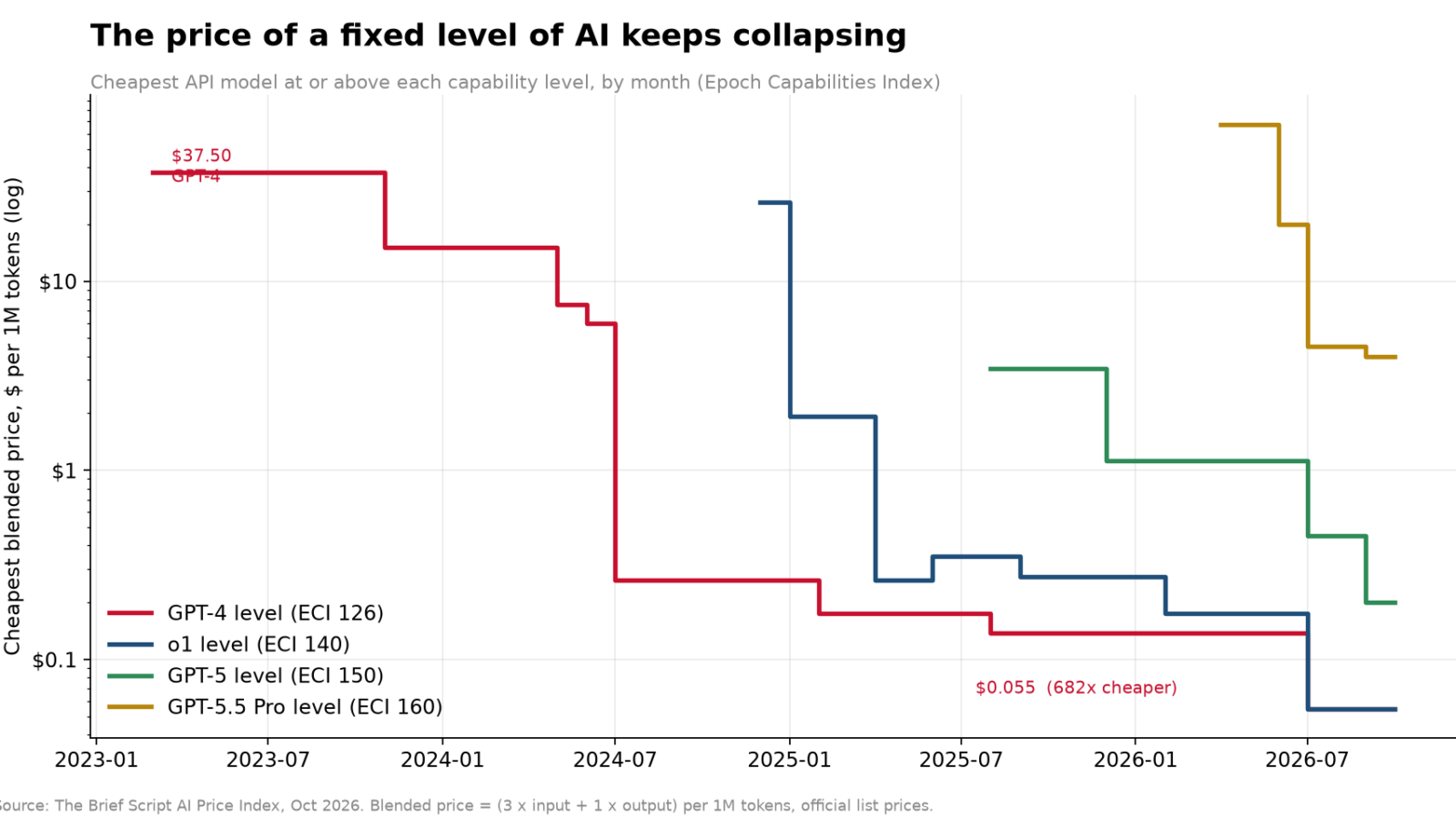
- GPT-4-level intelligence is 682x cheaper. It cost $37.50 per million blended tokens in March 2023. Today Qwen3.7 Flash clears the same bar for $0.055. That’s a 6x drop every year for three and a half years.
- Frontier-class AI fell even faster. GPT-5-level capability cost $3.44 when GPT-5 launched in August 2025. Fourteen months later, GPT-6 Luna and Claude Haiku 5.5 deliver it for $0.20, a 17x drop.
- But flagship prices made a U-turn. OpenAI’s top general model fell 91% from GPT-4 ($37.50) to GPT-5 ($3.44), then rose 5.8x to GPT-6 Astra ($20.00).
- New models are launching pricier. The median launch price of a new API model tripled, from $0.99 in the second half of 2024 to $3.00 since July 2026.
- Price increases are back. In 2024 we found 15 price cuts and zero increases on existing models. Since mid-2025 we count 5 increases, including Google doubling Gemini 4 Argon on December 1, 2026.
- Chinese labs charge half or less. Among frontier-class models live today, the median Chinese model costs $2.36 per million tokens, against $4.81 for US labs.
What we built: The Brief Script AI Price Index
We assembled three datasets. (The full process is in the Methodology section at the end.)
- Official price history. 348 pricing events (197 launches, 49 price changes, 93 deprecations, eight retirement notices for related models we don’t price, and one scheduled price change that was later withdrawn) across 197 models from OpenAI, Anthropic, Google, xAI, Meta (Llama, via hosting providers), Amazon, Mistral, Cohere, DeepSeek, Alibaba (Qwen), Moonshot (Kimi) and MiniMax. Every launch price, price change and deprecation from March 2023 to October 24, 2026, each with a source URL to an official pricing page, launch post, changelog or archived snapshot.
- Independent capability scores for 363 models, chiefly the Epoch Capabilities Index (ECI), plus GPQA Diamond, LMArena and the Artificial Analysis Intelligence Index.
- A live market snapshot of 462 models listed on OpenRouter on October 24, 2026.
From these we rebuilt the price menu for every month since March 2023: which models were on sale, at what price, and how capable each one was. That lets us answer a simple question for any month:
What’s the cheapest way to buy a given level of intelligence?
All prices in this report are blended: three parts input to one part output, per million tokens, at standard list prices. It’s the convention most analysts use, and it roughly matches a typical chat or RAG workload.
Finding 1: A fixed level of intelligence gets about 6x cheaper every year
When GPT-4 launched on March 14, 2023, it cost $30 per million input tokens and $60 per million output tokens. That’s $37.50 blended, and for eight months nothing on the market matched it for less.
Then the price of “GPT-4-level” started falling in steps:
| Month | Cheapest model at GPT-4 level (ECI 126+) | Blended price |
|---|---|---|
| Mar 2023 | GPT-4 | $37.50 |
| Nov 2023 | GPT-4 Turbo | $15.00 |
| May 2024 | GPT-4o | $7.50 |
| Jul 2024 | GPT-4o mini | $0.26 |
| Feb 2025 | Gemini 2.0 Flash | $0.18 |
| Aug 2025 | GPT-5 nano | $0.14 |
| Jul 2026 | Qwen3.7 Flash | $0.055 |
That’s a 682x drop in three years and seven months, or about 6.2x a year.
The result holds on a second yardstick. Using GPQA Diamond instead of ECI, Qwen3.7 Flash is again the cheapest model at GPT-4 level, for the same 682x. On LMArena Elo, a measure of human preference, the cheapest GPT-4-level model is GPT-5 nano at $0.14, a 273x drop. Note that Qwen3.7 Flash’s $0.055 applies to prompts up to 32K tokens; longer prompts cost about 3x more.
Higher levels of capability follow the same pattern, and often fall faster in their first year:
| Capability level (ECI) | First reached | Price then | Cheapest today | Price today | Drop |
|---|---|---|---|---|---|
| 126 (GPT-4) | Mar 2023, GPT-4 | $37.50 | Qwen3.7 Flash | $0.055 | 682x |
| 140 (o1) | Dec 2024, o1 | $26.25 | Qwen3.7 Flash | $0.055 | 477x |
| 145 (o4-mini) | Apr 2025, o4-mini | $1.93 | Claude Haiku 5.5 | $0.20 | 10x |
| 150 (GPT-5) | Aug 2025, GPT-5 | $3.44 | GPT-6 Luna | $0.20 | 17x |
| 155 (GPT-5.2 Pro) | Dec 2025, GPT-5.2 Pro | $57.75 | GPT-6 Luna | $0.20 | 289x |
| 160 (GPT-5.5 Pro) | Apr 2026, GPT-5.5 Pro | $67.50 | Claude Sonnet 5.5 | $4.00 | 17x |
The o1-level line is the starkest. In December 2024, reasoning at o1’s level cost $26.25 per million tokens. Within a month, DeepSeek-R1 offered it for $0.96. Today it’s $0.055.
This fits what other researchers have found. In November 2024, a16z measured a 10x annual drop for a fixed MMLU score and called it “LLMflation.” Epoch AI measured declines of 9x to 900x a year depending on the task. Our index extends those series to October 2026 and adds the 2025 to 2026 reasoning-model era.
What this means: If your product needs “GPT-4-class” or even “GPT-5-class” quality, you’re very likely overpaying. A model at that level is now available for $0.20 or less per million tokens. Re-run your model choice at least every quarter, because the cheapest option changes several times a year.
Finding 2: The flagship U-turn
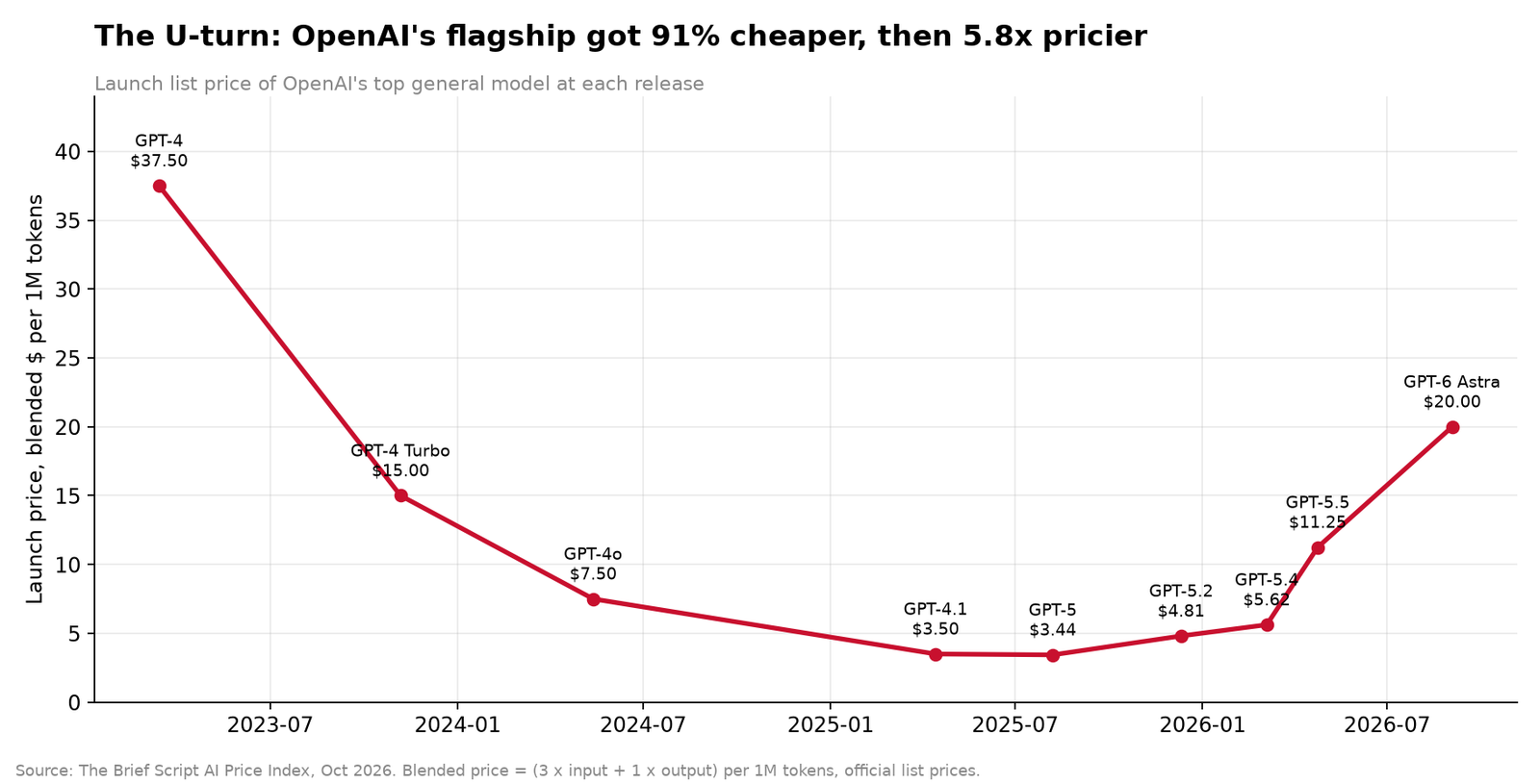
If intelligence is getting so cheap, why are AI bills going up?
Because the best model isn’t getting cheaper. Since mid-2025, it’s been getting more expensive.
Track OpenAI’s top general-purpose model at each launch:
| Model | Launched | Input / output per 1M | Blended |
|---|---|---|---|
| GPT-4 | Mar 14, 2023 | $30 / $60 | $37.50 |
| GPT-4 Turbo | Nov 6, 2023 | $10 / $30 | $15.00 |
| GPT-4o | May 13, 2024 | $5 / $15 | $7.50 |
| GPT-4.1 | Apr 14, 2025 | $2 / $8 | $3.50 |
| GPT-5 | Aug 7, 2025 | $1.25 / $10 | $3.44 |
| GPT-5.2 | Dec 11, 2025 | $1.75 / $14 | $4.81 |
| GPT-5.4 | Mar 5, 2026 | $2.50 / $15 | $5.63 |
| GPT-5.5 | Apr 24, 2026 | $5 / $30 | $11.25 |
| GPT-6 Astra | Sep 3, 2026 | $10 / $50 | $20.00 |
From GPT-4 to GPT-5, OpenAI’s flagship price fell 91%. From GPT-5 to GPT-6 Astra, it rose 482%.
OpenAI isn’t alone:
- Anthropic cut its top tier from $30 blended (Claude Opus 4) to $10 (Opus 4.5, November 2025). Then it launched the Claude Fable 5 tier at $20 in June 2026.
- Google is launching Gemini 4 Argon at a promotional $4 blended, but its own pricing page says that doubles to $8 on December 1, 2026. Gemini 3.6 and 3.8 Flash double on January 1, 2027.
- Moonshot launched Kimi K3 at $3 / $15, roughly three to four times the price of Kimi K2.6.
The premium tiers sit above even that. GPT-5.4 Pro and GPT-5.5 Pro list at $30 / $180 per million tokens ($67.50 blended), the most expensive models still on the market now that o1-pro ($262.50 blended) was shut down on October 23, 2026. That’s 1,227 times the cheapest model still on sale (Qwen3.7 Flash, $0.055).
What this means: “AI is getting cheaper” is true for any fixed level of capability and false for the frontier. If your roadmap assumes you’ll always run the newest flagship, budget for flat-to-rising unit costs, not falling ones.
Finding 3: New models are launching at higher prices
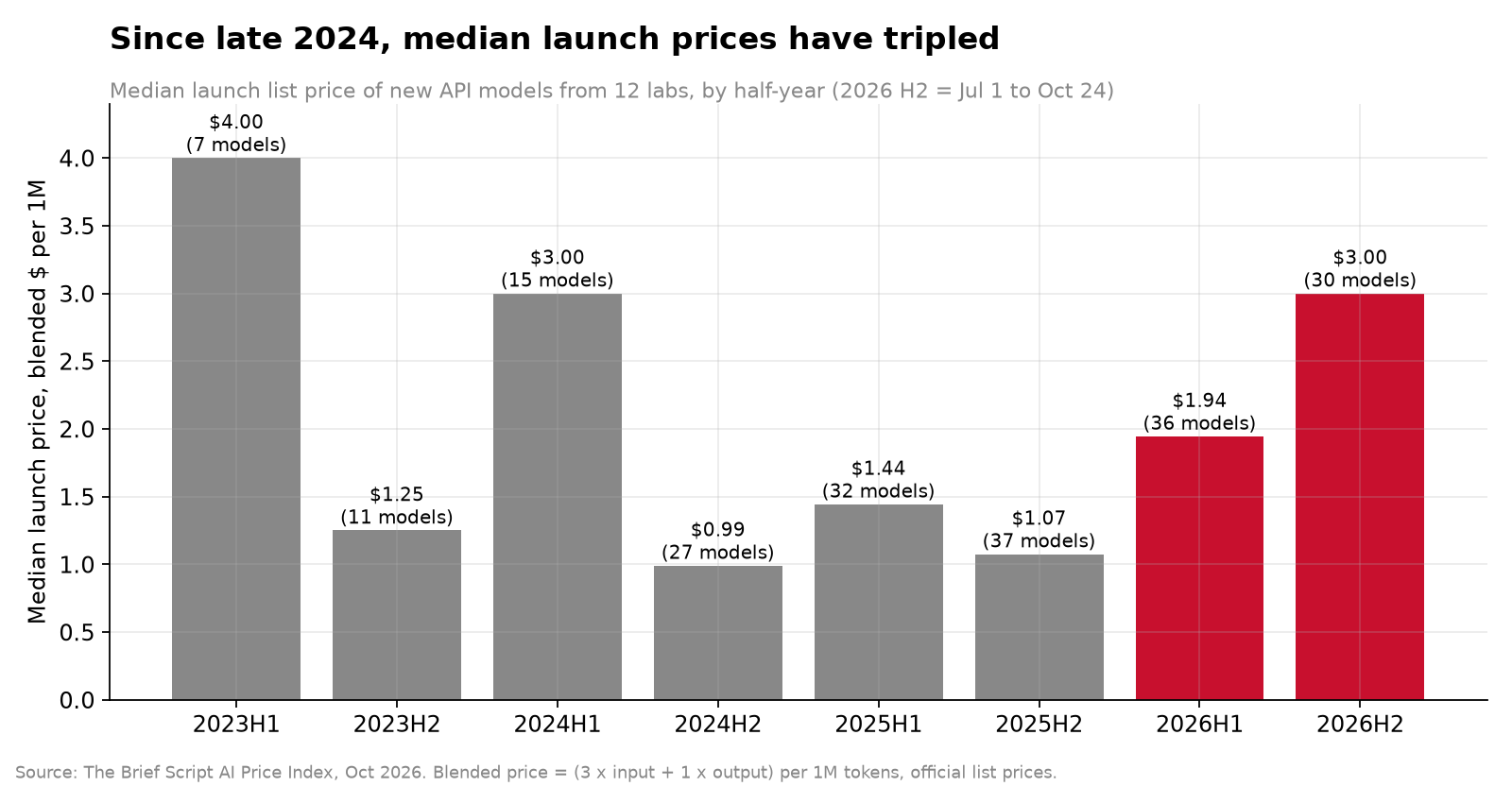
Zoom out from flagships to every new model, and the same shift shows up.
| Half-year | New models | Median launch price (blended) |
|---|---|---|
| 2023 H1 | 7 | $4.00 |
| 2023 H2 | 11 | $1.25 |
| 2024 H1 | 15 | $3.00 |
| 2024 H2 | 27 | $0.99 |
| 2025 H1 | 32 | $1.44 |
| 2025 H2 | 37 | $1.07 |
| 2026 H1 | 36 | $1.94 |
| 2026 H2 (to Oct 24) | 30 | $3.00 |
The second half of 2024 was the low point: a flood of “mini,” “flash” and “haiku” models, with a median launch price under $1. Since then, the median has tripled.
The live market agrees. Of the 442 paid models on OpenRouter today, the 255 first listed in 2026 have a median price of $1.13, against $0.70 for the 141 listed in 2025: 61% higher.
We see three likely reasons:
- Capability per model is up. A median 2026 model is far stronger than a median 2024 model, and labs are pricing for that.
- Reasoning is expensive to serve. Long chains of thought burn compute, and labs that once subsidized usage to win share are now pricing closer to cost.
- Demand outruns compute. When capacity is tight, labs have less reason to cut prices on models that already sell out. (This one is our reading, not something the price data proves.)
What this means: Don’t assume a newer model in the same family will cost the same as the old one. Since late 2025 several “next versions” have launched higher: GPT-5.2 charged 40% more per input token than GPT-5.1, and Mistral Medium 3.5 is 3.75x Medium 3.
Finding 4: Price cuts are slowing. Price increases are new.
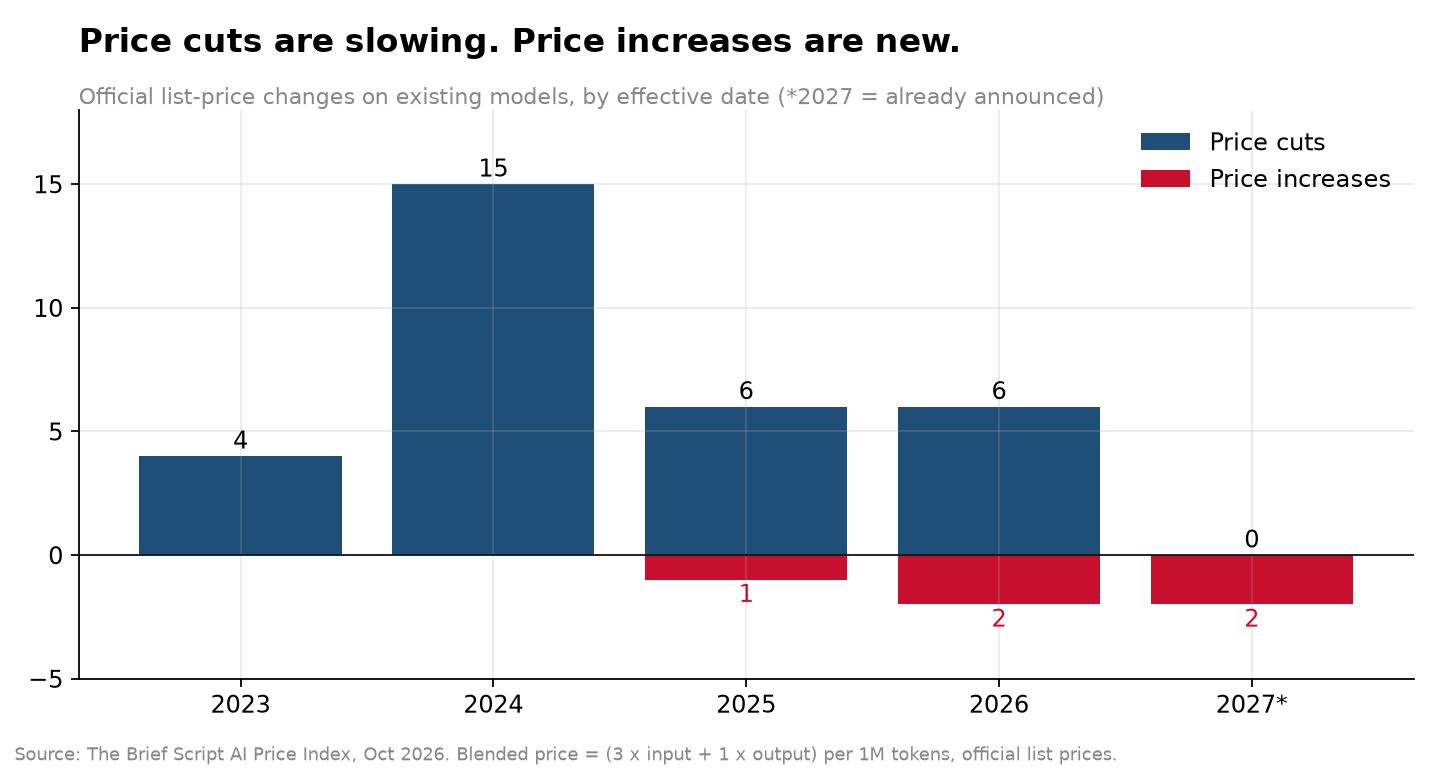
We logged every official list-price change on a model already on sale. Of 36 changes, 31 were cuts. The median cut was 50%.
But the timing matters:
- 2023: 4 cuts, 0 increases
- 2024: 15 cuts, 0 increases
- 2025: 6 cuts, 1 increase
- 2026: 6 cuts, 2 increases
- 2027 (already announced): 0 cuts, 2 increases
The biggest cuts on record:
| Model | Date | Change |
|---|---|---|
| GPT-5.6 Luna | Jul 30, 2026 | $1.00/$6.00 → $0.20/$1.20 (−80%) |
| o3 | Jun 10, 2025 | $10/$40 → $2/$8 (−80%) |
| Codestral | Sep 17, 2024 | −80% |
| DeepSeek-R1 | Feb 26, 2025 | −75% |
| DeepSeek-V4-Pro | Apr 26, 2026 | −75% |
| Gemini 1.5 Flash | Aug 12, 2024 | $0.35/$1.05 → $0.075/$0.30 (−75%) |
And the increases:
| Model | Effective | Change |
|---|---|---|
| Gemini 2.5 Flash | Jun 17, 2025 | $0.15/$0.60 → $0.30/$2.50 at general availability (+224%) |
| DeepSeek-V4-Flash | Aug 16, 2026 | New peak/off-peak schedule (+277% blended) |
| Gemini 4 Argon | Dec 1, 2026 | $2/$10 → $4/$20 (+100%) |
| Gemini 3.6, 3.8 Flash | Jan 1, 2027 | Doubling (+100% each) |
A new pattern has emerged: launch at a promotional price, then raise it. Google’s Gemini 3.6 Flash and Gemini 4 Argon both launched with introductory pricing and scheduled increases. DeepSeek’s V4-Pro did the reverse, turning a 75%-off launch promo into its permanent price.
What this means: Read the pricing page footnotes. “Promotional through November 30” is now a common line. If you build a cost model on a launch price, set a calendar reminder for the date it expires.
Finding 5: Chinese labs charge half or less for the same tier
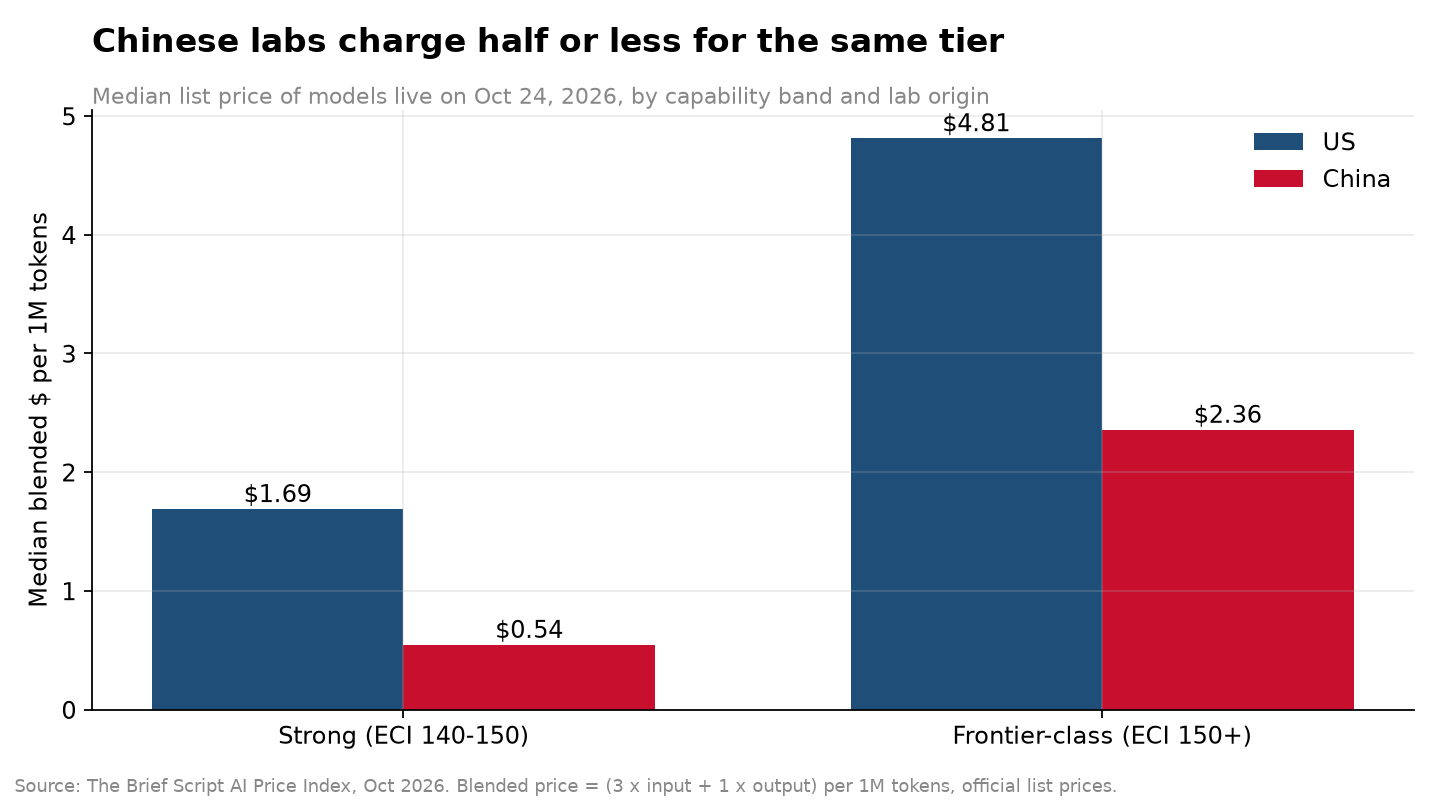
We grouped every model live on October 24, 2026, by capability band and lab origin.
| Capability band | US median | China median | Cheapest US | Cheapest China |
|---|---|---|---|---|
| Frontier-class (ECI 150+) | $4.81 (37 models) | $2.36 (6 models) | Claude Haiku 5.5, $0.20 | DeepSeek V4.1 Flash, $0.53 |
| Strong (ECI 140–150) | $1.69 (13 models) | $0.54 (11 models) | GPT-5.4 nano, $0.46 | Qwen3.7 Flash, $0.055 |
At the frontier-class tier, the typical Chinese model costs about half as much. One tier down, it’s about two-thirds cheaper.
But the cheapest frontier-class model in our data is American. OpenAI’s GPT-6 Luna and Anthropic’s Claude Haiku 5.5 both cost $0.20 blended, below DeepSeek’s off-peak price. US labs have learned to compete on price with their small models while charging a premium for their flagships.
The best-value frontier-class models live today (ECI 150 or higher, sorted by price):
| Model | Lab | Blended price | ECI |
|---|---|---|---|
| GPT-6 Luna | OpenAI | $0.20 | 156.8 |
| Claude Haiku 5.5 | Anthropic | $0.20 | 159.3 |
| GPT-5.6 Luna | OpenAI | $0.45 | 156.5 |
| DeepSeek V4.1 Flash | DeepSeek | $0.53 | 155.9 |
| Gemini 3 Flash | $1.13 | 151.9 | |
| Gemini 3.8 Flash | $1.50 | 157.4 | |
| Grok 4.20 | xAI | $1.56 | 152.1 |
| Kimi K2.6 | Moonshot | $1.71 | 150.9 |
What this means: For most production workloads, the “small” model from a top lab is now frontier-class. Before paying $4 to $20 for a flagship, test whether a $0.20 model already clears your quality bar.
Finding 6: OpenAI API pricing today, explained
OpenAI has the widest price range of any lab, so it deserves its own breakdown. Here’s the main OpenAI text models on sale, as of October 24, 2026:
| Tier | Model | Input / output per 1M | Blended |
|---|---|---|---|
| Cheapest | GPT-5 nano | $0.05 / $0.40 | $0.14 |
| Small, frontier-class | GPT-6 Luna | $0.10 / $0.50 | $0.20 |
| Small | GPT-5.6 Luna | $0.20 / $1.20 | $0.45 |
| Mid | GPT-5 mini | $0.25 / $2.00 | $0.69 |
| Mid | GPT-5.4 mini | $0.75 / $4.50 | $1.69 |
| Standard | GPT-6.1 Sol | $2.00 / $10.00 | $4.00 |
| Standard | GPT-6 Sol | $2.00 / $10.00 | $4.00 |
| Standard | GPT-5.6 Sol (promo) | $4.00 / $20.00 | $8.00 |
| Flagship | GPT-6 Astra | $10.00 / $50.00 | $20.00 |
| Pro | GPT-5.5 Pro | $30.00 / $180.00 | $67.50 |
Two things stand out. First, GPT-6.1 Sol costs half as much as GPT-5.6 Sol and scores higher (ECI 168.4 vs 162.8), so anyone still on 5.6 Sol is overpaying. Second, OpenAI’s newest small model, GPT-6 Luna, is 100x cheaper than GPT-6 Astra and scores within about 12 ECI points of it.
OpenAI also offers a 50% discount through its Batch API for jobs that can wait up to 24 hours, and lower cached-input rates for repeated prompts.
OpenAI API pricing
OpenAI’s current lineup runs from GPT-6 Luna at $0.10 / $0.50 per million input/output tokens to GPT-6 Astra at $10 / $50, with Pro models above that. We re-checked every price on OpenAI’s official API pricing page on October 26, 2026. None of the models in our index changed price since October 24. One model is new: GPT-6.1 Terra, released October 26 at $1 / $5 ($2.00 blended). It launched after our cutoff and is too new for an independent capability score, so it isn’t in the index figures above.
Standard prices per 1M tokens, for prompts up to 272K tokens:
| Model | Input | Cached input | Output | Batch (input / output) |
|---|---|---|---|---|
| GPT-6 Astra (flagship) | $10.00 | $1.00 | $50.00 | $5.00 / $25.00 |
| GPT-6.1 Sol | $2.00 | $0.10 | $10.00 | $1.00 / $5.00 |
| GPT-6.1 Terra (new, Oct 26) | $1.00 | $0.05 | $5.00 | $0.50 / $2.50 |
| GPT-6 Sol | $2.00 | $0.20 | $10.00 | $1.00 / $5.00 |
| GPT-6 Luna | $0.10 | $0.01 | $0.50 | $0.05 / $0.25 |
| GPT-5.6 Sol (promo) | $4.00 | $0.40 | $20.00 | $2.00 / $10.00 |
| GPT-5.6 Terra | $2.00 | $0.20 | $12.00 | $1.00 / $6.00 |
| GPT-5.6 Luna | $0.20 | $0.02 | $1.20 | $0.10 / $0.60 |
| GPT-5.5 | $5.00 | $0.50 | $30.00 | $2.50 / $15.00 |
| GPT-5.5 Pro | $30.00 | – | $180.00 | $15.00 / $90.00 |
| GPT-5.4 mini | $0.75 | $0.075 | $4.50 | $0.375 / $2.25 |
| GPT-5 nano (retires Dec 11) | $0.05 | $0.005 | $0.40 | $0.025 / $0.20 |
The rules that change the bill:
- Batch and Flex are half price. Both cut input and output by 50%. Fast mode (formerly Priority processing) costs 2x Standard, and an Ultrafast tier for GPT-6 Astra and GPT-6.1 Sol costs 6x.
- Caching: cached input costs 5% of the input price on GPT-6.1 Sol and Terra and 10% on most other current models. On GPT-5.6 and newer, cache writes cost 1.25x input for 30-minute retention or 2.5x for the new 12-hour option.
- Long prompts cost more. Above 272K input tokens, the whole request is billed at 2x input and 1.5x output (GPT-6 Astra: $20 / $75).
- Regional processing (data residency) adds 10% for models released on or after March 5, 2026.
- Promotions and retirements: GPT-5.6 Sol’s promotional price runs at least through November 21, 2026. GPT-5, GPT-5 mini, GPT-5 nano, GPT-5 Pro, o3 and o3-pro leave the API on December 11, 2026 (deprecations page).
Claude API pricing
Anthropic’s current models range from Claude Haiku 5.5 at $0.10 / $0.50 per million input/output tokens to Claude Fable 5.1 at $10 / $50. Claude Opus 5.5 costs $4 / $20 ($8.00 blended), and Sonnet 5.5 costs $2 / $10 ($4.00). All prices below match Anthropic’s official pricing page as checked on October 26, 2026, with no changes since October 24.
Standard prices per 1M tokens:
| Model | Input | Cache hit | Output | Batch (input / output) |
|---|---|---|---|---|
| Claude Fable 5.1 (top tier) | $10 | $0.25 | $50 | $5 / $25 |
| Claude Opus 5.5 | $4 | $0.20 | $20 | $2 / $10 |
| Claude Sonnet 5.5 | $2 | $0.10 | $10 | $1 / $5 |
| Claude Haiku 5.5 (prompts up to 100K) | $0.10 | $0.01 | $0.50 | $0.05 / $0.25 |
| Claude Haiku 5.5 (prompts over 100K) | $0.50 | $0.05 | $2.50 | $0.25 / $1.25 |
| Claude Fable 5 | $10 | $1 | $50 | $5 / $25 |
| Claude Opus 5 (and Opus 4.5 to 4.8) | $5 | $0.50 | $25 | $2.50 / $12.50 |
| Claude Sonnet 5 | $2 | $0.20 | $10 | $1 / $5 |
| Claude Sonnet 4.6 | $3 | $0.30 | $15 | $1.50 / $7.50 |
| Claude Haiku 4.5 | $1 | $0.10 | $5 | $0.50 / $2.50 |
The rules that change the bill:
- Batch is half price on input and output, and it stacks with prompt caching.
- Caching: a cache hit normally costs 10% of the input price, but only 5% on Opus 5.5 and Sonnet 5.5 and 2.5% on Fable 5.1. Writing to the cache costs 1.25x input (5-minute cache) or 2x (1-hour cache).
- Long context: Claude 4.6 and later models bill the full 1M-token window at standard rates, except Haiku 5.5, which charges 5x more on every request whose prompt exceeds 100K tokens.
- US-only inference adds 10% on Claude 4.6 and later models. Fast mode for Opus 5.5 costs $8 / $40 and can’t be combined with Batch.
- Tokenizer: Claude 4.7 and later models produce about 30% more tokens for the same text, so the same list price buys less text than it did on older models.
- Claude Mythos 5 and 5.1 are priced like Fable but limited to verified organizations. New API users get a small amount of free credit.
Gemini API pricing
Google’s current paid lineup runs from Gemini 3.1 Flash-Lite at $0.25 / $1.50 per million input/output tokens to the flagship Gemini 4 Argon at $2 / $10 (Gemini 3.1 Pro Preview is slightly pricier on output, at $2 / $12). Several of those prices are promotional: Argon doubles to $4 / $20 on December 1, 2026, and Gemini 3.6 and 3.8 Flash double on January 1, 2027. Prices below are from Google’s official Gemini API pricing page, checked October 26, 2026, and match our October 24 data. (Gemini 3.7 Flash and 3.5 Flash were deprecated on October 8, 2026; requests now route to 3.8 Flash and 3.6 Flash.)
Paid-tier prices per 1M tokens (output includes thinking tokens):
| Model | Input | Output | Context cache | Batch (input / output) | Scheduled change |
|---|---|---|---|---|---|
| Gemini 4 Argon (flagship, promo) | $2.00 | $10.00 | $0.10 (implicit only) | $1.00 / $5.00 | $4 / $20 from Dec 1, 2026 |
| Gemini 3.8 Flash (promo) | $0.75 | $3.75 | $0.075 | $0.375 / $1.875 | $1.50 / $7.50 from Jan 1, 2027 |
| Gemini 3.6 Flash (promo) | $0.75 | $3.75 | $0.075 | $0.375 / $1.875 | $1.50 / $7.50 from Jan 1, 2027 |
| Gemini 3.1 Pro Preview (prompts up to 200K) | $2.00 | $12.00 | $0.20 | $1.00 / $6.00 | None announced |
| Gemini 3 Flash Preview | $0.50 | $3.00 | $0.05 | $0.25 / $1.50 | None announced |
| Gemini 3.5 Flash-Lite | $0.30 | $2.50 | $0.03 | $0.15 / $1.25 | None announced |
| Gemini 3.1 Flash-Lite | $0.25 | $1.50 | $0.025 | $0.125 / $0.75 | None announced |
The rules that change the bill:
- There’s a free tier. Flash and Flash-Lite models have free input and output tokens at lower rate limits, but free-tier content may be used to improve Google’s products. Gemini 4 Argon and Gemini 3.1 Pro Preview are paid only.
- Batch and Flex are half price. Priority costs 1.8x Standard.
- Caching has two parts: a per-token cache price plus an hourly storage fee (for example, $0.50 per million tokens per hour on 3.8 Flash until the price change). Argon supports implicit caching only.
- Long prompts cost more on Pro. Gemini 3.1 Pro Preview charges $4 / $18 for prompts over 200K tokens.
- Grounding with Google Search includes 5,000 free requests a month across Gemini 3 and newer models, then costs $14 per 1,000.
The hidden costs a price table won’t show you
List price per token is only half of what you pay. Four things can push your real cost well above the sticker:
- Reasoning tokens. Reasoning models bill their internal “thinking” as output tokens. On a hard task, a model can produce many times more tokens than the visible answer, so a cheap per-token model can cost more per task than a pricier one that thinks less. Epoch AI’s September 2026 study, “The plunging price of thought,” measures cost per task for this reason.
- Tokenizer changes. Anthropic’s newer tokenizers (from Claude Opus 4.7 onward) produce about 30% more tokens for the same text. Same list price, roughly 30% higher bill.
- Long-context surcharges. Many models charge more once a prompt crosses a threshold. GPT-5.6 Sol bills prompts over 272K tokens at 2x input and 1.5x output. Gemini 3.1 Pro Preview jumps from $2/$12 to $4/$18 above 200K tokens.
- Peak pricing. DeepSeek now has peak and off-peak rates. V4.1 Flash costs $0.15/$0.60 off-peak and $0.30/$1.20 at peak.
On the other side, two levers cut costs: cached input (typically 75% to 90% off for repeated context) and batch processing (typically 50% off).
What to do about it
1. Price your workload by capability, not by brand
The takeaway: The cheapest model that clears a given capability bar changes several times a year, and it’s often not from the lab you’d guess.
Next step: Define the minimum quality your task needs with your own evaluation set. Then test the cheapest three or four models above that bar every quarter.
2. Default to a small frontier-class model
The takeaway: GPT-6 Luna, Claude Haiku 5.5 and DeepSeek V4.1 Flash all reach GPT-5-level capability for $0.20 to $0.53 per million tokens.
Next step: Route most traffic to a small model and escalate only hard requests to a flagship.
3. Budget for flat or rising flagship costs
The takeaway: Flagship prices have risen since mid-2025, and new models launch higher than old ones.
Next step: If your product depends on the newest top model, model your AI unit costs as flat or rising year over year, not falling.
4. Watch promotional expiry dates
The takeaway: Several current prices are promotional and already scheduled to double.
Next step: Track the end date of any promotional price you rely on, and re-test alternatives before it expires.
5. Measure cost per task, not cost per token
The takeaway: Reasoning tokens, tokenizers and long-context surcharges can make a “cheap” model expensive.
Next step: Log real token usage per completed task for each model you test, and compare on that.
The bottom line
The Brief Script AI Price Index tells two stories at once.
The first is the one everyone repeats: AI keeps getting cheaper. GPT-4-level intelligence costs 682 times less than it did in March 2023, and frontier-class capability fell 17x in just 14 months.
The second is the one your invoice tells: the best models are getting more expensive again. OpenAI’s flagship rose 5.8x from GPT-5 to GPT-6 Astra, new models are launching at triple the median price of late 2024, and price increases have returned after two years of nothing but cuts.
The winners will be the teams that treat model choice as a quarterly pricing decision, not a one-time vendor pick.
We’ll update this index every month. You can download the full dataset in the methodology section.
Methodology
Question. What does a fixed level of AI capability cost over time, and how are prices for new and top models changing?
Price data. We recorded 348 official price events (197 launches, 49 price changes, 93 deprecations, eight retirement notices for related models we don’t price, and one scheduled price change that was later withdrawn) for 197 text and multimodal LLM API models from 12 labs, March 2023 to October 24, 2026. Sources are official pricing pages, launch announcements, documentation changelogs, official price-sheet PDFs and Wayback Machine snapshots of pricing pages. Every row carries its source URL. Where a date or price could only be bracketed or came from a secondary source, the row is flagged (32 of 348 rows).
Scope. Standard list prices only, for the shortest context tier. We excluded batch, flex and priority tiers, audio, image, embedding and realtime models, and invitation-only models. Meta has no paid first-party Llama API, so Llama prices come from Amazon Bedrock and Together AI. Qwen prices are Alibaba’s international (Model Studio) rates from January 2025. PaLM 2 and early Gemini 1.0 Pro were priced per character; we converted at about 4 characters per token.
Blended price. (3 × input price + 1 × output price) ÷ 4, in US dollars per million tokens.
Capability scores. Our main measure is the Epoch Capabilities Index (ECI), the only consistent single score that spans 2023 to 2026; 137 of the priced models have one. We also collected GPQA Diamond (Epoch AI runs, with Artificial Analysis where Epoch had none), LMArena style-controlled text scores, HELM MMLU, and the Artificial Analysis Intelligence Index. GPT-4 (March 2023) scores 125.7 on ECI, which we use as “GPT-4 level.”
Monthly index. For each month we listed every model on sale (launched, not yet retired, with each official retirement matched to the exact model it covers), applied its price as of month end (for October 2026, as of our October 24 snapshot, so models retired earlier in October, such as Gemini 3.7 Flash and o1-pro, are excluded), and found the cheapest model at or above each ECI threshold.
Market snapshot. We pulled all 462 models listed on OpenRouter on October 24, 2026, as a cross-check on launch-price trends. OpenRouter prices can differ from official rates, so they aren’t used in the index itself.
Limitations.
- List prices aren’t what every customer pays. Enterprise discounts, committed-use deals and free tiers are invisible to us.
- Blended price assumes a 3:1 input-to-output ratio. Output-heavy and reasoning-heavy workloads cost more.
- Price per token isn’t cost per task. Models that reason longer use more tokens.
- Models without an ECI score are left out of the capability analysis but stay in the launch-price and price-change counts.
- We matched model names across sources by hand. We checked each match, but errors are possible.
- Some models have tiered prices by prompt length. We use the shortest tier: Qwen3.7 Flash’s rate covers prompts up to 32K tokens and Claude Haiku 5.5’s up to 100K. Longer prompts cost 3x to 5x more on those models.
- Several current prices are promotional, including GPT-5.6 Sol (at least through November 21, 2026), Gemini 4 Argon and Gemini 3.6 and 3.8 Flash. We record the price in effect on October 24, 2026.
Prior work we build on. a16z, “Welcome to LLMflation” (November 2024); Epoch AI, “LLM inference prices have fallen rapidly but unequally across tasks” (March 2025) and “The plunging price of thought” (September 2026); Gundlach et al., “The Price of Progress” (arXiv, 2026); Artificial Analysis trends data.
Data. Download the full dataset (CSV): price events with sources, the monthly index, and capability scores. Epoch AI and LMArena data are CC-BY 4.0. Artificial Analysis data is used with attribution and isn’t redistributed in bulk.
Cite this report: The Brief Script, “The Brief Script AI Price Index,” October 2026. thebriefscript.com/ai-api-price-index/
FAQ
How much does the OpenAI API cost? As of October 26, 2026, OpenAI’s text models range from $0.05 / $0.40 per million input/output tokens (GPT-5 nano, which retires December 11, 2026) to $30 / $180 (GPT-5.4 Pro and GPT-5.5 Pro; o1-pro was shut down on October 23). Its current standard model, GPT-6.1 Sol, costs $2 / $10, the new GPT-6.1 Terra $1 / $5, and its flagship, GPT-6 Astra, $10 / $50. Batch and Flex requests are half price.
How much does the Claude API cost? As of October 26, 2026, Claude Haiku 5.5 costs $0.10 / $0.50 per million input/output tokens (for prompts up to 100K tokens), Sonnet 5.5 $2 / $10, Opus 5.5 $4 / $20 and Fable 5.1 $10 / $50. The Batch API halves those prices, and cache hits cost 2.5% to 10% of the input price.
How much does the Gemini API cost? As of October 26, 2026, Gemini 3.1 Flash-Lite costs $0.25 / $1.50 per million input/output tokens, Gemini 3.8 Flash $0.75 / $3.75 and Gemini 4 Argon $2 / $10. Argon’s price doubles on December 1, 2026, and the Flash prices double on January 1, 2027. Flash models also have a free tier.
How fast are LLM prices falling? For a fixed level of capability, about 6x a year since March 2023. GPT-4-level capability fell from $37.50 to $0.055 per million blended tokens, a 682x drop.
Are AI API prices going up? For top models, yes. OpenAI’s flagship price rose 5.8x from GPT-5 (August 2025) to GPT-6 Astra (September 2026), and Google has announced price doublings for Gemini 4 Argon and two Gemini Flash models.
What is the cheapest frontier-class AI model? In our data, GPT-6 Luna and Claude Haiku 5.5, both at $0.20 per million blended tokens, are the cheapest models with GPT-5-level capability (ECI 150 or higher).
Are Chinese AI models cheaper? Yes, typically. Among frontier-class models live in October 2026, the median Chinese model costs $2.36 per million blended tokens versus $4.81 for US models.