AI Supply Chain 2026: How AI is Preventing the Next Disruption Crisis

The Brief
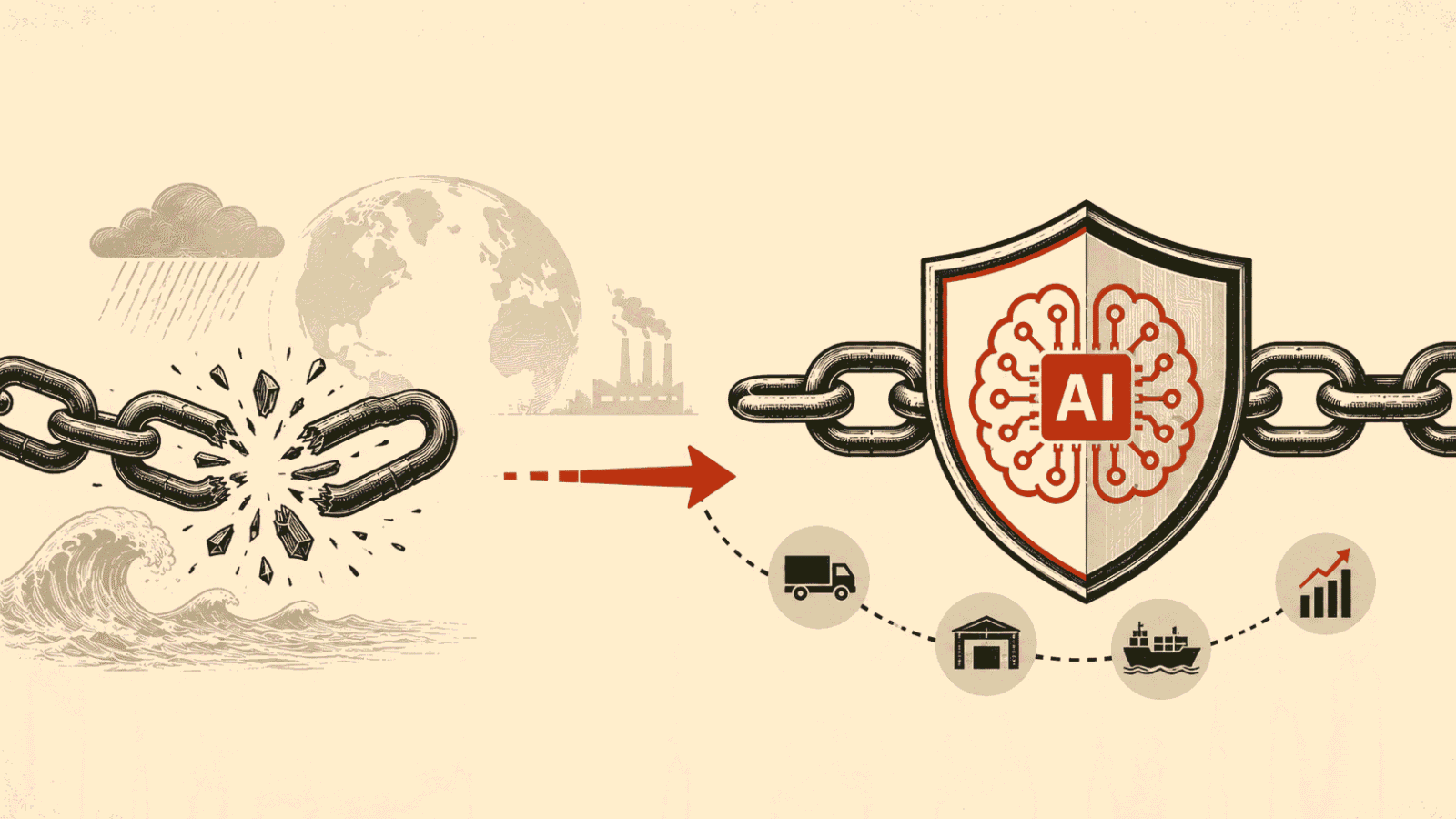
AI supply chain tools are moving from visibility dashboards into prevention systems that help companies detect disruption before it hits operations.
Why It Matters
For enterprise buyers, the shift matters because supply chain AI is no longer just reporting risk. It is becoming part of procurement, logistics, and continuity planning.
Watch Next
Watch whether large manufacturers start treating AI supply chain visibility as required infrastructure rather than optional analytics software.
The Pulse
McKinsey research found that companies with AI-driven supply chain visibility were three times more likely to report minimal impact during the COVID-19 disruptions. In 2026, those same AI visibility platforms are being deployed against a different disruption profile: tariff shocks, geopolitical realignment, labor shortages, and autonomous vehicle logistics all converging simultaneously.
Project44 now tracks 1.5 billion shipments annually for more than 1,000 brands. Its AI Disruption Navigator identifies global disruptions up to 75% faster than manual monitoring, cutting disruption-related costs by an estimated 40%.
In January 2026, Gatik became the first company in North America to deploy fully driverless commercial trucks at scale, completing more than 60,000 driverless orders for Walmart and Fortune 50 retailers without a single incident. The experiment stage of AI in supply chain is over.
Core significance
Why it matters:
- AI has shifted supply chain management from reactive to predictive, identifying disruptions before they cascade: Modern AI platforms can assess how geopolitical events, raw material shortages, weather, or port congestion affect demand capability, and then plot alternate sourcing and routing strategies before the disruption reaches the organization’s tier-one suppliers. [Digital Adoption AI in logistics supply chain examples 2026]
- The autonomous vehicle transition in US commercial logistics is accelerating faster than most enterprise procurement calendars: Aurora has logged more than 250,000 driverless miles across ten Sun Belt freight lanes with zero system-attributed collisions. AI-powered freight matching platforms are reducing empty miles by up to 45%, cutting both cost and carbon simultaneously. [AngelHack DevLabs AI in logistics use cases 2026]
- Labor shortage is making AI adoption a matter of operational continuity, not competitive advantage: Highly skilled workers are retiring at a rapid rate, leaving up to 600,000 job vacancies across US supply chains and manufacturing. Younger workers are less inclined to enter these industries, making sustained productivity dependent on automation rather than headcount growth. [ABI Research supply chain disruptions 2026 resilience AI automation]
Seventy-seven percent of supply chains are now considering, in pilot, or beginning implementation of mobile automation including autonomous mobile robots and automated guided vehicles, according to ABI Research’s survey, reflecting a sector-wide shift toward AI-augmented operations rather than AI-assisted ones.
Deep Context: Why traditional supply chain management cannot handle modern disruption frequency
Gartner projects that by 2031, 60% of supply chain disruptions will be resolved without human involvement, a forecast that reflects not just technology capability but the sheer volume of disruption events that modern supply chains face. Organizations are finding it harder to manage disruptions like trade uncertainty and geopolitical conflict without real-time analytics and automated risk analysis, simply because the frequency of disruption has outpaced what human teams can monitor manually. [ISM World Gartner AI automation disruption management 2026]
A national retail chain that deployed AI logistics tools cut delivery times by 18% and saved more than 200,000 dollars annually in fuel and labor costs. US distribution companies integrating AI and robotics into warehouse operations report 30 to 50% increases in warehouse throughput without proportional headcount increases.[ERP Software Blog top 7 use cases AI supply chain 2026]
As covered in our Enterprise AI Stack Cost report, supply chain AI deployments follow the same pattern as other enterprise AI systems: integration to existing ERP, WMS, and TMS platforms is typically the most expensive and time-consuming component, often consuming more budget than the AI platform itself.
The agentic supply chain is already moving from pilot to production
The most significant development in enterprise supply chain management in 2026 is the shift from AI that recommends to AI that acts. Vendors including Blue Yonder, FourKites, and SAP are moving control towers beyond alerting into agentic capabilities, where AI agents automatically execute decisions and take corrective measures without waiting for human approval in predefined operational scenarios.
Spearheaded by platforms like Blue Yonder and FourKites, next-generation supply chain control towers now support multi-tier supplier discovery and relationship mapping down to the bill of materials level, helping enterprises understand exposure to external risks and proactively assess alternate suppliers when tariffs change or geopolitical risk increases.
Data insights
By the numbers:
All figures from McKinsey, Gartner, ABI Research, Project44, and company case studies cited inline.
- Companies with AI-driven supply chain visibility were 3 times more likely to report minimal disruption impact during COVID-19: McKinsey’s finding, cited consistently across enterprise supply chain research, has become the foundational ROI benchmark for AI supply chain investment, particularly for boards that lived through 2020 and 2021 disruptions without adequate visibility tools.[Emerj AI avoiding supply chain disruptions two use cases]
- AI monitoring systems have reduced disruption response time from multi-day manual assessments to under 15 minutes in production deployments: Academic research on multi-agent supply chain disruption monitoring demonstrates that automated systems can reduce response time by more than three orders of magnitude compared to analyst-driven assessment, with one agentic system monitoring a Russia-Ukraine conflict disruption scenario in real time during the 2022 crisis as a validated test case. [arXiv 2601 automating supply chain disruption monitoring agentic AI]
- Early AI adopters in supply chain are reporting 15% reductions in logistics costs and 35% decreases in inventory levels: The compounding effect of better demand forecasting, optimized routing, predictive maintenance, and automated supplier risk scoring produces improvements across all three cost categories simultaneously, rather than optimizing one at the expense of another.
Table 1: AI supply chain use cases and documented ROI
| Use case | Technology | Documented outcome | Enterprise example | 2026 adoption stage |
| Disruption monitoring | AI control towers | 75% faster detection, 40% cost reduction | Project44 for 1,000 plus brands | Production at scale |
| Route optimization | ML plus telematics | 38M liters fuel saved annually | UPS ORION 30K optimizations per minute | Mature, widely deployed |
| Autonomous trucking | Computer vision plus AI | 60,000 plus driverless orders incident-free | Gatik for Walmart, Jan 2026 | Early commercial scale |
| Warehouse automation | AMR plus AI orchestration | 30 to 50% throughput increase | Distribution sector average | 77% considering or implementing |
| Predictive maintenance | IoT plus ML | 30% vessel downtime reduction, $300M annual savings | Maersk maritime logistics | Production at global carriers |
Table 2: AI supply chain platforms and their primary capabilities
| Platform | Primary capability | Key differentiator |
| Project44 | Shipment visibility and disruption detection | 1.5B shipments tracked, AI Disruption Navigator |
| Flexport | Freight forwarding plus AI customs | Trade and Tariff Studio automates up to 80% of manual compliance |
| Blue Yonder | End-to-end supply chain planning | Agentic AI executing autonomous corrective decisions |
| Microsoft Dynamics 365 SCM | ERP-integrated supply chain Copilot | 18% delivery improvement, $200K annual savings documented |
The Business Case: What enterprises should prioritize in their 2026 supply chain AI investment
The most common mistake in enterprise supply chain AI investment is prioritizing a single optimization problem, typically route optimization or demand forecasting, over the end-to-end orchestration layer that produces compounding returns across all supply chain functions simultaneously.
Organizations generating the most value from supply chain AI are connecting data across silos rather than optimizing individual nodes. Project44, Flexport, and Symbotic are generating outsized returns specifically because they operate across the supply chain network rather than within one function of it. A warehouse optimization platform that does not feed into transportation planning and supplier risk scoring delivers a fraction of the ROI of a connected system that does.
The 600,000 job vacancy figure is the strongest business case for automation investment that does not require ROI modeling. As covered in our shadow AI enterprise risk report, organizations that try to solve labor shortage problems through workforce management tools alone, rather than automation, are treating a structural supply reduction as a temporary staffing problem.
Expert Nuance: Predictive maintenance may be the highest-return, least-glamorous AI application in the supply chain
Maersk’s AI-powered maritime logistics system reduced vessel downtime by 30%, saving an estimated 300 million dollars annually and cutting 1.5 million metric tons of carbon emissions. UPS’s ORION system processes 30,000 route optimizations per minute, preventing roughly 38 million liters of fuel consumption annually, translating to approximately 100,000 metric tons of CO2 avoided per year. [HBLab AI in supply chain use cases benefits 2026]
These numbers are cited in the industry primarily as sustainability stories. Their more important implication is financial. Maersk’s 300 million dollar annual savings did not come from a new revenue line or a market expansion. It came from not having ships sit idle in port unexpectedly. For enterprises with significant physical asset fleets, predictive maintenance AI is not infrastructure spend in the traditional sense. It is a direct operating cost reduction.
Early adopters across logistics, manufacturing, and retail are reporting a 15% reduction in logistics costs and a 35% decrease in inventory levels from comprehensive AI deployment, a combination that reduces both operating costs and working capital requirements simultaneously, the two most direct levers on enterprise cash flow available to supply chain leaders.
Strategic outlook
- The agentic supply chain transition from alerting to autonomous action is the defining shift of 2026 to 2028: SAP’s supply chain blueprint for 2026 documents specific production outcomes from agentic deployments: supplier onboarding time cut by up to 50%, unplanned maintenance outages reduced by 30%, and inventory lead times shortened by 25% through autonomous AI agents placing and adjusting orders without human intervention in predefined scenarios. [SAP blueprint supply chain resilience 2026 agentic AI]
- Autonomous trucking will become a board-level supply chain risk factor within 24 months: With Gatik running commercial driverless operations, Aurora targeting 200 plus driverless trucks by year-end, and Waabi raising 1 billion dollars for AI-first autonomous trucks with Uber Freight, the infrastructure layer for autonomous commercial logistics is being built at a pace that will make 2024 drayage rates look like a different industry by 2028.
- Organizations that skip the control tower layer and go directly to autonomous execution will face higher implementation risk: The consensus view from enterprise supply chain practitioners in 2026 is that AI’s most impactful near-term role is augmenting human decision-making, helping teams sense issues faster and act more consistently under pressure, rather than replacing the decision entirely.
Key Question Answered
How is AI preventing supply chain disruptions in 2026, and what are the real-world results?
AI is preventing supply chain disruptions through three distinct mechanisms. First, real-time monitoring at scale, platforms like Project44 now track 1.5 billion shipments annually and identify disruptions up to 75% faster than manual processes, cutting disruption-related costs by 40%. Second, predictive analytics that model disruption scenarios before they materialize, allowing enterprises to pre-position inventory, qualify alternate suppliers, and reroute freight before a disruption reaches the tier-one supplier layer where traditional risk management typically focuses. Third, autonomous action execution, where agentic AI systems in 2026 are moving beyond alerting to actually placing orders, rerouting shipments, and adjusting inventory levels without waiting for human approval within predefined parameters.
The documented outcomes for enterprises that have deployed comprehensive AI supply chain programs are significant: a 15% reduction in logistics costs, 35% lower inventory levels, 30 to 50% higher warehouse throughput, and the three-times-more-likely-minimal-disruption-impact finding that McKinsey documented and that has become the sector’s primary ROI benchmark since 2020.
The Takeaway
Supply chain AI in 2026 is no longer a pilot conversation. Gatik is running fully driverless commercial trucks for Walmart. Project44 tracks more shipments per year than most logistics software providers track in a decade. Maersk has turned AI predictive maintenance into 300 million dollars in annual operating cost savings.
The enterprises still treating supply chain AI as an emerging technology to evaluate on a two-year roadmap are a generation behind where their most competitive peers already are. The gap between organizations that built real-time visibility and predictive analytics capability before 2023 and those that are still evaluating is the same gap that COVID-19 made visible between companies that could see their supply chains and companies that could not.
The next disruption, whether it is a geopolitical shock, a major port closure, or a tariff change, will arrive on a timeline that manual supply chain management cannot track and respond to competitively. The organizations with agentic supply chain platforms already in production will absorb the shock and route around it before their competitors have finished assessing the impact. That is the real business case for supply chain AI in 2026.