Agentic AI Enterprise 2026: From Pilots to Production

The Brief
The Pulse Eighty percent of enterprise applications shipped or updated in the first quarter of 2026 embed at least one AI agent, up from 33% just two years earlier. That is the steepest enterprise software adoption curve since cloud computing took off between 2010 and 2012. [Digital Applied AI agent adoption 2026 enterprise data points] […]
Why It Matters
The story matters because it changes how buyers, builders, or policymakers should read the Enterprise AI market.
Watch Next
Watch whether the signal becomes a budget, procurement, or platform decision in the next cycle.
The Pulse
Eighty percent of enterprise applications shipped or updated in the first quarter of 2026 embed at least one AI agent, up from 33% just two years earlier. That is the steepest enterprise software adoption curve since cloud computing took off between 2010 and 2012. [Digital Applied AI agent adoption 2026 enterprise data points]
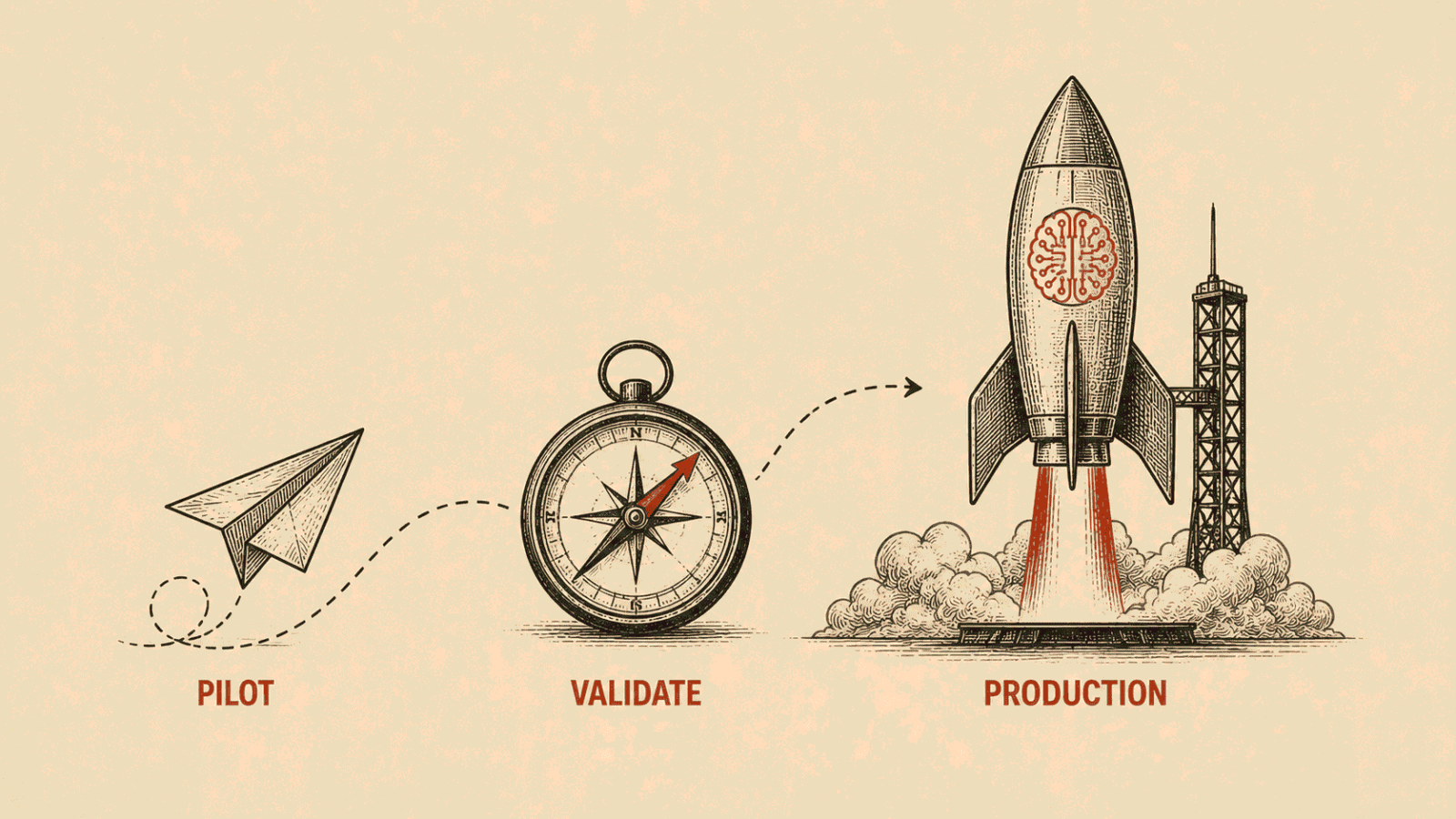
But that headline number sits next to a far less impressive one. Only 31% of organizations actually have an AI agent running in production. The gap between agents embedded in shipped applications and agents genuinely operating autonomously in a live business process is where most of 2026’s enterprise AI budget is being spent, and where most of the disappointment is being recorded.
That gap, not the adoption headline, is the real story of agentic AI in 2026. The technology has moved decisively past the demo stage. Whether it has moved past the pilot stage inside any specific enterprise is a separate and much harder question, and the data on that second question is considerably more sobering than most vendor marketing suggests.
Core Significance
Why it matters:
- Gartner projects 40% of enterprise applications will embed task-specific AI agents by the end of 2026, up from less than 5% in 2025, an eightfold increase in a single year: That trajectory is real and broadly confirmed across independent research firms, but Gartner’s own companion forecast is equally significant: more than 40% of agentic AI projects are at risk of cancellation by the end of 2027, driven by escalating costs, unclear business value, and inadequate risk controls. [Paul Okhrem enterprise AI agents statistics 2026]
- The global agentic AI market is scaling extremely fast even by AI industry standards, roughly doubling year over year: Market sizing estimates cluster around 9.9 to 12 billion dollars in 2026, up from roughly 7 to 7.8 billion in 2025, with independent forecasts converging on a 44 to 46% compound annual growth rate through 2030, a pace that outstrips nearly every other enterprise technology category currently being tracked. [Unico Connect agentic AI statistics 2026 adoption ROI market size]
- Real, measurable ROI remains the exception rather than the norm, and the gap between broad usage and scaled value capture is the defining tension of the current cycle: McKinsey’s 2025 data found 88% of organizations report AI usage in at least one business function, yet only about 23% report scaling an agentic AI system specifically, and single-function scaling stays in the single digits inside any particular business process. [GoGloby AI agent adoption statistics 2026 enterprise usage]
Deep context: Why adoption and production are two different numbers
The distinction driving most of the confusion in 2026 agentic AI coverage is the difference between an agent embedded in a shipped application and an agent genuinely operating autonomously inside a live business workflow. Vendors ship agent features by default now, the same way they shipped mobile-responsive design a decade ago, which explains the 80% embedded-by-default figure. That number describes vendor behavior, not enterprise outcomes.
Enterprise-specific adoption tells a more conservative story. First Page Sage’s research found that enterprise organizations currently lead all company-size segments in agentic AI adoption at 25%, ahead of mid-market and small business, largely because enterprises have the technical resources and dedicated AI budgets smaller organizations lack. But even within that leading segment, most deployments remain in the experimentation stage rather than partial or full deployment. [First Page Sage agentic AI adoption statistics 2026]
As covered in our Enterprise AI Stack Cost report, the integration and orchestration layer connecting an AI agent to real enterprise data and systems typically consumes 40 to 60% of total deployment cost, a cost structure that explains why so many agentic AI pilots stall between demo and production. The model capability is rarely the bottleneck. The surrounding infrastructure, data access, tool integration, and governance, almost always is.
The abandonment rate is a feature of the current cycle, not a failure signal alone
Gartner’s projection that more than 40% of agentic AI projects will be cancelled by the end of 2027 has been widely reported as evidence that agentic AI is overhyped. A more precise reading is that the abandonment rate reflects a normal, if unusually fast, technology adoption cycle where organizations are running many parallel experiments and expect most of them not to survive contact with production requirements.
The organizations distinguishing themselves in 2026 are not the ones avoiding cancellations entirely. They are the ones treating cancellation as a normal part of a disciplined portfolio approach, scoping pilots narrowly enough that failure is cheap and fast, rather than launching broad, loosely defined agentic initiatives that fail slowly and expensively after significant sunk investment.
Data Insights
By the numbers:
All figures from Gartner, McKinsey, S&P Global Market Intelligence, BCG, and Forrester research cited inline.
- Median payback period on agentic AI deployments is 5.1 months across functions, with meaningful variation by use case: Sales development representative agents pay back fastest at 3.4 months, while finance and operations agents take considerably longer at 8.9 months, reflecting the difference between well-bounded, high-volume tasks and more complex, judgment-intensive workflows.
- Only 21% of organizations report having a mature governance model for autonomous AI agents, even as deployment accelerates: 52% of organizations cite data quality as the single biggest blocker to further agentic AI deployment, ahead of model capability, cost, or talent availability, underscoring that the constraint on scaling agents is almost always the surrounding data and systems environment rather than the AI itself. [Accelirate agentic AI statistics 2026 global enterprise adoption]
- Multi-agent orchestration, where several specialized agents coordinate on a single task, is moving from research concept to operational reality: 22% of production agentic deployments now coordinate three or more agents working together, and adoption of the Model Context Protocol, the emerging standard for how agents connect to enterprise data and tools, has crossed 9,400 public servers, indicating the technical rails for cross-vendor agent ecosystems are actively being built out. [Nevermined agentic AI enterprise adoption trends 2026]
Production adoption by industry is highly uneven. Banking and insurance lead at 47% of organizations with at least one agent in production, while healthcare trails at 18% and government at just 14%, a gap that reflects regulatory complexity and data infrastructure maturity more than any difference in perceived value.
Table 1: Agentic AI adoption versus production by company segment
| Segment | Adoption rate | Production rate | Governance maturity | Primary blocker |
| Enterprise | 25%, leading all segments | 31% have agent in production | 21% report mature governance | Data quality and integration |
| Mid-market | Rising faster YoY than enterprise | Highest partial deployment rate | Fewer approval layers than enterprise | Budget capacity |
| SMB | Fastest YoY growth from small base | Lowest full deployment rate | Least formal governance | Cost of scaling |
| Banking and insurance | Leading vertical | 47% in production | Above average | Regulatory and audit requirements |
| Healthcare and government | Slower rollout, high interest | 18% and 14% respectively | Below average | Data maturity, compliance bar |
Table 2: Where agentic AI delivers measurable ROI fastest
| Use case | Median payback period | Why it works |
| Sales development representative agents | 3.4 months | Narrow, high-volume, well-bounded task |
| Customer service deflection | Fast, among shortest reported | Repeatable workflow, clear success metric |
| Coding and technical agents | Strong measured usage, fastest real-world traction | Bounded task, immediate output verification |
| Finance and operations agents | 8.9 months | Higher complexity, more judgment required |
The Business Case: How enterprises should actually scope an agentic AI pilot in 2026
The data points to a consistent pattern among organizations that successfully move agentic AI from pilot to production: narrow scope, a single measurable workflow metric, and named ownership. The 22% of deployments reporting negative ROI almost never lost on model capability. They lost on scoping, launching broad, loosely defined agentic initiatives without a clear success metric defined in advance.
The practical starting point recommended across multiple research firms is to identify one specific workflow, sales development outreach, customer service ticket triage, or code review, and define a single baseline metric, cycle time, cost per task, or resolution rate, before deployment begins. Organizations that skip this step and instead pursue broad, general-purpose agent deployment consistently report worse outcomes and slower time to any measurable value.
As covered in our Future of SaaS report, the pricing models built around agentic AI, consumption-based and outcome-based billing rather than per-seat, only make financial sense once an enterprise can actually measure what an agent produces. That measurement discipline, establishing a clear baseline and success metric before deployment, is the same discipline that separates agentic AI pilots that scale from the 40% Gartner expects to be cancelled by 2027.
Expert Nuance: Governance ownership is emerging as the strongest predictor of success
A specific organizational signal correlates more strongly with successful agentic AI scaling than any technology choice: whether the enterprise has named a dedicated owner for agent governance. 56% of enterprises now have a formal ‘AI agent owner’ or ‘agentic ops’ lead in 2026, up sharply from just 11% in 2024, and that ownership maturity tracks closely with the small subset of organizations actually crossing the production threshold. [OneReach agentic AI stats 2026 adoption rates ROI market trends]
The mechanism behind that correlation is straightforward. Agentic AI failures are rarely traced back to the underlying model. Forrester’s research attributes most agent failures to ambiguity, miscoordination between multiple agents or systems, and unpredictable system dynamics rather than traditional software bugs, all of which are governance and design problems that a dedicated owner is positioned to catch before they compound into a failed deployment.
Enterprises without that ownership role tend to treat agentic AI as a feature of whatever software vendor ships it, rather than as a distinct operational capability requiring its own accountability structure. That distinction, treating agents as infrastructure to be governed versus a feature to be enabled, is increasingly the line between organizations extracting real value and organizations accumulating a portfolio of quietly abandoned pilots.
Strategic Outlook
- Watch whether multi-agent orchestration standards consolidate around the Model Context Protocol or fragment across competing approaches: With more than 9,400 public MCP servers already live, the protocol has meaningful momentum, but the agentic AI market remains young enough that a competing standard or a major platform vendor’s proprietary alternative could still reshape how enterprises architect multi-agent systems over the next 18 months. [Salesmate AI agent adoption statistics by industry 2026]
- Expect the adoption-versus-production gap to narrow slowly rather than close quickly: The 80% embedded-by-default figure will keep climbing as vendors ship agent features as standard, but the 31% production figure is gated by enterprise-side governance, data quality, and integration work that moves on a much slower timeline than vendor feature releases.
- The agentic ops or AI agent owner role is likely to formalize into a standard enterprise IT position over the next two years: Given how strongly ownership maturity currently correlates with production success, and given the role’s growth from 11% to 56% of enterprises in just two years, treating this as a temporary transitional function rather than a permanent addition to the enterprise IT organization chart would be a significant strategic miscalculation.
Key Question Answered
How widely have enterprises actually adopted agentic AI in 2026, and where is the real value showing up?
Adoption at the surface level is nearly universal. 80% of enterprise applications shipped or updated in Q1 2026 embed at least one AI agent, and 88% of organizations report using AI in at least one business function. But genuine production deployment, an agent operating autonomously inside a live business process, sits at a much lower 31% of organizations, and only about 23% report having successfully scaled an agentic system specifically rather than merely piloting one.
Real, measurable value is concentrated in narrowly scoped, well-bounded use cases: sales development outreach paying back in as little as 3.4 months, customer service deflection, and coding assistance, all workflows with clear success metrics and high task volume. Value is much harder to capture in complex, judgment-intensive functions like finance and operations, where median payback stretches to 8.9 months. The single strongest predictor of which organizations cross from pilot to production is not model capability or budget size. It is whether the organization has named a dedicated agent governance owner, a role that has grown from 11% to 56% of enterprises in two years and tracks closely with which companies are actually capturing value versus accumulating abandoned pilots.
The Takeaway
The agentic AI story in 2026 is not a story about whether the technology works. It clearly does, in specific, well-bounded use cases with measurable payback periods under a year. It is a story about the gap between how fast vendors can ship agent features and how slowly enterprises can build the governance, data quality, and integration foundation those features actually require to deliver value.
That gap is why the 40% cancellation rate Gartner projects for 2027 is not primarily a story about AI disappointing expectations. It is largely a story about organizations launching agentic AI initiatives before they had the ownership structure, the scoped success metrics, or the data infrastructure to support them, then discovering that gap only after significant investment.
For enterprises building agentic AI strategy for the remainder of 2026, the data points toward a specific, disciplined approach: scope pilots narrowly around a single measurable workflow, name a dedicated governance owner before deployment rather than after problems emerge, and treat agent infrastructure, data access, tool integration, and observability, as the primary investment rather than an afterthought to model selection. The organizations following that discipline are the ones showing up in the 31% production figure. Everyone else is contributing to the 40% cancellation rate still to come.