The Enterprise AI Stack in 2026: What a Deployment Costs Layer by Layer

The Brief
The Pulse A lightweight AI API integration can cost under 5,000 dollars. A complex enterprise AI system can exceed 500,000 dollars. Both numbers are accurate, and the gap between them is almost entirely explained by layers most budget conversations never break apart.[CloudZero how much does AI cost complete guide 2026] Gartner forecasts worldwide AI spending […]
Why It Matters
The story matters because it changes how buyers, builders, or policymakers should read the Enterprise AI market.
Watch Next
Watch whether the signal becomes a budget, procurement, or platform decision in the next cycle.
The Pulse
A lightweight AI API integration can cost under 5,000 dollars. A complex enterprise AI system can exceed 500,000 dollars. Both numbers are accurate, and the gap between them is almost entirely explained by layers most budget conversations never break apart.[CloudZero how much does AI cost complete guide 2026]
Gartner forecasts worldwide AI spending will reach 2.52 trillion dollars in 2026, a 44% increase over the prior year, with AI infrastructure alone adding 401 billion dollars in new spending. Those macro numbers explain almost nothing about what a single enterprise should actually budget for its own deployment.
Most AI budgets are wrong by two to four times their actual final cost before development even begins, primarily because organizations underestimate data preparation, integration depth, ongoing API costs, and post-deployment maintenance.[Uvik Software AI development cost 2026 complete enterprise guide]
Core Significance
Why it matters:
- Integration, not the AI model itself, is typically the largest single cost line: For enterprise deployments, integration engineering and quality testing together often account for 40 to 60% of total build cost, connecting AI to existing CRM, ERP, or data warehouse systems.
Deloitte’s State of AI in the Enterprise 2026 survey of 3,235 senior leaders identified the AI skills gap as the single biggest barrier to enterprise AI integration, with organizations lacking in-house expertise typically paying 150 to 300 dollars per hour for external development.
- Each individual system connection costs 5,000 to 25,000 dollars to design, build, and harden: A typical enterprise AI deployment touches four to twelve systems, CRM, ERP, data warehouse, identity provider, content store, telemetry, ticketing, communication, and payment systems among them.
At an average of roughly 15,000 dollars per connection, eight integrations alone add up to 120,000 dollars before any AI-specific development work has even started.
- Vector database infrastructure alone often represents 25 to 40% of total integration cost: Systems like Pinecone, Weaviate, or Azure AI Search that store embeddings for semantic search and knowledge retrieval require substantial engineering investment regardless of which underlying model the enterprise ultimately chooses.[BetaTest Solutions AI integration cost enterprise pricing guide]
Compliance requirements add another 20 to 30% on top of that in regulated industries, covering the security architecture, audit logging, and access control standards enterprise AI deployments increasingly require before legal will approve production launch.
Deep Context: Why the model is the cheapest layer in the entire stack
The most common misconception in enterprise AI budgeting is that the language model itself is the expensive part. In practice, the model API call is frequently the smallest line item in the entire cost stack, dwarfed by the engineering required to make that model useful inside a real business.
The model type chosen does meaningfully change the shape of the budget. Classical machine learning carries lower complexity and lower infrastructure overhead, while fine-tuned large language models or retrieval-augmented generation systems require significant integration work, vector databases, prompt management, and governance infrastructure layered on top.[RTS Labs AI development cost 2026 enterprise budgeting ROI]
Understanding how many systems must communicate with the AI solution, how old those systems are, how mature their APIs are, and how clean their underlying data is matters more for the final budget than which specific model a company ultimately selects.
The prototype to production gap is where most budgets actually break
A working prototype and a production-ready deployment are two fundamentally different cost categories, and the gap between them is the single most common source of enterprise AI budget shock.[Zylver AI implementation costs 2026 what companies actually spend]
One frequently cited case involved a prototype that worked well in testing, but whose actual production deployment cost 180,000 dollars, the difference accounted for entirely by error handling, observability, security hardening, integration with six internal systems, and the operational infrastructure required to keep the system running reliably day after day.
As covered in our Salesforce news report, this same prototype-to-production gap is exactly what sits underneath enterprise vendors shifting from per-seat to consumption-based pricing models, since the true operational cost of running AI at production scale rarely resembles what a demo or pilot suggested it would cost.
Data Insights
By the numbers:
All figures from named enterprise AI cost research, Gartner, and Deloitte surveys cited inline.
- Annual maintenance runs 15 to 25% of the initial build cost every single year: That ongoing spend covers monitoring, periodic retraining, and infrastructure management, a recurring cost most initial project proposals significantly underweight relative to the one-time build cost.
- AI agent deployments range from 10,000 to over 500,000 dollars depending on complexity: Simple chatbot agents typically cost 5,000 to 20,000 dollars to build, while enterprise autonomous agents with workflow automation and multiple system integrations can exceed 200,000 dollars in development cost alone.[ServicesGround cost of building AI agents 2026 breakdown]
Monthly operating cost for those same agents ranges from 50 to 2,000 dollars for small deployments up to 10,000 dollars or more for enterprise-scale systems, covering model API usage, vector database hosting, and ongoing infrastructure.
- 97,500 dollars is the median annual enterprise AI contract based on real purchase data: Vendr’s purchasing data across 159 actual enterprise transactions puts the median annual contract at 97,500 dollars, with per-user pricing typically running 25 to 40 dollars per month depending on deployment size.[Coworker AI enterprise AI pricing compared 2026 guide]
Larger organizations negotiate meaningfully better per-user rates than smaller buyers, which is part of why enterprise AI vendors increasingly favor consumption or seat-tier pricing models that reward total deployment scale rather than flat per-feature fees.
Table 1: Enterprise AI deployment cost by layer
| Layer | Share of total cost | Typical range | Primary cost driver |
| Model API or licensing | Often under 10% | Usage-based, scales with volume | Token consumption, model tier selected |
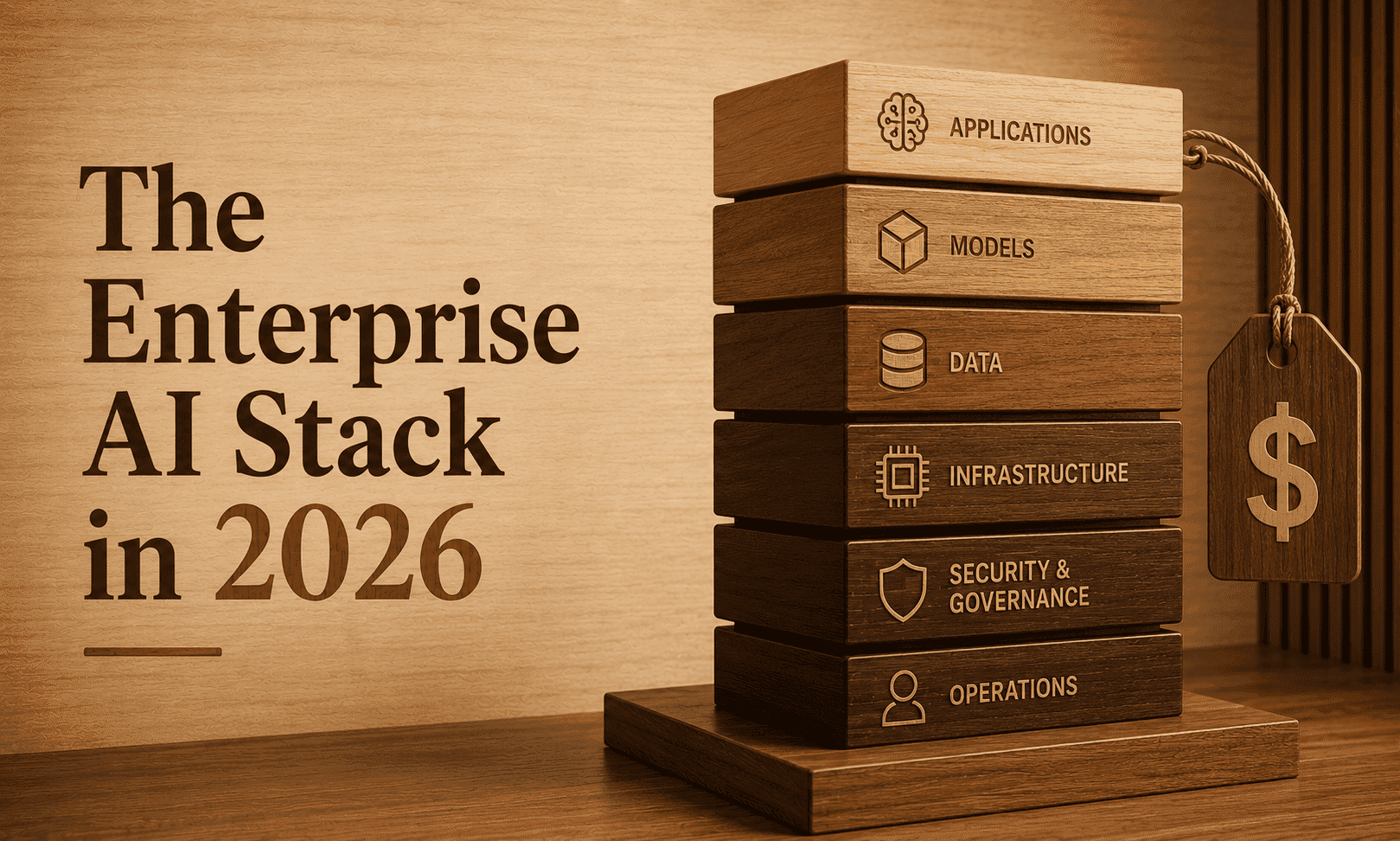
| Vector database and data layer | 25 to 40% | Included in integration estimate | Embedding storage, retrieval infrastructure |
| Integration and orchestration | 40 to 60% | 5,000 to 25,000 dollars per system | Number of systems connected, API maturity |
| Compliance and governance | 20 to 30% added in regulated industries | Varies by industry requirement | Security architecture, audit logging |
| Ongoing maintenance | 15 to 25% of build cost annually | Recurring, every year | Monitoring, retraining, infrastructure upkeep |
Table 2: Deployment cost by project scale
| Project type | Typical total cost | Monthly operating cost |
| Lightweight API integration | Under 5,000 dollars | 50 to 500 dollars |
| Simple chatbot agent | 5,000 to 20,000 dollars | 50 to 2,000 dollars |
| Enterprise autonomous agent platform | 200,000 dollars and above | 2,000 to 10,000 plus dollars |
| Full enterprise AI platform across products | 2 million to 5 million dollars plus | Scales with deployment breadth |
| IMAGE PROMPT BOXPrompt: A clean horizontal bar chart infographic comparing four AI project scales by total cost, from lightweight API integration on the left to full enterprise platform on the right, using a gradient from light to dark navy blue, minimalist financial chart style, white background, no readable axis numbers needed.Alt text: Enterprise AI deployment cost comparison 2026 from lightweight integration to full enterprise platformPlacement: After Table 2, before The business case section |
The Business Case: How to budget an AI deployment without getting it wrong by 2 to 4x
The single most effective correction enterprises can make to their AI budgeting process is moving integration and data infrastructure to the top of the estimate, not the bottom. Most internal proposals lead with model selection and API pricing, the cheapest and most predictable part of the entire stack, while integration, the most expensive and most variable part, gets addressed almost as an afterthought.
A practical planning rule worth adopting directly: for any AI feature reaching production, model the inference cost projection at 1x, 10x, and 100x current expected load before committing budget.
Many enterprise AI projects reach financial unviability within 18 months specifically because nobody modeled what the cost structure looks like once usage actually scales, rather than what it looked like during the pilot phase with a handful of test users.
Cost optimization techniques available in 2026 can meaningfully change the model layer’s share of total spend. Batch API discounts from providers like OpenAI and Anthropic offer roughly 50% savings for workloads that do not require real-time response, prompt caching can reduce input costs by around 40% for applications with repeated system prompts, and complexity-based model routing, sending simple tasks to smaller, cheaper models while reserving frontier models for genuinely complex reasoning, can cut model spend substantially without any loss in output quality for the bulk of requests.
Expert Nuance: The hidden cost layer nobody puts in the original proposal
Beyond the visible layers of model, data, and integration cost sits a less visible but equally real layer, the tooling and talent required to actually operate an enterprise AI system day to day.[Finout top 6 AI cost drivers GenAI cost examples 2026]
Organizations frequently rely on commercial platforms, AutoML tools, MLOps platforms, vector database services, embedding APIs, and orchestration frameworks like LangChain or LlamaIndex, to accelerate deployment and reduce raw engineering hours. Each of these carries its own licensing fees and usage-based charges that compound quickly once deployed across multiple departments or customer-facing systems.
AI adoption at meaningful scale also requires specialized talent across multiple roles, machine learning engineers, data scientists, data engineers, and MLOps professionals specifically, none of which typically show up as a line item in an initial AI project proposal built primarily around model and API costs. As covered in our ChatGPT vs Claude for business report, this talent and tooling layer is frequently the deciding factor in whether an enterprise builds AI capability in-house or buys it through an already-integrated enterprise platform instead.
Strategic Outlook
- Watch for vendors shifting more cost into the integration layer rather than the model layer: As model API pricing continues to fall through 2026 and 2027, expect AI vendors to increasingly compete on integration depth, prebuilt connectors, and governance tooling rather than on raw model price, since that is where the real budget now sits.
- The build versus buy decision will increasingly favor buy for mid-market enterprises: With integration alone often consuming 40 to 60% of a custom build’s budget, an already-integrated enterprise platform at a median 97,500 dollar annual contract becomes financially competitive against a custom build that can easily exceed 200,000 dollars before any ongoing maintenance is counted.
- Cost optimization techniques will become a standard line item in enterprise AI RFPs: Batch processing discounts, prompt caching, and complexity-based model routing are no longer advanced techniques reserved for sophisticated engineering teams. Expect enterprise buyers to start requiring vendors to demonstrate these optimizations are already built into their pricing rather than treating them as a customer-side responsibility.
Key Question Answered
What does an enterprise AI deployment actually cost in 2026?
An enterprise AI deployment in 2026 ranges from under 5,000 dollars for a lightweight API integration to over 500,000 dollars for a complex, fully integrated enterprise system, with the model itself rarely the dominant cost.
Integration and orchestration typically account for 40 to 60% of total build cost, since most deployments must connect to four to twelve existing systems at 5,000 to 25,000 dollars per connection. Vector database and data infrastructure adds another 25 to 40%, and compliance requirements in regulated industries add 20 to 30% on top of that. Annual maintenance afterward runs 15 to 25% of the original build cost every year. The median real-world enterprise AI contract, based on actual purchase data, sits at 97,500 dollars annually, and the most common budgeting failure is underestimating the gap between a working prototype and a production-ready deployment, a gap that has pushed individual project costs as high as 180,000 dollars beyond initial estimates.
The Takeaway
The enterprise AI cost conversation in 2026 has matured past the simple question of which model to use. The model is, almost without exception, the cheapest and most predictable layer in the entire deployment stack.
The layers that actually determine whether an AI project comes in on budget, integration depth, data infrastructure, compliance requirements, and the often-invisible cost of tooling and specialized talent, are exactly the layers most initial proposals underweight. The two to four times budget overruns documented across nearly every cost study cited here are not random. They are the predictable result of estimating the cheap layer carefully and the expensive layers casually.
For any enterprise building a 2026 AI budget, the practical fix is straightforward even if the execution is not: build the integration and data layer estimate first, in detail, before finalizing model selection, and model what the system costs at ten and one hundred times pilot-phase usage rather than assuming costs scale linearly with adoption. The organizations that do this consistently land within their original budget. The ones that lead with model selection and treat integration as a detail to resolve later are the ones contributing to the two to four times overrun statistic next year.