Will Cybersecurity Be Replaced by AI? 2026 Reality Check

The Brief
The Pulse Will cybersecurity be replaced by AI? The evidence in 2026 says no—but that answer hides a major change already underway. Artificial intelligence is automating alert triage, log analysis, vulnerability prioritization, report generation and basic threat hunting, which means some of the work that traditionally defined junior cybersecurity careers is disappearing or being redesigned. […]
Why It Matters
The story matters because it changes how buyers, builders, or policymakers should read the Enterprise AI market.
Watch Next
Watch whether the signal becomes a budget, procurement, or platform decision in the next cycle.
The Pulse
Will cybersecurity be replaced by AI? The evidence in 2026 says no—but that answer hides a major change already underway. Artificial intelligence is automating alert triage, log analysis, vulnerability prioritization, report generation and basic threat hunting, which means some of the work that traditionally defined junior cybersecurity careers is disappearing or being redesigned.
ISC2 surveyed 856 cybersecurity professionals who actively use AI in May 2026. A majority, 56%, said AI had somewhat or significantly reduced the need for entry-level cybersecurity positions during the previous year. Yet 53% also believed AI was creating new kinds of entry-level roles, while 62% said AI had not reduced the need for foundational cybersecurity skills. [ISC2 research on AI and cybersecurity roles]
The broader labor market points in the opposite direction from a cybersecurity collapse. The U.S. Bureau of Labor Statistics projects information security analyst employment to grow about 29% from 2024 to 2034, adding roughly 52,100 jobs and producing around 16,000 openings per year. BLS specifically says growing cyberattacks, new technologies and increased use of AI are contributing to demand for security professionals. [BLS information security analyst outlook]
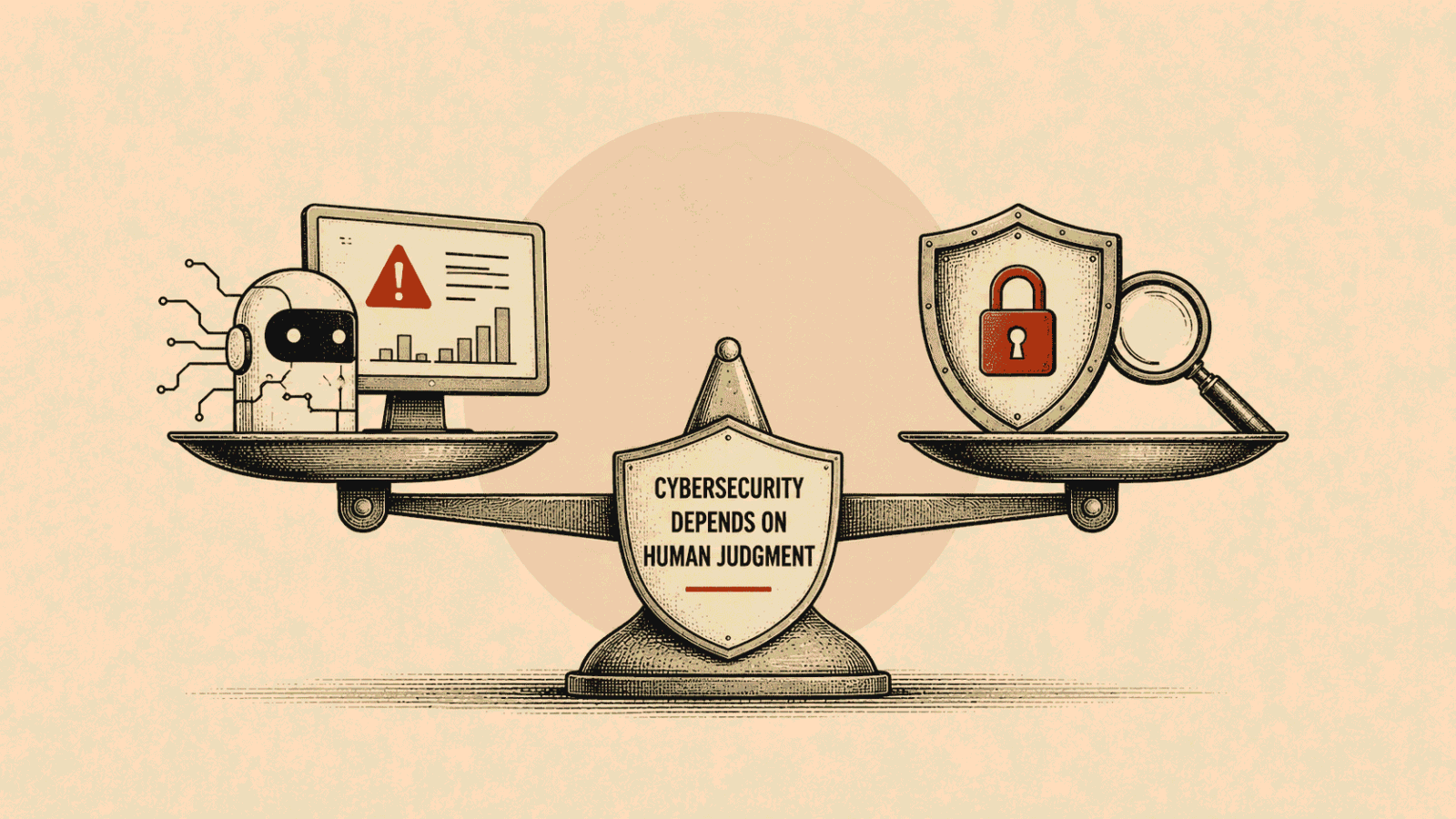
The contradiction is the real story. Cybersecurity demand can grow while the traditional cybersecurity career ladder becomes more automated. AI is not eliminating the profession. It is changing which tasks create value, which junior roles survive, and how people gain the experience required to become senior defenders.
Core Significance
Why it matters:
- AI is automating the traditional entry layer first: Alert triage, log review, indicator enrichment, report drafting and basic threat hunting are repetitive, information-heavy tasks that AI systems can increasingly perform or accelerate. Those same tasks historically gave junior analysts their first hands-on security experience.
- Cybersecurity demand is still growing: BLS projects information security analysts to be one of the fastest-growing occupations in the U.S. economy through 2034. AI itself contributes to that demand because every new model, agent, cloud system and automated workflow creates additional infrastructure that needs protection.
- AI creates verification work as it removes manual work: ISC2 found 65% of surveyed professionals were spending more time deciding when to trust or act on AI recommendations, while 63% were spending more time reviewing or validating AI outputs. Security teams increasingly need people who can determine when automation is wrong. [ISC2 AI role research]
Deep Context: AI is replacing security tasks before security jobs
The most useful way to answer whether cybersecurity will be replaced by AI is to stop treating a cybersecurity job as one indivisible activity.
A SOC analyst may review alerts, search logs, enrich indicators, compare activity with threat intelligence, decide whether an event is malicious, write an incident summary, escalate the case and recommend containment. AI can automate several of those steps without being capable of owning the entire incident.
The same pattern appears across vulnerability management, malware analysis, threat intelligence and incident response. AI can search faster, summarize more information and generate possible next actions. Humans still determine whether evidence is credible, whether the action is appropriate for the business and whether the consequences are acceptable.
As covered in our AI applications in cybersecurity 2026 analysis, security AI is moving beyond detection toward investigation, vulnerability discovery, remediation and bounded response. That makes the workforce question more important because AI is beginning to act rather than simply recommend.
The entry-level SOC is where AI pressure is strongest
Traditional security operations centers were built around human attention. Large numbers of alerts entered a queue, junior analysts investigated the obvious cases and escalated the harder ones to more experienced responders.
That structure made L1 SOC work repetitive, but it also made it valuable as training. Reviewing hundreds of false positives teaches analysts what normal behavior looks like. Investigating suspicious identities builds intuition around attacker behavior. Reconstructing simple incidents builds the mental models required for complex ones.
ISC2 says many of those entry-level tasks—including alert triage, log analysis, report generation, vulnerability prioritization and basic threat hunting—are increasingly being performed or accelerated by AI tools. That helps explain why 56% of its surveyed AI-using cybersecurity professionals reported reduced need for entry-level positions. [ISC2 entry-level cybersecurity findings]
The likely outcome is not the disappearance of the junior analyst. It is a different junior analyst. Instead of spending most of the day manually processing alerts, an entry-level professional may supervise AI-generated investigations, verify evidence, test detections, investigate exceptions and escalate cases where the model’s confidence breaks down.
The cybersecurity apprenticeship model is being compressed
This creates a deeper workforce problem. Cybersecurity expertise traditionally developed through exposure.
A common career path moved from help desk or system administration into junior SOC work, then incident response, detection engineering, architecture or leadership. Early-career professionals learned through repetitive interaction with real systems and real incidents.
An ISC2 analysis describes this as a collapsing apprenticeship model. Log triage, alert validation and basic investigation—the work that once allowed junior professionals to build pattern recognition—are precisely the tasks being automated first. [ISC2 cybersecurity roles re-platforming analysis]
The survey data already shows uncertainty around this effect. Thirty-seven percent of respondents said AI had reduced hands-on learning opportunities in their workplace, while 36% said it had not. The profession therefore faces a training problem even if total employment continues to grow.
Companies cannot assume future security architects and incident commanders will acquire judgment automatically if AI performs most of the investigations that used to develop it. AI-era cybersecurity teams will need deliberate simulations, labs, mentoring, red-team exercises and structured exposure to incidents.
AI replaces execution faster than accountability
The strongest reason cybersecurity is difficult to replace completely is not that humans can process more security data than AI. They cannot. It is that organizations still need someone accountable for consequential decisions.
ISC2 found that 89% of surveyed cybersecurity professionals had encountered AI recommendations that led to incorrect outcomes at their organizations. When an AI-recommended action produced the wrong result, 50% said human decision-makers were ultimately held accountable. [ISC2 AI accountability findings]
That distinction becomes more important as security tools become autonomous.
An AI copilot may recommend disabling an account. An autonomous security agent may actually disable it. The same system may isolate a production server, change a firewall rule, revoke credentials, patch software or modify cloud resources.
The cost of a wrong recommendation is therefore no longer just analyst time. Automation can scale the wrong decision across systems before a human understands what happened.
ISC2 found the biggest concerns around autonomous security AI were over-reliance on AI recommendations at 62%, undetected errors scaling rapidly at 61%, and reduced human judgment at critical decision points at 56%. [ISC2 autonomous security AI concerns]
As covered in our AI enterprise governance 2026 analysis, the deeper AI moves into operational execution, the more permissions, auditability and human override become part of the system architecture rather than optional governance layers.
Which cybersecurity tasks will AI automate first?
The highest-exposure cybersecurity tasks share several characteristics: high volume, repeatability, standardized inputs and outputs that can be independently verified.
Alert enrichment is an obvious example. An AI system can retrieve domain reputation, IP history, identity activity and related endpoint events much faster than a person switching between several tools manually.
Routine log correlation is similarly exposed. Models can search large telemetry datasets, identify related events and build an initial incident timeline without requiring an analyst to manually reconstruct every step.
Report generation, vulnerability prioritization and first-pass malware explanations are also increasingly automatable because the AI output can be reviewed before a consequential action occurs.
That does not mean these tasks become completely unsupervised. The likely model is machine-first processing followed by human validation for exceptions, uncertainty and high-impact cases.
Which cybersecurity roles are harder to replace?
Roles become harder to automate as they require more context, adversarial reasoning, cross-functional coordination and accountability.
Incident commanders must decide whether to shut down systems, involve legal teams, notify regulators, communicate with executives and balance containment against business continuity. Those decisions combine technical evidence with operational, financial and legal consequences.
Security architects face a similar challenge. Designing identity systems, cloud controls, segmentation, security boundaries and resilience strategies requires trade-offs between usability, cost, business requirements and threat models that change by organization.
Detection engineers may use AI to generate queries or suggest rules, but humans still need to understand what behavior should be detected, what false positives are acceptable and how attackers might evade the control.
Cybersecurity leadership is even more resistant to full automation because a CISO is accountable for risk decisions, budgets, regulatory communication, crisis leadership and business priorities rather than simply processing security information.
AI is also creating entirely new cybersecurity work
AI does not only automate existing cybersecurity tasks. It creates new systems that must themselves be secured.
Enterprise AI agents introduce risks around prompt injection, tool permissions, identity, memory, model supply chains, sensitive retrieval data and autonomous actions. AI application security therefore adds workloads that barely existed in traditional security programs.
This creates emerging roles around AI red teaming, model security, agent permission design, AI governance, runtime monitoring, prompt-injection testing, AI incident response and validation of AI-generated security decisions.
ISC2 found 53% of respondents already believed AI was creating new kinds of entry-level cybersecurity roles. Its broader workforce analysis also argues that demand is shifting toward professionals capable of designing, supervising and governing intelligent security systems. [ISC2 emerging cybersecurity roles]
The future entry-level question may therefore change from “Can you manually triage this alert?” to “Can you determine whether the AI that triaged this alert is wrong?”
Data Insights
By the numbers:
The figures below measure different things: perceptions from cybersecurity professionals, U.S. occupational projections and cybersecurity job-posting demand. They should not be combined into a single forecast of cybersecurity employment.
- 56% say AI reduced the need for entry-level cybersecurity positions: ISC2’s May 2026 survey asked 856 cybersecurity professionals who use AI about its effect during the previous year. Only 12% said AI had increased the need for traditional entry-level positions. [ISC2 2026 AI workforce survey]
- 53% believe AI is creating new types of entry-level cybersecurity roles: The same research suggests entry-level demand may be changing rather than simply disappearing.
- 62% say foundational cybersecurity skills remain necessary: Only 26% of surveyed professionals believed AI had reduced the need for cybersecurity fundamentals, reinforcing the importance of networking, systems, identity, security architecture and attacker behavior.
- 89% had encountered incorrect AI security recommendations: ISC2 found that only just over one in ten had not yet encountered an AI recommendation leading to an incorrect outcome at their organization.
- Information security analyst employment is projected to grow about 29% through 2034: BLS projects employment to rise from approximately 182,800 workers in 2024 to 234,900 in 2034, adding roughly 52,100 positions. [BLS cybersecurity employment projections]
- CyberSeek reports more than 514,000 U.S. cybersecurity job listings in its reporting period: About 10% of cybersecurity postings explicitly reference AI skills, showing that AI is beginning to become part of the cybersecurity hiring profile rather than simply a technology used to reduce staffing. [CyberSeek cybersecurity workforce data]
Table 1: Cybersecurity jobs and AI automation exposure
| Role or task | AI exposure | What AI can automate | Human value that remains |
| L1 SOC alert triage | Very high | Correlation, enrichment, prioritization and summaries | Validate uncertain cases and recognize model errors |
| Log correlation | Very high | Search telemetry and reconstruct initial timelines | Interpret context and determine significance |
| IOC enrichment | Very high | Reputation checks, threat-intelligence retrieval and classification | Determine whether evidence changes incident severity |
| Vulnerability triage | High | Prioritize findings, validate reachability and suggest fixes | Assess business exposure and remediation risk |
| Security reporting | High | Draft incident summaries and recurring reports | Verify conclusions and communicate business implications |
| Threat hunting | Medium-high | Generate queries, correlate telemetry and search intelligence | Form adversarial hypotheses and challenge assumptions |
| Penetration testing | Medium-high | Generate tests, inspect code and accelerate exploitation research | Design attack paths, control scope and interpret business impact |
| Incident response | Medium | Build timelines and recommend or execute bounded actions | Make consequential containment and recovery decisions |
| Detection engineering | Medium | Generate queries and suggest detection logic | Design coverage and understand attacker evasion |
| Security architecture | Lower | Analyze configurations and propose patterns | Balance business, technical and adversarial trade-offs |
| AI and agent security | Growing field | AI assists testing and monitoring | New security work created by AI deployment itself |
| CISO and security leadership | Low replacement exposure | AI supports analysis and reporting | Strategy, accountability, crisis leadership and risk ownership |
Table 2: How the cybersecurity career ladder changes with AI
| Career stage | Traditional SOC work | AI-era SOC work | Skill that becomes more important |
| Entry level | Review alerts, search logs and enrich indicators | Validate AI triage, investigate exceptions and test outputs | Cyber fundamentals and AI verification |
| Junior analyst | Investigate incidents and prepare reports | Supervise AI investigations and tune detection workflows | Evidence validation and detection logic |
| Senior analyst | Handle complex incidents and mentor junior staff | Overrule AI, manage edge cases and supervise autonomous workflows | Adversarial reasoning and institutional context |
| Incident responder | Build timelines and execute containment manually | Direct AI-assisted investigations and approve high-impact response actions | Incident command and business judgment |
| Engineer or architect | Build controls and security architecture | Design AI-enabled controls, agent permissions and automated defense systems | Systems design and security architecture |
| Security leader | Manage teams, risk and security strategy | Govern human-plus-AI security operations and accept AI-related risk | Accountability, governance and strategic judgment |
The Business Case: How security teams should redesign jobs around AI
The wrong workforce strategy is to identify every security task AI can perform and immediately convert that percentage into a headcount reduction target.
Security operations are not a production line where every task carries the same consequence. Automating alert enrichment has a very different risk profile from automating account shutdowns, firewall changes or production containment.
The first step should be task decomposition. Security leaders need to separate repetitive information-processing work from judgment-heavy actions and determine where AI can safely become machine-first.
Alert correlation, enrichment, report drafting and routine vulnerability prioritization are strong automation candidates because human analysts can review the result before it creates material impact.
The second step is creating explicit decision boundaries. AI can investigate aggressively while organizations remain conservative about what it can execute. High-impact response actions should have defined permission levels, evidence requirements and escalation rules.
The third step is redesigning entry-level development. Junior analysts should spend less time manually copying indicators between tools, but they still need exposure to raw logs, packet data, identity events, cloud activity and real incidents so they understand what AI-generated conclusions actually mean.
The fourth step is measuring outcomes rather than automation volume. AI should reduce alert backlogs, investigation time, false positives and mean time to respond. If the organization simply handles more alerts while analysts spend increasing amounts of time correcting AI mistakes, the automation has not improved the security operation.
The fifth step is protecting senior expertise. AI-enabled teams may need fewer people performing mechanical triage, but they become more dependent on professionals who have enough experience to recognize when automation is confidently wrong.
ISC2’s workforce analysis argues that experience density becomes a security control in an AI-enabled SOC because senior professionals provide the judgment required to distinguish real breaches from unusual but legitimate behavior. [ISC2 AI-era security workforce analysis]
Expert Nuance: The real risk is losing the people who can overrule AI
The cybersecurity workforce debate often assumes automation and human expertise are substitutes. In practice, greater automation can make experienced human judgment more important.
AI systems can correlate millions of signals, but they do not carry the organization’s institutional memory. They may not know that an unusual login is expected because a merger team is working overnight, that a supposedly vulnerable system is isolated behind a compensating control, or that shutting down one application will interrupt a critical business process.
That context matters most precisely when the automated system is uncertain or wrong.
ISC2 found 65% of professionals were spending more time deciding when to trust AI recommendations and 63% more time validating AI outputs. Eighty-two percent considered knowing when to trust AI very important, while 80% said knowing when to override or ignore an AI recommendation was very important. [ISC2 trust and verification findings]
This suggests a different definition of future cybersecurity expertise. The valuable professional is not necessarily the person who can manually process security data faster than AI. It is the person who understands the systems well enough to recognize when AI is misreading them.
That makes fundamentals more important, not less. Networking, operating systems, cloud architecture, identity, application security, incident response and attacker behavior become the knowledge layer that lets professionals challenge an AI-generated conclusion instead of accepting it because it sounds convincing.
The strongest long-term moat may therefore be the ability to combine technical depth with adversarial reasoning and accountability.
Strategic Outlook
- Watch L1 SOC roles change before senior roles disappear: The first major workforce effect is likely to be fewer positions centered entirely on alert processing and more entry-level roles focused on validating AI, investigating exceptions and tuning automated detections.
- Watch AI skills become part of baseline cybersecurity hiring: CyberSeek currently reports that about 10% of cybersecurity job postings explicitly mention AI skills. That share should become more important as AI moves deeper into security operations. [CyberSeek workforce data]
- Watch AI security become a new career track: Prompt injection, model security, agent identity, AI supply chains, runtime monitoring and autonomous-action controls create security problems that traditional SOC programs were not designed to manage.
- Watch security teams hire for judgment rather than alert throughput: If machines perform more first-pass analysis, hiring assessments will increasingly test whether candidates can validate evidence, reason about attacker behavior and understand system context.
- Watch apprenticeship become deliberate rather than incidental: Security teams will need labs, simulations, attack exercises and structured mentorship to replace some of the hands-on learning that junior analysts previously gained from repetitive operational work.
- Watch autonomous defense increase demand for accountability: The more authority security agents receive, the more organizations will need humans responsible for permission design, overrides, incident review and explaining why automated decisions were allowed.
Key Question Answered
Will cybersecurity be replaced by AI?
No. Current evidence does not suggest that AI will replace cybersecurity as a profession. The U.S. Bureau of Labor Statistics still projects information security analyst employment to grow about 29% between 2024 and 2034, adding roughly 52,100 jobs.
AI is, however, replacing or accelerating specific cybersecurity tasks. Alert triage, log analysis, indicator enrichment, report generation, vulnerability prioritization and basic threat hunting are among the most exposed activities.
The biggest near-term impact is likely to be on entry-level cybersecurity work. ISC2 found 56% of AI-using security professionals believed AI had reduced the need for entry-level positions, while 53% believed it was simultaneously creating new kinds of junior roles.
The likely future is therefore not cybersecurity without humans. It is a cybersecurity workforce where machines perform more repetitive detection and investigation while humans increasingly validate AI outputs, design security systems, manage incidents, supervise autonomous agents and remain accountable for consequential decisions.
FAQ
1. Will cybersecurity jobs be replaced by AI?
Some cybersecurity tasks and narrowly defined roles will face automation pressure, especially repetitive alert triage, log analysis and routine reporting. However, current U.S. employment projections still show strong growth for information security analysts, suggesting the profession is changing rather than disappearing.
2. Which cybersecurity jobs are most at risk from AI?
Roles centered mainly on high-volume, repetitive information processing are most exposed. L1 SOC triage, basic indicator enrichment, routine log correlation, first-pass vulnerability prioritization and standardized reporting can increasingly be automated or heavily AI-assisted.
3. Which cybersecurity jobs are safest from AI?
No cybersecurity role is completely insulated from AI, but security architecture, incident command, detection engineering, risk leadership, cloud security design and CISO-level roles are harder to replace because they require organizational context, adversarial reasoning, trade-offs and accountability.
4. Is cybersecurity still a good career in the AI era?
Current labor data suggests cybersecurity remains a strong growth field. BLS projects information security analyst employment to grow about 29% through 2034, while CyberSeek continues to report substantial U.S. cybersecurity hiring demand. The skill mix is changing, however, with AI literacy becoming increasingly valuable.
5. Can AI completely replace a SOC analyst?
AI can automate large parts of SOC analysis, including alert correlation, enrichment, summaries and investigation preparation. But consequential incidents still require humans to validate evidence, interpret business context, decide containment actions and accept responsibility when automated recommendations are wrong.
6. What cybersecurity skills should people learn for the AI era?
Strong fundamentals remain critical: networking, operating systems, cloud security, identity, application security, incident response and attacker techniques. Professionals should add AI-system security, model validation, agent permissions, prompt-injection defense and the ability to verify AI-generated security conclusions.
The Takeaway
AI is unlikely to replace cybersecurity. It is replacing parts of how cybersecurity work has traditionally been done.
The mechanical layer is moving first. Alert triage, log correlation, indicator enrichment, vulnerability prioritization and report drafting increasingly belong to machines because those tasks reward speed and scale.
The human layer moves upward. Security professionals increasingly need to challenge AI outputs, understand attacker behavior, design resilient systems, manage incidents and decide when an automated action creates more risk than the threat it is trying to stop.
That creates a real challenge for entry-level cybersecurity. AI can automate the work that historically trained junior analysts, which means companies must rethink how the next generation gains enough experience to supervise increasingly autonomous security systems.
But the evidence does not support the disappearance of the profession. Cybersecurity employment is still projected to grow rapidly, AI creates new infrastructure that needs protection, and more autonomous security tools increase rather than eliminate the need for accountability.
The future cybersecurity professional will not win by trying to process alerts faster than AI. The durable advantage will be knowing when the AI is wrong, understanding why it is wrong, and having the technical judgment and authority to decide what happens next.
“`