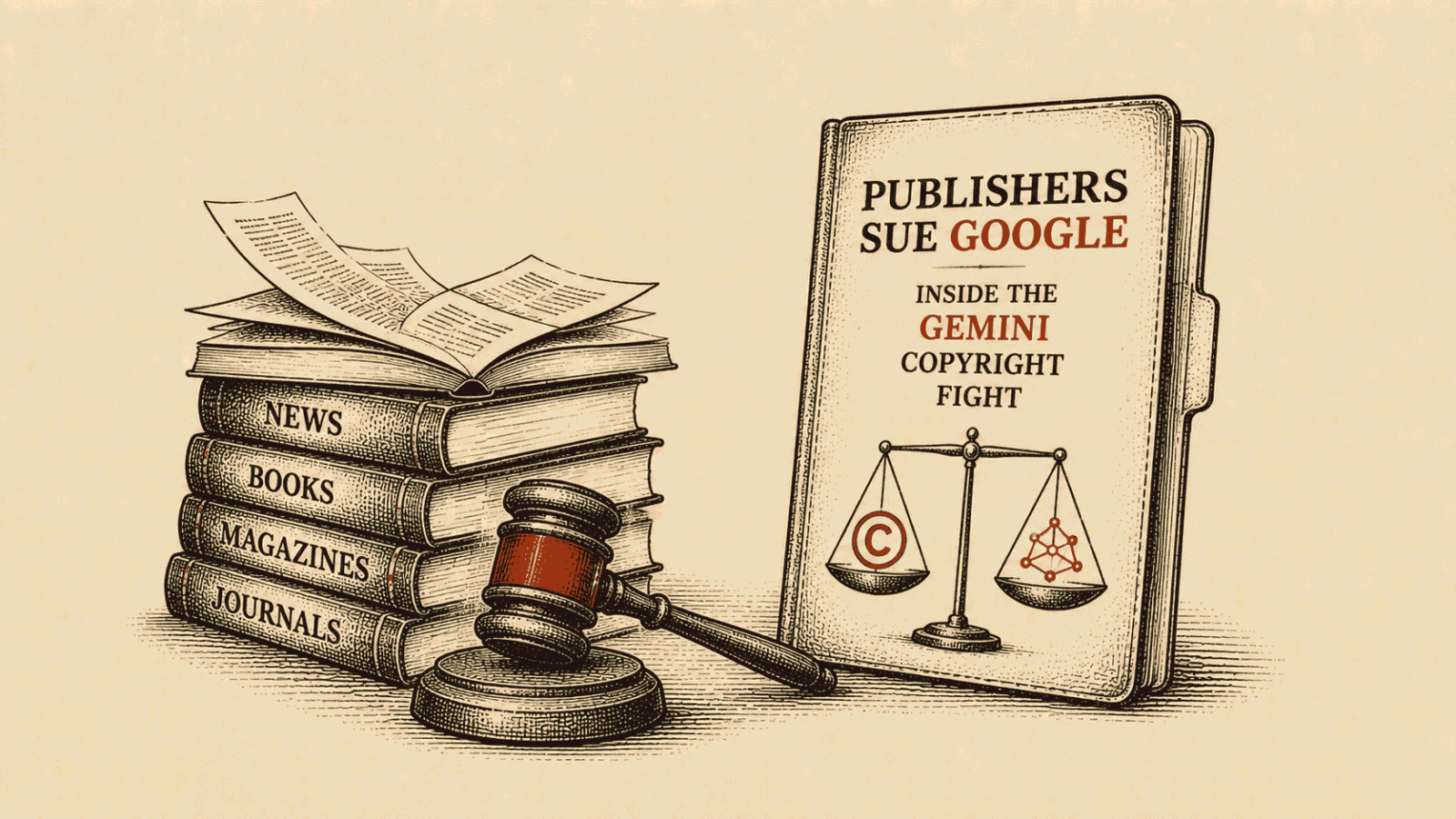
Publishers Sue Google: Inside the Gemini Copyright Fight

The Pulse
Hachette Book Group, Cengage Learning, Elsevier, bestselling author Scott Turow, and his rights-holding company S.C.R.I.B.E. have filed a proposed class action against Google over the development of Gemini. Filed on July 10, 2026, in the Southern District of New York, the complaint alleges that Google copied millions of books and journal articles without permission to assemble training material for its commercial AI models. [CNET publishers sue Google over Gemini copyright claims]
The lawsuit is not limited to the familiar claim that an AI company scraped copyrighted material from the open web. Its most consequential allegation is that Google reused books supplied for specific, limited services, including Google Books, Google Play Books, and Google Scholar, for a separate commercial purpose that authors and publishers say they never authorized. Publishers sue Google is now at the center of AI debates.
That distinction puts a twenty-year relationship between Google and the publishing industry back under legal scrutiny. The plaintiffs are asking a court to decide whether copies accepted or protected for search, snippets, retail distribution, and scholarly discovery could lawfully become inputs for a generative system capable of producing summaries, replacement textbook passages, and imitation books. The complaint contains allegations that Google is expected to contest, and no court has yet ruled on their merits.
Core Significance
Why It Matters:
• The case alleges that Google recognized the legal danger before proceeding: The complaint cites internal analyses describing the use of publisher-provided Google Play Books content for AI as highly problematic and warning of potential exposure in the tens of billions to hundreds of billions of dollars. It also alleges that internal reviewers identified restrictive licenses, publisher sensitivity, and heightened fair use risk before the disputed copying occurred. [Hachette v. Google class action complaint]
• The plaintiffs are attacking the full data pipeline, not only Gemini outputs: Their claims cover the initial acquisition of works, repeated copying into machine-readable formats and training sets, movement of material from one model generation to another, and alleged removal or alteration of copyright management information. That structure gives the case several legal routes even if a court rejects one part of the theory.[Hachette publishers and authors lawsuit announcement]
• The separate filing appears designed to preserve a broader class before time limits become a problem: Hachette and Cengage had previously tried to join an older Google generative AI lawsuit filed by writers and illustrators. They withdrew that effort and filed a new case after identifying a risk that Google could invoke a three-year limitations period against claims that might fall outside the earlier proposed class. [Publishers Weekly publishers and authors file Google class action]
Deep Context: Google Books is Back at the Center of a Copyright Fight
The dispute began taking shape publicly in January 2026, when Hachette and Cengage asked to intervene in an existing California case against Google. Their proposed complaint already argued that Gemini had been trained on books from authors including Scott Turow and N.K. Jemisin without permission. The July filing moves that conflict into a standalone New York class action and adds Elsevier, scholarly publications, and a more detailed set of claims about Google-controlled book repositories.[Reuters publishers seek to join Google AI training lawsuit]
The timing also reflects a broader escalation across the sector. As covered in our AI Copyright Lawsuit Tracker, book authors, news organizations, visual artists, music companies, and publishers are now testing different parts of the AI training pipeline in parallel. The Google case is distinctive because it combines alleged web scraping and piracy with a claim that Google repurposed material obtained through long-standing commercial and library relationships.
The 2015 Google Books Victory Does Not Automatically Resolve the New Case
Google won the defining Google Books case in 2015 when the Second Circuit held that scanning complete books to create a searchable index and display limited snippets was fair use. The court emphasized that the service served a different, highly transformative purpose and did not provide a meaningful substitute for reading the books themselves. The new plaintiffs are trying to separate Gemini from that precedent by arguing that generative outputs can compete with the original works rather than simply help users locate them.[Authors Guild v. Google Second Circuit opinion]
That does not mean the publishers have already defeated Google’s likely fair use defense. The earlier decision remains powerful precedent for the idea that complete copying can be lawful when technically necessary for a new information tool. The central question is whether training and deploying Gemini is sufficiently different in purpose and market effect from a searchable book index, especially where the complaint alleges that the system can reproduce, summarize, or imitate protected expression.
Data Insights
By the Numbers:
Figures below are drawn from the complaint, court reporting, and named publishing-industry sources cited inline.
• 20 minutes and 39 cents is the complaint’s most direct market-substitution example: The publishers allege that Gemini can produce a 100-page murder mystery based on a detailed prompt in roughly twenty minutes at a stated cost of thirty-nine cents, an example they use to argue that AI-generated books can enter the same market at a speed and price no traditional author or publisher can match.[Publishing Perspectives publishers sue Google over Gemini]
• The 1.5 billion dollar Anthropic settlement is now the clearest financial benchmark in book-training litigation: The 2025 agreement created a fund equal to about 3,000 dollars for each of approximately 500,000 downloaded books and required destruction of the disputed copies. Although the legal theories and facts are not identical, publishers suing Google now have a concrete settlement benchmark that did not exist when the earliest AI copyright cases were filed.[Reuters Anthropic 1.5 billion dollar author settlement]
• The same publishing coalition is already pursuing a parallel case against Meta: Hachette, Cengage, Elsevier, Macmillan, McGraw Hill, and Scott Turow sued Meta in May 2026 over alleged use of millions of books and journal articles to train Llama. The Google filing therefore looks less like an isolated dispute and more like a coordinated enforcement strategy aimed at establishing common rules across the largest model developers.[Reuters major publishers sue Meta over AI training]
Table 1: From Google Books to the Gemini Lawsuit
| Year or Date | Development | Parties | Why It Matters |
| 2005 | Authors and publishers sue over Google Books scanning | Authors Guild, publishers, Google | Begins the first major fight over Google copying complete books |
| October 2015 | Second Circuit affirms Google Books as fair use | Authors Guild, Google | Protects search indexing and limited snippet display |
| December 2023 | Google launches the first Gemini models | Turns Google from search indexer into a major generative AI provider | |
| January 15, 2026 | Hachette and Cengage seek to join an existing AI case | Publishers, Google | Signals that major publishers intend to challenge Gemini training |
| May 5, 2026 | Publishers file a parallel training-data case against Meta | Publishers, Scott Turow, Meta | Shows a coordinated litigation strategy across model developers |
| July 10, 2026 | New proposed class action filed in New York | Hachette, Cengage, Elsevier, Turow, Google | Places Google Books, Play Books, Scholar, and web scrapes in one case |
Table 2: What the Publishers Are Asking the Court to Order
| Relief Sought | What It Would Require | Potential Business Effect |
| Class certification | Allow authors and publishers with qualifying registered works to proceed together | Could multiply the number of works and potential damages |
| Permanent injunction | Stop unlawful copying and use of protected works | May require changes to training, data retention, or model development |
| Statutory or actual damages | Pay copyright and DMCA damages, or proven losses and profits | Creates potentially material financial exposure |
| Training-data accounting | Identify works, collection methods, training methods, and third parties | Would force unusual transparency into Gemini development |
| Destruction of copies | Delete infringing copies under court supervision and report compliance | Could require data remediation or reconstruction of training assets |
The Business Case: Why the Lawsuit Matters Beyond Publishing
For publishers, the case is an attempt to convert content provenance from a policy preference into a legally enforceable requirement. The plaintiffs are not merely demanding compensation for past use. They are asking for an accounting of the materials, methods, and third parties involved in Gemini training, plus supervised destruction of unauthorized copies. If granted, those remedies would make data lineage a board-level operational obligation rather than an internal research detail.
The lawsuit also strengthens the commercial argument for the emerging AI content licensing market. Every major settlement, injunction request, or discovery order creates a clearer price for lawful access. Publishers that once treated AI licensing as experimental can now compare negotiated revenue with the cost, uncertainty, and delay of litigation.
For AI companies, the immediate lesson is that possession of a useful dataset does not settle the question of permissible use. Material obtained for search, retail, scholarship, library access, or another product may carry purpose-specific restrictions that survive long after the files enter a company’s infrastructure. The more vertically integrated the platform, the more carefully it must separate the rights attached to each data source.
Enterprise customers should read the case as a vendor-risk signal. A court order requiring disclosure, deletion, retraining, or limits on particular outputs could affect model availability, pricing, or product roadmaps. Procurement teams do not need to decide whether the publishers will win, but they do need contractual answers on indemnity, provenance controls, model substitution, and continuity if a core AI supplier is forced to change its training stack.
Expert Nuance: The Real Legal Test Is Use by Use, Not AI Training in the Abstract
The US Copyright Office has rejected a single blanket answer to whether AI training is fair use. Its 2025 report says different acts in development and deployment must be analyzed separately, including dataset creation, pretraining, fine-tuning, retrieval, and outputs. It also notes that commercial purpose, access to pirated copies, the expressive nature of books, market substitution, and an emerging licensing market can all affect the balance.[US Copyright Office generative AI training report]
That framework explains why this case is broader than the question of whether a model may learn statistical patterns from text. The publishers have pleaded several distinct acts of copying and several distinct harms. Google could potentially prevail on one stage, such as intermediate training, while still face exposure on another, such as unauthorized acquisition, removal of copyright information, or outputs that reproduce protectable expression.
The Google Books history makes the dispute unusually difficult for both sides. Google can point to a major appellate decision recognizing the public benefit of large-scale book digitization. The publishers can respond that the earlier ruling depended on limited snippets and a non-substitutive search function. The outcome may therefore turn less on whether Gemini is innovative and more on the exact purpose, source, safeguards, and market effect of each disputed copy.
Strategic Outlook
1. Watch whether Google attacks class scope before the court reaches fair use: The proposed class spans registered books with ISBNs and journal articles identified by standard serial numbers, while the complaint alleges multiple sourcing routes and multiple generations of Gemini. Google may argue that ownership, registration, data inclusion, model version, and output evidence vary too widely for one class to proceed together.
2. Expect discovery over Google Books and Play Books permissions to become the first major pressure point: The most commercially sensitive question is whether Google reused partner-provided files outside the purposes for which they were supplied. Contract language, internal access controls, data inventories, and records of model training decisions could matter before a court ever decides the broadest fair use questions.
3. Watch for a licensing offer or settlement structure before an injunction ruling: The Anthropic settlement has already created a per-title benchmark, while publishers are building recurring licensing businesses with other AI companies. A negotiated data license, compensation fund, or provenance program could reduce the risk of a disruptive ruling while still giving publishers a market-based victory.
The business stakes are amplified by Gemini’s expanding reach across search, productivity, mobile devices, and cloud services. Our Google I/O 2026 analysis explains why a legal constraint on Gemini training or outputs would affect a much larger platform strategy than a standalone chatbot product.
Key Question Answered
Why Are Publishers Suing Google Over Gemini?
Hachette, Cengage, Elsevier, Scott Turow, and S.C.R.I.B.E. are suing Google because they allege the company copied millions of copyrighted books and journal articles without permission to build and train Gemini. Their case covers works allegedly sourced from Google Books, Google Play Books, Google Scholar, web scrapes, paywalled material, and known pirate sources. They also claim Google repeatedly copied the material during model development and removed or altered copyright management information.
The plaintiffs argue that Gemini does not merely analyze the works internally. According to the complaint, it can produce verbatim or near-verbatim passages, detailed summaries, replacement textbook sections, and low-cost imitation books that compete with the originals. They seek class certification, damages, an injunction, disclosure of Gemini training materials and methods, and destruction of unauthorized copies. Google has not yet litigated its defenses in the new case, and the allegations remain unproven.
The Takeaway
The publishers’ lawsuit against Google is the clearest attempt yet to separate the legal protection Google won for book search from the far broader commercial use of books in generative AI. The case asks whether a company that lawfully or defensibly held complete digital copies for one limited function can repurpose those same files to build a system that creates new text on demand.
That question matters because Google is not an AI startup assembling data from a single disputed archive. It operates search, books, retail, scholarship, cloud infrastructure, and one of the world’s largest generative AI platforms. The plaintiffs are effectively arguing that vertical integration gave Google a unique data advantage and that the company crossed legal boundaries when it carried that advantage from one service into another.
Whatever the court ultimately decides, the case raises the standard for data governance across the AI industry. Model developers will need to know not only where content came from, but why it was originally collected, what permissions travelled with it, whether copyright information was preserved, and whether outputs compete with the underlying market. The era of treating all accessible text as one interchangeable training corpus is moving rapidly toward legal, contractual, and financial accountability.