Sovereign AI 2026: The $100 Billion Race Every Government is Now Running

The Brief
The Pulse At the World Economic Forum in Davos on January 21, 2026, Nvidia CEO Jensen Huang told world leaders that AI is now as essential as electricity and roads. He urged every country to build its own. France had already announced €109 billion in AI investment. Saudi Arabia had deployed 200,000 Nvidia GPUs through […]
Why It Matters
The story matters because it changes how buyers, builders, or policymakers should read the AI Policy and Power market.
Watch Next
Watch whether the signal becomes a budget, procurement, or platform decision in the next cycle.
The Pulse
At the World Economic Forum in Davos on January 21, 2026, Nvidia CEO Jensen Huang told world leaders that AI is now as essential as electricity and roads. He urged every country to build its own. France had already announced €109 billion in AI investment. Saudi Arabia had deployed 200,000 Nvidia GPUs through its HUMAIN programme. India had partnered with the UAE to build AI infrastructure on its own soil specifically to bypass Amazon, Microsoft, and Google. The sovereign AI movement, which was a policy aspiration in 2024, crossed $100 billion in committed global spending in 2026.
Sovereign AI refers to a nation’s domestic capability to produce artificial intelligence using its own infrastructure, data, workforce, and business networks. The goal is control over language, culture, and data rather than dependence on a small number of US frontier labs. For enterprise technology buyers, the sovereign AI movement is not an abstract geopolitical story. It is reshaping cloud procurement decisions, AI vendor selection criteria, and data residency requirements across every major economy outside the United States.
Core significance
Why it matters:
- Every G20 government now has a sovereign AI strategy: In 2024 sovereign AI was a stated aspiration for a handful of advanced economies. By 2026 it is a budget line in most of the G20 and a stated strategic priority of every government with the fiscal capacity to fund one, according to PDPSpectra’s June 2026 analysis of national AI programmes. The shift from aspiration to procurement is the defining change. Governments are not just passing AI laws. They are buying GPUs, funding frontier model companies, and building data centres.[PDPSpectra — Sovereign AI 2026 national programmes full map]
- The rationale has three parts that reinforce each other: First, supply-chain risk: dependence on a small number of US frontier labs and the narrow set of GPU exporters that supply them is strategically uncomfortable for sovereign decision-makers. Second, data sovereignty: language, cultural context, and regulatory compliance argue for nationally controlled training data and inference. Third, economic opportunity: AI is projected to generate trillions in productivity gains and governments that control their AI infrastructure capture more of that value domestically.[CNAS — The rising tide of sovereign AI analysis]
- Jensen Huang has become the most visible advocate for national AI infrastructure: NVIDIA’s business model depends on sovereign AI. Every national data centre programme is a GPU procurement event. Huang has made the geopolitical case at Davos, at the World Governments Summit in Dubai, and in direct conversations with heads of state. His January 2026 Davos statement that AI is ‘the largest infrastructure build-out in human history’ and that every nation must build its own was the clearest public crystallisation of a trend that had been building for three years.[Fortune — Jensen Huang Davos sovereign AI largest infrastructure build January 2026]
Deep context: From Bletchley to HUMAIN in 18 months
The sovereign AI movement has three distinct phases that explain how quickly the policy conversation translated into capital commitments. Phase one, from 2022 to 2023, was the regulatory phase. The EU AI Act, the UK AI Safety Institute, and the Bletchley Declaration established that governments needed to engage with AI governance. The dominant question was how to regulate AI developed by US companies.
Phase two, in 2024, was the industrial policy phase. France’s backing of Mistral AI, Canada’s investment in Cohere, and the UAE’s G42 partnership with Microsoft signalled that governments were moving from regulating US AI to building competing domestic capability. The European Commission’s EuroStack framework gave this industrial policy a continental architecture.
Phase three, in 2025 and 2026, is the infrastructure phase. France announced €109 billion in AI investment at the February 2025 AI Action Summit, the most ambitious sovereign AI programme outside the US and China. Saudi Arabia launched HUMAIN as a wholly owned Public Investment Fund subsidiary and announced a 200,000-GPU partnership with Nvidia in November 2025. India launched a $1.25 billion national AI programme and partnered with the UAE’s G42 to deploy Cerebras supercomputers on Indian soil to break what India explicitly characterised as the cloud monopoly of American big tech.
As covered in our AWS vs Azure vs Google Cloud AI analysis, the EU AI Act’s August 2026 enforcement deadline is already reshaping enterprise procurement. The sovereign AI infrastructure coming online in France, Germany, and the UAE gives enterprises in those markets credible non-US alternatives for the first time.
Data insights
By the numbers:
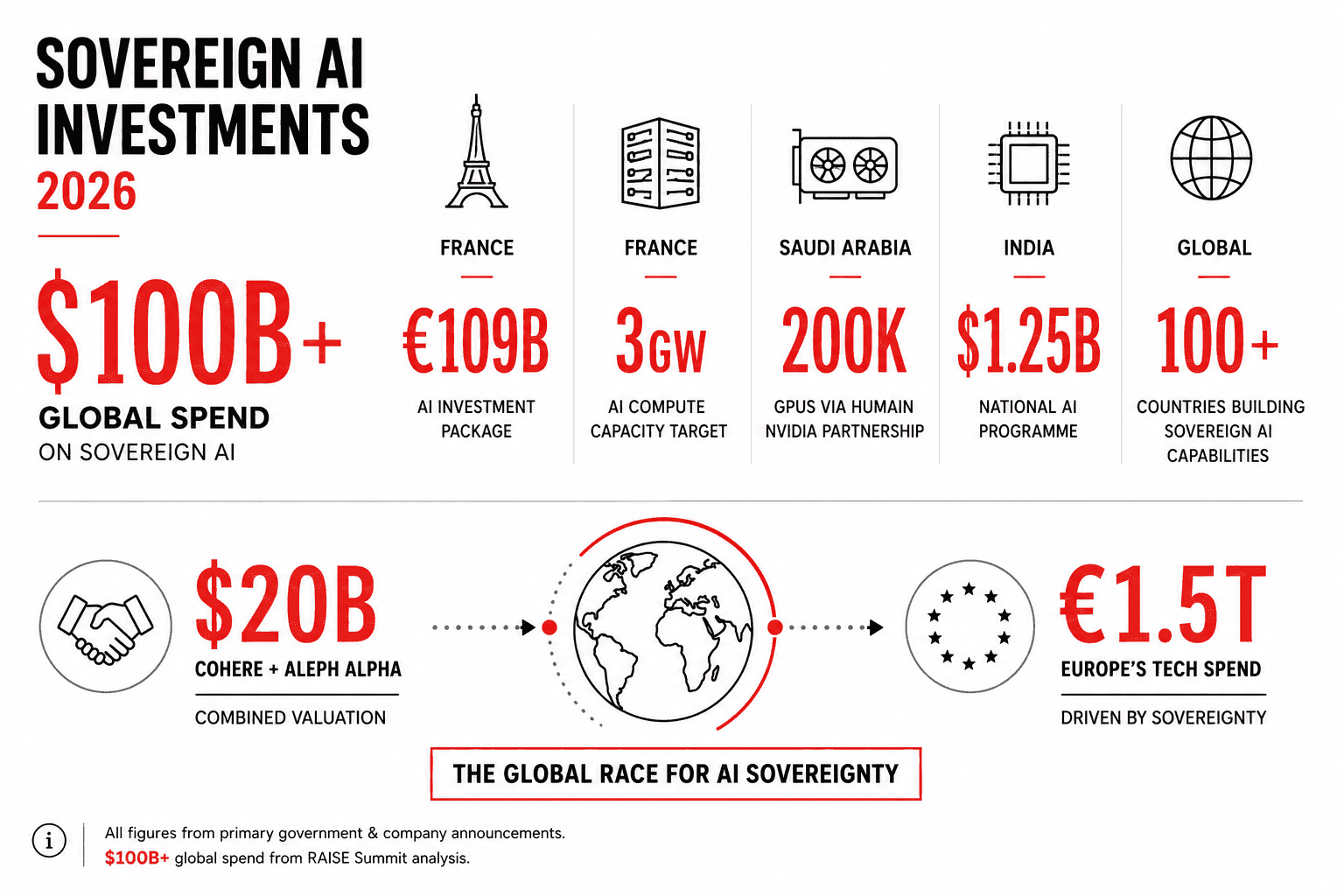
All investment figures from primary government and company announcements. $100B+ global spend from RAISE Summit analysis. Individual programme figures confirmed from named primary sources.
- $100 billion+: Global sovereign AI spending projected to surpass this level in 2026, spanning GPU procurement, data centres, model development programmes, and research grants across all major economies.[RAISE Summit — Sovereign AI compute critical infrastructure]
- €109 billion: France’s AI investment package announced at the February 2025 AI Action Summit, combining sovereign, private, and European funding. The most ambitious single-country sovereign AI programme outside the US and China.[Introl — France AI sovereignty Mistral sovereign cloud 2025]
- 3 gigawatts: AI computing capacity targeted by Bpifrance, Mistral AI, and Abu Dhabi-backed MGX across France, announced at the Choose France summit in early June 2026. Construction begins H2 2026. Operations expected 2028. [La Voix de France — France Bpifrance Mistral MGX 3GW AI computing June 2026]
- 200,000 GPUs: Scale of Saudi Arabia’s HUMAIN Nvidia partnership announced November 2025. Saudi Arabia intends to be a top-five global compute jurisdiction by 2027, combining HUMAIN model development, compute infrastructure, and AI services under Vision 2030.[PDPSpectra — HUMAIN sovereign AI national programmes 2026]
- $1.25 billion: India’s national AI programme, running entirely on Nvidia processors, with 34,000 GPUs currently available to researchers and businesses and a target of 100,000 by end of 2026.[Rest of World — India UAE G42 Cerebras sovereign AI May 2026]
- $20 billion: Combined valuation of Cohere and Aleph Alpha following their merger on April 24, 2026, endorsed by the German and Canadian governments and anchored by Schwarz Group’s $600 million lead investment. The defining consolidation event of the European sovereign AI ecosystem.[SoftwareSeni — Sovereign AI governments backing national champions]
- €1.5 trillion: Europe’s 2026 technology spending, exceeding this level for the first time, with digital sovereignty cited by Forrester as the defining theme of European enterprise technology procurement.[Forrester — Europe 2026 tech spend €1.5 trillion AI sovereignty]
Table 1: National sovereign AI programmes :Who is building what in 2026
| Country | Programme | Investment | National model / infrastructure | Status 2026 |
| France | Bpifrance + France 2030 + Mistral Compute | €109B announced Feb 2025 | Mistral AI — €11.7B valuation; 3GW campus with MGX | Infrastructure build; Mistral raising €1.7B |
| Saudi Arabia | HUMAIN (PIF subsidiary) | 200,000 Nvidia GPUs; multi-billion commitment | ALLaM Arabic frontier models; national compute | Scaling through 2026-2027 |
| UAE | G42 (Abu Dhabi) | $1.5B Microsoft investment + multiple partnerships | Falcon open-source model (TII); global cloud JVs | Active; India G42 Cerebras partnership May 2026 |
| India | IndiaAI Mission + G42 Cerebras deal | $1.25B national programme; $45B US hyperscaler commitments | BharatGen (IIT Bombay); Sarvam AI | $1.25B programme; 34K GPUs, targeting 100K |
| Germany | EuroStack; Aleph Alpha (post-merger) | Part of €1.5T European tech spend | Aleph Alpha merged with Cohere at $20B valuation | Cohere-Aleph Alpha merger April 2026; endorsed |
| Canada | Sovereign AI Compute Strategy | $240M CAD in Cohere pre-merger | Cohere (now merged with Aleph Alpha) | Cohere-Aleph Alpha deal completed April 2026 |
| South Korea | National sovereign AI cloud | 250,000+ Nvidia GPUs | Multiple domestic AI companies; NAVER HyperCLOVA | Infrastructure active; expanding |
| Singapore | AI Singapore; SEA-LION model | Part of Smart Nation strategy | SEA-LION multilingual Southeast Asian model | Active and expanding |
| Japan | AI Strategy Council; LLM-jp | Part of Digital Japan budget | LLM-jp consortium (NIST Japan) | Research active; compute build underway |
The National Programmes: What each country is actually building
France: the most ambitious European programme
France has the most coherent and best-capitalised sovereign AI strategy in Europe. The €109 billion AI investment package announced at the February 2025 AI Action Summit combines direct state investment through Bpifrance, private capital through France 2030 industrial policy incentives, and European funding mechanisms. The centrepiece is Mistral AI, the Paris-based frontier model company raising €1.7 billion at an €11.7 billion valuation with ASML as its largest shareholder, signalling deep integration of the French technology and industrial base.
The Mistral Compute initiative, announced in early 2026, deploys 18,000 Nvidia Grace Blackwell Superchips in a 40MW data centre in Essonne, east of Paris. At the Choose France summit in June 2026, Bpifrance, Mistral, and Abu Dhabi-backed MGX announced a target of 3 gigawatts of AI computing capacity across France by 2028. The France-UAE partnership explicitly introduces the concept of virtual data embassies, allowing for collaborative sovereign infrastructure across national boundaries.
Saudi Arabia: the Gulf’s AI factory strategy
HUMAIN, launched by Saudi Arabia’s Public Investment Fund in May 2025 as a wholly owned subsidiary, represents the Gulf’s most systematic sovereign AI programme. The November 2025 Nvidia partnership announcement of 200,000 GPUs, made with Jensen Huang on stage with Saudi leadership, set the scale explicitly: Saudi Arabia intends to be a top-five global compute jurisdiction by 2027. HUMAIN combines model development through the ALLaM Arabic-language model lineage from the Saudi Data and AI Authority, national data infrastructure under Saudi data and AI law, and compute deployment at hyperscale.
India: pragmatic sovereignty through strategic partnerships
India’s approach to sovereign AI is the most instructive for developing economies. The $1.25 billion national AI programme runs on Nvidia processors and provides 34,000 GPUs to researchers and businesses through the IndiaAI Mission. Rather than rejecting US technology, India has simultaneously accepted $45 billion in US hyperscaler commitments from Amazon, Microsoft, and Google while building a separate sovereign compute path through the G42 Cerebras deployment announced in May 2026. The G42 deal puts 64 Cerebras supercomputers on Indian soil, under Indian rules, operated by a non-US partner.
Rest of World’s reporting captured the strategic logic precisely: any government that wants to use AI today typically rents computing power from Amazon, Microsoft, or Google. The G42 deal gives India machines on its own soil under its own rules, without requiring rejection of US partnerships. Cameron Kerry, former acting secretary at the US Department of Commerce, described it as India’s pragmatic approach to AI sovereignty, using the power of its scale to adapt what is available from other countries to its own needs.
Expert nuance: the CLOUD Act problem
The most technically important driver of sovereign AI investment is a US law that most technology executives in non-US markets understand better than most US technology executives: the Clarifying Lawful Overseas Use of Data Act, known as the CLOUD Act.
The CLOUD Act requires US-incorporated companies to provide US law enforcement with access to data stored on their servers, regardless of where those servers are physically located. The legal test is simple: if a vendor is US-incorporated, or if a US-incorporated parent holds operational access to customer data, the vendor is subject to the CLOUD Act regardless of where its servers are located. This means that an AWS data centre in Frankfurt, an Azure data centre in Singapore, or a Google Cloud data centre in Mumbai is all potentially subject to US government data access requests.
For European, Gulf, and Asian enterprises with data residency requirements, compliance mandates, or national security-adjacent workloads, the CLOUD Act creates a structural argument for sovereign infrastructure that no amount of US hyperscaler contractual commitment can fully resolve. The Cohere-Aleph Alpha merger in April 2026 is partly a CLOUD Act response: both companies are incorporated outside the US, and their combined entity offers enterprise customers a credible non-US option for frontier AI at scale.
Strategic outlook: three things US enterprises need to understand
- Sovereign AI is a procurement filter, not a policy abstraction: Enterprise technology buyers in European, Gulf, and Asian markets are increasingly required by their legal, compliance, or board-level governance processes to evaluate whether their AI infrastructure dependencies on US companies are strategically acceptable. This is not a future scenario. It is happening in current procurement cycles. US AI vendors that cannot offer genuine data residency, non-CLOUD Act compliance paths, or sovereign deployment options are being filtered out of evaluation processes in regulated industries and government-adjacent enterprise segments.
- The European sovereign AI ecosystem is now viable, not just aspirational: The Cohere-Aleph Alpha merger creates the first European frontier AI platform with a valuation above $20 billion, government endorsement from two G7 countries, and a combined capability set that covers enterprise language models, developer infrastructure, and sovereign deployment options. France’s 3-gigawatt AI computing commitment with Mistral and MGX closes the compute gap that previously made European sovereign AI technically inferior to US alternatives. US enterprises expanding into European markets need to understand that their European subsidiaries now have credible alternative AI vendors for compliance-sensitive workloads.
- Saudi Arabia and the UAE are building AI infrastructure that will compete commercially, not just strategically: HUMAIN and G42 are not purely defensive sovereign AI programmes. They are commercial platforms targeting the global AI infrastructure market. HUMAIN’s compute infrastructure and Arabic-language models are designed to serve the entire Arab-speaking world, not just Saudi Arabia’s domestic market. G42’s Microsoft partnership, $30 billion BlackRock AI infrastructure fund participation, and Stargate-adjacent deployments in Italy and India confirm that Gulf sovereign AI is an export strategy as much as a domestic policy. US enterprises evaluating infrastructure partners for Middle East and North Africa expansion need to engage with these platforms on commercial terms, not just as government-sponsored initiatives.
Key question answered
What is sovereign AI and why is every government building it in 2026?
Sovereign AI refers to a nation’s domestic capability to produce artificial intelligence using its own infrastructure, data, workforce, and business networks, as defined by NVIDIA CEO Jensen Huang at the World Governments Summit in Dubai. In 2026, global sovereign AI spending has crossed $100 billion. France has committed €109 billion in AI investment and is targeting 3 gigawatts of AI computing capacity with Mistral AI and Abu Dhabi’s MGX by 2028. Saudi Arabia’s HUMAIN has partnered with Nvidia for 200,000 GPUs. India’s $1.25 billion national AI programme is supplemented by a UAE G42 Cerebras deployment putting sovereign compute on Indian soil. Germany and Canada endorsed the $20 billion Cohere-Aleph Alpha merger. Europe’s €1.5 trillion 2026 tech spend has digital sovereignty as its defining theme. The primary commercial driver is the CLOUD Act, which subjects all US-incorporated technology companies to US government data access requests regardless of server location, creating structural demand for non-US AI infrastructure in regulated enterprise and government-adjacent markets globally.
The takeaway
Sovereign AI is no longer a policy debate. It is a capital allocation decision that has already been made in France, Saudi Arabia, the UAE, India, South Korea, Germany, and Canada. The question for US technology companies and their enterprise customers is not whether sovereign AI infrastructure is real. It is what the existence of credible sovereign alternatives means for pricing power, vendor lock-in, and the long-term structure of the global AI market.
For US enterprises with international operations, the sovereign AI movement creates a two-track procurement environment. Domestically, the major US AI providers remain the default choice. Internationally, the sovereign AI programmes coming online in 2026 and 2027 are creating genuine alternatives that are increasingly capable, government-backed, and CLOUD Act-exempt. Managing that two-track environment is becoming a core competency for global enterprise technology teams.
Jensen Huang’s Davos statement that this is the largest infrastructure build-out in human history applies as much to the sovereign AI programmes building outside the US as to the hyperscaler campuses building inside it. The difference is that the sovereign programmes are not building for the global market. They are building to ensure that national data, national culture, and national economic value stays national. For the enterprise technology industry, that political fact has commercial consequences that are only beginning to be priced in.