The Pulse
Pakistan’s startup ecosystem has crossed a new threshold. Dealroom and inDrive estimate that VC-backed Pakistani startups now exceed $4 billion in combined enterprise value, up 3.6 times since 2020, a growth rate that outpaces larger ecosystems including India, New York, Paris, and Dubai. But the country’s tech future is not being built in one place.
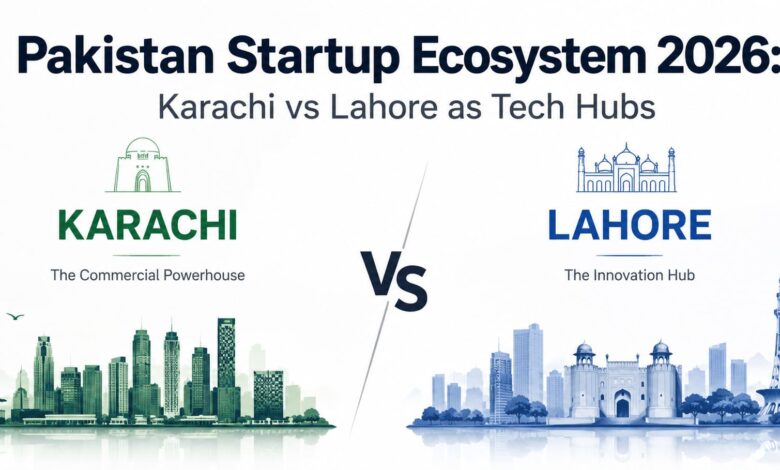
Karachi brings commercial density: banks, port infrastructure, enterprise customers, fintech networks, and commercial capital. Lahore brings ecosystem density: universities, software talent, founder communities, SaaS builders, and a StartupBlink ranking of #169 globally and #1 in Pakistan. The real question in the Pakistan startup ecosystem 2026 story is not which city becomes Pakistan’s Silicon Valley. It is whether the two cities can build complementary strengths before capital, energy, and exit-market constraints slow the ecosystem down.
Core Significance
Why it matters:
- Pakistan’s Startup Ecosystem Has Reached Critical Mass: Pakistan ranks #79 globally on the 2025 StartupBlink Global Startup Ecosystem Index, with 1,114 tracked startups. From just two incubators and fewer than 100 startups in 2012, the country now has over 40 active accelerator and incubator programmes and over 170 VC-backed startups. The growth rate outpaces comparable emerging markets by a significant margin.[2025 GSEI — Pakistan #79]
- Lahore Is #1 in Pakistan, Growing at 66% Annually: Lahore ranks #169 globally on StartupBlink’s ecosystem index and #1 within Pakistan, with 414 tracked startups and 66% ecosystem growth in 2025. That growth rate places Lahore among the fastest-growing startup city ecosystems in South Asia. Lahore’s primary strength is founder culture: a dense university network, mature informal mentorship networks, and consistent SaaS and IT export orientation.[StartupBlink — Lahore Ecosystem]
- The Domestic Capital Gap Limits Both Cities: Despite the momentum, no Pakistani startup has reached unicorn status or generated more than $100 million in annual revenue. Limited domestic institutional capital is the primary bottleneck. Most growth funding comes from international investors, making the ecosystem vulnerable to global VC cycles. After the 2021 to 2022 boom, Pakistani startup funding tightened significantly in 2023 and 2024. The strongest companies are still raising, but broad-based funding has not returned to peak levels.[Dealroom Pakistan Tech Report via Profit Pakistan Today]
Deep Context: How Two Cities Built Two Different Tech Ecosystems
The divergence between Karachi and Lahore’s tech ecosystems was not planned. It emerged from fundamentally different city characters that predate the technology industry entirely.
Karachi has always been Pakistan’s city of commerce. Its founders were merchants, traders, and industrialists who built the country’s financial infrastructure. The city’s startup ecosystem inherited that commercial DNA. When Karachi founders build technology companies, they typically build for the domestic market at scale: a payments platform for Pakistan’s underbanked population, a logistics network for the country’s fragmented supply chains, or a healthcare platform for a city of 25 million people. The market is right there. The commercial problem is real and large.
Lahore has always been Pakistan’s city of culture and education. Home to some of Pakistan’s oldest universities and a dense population of engineering and computer science graduates, Lahore developed a technology community that thought globally from its earliest days. As Startup.pk’s May 2026 accelerator analysis noted, Pakistan does not have one accelerator ecosystem, it has two. The tech-heavy urban tier concentrated in Karachi, Lahore, and Islamabad focuses on fintech, e-commerce, SaaS, and digital platforms. A separate alternative sector tier targets agriculture, social enterprise, and rural development.
The institutional infrastructure confirms the divergence. Karachi’s National Incubation Centre focuses on fintech and industrial automation with dedicated labs for financial services startups. Lahore’s NIC focuses on IT services and SaaS with strong links to the Punjab government’s Startup Punjab programme. The city split is not just geographic. It is a split in what kind of technology company each city is best equipped to produce.
Data Insights
By the numbers:
Some important data stats you can find below.
- #79 Globally: Pakistan’s ranking on the 2025 StartupBlink Global Startup Ecosystem Index, with 1,114 tracked startups across the country.[StartupBlink 2025 GSEI Blog]
- #169 Globally, #1 in Pakistan: Lahore’s confirmed live ranking on StartupBlink as of May 2026, with 66% ecosystem growth in 2025 and 414 tracked startups.[StartupBlink — Lahore]
- $4 Billion: Combined enterprise value of Pakistan’s VC-backed startups as of January 2026, up 3.6 times since 2020, per Dealroom.co and inDrive’s Pakistan Tech Report.[Profit Pakistan Today — Dealroom Jan 2026]
- $4.77 Billion: Total raised by Pakistan-based companies across venture capital and private equity rounds, with 719 investors participating across 704 funding rounds, per Tracxn. Note: this includes both VC and PE, not startup VC only.[Tracxn — Pakistan Startups 2026]
- $93.5 Million: Raised across 5 equity funding rounds in Pakistan in Q1 2026 alone, per Tracxn data through March 2026. [Tracxn — Pakistan Q1 2026]
- 170+: VC-backed startups in Pakistan, with 17 breakout companies raising $15 to $100 million and 2 scale-ups exceeding $100 million in total funding.[Dealroom via Profit Pakistan Today]
- 40+: Active accelerator and incubator programmes across Pakistan by 2026, up from just 2 in 2012.[PakBusinessWorld — Pakistan Startup Ecosystem]
- 32: New startups raising their first VC round in Pakistan every year, with a significant share of growth funding coming from international investors.[Dealroom Pakistan Tech Report]
Table 1: Karachi vs Lahore Tech Ecosystem: Direct Comparison 2026
| Metric | Karachi | Lahore |
| City Character | Commercial capital, financial hub | Cultural capital, educational hub |
| Primary Tech Sectors | Fintech, logistics, healthtech, consumer | SaaS, enterprise software, IT exports |
| Key Incubators | NIC Karachi, The Nest I/O, ICCBS Tech Park UoK | NIC Lahore, Daftarkhwan, Arfa Tech Park |
| StartupBlink City Rank | Not separately top-ranked (part of Pakistan #79) | #169 globally, #1 in Pakistan (confirmed live) |
| Ecosystem Growth 2025 | N/A separately tracked | 66% — confirmed via StartupBlink screenshot |
| Key Advantage | Market access, commercial networks, port economy | Talent pipeline, founder culture, IT exports |
| Key Challenge | Load shedding, traffic, higher operating costs | Smaller domestic market, capital access |
| Notable Startups | Bazaar ($107.8M total), Abhi (Series A $17M), Haball | Metric, Trukkr (~$10M), Bookme.pk, Marham |
Table 2: Pakistan’s Key Tech Incubators and Accelerators 2026
| Institution | City | Focus | Key Feature |
| The Nest I/O | Karachi | Technology, fintech, startups | Google for Entrepreneurs partner, 62 investments, 6,500 sq ft |
| NIC Karachi | Karachi | Fintech, industrial automation | Ignite-funded, FinTech + IoT labs, 80-100 person auditorium |
| ICCBS Tech Park (UoK) | Karachi | IT, biotech, AI in health | 50,000 sq ft, University of Karachi anchor, AI health cohorts |
| NIC Lahore | Lahore | SaaS, IT services, enterprise | Punjab government backed, Arfa Software Technology Park |
| Daftarkhwan | Lahore | Coworking, startup community | Multiple locations, 021Disrupt conference host |
| Startup Punjab | Lahore | Government ecosystem support | Policy support, Punjab government anchor |
| NIC Islamabad | Islamabad | Policy tech, AI, telecom | Federal government anchor, AI policy adjacent |
The tables frame the Pakistan startup ecosystem 2026 across its three main cities. Karachi leads on commercial depth. Lahore leads on ecosystem growth rate. Islamabad shapes the policy environment both depend on.
The Business Case: What Each City Does Better
Karachi’s advantage is commercial density. Lahore’s advantage is ecosystem density. These are not the same thing, and Pakistan’s tech future requires both.
Karachi: Where Commercial Scale Lives
Karachi is Pakistan’s largest commercial centre, hosting the Pakistan Stock Exchange, the country’s primary port, and the deepest concentration of banking and insurance sector headquarters. For technology startups, those facts are the customer base, not background context.
Bazaar, headquartered in Karachi, raised a $70M Series B bringing total funding to $107.8M, making it one of Pakistan’s most funded startups. It built its B2B commerce platform on top of Karachi’s sprawling informal retail networks. Abhi, Karachi-based, raised a $17M Series A for its financial wellness platform targeting Pakistan’s underserved workforce. Haball, also Karachi-based, is building embedded payments infrastructure for the B2B supply chain. All three companies share a common attribute: they are solving commercial problems that only exist at the scale Karachi’s economy creates.
The Nest I/O, launched by P@SHA with Google for Entrepreneurs and Samsung as global partners, has made 62 investments and connects founders to over 30 global startup hubs. As CB Insights profiles The Nest I/O, its 6,500 square feet of physical space and curriculum-based support model has been the most credible early-stage infrastructure Karachi has built. The NIC Karachi adds dedicated fintech and industrial automation labs. The ICCBS Technology Park at the University of Karachi brings 50,000 square feet of incubation space and direct research access across IT, IoT, biotechnology, and AI health applications.
Lahore: Where Founder Culture Lives
Lahore’s advantage is less visible than Karachi’s commercial infrastructure but arguably more durable. The city has spent a decade building the informal networks, mentor relationships, and founder communities that produce repeat entrepreneurs. As Pakistan Indonesia’s February 2026 analysis documented, failures in Lahore’s ecosystem are absorbed quietly, lessons are shared informally, and second-time founders are becoming more common. That maturity is one reason the city keeps attracting new ventures.
Metric, built by Meenah Tariq, Omar Parvez Khan, and Dr. Habiba, is the clearest example of Lahore’s model. It builds AI-powered financial intelligence for SMEs that cannot afford chief financial officers. Trukkr raised close to $10 million in 2025 from Yango Ventures to digitise Pakistan’s trucking logistics. Bookme.pk became Pakistan’s leading ticketing and transport platform from Lahore. Marham and oladoc built healthtech platforms that now operate nationally but grew out of Lahore’s university-adjacent talent pools.
Daftarkhwan is the connective tissue of Lahore’s ecosystem. Its 021Disrupt conference has brought over 7,300 international and local innovators together and facilitated 550 startups engaging with 31 investors across 315 office hours in a single conference. That event infrastructure is what turns a collection of individual startups into an ecosystem with a culture.
Islamabad: The Policy Corridor
Any honest analysis of Pakistan’s startup ecosystem must include Islamabad, even though it is not the commercial engine Karachi is or the founder-culture engine Lahore is. Islamabad is becoming Pakistan’s policy-tech corridor.
For AI governance, digital public infrastructure, telecom regulation, and Gulf-backed initiatives, Islamabad often matters more than either city. The National Incubation Centre Islamabad operates under direct federal government backing with a policy-adjacent mandate. The Ministry of IT and Telecommunication, the Pakistan Software Export Board, and the National AI Policy architecture all originate in Islamabad and shape the operating environment for startups in every other city. As covered in our Pakistan AI economy analysis, the $1 billion National AI Fund is administered from Islamabad through Ignite. The city is not building startups at Karachi or Lahore’s pace. It is building the framework those startups operate within.
The Missing Milestone: Exits
A mature startup ecosystem is not only about funding. It needs exits, acquisitions, IPOs, and secondary markets. Pakistan still largely lacks this.
Without repeatable exit paths, founders and early employees cannot recycle capital and experience back into the next generation of startups. Investors cannot demonstrate returns that would attract domestic institutional capital. The $4 billion ecosystem valuation is built primarily on private market estimates rather than realised returns. Pakistan has had 11 acquisitions in 2025 and 2 IPOs in 2024, per Tracxn. Those are not the exit volumes of a maturing ecosystem. The missing milestone is not only a unicorn. It is a repeatable exit mechanism that creates the recycling loop that mature ecosystems depend on.
Between the lines:
The honest assessment of Karachi versus Lahore is that Pakistan needs both cities to succeed in different ways for its overall tech ecosystem to reach scale. The startups that have raised the most capital have typically launched in one city and expanded to the other within 18 months. Pakistan’s domestic market is large enough to require both cities but not yet deep enough to sustain separate, competing ecosystems. The ecosystem is larger than it was five years ago, but funding remains selective after the 2022 to 2024 global VC reset. The strongest companies are still raising. Broad-based startup funding has not returned to the 2021 to 2022 peak, and building to that peak sustainably requires domestic institutional capital that does not yet exist at the required scale.
Regional Spotlight: Karachi’s Specific Challenges as a Tech Hub
Karachi’s advantages as a tech hub are real and structural. So are its challenges, and the tech community has not always been honest about the gap between them.
The Opportunity:
Karachi’s 25 million population makes it one of the ten largest cities in the world. That scale creates market opportunities that no other Pakistani city can match. A healthcare platform that achieves 1% penetration in Karachi has 250,000 users. A fintech product that captures 2% of Karachi’s informal retail market handles transactions worth hundreds of millions of dollars annually.
As covered in our Pakistan AI economy analysis, Pakistan’s IT exports reached $3.38 billion in FY2025-26. A significant share of that export revenue passes through Karachi’s banking and payment infrastructure. The city’s commercial depth means IT export growth strengthens Karachi’s economic position regardless of where the developers are physically located.
The Crisis:
Karachi’s infrastructure challenges are embedded in its tech ambitions, not separate from them. Load shedding of 8 to 12 hours daily forces every Karachi-based startup to budget for generator fuel as a fixed operational cost. Traffic congestion means a cross-city meeting can consume three hours of a founder’s working day. The Karachi Chamber of Commerce has cited load shedding as a key reason for declining investment.
As covered in our AI energy cost analysis, energy unreliability is the single most underappreciated structural barrier to Pakistan’s tech ambitions. For Karachi specifically, where operating costs are already higher than Lahore due to commercial property prices and congestion costs, energy unreliability adds a margin erosion that compounds over time.
Expert Nuance: The Domestic Capital Gap Limits Both Cities Equally
The most honest constraint on both Karachi and Lahore’s tech ecosystems is not talent, not infrastructure, and not market size. It is domestic capital. And it affects both cities identically regardless of their different strengths.
Pakistan’s high-net-worth individual community is significant by regional standards. But it has historically invested in real estate, manufacturing, and trading rather than technology ventures. The cultural shift toward technology as an investable asset class is happening but slowly. The result is a startup ecosystem where earliest funding rounds are increasingly accessible through government-backed incubators and international accelerators, but where Series A and Series B capital that converts promising startups into scalable companies is scarce and primarily foreign.
That foreign capital dependency creates a specific vulnerability. When global VC sentiment turns cautious, as it did from 2022 through 2024, Pakistani startups lose access to growth capital regardless of their own performance. Building a domestic institutional investment class through insurance companies, pension funds, or family offices is the structural change that would most significantly accelerate both cities’ tech ecosystems simultaneously.
The Aurora Tech Award’s 288 applications from women-led startups in 2025 confirms the talent and founder diversity exists. The capital to back those founders at scale does not yet exist in the same proportion. That gap is not a Karachi problem or a Lahore problem. It is a Pakistan problem that requires a national policy response rather than a city-level initiative.
Strategic Outlook: What’s Next
Three developments will define whether the Pakistan startup ecosystem 2026 momentum translates into durable scale.
- The First Pakistani Unicorn Will Define Both Cities: Pakistan has never produced a company valued at $1 billion or more. The two scale-ups that have exceeded $100 million in total funding are the current candidates. When the first Pakistani unicorn emerges, its city affiliation will shape international investor perceptions of where Pakistan’s tech capital sits for the following five to ten years. That is not just a commercial competition between companies. It is a geopolitical competition between cities for the identity of Pakistan’s technology economy.
- The AI Layer Reshapes Both Ecosystems: Metric’s AI financial intelligence platform and Metal’s AI-powered venture capital workflow tool are both examples of Pakistani founders building AI-native products rather than simply adding AI as a feature. As Pakistan’s $1 billion National AI Fund begins to deploy capital, startups that have already built AI-native products will be best positioned to access fund resources, government partnerships, and international validation. Karachi’s fintech startups are natural candidates for AI-native rebuilds. Lahore’s SaaS companies are positioned to embed AI workflow tools that make them competitive with Indian and Eastern European alternatives.
- The Gulf Pipeline Accelerates Both Cities: As covered in our Pakistan AI Geopolitics analysis, Saudi Arabia’s GO Telecom AI Hub in Islamabad and broader Gulf talent demand for Pakistani technology workers is creating a new funding and opportunity pipeline. Karachi’s commercial networks connect most naturally to Gulf banking and finance clients. Lahore’s IT services exporters connect most naturally to Gulf enterprise software procurement. Both cities benefit from the Gulf connection. Neither has fully institutionalised it yet.
Key Question Answered
Is Karachi becoming a major tech hub and how does it compare to Lahore in 2026?
Karachi is Pakistan’s dominant commercial tech hub in 2026, hosting the country’s largest fintech startups including Bazaar ($107.8M total funding), Abhi (Series A $17M), and Haball, along with key incubators including The Nest I/O with 62 investments, NIC Karachi with dedicated fintech and IoT labs, and the ICCBS Technology Park at the University of Karachi with 50,000 square feet of incubation space.
Lahore is growing faster within the Pakistan startup ecosystem 2026, confirmed at #169 globally and #1 in Pakistan on StartupBlink’s live ecosystem index with 66% growth in 2025 and 414 tracked startups. Lahore concentrates on SaaS, enterprise software, and IT exports, with NIC Lahore, Daftarkhwan coworking spaces, and the Punjab government’s Startup Punjab programme. Pakistan’s overall startup ecosystem is valued at $4 billion, has raised $4.77 billion in total VC and PE funding, and ranks #79 globally. The primary constraint for both cities is limited domestic institutional capital, which makes the ecosystem vulnerable to international VC cycles after the 2022 to 2024 global funding reset.
The Takeaway
Karachi and Lahore are not competing to be Pakistan’s Silicon Valley. That framing misses what is actually being built. Karachi is becoming Pakistan’s fintech and commercial technology capital, where the proximity to banking infrastructure, port logistics, and enterprise customers creates conditions for companies solving real problems at scale. Lahore is becoming Pakistan’s builder capital, where the density of engineering talent, the maturity of informal networks, and the consistency of the startup community creates conditions for exportable technology companies that compete globally.
Pakistan needs both. The $4 billion ecosystem valuation is impressive for a country that had two incubators fourteen years ago. It is nowhere near the scale the country’s talent, market size, and diaspora capital could support with functioning domestic investment infrastructure, reliable energy, and payment systems that do not require workarounds.
The cities are building the right foundations. Karachi is solving for commercial scale. Lahore is solving for founder culture and global orientation. Islamabad is building the policy architecture that determines whether both cities’ ambitions become national outcomes. The missing infrastructure is not in any city. It is in the domestic capital markets, exit mechanisms, and energy infrastructure that connect Pakistan’s startup ambition to the global technology economy that is already looking for it.