AI Infrastructure News 2026: Data Centers, Chips and Power Demand

The Brief
The Pulse AI infrastructure news 2026 is no longer just a story about GPUs. The real story is the full physical stack behind artificial intelligence: chips, data centers, cloud capex, power grids, cooling, networking, energy contracts, inference efficiency and the race to secure enough capacity before demand moves somewhere else. The pressure is now visible […]
Why It Matters
The story matters because it changes how buyers, builders, or policymakers should read the Enterprise AI market.
Watch Next
Watch whether the signal becomes a budget, procurement, or platform decision in the next cycle.
The Pulse
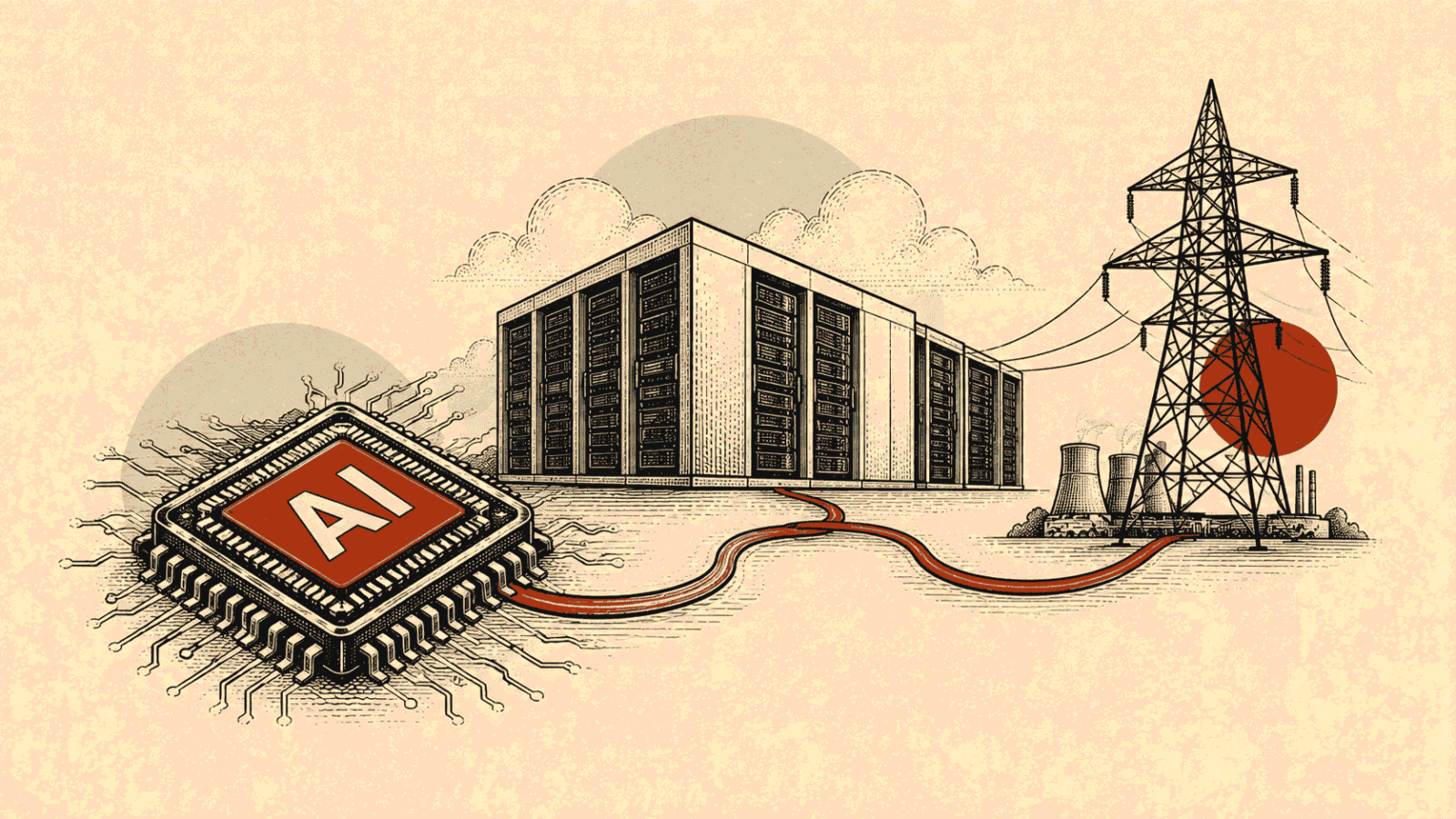
AI infrastructure news 2026 is no longer just a story about GPUs. The real story is the full physical stack behind artificial intelligence: chips, data centers, cloud capex, power grids, cooling, networking, energy contracts, inference efficiency and the race to secure enough capacity before demand moves somewhere else.
The pressure is now visible outside Silicon Valley. The International Energy Agency says capital expenditure by five large technology companies exceeded 400 billion dollars in 2025 and is expected to jump another 75% in 2026, while AI factories have more than tripled in capacity over the past 18 months. Gartner separately projects worldwide data-center electricity consumption to grow 26% in 2026, with AI-optimized servers accounting for 31% of data-center power consumption. [IEA Key Questions on Energy and AI] [Gartner data center electricity forecast]
The result is a new infrastructure bottleneck. AI companies can raise capital, release models and sell enterprise software faster than utilities can build generation, grids can add transmission, and operators can secure land, cooling, transformers and interconnection approvals. In 2026, the limiting factor for AI growth is increasingly not model intelligence. It is speed to power.
Core Significance
Why it matters:
- AI infrastructure is becoming a national-scale capital cycle: The AI buildout now touches semiconductors, server manufacturing, cloud platforms, data-center real estate, utilities, gas turbines, batteries, nuclear discussions, transmission planning and local permitting. That makes AI infrastructure a macroeconomic story, not only a technology story.
- Power availability is becoming the new GPU shortage: Gartner says AI capacity is now constrained by power availability, making data-center power security the new battleground for scaling and protecting margins. Utilities are already seeing the effect, with Reuters reporting that American Electric Power lifted its forecast as data centers and large customers drove electricity demand. [Gartner data center power demand] [Reuters American Electric Power AI demand]
- The infrastructure race is shifting from training to inference: As AI agents, video models, copilots and enterprise assistants move into daily use, the cost problem is not only training frontier models. It is serving millions of prompts, actions, videos, workflows and long-context tasks at predictable latency and acceptable energy cost.
Deep Context: What changed in AI infrastructure in 2026
The biggest change is that AI infrastructure has become a capacity race across multiple layers at once. In 2023 and 2024, the conversation was dominated by GPU scarcity. In 2026, GPUs still matter, but the constraint has widened to include data-center shells, substations, transformers, cooling systems, networking equipment, memory supply, grid interconnection and long-term power contracts.
The IEA’s 2026 update shows how quickly the physical demand is scaling. It says data-center electricity demand surged in 2025, while investment by five large technology companies crossed 400 billion dollars and is expected to grow sharply again in 2026. The report also says AI factories have more than tripled in capacity in 18 months, showing that the buildout is no longer speculative. [IEA AI and energy executive summary]
That buildout is changing the energy sector. Reuters reported that Siemens Energy posted record third-quarter sales, margins and orders, helped by demand for gas turbines from expanding AI data centers in the United States and power projects in the Middle East. This is one of the clearest signs that AI infrastructure demand has moved into industrial power equipment, not only cloud budgets. [Reuters Siemens Energy AI data center demand]
The United States is also seeing AI infrastructure move onto unusual sites. AP reported that the US Department of Energy selected a Kentucky uranium-enrichment site for an AI data center and gas power complex, with a planned 1.8 gigawatt AI data-center campus, 2 gigawatts of natural-gas generation and 2.6 gigawatts of battery storage. That shows how closely compute strategy, power strategy and industrial land reuse are beginning to merge. [AP Kentucky AI data center power complex]
The chip layer is moving just as quickly. NVIDIA announced in May 2026 that Vera Rubin had ramped into full production, positioning the platform for agentic AI factories with 10x agent throughput at scale compared with Grace Blackwell. NVIDIA also says the platform includes Spectrum-X Ethernet Photonics, now in production, for million-GPU AI factories. [NVIDIA Vera Rubin full production]
At rack scale, the infrastructure requirements are changing too. NVIDIA’s data-center product page describes GB200 NVL72 as a liquid-cooled rack-scale system with 72 Blackwell GPUs and 36 Grace CPUs connected inside a 72-GPU NVLink domain. The company says it delivers up to 30x faster inference for trillion-parameter LLMs compared with prior systems. [NVIDIA data center products]
As covered in our AI agents enterprise news 2026 analysis, agentic AI makes this infrastructure problem harder because agents do not only answer prompts. They reason, use tools, run workflows and often require repeated model calls. That pushes infrastructure demand toward always-on inference, not occasional training runs.
The bottleneck moved from chips to systems
GPU supply still matters, but an enterprise cannot run useful AI on chips alone. It needs memory bandwidth, high-speed networking, liquid cooling, reliable power, data pipelines, model serving, observability, security, governance and cost attribution.
This is why AI infrastructure is becoming a systems problem. A faster chip can lower cost per token, but only if the surrounding rack, network, storage, cooling and scheduling layer can actually keep it utilized. Idle GPUs, grid delays and inefficient inference pipelines can destroy the economics of even the best hardware.
As covered in our enterprise AI deployment cost analysis, the visible AI bill is rarely the full cost. Integration, orchestration, monitoring, security and governance often determine whether AI infrastructure produces value or becomes another expensive platform layer.
Data Insights
By the numbers:
All figures below come from official agency reports, energy-sector research, analyst reports, company announcements and named reporting. AI infrastructure forecasts are highly sensitive to model efficiency, utilization rates, power availability and how quickly announced data-center projects actually come online.
- Five major technology companies crossed 400 billion dollars in capex in 2025: The IEA says the capital expenditure of five large technology companies exceeded 400 billion dollars in 2025 and is expected to rise another 75% in 2026. It also says that capex from those five companies is now larger than global investment in oil and natural gas production. [IEA technology capex and AI infrastructure]
- Global data-center electricity consumption is projected to double by 2030: The IEA’s base case projects global data-center electricity consumption to reach around 945 TWh by 2030, representing just under 3% of global electricity consumption. It says accelerated servers, mainly driven by AI adoption, are projected to grow around 30% annually. [IEA energy demand from AI]
- AI server power density is moving beyond traditional data-center design: The IEA says AI server power density increased 11x between 2020 and 2025 and could rise another fourfold by 2027. It also says an advanced rack by 2027 could have peak power demand equivalent to 65 households. [IEA rack power density]
- US data-center electricity exposure could become regionally large: EPRI’s 2026 Powering Intelligence work says data-center load forecasting remains difficult, but its updated scenarios show a substantially higher planning range than prior estimates. EPRI’s public release says data centers could consume up to 17% of US electricity by 2030 in high-growth scenarios. [EPRI Powering Intelligence 2026] [EPRI data centers up to 17% of US electricity]
Table 1: The AI infrastructure stack in 2026
| Infrastructure layer | Main components | 2026 pressure point | Business impact |
| Compute | GPUs, CPUs, accelerators, memory | Blackwell, Rubin, HBM supply and utilization | Determines training speed, inference cost and model capacity |
| Data centers | Shells, racks, cooling, land, interconnection | Speed to power and site approval | Decides where AI capacity can actually be deployed |
| Power | Generation, substations, transformers, batteries | Grid delays and large-load connection queues | Becomes the limiting factor for AI scale |
| Networking | NVLink, InfiniBand, Ethernet, optics | Cluster scale and GPU communication bottlenecks | Controls whether large AI systems operate efficiently |
| Cooling | Liquid cooling, heat rejection, water systems | Higher rack density and thermal stress | Affects site design, operating cost and permitting |
| Cloud platforms | AWS, Azure, Google Cloud, Oracle, CoreWeave | Capacity commitments and AI workload scheduling | Turns AI infrastructure into long-term customer lock-in |
| Governance | Cost attribution, usage controls, resilience, security | Sprawl across teams, clouds and models | Determines whether infrastructure spend becomes business value |
Table 2: AI infrastructure bottlenecks and business impact
| Bottleneck | What causes it | Who feels it first | Practical response |
| Power availability | Large AI loads, slow grid upgrades, interconnection queues | Hyperscalers, colocation providers, utilities | Secure power early, use flexible load, consider hybrid supply |
| GPU utilization | Poor scheduling, idle clusters, inefficient inference routing | AI labs, cloud customers, enterprise AI teams | Track tokens, jobs, utilization and business output by workload |
| Cooling capacity | High-density racks and liquid-cooled systems | Data-center operators and chip buyers | Design around rack density, heat rejection and water constraints |
| Networking | Large model training, multi-GPU clusters, agent workloads | Cloud platforms and AI model builders | Invest in high-speed fabric, optics and cluster-aware architecture |
| Capital commitments | Long leases, power contracts, chip supply agreements | CFOs, cloud buyers, investors | Compare capex, leases and obligations, not only headline spend |
| Inference economics | Agents, long context, multimodal workloads and video generation | Enterprise AI product owners | Measure cost per task, not only cost per token |
The Business Case: How companies should plan AI infrastructure
The starting question should not be how many GPUs a company can buy. It should be which AI workloads need dedicated infrastructure, which can run through cloud APIs, which require private deployment, and which should not be scaled until the business case is clearer.
Training frontier models requires one kind of infrastructure. Enterprise inference requires another. AI agents, retrieval systems, customer copilots, synthetic video, code assistants and internal automation all create different patterns of latency, storage, network, security and cost demand.
For most enterprises, the practical infrastructure question is not whether to build a data center. It is how to avoid accidental infrastructure sprawl. Teams often start with public APIs, add a cloud model endpoint, test an open model, buy a SaaS copilot, and later discover they have no central view of usage, cost, data movement or security exposure.
That is why AI infrastructure planning should connect finance, engineering, security, procurement, legal and business owners from the start. A cloud AI deployment without cost attribution becomes a margin problem. A private model without monitoring becomes a security problem. An agent platform without permissions becomes a governance problem.
As covered in our AI enterprise governance 2026 analysis, companies need inventories, risk tiers, data controls and monitoring before AI systems spread across workflows. Infrastructure strategy and governance strategy are now the same conversation.
For AI-native companies, the issue is sharper. Infrastructure can become the business model, but it can also become the balance-sheet risk. Long-term leases, power commitments, chip prepayments and cloud capacity deals can look like growth until demand, pricing or model efficiency changes.
Expert Nuance: The new bottleneck is speed to power
The most important AI infrastructure constraint in 2026 is not simply total electricity. It is speed to power: how quickly a project can secure enough reliable power at the right location, with the right grid connection, cooling design and regulatory approval.
This is why data-center demand is reshaping power markets. A GPU cluster can be ordered faster than a substation can be built. A model can become popular faster than a transmission upgrade can be permitted. A cloud customer can reserve capacity faster than a utility can guarantee the load profile behind it.
Technical research is already pointing toward more flexible compute. A 2026 paper on power-flexible AI data centers argues that GPU clusters can respond to grid signals through workload scheduling and power telemetry, reducing load during peak demand and shifting work across regions while preserving priority service levels. [Power-flexible AI data centers]
Another 2026 review of next-generation AI data centers argues that rising AI workloads are exposing limits in traditional 48V rack architectures, low-voltage AC distribution and transformer interfaces. It points toward higher-voltage conversion, DC distribution and solid-state transformers as possible architectural shifts for future AI data centers. [Next-generation AI data center power architecture]
The business implication is simple. The cheapest AI infrastructure will not always be the newest chip or the lowest token price. It may be the platform that can keep GPUs utilized, avoid grid delays, shift non-urgent workloads, manage cooling efficiently and turn power availability into a scheduling advantage.
As covered in our AI data center deals 2026 tracker, the market is already moving in that direction. Data-center assets, power access and strategic land are becoming part of the AI competitive moat.
Strategic Outlook
- Watch power contracts become AI strategy: The next phase of AI infrastructure competition will be fought through electricity access, utility relationships, onsite generation, battery storage, grid flexibility and long-term power procurement.
- Watch inference efficiency matter more than training headlines: As agents, video generation, enterprise copilots and search assistants scale, the core infrastructure metric will shift toward cost per useful task, not just the cost of training a frontier model.
- Watch NVIDIA’s Rubin cycle redefine rack-scale AI: Vera Rubin is designed for agentic AI, reasoning and high-throughput inference, which means infrastructure competition is moving toward complete systems: GPUs, CPUs, networking, optics, cooling and software orchestration.
- Watch grid-responsive compute become a serious category: If AI workloads can shift across time and geography, data centers may become more flexible power-system participants rather than pure inflexible loads. That will matter in markets with constrained grids and volatile power prices.
- Watch infrastructure governance become a CFO issue: AI infrastructure commitments increasingly include leases, cloud contracts, capacity reservations, chip purchases and power agreements. CFOs will need to compare full obligations, not only reported capex or model invoices.
Key Question Answered
What is AI infrastructure in 2026?
AI infrastructure in 2026 is the physical and software stack required to train, deploy and operate artificial intelligence at scale. It includes GPUs, accelerators, CPUs, memory, servers, data centers, power systems, cooling, networking, storage, cloud platforms, model-serving tools, monitoring systems, security controls and cost governance.
The biggest AI infrastructure news in 2026 is that the bottleneck has expanded beyond chips. Companies now need enough compute, enough power, enough cooling, enough networking, enough land, enough capital and enough governance to make AI systems useful in production.
For enterprises, this means infrastructure decisions can no longer sit only with engineering teams. AI infrastructure affects finance, procurement, security, legal, sustainability, operations and corporate strategy. The organization that can see and control its AI infrastructure stack will scale more safely than the one only chasing the next model release.
FAQ
Why is AI infrastructure important in 2026?
AI infrastructure is important because model performance depends on the systems underneath it. Chips, data centers, power, cooling, networking and cloud capacity determine how quickly AI can be trained, deployed and served to users at scale.
What is the biggest AI infrastructure bottleneck?
The biggest bottleneck is increasingly power availability. GPUs remain important, but AI data centers also need grid connections, substations, generation capacity, cooling and long-term power agreements before compute can actually come online.
How much electricity will data centers use by 2030?
The IEA’s base case projects global data-center electricity consumption to reach around 945 TWh by 2030, just under 3% of global electricity use. US-focused estimates vary widely, and EPRI says high-growth scenarios could push data centers to a much larger share of US electricity demand by 2030.
Why does inference matter for AI infrastructure?
Inference matters because most AI products spend their operating life serving users, not training models. AI agents, copilots, search tools and video generators can create repeated model calls, which makes cost per task, latency and utilization critical infrastructure metrics.
Should enterprises build their own AI infrastructure?
Most enterprises should not build full AI infrastructure from scratch unless they have unusual scale, data-control requirements or economics. The more practical decision is usually which workloads belong on public APIs, cloud AI platforms, private deployments, SaaS copilots or specialized infrastructure providers.
The Takeaway
AI infrastructure in 2026 is entering its industrial phase.
The first phase of generative AI was software excitement. The second phase was model competition. The third phase is physical scale: chips, data centers, power contracts, cooling systems, networking fabrics, grid connections and capital commitments large enough to reshape energy and industrial markets.
That is why AI infrastructure news now matters beyond the cloud industry. It affects utilities, chipmakers, construction firms, energy suppliers, governments, enterprise buyers and investors trying to understand whether AI demand can justify the scale of spending behind it.
The winners will not simply be the companies with the most GPUs. They will be the companies that secure power early, use compute efficiently, manage inference cost, build resilient data-center capacity and connect infrastructure spending to real business output.
The AI race is still about models, but the next advantage may come from something less glamorous: who can get enough electricity, cooling, networking and utilization to make those models run at scale.