Data Governance Tools (2027): 12 Platforms Compared for AI-Ready Data
What data governance tools do, the four categories, and 12 platforms compared (Collibra, Informatica, Alation, Atlan, Unity Catalog, Snowflake Horizon and more) with our AI-readiness capability matrix, pricing and a buyer checklist. Purview Data Governance retires Nov 12, 2027.

In short: Data governance tools catalog an organization’s data, trace its lineage, score its quality, classify sensitive fields and enforce who can use it. Enterprise leaders include Collibra, Informatica, Alation and Atlan, plus native catalogs in Databricks, Snowflake, Google Cloud and AWS. For AI work, also check unstructured-data coverage, an MCP server for agents and runtime controls on what agents do.
Data governance software used to be bought for compliance reports and a business glossary. Now AI agents query the same tables, documents and APIs that analysts do, and they act on whatever they find. Gartner predicts that through 2026 organizations will abandon 60% of AI projects that are not supported by AI-ready data, and it found that 63% of organizations lack, or are unsure they have, the right data management practices for AI.
This guide is for enterprise buyers comparing data governance platforms. It explains what the tools do, groups the market into categories, compares 12 platforms in a dated table, and scores each one on eight AI-readiness capabilities using only the vendor’s own documentation. If you are governing AI models and agents rather than the data under them, start with our comparison of AI governance tools instead; this page is about the data layer.
What do data governance tools do?
A data governance tool is the system of record for what data exists, what it means, where it came from, whether it can be trusted and who may use it. Most enterprise data governance tools combine six jobs:
- Data catalog and discovery. Connectors harvest technical metadata (schemas, tables, columns, files, dashboards) from warehouses, lakes, databases and BI tools into one searchable inventory, usually with a business glossary on top.
- Data lineage. The tool parses SQL, pipeline code and query logs to show how data flows from source to report. Column-level lineage shows which upstream columns produce a given field, which is what auditors and incident responders actually need.
- Data quality. Profiling, rules and anomaly detection produce quality scores per table or data product, with alerts when a check fails.
- Classification. Scanners tag personal, financial and health data so policies can follow it.
- Access policy. Policies decide who can query or see a column, and either enforce that inside the platform or push it down to Snowflake, Databricks, BigQuery and other engines as masks and row filters.
- Stewardship workflow. Owners, stewards, approvals, certification and data products give the program accountability.
A data governance framework (the roles, policies and standards) is the operating model; the tool is how you run it at scale. The AI enterprise governance playbook covers the operating-model side.
Why AI changed what a data governance platform must do
Three shifts moved data governance from back office to the AI critical path.
First, regulation now names data governance directly. Article 10 of the EU AI Act requires training, validation and testing datasets for high-risk AI systems to be subject to data governance and management practices, including examination for bias and gaps. After the 2026 AI Omnibus, Annex III high-risk obligations apply from December 2, 2027, so 2027 is the year this becomes evidence an auditor can ask for.
Second, most of the data AI uses is unstructured. Retrieval-augmented generation (RAG) and agents read PDFs, contracts, tickets and slide decks, not just warehouse tables. A catalog that only knows tables cannot tell you whether the document an agent quoted was the current, approved version.
Third, agents are now consumers of the catalog itself. Through the Model Context Protocol (MCP), an agent can ask a governance tool for a certified definition, check lineage, or request access. That makes the catalog part of the agent’s runtime, and it raises a new question: can the governance tool stop an agent’s action, or only describe the data?
Types of data governance tools
The market splits into four categories. Most large enterprises end up with one from the first group plus the native catalog of their main data platform.
| Category | What it is | Examples | Best for |
|---|---|---|---|
| Cross-platform governance suites | Independent catalogs that connect to many platforms and run stewardship programs | Collibra, Informatica CDGC, Alation, Atlan | Multi-cloud estates, regulated industries, business-led programs |
| Platform-native catalogs | Governance built into one data or cloud platform, enforced in its engine | Databricks Unity Catalog, Snowflake Horizon, Google Knowledge Catalog, Amazon SageMaker Catalog, Microsoft Fabric OneLake catalog | Estates concentrated on one platform; enforcement without extra licences |
| Data quality-led platforms | Quality and observability first, with catalog and lineage around it | Ataccama ONE | Teams whose main risk is bad data feeding reports and models |
| Privacy and security-led platforms | Discovery and classification of sensitive data across structured and unstructured stores | BigID | CISOs and privacy teams; unstructured data and AI data risk |
Two ownership changes matter for anyone reading older lists. Salesforce completed its acquisition of Informatica on November 18, 2025, and the product is now sold as “Informatica from Salesforce.” ServiceNow completed its purchase of data.world in July 2025, according to its Q3 2025 quarterly filing, and sells it as ServiceNow Data Catalog inside Workflow Data Fabric.
Microsoft is also changing course. On November 12, 2026, it announced that Microsoft Fabric is now its data governance solution and that Purview Data Governance will be retired, with support ending November 12, 2027. New Purview data governance accounts can no longer be created, and Unified Catalog stays in maintenance mode until then. Purview’s data security and compliance products (labels, data loss prevention, insider risk) are not affected. If you run Purview Unified Catalog today, your 2027 decision is where your glossary, data products and lineage move next: the Fabric OneLake catalog, another platform’s native catalog, or a cross-platform suite.
Google renamed Dataplex Universal Catalog to Knowledge Catalog. Its documentation dates the rename to April 10, 2026, and says the API, client library, CLI and IAM names did not change.
Data governance tools compared (November 2026)
The table compares 12 data governance platforms on what their vendors publish. Status and prices were checked November 19 to 22, 2026. “Not public” means the vendor publishes no list price; marketplace list prices are shown where they exist, and real contracts are usually negotiated.
| Tool | Type and deployment | Core strengths | AI and unstructured support | Public pricing (Nov 2026) |
|---|---|---|---|---|
| Collibra | Cross-platform suite; SaaS on AWS and GCP, self-hosted option | Stewardship workflows, column-level lineage, Data Access policy push-down to Snowflake, BigQuery and Databricks | AI Command Center registry of models, agents and MCP servers; MCP tool allow/deny rules; Unstructured AI with Deasy Labs | AWS Marketplace: $170,000 for a 12-month Cloud Platform subscription |
| Informatica Cloud Data Governance and Catalog (CDGC) | Cross-platform suite on IDMC; owned by Salesforce | Broad connectors, CLAIRE classification, policy push-down to Snowflake, Databricks, Redshift, Fabric, Power BI | Catalogs PDF, Word, PowerPoint files from S3; AI model governance; MCP servers for catalog and data quality | AWS Marketplace: $131,760 a year for 120 IPUs a month (IPUs are shared across IDMC) |
| Alation | Cross-platform suite; SaaS and customer-managed | Usage-ranked search, curation agents, data quality, Agent Studio | AI Governance registry (available now); hosted MCP server; Governed Collections for documents in early access | AWS Marketplace: from $60,000 a year; new AIOS products included |
| Atlan | Cross-platform suite; SaaS | Automatic column-level lineage, active metadata, two-way tag sync with Snowflake and Databricks | AI asset governance; hosted MCP server with 41 tools; S3 objects listed without content analysis | Not public; AI actions use Flexi Credits on top of the subscription |
| Ataccama ONE | Data quality-led platform; SaaS, hybrid edge | Data quality, observability, MDM and lineage in one product; Data Trust Index | Hosted MCP trust layer; unstructured document governance off by default, enabled on request | Not public |
| ServiceNow Data Catalog (data.world) | Catalog inside ServiceNow Workflow Data Fabric | Knowledge-graph catalog, Eureka Explorer lineage | Hosted MCP server with read and write tools; sensitive data classification is a paid add-on in public preview | Not public |
| BigID | Privacy and security-led platform; SaaS to air-gapped | Discovery and classification across structured and unstructured data, access governance | One registry of models, agents and pipelines; discovers MCP servers; MCP server | Not public; priced by data sources, apps, connectors and deployment |
| Databricks Unity Catalog | Platform-native (Databricks), open-source edition available | Column-level lineage, ABAC, row filters and column masks enforced in the engine | Volumes govern files of any format; models, agents and MCP services are securables; Unity Gateway GA | No separate list price; billed through Databricks usage† |
| Snowflake Horizon Catalog | Platform-native (Snowflake) | Masking and row access policies, classification, lineage, data quality checks | Model Registry; Snowflake-managed MCP server GA; Cortex AI Gateway Tools in preview | Included in Snowflake editions; lineage and data quality need Enterprise Edition |
| Google Knowledge Catalog (formerly Dataplex) | Platform-native (Google Cloud) | Automatic metadata harvesting, lineage, auto data quality, BigQuery policy tags | Vertex AI models and agents catalogued; remote MCP server; PDF profile scans in preview | $0.06 per DCU-hour standard, $0.089 premium (lineage, quality, profiling), plus metadata storage |
| Amazon SageMaker Catalog (built on DataZone) | Platform-native (AWS) | Publish-subscribe access with grants in Lake Formation and Redshift, column-level lineage, data quality | AI models catalogued; unstructured data via custom assets; no catalog-specific managed MCP server | $10 per 100,000 requests, $0.40 per GB metadata, $1.776 per compute unit, with a monthly free tier |
| Microsoft Purview Unified Catalog | Platform-native (Microsoft); retiring | Governance domains, data products, data quality scores, scans of Azure and S3 files | No first-party MCP server; support ends November 12, 2027 | $0.0165 per governed asset per day (about $0.50 a month); data quality $15 to $240 per processing unit |
Sources for each row are in the Sources list below; marketplace prices are AWS Marketplace list prices for 12-month contracts. † Databricks publishes no separate Unity Catalog price; we have not found an official statement of which tiers include every feature.
Original analysis: how AI-ready are data governance tools?
Vendor marketing now says “AI-ready” on almost every page, so we checked what each vendor documents. We scored the 12 tools on eight capabilities that matter when AI agents use governed data. Each of the 96 cells links to one vendor documentation page, release note or product page, read between November 19 and 22, 2026. A tool scores 1 when the capability is documented and generally available, ½ when it is in preview, beta or early access, available only on request, or limited to one platform, and 0 when we could not find it documented.
The eight capabilities:
- Column-level lineage: traces fields, not only tables.
- Data quality monitoring: built-in rules, scores or anomaly detection.
- Sensitive-data classification: automatic tagging of personal or regulated data.
- Access-policy enforcement: masks, row filters or grants enforced in the engine or pushed down to it.
- Unstructured data governance: documents and files catalogued and governed by content, not only listed as objects.
- AI asset catalog: models or agents registered as governed assets.
- First-party MCP server: an MCP server published or hosted by the vendor for agents.
- Runtime agent tool policy: allow or deny rules checked on an agent’s tool call before it runs.
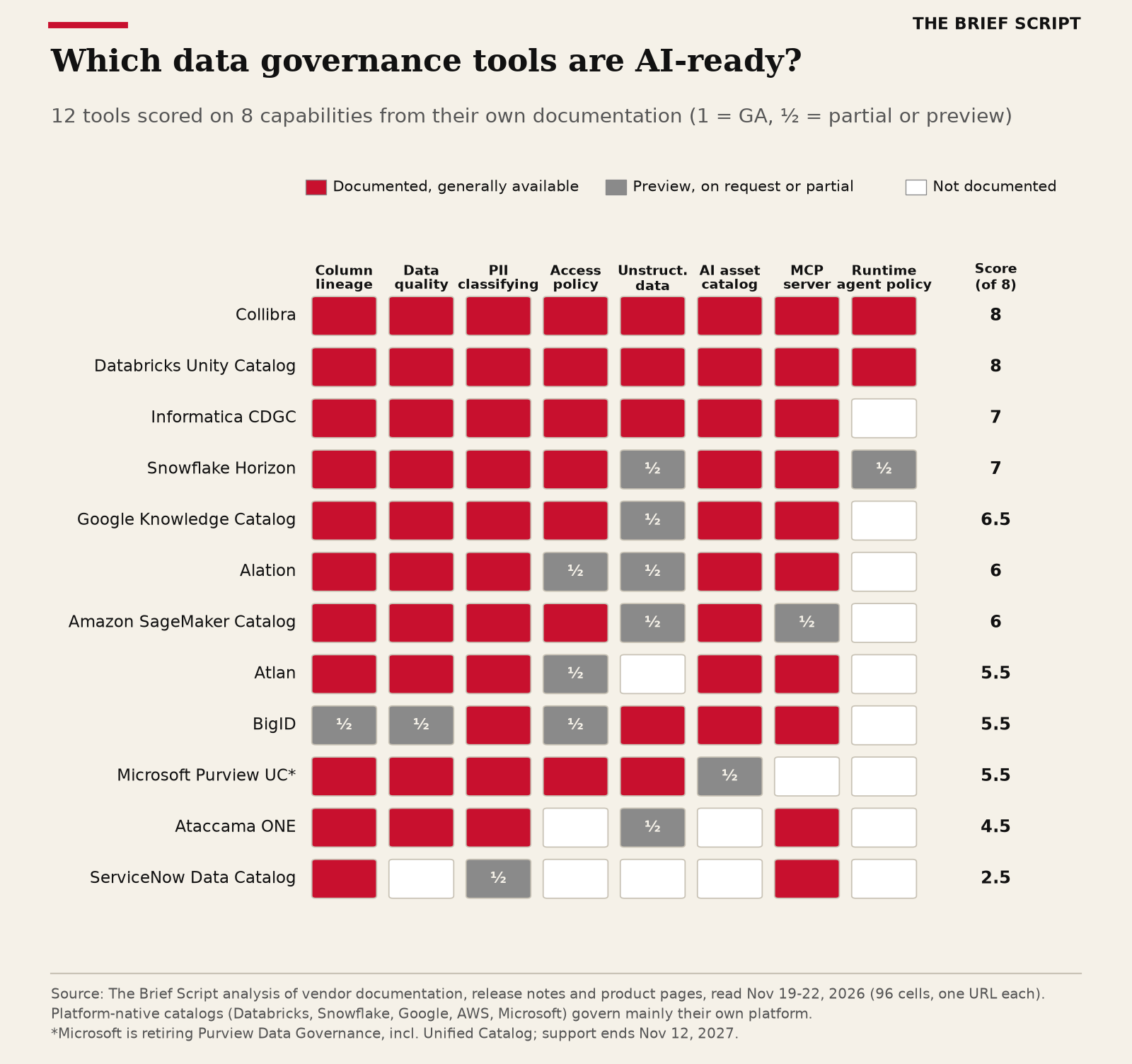
The basics are solved. Eleven of 12 tools document column-level lineage as generally available, 11 document sensitive-data classification, and 10 document built-in data quality monitoring. On the classic checklist, most enterprise data governance tools now look alike.
Every tool now feeds agents. Ten of the 12 document a first-party MCP server as generally available, and an eleventh, AWS, offers its general-purpose AWS MCP Server rather than one built for the catalog. Microsoft Purview Unified Catalog is the only tool with none, which fits its retirement.
Few can stop an agent. Only two tools document runtime allow and deny rules on an agent’s tool calls as generally available. Databricks made Unity Gateway generally available on August 4, 2026, governing which MCP services and models users and agents can reach. Collibra’s MCP governance, added in its 2026.11 release, lets admins set allow and deny rules per agent and block disallowed tool calls through its gateway; its Guardian Agents, which supervise behavior at runtime, are slated for a future release. Snowflake’s Cortex AI Gateway Tools does the same job but is still in preview. Everyone else describes data to agents without a documented way to block what they do with it.
Unstructured data is the widest gap. Only five tools fully govern documents and files by content: Collibra, Informatica, Databricks (through volumes), BigID and the retiring Purview. Five more have it in preview, on request or only partly, including Alation’s Governed Collections (early access) and Ataccama’s document governance, which is off by default until customer success turns it on.
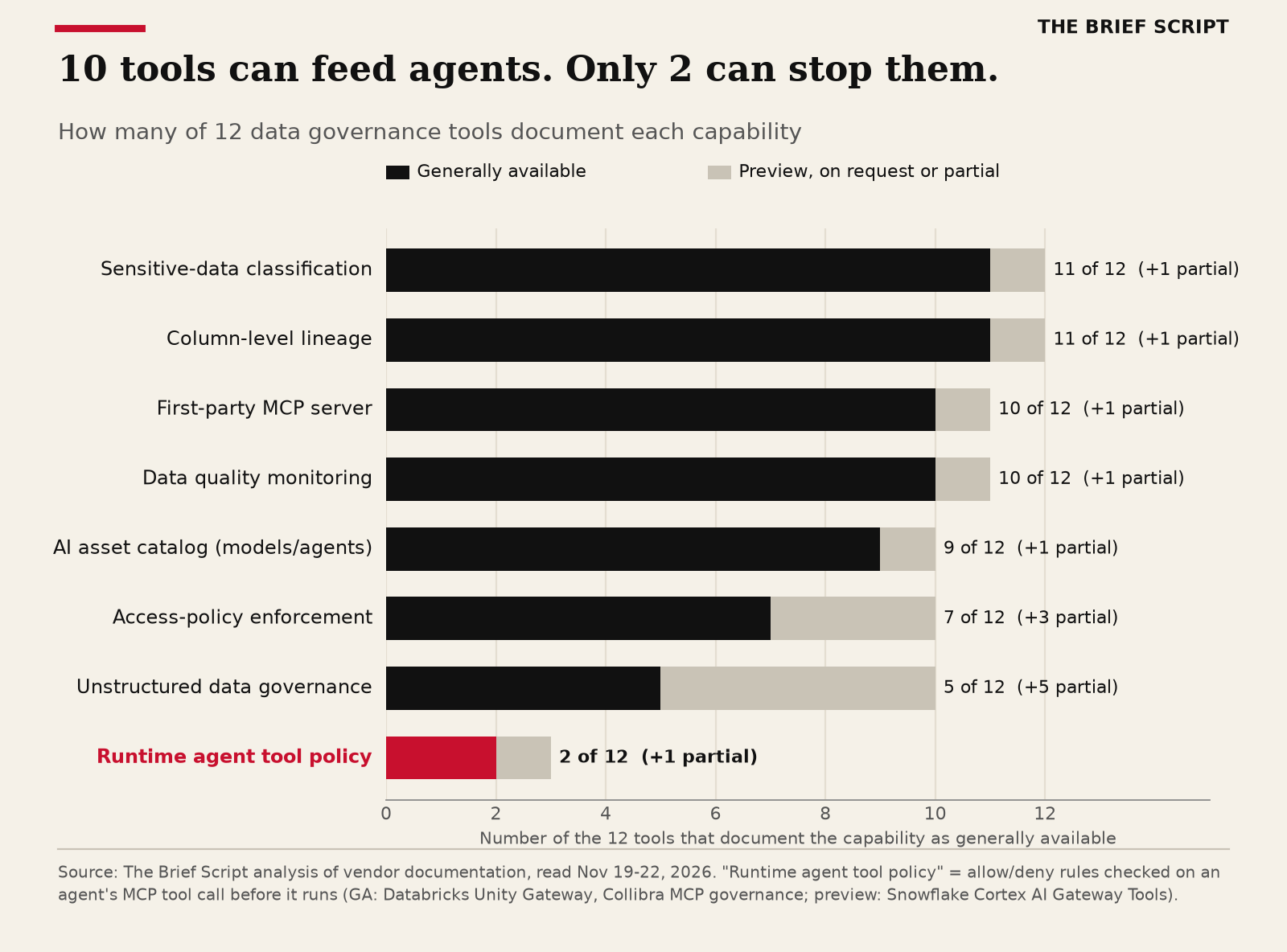
Read the scores as a map of documented features, not a ranking of products. A platform-native catalog that scores 8 of 8, such as Unity Catalog, governs mainly its own platform; a cross-platform suite that scores lower may still be the better fit for a multi-cloud estate. Across all 96 cells, 65 are generally available, 14 partial and 17 not documented.
The 12 data governance tools in brief
Collibra. The most complete cross-platform suite in our check and the deepest stewardship workflows. AI Command Center puts AI use cases, models, agents, tools and MCP servers in one registry, and its hosted MCP server uses OAuth 2.0. It is also the most expensive marketplace list price we found.
Informatica CDGC. Strongest when you also need data integration, quality and master data management from one vendor. Its access management pushes data filter policies down to Snowflake, Databricks, Redshift, Fabric Data Warehouse and Power BI. The open question for buyers is how roadmap priorities shift under Salesforce.
Alation. Known for search and adoption among analysts. On September 17, 2026, Alation said its AI Governance and Semantic Model Mastering enhancements are available now, while Ontologies, Intelligent Feeds, Console and Governed Collections are in early access, all within existing pricing. Its Policy Center documents Snowflake masking and row access policies; we found no other engine listed.
Atlan. A modern, metadata-first catalog that captures column-level lineage automatically and syncs tags both ways with Snowflake and Databricks. Its hosted MCP server is available on every tenant. Atlan publishes no prices; its pricing documentation says AI actions draw on Flexi Credits, separate from the asset entitlement.
Ataccama ONE. Data quality is the core, with observability, lineage and master data around it. Its hosted MCP trust layer gives agents a Data Trust Index score per asset; we found no AI model or agent registry.
ServiceNow Data Catalog (data.world). A knowledge-graph catalog with good lineage exploration and a hosted MCP server that can read and write catalog content. Its machine learning-based sensitive data classification is a public preview that needs a paid add-on, and we found no built-in data quality monitoring.
BigID. The pick when sensitive and unstructured data is the main risk. Its AI governance puts models, agents, pipelines and data sources in one registry, discovers unregistered MCP servers, and classifies files, chat, code and vector stores. Lineage and data quality are less documented than in the catalog suites.
Databricks Unity Catalog. The only platform-native catalog to score full marks: lineage down to the column, data classification, attribute-based access control and quality monitoring, with models, MCP services and agents governed as securables. It is the natural choice if most of your data and AI runs on Databricks, since its controls are built around that platform.
Snowflake Horizon Catalog. Strong in-engine policy (masking, tag-based masking, row access), classification and lineage that now reaches external databases and BI through OpenLineage. Lineage and data quality monitoring require Enterprise Edition. Its managed MCP server has been generally available since November 4, 2025.
Google Knowledge Catalog. Harvests metadata across BigQuery, AlloyDB, Spanner, Cloud SQL and Looker, catalogs Vertex AI models and agents, and exposes context through a remote MCP server. Its pricing is usage-based: $0.06 per data compute unit (DCU) hour for discovery and $0.089 for lineage, quality and profiling.
Amazon SageMaker Catalog. AWS’s business catalog, built on DataZone, with publish-subscribe access that lands grants in Lake Formation and Redshift. AWS prices it at $10 per 100,000 requests, $0.40 per GB of metadata and $1.776 per compute unit, after a monthly free tier of 4,000 requests, 20 MB and 0.2 compute units per account.
Microsoft Purview Unified Catalog. Still capable on paper, with quality scores, data products and scans of documents in Azure storage and S3, but retiring. Microsoft’s own pricing lab lists $0.0165 per governed asset per day. Treat it as a migration project, not a new purchase.
How to choose a data governance tool: a buyer checklist
Use this checklist in a request for proposal or a proof of concept. Ask vendors to show each item working on your data, and ask for the documentation link and release status.
- Map your estate first. If more than about 80% of governed data sits in one platform, start with that platform’s native catalog and add a cross-platform suite only for what it cannot reach.
- Test column-level lineage on your hardest pipeline. Pick one with stored procedures, dbt models and a BI dashboard, and check whether lineage is parsed automatically or must be stitched by hand.
- Check where policy is enforced. A policy that lives only in the catalog is documentation. Ask whether masks and row filters are enforced in your warehouse, and on which engines.
- Bring your documents. Ask the vendor to catalog a SharePoint or S3 folder of contracts, classify the content and show who can retrieve it through a RAG pipeline.
- Connect an agent. Point Claude, ChatGPT or your own agent at the vendor’s MCP server. Confirm it uses OAuth, acts with the end user’s permissions, and logs each call. Our MCP security checklist lists what to test.
- Ask how an agent is stopped. Ask whether an admin can deny a specific tool or write action before it runs, and whether that control is generally available or in preview.
- Register AI assets. Check that models, agents and their training or retrieval data can be linked, so you can answer an EU AI Act Article 10 question about one system.
- Look for unsanctioned AI. Ask whether the tool can find models, agents or MCP servers nobody registered; shadow AI is where most data exposure starts.
- Check roadmap and ownership risk. Get the status of every feature in writing (GA, preview, early access), and ask about the plan after an acquisition or product retirement.
- Model the cost at your scale. Count governed assets, scans, users and AI actions, and price three years, not one.
If you are not sure your data is ready for any of this, our AI readiness assessment scores data, governance and skills in one checklist.
How much do data governance tools cost?
Pricing falls into three models.
Annual subscriptions from independent vendors. Most do not publish prices, but AWS Marketplace gives public anchors. Collibra lists $170,000 for a 12-month Cloud Platform subscription. Alation’s Data Catalog starts at $60,000 for 12 months. Informatica sells a 120-IPU-per-month bundle for $131,760 a year, and those processing units are shared across its whole cloud, not only governance. Atlan, Ataccama, BigID and ServiceNow quote on request. Price AI features separately: Atlan meters AI actions in credits, and data.world sells sensitive data classification as an add-on.
Usage-based cloud catalogs. Google, AWS and Microsoft meter by use. As a worked example using Microsoft’s published rate, 10,000 governed assets in Purview Unified Catalog would cost about $4,950 a month (10,000 × $0.0165 × 30), or roughly $60,000 a year before data quality compute. That is close to Alation’s entry list price, which shows that “pay as you go” is not automatically cheaper at enterprise scale.
Included in a data platform. Unity Catalog and Snowflake Horizon carry no separate licence; you pay through platform consumption. On Snowflake, lineage and data quality monitoring require Enterprise Edition, and scheduled checks consume credits.
Licences are rarely the biggest line. Budget for connector setup, stewards’ time, migration of glossaries and policies, and, if you run Purview Data Governance today, a forced migration before November 12, 2027. For how governance fits a wider AI budget, see our guide to AI compliance management platforms, which covers evidence and audit tools that sit above the data layer.
Frequently asked questions
What is the difference between a data catalog and a data governance tool?
A data catalog is the inventory: it finds data and describes it. A data governance tool adds the controls around that inventory, such as lineage, quality rules, classification, access policies and stewardship workflows. Most products now do both, so compare features rather than labels.
Which data governance tool is best for AI?
It depends on your estate. In our check of vendor documentation, Collibra and Databricks Unity Catalog documented all eight AI-readiness capabilities as generally available, with Informatica and Snowflake Horizon next at seven. A Databricks-centric company should start with Unity Catalog; a multi-cloud, regulated enterprise will usually want a cross-platform suite such as Collibra or Informatica. Pressure-test unstructured data and agent controls in any proof of concept.
What happens to Microsoft Purview data governance?
Microsoft announced on November 12, 2026, that Purview Data Governance will be retired and that Microsoft Fabric, with the OneLake catalog, is now its data governance solution. Support ends November 12, 2027, new accounts cannot be created, and existing features are in maintenance mode. Purview’s data security and compliance products continue.
Do I still need a data governance tool if I use Databricks or Snowflake?
Not always. If nearly all your governed data and AI workloads run on one platform, its native catalog enforces policy in the engine at no extra licence cost. You need a cross-platform tool when data is spread across several clouds, warehouses, SaaS apps and document stores, or when business stewards, not engineers, run the governance program.
Methodology
We built this comparison from desk research between November 19 and 22, 2026; we did not test the products hands-on. The 12 tools cover the four categories above. For each tool we read the vendor’s documentation, release notes, product pages, pricing pages and AWS Marketplace listings, and saved copies where pages allowed it.
The capability matrix scores each tool 1, ½ or 0 on eight capabilities, using only first-party sources, and records one URL per cell. “Not documented” means we could not find it in public documentation, not that the vendor cannot do it. We scored generally available features as 1 and previews, betas, early-access programs, on-request features and single-platform limits as ½. We did not weight capabilities or adjust for platform scope, which is why native catalogs score high. We used independent comparison sites only to find documentation, never as the source of a score. Facts marked † are hedged because the vendor’s own statement was incomplete. No vendor paid for inclusion or reviewed this article.
Sources
- Gartner, “Lack of AI-Ready Data Puts AI Projects at Risk,” Feb 26, 2025: https://www.gartner.com/en/newsroom/press-releases/2025-02-26-lack-of-ai-ready-data-puts-ai-projects-at-risk
- Microsoft Tech Community, “A next step in the evolution of the Microsoft Data Governance strategy,” Nov 12, 2026: https://techcommunity.microsoft.com/blog/microsoft-security-blog/a-next-step-in-the-evolution-of-the-microsoft-data-governance-strategy/4572227
- Microsoft Learn, data governance with Microsoft Purview (retirement notice): https://learn.microsoft.com/en-us/purview/data-governance-overview
- Microsoft, Purview data governance masterclass, pricing and licensing lab: https://github.com/microsoft/purview-data-governance-masterclass/blob/main/Lab-15%20-%20Pricing%20and%20Licensing.md
- Regulation (EU) 2024/1689 (AI Act), EUR-Lex: https://eur-lex.europa.eu/eli/reg/2024/1689/oj/eng
- Informatica, “Salesforce Completes Acquisition of Informatica,” Nov 18, 2025: https://www.informatica.com/about-us/news/news-releases/2025/11/20251118-salesforce-completes-acquisition-of-informatica.html
- ServiceNow, Form 10-Q for the quarter ended Sep 30, 2025: https://www.sec.gov/Archives/edgar/data/1373715/000137371525000309/now-20250930.htm
- Google Cloud, use the Knowledge Catalog remote MCP server: https://docs.cloud.google.com/knowledge-catalog/docs/use-remote-mcp
- Google Cloud, Knowledge Catalog pricing: https://cloud.google.com/products/knowledge-catalog/pricing
- AWS Marketplace, Collibra Cloud Platform: https://aws.amazon.com/marketplace/pp/prodview-6gqg3yc2e2rsu
- AWS Marketplace, Alation Data Catalog: https://aws.amazon.com/marketplace/pp/prodview-ylge6fq43dtg6
- AWS Marketplace, Informatica IDMC: https://aws.amazon.com/marketplace/pp/prodview-vetdnosd4u6oe
- AWS, Amazon SageMaker pricing (SageMaker Catalog): https://aws.amazon.com/sagemaker/pricing/
- AWS, Amazon SageMaker Catalog: https://aws.amazon.com/sagemaker/catalog/
- AWS, “The AWS MCP Server is now generally available,” May 6, 2026: https://aws.amazon.com/about-aws/whats-new/2026/05/aws-mcp-server
- Databricks, Unity Gateway release notes: https://docs.databricks.com/aws/en/release-notes/unity-gateway/
- Databricks, Unity Catalog overview: https://docs.databricks.com/aws/en/data-governance/unity-catalog/
- Collibra, About MCP governance: https://productresources.collibra.com/docs/collibra/latest/Content/AICommandCenter/MCPGovernance/co_mcp-governance.htm
- Collibra, Release 2026.11 notes: https://productresources.collibra.com/docs/collibra/latest/Content/ReleaseNotes/Archive/ref_release-202611.htm
- Collibra, Integrating with Collibra’s MCP server: https://productresources.collibra.com/docs/collibra/latest/Content/ModelContextProtocol/co_integrating-with-collibra-mcp.htm
- Snowflake, Tools for Cortex AI Gateway (Preview), Oct 19, 2026: https://docs.snowflake.com/en/release-notes/2026/other/2026-10-19-cortex-ai-gateway-tools
- Snowflake, Cortex AI Gateway general availability, Nov 3, 2026: https://docs.snowflake.com/en/release-notes/2026/other/2026-11-03-cortex-ai-gateway-ga
- Snowflake, Snowflake-managed MCP server GA, Nov 4, 2025: https://docs.snowflake.com/en/release-notes/2025/other/2025-11-04-cortex-agents-mcp
- Snowflake, data lineage (Enterprise Edition): https://docs.snowflake.com/en/user-guide/ui-snowsight-lineage
- Alation, AIOS expansion press release, Sep 17, 2026: https://www.alation.com/news-and-press/alation-launches-aios-tm-expansion-with-six-products-that-accelerate-ai-transformation/
- Alation, working with data policies (Policy Center): https://docs.alation.com/en/latest/steward/PolicyCenter/WorkingDataPolicies.html
- Atlan, how Atlan pricing works: https://docs.atlan.com/get-started/concepts/how-atlan-pricing-works
- Atlan, Atlan MCP: https://docs.atlan.com/product/capabilities/atlan-ai/how-tos/atlan-mcp-overview
- Informatica, data access policy enforcement methods: https://onlinehelp.informatica.com/IICS/prod/DGC/en/ae-data-accessmanagement/Data_access_policy_enforcement_methods.html
- Informatica, Amazon S3 catalog source: https://onlinehelp.informatica.com/IICS/prod/MCC/en/metadata-command-center-amazon-s3-sources/About_the_Amazon_S3_catalog_source.html
- Ataccama, unstructured data governance: https://docs.ataccama.com/ataccama-one-agentic/latest/data-catalog/unstructured-data.html
- Ataccama, MCP trust layer for external AI agents: https://docs.ataccama.com/ataccama-one-agentic/latest/gen-ai/mcp-trust-layer.html
- data.world, discover and catalog sensitive data: https://docs.data.world/en/374151-discover-and-catalog-sensitive-data.html
- data.world, MCP server for AI assistants: https://docs.data.world/en/413220-data-world-mcp-server-for-ai-assistants.html
- BigID, AI governance: https://bigid.com/ai-governance
- BigID, pricing: https://home.bigid.com/pricing
- Microsoft Learn, OneLake catalog overview: https://learn.microsoft.com/en-us/fabric/governance/onelake-catalog-overview