We Tracked 100 B2B SaaS Companies From 2019 to 2026. AI Took Over the Homepage. The Pricing Page Didn’t Follow.
75% of B2B SaaS homepages now lead with AI, yet 28 of 100 vendors publish no AI price and only 7% bill by outcome. Data on 100 vendors, 2019 to 2026.

Original research by The Brief Script. Homepages and pricing pages checked November 18, 2026. Every vendor row links to its source, and the full dataset is free to download.
Open the homepage of almost any big B2B software company today and you’ll meet AI in the first sentence. Open the same company’s pricing page and the AI often vanishes into a “Contact sales” button.
We tracked the same 100 B2B SaaS category leaders, ten in each of ten verticals, from 2019 to 2026. For each one we read the homepage headline in three eras, using archived captures on the Wayback Machine for 2019–20 and 2023–24 and the live site for November 2026. Then we opened each vendor’s own pricing page and documentation to record exactly how, and whether, it charges for AI.
The result is a clear gap between what homepages claim and what pricing pages actually price.
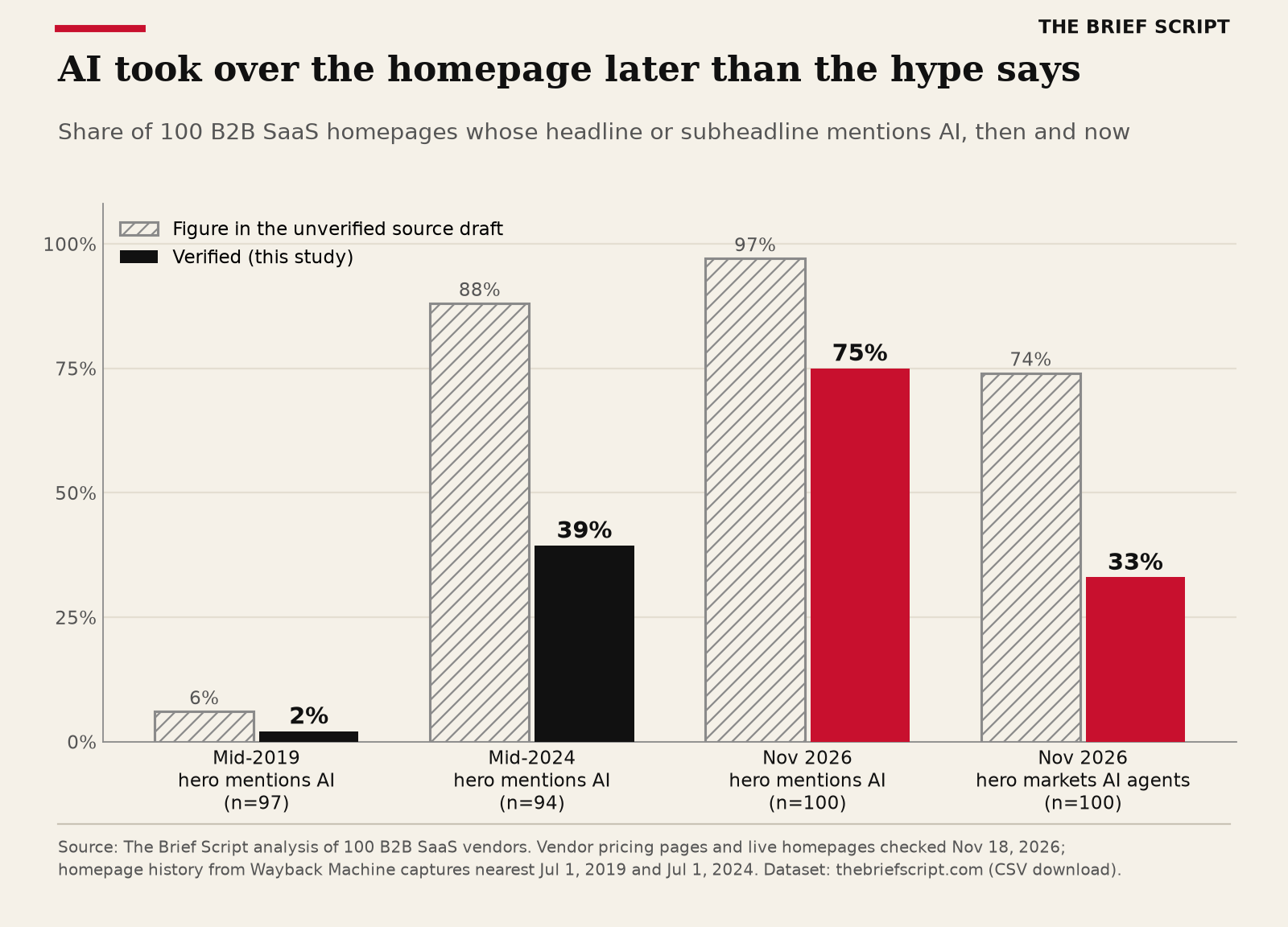
- 75% of homepage headlines mention AI in November 2026. In 2019–20 it was 2.1% (2 of 97 readable captures). In mid-2024 it was 39.4% (37 of 94).
- Only 33% market AI agents in that headline, despite a year of “agentic” launches.
- 28 of 100 vendors publish no AI price at all. Quote-only, opaque enterprise pricing is the primary AI model for 27 of them.
- Only 7% bill by a verified outcome, such as a resolved support conversation.
- 52% now charge for AI through something other than a seat: credits, tokens, compute, outcomes, or a different business meter. The seat model is breaking down, but it isn’t dead. Most of those vendors still sell seats and layer an AI meter on top.
This study started life as a much bolder draft. When we checked it line by line, 67 of the 100 vendor records needed a correction and the headline numbers fell sharply (see Validation and limitations). What’s left is smaller, and we think more useful: a dated, sourced map of how B2B SaaS really prices AI at the end of 2026.
Key findings
- AI moved onto the homepage late, then fast. AI in the headline went from 2.1% (2019–20) to 39.4% (mid-2024) to 75% (November 2026). Only Freshsales and Genesys led with AI in 2019.
- “Agents” is still a minority message. 33 of 100 homepage headlines market AI agents. Productivity and data vendors use it most (60% each); none of the ten HR vendors do.
- The pricing page lags the homepage. 42 vendors fully publish what their AI costs, 29 publish part of it, and 28 publish nothing. Of the 75 vendors whose homepage leads with AI, 22 publish no AI price.
- Five pricing archetypes cover the market: metered credit, token or compute pools (38), AI bundled into the seat or tier (21), quote-only enterprise pricing (27), AI given away and monetized elsewhere (7), and outcome or resolution meters (7).
- Seats are bending, not breaking. 52% use a non-seat AI meter, but 8 vendors still sell priced per-user AI add-ons, including Salesforce, Zendesk, Intercom and Freshdesk.
- Severe AI-washing is rare: 3%. Only Outreach, Coupa and BlackLine pair an “agents” headline with a score below 55 and no public AI price. On average, vendors that market agents score higher (77.9) than those that don’t (67.7).
- The cohort gap is 23 points: 75% lead with AI, 52% have actually re-engineered how AI is billed.
- Developer tools (83.6) and customer service (82.7) lead the vertical ranking. HR tech (59.2) is last. The mean score across all 100 is 71.0 out of 100.
- Transparency pays off in the score. Vendors that fully publish AI pricing average 81.3; those that publish nothing average 57.2.
From footnote to headline: how AI took over the homepage
In mid-2019, AI was a feature, not a pitch. Of the 97 homepages we could read in archived captures from 2019–20, only two put AI in the headline or subheadline: Freshsales and Genesys. Everyone else led with the system-of-record story of the time: one platform, one source of truth, better teamwork, faster pipelines.
By mid-2024, eighteen months after ChatGPT, the picture had changed but not as much as many trend pieces suggest. 37 of 94 readable homepages (39.4%) mentioned AI in the headline. The early movers were concentrated in customer service (Zendesk, Intercom, Freshdesk, Front, Gladly, Kustomer, Talkdesk, Genesys, Gorgias), data platforms (Snowflake, Databricks, Palantir, Alteryx, Domo, Tableau) and developer tools (GitHub, GitLab, CircleCI). Most finance, HR and marketing leaders still didn’t lead with AI.
The bigger jump came in the following two years. In November 2026, 75 of 100 homepages mention AI in the headline, and 33 of them now talk about AI agents specifically. Customer service, productivity and data platforms hit 100% AI headlines; HR tech and marketing sit at 50%.
Some of the most interesting rows are the 25 vendors that don’t lead with AI, because several of them have the most sophisticated AI pricing in the dataset. GitHub’s homepage headline doesn’t mention AI in our November capture, yet GitHub meters Copilot by tokens. Adobe’s Firefly plans are sold in generative credits. Autodesk sells Flex tokens. CircleCI prices compute in credits. Sentry charges a separate fee for its Seer AI debugger. The homepage isn’t always where the real AI story is told.
What this means: A homepage headline is a marketing decision, not a pricing one. When you evaluate a vendor’s AI, go straight to the pricing page and the billing documentation. In our sample, the homepage was a weak signal of how mature the AI pricing actually was.
The gap: what pricing pages actually price
Here’s the core finding. We classified every vendor’s pricing page by whether it tells a buyer what the AI costs.
- Full (42 vendors): the AI price is public. That might be a per-credit rate, a per-resolution fee, a per-user add-on price, or an explicit statement that AI is included in a published plan price.
- Partial (29): some of it is public. The most common pattern is a credit allowance with no published price per credit, or a public seat price with the AI tier marked “contact sales.”
- None (28): no AI price at all. The pricing page is a form, a “Request pricing” button, or doesn’t exist.
- Unverified (1): Lever’s pricing page returned empty responses on our check date, so we mark that row †.
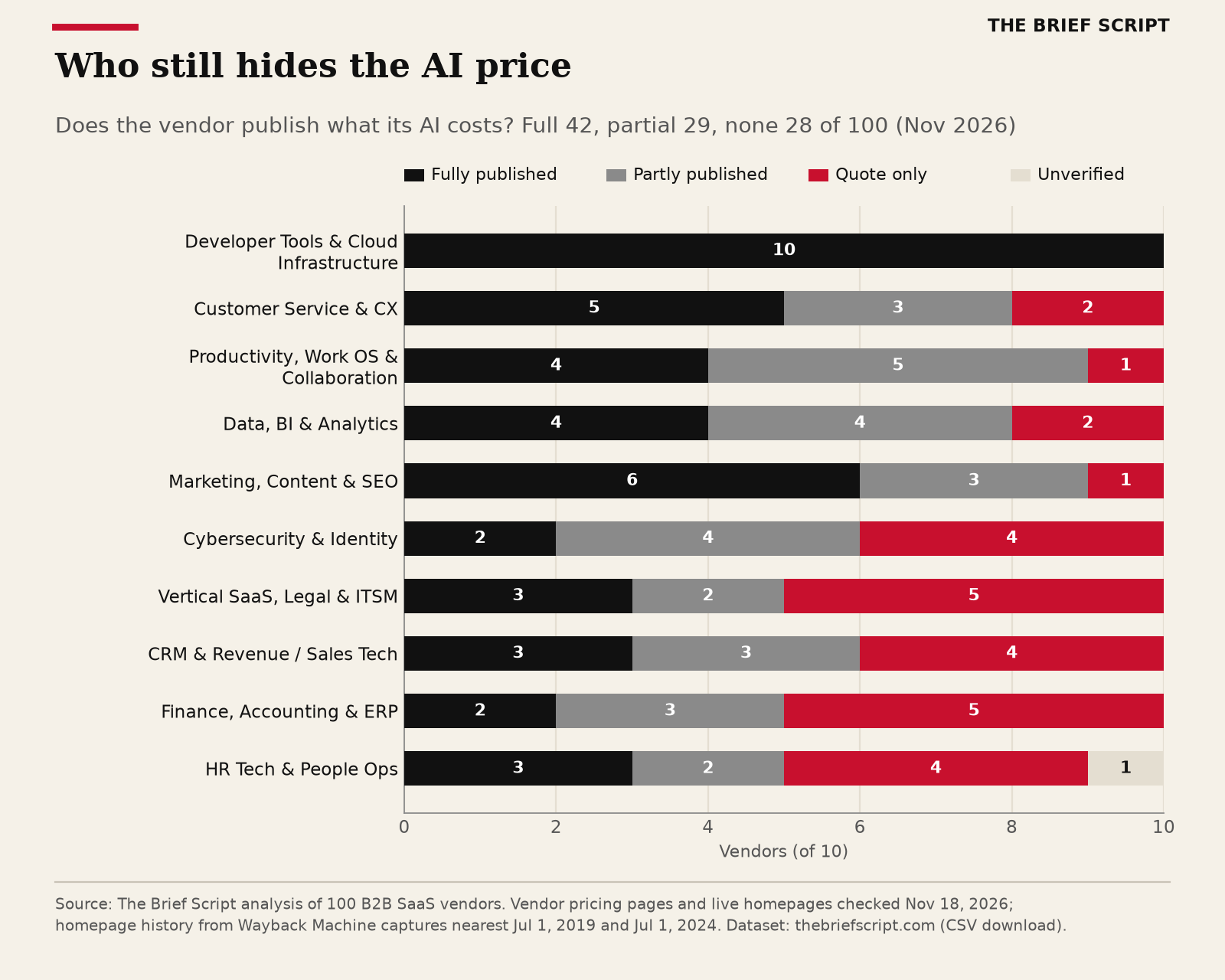
The gap is sharpest where the homepage is loudest. Of the 75 vendors that lead with AI, 22 publish no AI price. That list includes Outreach, Gong, ZoomInfo, Talkdesk, Sage Intacct, Oracle NetSuite, Coupa, BlackLine, Workiva, Smartsheet, Braze, Rippling, Greenhouse, Palantir, Domo, Palo Alto Networks, Zscaler, Vanta, ServiceNow, Ironclad, Veeva and Gladly.
Some of those are reasonable. Gladly’s help center confirms it bills per AI resolution, which is a buyer-friendly unit, but the rate isn’t public. Workiva says its AI is included in every plan; the plans just aren’t priced publicly. Domo uses a published credit-based consumption model with unlimited users but publishes no dollar rates. Others give the buyer nothing to work with before a sales call.
Transparency tracks with the overall score. Vendors that fully publish their AI pricing average 81.3 out of 100. Those that publish nothing average 57.2. That’s partly built into the rubric, since two of the eight criteria reward published pricing. But the other six criteria (product, billing unit, tier access, continuity, outcome alignment and the homepage) point the same way: the vendors that publish their AI rates are usually the ones that have rebuilt their billing around AI.
What this means: For buyers, “no AI price” isn’t neutral. It means the AI cost will be set in negotiation, usually bundled into a renewal. Ask for the AI line item in writing, with the unit, the rate and what happens at overage, before you compare vendors. For vendors, the data suggests opacity no longer reads as premium. The best-scoring companies in nearly every vertical publish their AI rates.
Is the per-seat model really breaking?
The short answer: it’s bending, and the story is more interesting than “seats are dead.” We’ve covered the argument in how AI agents are challenging the per-seat model. Here’s what 100 pricing pages actually show.
52 of 100 vendors now charge for AI through something other than a seat. That’s the sum of three archetypes: metered credit, token or compute pools (38), outcome or resolution meters (7), and vendors that give AI away and monetize a different unit such as payments, card spend or tracked events (7).
But look closely at the 38 credit-pool vendors and most of them still sell seats. Notion’s Business plan is $20 per seat and includes AI credits per member. Asana, ClickUp, Airtable, Miro and Dropbox attach credit allowances to each paid user. Atlassian bundles Rovo into its paid plans with 25, 70 or 150 credits per user per month on Jira. GitLab includes a dollar amount of GitLab Credits with each Premium seat. The seat survives as the entry ticket. What changed is that heavy AI usage now runs on a meter.
And the flat per-user AI add-on, the signature product of 2023 and 2024, is still on sale. Eight vendors in our sample still sell a priced per-user AI add-on in November 2026:
| Vendor | Per-user AI add-on still sold (Nov 2026) |
|---|---|
| Salesforce | Agentforce add-ons at $125 per user per month, alongside Flex Credits |
| Zendesk | Copilot at $50 per agent per month |
| Intercom | Copilot at $29 per teammate per month |
| Freshdesk | Copilot at $29 per agent per month (Pro, Enterprise) |
| Front | Copilot at $20 per seat (included in Enterprise) |
| Kustomer | Envoy at $50 per user per month |
| Sprout Social | Trellis Plus at $28 per seat (1,000 credits) |
| Sentry | Seer AI debugger at $40 per active contributor per month |
Our original draft claimed that 14% of vendors had killed their flat AI add-ons. We couldn’t find a list behind that figure, and these eight rows contradict it, so we dropped it.
What the data does support is a pattern inside the same vendor: a per-user add-on for the human-assist “copilot,” and a usage meter for the autonomous agent. Intercom sells Copilot per teammate and Fin per outcome. Zendesk sells Copilot per agent and bills AI agents per automated resolution. Freshdesk sells Copilot per agent and its AI Agent per session. The seat follows the human. The meter follows the work the AI does on its own.
The dated shifts we could confirm
These are the pricing changes in our cohort where we found a primary source with a date. We dropped every date we couldn’t trace.
| Date | Vendor | Change |
|---|---|---|
| May 15, 2025 | Salesforce | Launched Agentforce Flex Credits: $500 per 100,000 credits, $0.10 per standard action |
| Sep 16, 2025 | Workday | Launched Flex Credits for its AI agents; no dollar rate per credit published |
| Oct 1, 2025 | Databricks | Standard tier discontinued; existing customers auto-upgraded |
| Apr 14, 2026 | HubSpot | Customer Agent moved to $0.50 per resolved conversation, from $1 per conversation; Prospecting Agent $1 per lead |
| May 6, 2026 | monday.com | New customers must buy a shared AI credit pool (minimum 1,000, 2,000 or 3,000 credits a month by plan) |
| May 18, 2026 | Zendesk | Automated resolution tiers in place; dollar rate not published |
| Jun 1, 2026 | GitHub | Copilot moved to token-metered GitHub AI Credits at $0.01 each, replacing premium requests |
| Oct 13, 2026 | Atlassian | Cloud list prices up about 7%; Rovo bundled into paid plans with credit pools |
| Dec 3, 2026 | Atlassian | Rovo usage billing starts at $0.01 per credit above the pool |
Two other changes are confirmed without a date we could pin down: Autodesk cut its Flex minimum purchase from 100 tokens ($300) to 33 tokens ($99), and Postman now bundles 50 to 800 AI credits per user into its plans with overage at $0.035 to $0.05 per credit.
What this means: “Seat pricing is dead” is the wrong takeaway. The accurate version: seats now buy access, and meters buy AI work. Budget for both. If your renewal adds a credit pool, find out the price per credit, the overage rate and whether unused credits expire, because those three numbers decide the real cost.
The five AI pricing archetypes of 2026
We assigned every vendor one primary archetype based on how its live pricing page captures AI revenue. Eight vendors moved archetype after checking against their own pages (for example, ServiceNow and Talkdesk moved to quote-only, and Snyk and dbt Labs moved to metered credits).
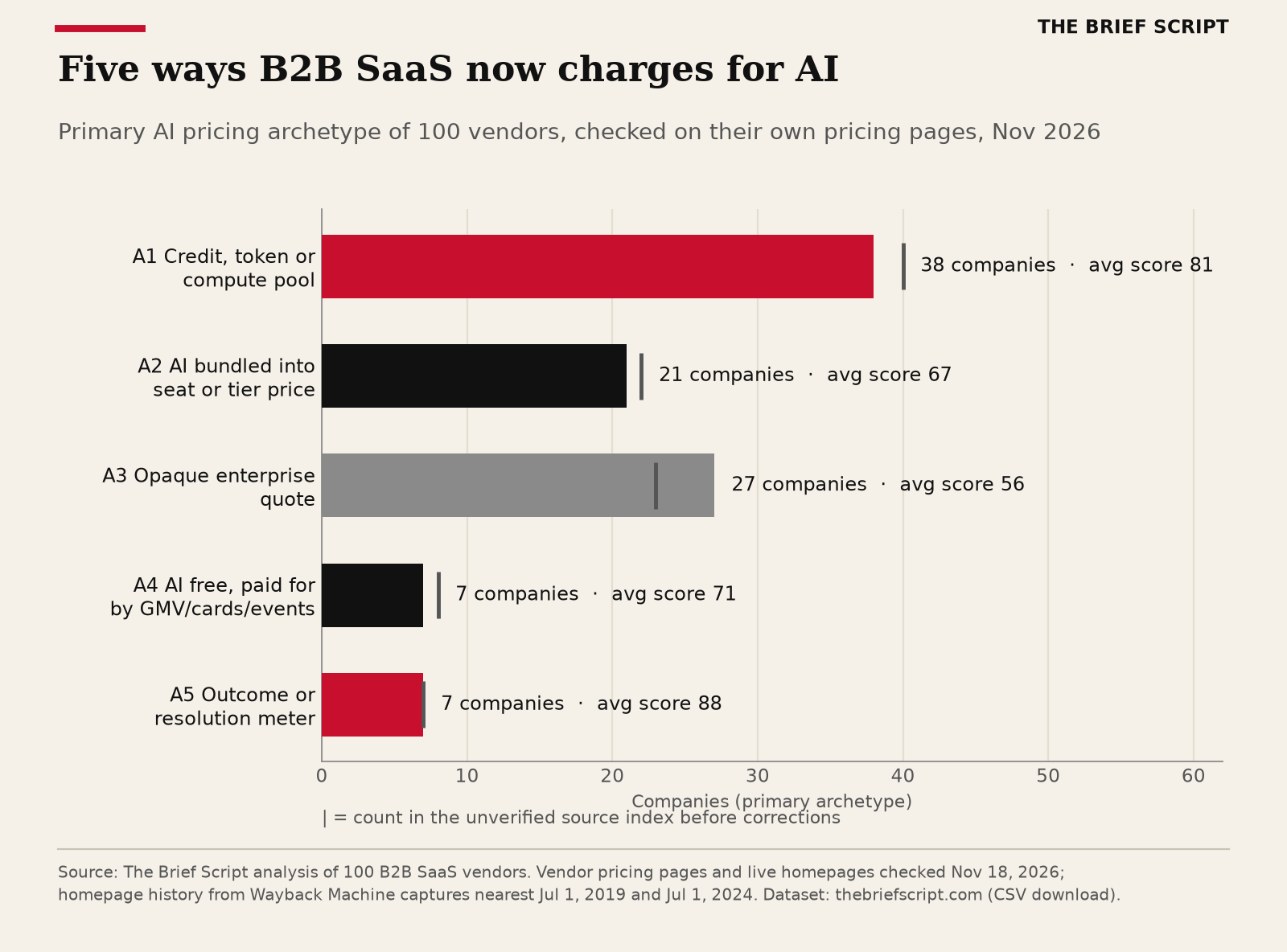
| Archetype | Vendors | Avg score | How it works |
|---|---|---|---|
| A1: Metered credit, token or compute pool | 38 | 81.1 | AI draws down credits, tokens or compute units, usually with an allowance per seat or account and paid overage |
| A2: AI bundled into seat or tier | 21 | 66.8 | AI is included in the plan price; no separate meter |
| A3: Opaque enterprise quote | 27 | 56.0 | No public AI price; quote only |
| A4: AI free, monetized elsewhere | 7 | 70.7 | AI costs nothing extra; revenue comes from payments, card spend, events or tracked usage |
| A5: Outcome or resolution meter | 7 | 87.9 | AI is billed per verified result, such as a resolved conversation |
A1: Metered credit, token or compute pools (38 vendors)
This is now the most common way B2B SaaS charges for AI, and it’s where the most sophisticated pricing lives. The group includes data and infrastructure platforms that always billed by consumption (Snowflake, Databricks, Cloudflare, Twilio, Datadog, Fivetran, HashiCorp, CircleCI, LaunchDarkly) and application vendors that moved AI onto a meter (Salesforce, Notion, Asana, monday.com, ClickUp, Airtable, Atlassian, Miro, Box, GitHub, GitLab, Postman, Vercel, Workday, Adobe Firefly, Ahrefs, Webflow, Canva, Sprout Social, Autodesk, CrowdStrike, Snyk and others).
The best of them publish a clean exchange rate. Snowflake prices AI Credits at $2.00 (global) or $2.20 (regional), separate from its warehouse credits, with no per-seat fees. Cloudflare’s Workers AI costs $0.011 per 1,000 Neurons after 10,000 free a day. GitHub, GitLab and Atlassian all use round dollar units ($0.01 per GitHub AI Credit or Atlassian credit, $1 per GitLab Credit). Snyk publishes a rate card at 1 credit = $1, with an AI pentest listed at 4,000 credits.
The weak spot is the exchange rate. 14 of the 38 credit-pool vendors don’t fully publish what a credit costs or what the AI tier costs. Notion’s Business plan includes 1,500 Standard and 500 Select credits per member a month, and Notion’s help center explains how they’re used, but we found no public price for extra credits. monday.com publishes credit minimums and per-run credit costs (roughly 10 to 250+ credits per agent run) but no dollar price per credit. Miro, Box, Workday, Apollo.io and Domo also publish allowances or credit mechanics without a dollar rate.
The A1 average score is 81.1, second only to outcome pricing.
What this means: A credit is only as transparent as its exchange rate. Before signing, get three numbers in writing: dollars per credit, credits per typical task (an agent run, a document, a query), and the overage rate. If a vendor won’t give the first one, you’re buying a meter you can’t read.
A2: AI bundled into the seat or tier (21 vendors)
Twenty-one vendors include AI in the plan price and don’t meter it separately. This group skews toward small-business and HR software: Pipedrive, Zoho CRM, QuickBooks, Xero, Mailchimp, Gusto, Deel, BambooHR, Lattice, DocuSign and Clio, plus Semrush, Hootsuite, Klaviyo, Dropbox, Smartsheet, Tableau, Okta, SentinelOne, 1Password and Sentry.
Bundling is simple for the buyer. Deel states there is no separate AI add-on. Pipedrive lists AI features on all plans. Mailchimp includes generative AI on its Standard and Premium plans at no additional cost. The trade-off is that AI cost is hidden inside the seat, so when the vendor raises seat prices “because AI is now included,” it’s hard to tell how much of the increase is really for AI.
Several A2 vendors are already hybrid. Dropbox includes 250 AI credits per person a month. Hootsuite includes 100 AI credits a month. Klaviyo meters its Composer AI in usage dollars. These may be the next vendors to move to A1.
The A2 average is 66.8.
What this means: Bundled AI is fine if you use it. If a renewal raises the seat price and cites AI, ask for the price without the AI features, or ask for the right to reduce seats if the AI automates work your people were doing.
A3: Opaque enterprise quote (27 vendors)
Twenty-seven vendors publish no AI price and sell through a quote. Most also publish no product price at all. This is the biggest single reason the cohort scores 71.0 rather than higher.
The group is concentrated in a few places:
- Sales engagement and revenue intelligence: Outreach, Salesloft, Gong and ZoomInfo.
- Finance and ERP: Sage Intacct, Oracle NetSuite, Coupa, BlackLine and Workiva.
- HR and payroll: Rippling, Greenhouse, Lever (†), ADP and Paycor.
- Security: Palo Alto Networks, Zscaler, Vanta and CyberArk (now part of Palo Alto Networks).
- Enterprise platforms and vertical systems of record: ServiceNow, Palantir, Alteryx, Ironclad, Procore, Veeva, Samsara, Braze and Talkdesk.
Talkdesk is a good example of how partial transparency can still end in a quote. Its seat prices are public ($85 to $225 per user per month), but its AI products are marked “contact sales.” Alteryx publishes its Starter plan at $250 per user per month but quotes Professional and Enterprise.
The A3 average is 56.0, the lowest of the five.
What this means: Quote-only AI isn’t always bad. Large platforms with long contracts, like ServiceNow or Palantir, have always sold this way. But for a buyer it means two things: you can’t benchmark the AI cost before a sales cycle, and the AI price will usually arrive bundled with the renewal. Ask for the AI component as a separate line with its own unit.
A4: AI free, monetized elsewhere (7 vendors)
Seven vendors give their AI away and earn the money on a different meter. We look at this group in detail below. Shopify, Toast, Ramp, Brex, BILL, Amplitude and Mixpanel average 70.7.
A5: Outcome or resolution meters (7 vendors)
Seven vendors bill AI per verified result. Six are in customer service: Intercom ($0.99 per Fin outcome), Front ($0.89 per resolution), Help Scout ($0.75 per resolution), Gorgias (per automated interaction, $0.85 to $1.00 by plan), Zendesk (per automated resolution, rate not published) and Gladly (per AI resolution, rate not published). The seventh is HubSpot, whose Customer Agent charges $0.50 per resolved conversation and whose Prospecting Agent charges $1 per lead.
This is the smallest archetype, and it’s the best-scoring one: 87.9 on average. Only 7% of the cohort bills by outcome, which is a long way from the “outcome pricing is taking over” narrative. But where it exists, it’s concrete: a named unit, a published price and, in most cases, a clear definition of what counts.
What this means: Outcome pricing is still a customer-service story. If you’re buying a support AI agent, it’s now reasonable to expect a per-resolution price and a written definition of “resolved.” Outside support, expect credits instead.
How much AI-washing is there, really?
“AI-washing” means claiming AI on the homepage without changing the product or the pricing behind it. We measured it two ways.
At the cohort level, the gap is 23 points. 75% of vendors lead with AI on the homepage; 52% have actually moved AI onto a non-seat billing unit. That’s our “AI-washing gap”: the share of the market making the claim minus the share that has re-engineered how AI is billed. It’s a real gap, but a narrower one than the 37 points in our original draft.
At the vendor level, severe AI-washing is rare. We defined a severe case as a homepage that markets AI agents, a total score below 55, and no public AI price. Three of 100 vendors meet all three tests:
| Vendor | Vertical | Score | Homepage | Pricing page (Nov 2026) |
|---|---|---|---|---|
| Outreach | CRM & sales tech | 52 | Markets AI agents | All packages “Request pricing”; AI Credits included by package, extra packs unpriced |
| Coupa | Finance & ERP | 54 | Markets AI agents | No pricing page; quote only |
| BlackLine | Finance & ERP | 49 | Markets AI agents | No pricing page; AI folded into the platform; quote only |
Two more vendors market agents and publish no AI price but score above 55: Veeva (63) and Domo (73). Domo publishes its credit-based consumption model, just not the dollar rates.
The more surprising result runs the other way. Vendors whose homepage markets AI agents score higher on average (77.9) than those that don’t (67.7). Of the 33 agent-marketing vendors, 21 sit in the metered-credit archetype and 3 bill by outcome. In other words, “agents” on the homepage usually comes with a real meter on the pricing page. The vendors that say less are often the ones that changed less.
What this means: Don’t dismiss agent marketing as hype by default. In this sample, it was more often a sign of real pricing change than of washing. The red flag is the combination: an agent headline with no AI price and no billing documentation.
The vertical scorecard: where the seat model broke and where it held
Each vertical has exactly ten vendors, so the averages compare like with like.
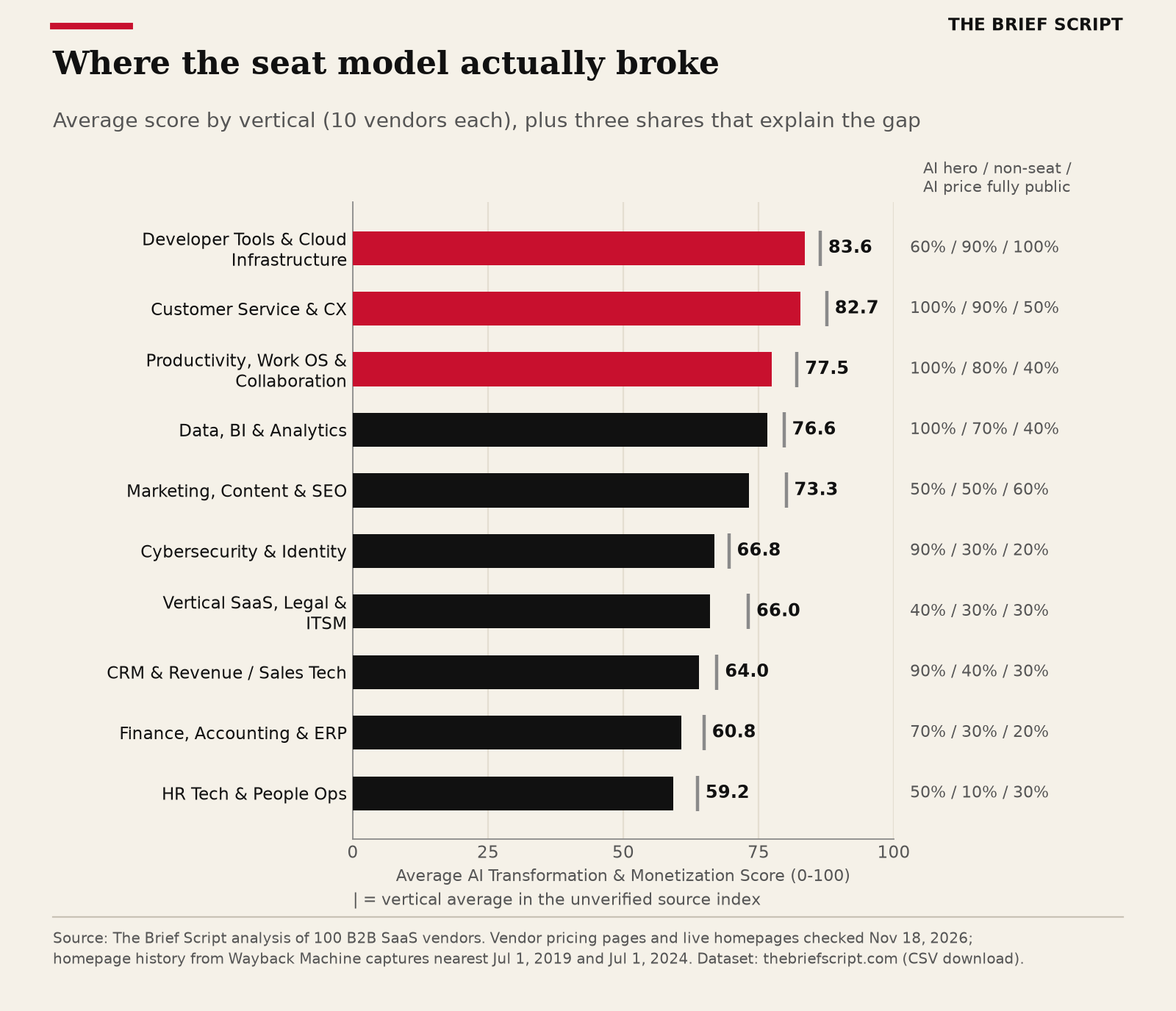
| Rank | Vertical | Avg score | AI in headline | Agents in headline | Non-seat AI meter | AI price fully public | AI-washing gap |
|---|---|---|---|---|---|---|---|
| 1 | Developer Tools & Cloud Infrastructure | 83.6 | 60% | 40% | 90% | 100% | 0 pts |
| 2 | Customer Service & CX | 82.7 | 100% | 50% | 90% | 50% | 10 pts |
| 3 | Productivity, Work OS & Collaboration | 77.5 | 100% | 60% | 80% | 40% | 20 pts |
| 4 | Data, BI & Analytics | 76.6 | 100% | 60% | 70% | 40% | 30 pts |
| 5 | Marketing, Content & SEO | 73.3 | 50% | 10% | 50% | 60% | 0 pts |
| 6 | Cybersecurity & Identity | 66.8 | 90% | 50% | 30% | 20% | 60 pts |
| 7 | Vertical SaaS, Legal & ITSM | 66.0 | 40% | 10% | 30% | 30% | 10 pts |
| 8 | CRM & Revenue / Sales Tech | 64.0 | 90% | 30% | 40% | 30% | 50 pts |
| 9 | Finance, Accounting & ERP | 60.8 | 70% | 20% | 30% | 20% | 40 pts |
| 10 | HR Tech & People Ops | 59.2 | 50% | 0% | 10% | 30% | 40 pts |
AI-washing gap = share leading with AI minus share using a non-seat AI meter, floored at zero. “AI price fully public” counts only vendors whose AI price is fully published.
Developer tools (83.6): quiet homepages, loud meters
Developer tools lead the ranking with the least AI marketing among the top verticals. Only six of ten lead with AI, but nine of ten use a non-seat meter and all ten fully publish their AI or usage prices. GitHub meters Copilot in $0.01 credits. GitLab sells Duo Agent Platform usage at $1 per GitLab Credit. Datadog sells AI Credits at $500 per 500 a month on an annual plan or $1.30 on demand. Postman bundles AI credits per user with published overage. Vercel’s v0 meters credits by model. Twilio prices voice AI by the minute and second. LaunchDarkly gives 5,000 free AI runs and then charges $5 per 1,000. Sentry is the one seat-based holdout, with its Seer AI debugger at $40 per active contributor.
Developer tools sold usage long before generative AI, so moving AI onto a meter was a smaller step. That’s also why the vertical shows no AI-washing gap.
Customer service (82.7): the home of outcome pricing
Customer service is the only vertical where every vendor leads with AI, and it’s where outcome pricing actually exists. Six of the seven outcome-priced vendors in the whole study are here, and the seventh, HubSpot, prices its support agent per resolution too.
But CX also shows that “usage-based” can mean very different things. Some vendors bill per resolved conversation; others bill every time the AI engages, whether it solves the problem or not. We model the difference in Trap 1 below. CX’s weakness is transparency: only half fully publish their AI price. Zendesk bills per automated resolution but doesn’t publish the rate, Kustomer quotes its seats, and Talkdesk quotes its AI.
Productivity and Work OS (77.5): seats plus credit pools
This is where the “seat plus credit pool” model took over. Notion, Asana, monday.com, ClickUp, Airtable, Atlassian, Miro and Box all now attach AI credits to their plans. The vertical’s weak spot is exchange rates: only four of ten fully publish what AI costs. ClickUp ($10 per 10,000 credits), Airtable (packs from $20 per 10,000 credits), Asana ($0.50 to $0.60 per extra AI request) and Atlassian ($0.01 per credit from December 3, 2026) publish rates. Notion, monday.com, Miro and Box publish allowances but no dollar price per credit.
Data and analytics (76.6): compute-native, with notable gaps
Snowflake (95) and Databricks (91) are among the clearest AI pricing models in the study. Amplitude and Mixpanel offer unlimited seats and include AI on all plans, earning their revenue on events. At the other end, Palantir publishes no pricing, Domo publishes a credit model without rates, and Alteryx quotes everything above Starter. Tableau’s agent sits in Tableau+ and Cloud+ editions, which are contact-sales.
Marketing (73.3): the least AI-forward homepages
Only half of marketing vendors lead with AI, and only one (Klaviyo) markets agents in its headline. Yet its pricing is fairly transparent: Adobe Firefly sells credit plans from $9.99 (2,000 credits) to $199.99 (50,000), Ahrefs sells AI prompt-check packs with per-check overage, Webflow sells extra AI credits at $20 a month for 2,000, and Semrush (now part of Adobe) prices AI visibility tracking at $99 per domain a month. Braze is the quote-only outlier.
Security (66.8): the widest gap
Security has the widest AI-washing gap in the study: 60 points. Nine of ten lead with AI, but only three use a non-seat AI meter and only two fully publish AI pricing. Cloudflare (96) and Snyk (70) are the transparent exceptions. Palo Alto Networks, Zscaler, Vanta and CyberArk sell through quotes. CrowdStrike publishes device prices, but its Charlotte agentic SOAR is credit-based and contact-sales. Okta lists an AI agents add-on without a price.
CRM and sales tech (64.0): a split vertical
CRM splits in two. HubSpot (92) and Salesforce (84) have re-engineered AI pricing around credits and outcomes, and Apollo.io (75) pools credits into its seats. The sales engagement and intelligence vendors (Outreach, Salesloft, Gong and ZoomInfo) are all quote-only, and Salesloft scores lowest in the study at 40. Pipedrive and Zoho bundle AI into published seat prices.
Finance and ERP (60.8) and HR (59.2): the seat holds
Finance and HR are where the seat model held most firmly. In HR, only one of ten vendors (Workday) uses a non-seat AI meter, and none markets agents in its homepage headline. HR software is priced per employee or per seat, and AI is mostly bundled into those prices: Gusto, Deel, BambooHR and Lattice include AI in published plans. Rippling, Greenhouse, ADP and Paycor quote.
Finance splits between the spend-management vendors (Brex, Ramp and BILL), which give AI away and earn on payments and cards, and the ERP and close vendors (Sage Intacct, Oracle NetSuite, Coupa, BlackLine and Workiva), which quote. QuickBooks and Xero bundle AI into published plans.
What this means: If you buy in HR or finance, expect AI to arrive as a seat or per-employee price increase, not a meter. That makes it harder to measure what you’re paying for AI. Ask vendors to price AI separately, or to show what changed in the plan when the price changed. If you buy dev tools, data or support software, the work is the opposite: model your usage, because the meter is where the cost lives.
Five AI pricing traps to audit before you sign
These five patterns come straight from the pricing pages and billing documentation in our dataset. Each is visible before you sign, if you know where to look.
Trap 1: Paying per session instead of per resolution
In customer service, a lower list rate can cost more. Some vendors charge only when the AI resolves a conversation. Others charge whenever the AI engages, even if it then hands the customer to a human.
We modelled 10,000 AI-handled chats a month with 30% (3,000) resolved without a human, using each vendor’s published rate:
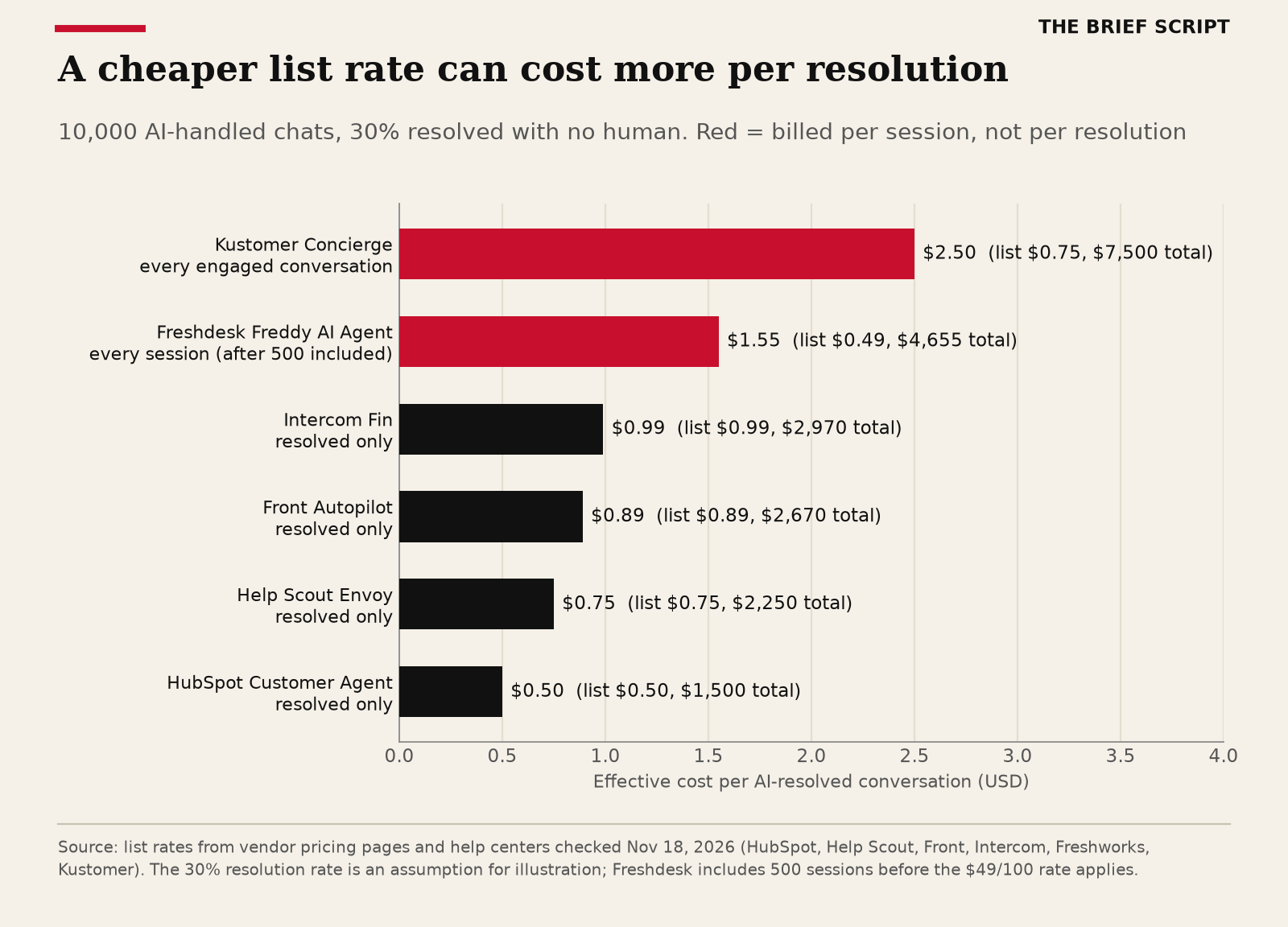
| Model | List rate | Billed on | Monthly bill | Cost per resolved chat |
|---|---|---|---|---|
| HubSpot Customer Agent | $0.50 | Resolved only | $1,500 | $0.50 |
| Help Scout Envoy | $0.75 | Resolved only | $2,250 | $0.75 |
| Front Autopilot | $0.89 | Resolved only | $2,670 | $0.89 |
| Intercom Fin | $0.99 | Resolved only | $2,970 | $0.99 |
| Freshdesk Freddy AI Agent | $0.49 | Every session after 500 included | $4,655 | $1.55 |
| Kustomer Concierge | $0.75 | Every engaged conversation | $7,500 | $2.50 |
Freshdesk’s pricing page lists 500 Freddy AI Agent sessions included, then $49 per 100 sessions, which is $0.49 a session. At a 30% resolution rate, that works out to $1.55 per resolved chat, more than Intercom’s $0.99 per outcome. Kustomer’s $0.75 per engaged conversation works out to $2.50. The comparison flips if your resolution rate is high, so run it on your own numbers.
Front’s model is a useful middle ground. Front’s help center lists $0.89 per resolution and $0.39 per handoff, so a failed AI attempt costs less than a successful one.
Trap 2: Two meters on the same conversation
Some vendors bill the underlying unit of work and then bill the AI on that same unit. Gorgias prices its helpdesk by ticket volume ($10 to $900 a month) and its AI Agent per automated interaction ($0.85 to $1.00 by plan, with 30 to 530 included). Zendesk and Freshdesk sell a per-agent Copilot and a separate AI agent meter. That’s not necessarily unfair, since the products do different jobs, but it means the cost of an AI-handled ticket is the sum of two lines. Model them together.
Trap 3: Credits without an exchange rate
Fourteen of the 38 credit-pool vendors don’t fully publish what a credit costs or what the AI tier costs. Notion, monday.com, Miro, Box, Workday, Apollo.io and Domo publish allowances or credit mechanics but no dollar rate per credit. Canva lists an AI Pass add-on without a price. Without a rate, you can’t compare vendors or forecast overage, and the vendor can change the effective price by changing how many credits a task uses.
Trap 4: Mandatory pools and minimums
Credit pools often come with a floor. Since May 6, 2026, new monday.com customers must buy a shared AI credit pool with a monthly minimum of 1,000, 2,000 or 3,000 credits depending on plan. Datadog prices annual AI Credits at $500 per 500 credits a month. Lattice has a $4,000 annual minimum and Okta a $1,500 minimum. A minimum isn’t a trap if you’ll use it, but it can turn a “pay for what you use” pitch into a fixed fee for small teams.
Trap 5: Promotions and scheduled switch-ons
Several prices in our dataset are temporary or scheduled to change. Vercel’s v0 Plus is listed at a $30 promotional price against a $90 list price. Intercom shows a $19 promotional helpdesk seat against $29. Atlassian’s Rovo credits switch to paid usage billing on December 3, 2026, at $0.01 per credit beyond the included pool. If you budget on a promotional rate or on today’s free allowance, your renewal will surprise you.
What this means: Put five lines in every AI contract: the billable unit and its definition, the price per unit, what’s included, the overage rate with a hard cap or auto-pause, and how much notice you get before any of these change.
The “free AI” playbook: monetize the work, not the AI
Seven vendors charge nothing extra for AI. They aren’t being generous. Their revenue sits on a unit that AI helps grow.
| Vendor | AI given away | Where the money comes from |
|---|---|---|
| Shopify | Sidekick on all plans, from Basic at $39 to Plus from $2,300 a month | Subscription plus payments; online card rates 2.9% to 2.25% + 30¢ |
| Toast | Toast IQ “included at no additional cost” | POS subscription and payment processing (processing rate not published) |
| Ramp | “AI-assisted” free tier; “AI-powered” Plus at $15 per user plus a platform fee | Card interchange and paid tiers |
| Brex | AI rules on the $0 Essentials tier; AI audit detection on Premium at $12 per user | Card interchange and paid tiers |
| BILL | AI receipt matching in $0 Spend & Expense | Per-user AP/AR plans and payment fees (ACH $0.59, check $1.99, instant 1%) |
| Amplitude | AI on all plans, unlimited seats | Event volume; Plus starts at $0 and scales with events |
| Mixpanel | AI and agent features on all plans, unlimited seats | Event volume; for example, 10M events at $840 a month (annual) |
The logic is simple. If AI helps a merchant sell more, Shopify earns more on payments. If it helps a product team track more events, Mixpanel earns more on events. Charging for the AI separately would slow adoption of the thing that drives the real meter.
This model only works where a usage or transaction meter already exists, which is why it’s limited to commerce, payments and product analytics in our sample. The group averages 70.7.
What this means: “Free AI” still has a price. Check what it increases: transaction volume, event volume or card spend. If the AI makes you send more events or run more payments through the platform, that’s where its cost appears.
Playbooks: what to do with this data
For buyers: CIOs, CFOs and procurement
- Ask for the AI line item. For any vendor whose pricing page doesn’t show an AI price (28 of 100 in our sample), ask for the AI component as its own line, with its unit and rate. Don’t accept “included” without knowing what the plan cost before.
- Get the exchange rate. For any credit pool, get dollars per credit, credits per typical task and overage per credit in writing.
- Prefer resolutions over sessions. For support AI, ask for per-resolution pricing and a written definition of “resolved,” including what happens if the customer comes back.
- Cap the meter. Ask for hard spend caps or auto-pause, not just alerts. Uncapped overage is where usage pricing hurts.
- Budget seats and meters separately. Most metered vendors still charge seats. Model both, and use your own usage numbers. Our guide to what an enterprise AI deployment costs breaks the stack down layer by layer, and our AI ROI benchmarks can help you set the value side of the equation.
- Watch the switch-on dates. Note when included allowances turn into paid usage, like Atlassian’s December 3, 2026 change, and plan renewals around them.
For SaaS founders and pricing leaders
- Publish the AI price. In every vertical we studied, the best-scoring vendors publish what AI costs. Full-transparency vendors average 81.3 against 57.2 for those that publish nothing.
- Publish the exchange rate, not just the allowance. A credit allowance without a dollar rate reads as a hidden price increase waiting to happen.
- Match the unit to the work. Seat for human-assist features, meter for autonomous work. Intercom, Zendesk and HubSpot all split their pricing this way.
- Use outcomes where outcomes are countable. Resolutions in support, leads in prospecting. Outside those, credits tied to clear task costs are more honest than an outcome you can’t verify.
- Make the homepage match the pricing page. If the headline says “agents,” the pricing page should show what an agent costs.
What this means: The market has moved from “does it have AI?” to “what does the AI cost per unit of work?” Vendors that can answer that on a public page are winning the comparison before the sales call starts. The same pressure is visible one layer down, in AI model API prices and in enterprise AI platform pricing, where only 9 of 22 platforms publish a full price list.
Ownership changes inside the cohort
Several companies in the study changed hands between 2019 and 2026. We kept each product as its own row because each still runs its own domain and pricing page. Confirmed deals:
| Deal | Status | Notes |
|---|---|---|
| IBM acquired HashiCorp | Completed Feb 27, 2025 | $6.4B enterprise value |
| Paychex acquired Paycor | Completed Apr 14, 2025 | About $4.1B enterprise value |
| Clio acquired vLex | Completed Nov 10, 2025 | US$1B in cash and stock |
| Salesloft and Clari merged | Completed Dec 3, 2025 | Agreement announced Aug 7, 2025 |
| Palo Alto Networks acquired CyberArk | Completed Feb 11, 2026 | About $25B equity value; CyberArk now branded Idira |
| Adobe acquired Semrush | Completed Apr 28, 2026 | Announced Nov 19, 2025 at about $1.9B |
| Fivetran and dbt Labs | Combined | dbt’s pricing page states “Fivetran + dbt Labs is now Fivetran” |
| Progress Software and Domo | Completed | Progress acquired Domo’s AI and data platform business, per Domo’s site |
Our original draft also listed a $4.4B take-private of Alteryx. We couldn’t confirm it from a primary source, so we dropped it. Salesforce owns Tableau, Intuit owns QuickBooks and Mailchimp, and Freshworks owns Freshsales and Freshdesk; each product keeps its own row.
Methodology
Cohort. 100 established B2B SaaS category leaders, ten in each of ten verticals: CRM and sales tech; customer service and CX; finance, accounting and ERP; productivity and Work OS; marketing, content and SEO; HR tech and people ops; developer tools and cloud infrastructure; data, BI and analytics; cybersecurity and identity; and vertical SaaS, legal and ITSM. The cohort was fixed before checking, and every company had to have operated across the full 2019 to 2026 window. The ten-per-vertical cap stops any one category from dominating the averages.
Homepage headlines. For each company we read the homepage headline and subheadline in three eras: a 2019–20 capture and a mid-2024 capture from the Internet Archive’s Wayback Machine (usually early July of each year), and the live homepage in November 2026. We recorded two flags: does the headline mention AI, and does it market AI agents? Where no readable capture existed, the company was excluded from that era’s denominator, which is why the 2019–20 figure is out of 97 and the 2024 figure out of 94.
Pricing. For each company we read the vendor’s own pricing page, plan pages and billing documentation on November 18, 2026, and recorded how AI is priced, whether that price is published (full, partial or none), whether a per-user AI add-on is still sold, and the primary pricing archetype. Each row in the dataset carries the URL we used.
Archetypes. Each vendor gets one primary archetype: A1 metered credit, token or compute pool; A2 AI bundled into the seat or tier; A3 opaque enterprise quote; A4 AI free and monetized elsewhere; A5 outcome or resolution meter. “Non-seat AI meter” means A1, A4 or A5.
The 100-point score. The score measures whether a vendor’s AI claims are backed by pricing and product change. It is not a measure of how cheap or good the product is. Eight criteria:
| Criterion | Points | What it tests |
|---|---|---|
| Homepage positioning | 10 | 10 if the headline markets AI agents, 8 if it mentions AI, 4 if neither |
| Product architecture | 15 | Has AI moved beyond a chat add-on into workflows, agents or integrations? |
| AI pricing clarity | 15 | Does the pricing page say how AI is packaged and billed? |
| Billing unit | 15 | Has the vendor added credits, tokens, metered actions or outcomes alongside or instead of seats? |
| Unit-rate transparency | 10 | Are exact dollar rates published? |
| Tier access | 10 | Is AI available on self-serve and mid-market tiers, or only in enterprise contracts? |
| Continuity | 10 | Can the 2019 and 2024 positioning be traced in readable archives? |
| Outcome alignment | 15 | Does the billing unit track work done, compute used or results delivered? |
Bands: Transformational (85 to 100), Advanced (70 to 84), Transitional (55 to 69), Legacy or gated (below 55). The cohort splits 20 / 39 / 27 / 14 across those bands.
Rescoring choices. We made three changes to the original scores, all mechanical:
- Pricing clarity is capped by what’s published. A vendor can score at most 15 on AI pricing clarity and 10 on unit-rate transparency if its AI price is fully published, 10 and 6 if partly published, and 5 and 2 if not published. That stops a vendor from scoring well on clarity for a price nobody can see.
- Continuity is scored on readable archives. 10 points if both the 2019–20 and 2024 captures were readable, 6 if one was, 2 if neither.
- The homepage score follows the checked flags (10, 8 or 4, as above).
The other four criteria (product architecture, billing unit, tier access and outcome alignment) carry the original study’s scores, which we did not independently re-score (see limitations).
Date and zone. All live checks ran on November 18, 2026. Prices are in US dollars as shown on US pricing pages, excluding tax.
Validation and limitations
This study began as a draft built from an AI research session. Before publishing, we checked every vendor against its own pages and every homepage against archived captures. That changed a lot, and we think readers should see how much.
What the checks changed.
- Vendor records: 32 of 100 were confirmed as written, 67 needed corrections, and 1 (Lever) couldn’t be checked because its site returned empty responses on our check date. That row is marked † and should be read with caution.
- Homepage flags: 25 AI-headline flags and 50 agent-headline flags changed after we read the actual captures.
- Archetypes: 8 vendors moved to a different archetype.
- Scores: 79 went down, 4 went up and 17 stayed the same. The mean fell 4.4 points.
Headline numbers, before and after.
| Measure | Original draft | After checks |
|---|---|---|
| AI in homepage headline, 2019–20 | 6% | 2.1% |
| AI in homepage headline, 2023–24 | 88% | 39.4% |
| AI in homepage headline, Nov 2026 | 97% | 75% |
| Markets AI agents, Nov 2026 | 74% | 33% |
| Mean score | 74.8 | 71.0 |
| Non-seat AI billing | 60% | 52% |
| Outcome billing | 8% | 7% |
| Severe AI-washing | 11% | 3% |
| AI-washing gap | 37 pts | 23 pts |
| Vendors that “killed” flat AI add-ons | 14% | Dropped: no list behind it, and 8 vendors still sell one |
Claims we dropped or couldn’t source. A Notion credit price of $10 per 1,000 and a May 4, 2026 launch date (Notion doesn’t publish either); an April 21, 2026 Salesforce Flex Credits update; a $4.4B Alteryx take-private; Front’s $0.05 triage rate and “July 2026” restructure; and several seat prices, minimums and add-on prices that the vendors’ own pages didn’t show. Where a vendor’s page and the draft disagreed, we used the vendor’s page.
Limitations.
- Four of the eight score criteria are not independently re-scored. Product architecture, billing unit, tier access and outcome alignment come from the original study, and the two pricing criteria were only capped, never raised. We checked the facts behind them (pricing, archetype, publication) but didn’t re-score each judgment. Treat small score differences, a few points, as noise.
- Homepage headlines are a narrow signal. We read the headline and subheadline only, not the whole page. Archived captures can be regional variants, and a site can change its headline weekly.
- Prices change fast. Several prices in this dataset are promotions or have announced changes ahead. Everything is as of November 18, 2026.
- One archetype per vendor simplifies things. Many vendors mix models. Salesforce, for example, sells both per-user add-ons and Flex Credits; we classified it by the mechanism its AI pricing page leads with.
- The cohort is large established vendors. It doesn’t represent startups or AI-native companies, which often price differently.
- Severe AI-washing is a strict definition. A vendor can over-claim on its homepage without meeting all three of our tests.
FAQ
How do B2B SaaS companies price AI in 2026? In our sample of 100, the most common model is a metered credit, token or compute pool (38 vendors), usually on top of seats. Next come quote-only enterprise pricing (27), AI bundled into seat or tier prices (21), AI given away and monetized elsewhere (7), and outcome or resolution pricing (7).
Is per-seat SaaS pricing dead? No. 52% of vendors now charge for AI through something other than a seat, but most of them still sell seats as the base. Eight vendors still sell a priced per-user AI add-on. Seats increasingly buy access, while meters buy AI work.
What is outcome-based AI pricing? Billing per verified result rather than per user or per use, such as $0.99 per resolved conversation on Intercom Fin or $0.50 per resolved conversation on HubSpot’s Customer Agent. Only 7% of our cohort bills this way, mostly in customer service.
What is AI-washing in SaaS? Claiming AI on the homepage without matching changes to the product or pricing. At the cohort level, 75% of vendors lead with AI but 52% have moved AI onto a non-seat meter, a 23-point gap. Only 3 vendors (Outreach, Coupa and BlackLine) met our strict definition of severe AI-washing.
Which SaaS vertical has the most mature AI pricing? Developer tools and cloud infrastructure (average score 83.6), narrowly ahead of customer service (82.7). HR tech is last at 59.2.
How much do SaaS AI credits cost? Published rates vary widely by unit. GitHub and Atlassian charge $0.01 per credit, GitLab $1 per GitLab Credit, Snowflake $2.00 to $2.20 per AI credit, and ClickUp $10 per 10,000 credits. Many vendors, including Notion, monday.com and Miro, don’t publish a dollar rate per credit.
Download the data
The full index is free to reuse with attribution (CC BY 4.0):
- briefscript_b2b_saas_ai_pricing_study_2019_2026.csv: one row per vendor with vertical, homepage flags for 2019–20, 2024 and 2026, archetype, AI price publication, AI pricing as of November 2026, the eight sub-scores, total score, verification status, and a
source_urlfor the pricing evidence, plus the homepage and Wayback capture URLs.
Cite this study: The Brief Script, “We Tracked 100 B2B SaaS Companies From 2019 to 2026,” November 2026. thebriefscript.com/b2b-saas-ai-pricing-study/
Appendix: the 100-company index
Homepage columns show whether the headline mentioned AI in 2019–20, mid-2024 and November 2026, and whether it marketed AI agents in November 2026 (n/a = no readable archive capture). Archetypes: A1 credit/token/compute pool, A2 bundled into seat or tier, A3 quote only, A4 free and monetized elsewhere, A5 outcome meter. “AI price” shows whether the AI price is fully, partly or not published. Every row’s source URL is in the dataset.
| # | Company | Vertical | AI headline 2019 / 2024 / 2026 | Agents 2026 | Archetype | AI price | Score | How AI is priced (Nov 2026) |
|---|---|---|---|---|---|---|---|---|
| 001 | Salesforce | CRM & sales | N / Y / Y | Y | A1 | Partial | 84 | Flex Credits $500 per 100K ($0.10 per standard action, 20 credits); Agentforce add-ons $125/user/mo; $5 Agentforce user licence; Conversations offered but no price published |
| 002 | HubSpot | CRM & sales | N / Y / Y | N | A5 | Full | 92 | HubSpot Credits at $0.010; Customer Agent 50 credits ($0.50) per resolved conversation, Prospecting Agent 100 credits ($1) per lead; outcome pricing from Apr 14, 2026 (was $1 per conversation) |
| 003 | Pipedrive | CRM & sales | N / N / Y | N | A2 | Full | 64 | Lite $14, Growth $39, Premium $59, Ultimate $79 per seat/mo (annual); AI features listed as available on all plans, no AI add-on or meter |
| 004 | Zoho CRM | CRM & sales | N / N / Y | N | A2 | Full | 70 | $14-$52/user/mo annual ($20-$65 monthly); AI agents listed from Professional ($23); Zia Agents offered free; MCP published as a capability |
| 005 | Outreach | CRM & sales | N / N / Y | Y | A3 | None | 52 | All Amplify packages “Request pricing”; seat access plus AI Credits (10K-100K included by package); extra credit packs unpriced |
| 006 | Salesloft | CRM & sales | N / Y / N | N | A3 | None | 40 | Pricing page redirects to “Talk to sales”; no tiers or prices published; Clari merger completed Dec 3, 2025 |
| 007 | Gong | CRM & sales | N / Y / Y | N | A3 | None | 46 | Per-user licences plus a platform fee; custom proposal only; no AI unit pricing |
| 008 | Apollo.io | CRM & sales | N / N / Y | Y | A1 | Partial | 75 | $49/$79/$119 per seat/mo (annual) with pooled credits for data and AI research (Free 900/yr; Basic 30K; Pro 48K; Org 72K per seat/yr); no $/credit rate |
| 009 | ZoomInfo | CRM & sales | N / N / Y | N | A3 | None | 52 | No published prices; licences + credits; tiers Professional, Copilot Advanced, Copilot Enterprise |
| 010 | Freshsales | CRM & sales | Y / Y / Y | N | A1 | Partial | 65 | $9/$39/$59 per user/mo (annual); Freddy AI Agent add-on $49 per 100 sessions |
| 011 | Zendesk | Customer service | N / Y / Y | N | A5 | Partial | 80 | Suite $55-$115/agent/mo; Copilot add-on $50/agent/mo; AI agents billed per automated resolution (tiered since May 18, 2026) but no $ rate published |
| 012 | Intercom | Customer service | N / Y / Y | Y | A5 | Full | 98 | Helpdesk $29 ($19 promo)/$85/$132 per seat; Fin $0.99 per outcome (one per conversation); Fin Voice $1.99; $9.99 per lead qualification; Copilot $29/teammate/mo |
| 013 | Freshdesk | Customer service | N / Y / Y | Y | A1 | Full | 86 | $19/$55/$89 per agent/mo; 500 Freddy AI Agent sessions included, then $49 per 100 sessions; Copilot $29/agent/mo (Pro, Enterprise) |
| 014 | Front | Customer service | N / Y / Y | Y | A5 | Full | 95 | $25/$65/$105 per seat/mo; Copilot $20/seat (included in Enterprise); Autopilot $0.39 per handoff, $0.89 per resolution |
| 015 | Help Scout | Customer service | N / N / Y | N | A5 | Full | 89 | Free (5 users) to $75/user/mo; Envoy AI agent $0.75 per resolution with monthly spend caps |
| 016 | Gladly | Customer service | N / Y / Y | N | A5 | None | 72 | No public pricing; help docs confirm billable AI resolutions (rate unpublished) |
| 017 | Kustomer | Customer service | N / Y / Y | N | A1 | Partial | 75 | Seats “Talk to Sales”; Concierge $0.75 per engaged conversation; Envoy $50/user/mo; AI QA $0.05/execution; usage credits |
| 018 | Talkdesk | Customer service | N / Y / Y | N | A3 | None | 65 | Seats $85/$105/$165/$225 per user/mo; AI (CXA Copilot/Autopilot) unpriced, contact sales |
| 019 | Genesys | Customer service | Y / Y / Y | Y | A1 | Partial | 78 | CX 1-4 $75/$115/$155/$240 per user/mo; 250 named / 350 concurrent Experience Units per org/month included; USD 1.00 per additional unit |
| 020 | Gorgias | Customer service | N / Y / Y | Y | A5 | Full | 89 | Ticket-based helpdesk ($10-$900/mo) plus AI Agent per automated interaction: $1.00/$0.90/$0.90/$0.85 with 30-530 included |
| 021 | Intuit QuickBooks | Finance & ERP | N / N / N | N | A2 | Full | 66 | $38/$85/$140/$340 per month list; Intuit Intelligence AI bundled in paid plans, no AI meter |
| 022 | Xero | Finance & ERP | N / N / N | N | A2 | Partial | 59 | US plans Early $27 / Growing $59 / Established $97 per month, no per-user fees; JAX AI inside plans, no AI price |
| 023 | Sage (Intacct) | Finance & ERP | N / Y / Y | N | A3 | None | 57 | Intacct and Copilot “Request pricing”; no statement that Copilot is bundled or paid |
| 024 | Oracle NetSuite | Finance & ERP | N / N / Y | N | A3 | None | 55 | Annual licence (platform + modules + users) plus implementation fee; NetSuite Next uses the same licence model; no AI price |
| 025 | BILL (Bill.com) | Finance & ERP | N / N / Y | N | A4 | Partial | 66 | AP/AR $49/$65/$89 per user/mo; Spend & Expense $0 with AI receipt matching; ACH $0.59, check $1.99, instant 1% |
| 026 | Brex | Finance & ERP | N / Y / N | N | A4 | Full | 71 | Essentials $0/user with AI rules; Premium $12/user/mo with AI compliance audit detection; card interchange model |
| 027 | Ramp | Finance & ERP | N / N / Y | N | A4 | Partial | 72 | Free $0 (“AI-assisted”); Plus $15/user/mo + platform fee (“AI-powered”, AI coding); Procurement add-on unpriced |
| 028 | Coupa | Finance & ERP | N / Y / Y | Y | A3 | None | 54 | No pricing page; quote only; no AI add-on statement |
| 029 | BlackLine | Finance & ERP | N / N / Y | Y | A3 | None | 49 | No pricing page; Studio360 and Verity AI folded into the platform; quote only |
| 030 | Workiva | Finance & ERP | N / N / Y | N | A3 | None | 59 | Unlimited users on all offerings; good/better/best packaging for some solutions; Workiva AI listed as included with every plan; quote only |
| 031 | Notion | Productivity | N / Y / Y | Y | A1 | Partial | 84 | Business $20/seat includes Notion Agent, Custom Agents and 1,500 Standard + 500 Select credits per member/mo; extra Notion credits purchasable, no $ rate published |
| 032 | Asana | Productivity | N / Y / Y | Y | A1 | Full | 88 | Starter $10.99 / Advanced $24.99 per user/mo include AI Studio credits (50K/75K per account) and 5 AI requests per user; extra AI requests $0.50 prepaid / $0.60 on demand |
| 033 | Monday.com | Productivity | N / N / Y | Y | A1 | Partial | 80 | Seats $9/$12/$19; since May 6, 2026 new customers must buy a shared AI credit pool (min 1K/2K/3K per month); agents ~10-250+ credits per run; no $/credit published |
| 034 | ClickUp | Productivity | N / N / Y | N | A1 | Full | 82 | Core $9 / Business $17 per user/mo (annual) include Brain² with pooled credits (1K-3K per user); top-up $10 per 10K credits; MAX $100 |
| 035 | Airtable | Productivity | N / N / Y | N | A1 | Full | 87 | Team $20 / Business $45 per seat include 15K/20K AI credits per paid user; packs from $20 per 10K credits |
| 036 | Smartsheet | Productivity | N / N / Y | N | A2 | None | 58 | Member model: Pro $9, Business $19 per member/mo with AI features included; no AI usage price |
| 037 | Atlassian | Productivity | N / N / Y | Y | A1 | Full | 92 | Rovo included in Standard/Premium/Enterprise; pooled credits 25/70/150 per user/mo (Jira); usage billing from Dec 3, 2026 at $0.01 per credit; list prices up ~7% Oct 13, 2026 |
| 038 | Miro | Productivity | N / n/a / Y | Y | A1 | Partial | 70 | Starter $8 / Business $20 per member/mo; 25/50 AI credits per member pooled; credit packs unpriced |
| 039 | Box | Productivity | N / N / Y | Y | A1 | Partial | 77 | $15-$50 per user/mo; Box AI integrated; 1K-2K AI Units/mo on Enterprise tiers; Enterprise Advanced quote; no $/unit |
| 040 | Dropbox | Productivity | N / n/a / Y | N | A2 | Partial | 57 | Standard $15 / Advanced $24 per user/mo (annual) with 250 AI credits per person per month; Dash not sold as a separately priced tier |
| 041 | Adobe (Firefly) | Marketing | N / Y / N | N | A1 | Full | 86 | Firefly Standard $9.99 (2,000 credits), Pro $19.99 (4,000), Pro Plus $49.99 (10,000), Premium $199.99 (50,000) |
| 042 | Klaviyo | Marketing | n/a / n/a / Y | Y | A2 | Partial | 63 | Priced on active profiles (Email from $20/mo); Composer AI metered in usage dollars ($10/mo on Free, add-on on paid); Customer Agent resolutions add-on |
| 043 | Intuit Mailchimp | Marketing | N / N / N | N | A2 | Full | 60 | Free under 250 contacts; Essentials from $13, Standard from $20; generative AI and Intuit Assist at no additional cost on Standard/Premium |
| 044 | Braze | Marketing | N / Y / Y | N | A3 | None | 61 | Quote only; MAU-based; BrazeAI features included in editions and drawn from a contracted Action Credits pool |
| 045 | Semrush | Marketing | N / N / Y | N | A2 | Full | 89 | SEO $139, Starter $199, Pro+ $299 per month (monthly) with AI prompt-tracking quotas; AI Visibility Base $99/domain/mo; Advanced custom; Adobe company since Apr 28, 2026 |
| 046 | Ahrefs | Marketing | N / N / Y | N | A1 | Full | 88 | Starter $29; Lite $129 / Standard $249 / Advanced $449; AI prompt checks 150-600; prompt packs $50-$250 with $0.010-$0.020 overage per check; Content Kit from $99 |
| 047 | Sprout Social | Marketing | N / N / N | N | A1 | Full | 77 | $79-$399 per seat/mo; Trellis 100 AI credits per seat included; Trellis Plus $28/seat (1,000 credits) |
| 048 | Hootsuite | Marketing | N / N / N | N | A2 | Partial | 59 | Standard $99 / Professional $199 / Advanced $399 per user/mo; Wisdom AI with 100 AI credits/mo; Lumen (Talkwalker) Enterprise only |
| 049 | Canva | Marketing | n/a / n/a / Y | N | A1 | Partial | 71 | Pro $144/yr, Business $250/yr per person with shared AI allowances; AI Pass monthly add-on (price not published) |
| 050 | Webflow | Marketing | N / N / N | N | A1 | Full | 79 | Workspace plans include 200/300/400 AI credits per workspace; +2,000 credits $20/mo; Optimize (incl. AI Optimize) $299/mo |
| 051 | Workday | HR tech | N / Y / Y | N | A1 | Partial | 80 | Flex Credits (launched Sep 16, 2025): annual credit subscription with complimentary allotment; 1-5 credits per agent action; no USD per credit published |
| 052 | Gusto | HR tech | N / N / N | N | A2 | Full | 63 | $49 + $6/person, $80 + $12, $180 + $22 per month; Gus AI assistant included |
| 053 | Rippling | HR tech | N / N / Y | N | A3 | None | 57 | From $8 per employee/mo plus base fee; custom quote; AI features unpriced |
| 054 | Deel | HR tech | N / N / N | N | A2 | Full | 64 | Per worker/employee prices published (HR $5-$29, EOR $599, contractors $49); AI included, “no separate AI add-on” |
| 055 | BambooHR | HR tech | N / N / Y | N | A2 | Partial | 64 | Core $10 / Pro $17 / Elite $25 per employee/mo; AI Assistant in all tiers (upgraded in Pro/Elite) |
| 056 | Lattice | HR tech | N / N / Y | N | A2 | Full | 71 | Foundations $13/seat/mo incl. AI Agent; base products $4-$10/seat; $4,000 annual minimum |
| 057 | Greenhouse | HR tech | N / Y / Y | N | A3 | None | 50 | Core/Plus/Pro, custom pricing; AI Notetaker in Core |
| 058 | Lever † | HR tech | N / N / N | N | A3 | Unverified | 48 | Not verified: lever.co returned empty responses to the browser on Nov 18, 2026 |
| 059 | ADP | HR tech | N / N / N | N | A3 | None | 49 | RUN packages “Get Pricing”; AI error flagging and ADP Assist agents described as built in, no price |
| 060 | Paycor | HR tech | N / N / N | N | A3 | None | 46 | Quote-based tiers; WISE agentic AI and recruiting add-ons unpriced; Paychex acquisition completed Apr 14, 2025 (~$4.1B EV) |
| 061 | GitHub | Dev tools | N / Y / N | N | A1 | Full | 90 | Since Jun 1, 2026 Copilot is token-metered in GitHub AI Credits ($0.01 each); Pro $10, Pro+ $39, Max $100 per month with 1,500/7,000/20,000 credits |
| 062 | GitLab | Dev tools | N / Y / Y | Y | A1 | Full | 90 | Premium $29/user/mo with $12 of included GitLab Credits; Ultimate contact sales ($24 credits); Duo Agent Platform at $1 per GitLab Credit |
| 063 | Datadog | Dev tools | N / n/a / Y | N | A1 | Full | 87 | AI Credits $500 per 500/month (annual) or $1.30 on demand; Bits Investigation ~4 credits per autonomous investigation |
| 064 | Postman | Dev tools | N / N / Y | Y | A1 | Full | 83 | Solo $9, Team $19 per user/mo; 50-800 AI credits; overage $0.035-$0.05 per credit; Enterprise contact sales |
| 065 | Vercel | Dev tools | N / N / Y | Y | A1 | Full | 94 | v0 Free ($5 one-time credits), Plus $30/user (promo, list $90), Business $100/user; token-metered credits per model |
| 066 | Sentry | Dev tools | N / N / N | N | A2 | Full | 81 | Team $26/mo, Business $80/mo, unlimited users, PAYG events; Seer AI debugger $40 per active contributor/mo |
| 067 | CircleCI | Dev tools | N / Y / N | N | A1 | Full | 72 | Credits $15 per 25,000; users 25,000 credits/user/mo; GPU classes 160-1,000 credits/min |
| 068 | Twilio | Dev tools | N / N / Y | Y | A1 | Full | 89 | ConversationRelay $0.07/min; Dialogflow CX virtual agent $0.095/sec; generative TTS $0.0130/100 chars |
| 069 | HashiCorp (IBM) | Dev tools | N / N / N | N | A1 | Full | 70 | HCP Terraform from $0.10 per resource/mo (rated hourly); Vault Dedicated from $0.62/cluster-hour; Vault Radar $7 per active contributor; no AI add-on |
| 070 | LaunchDarkly | Dev tools | N / N / Y | N | A1 | Full | 80 | Unlimited seats; $10-$12 per service connection; $8.33-$10 per 1K MAU; AgentControl AI runs 5K free then $5 per 1K |
| 071 | Snowflake | Data & BI | N / Y / Y | Y | A1 | Full | 95 | Platform credits $2/$3/$4 by edition; separate AI Credits $2.00 global / $2.20 regional, no per-seat fees |
| 072 | Databricks | Data & BI | N / Y / Y | Y | A1 | Full | 91 | AI from $0.07 per DBU; model serving priced per DBU x DBU per million tokens; Standard tier discontinued (auto-upgrade Oct 1, 2025) |
| 073 | Palantir | Data & BI | N / Y / Y | N | A3 | None | 71 | No pricing page; AIP unpriced |
| 074 | Amplitude | Data & BI | N / N / Y | N | A4 | Partial | 74 | Unlimited seats; AI included on all plans; Plus starts at $0 and scales with events; Growth/Enterprise custom |
| 075 | Mixpanel | Data & BI | N / N / Y | N | A4 | Full | 80 | Unlimited seats; Mixpanel AI/Agent on all plans; Growth from $0, e.g. 10M events $840/mo (annual) |
| 076 | Alteryx | Data & BI | N / Y / Y | Y | A3 | Partial | 64 | Starter $250/user/mo; Professional and Enterprise contact sales |
| 077 | Domo | Data & BI | N / Y / Y | Y | A1 | None | 73 | Credit-based consumption (data, workflows, ML inference), unlimited users; no $ rates published |
| 078 | Fivetran | Data & BI | N / N / Y | Y | A1 | Full | 73 | Monthly active rows per connection; model runs $0.002-$0.01 above 5,000; unlimited users on Standard |
| 079 | dbt Labs | Data & BI | N / N / Y | N | A1 | Partial | 73 | Starter $100/user/mo; dbt Wizard AI billed per token: trial credit then pay-as-you-go; Enterprise $100/mo (Enterprise+ $200/mo) of Wizard credits per account |
| 080 | Tableau | Data & BI | N / Y / Y | Y | A2 | Partial | 72 | Standard Creator $75 / Enterprise Creator $115 per user/mo; Tableau Agent in Cloud+ and Tableau+ (contact sales) |
| 081 | CrowdStrike | Security | N / N / Y | Y | A1 | Partial | 77 | Falcon Go $59.99 / Pro $99.99 / Enterprise $184.99 per device/yr; Charlotte Agentic SOAR credit-based, contact sales; Falcon Flex drawdown |
| 082 | Okta | Security | N / N / Y | Y | A2 | Partial | 71 | Workforce $6-$17 per user/mo ($1,500 minimum); Okta for AI Agents add-on unpriced; Auth0 by MAU |
| 083 | Palo Alto Networks | Security | N / Y / Y | N | A3 | None | 65 | No product pricing page; CyberArk deal (~$25B) completed Feb 11, 2026 |
| 084 | Zscaler | Security | N / N / Y | N | A3 | None | 59 | Essentials Platform and Zscaler Platform bundles, quote only; AI items (AI-SPM, GenAI security, ZDX AI) unpriced |
| 085 | SentinelOne | Security | N / Y / Y | N | A2 | Partial | 71 | Complete $179.99, Commercial $229.99 per endpoint/yr; AI Security Assistant in Complete; Agentic AI SOC Analyst add-on (Enterprise contact sales) |
| 086 | Cloudflare | Security | N / N / Y | Y | A1 | Full | 96 | Workers AI $0.011 per 1,000 Neurons after 10,000 free per day; AI Gateway core free (5% fee on Unified Billing credits); pay per crawl in closed beta |
| 087 | Vanta | Security | N / N / Y | N | A3 | None | 52 | Quote-only tiers; AI questionnaire automation included in Plus (25/yr) and Professional (144/yr), add-on in Essentials/Enterprise |
| 088 | Snyk | Security | N / N / Y | Y | A1 | Full | 70 | Team from $25/month (up to 10 developers); Enterprise credits at 1 credit = $1 with a published rate card (e.g. AI pentest 4,000 credits) |
| 089 | CyberArk | Security | N / N / N | N | A3 | None | 51 | Now Idira (Palo Alto Networks); quote only; acquisition completed Feb 11, 2026 |
| 090 | 1Password | Security | N / N / Y | Y | A2 | Partial | 56 | Business $8.99/user/mo; Teams Starter Pack $24.95/mo; Unified Access (AI-agent and shadow-AI controls) quote only |
| 091 | ServiceNow | Vertical/legal/ITSM | N / Y / Y | N | A3 | None | 74 | Custom quote only; AI marketed as Otto / AI Agents / Super Intelligence Control Tower |
| 092 | DocuSign | Vertical/legal/ITSM | N / N / N | N | A2 | Full | 77 | IAM Starter $45, Standard $50, Professional $80 per user/mo (annual); AI bundled |
| 093 | Ironclad | Vertical/legal/ITSM | N / Y / Y | N | A3 | None | 60 | Custom quote; AI assistant selectable product, unpriced |
| 094 | Clio | Vertical/legal/ITSM | N / N / N | N | A2 | Partial | 68 | Starter from $49/user; higher tiers “Get pricing”; AI included from Core; Clio Work per-user add-on (unpriced); Grow AI billed per hired matter |
| 095 | Procore | Vertical/legal/ITSM | N / N / N | N | A3 | None | 53 | Unlimited users, priced on annual construction volume; AI sold as Digital Coworker plans (flat or credit-based), quote only |
| 096 | Toast | Vertical/legal/ITSM | n/a / n/a / N | N | A4 | Partial | 54 | Starter Kit $0, POS from $69/mo; Toast IQ “included at no additional cost”; processing rate not published |
| 097 | Shopify (Plus) | Vertical/legal/ITSM | N / N / Y | N | A4 | Full | 78 | Basic $39 to Plus from $2,300/mo; Sidekick AI on all plans; online card rates 2.9% to 2.25% + 30c |
| 098 | Veeva Systems | Vertical/legal/ITSM | N / N / Y | Y | A3 | None | 63 | No pricing; Vault AI built into the platform; Veeva Falcon separate product |
| 099 | Samsara | Vertical/legal/ITSM | N / N / N | N | A3 | None | 59 | Quote only (“Get pricing”); AI built into platform; no published list prices |
| 100 | Autodesk | Vertical/legal/ITSM | N / Y / N | N | A1 | Full | 74 | AutoCAD $2,095/yr, Revit $3,005/yr; Flex $99 per 33 tokens ($3.00/token), minimum cut from 100 tokens/$300 on June 4; AI Assistant not separately priced |
† Lever: not verified. Its pricing page returned empty responses on November 18, 2026; the row keeps the original classification with capped pricing scores.
Sources
Vendor pricing pages for all 100 companies are linked row by row in the dataset. Key primary sources cited in this study:
- Internet Archive Wayback Machine (2019–20 and 2024 homepage captures)
- Salesforce: Agentforce flexible pricing (May 15, 2025)
- Salesforce: Agentforce pricing
- Workday: Illuminate AI agents and Flex Credits (Sep 16, 2025)
- Databricks: platform add-ons and Standard tier
- HubSpot: Customer Agent and Prospecting Agent outcome pricing
- monday.com: pricing model for the monday AI portfolio
- Zendesk: about automated resolution tiers
- GitHub Docs: Copilot billing for individuals
- Atlassian: cloud list price and Rovo usage billing FAQ
- Autodesk: Flex update for small business
- Postman: pricing
- Snowflake Docs: Cortex AI pricing
- Cloudflare Docs: Workers AI pricing
- Snyk: plans
- Notion: manage your AI credits
- Intercom: pricing
- Front: Autopilot pricing (help center)
- Help Scout: pricing
- Gorgias: pricing
- Freshdesk: pricing
- Kustomer: pricing details
- Datadog: AI Credits pricing
- Outreach: pricing
- Shopify: pricing
- Mixpanel: pricing
- IBM: completes acquisition of HashiCorp (Feb 27, 2025)
- Paycor: Paychex completes acquisition of Paycor
- Clio: completes $1B vLex acquisition
- Salesloft: Clari and Salesloft merger
- Palo Alto Networks: completes acquisition of CyberArk (Feb 11, 2026)
- Adobe: to acquire Semrush (Nov 19, 2025)
- dbt Labs: pricing (“Fivetran + dbt Labs is now Fivetran”)
- Domo: pricing (Progress acquisition notice)