Enterprise AI Coding Tools Index (2027): 18 Platforms Ranked on 28 Verified Fields
Claude Code (90.0) and GitHub Copilot (89.0) lead our 2027 index of 18 enterprise AI coding tools, scored on 28 verified fields. Rankings, pricing and risks.

Original research by The Brief Script. Data as of November 21, 2026; external facts rechecked November 22, 2026. Every scored field links to its source in the free dataset.
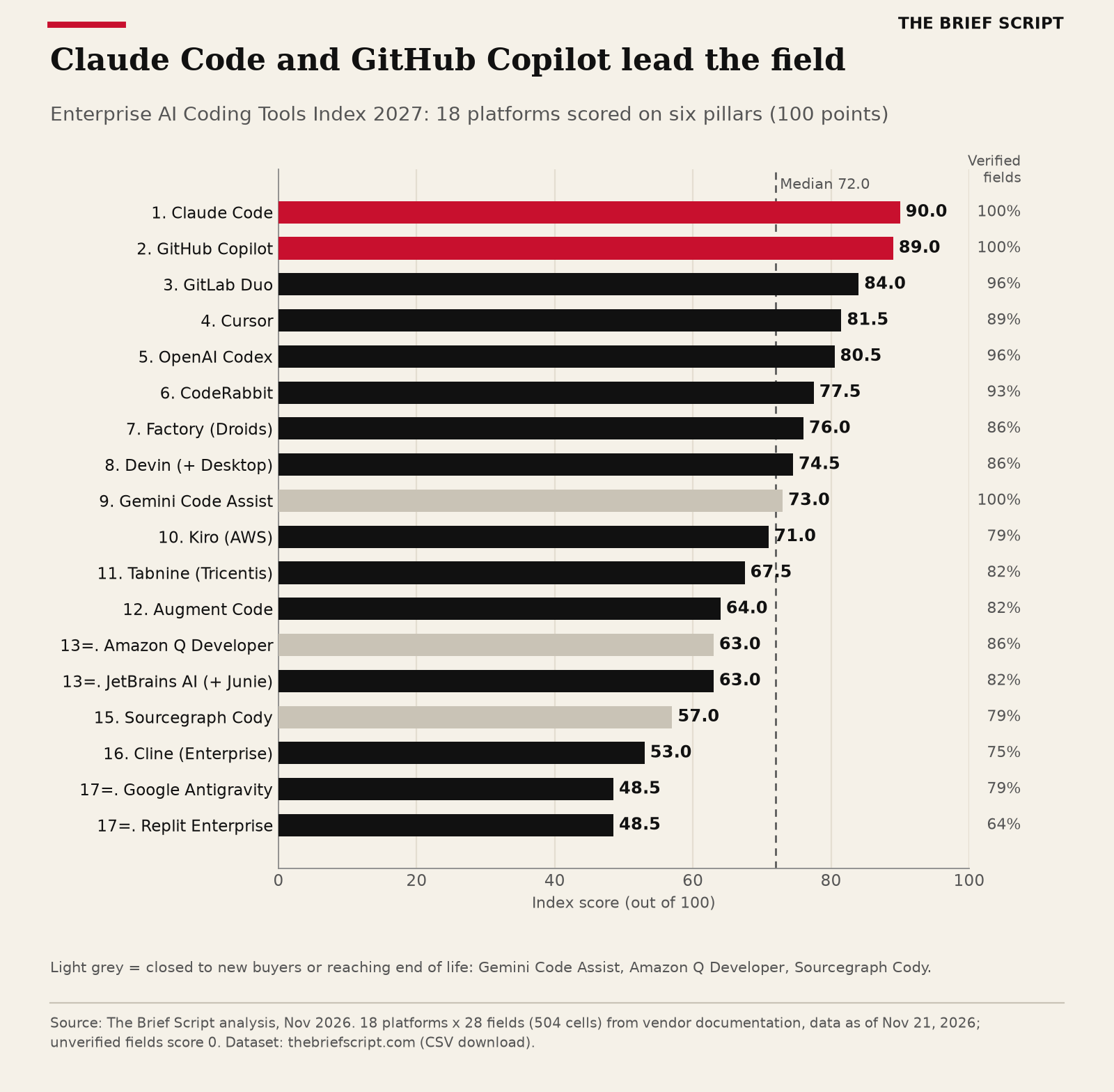
Short answer: In our Enterprise AI Coding Tools Index 2027, Claude Code (90.0 of 100) and GitHub Copilot (89.0) lead 18 enterprise platforms, followed by GitLab Duo (84.0), Cursor (81.5) and OpenAI Codex (80.5). Agent controls are now standard. Compliance, published pricing, IP indemnity and product lifecycle risk are what separate the field.
Most “best AI coding tools” lists rank editors by developer vibe. We did something more boring and, for a buyer, more useful. We collected 28 verifiable facts for each of 18 enterprise AI coding platforms (504 scored cells), tied every verified field to a source URL, and built a 100-point index across six pillars:
- Model and surface architecture (15 points)
- Pricing and cost governance (15)
- Security and compliance (20)
- Data control and IP governance (20)
- Agentic and admin controls (15)
- Ecosystem and market proof (15)
Unverified facts score zero and are never imputed. Facts that rest only on a secondary or third-party source are marked †. We then re-ran the ranking under 10 alternative scoring scenarios to see which positions hold.
The headline: Claude Code edges out GitHub Copilot by a single point. Claude Code never finishes below second place in any of the 10 scenarios, and Copilot ranks first or second in nine of ten. Below the top tier, the biggest gaps are no longer agent features. They are compliance certifications, published enterprise pricing, IP indemnification and whether the product will still exist at your next renewal.
Key findings
- Claude Code (90.0) and GitHub Copilot (89.0) lead a tight top five. Claude Code ranks #1 or #2 in all 10 sensitivity scenarios. It is the only platform with a perfect 20/20 on security and compliance, and one of three (with Copilot and Kiro) with a perfect 15/15 on pricing. Copilot takes #1 under equal pillar weights and when the security or data-control pillar is dropped, and falls to #5 only when secondary-sourced fields (†) are zeroed out.
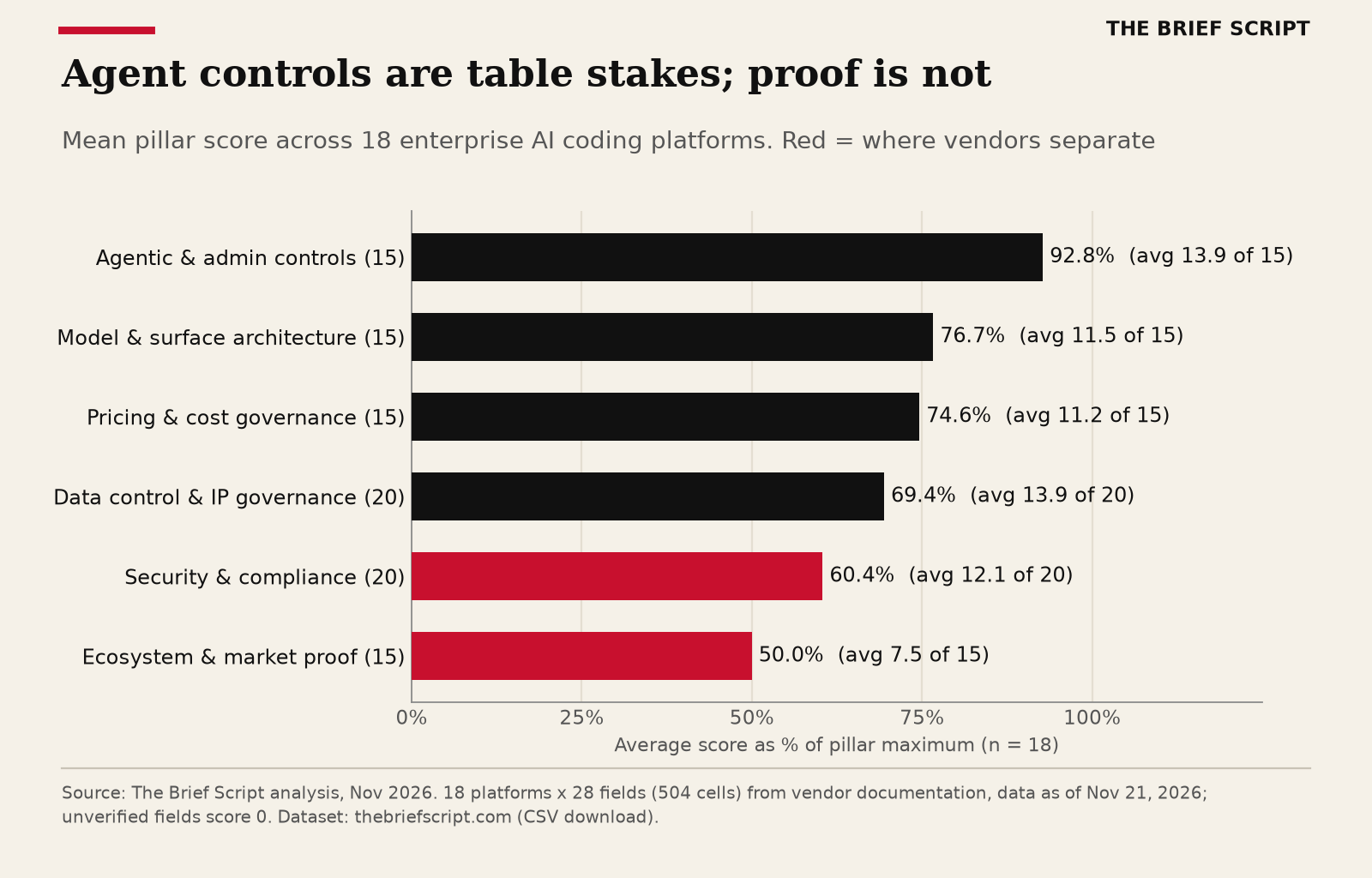
- Agent controls are table stakes. All 18 platforms document Model Context Protocol (MCP) support and organization-wide policy controls or an admin kill switch. The agentic and admin pillar averages 92.8% of its maximum (13.9 of 15), the least differentiating pillar in the index.
- Pricing transparency and compliance separate the field. Only 5 of 18 platforms (28%) publish a full enterprise price list, and two of those five are closed to new buyers or sunsetting. Only 5 of 18 confirm a signed HIPAA BAA, and only 6 of 18 (33%) hold full ISO/IEC 42001 certification.
- IP indemnity and zero data retention are still procurement gaps. Ten of 18 (56%) verify full vendor IP indemnification for AI output. Full commercial zero data retention (ZDR) is verified for 7 of 18 (39%), and air-gapped deployment for 8 of 18 (44%).
- Three enterprise tools are sunsetting or closed to new sales. Sourcegraph Cody reaches end of life on January 31, 2027. Amazon Q Developer IDE plugins end support on April 30, 2027. Gemini Code Assist closed new Standard and Enterprise purchases on October 9, 2026.
- 2026 deal-making reshaped the market. SpaceX completed its acquisition of Cursor on August 14, 2026, Tricentis bought Tabnine on July 30, and Harness bought Augment Code’s core products on October 8. Tabnine’s rank swings from #9 to #18 across scenarios because its post-acquisition pages moved behind sales.
- Google Antigravity has a stark compliance split. Inside Gemini Enterprise it does not support SOC 2, ISO 27001 or ISO 42001, yet its standalone components are supported in FedRAMP High and DoD IL4/IL5 environments.
- Average verified-field coverage is 86.3%. Of 504 cells, 435 were verified and 69 remain blank. Claude Code, GitHub Copilot and Gemini Code Assist hit 100%; Replit Enterprise (64.3%) and Cline Enterprise (75.0%) have the thinnest public records.
What is an enterprise AI coding platform?
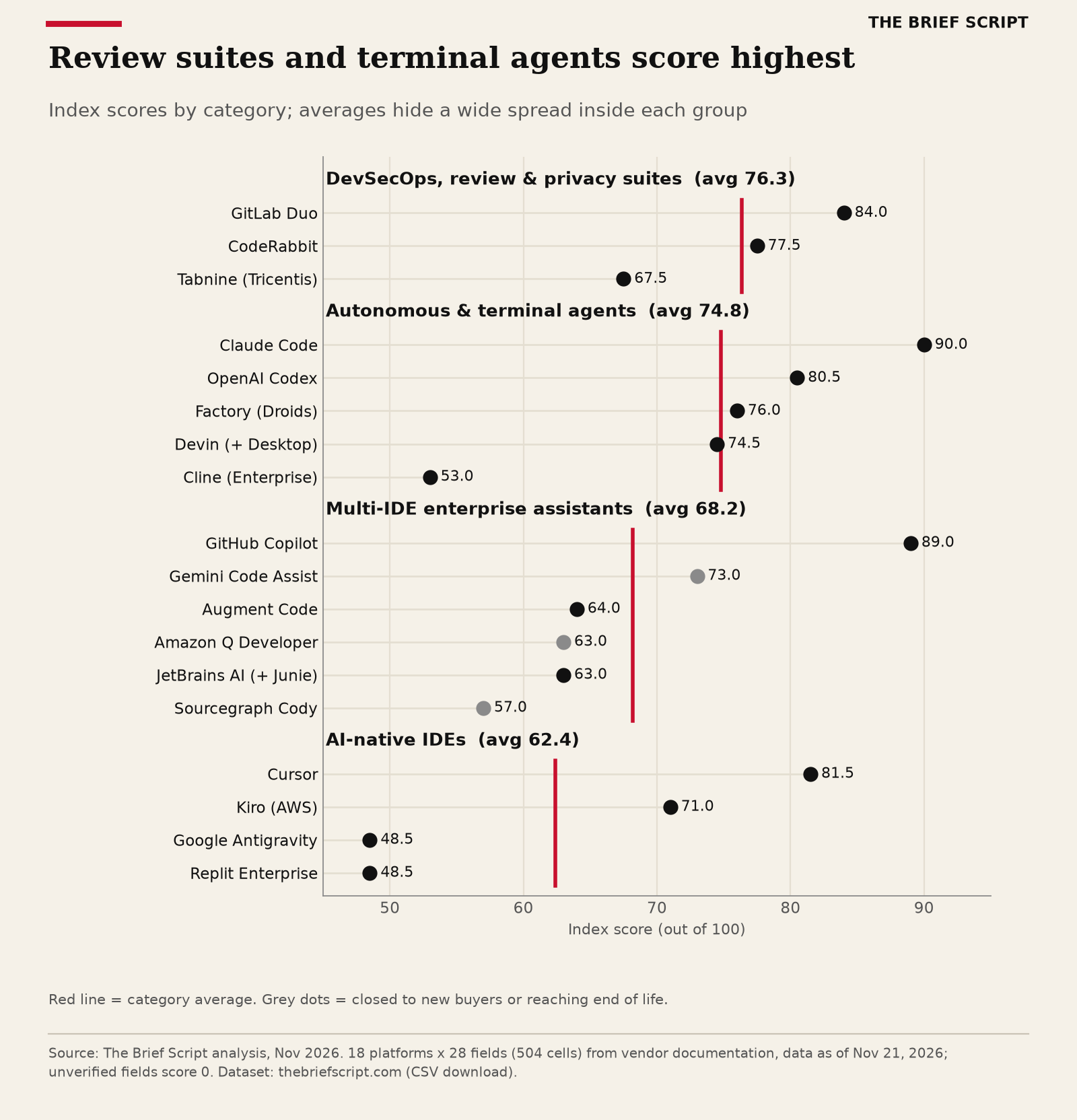
An enterprise AI coding platform gives an engineering organization code generation, repository-scale reasoning, automated pull-request review and autonomous task execution, all under central identity, billing, security and IP controls. Because these tools solve different parts of the software delivery lifecycle, we grouped the 18 platforms into four categories.
| Category | Core job | Platforms in this index | Category average |
|---|---|---|---|
| DevSecOps, review and privacy suites (3) | End-to-end SDLC governance, PR merge gates or air-gapped code intelligence | GitLab Duo, CodeRabbit, Tabnine (Tricentis) | 76.3 |
| Autonomous and terminal agents (5) | CLI-first and cloud-sandboxed agents that execute multi-file tasks and open PRs | Claude Code, OpenAI Codex, Factory (Droids), Devin (+ Desktop), Cline (Enterprise) | 74.8 |
| Multi-IDE enterprise assistants (6) | Plugins across VS Code, JetBrains and Visual Studio without forcing an editor switch | GitHub Copilot, Gemini Code Assist, Augment Code, Amazon Q Developer, JetBrains AI (+ Junie), Sourcegraph Cody | 68.2 |
| AI-native IDEs (4) | Purpose-built agentic editors and cloud workspaces | Cursor, Kiro (AWS), Google Antigravity, Replit Enterprise | 62.4 |
The Enterprise AI Coding Tools Index 2027: full results
Each pillar is scored from field-level rules described in the methodology. Blank or unverified fields score 0. Coverage is the share of the 28 fields we verified from retrieved documentation. The 10-run range is the best and worst rank across the sensitivity scenarios.
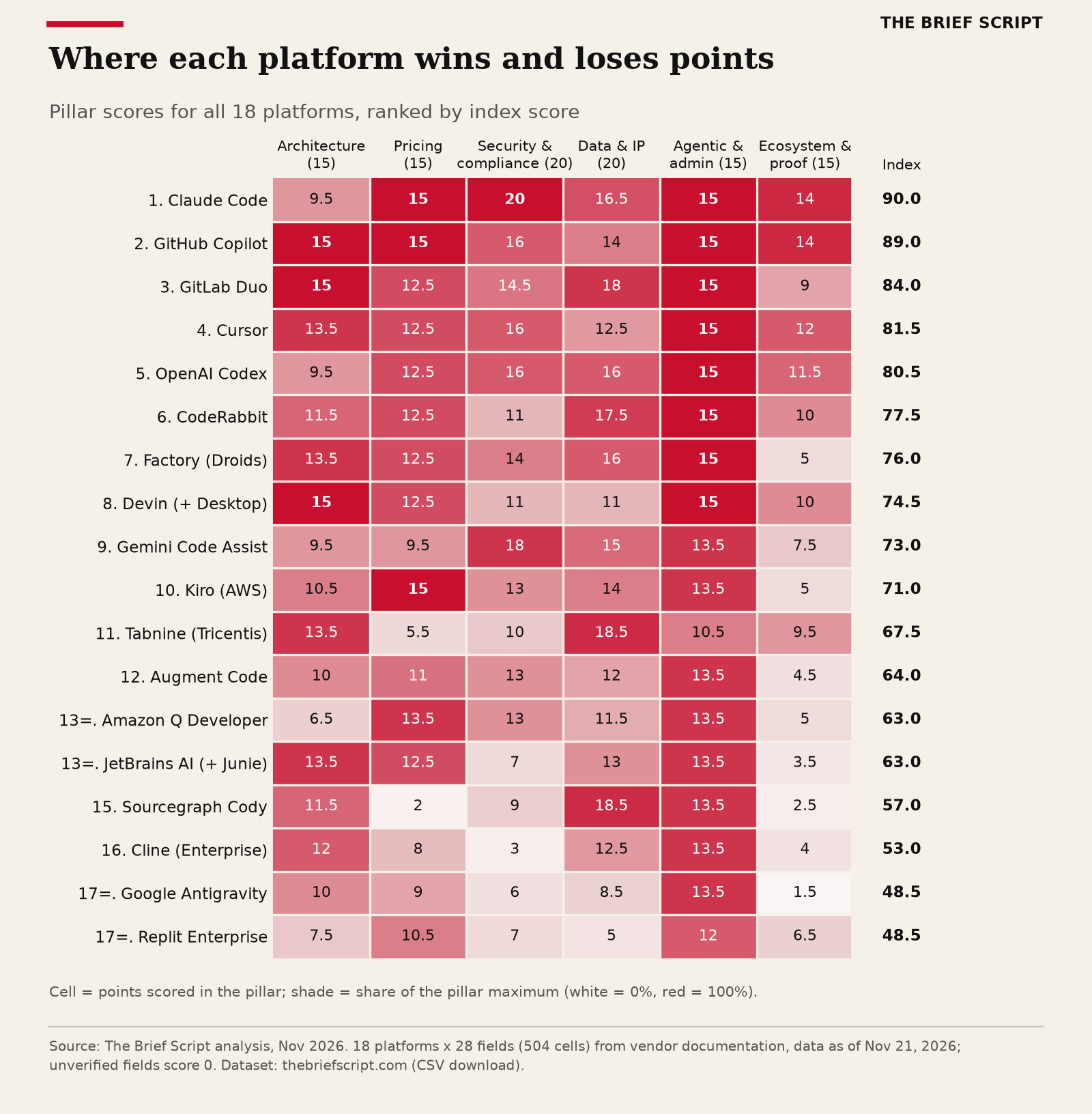
| # | Platform | Category | Arch (15) | Price (15) | Sec (20) | Data/IP (20) | Agent (15) | Eco (15) | Index | Cov. | 10-run range | Lifecycle status |
|---|---|---|---|---|---|---|---|---|---|---|---|---|
| 1 | Claude Code | Autonomous agent | 9.5 | 15.0 | 20.0 | 16.5 | 15.0 | 14.0 | 90.0 | 100% | 1–2 | Active |
| 2 | GitHub Copilot | Multi-IDE assistant | 15.0 | 15.0 | 16.0 | 14.0 | 15.0 | 14.0 | 89.0 | 100% | 1–5 | Active |
| 3 | GitLab Duo | DevSecOps suite | 15.0 | 12.5 | 14.5 | 18.0 | 15.0 | 9.0 | 84.0 | 96% | 2–4 | Active |
| 4 | Cursor | AI-native IDE | 13.5 | 12.5 | 16.0 | 12.5 | 15.0 | 12.0 | 81.5 | 89% | 2–5 | Active (SpaceX-owned since Aug 2026) |
| 5 | OpenAI Codex | Autonomous agent | 9.5 | 12.5 | 16.0 | 16.0 | 15.0 | 11.5 | 80.5 | 96% | 3–6 | Active |
| 6 | CodeRabbit | DevSecOps suite | 11.5 | 12.5 | 11.0 | 17.5 | 15.0 | 10.0 | 77.5 | 93% | 4–7 | Active |
| 7 | Factory (Droids) | Autonomous agent | 13.5 | 12.5 | 14.0 | 16.0 | 15.0 | 5.0 | 76.0 | 86% | 4–8 | Active |
| 8 | Devin (+ Desktop) | Autonomous agent | 15.0 | 12.5 | 11.0 | 11.0 | 15.0 | 10.0 | 74.5 | 86% | 6–10 | Active |
| 9 | Gemini Code Assist | Multi-IDE assistant | 9.5 | 9.5 | 18.0 | 15.0 | 13.5 | 7.5 | 73.0 | 100% | 7–12 | Closed to new purchases (Oct 2026) |
| 10 | Kiro (AWS) | AI-native IDE | 10.5 | 15.0 | 13.0 | 14.0 | 13.5 | 5.0 | 71.0 | 79% | 8–11 | Active |
| 11 | Tabnine (Tricentis) | DevSecOps suite | 13.5 | 5.5 | 10.0 | 18.5 | 10.5 | 9.5 | 67.5 | 82% | 9–18 | Acquired (Jul 2026) |
| 12 | Augment Code | Multi-IDE assistant | 10.0 | 11.0 | 13.0 | 12.0 | 13.5 | 4.5 | 64.0 | 82% | 11–13 | Core assets sold to Harness (Oct 2026) |
| 13= | Amazon Q Developer | Multi-IDE assistant | 6.5 | 13.5 | 13.0 | 11.5 | 13.5 | 5.0 | 63.0 | 86% | 11–15 | IDE end of support Apr 30, 2027 |
| 13= | JetBrains AI (+ Junie) | Multi-IDE assistant | 13.5 | 12.5 | 7.0 | 13.0 | 13.5 | 3.5 | 63.0 | 82% | 11–14 | Active |
| 15 | Sourcegraph Cody | Multi-IDE assistant | 11.5 | 2.0 | 9.0 | 18.5 | 13.5 | 2.5 | 57.0 | 79% | 12–18 | End of life Jan 31, 2027 |
| 16 | Cline (Enterprise) | Autonomous agent | 12.0 | 8.0 | 3.0 | 12.5 | 13.5 | 4.0 | 53.0 | 75% | 14–16 | Active |
| 17= | Google Antigravity | AI-native IDE | 10.0 | 9.0 | 6.0 | 8.5 | 13.5 | 1.5 | 48.5 | 79% | 17–18 | Active |
| 17= | Replit Enterprise | AI-native IDE | 7.5 | 10.5 | 7.0 | 5.0 | 12.0 | 6.5 | 48.5 | 64% | 15–18 | Active |
The median score is 72.0 and the mean is 70.1. The heatmap below shows where each platform earns and loses its points.
Where vendors converge, and where they still separate
Pillar averages show where the market has caught up and where real enterprise differentiation lives:
- Agentic and admin controls: 92.8% of maximum (13.9 of 15)
- Model and surface architecture: 76.7% (11.5 of 15)
- Pricing and cost governance: 74.6% (11.2 of 15)
- Data control and IP governance: 69.4% (13.9 of 20)
- Security and compliance: 60.4% (12.1 of 20)
- Ecosystem and market proof: 50.0% (7.5 of 15)
The control-by-control count makes the same point more bluntly. Every platform ships MCP support and org-wide policy controls. Sixteen of 18 offer full SSO, SCIM and audit logs, and 16 promise no training on customer code by default. Then the curve drops: 10 offer full output IP indemnity, 8 hold a FedRAMP authorization (with two more in process, Devin and Factory), 8 support air-gapped deployment, 7 document full zero data retention, 6 hold ISO 42001, 5 publish a full price list and 5 sign a HIPAA BAA.
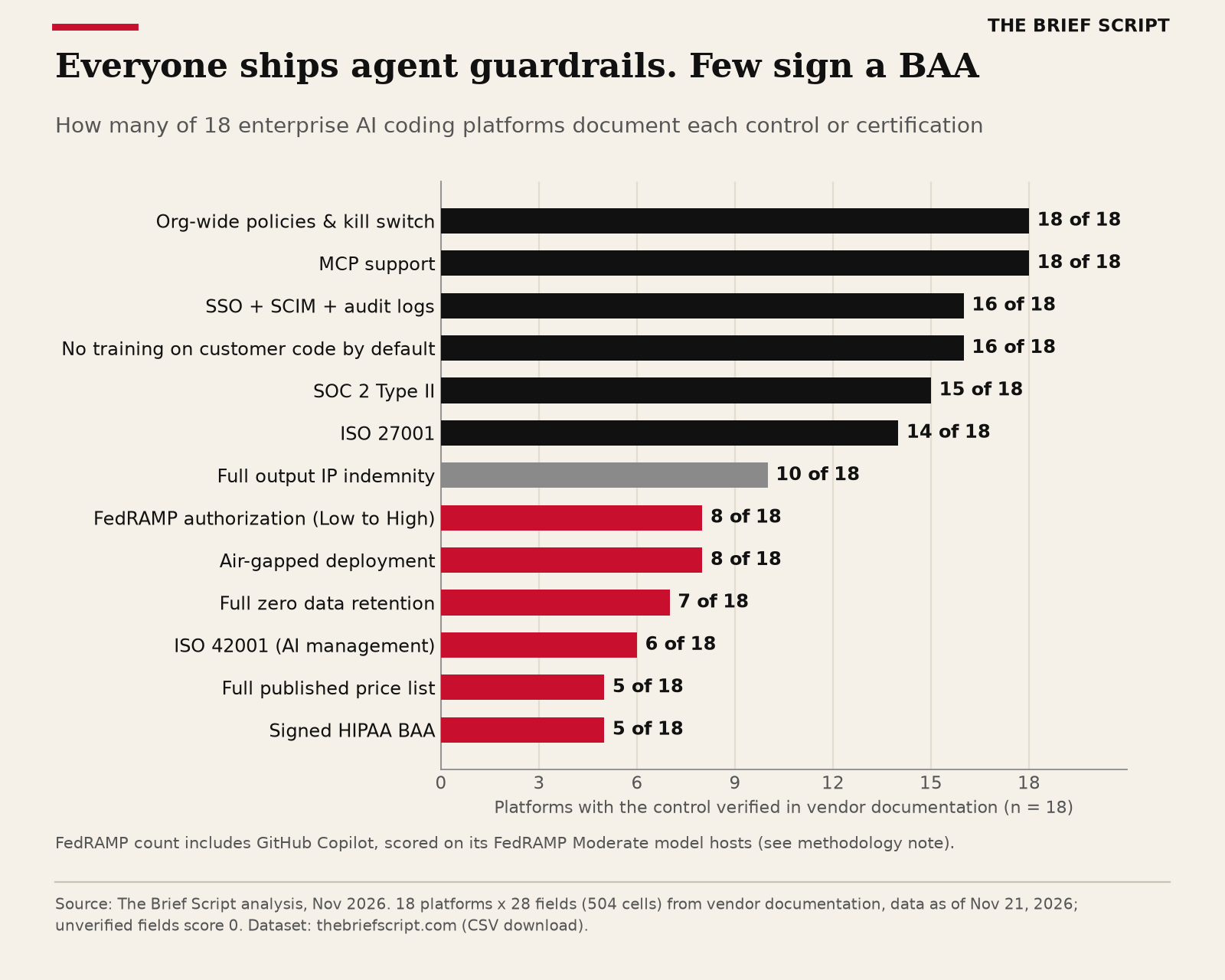
What this means: Stop scoring vendors on whether they “have agents.” Every shortlist candidate does. Score them on the evidence your security, legal and finance teams will ask for: the certificate, the BAA, the indemnity clause, the retention setting and the overage rate. That is where the 18 platforms actually differ.
Is the ranking stable? Ten scoring scenarios
We re-ran the index under 10 specifications: the baseline, equal pillar weights (16.67% each), six leave-one-pillar-out runs, no secondary sources (every † field zeroed) and no weak signals (G2 ratings and analyst placements removed).
- Top-two resilience. Claude Code ranks #1 in seven of ten scenarios and #2 in the other three. GitHub Copilot ranks #1 under equal weights, drop-security and drop-data/IP, and #2 in six more. It slips to #5 only when secondary-sourced ISO 27001, ISO 42001 and G2 fields are zeroed.
- A stable top five. GitLab Duo stays in the top four in every run (range 2–4). Cursor stays in the top five (2–5) and rises to #2 under no secondary sources because its primary documentation is unusually complete. OpenAI Codex stays between #3 and #6.
- Biggest movers. Factory jumps from #7 to #4 when ecosystem and market proof is dropped (and to #5 without weak signals): its security and air-gap engineering is ahead of its analyst footprint. Tabnine falls from #11 to #18 under no secondary sources because, after the Tricentis deal, its public pricing and compliance pages moved behind sales.
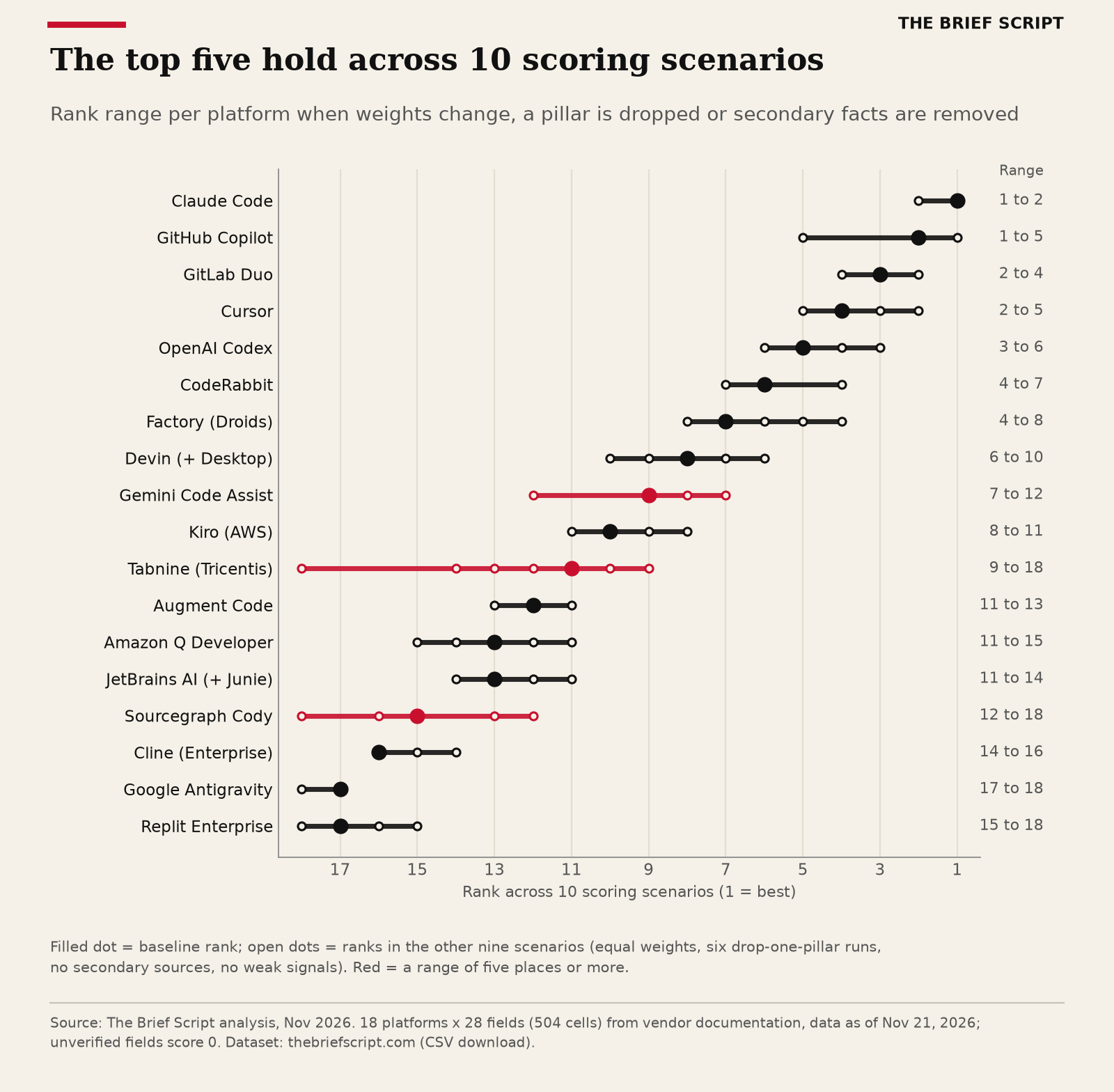
What this means: The order of the top five is robust to how you weight the pillars, so you can use it as a starting shortlist. Do not over-read single-place gaps lower down. A 63 and a 64 are statistically the same product for your purposes; your Git host and compliance floor matter more.
Category deep dives
Autonomous and terminal coding agents (category average 74.8)
1. Claude Code (Anthropic): 90.0, coverage 100%
- Best for: security-conscious engineering orgs that want frontier agentic coding across CLI, IDE and CI with transparent API-rate economics.
- Pricing as published: full price list. Team Standard $20 per seat per month billed annually ($25 monthly), Team Premium $100 ($125 monthly). Enterprise is $20 per seat per month, billed annually with a 20-seat minimum, plus usage at API rates. Anthropic’s own guidance puts average enterprise spend at about $150 to $250 per developer per month.
- Standout: the only perfect 20/20 on security and compliance (SOC 2 Type II, ISO 27001, ISO 42001, HIPAA-ready Enterprise with a BAA, FedRAMP High through Claude for Government, plus SSO, SCIM and audit logs), alongside ZDR, commercial IP indemnification, OS-level Bash sandboxing and $1B+ run-rate revenue reached in December 2025 ($2.5B reported in February 2026†).
- Watch-out: runs Anthropic Claude models only (1 of 5 on multi-model), relies on agentic search and LSP rather than a persistent multi-repo cloud index, and US-only inference costs 1.1x.
5. OpenAI Codex: 80.5, coverage 96%
- Best for: ChatGPT Enterprise shops delegating parallel, cloud-sandboxed engineering tasks across global residency zones.
- Pricing as published: partial. ChatGPT Business seats include Codex: Standard $20 per seat per month billed annually ($25 monthly) and Premium $100 ($125 monthly). Enterprise is custom, with a published credits-per-token rate card. OpenAI says plan usage will share one limit across ChatGPT and Codex from December 2026.
- Standout: a 2026 Gartner Magic Quadrant Leader, FedRAMP 20x Moderate and a HIPAA BAA (Codex Local), and the widest residency footprint in the index: data residency in ten regions plus US, EU and UAE inference residency.
- Watch-out: OpenAI models by default, ISO 42001 unverified, and ZDR does not cover synced local Work tasks.
7. Factory (Droids): 76.0, coverage 86%
- Best for: large enterprises that want model-agnostic autonomous “software factories” with strict air-gapped or EU residency options.
- Pricing as published: partial. Teams is $60 per month plus $40 per seat (up to 10 seats); Business and Enterprise are quote-only, metered in Factory Standard Credits.
- Standout: SOC 2 Type II, ISO 27001 and ISO 42001, dedicated EU hosting, true air-gap binaries and support for all four major Git hosts. Factory raised $200M at a $5B valuation on September 15, 2026, and names Nvidia, Blackstone, RBC and T-Mobile as customers.
- Watch-out: not in Gartner’s 2026 Magic Quadrant; HIPAA BAA, output IP indemnity in the enterprise MSA and a native IDE inline-completion plugin are unverified.
8. Devin (+ Devin Desktop, Cognition): 74.5, coverage 86%
- Best for: engineering orgs that want an AI-native IDE (Devin Desktop, formerly Windsurf) and autonomous cloud agents on one contract.
- Pricing as published: partial. Teams is a flat $80 per month shared pool for up to 100 members; Enterprise uses custom ACU contracts.
- Standout: perfect 15/15 on architecture (multi-model plus SWE-2, multi-repo Blueprints, IDE, CLI and cloud) and on agentic controls, FedRAMP High “in process”, an air-gapped Desktop and CLI beta, and fast growth: run-rate revenue of $492M at its May 2026 Series D and almost $900M when Cognition raised over $2B at a $48B valuation on September 8, 2026.
- Watch-out: self-serve plans can train on data unless on Enterprise; commercial ZDR and output IP indemnity are unverified; Gartner moved Cognition from 2025 Leader to 2026 Challenger†.
16. Cline (Enterprise): 53.0, coverage 75%
- Best for: strict zero-markup bring-your-own-key shops that want client-side, open-source (Apache 2.0) agents routed only through their own Bedrock, Vertex or Azure accounts.
- Pricing as published: partial. The open-source client is $0 with no inference markup; Enterprise is quote-only.
- Standout: full multi-model BYOK, air-gapped and on-prem support, an instant admin “YOLO mode” kill switch, and 11M+ developers by Cline’s own count.
- Watch-out: the lowest security and compliance score in the index (3 of 20). SOC 2 Type II, ISO 27001, ISO 42001, a HIPAA BAA and IP indemnity are all unverified for Cline itself, which leans on its customers’ cloud compliance, and it deliberately performs no codebase indexing.
Multi-IDE enterprise assistants (category average 68.2)
2. GitHub Copilot: 89.0, coverage 100%
- Best for: organizations standardized on GitHub Enterprise Cloud that want multi-IDE flexibility, transparent billing and multi-model choice under one Microsoft contract.
- Pricing as published: full. Business $19 per seat per month (1,900 pooled GitHub AI Credits), Enterprise $39 (3,900 credits), with usage beyond the pool at $0.01 per credit.
- Standout: perfect 15/15 on architecture, pricing and agentic controls; six-plus model families plus BYOK; US and EU data residency; the Microsoft Customer Copyright Commitment; a Gartner Leader for the third year running; and adoption at more than 90% of the Fortune 100.
- Watch-out: cloud SaaS only (no GitHub Enterprise Server, on-prem or air-gapped option) and no HIPAA BAA†. On FedRAMP, read the scope carefully: Copilot can be restricted to models on FedRAMP Moderate-authorized hosts, but GitHub’s own trust center lists the FedRAMP Moderate authorization for GitHub Enterprise Cloud with US data residency as still in progress (status as of October 25, 2026).
9. Gemini Code Assist: 73.0, coverage 100%. Closed to new purchases
- Best for: existing Google Cloud subscribers running out legacy renewals before migrating.
- Pricing as published: legacy $19 (Standard) and $45 (Enterprise) per seat per month on 12-month terms. Google stopped selling new Standard and Enterprise subscriptions on October 9, 2026. Annual subscriptions can auto-renew until January 31, 2027, monthly ones until December 31, 2027, and existing Gemini Enterprise subscriptions keep the Code Assist entitlement until March 31, 2027.
- Standout: the strongest legacy compliance stack among multi-IDE tools (SOC 2, ISO 27001, ISO 42001, HIPAA and HITRUST, FedRAMP 20x Low, IP indemnification).
- Watch-out: it is winding down, and Google’s successor, Antigravity, does not yet carry SOC 2 or ISO parity inside Gemini Enterprise.
12. Augment Code: 64.0, coverage 82%
- Best for: large monorepo teams on VS Code or JetBrains (and Harness CI/CD) that need deep multi-repo context.
- Pricing as published: partial. Flat workspace pools ($20 per month Standard or $100 per month Business, each for up to 50 seats) plus model usage with a 40% service fee; Enterprise is custom.
- Standout: the Context Engine indexes 400,000+ files across repositories; SOC 2 Type II, ISO 27001 and ISO 42001; documented IP indemnification.
- Watch-out: on October 8, 2026, Harness acquired select Augment Code assets, including Cosmos, the Auggie CLI and the Context Engine, and the team behind them. Confirm which entity will hold your contract. HIPAA BAA, FedRAMP, ZDR and BYOK are unverified, and self-hosting documentation conflicts across Augment’s own pages.
13=. Amazon Q Developer: 63.0, coverage 86%. Sunsetting April 30, 2027
- Best for: existing Q Developer Pro subscribers managing an orderly move to Kiro.
- Pricing as published: legacy Pro $19 per user per month. New sign-ups were blocked from May 15, 2026, and the IDE plugins and paid subscriptions reach end of support on April 30, 2027.
- Standout: clean IAM Identity Center and CloudTrail integration, AWS FedRAMP scope and Pro-tier IP indemnity†.
- Watch-out: the GitHub app ends on January 30, 2027 (new installs stopped on November 18, 2026), the newest Claude models are already Kiro-only, and AWS says Q Developer is not HIPAA eligible.
13=. JetBrains AI Assistant (+ Junie): 63.0, coverage 82%
- Best for: organizations standardized on IntelliJ, PyCharm or Rider that want zero-markup API credits and optional air-gapped self-hosting.
- Pricing as published: partial. Shared AI Credits at $1.00 each at public API rates, free Basic and Business governance tiers, and quote-only Enterprise.
- Standout: deep multi-model support with BYOK (including Ollama and LM Studio), ZDR on AI Enterprise, and full on-prem or air-gapped deployment with self-hosted Mellum.
- Watch-out: JetBrains states it is not ISO 27001 certified, its acceptable-use policy prohibits HIPAA PHI, it documents no vendor output IP indemnity, and it sits in Gartner’s 2026 Niche Players quadrant†.
15. Sourcegraph Cody: 57.0, coverage 79%. End of life January 31, 2027
- Best for: existing Sourcegraph Enterprise customers moving to Sourcegraph’s code-intelligence MCP server.
- Pricing as published: quote-only Enterprise.
- Standout: tied for the highest data-control and IP score in the index (18.5 of 20): full ZDR, uncapped IP indemnification on enterprise order forms, air-gapped deployment and deterministic SCIP multi-repo search.
- Watch-out: Sourcegraph will end Cody on January 31, 2027. Its agent, Amp, is now an independent company. Evaluate Sourcegraph as an MCP context layer, not an IDE assistant.
DevSecOps, review and privacy-first suites (category average 76.3)
3. GitLab Duo (+ Agent Platform): 84.0, coverage 96%
- Best for: GitLab Ultimate and Self-Managed enterprises that want governed, air-gappable agents wired into merge requests, CI/CD and security scanning.
- Pricing as published: partial. Usage runs on GitLab Credits at $1.00 each, with $12 (Premium) and $24 (Ultimate) per user per month included; legacy Duo Pro is $19 per seat; a standalone Duo Enterprise list price is unverified.
- Standout: perfect 15/15 on architecture and agentic controls; 18 of 20 on data control and IP (no training, IP indemnification, regional Dedicated hosting and offline air-gapped deployment); FedRAMP Moderate for GitLab Dedicated for Government; and the GitLab Orbit cross-project context graph.
- Watch-out: GitLab-native (no native PR agent for GitHub, Bitbucket or Azure DevOps), left out of Gartner’s 2026 coding-agents Magic Quadrant despite being a 2025 Leader, and HIPAA BAA unverified.
6. CodeRabbit: 77.5, coverage 93%
- Best for: any engineering org adding an independent, multi-Git-host AI code review, security and QA merge gate alongside Cursor, Claude Code or Copilot.
- Pricing as published: partial. Essentials $24, Team $48 and Advanced $72 per developer per month billed annually, with overages at $0.25 per reviewed file and admin spend caps; Enterprise is quote-only.
- Standout: all four Git hosts (cloud and self-managed), SOC 2 Type II and ISO 27001:2022, ZDR, dedicated US and EU regions and air-gapped self-hosting (500+ seats). CodeRabbit passed $100M in ARR on November 12, 2026, with more than 20,000 customers.
- Watch-out: a review gate rather than an inline autocomplete editor; its MSA (section 9.2) excludes AI outputs from IP indemnification; ISO 42001, HIPAA BAA and FedRAMP are unverified.
11. Tabnine (Tricentis): 67.5, coverage 82%
- Best for: defense, finance and other regulated enterprises that prioritize air-gapped deployment and context-engine guardrails.
- Pricing as published: partial and shifting to Tricentis quotes ($39 Code Assistant and $59 Agentic Platform were the last published list prices†).
- Standout: tied for the highest data-control and IP score (18.5 of 20: no training†, ZDR†, IP indemnity†, full air-gapped on-prem), Gartner’s sole 2026 Visionary†, and all four Git hosts†.
- Watch-out: Tricentis acquired Tabnine on July 30, 2026. The CLI is deprecated from December 31, 2026†, and post-acquisition primary documentation for pricing, spend caps and compliance is thin, which is why it is the most sensitive platform in our scenarios.
AI-native IDEs (category average 62.4)
4. Cursor: 81.5, coverage 89%
- Best for: developer-led enterprises willing to adopt an AI-native editor for multi-model speed, Bugbot PR review and strong compliance.
- Pricing as published: partial. Teams seats cost $30, $100 or $200 per month, with usage at API list price plus a Cursor Token Rate of $0.25 per million tokens on eligible third-party models; Enterprise is custom.
- Standout: a 2026 Gartner Leader with the furthest placement on completeness of vision, SOC 2 Type II, ISO 27001, ISO 42001 and AIUC-1, a HIPAA BAA, ZDR privacy mode, self-hosted cloud agents and all four Git hosts.
- Watch-out: Cursor is now owned by SpaceX: the $60B all-stock merger closed on August 14, 2026. Ask how model routing, data use and sub-processors will change. Vendor output IP indemnification is not publicly documented, FedRAMP is unverified, and US-only data residency carries a 10% uplift while EU and APAC residency are still in development.
10. Kiro (AWS): 71.0, coverage 79%
- Best for: AWS-centric and US federal or defense teams migrating off Amazon Q Developer.
- Pricing as published: full. Teams and Enterprise credit pooling costs $20 per seat per month with 500 credits per seat, add-on credits at $0.04 each, and GovCloud pricing about 20% higher.
- Standout: perfect 15/15 on pricing, FedRAMP High and DoD IL4/5 in AWS GovCloud (US), HIPAA eligibility and ISO 27001, AWS IP indemnity, and VPC-attached cloud sessions.
- Watch-out: SOC 2 Type II, ISO 42001, ZDR, bring-your-own-model and aggregate adoption figures are unverified on Kiro’s public pages, and CloudTrail auditing is not emitted in GovCloud.
17=. Google Antigravity: 48.5, coverage 79%
- Best for: Google Cloud organizations testing multi-surface Gemini and Claude coding agents, or US public-sector teams using Assured Workloads.
- Pricing as published: partial. Bundled in Gemini Enterprise Standard and Plus ($30 per seat per month†) or $0 per seat pay-as-you-go, with token consumption drawing on pooled edition credits.
- Standout: OS-level sandboxing (seatbelt on macOS, bubblewrap on Linux) plus cloud sandboxes, MDM-managed admin settings, VPC Service Controls support, and components supported in FedRAMP High, IL4 and IL5 environments via Assured Workloads.
- Watch-out: Google’s documentation states that Antigravity in Gemini Enterprise does not support SOC 1/2/3, ISO 27001, ISO 42001 or FedRAMP Moderate and High. ZDR, a HIPAA BAA, IP indemnity and native Git-host apps are unverified.
17=. Replit Enterprise: 48.5, coverage 64%
- Best for: product, prototyping and internal-app teams that want no per-seat fees, browser-based workspaces and bring-your-own-cloud hosting.
- Pricing as published: partial. $0 per seat; Pro starts at a $100 per month pooled plan for up to 15 builders; Enterprise uses custom annual credit commitments with unlimited seats.
- Standout: more than 60 million users and builders at 85% of the Fortune 500 (company statement, November 11, 2026), full bring-your-own-cloud cells, hard per-user spend caps and NA, EU and Asia workspace geo-pinning.
- Watch-out: the thinnest public enterprise record in the index (64% coverage). Replit states it is not ISO 27001 certified, and contractual no-training, ZDR, a HIPAA BAA, IP indemnity and PR or CI integration are unverified.
Security, data control and lifecycle risk
- Universal controls: MCP support (18 of 18), org-wide policy rules and kill switches (18), default no-training (16), full SSO plus SCIM plus audit logs (16) and SOC 2 Type II (15).
- Rare differentiators: a signed HIPAA BAA (5 of 18), full ISO 42001 (6), full commercial ZDR (7), a FedRAMP authorization (8, with Devin and Factory in process) and air-gapped deployment (8: GitLab Duo, CodeRabbit, Factory, Devin beta, JetBrains AI, Tabnine, Sourcegraph Cody and Cline).
Procurement teams renewing multi-year contracts should account for six live transitions:
| Platform | What changed | Date | What to do |
|---|---|---|---|
| Sourcegraph Cody | End of life | Jan 31, 2027 | Plan an exit now; keep Sourcegraph only as a code-search or MCP context layer |
| Amazon Q Developer | GitHub app ends; IDE plugins and paid subscriptions end | Jan 30, 2027; Apr 30, 2027 | Move to Kiro well before April and re-verify SOC 2 and ZDR evidence |
| Gemini Code Assist | Closed to new purchases; renewals wind down | Oct 9, 2026; Jan 31 to Dec 31, 2027 | Do not sign new multi-year terms; test the successor’s compliance scope first |
| Cursor | Acquired by SpaceX | Aug 14, 2026 | Ask for updated sub-processor, data-use and model-routing terms |
| Tabnine | Acquired by Tricentis | Jul 30, 2026 | Request current pricing, certificates and spend-cap documentation in writing |
| Augment Code | Core products and team acquired by Harness | Oct 8, 2026 | Confirm the contracting entity and product roadmap |
What this means: Lifecycle risk is now a scoring factor in its own right. Three of the 18 platforms are closed to new buyers or reaching end of life, and three more changed hands in 2026. Put a termination-assistance and data-export clause into every AI coding contract, and avoid multi-year prepayment with any vendor whose ownership or roadmap changed this year.
Analyst landscape: Gartner’s 2026 Magic Quadrant and Forrester
On May 20, 2026, Gartner replaced its earlier AI code assistants report with the Magic Quadrant for Enterprise AI Coding Agents, evaluating 12 vendors. As Virtualization Review reported†, AI-native labs pushed the cloud hyperscalers out of the Leaders quadrant:
- Leaders (4): GitHub, Cursor (furthest completeness of vision), OpenAI and Anthropic.
- Challengers (4): AWS (Q Developer and Kiro), Google (Gemini Code Assist), Cognition (Devin and Windsurf) and Alibaba Cloud.
- Visionary (1): Tabnine.
- Niche Players (3): JetBrains, Atlassian and BytePlus.
- Not included: GitLab (a 2025 Leader), Augment Code, Sourcegraph, Factory, CodeRabbit, Cline and Replit.
GitHub, Cursor and OpenAI confirm their Leader placements on their own sites; the other placements rest on press coverage (†). Forrester has not published a dedicated coding-agents Wave as of November 22, 2026. Its first Agentic Development Security Tools Wave (November 4, 2026) covers tools that secure agent-written code, not the coding platforms themselves.
Pricing reality: seats, credits, token pass-through and quotes
Enterprise coding pricing in late 2026 has moved away from flat “all-you-can-eat” seats toward four hybrid structures:
- Seat plus pooled credits: GitHub Copilot ($19 or $39 plus $0.01 per credit), Kiro ($20 per seat plus $0.04 per add-on credit) and GitLab Duo ($12 to $24 of included credits plus $1.00 per credit).
- Seat plus API token pass-through: Claude Code ($20 per seat plus API rates), Cursor (Teams seat plus API rates plus a $0.25 per million token rate) and Augment Code (flat pool plus model usage plus a 40% service fee).
- Zero-seat, pooled consumption: Replit Enterprise ($0 per seat plus an annual credit commitment), JetBrains AI (free governance tiers plus $1.00 credits) and Cline ($0 open source plus zero-markup BYOK).
- Enterprise quote-only: 13 of 18 platforms keep some or all enterprise pricing behind a sales quote.
For a budget, treat the seat as the floor, not the price. Anthropic’s own enterprise average of $150 to $250 per developer per month for Claude Code is several times its $20 seat. For a related view of how AI pricing pages are changing across B2B software, see our B2B SaaS AI pricing study.
What this means: Before signing, get the credit-to-model multiplier table, the overage rate and the hard-cutoff behavior in writing, and model a heavy-usage month, not an average one. A cheap seat with an uncapped meter can cost more than an expensive seat with a pool.
Buyer playbook: which platform fits your stack?
- GitHub Enterprise and Microsoft shops: standardize on GitHub Copilot (89.0) for multi-IDE coverage, transparent $19 or $39 plus $0.01 credit billing and Microsoft’s copyright commitment; add Claude Code (90.0) for complex terminal and agentic refactors.
- Healthcare and regulated SaaS: shortlist Claude Code (90.0), Cursor (81.5), OpenAI Codex (80.5) or Kiro (71.0), the four active platforms with a confirmed HIPAA BAA or HIPAA eligibility (Gemini Code Assist is sunsetting).
- Air-gapped, defense and sovereign environments: shortlist GitLab Duo (84.0), Factory (76.0), Devin’s air-gapped beta (74.5), Tabnine (67.5) or JetBrains AI on-prem (63.0). For US federal SaaS, Kiro in GovCloud, Claude for Government and Antigravity on Assured Workloads all reach FedRAMP High. Defense buyers should note that the US Department of War’s March 2026 supply-chain-risk designation of Anthropic applies to Claude use on Department of War contracts; Anthropic is challenging it in court.
- AWS estates leaving Q Developer: move to Kiro (71.0) well ahead of the April 30, 2027 cutoff, and collect SOC 2 and ZDR evidence through AWS Artifact during procurement.
- GitLab-native DevSecOps orgs: stay native with GitLab Duo (84.0) for the MR code-review flow, the Orbit context graph and air-gapped self-hosting.
- Independent PR review and QA gate: layer CodeRabbit (77.5) across GitHub, GitLab, Bitbucket or Azure DevOps, whichever IDE or agent your developers prefer.
Two governance notes apply whatever you pick. Every one of these tools can call MCP servers, so apply the controls in our MCP security checklist before you switch on agent mode. And if you already buy ChatGPT or Claude seats for the whole company, compare the coding entitlements inside ChatGPT Enterprise and Claude Team vs Enterprise before adding a separate coding contract. For the commercial backdrop to Copilot’s lead, see our analysis of GitHub Copilot revenue, and for agent platforms beyond coding, our AI agent platforms comparison.
Methodology
- Universe and cutoff. 18 enterprise AI coding platforms in four categories. Field data as of November 21, 2026; dated external facts in this article rechecked on vendor pages on November 22, 2026.
- Sourcing and blanks. Each of the 28 fields carries a source URL in the companion CSV. Fields that rest only on a secondary source are flagged †. Unverified fields stay blank and score 0; they are never imputed. Explicit vendor exclusions (for example, JetBrains confirming it is not ISO 27001 certified, or Google excluding SOC 2 for Antigravity in Gemini Enterprise) count as verified facts for coverage while scoring 0.
- 100-point rubric.
- Model and surface architecture (15): multi-model choice (4+ families 5, 2–3 families 3, 1 family 1); BYOM or BYOK (full 3, partial 1.5); workflow surfaces across IDE, CLI and async cloud or PR (all three 4, two 2.5, one 1); repository indexing (multi-repo 3, partial 1.5).
- Pricing and cost governance (15): published price list (full 5, partial 2.5, quote 0); visible entry price (3); clear overage meter (full 4, partial 2); admin hard spend caps (full 3, partial 1.5).
- Security and compliance (20): SOC 2 Type II (4); ISO 27001 (3); ISO 42001 (3, roadmap or partial 1.5); HIPAA BAA (3, claim without BAA 1); FedRAMP (High 4, Moderate 3, Low 2, in process 1); enterprise IAM with SSO, SCIM and audit logs (all three 3, two 2, one 1).
- Data control and IP governance (20): default no-training (5, Enterprise-only 3.5); ZDR (full 4, partial 2); IP indemnification (full output 4, services only 1.5); data residency (multi-region 3, partial 1.5); deployment isolation (VPC or on-prem +2, air-gapped +2; partial VPC-SC or PrivateLink 1).
- Agentic and admin controls (15): MCP support (3); sandboxed execution with human approvals (3, partial 1.5); org-wide policies, exclusions and kill switches (3); PR review and CI/CD (3, partial 1.5); usage telemetry and analytics API (3, partial 1.5).
- Ecosystem and market proof (15): analyst recognition (2026 Gartner MQ Leader 5; Challenger, Visionary or 2025 Leader 3; Niche or adjacent 1.5); disclosed enterprise scale (product-specific ARR, seats or Fortune 500 share 4; company-level or named customers 2); G2 proof (4.3+ with 100+ reviews 3; 4.0+ with 30–99 reviews 1.5); multi-Git-host support (all four 3, three 2.5, two 2, one 1).
- Sensitivity analysis. Ten scenarios: baseline, equal pillar weights, six leave-one-pillar-out runs (remaining pillars rescaled to 100), no secondary sources and no weak signals (G2 and analyst points removed, rescaled to 100). We independently recomputed all pillar sums, totals, ranks, coverage counts and nine of the ten scenarios from the field scores; they match the published file exactly. The no-secondary scenario depends on which partially sourced fields are treated as secondary, so small differences are possible under a stricter reading.
Validation and limitations
- What we measured. Feature checklists measure documented availability, not code quality or benchmark accuracy such as SWE-bench. A platform can score well here and still be the wrong tool for your codebase. Pilot before you buy.
- Gated evidence. Trust portals behind NDAs (for example, Microsoft’s Service Trust Portal or post-acquisition Tricentis pages) limit public verification of some certifications, which costs those vendors coverage.
- FedRAMP scope note. GitHub Copilot’s FedRAMP field is scored at Moderate because Copilot can be restricted to models whose hosts hold FedRAMP Moderate authorization. GitHub’s trust center lists the FedRAMP Moderate authorization of GitHub Enterprise Cloud with US data residency itself as in progress (October 25, 2026). Buyers who need an authorized service boundary, not authorized model hosts, should treat Copilot as “in process” for now.
- A fast-moving market. At least six platforms in this index repriced, renamed or changed ownership during 2026, and plan details change quarterly. We will refresh the index as vendors change.
FAQ
What is the best enterprise AI coding tool for 2027?
Claude Code (90.0) and GitHub Copilot (89.0) lead our index, followed by GitLab Duo (84.0) and Cursor (81.5). The best choice depends mostly on your Git host, your compliance floor (HIPAA, FedRAMP, air-gap) and whether your developers want an IDE plugin, an AI-native editor or a terminal agent.
Which enterprise AI coding tools offer a signed HIPAA BAA?
Five platforms verify a HIPAA BAA or HIPAA eligibility: Claude Code (HIPAA-ready Enterprise), OpenAI Codex (Codex Local on Enterprise), Cursor (Enterprise with locked privacy mode), Kiro (IDE and CLI under the AWS BAA) and the sunsetting Gemini Code Assist.
Which AI coding tools support fully air-gapped deployment?
Eight platforms document air-gapped deployment: GitLab Duo, CodeRabbit (500+ seats), Factory (Airgap Mode), Devin (air-gapped Desktop and CLI beta), JetBrains AI on-premises, Tabnine, Sourcegraph Cody (end of life January 2027) and Cline.
Which AI coding tools are being retired in 2027?
Sourcegraph Cody reaches end of life on January 31, 2027. Amazon Q Developer’s GitHub app ends on January 30, 2027 and its IDE plugins on April 30, 2027, with Kiro as the replacement. Gemini Code Assist closed to new purchases on October 9, 2026, and its renewals wind down through 2027.
How much does an enterprise AI coding tool cost per developer?
List seats range from $0 (Replit, JetBrains governance tiers, open-source Cline) to $39 (Copilot Enterprise) and $45 (legacy Gemini Code Assist Enterprise), but most platforms now add usage. Anthropic, for example, puts average Claude Code enterprise spend at $150 to $250 per developer per month on top of a $20 seat.
Download the data
The full index is free to reuse with attribution to The Brief Script.
| File | What it contains |
|---|---|
| briefscript_enterprise_ai_coding_index_2027.csv | One row per platform: category, lifecycle status, pillar scores, index score, rank, verified-field coverage, 10-scenario rank range, and all 28 fields with score, value and source URL. |
| briefscript_enterprise_ai_coding_index_2027_sensitivity.csv | Ranks and scores for all 18 platforms in all 10 sensitivity scenarios. |
Sources
- Claude: plans and pricing
- Claude Code docs: costs
- Claude for Government (FedRAMP High; Department of War designation FAQ)
- Anthropic: acquires Bun as Claude Code reaches $1B milestone
- GitHub Docs: Copilot plans
- GitHub Docs: FedRAMP-compliant models for Copilot
- GitHub Changelog: Copilot data residency (US + EU) and FedRAMP-authorized models (Apr 13, 2026)
- GitHub Enterprise Trust Center FAQ (GHEC-US FedRAMP status)
- GitHub Blog: Leader in the 2026 Gartner Magic Quadrant for Enterprise AI Coding Agents
- GitLab: Duo Agent Platform is generally available
- GitLab: Dedicated for Government is FedRAMP authorized
- Cursor Docs: models and pricing
- Cursor: security
- Cursor: Leader in the 2026 Gartner Magic Quadrant
- SpaceX Form 8-K: completion of Cursor (Anysphere) merger (Aug 14, 2026)
- OpenAI: business pricing
- OpenAI Help: ChatGPT rate card (Business, Enterprise/Edu)
- OpenAI: Leader in the Gartner Magic Quadrant for Enterprise AI Coding Agents
- CodeRabbit Docs: plans
- CodeRabbit: passes $100 million in ARR (Nov 12, 2026)
- Factory: raises $200M at $5B valuation (Sep 15, 2026)
- Factory: pricing
- Devin: plans and pricing
- Cognition: Series D (May 27, 2026)
- Cognition: Series E (Sep 8, 2026)
- Google Cloud: Gemini Code Assist sunset
- Google Cloud: Gemini Enterprise compliance and security controls (Antigravity limitations)
- Google Cloud: deploy Antigravity in US public sector environments
- Antigravity: enterprise documentation
- Kiro: pricing
- Kiro: authorized for FedRAMP High and DoD IL-4/5 in AWS GovCloud (US)
- AWS DevOps Blog: Amazon Q Developer end of support announcement
- AWS Docs: Amazon Q Developer IDE end of support
- AWS Docs: Amazon Q Developer for GitHub code reviews
- Sourcegraph: sunsetting Cody
- Tricentis: acquires Tabnine (Jul 30, 2026)
- Harness: acquires Augment Code (Oct 8, 2026)
- Augment Code: pricing
- JetBrains Trust Center FAQ
- Cline: pricing
- Replit: 2026 Microsoft for Startups Partner of the Year (PR Newswire, Nov 11, 2026)
- Replit Trust Center
- Virtualization Review: AI firms push cloud giants from Leaders quadrant in Gartner AI coding report†
- Forrester: The Forrester Wave: Agentic Development Security Tools, Q4 2026