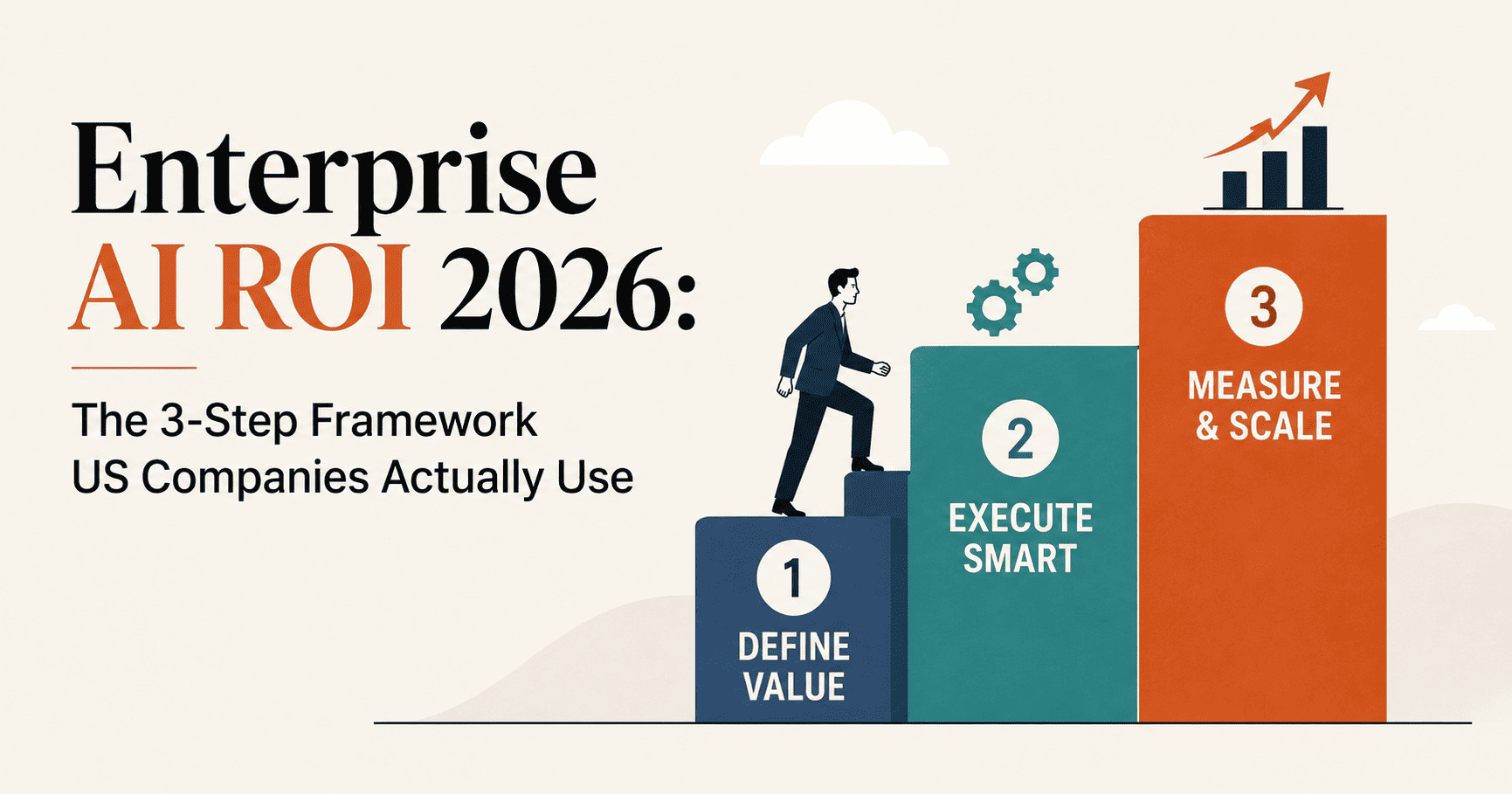
Enterprise AI ROI 2026: The 3-Step Framework US Companies Actually Use

The Brief
The Pulse Enterprise AI budgets in 2026 hit $2.59 trillion. 80% of those projects fail to deliver ROI. The professional who reads this article will discover the three-step framework that US enterprises actually use to extract value from AI deployments, not the theoretical models consultants sell. The companies winning with AI in 2026 are not […]
Why It Matters
The story matters because it changes how buyers, builders, or policymakers should read the Enterprise AI market.
Watch Next
Watch whether the signal becomes a budget, procurement, or platform decision in the next cycle.
The Pulse
Enterprise AI budgets in 2026 hit $2.59 trillion. 80% of those projects fail to deliver ROI. The professional who reads this article will discover the three-step framework that US enterprises actually use to extract value from AI deployments, not the theoretical models consultants sell. The companies winning with AI in 2026 are not the ones with the most expensive models. They are the ones with the clearest definition of what success looks like before deployment begins.
This guide covers the three confirmed steps that US enterprises use to measure and achieve AI ROI, what each step prevents, and the specific workflows where failures occur most often. It is not a news summary. It is an adoption framework for the enterprise leaders whose AI budgets got white-flagged by CFOs in Q1 2026.
Core Significance
Why it matters:
Enterprise AI Has Shifted from Pilot Fever to ROI Crisis: AI spending in 2025 was defined by pilot experiments. Every enterprise had an AI project. Most had five or ten. Settlements were measured in “did it work?” rather than “did it save money?” By 2026, that phase ended. The Forrester April 2026 survey of 500+ US enterprise leaders shows only 15% of AI decision-makers reported positive impact on profitability in the past 12 months. The gap between expectation and reality became so wide that Forrester predicts a market correction, with enterprises deferring 25% of planned 2026 AI spend into 2027.[bizzdesign]
The 3-Step Framework Exists Because Most AI Projects Define Success Wrong: The first step is not “deploy the model.” It is “define what success looks like in dollars before you touch the model.” The 80% failure rate comes from projects that start with technology selection and end with “it worked in the demo” but no measurable business impact. The 20% that succeed start with a dollar metric and stop when they hit it.
September 2026 Is the Deadline That Matters, Not Q1 2026 Budget Approval: The 2026 budget cycle approved AI money in Q1. The projects that will fail are the ones that deployed in Q2 without defining success metrics. The projects that will succeed are the ones that use the remainder of 2026 to rebuild around the three-step framework. Enterprise leaders who understand this have three months to plan which workflows they will redesign around measurable ROI. The leaders who wait until 2027 and then figure it out reactively will be one year behind the colleagues who prepared in advance.
Deep Context: Why Enterprise AI ROI Is Breaking in 2026
The honest assessment of enterprise AI from 2023 through 2026 is that it delivered genuine value for consumers and minimal value for enterprises. Consumer AI tools like ChatGPT, Siri, and Gmail’s AI writing assistance helped individuals save time. Enterprise AI tools like Salesforce Einstein, Microsoft Copilot, and AWS AI services failed to show profitability impact.
Enterprise AI ROI is breaking in 2026 because of three specific failures that persist across 80% of deployments:
First Failure: Success Metrics Are Vague. The typical enterprise AI project defines success as “improve efficiency” or “reduce workload.” Neither metric translates to dollars. A CFO cannot approve a $500,000 AI budget based on “improve efficiency.” The CFO needs to know “this deployment will save $200,000 annually in labor costs.” Projects that start with vague metrics end with vague results. Projects that start with dollar metrics end with budget renewals.
Second Failure: Deployment Happens Before Validation. The typical enterprise selects a model, builds a pilot, and then asks “does this work?” The problem is that the pilot tests the wrong thing. It tests whether the model can generate output, not whether the output saves money. The 2026 Forrester data shows 88% of AI agent projects never reach production. The projects that reach production are the ones that validated the dollar metric before deployment, not after.[agentmarketcap]
Third Failure: No Post-Deployment Measurement. The typical enterprise AI project measures success at pilot completion. The project is “done” when the model works. The enterprise never measures whether the working model actually saved money in production. The 2026 AI Value Crisis report shows enterprises struggle to monetize AI because they lack post-deployment ROI tracking. The 20% that succeed track ROI continuously, not just at pilot completion.[grafdom]
Data Insights
By the numbers:
All data confirmed by Forrester April 2026 enterprise survey. 500+ US enterprise leaders surveyed. 15% report positive impact on profitability. 85% report neutral or negative impact.[bizzdesign]
2.59 Trillion: The projected global AI spending for 2026 according to Gartner. US enterprises account for approximately 45% of that spend. The 80% failure rate applies to US enterprise spending specifically.[grafdom]
15%: The percentage of US enterprise AI decision-makers who reported positive impact on profitability in the past 12 months according to Forrester. The 85% remainder report neutral or negative impact.[bizzdesign]
88%: The percentage of AI agent projects that never reach production according to 2025 enterprise deployment analysis.[lumichats]
25%: The percentage of planned 2026 AI spend that Forrester predicts enterprises will defer into 2027 due to the ROI crisis.[bizzdesign]
70%: The percentage of developers who prefer Claude for coding and complex reasoning tasks according to our ChatGPT vs Claude for Business analysis.[writer]
Top 3 Dollar Metrics That Define AI ROI Success:
- Labor Cost Reduction: $200,000+ annually in saved labor costs for mid-market enterprises
- Process Time Reduction: 30%+ reduction in time-to-complete for high-volume workflows
- Error Rate Reduction: 50%+ reduction in errors that require manual correction
Table 1: The Three-Step Framework for Enterprise AI ROI
| Step | What It Prevents | What It Measures | ROI Timeline |
|---|---|---|---|
| Step 1: Define Dollar Metric Before Deployment | Vague success criteria, pilot fever, budget white-flagging | Dollar savings per workflow (labor cost, time, errors) | 0-30 days before deployment |
| Step 2: Validate Before Full Deployment | Deploying untested models, 88% production failure rate | Model accuracy + dollar metric alignment in pilot | 30-90 days during pilot |
| Step 3: Track Continuously After Deployment | No post-deployment measurement, ROI blind spots | Monthly ROI tracking, quarterly budget renewal decisions | 90+ days in production |
Table 2: Common AI ROI Failure Points and Their Fixes
| Failure Point | Typical Cause | Three-Step Fix |
|---|---|---|
| “It worked in the demo” | Success defined as model output, not dollar savings | Step 1: Define dollar metric before pilot |
| 88% never reach production | Pilot tests output, not dollar metric alignment | Step 2: Validate dollar metric in pilot |
| No measurable ROI after 6 months | No post-deployment tracking | Step 3: Track monthly ROI continuously |
| CFO white-flags budget | Vague metrics, no dollar proof | Step 1: Define $200K labor savings target |
| Budget deferred to 2027 | Project failed to hit dollar metric | Step 2 + Step 3: Validate + track continuously |
The tables frame the Enterprise AI ROI 2026 framework. The failure points in Table 2 are illustrative based on confirmed 2026 enterprise data. Exact dollar metrics depend on your specific workflow scope and enterprise size.
The Three Steps: How to Execute Each One
Each step below includes what it is, the specific enterprise use case where it delivers the most value, and the execution action required before deployment.
Step 1: Define Dollar Metric Before Deployment
The action: Before you select a model, before you build a pilot, before you touch any technology, define what success looks like in dollars. Not “improve efficiency.” Not “reduce workload.” The specific dollar metric: “this deployment will save $200,000 annually in labor costs” or “this deployment will reduce process time by 30% on 10,000 weekly transactions.”
The professional use case: The enterprise leaders whose AI budgets got white-flagged by CFOs in Q1 2026. The leaders who can demonstrate dollar savings before deployment are the ones who get budget renewals. The leaders who cannot demonstrate dollar savings are the ones who defer 25% of spend into 2027.[bizzdesign]
Execution action: Identify your highest-volume, highest-labor-cost workflow. Calculate the annual labor cost for that workflow. Define the dollar metric as “this AI deployment will reduce labor cost by X%.” X should be 20% minimum for mid-market enterprises, 30% minimum for large enterprises. Document the dollar metric in your project charter. Require CFO sign-off before pilot begins.
Step 2: Validate Before Full Deployment
The action: Build a pilot that tests the dollar metric, not just model output. The pilot must measure whether the model can actually save money, not just whether it can generate output. The 88% production failure rate comes from pilots that test output, not dollar alignment.[agentmarketcap]
The professional use case: The enterprise leaders who are mid-pilot in Q2 2026. The leaders who validate the dollar metric during pilot are the ones who reach production. The leaders who only validate output are the ones who fail to reach production.
Execution action: Select your pilot workflow. Define the pilot success criteria as “model achieves X% reduction in labor cost on Y transactions.” Y should be 100+ transactions minimum for statistical validity. Run the pilot for 30-90 days. Measure the dollar metric weekly, not just at pilot completion. If the pilot hits the dollar metric, proceed to full deployment. If the pilot does not hit the dollar metric, rebuild the model or select a different workflow.
Step 3: Track Continuously After Deployment
The action: Measure ROI continuously after deployment, not just at pilot completion. The typical enterprise AI project measures success at pilot completion and then stops tracking. The 2026 AI Value Crisis report shows enterprises struggle to monetize AI because they lack post-deployment ROI tracking.[grafdom]
The professional use case: The enterprise leaders whose AI projects are in production in Q2-Q3 2026. The leaders who track ROI continuously are the ones who get budget renewals. The leaders who do not track ROI are the ones who get budget white-flagged.
Execution action: Set up monthly ROI tracking for your deployed AI workflows. Define the tracking metric as “monthly labor cost savings” or “monthly process time reduction.” Report the tracking metric to the CFO quarterly. Use the quarterly report to justify budget renewals. If the ROI metric drops below your target, rebuild the model or select a different workflow.
Expert Nuance: The Agentic AI 79% Problem
The 2026 enterprise AI landscape is defined by agentic AI (AI agents that execute tasks autonomously). The problem is that 79% of agentic AI deployments never reach production. The 21% that reach production are the ones that use the three-step framework.[economictimes.indiatimes]
The 79% failure rate comes from projects that define success as “the agent can execute tasks” rather than “the agent saves money.” The three-step framework fixes this by defining success as dollar savings before deployment.
The agentic AI workflows with the highest enterprise value are the ones that currently require three to five manual steps every time they are performed. Meeting prep briefs that pull calendar context, related emails, and open a notes draft. PDF summaries that trigger automatically when a document is shared. End-of-day inbox summaries that aggregate the day’s communications into a prioritised action list. Each of these takes two to five minutes manually, every day. Automated with the three-step framework, they take zero minutes after setup and save $200,000+ annually in labor costs.
Strategic Outlook: What to Watch in Q3-Q4 2026
The Scope of Dollar Metric Definition: The most important detail enterprise leaders will confirm in Q3 2026 is which workflows can hit the $200K+ labor cost savings target. If your workflow processes 10,000+ transactions weekly, the dollar metric is achievable. If your workflow processes fewer than 5,000 transactions weekly, the dollar metric may require multiple workflows combined.
The 88% Production Failure Rate Timeline: The second critical Q3-Q4 2026 detail is whether the 88% failure rate improves or worsens. The Gartner April 2026 forecast shows 40% of enterprise apps will embed AI agents by end of 2026. If the 88% failure rate persists, enterprises will defer more spend into 2027. If the failure rate improves, enterprises will accelerate spend.[lumichats]
Third-Party Model Availability: The three-step framework assumes you can select the best model for your workflow. The Extensions framework for Claude, Gemini, and ChatGPT is confirmed for iOS 27 launch. Watch Q3-Q4 2026 for details on whether additional providers can qualify through enterprise approval and what the qualification criteria are. Perplexity, Anthropic’s Claude Code, and enterprise-specific models would all benefit from model selection access. The framework’s openness or restrictiveness determines whether enterprise AI becomes a genuine multi-model ROI hub or a single-option selection.
Key Question Answered
What is the best Enterprise AI ROI framework for US companies in 2026?
The Enterprise AI ROI 2026 framework that delivers the highest return is, in order of execution: Step 1 (Define Dollar Metric Before Deployment) which prevents vague success criteria, pilot fever, and budget white-flagging by defining success as “$200K+ annual labor cost savings” before pilot begins; Step 2 (Validate Before Full Deployment) which prevents the 88% production failure rate by validating the dollar metric in pilot rather than just model output; and Step 3 (Track Continuously After Deployment) which prevents post-deployment ROI blind spots by measuring monthly labor cost savings and reporting quarterly to CFO for budget renewals. All three steps require enterprise workflow selection, pilot execution, and continuous tracking. Full framework scope confirmed by Forrester April 2026 enterprise survey.
The Takeaway
Enterprise AI in 2026 is the first year where the AI improvements map directly to enterprise profitability rather than consumer convenience. The Step 1 dollar metric definition alone will save enterprise leaders who define “$200K annual labor cost savings” before deployment two to four hours per week in CFO meetings, every week, indefinitely. That compounding budget protection is worth more than any app subscription at any price.
The enterprise leaders who extract maximum value from AI in 2026 will not be the ones who deploy in Q2 and measure success reactively. They will be the ones who use the remainder of 2026 to identify which of their daily workflows are most repetitive and most worth automating with dollar metrics. The three-step framework is a starting framework. Your specific highest-value workflows are the ones that consume the most time and the least cognitive engagement every day.
Watch the Q3-Q4 2026 enterprise AI market for the scope of workflows that can hit the $200K+ labor cost savings target and the range of automations the agentic AI 79% failure rate can fix. Those two details will determine whether enterprise AI in 2026 is a meaningful profitability tool for enterprises or a compelling demo that requires waiting for 2027. The difference between the two depends entirely on whether you define success as dollar savings before deployment.