Hardware-as-a-Service: Why Enterprises are Renting GPUs Instead of Buying Them

The Brief
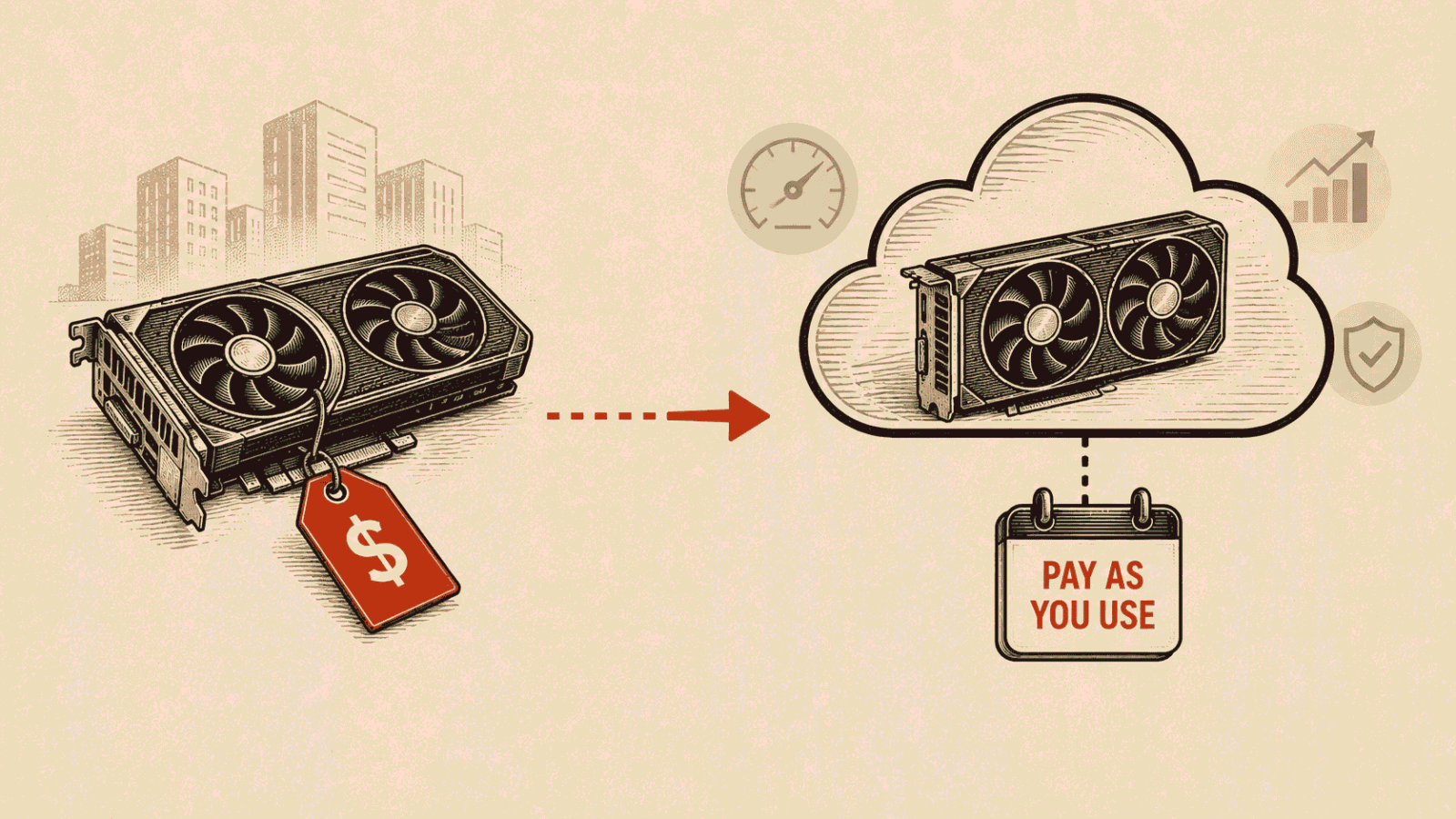
GPU rental hit $7.38B in 2026 as H100s renting for $1.38/hour undercut the $30K–40K purchase cost. The HaaS market is scaling from $120B to $525B by 2031 on the same logic..
Why It Matters
GPU hardware depreciates on a two-year cycle, so ownership locks enterprises into obsolescence risk that rental shifts onto the provider. This is reshaping how every AI-deploying enterprise budgets compute
Watch Next
Watch whether reserved capacity contracts (6–36 months) tighten as Vera Rubin GPUs route mainly to hyperscalers. Also watch for consolidation among the dozens of GPU rental providers competing purely on price.
The Pulse
The global Hardware-as-a-Service market was valued at 120.54 billion dollars in 2025 and is projected to reach 525.74 billion dollars by 2031, growing at a 27.82% compound annual growth rate. Within that broader market, GPU-as-a-Service is scaling even faster, from 4.31 billion dollars in 2025 to a projected 49.84 billion dollars by 2031. [Mordor Intelligence hardware as a service market 2026 2031]
The shift is not just about cost. Leasing overtook purchasing for 54% of US equipment acquisitions in 2024, reflecting a structural CFO preference for operating expense flexibility over capital expenditure that predates AI but is being accelerated by it. Enterprises that would need to invest 30,000 to 40,000 dollars per GPU to build on-premise AI capability can now access equivalent compute for as little as 1.38 dollars per hour.
For AI specifically, the GPU rental market has already reached 7.38 billion dollars in 2026 and is expected to grow another 28.73% in 2027, driven by the impracticality of purchasing hardware that depreciates as fast as GPU technology evolves.
Core Significance
Why it matters:
- GPU-as-a-Service is projected to grow from 8.66 billion dollars in 2026 to 162.54 billion dollars by 2034, a 44.3% CAGR: North America dominates with 39.37% market share, driven by the concentration of major cloud providers and the capital-intensive nature of GPU infrastructure that makes ownership impractical for all but the largest hyperscalers.[Fortune Business Insights GPU as a service market 2026 2034]
- GPU rental pricing has fallen dramatically, with H100 spot rates starting at 1.38 dollars per hour versus 30,000 to 40,000 dollars to purchase: A100 80GB GPUs now rent for as low as 0.78 dollars per hour on competitive platforms, and competition among providers is increasingly shifting from price alone toward developer experience, reliability, and workload-specific optimization.[Thunder Compute AI GPU rental market trends June 2026]
- AI workloads held 49.87% of GPU-as-a-Service revenue in 2025, making artificial intelligence the single largest demand driver: The remaining demand comes from high-performance computing, scientific research, gaming cloud services, and media rendering, but AI training and inference have decisively overtaken all other use cases combined as the primary market driver.[Mordor Intelligence GPU as a service market 2026 2031]
Deep Context: Why ownership economics no longer work for most enterprise AI deployments
The fundamental economic argument for GPU-as-a-Service is obsolescence risk. Nvidia’s GPU architecture advances on a roughly two-year cycle. The H100, released in 2022, is already being substantially outperformed by the B200, and Vera Rubin GPUs are expected to hit the market in late 2026. An enterprise that purchased H100s at 30,000 dollars each in 2023 now owns hardware that rents for 1.38 dollars per hour on the spot market.
Dell APEX customers using HaaS models report a 50% cut in help-desk load and 30% lower support costs compared to owned infrastructure, demonstrating that the operational savings from subscription models extend well beyond the hardware itself into reduced management overhead. [GlobeNewswire hardware as a service HaaS market forecast 2026 2031]
As covered in our training vs inference report, inference now accounts for 80 to 90% of AI’s compute cost over the lifetime of a deployed system, and inference workloads are inherently variable in volume. That variability is precisely what makes consumption-based GPU rental more cost-effective than owned capacity for most enterprise AI deployments.
The self-hosting break-even has shifted the market structure
The break-even math between managed API inference and self-hosted GPU rental has become clearer in 2026. At roughly 50 to 100 million tokens per month, self-hosting on rented GPU infrastructure becomes cheaper than managed API pricing. Below 20 million tokens, managed APIs remain more cost-effective including engineering overhead. Above 100 million tokens, GPU rental wins decisively on unit economics.
As covered in our enterprise AI stack cost report, the integration and orchestration layer around GPU infrastructure typically costs 40 to 60% of total build cost. That overhead is why mid-market enterprises without dedicated ML infrastructure teams are increasingly choosing managed GPU services with deployment assistance rather than raw GPU rental alone.
Data Insights
By the numbers:
All figures from named market research firms and GPU rental provider data cited inline.
- A single H100 GPU costs 30,000 to 40,000 dollars to purchase, while renting equivalent compute costs 1.38 to 11.06 dollars per hour depending on tier: The price range reflects the difference between spot instances, which offer 70 to 90% savings but can be interrupted, and on-demand hyperscaler pricing that provides guaranteed availability with enterprise SLAs. [Cyfuture GPU server rentals 2026 performance cloud hosting]
- GPU-as-a-Service is projected to reach 26.62 billion dollars by 2030 at a 26.5% CAGR from the current 8.21 billion dollar base: SMEs are the fastest-growing adopter segment at a 29.1% CAGR, reflecting small and medium enterprises adopting cloud GPU access for AI workloads that would be entirely inaccessible through hardware purchase.[MarketsandMarkets GPU as a service market size 2026 2030]
- Robot-as-a-Service is the fastest growing segment within the broader HaaS market at a 29.35% CAGR: Small-factory automation and cheaper collaborative robots are driving subscription-based robotics adoption that follows the same capex-to-opex logic as GPU rental, extending the HaaS model from compute into physical industrial automation.
Table 1: GPU rental pricing tiers in June 2026
| GPU model | Spot price per hour | On-demand price per hour | Purchase cost per unit | Best use case |
| A100 80GB | 0.78 dollars | 5.07 dollars | 10,000 to 15,000 dollars | Cost-sensitive training, fine-tuning |
| H100 80GB | 1.38 dollars | 11.06 dollars | 30,000 to 40,000 dollars | LLM training, large-scale inference |
| B200 SXM6 | Higher, limited supply | Premium tier | Not widely available | Frontier model training, FP4 throughput |
Table 2: When to rent versus when to buy GPU infrastructure
| Decision factor | Rent GPU compute | Buy GPU hardware |
| Monthly token volume | Variable or growing, hard to predict | Stable at very high volume for 3 plus years |
| Hardware lifecycle risk | Provider absorbs obsolescence | Enterprise absorbs depreciation |
| Engineering team | Small or no dedicated ML infrastructure team | Large dedicated GPU ops team |
| Upfront capital | Near zero, operating expense model | 30,000 to 40,000 dollars per GPU plus facility |
| Compliance requirement | Check provider certifications | Full control of physical infrastructure |
The Business Case: When GPU rental makes financial sense and when it does not
GPU rental is unambiguously the right choice for enterprises with variable AI inference workloads, limited ML infrastructure engineering capacity, or AI programs still in the scaling phase where demand volume is uncertain. The combination of zero upfront capital, provider-absorbed obsolescence risk, and consumption-based pricing matches the financial profile of most enterprise AI deployments in 2026.
GPU ownership makes financial sense only for organizations running stable, predictable, very high-volume AI workloads on a continuous basis with dedicated GPU operations teams and the facility infrastructure to house and cool the hardware. Hyperscalers, frontier AI labs, and a small number of enterprises with massive internal inference workloads fall into this category. Nearly everyone else is better served by rental.
The hybrid model, where enterprises rent GPU compute for variable and experimental workloads while maintaining a smaller owned baseline for predictable production inference, is emerging as the dominant enterprise architecture in 2026 and is likely to remain so as long as GPU hardware continues to evolve on a two-year cycle.
One frequently underestimated cost of GPU ownership is facility infrastructure. Housing high-density GPU hardware requires power density capacity of 40 to 60 kilowatts per rack, liquid cooling infrastructure, and redundant power systems that most existing enterprise data centers were not designed to support. Renting GPU compute from a provider who has already invested in that infrastructure converts a multi-million dollar facility upgrade into a metered service charge.
Expert Nuance: The provider landscape is fragmenting in ways that benefit buyers
The GPU cloud market in 2026 is no longer a simple choice between three hyperscalers. Specialized providers including CoreWeave, Lambda Labs, Nebius, RunPod, Vast.ai, and aggregator marketplaces have created a competitive environment where H100 and B200 spot prices are consistently lower than hyperscaler on-demand pricing by 2 to 4 times. [Spheron AI infrastructure companies 2026 GPU cloud providers]
The trade-off is between price and enterprise guarantees. Hyperscalers cost more but offer enterprise support, compliance certifications, and guaranteed SLAs. Specialized providers offer substantially lower pricing but with varying reliability, and marketplace aggregators that connect buyers to idle capacity across multiple providers offer the lowest prices with the least predictability.
For enterprises, the practical decision framework is straightforward. Production inference with SLA requirements should run on hyperscaler or dedicated provider reserved instances. Training and experimentation workloads should run on spot instances from whichever provider currently offers the best price-performance. Batch embedding and summarization jobs should use the cheapest available spot instances regardless of provider.
Strategic Outlook
- Reserved GPU capacity is becoming a strategic procurement decision, not just an infrastructure expense: Enterprises locking in 6 to 36 month reserved GPU capacity are securing pricing and availability guarantees that shorter-term buyers cannot access, particularly as Nvidia Vera Rubin GPUs channel primarily to hyperscalers while Hopper and Blackwell remain the accessible tier for most organizations. [Compute Exchange best GPU rental platforms 2026 comparison]
- The GPU-as-a-Service market will likely consolidate as the number of providers currently competing on price alone becomes unsustainable: The current fragmented market with dozens of providers benefits buyers through price competition, but providers operating on razor-thin margins without differentiated services will either consolidate or exit as the market matures past its current growth phase.
- Hybrid deployments that mix owned baseline compute with rented surge capacity will become the standard enterprise architecture: The pure-rent and pure-buy models each serve a small minority of enterprises. Most organizations will settle on a baseline of reserved capacity at the most predictable discount tiers, supplemented by on-demand and spot capacity that scales with actual workload demand.
Key Qestion Answered
Why are enterprises renting GPUs instead of buying them in 2026?
Because GPU hardware depreciates faster than almost any other enterprise capital asset, the cost of ownership is extreme relative to rental, and inference workloads are inherently variable in ways that make fixed infrastructure poorly matched to actual demand. An H100 that cost 30,000 to 40,000 dollars to purchase now rents for 1.38 dollars per hour on spot markets, and the B200 that will outperform it is already shipping.
The broader HaaS market growing from 120.54 billion to 525.74 billion dollars by 2031 reflects a structural enterprise preference for operating expense flexibility, and GPU-as-a-Service growing from 4.31 billion to 49.84 billion within that market confirms that AI compute is the specific category driving the fastest adoption. For all but the largest hyperscalers and frontier labs running continuous maximum-utilization workloads, renting GPU compute is now less expensive, less risky, and more operationally flexible than owning it.
The Takeaway
The GPU-as-a-Service market in 2026 is doing to AI compute what AWS did to general-purpose cloud in the late 2000s: converting a massive capital expenditure into a metered operating expense that scales with actual demand rather than projected demand. The economics are already decisive for most enterprises, and the competitive provider landscape is pushing prices down faster than any single organization’s procurement team could negotiate.
The organizations still evaluating whether to buy or rent GPU infrastructure in 2026 are asking the wrong question. The productive question is how to structure a rental portfolio that matches workload patterns: reserved capacity for predictable production inference, on-demand for responsive scaling, and spot instances for batch processing and experimentation. That portfolio approach, not a binary buy-or-rent decision, is how enterprise AI infrastructure will be financed for the foreseeable future.
The enterprises that get this right will have materially lower AI infrastructure costs and faster scaling capability than those that either over-invest in owned hardware that depreciates in two years or under-invest in reserved capacity that could have locked in pricing before the next demand spike.