Salesforce News 2026: Agentforce Hits 1.2 billion in ARR While the Stock Drops 33 Percent

The Brief
The Pulse Salesforce closed fiscal year 2026 with 41.5 billion dollars in revenue and a 72 billion dollar backlog. Three months later, its stock had fallen 33% for the year. Salesforce reported Q1 fiscal 2027 results on May 27, 2026, with revenue of 11.1 billion dollars, up 13% year over year, and Agentforce annual recurring […]
Why It Matters
The story matters because it changes how buyers, builders, or policymakers should read the Enterprise AI market.
Watch Next
Watch whether the signal becomes a budget, procurement, or platform decision in the next cycle.
The Pulse
Salesforce closed fiscal year 2026 with 41.5 billion dollars in revenue and a 72 billion dollar backlog. Three months later, its stock had fallen 33% for the year.
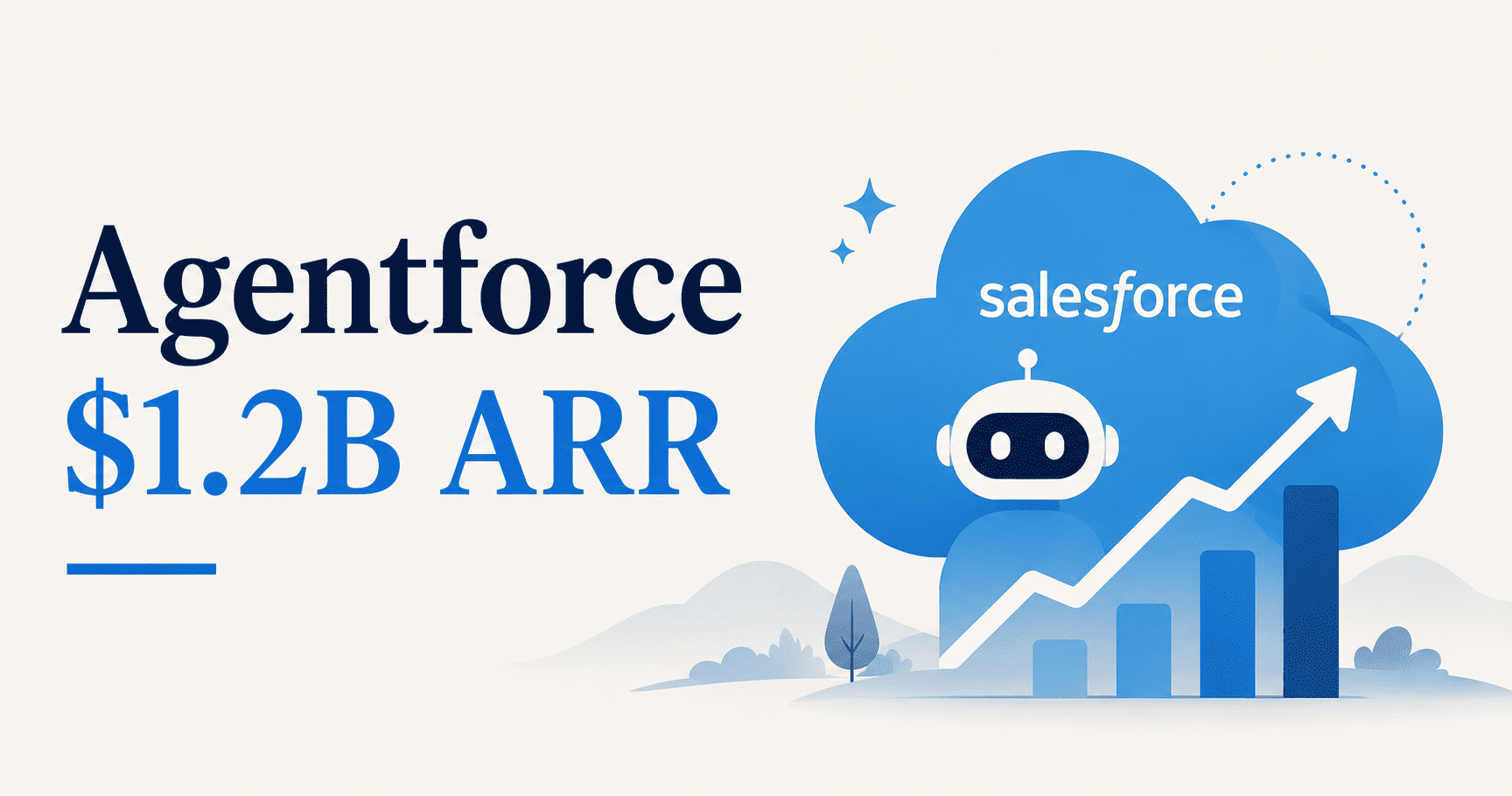
Salesforce reported Q1 fiscal 2027 results on May 27, 2026, with revenue of 11.1 billion dollars, up 13% year over year, and Agentforce annual recurring revenue crossing 1.2 billion dollars, up 205% year over year.
The earnings beat estimates on every major metric. The stock barely moved. Investors are no longer asking whether Agentforce works. They are asking whether AI agents from OpenAI and Anthropic will make Salesforce itself unnecessary.
Core significance
Why it matters:
- Agentforce crossed 1.2 billion dollars in annualized revenue, up 205 percent year over year: Combined with Data 360, annual recurring revenue from the two products reached nearly 3.4 billion dollars, more than double the prior year.[Salesforce official Q1 FY2027 earnings release]
Salesforce delivered 3.8 billion agentic work units in the quarter alone, its internal metric for discrete tasks an AI agent completes without human intervention.
- The stock fell 33 percent in 2026 despite the company beating Wall Street on every headline number: Subscription revenue from Agentforce apps across sales, service, marketing, commerce, and Slack totalled 6.91 billion dollars, up almost 9% from a year earlier.[CNBC Salesforce Q1 fiscal 2027 earnings report]
Data 360 and other subscription revenue grew 25% to 3.68 billion dollars, helped by the recently acquired Informatica business. Tableau and commerce categories showed weakness.
- Salesforce raised its long term target to 63 billion dollars by fiscal 2030 and authorized a 50 billion dollar buyback: Fiscal 2026 closed at 41.5 billion dollars in revenue, up 10% year over year, with 72 billion dollars in total remaining performance obligation, up 14%.[Salesforce official Q4 fiscal 2026 earnings release]
CEO Marc Benioff described the quarter as the moment Salesforce rebuilt itself into the operating system for the agentic enterprise, bringing humans and AI agents onto one platform.
Deep Context: From seats to work units
For three decades, Salesforce sold software the same way every enterprise vendor did: per seat, per user, per month. Agentforce breaks that model entirely.
Salesforce now reports a metric called agentic work units, defined as discrete tasks completed by an AI agent, a decision made, a record updated, a workflow triggered.[TechHQ Salesforce Agentforce enterprise agentic AI analysis]
The company introduced this metric deliberately to shift the conversation away from how many people are logged in toward how much work is actually getting done by software that nobody is logged into.
The governance gap beneath the headline numbers
More than 60% of Agentforce and Data 360 Q4 bookings came from existing customer expansion rather than new logos, a figure that shows where the platform is taking root fastest.
But the harder question for fiscal 2027 is whether integration discipline and data governance can keep pace with deal count. Enterprises getting the most from Agentforce are the ones that treated clean data as a precondition, not an afterthought.
As covered in our Power BI news report, Microsoft is making the identical bet, that the semantic layer and data governance underneath AI agents matters more than the agents themselves. Salesforce and Microsoft are now converging on the same architectural thesis from different starting points.
Why Salesforce abandoned per seat pricing for Agentforce
The pricing model is the clearest evidence of how seriously Salesforce takes the agentic disruption threat. Agentforce is priced on consumption, not per user seat, through Flex Credits at roughly 0.10 dollars per action or 2 dollars per conversation.[VaaSBlock enterprise SaaS agentic AI Salesforce ServiceNow Workday]
The strategic logic is direct. If AI agents are going to perform work that previously required a human with a paid seat, Salesforce wants to capture revenue from the agent’s work itself rather than lose that revenue when the seat disappears.
The execution risk is that the conversion from seat revenue to agent consumption revenue has been gradual. Salesforce’s overall revenue mix is still dominated by traditional seat licences, with Agentforce a smaller but fast growing component, which is part of why the stock has lagged even as Agentforce metrics accelerate.
What Agentforce 360 actually looks like in production
Salesforce calls itself Customer Zero for Agentforce, meaning it runs the product internally before pitching it externally. Reddit, an external customer, deflected 46% of support cases after deployment and cut resolution times from 8.9 minutes to 1.4 minutes.[Salesforce investor relations Agentforce 360 general availability]
That kind of result depends on the Atlas Reasoning Engine, the multi step decision layer that breaks a customer request into subtasks, identifies which data sources and tools to invoke, and executes the response in real time.[AI Automation Global Agentforce 360 85 percent resolution analysis]
Salesforce reports that enterprises across 124 countries are now resolving 85% of customer queries through Agentforce without human involvement, with escalation rates as low as 5%. Q4 fiscal 2026 alone saw 771 million agentic work units processed, a 57% sequential increase.
Slack becomes the interface, not just the chat app
Starting in 2026, every new Salesforce customer is provisioned with Slack by default, already connected on day one. Slackbot now acts as an MCP client, meaning it can route a request to Agentforce or any other agent or app in the enterprise automatically.[Salesforce Slackbot agent orchestration MCP official]
The practical effect is that an employee can update an opportunity, research an account, or trigger a workflow entirely through a Slack message, without opening a Salesforce application at all. This is the same convergence-on-conversational-interface trend reshaping enterprise software across vendors in 2026.
Data insights
By the numbers:
All figures from Salesforce official earnings releases, SEC filings, and named analyst reports cited inline.
- 29,000 cumulative Agentforce deals closed, up 50 percent quarter over quarter in Q4 alone: Adjusted operating margin reached 34.2%, up from 33.1% a year earlier, with adjusted diluted earnings per share of 3.81 dollars against a consensus of 3.05 dollars.[Futurum Group Salesforce Q4 FY2026 earnings analysis]
Management’s fiscal 2027 outlook points to a steadier growth profile as customers pace AI investment against budget discipline and proof of value requirements.
- 19 trillion tokens processed all time, up from 3.2 trillion just two quarters earlier: Salesforce’s Q3 fiscal 2026 results already showed Agentforce surpassing 3.2 trillion tokens with current remaining performance obligation up 11% year over year to 29.4 billion dollars.[Salesforce investor relations Q3 fiscal 2026 results]
The roughly six fold increase in token processing between Q3 fiscal 2026 and Q1 fiscal 2027 is the clearest internal evidence that Agentforce usage, not just bookings, is compounding.
- 63 billion dollars is the new fiscal 2030 revenue target, raised from a prior internal goal: Salesforce closed fiscal 2026 with 15 billion dollars in operating cash flow and 14.4 billion dollars in free cash flow.[Salesforce SEC filing fiscal 2026 fourth quarter exhibit]
The 50 billion dollar buyback authorization, the largest in company history, replaced all previously unused repurchase authorizations in a single move.
Table 1: Salesforce Agentforce growth trajectory FY2026 to FY2027
| Period | Agentforce ARR | Growth rate | Tokens processed | Key milestone |
| Q3 FY2026 | Not separately disclosed | Building | 3.2 trillion | cRPO up 11% to 29.4 billion dollars |
| Q4 FY2026 | 800 million dollars | 169% YoY | Nearly 20 trillion all time | 29,000 cumulative deals, 50% QoQ growth |
| Q1 FY2027 | 1.2 billion dollars (combined with Data 360 at 3.4B) | 205% YoY | Not separately disclosed | 3.8 billion agentic work units in one quarter |
| FY2030 target | Implied multibillion | Path to 63 billion total revenue | Compounding | 50 billion dollar buyback authorized |
Table 2: Salesforce revenue mix Q1 fiscal 2027
| Segment | Q1 FY2027 revenue | Year over year change |
| Total revenue | 11.1 billion dollars | Up 13%, beat 11.17B consensus narrowly |
| Subscription and support | 10.6 billion dollars | Up 14%, including 428 million from Informatica |
| Agentforce apps (sales, service, marketing, commerce, Slack) | 6.91 billion dollars | Up almost 9% |
| Data 360 and other subscription | 3.68 billion dollars | Up 25%, including Informatica contribution |
| Tableau and commerce | Within above totals | Described as showing weakness in the quarter |
| IMAGE PROMPT BOXPrompt: A side by side comparison infographic showing two enterprise software company logos represented as abstract geometric shapes, one in Salesforce blue and one in a neutral gray, with a downward stock chart line overlaid across both, on a white background, no readable text or actual logos needed.Alt text: Salesforce and ServiceNow stock decline 2026 amid AI agent disruption fears in enterprise software sectorPlacement: After Table 2, before The business case section |
The Business Case: What this means for enterprise buyers
The Salesforce story in 2026 is a useful test case for any enterprise evaluating AI vendor claims. The product metrics are genuinely strong. Agentforce adoption, token consumption, and deal counts are all compounding at triple digit rates.
But the market reaction shows that strong product metrics alone no longer satisfy investors, and by extension, they may not satisfy enterprise buyers either. The question shifting from can this AI agent perform a task to will this category of software still exist in three years is a different evaluation entirely.
For enterprises currently running Salesforce, the practical signal is the governance point buried in the TechHQ analysis. The customers getting the most value from Agentforce treated data cleanup and governance as a precondition for deployment, not a parallel workstream. That sequencing matters more than which AI vendor an enterprise chooses.
For enterprises evaluating Salesforce against alternatives, the 60% expansion bookings figure is informative. Existing Salesforce customers are the ones buying Agentforce fastest, which suggests the product works best as an extension of an existing CRM investment rather than a greenfield agentic AI purchase.
The pricing structure adds a layer enterprises should model before signing. Flex Credits at roughly 0.10 dollars per action sound trivial in isolation, but a support deployment running 100,000 sessions per month at an average of eight actions per session adds up quickly.
Procurement teams should request a 90 day ramp period where internal testing and sandbox traffic do not count against committed volume, since early deployments routinely run 30 to 60% above forecast purely from QA and retry loops, independent of real customer usage.
Expert nuance: Is the sell off about Salesforce, or about software itself
Salesforce stock dropped 9% in a single session in April 2026 on what 24/7 Wall Street described as sector panic, despite zero Salesforce specific news that day.[24/7 Wall St Salesforce sector panic analysis]
Several investment banks cut price targets on ServiceNow that same week while keeping bullish ratings, framing the issue as deal timing rather than structural weakness. The selling spread to Salesforce as the category bellwether anyway.
The deeper source of the fear has a name: Claude Cowork. Anthropic’s plugin launch earlier in 2026 sparked concern that AI agents could disrupt traditional SaaS models by replacing platforms rather than running on top of them.[Yahoo Finance Salesforce ServiceNow selloff Wedbush analysis]
Wedbush analysts who spoke with CIOs across the industry called the fear overdone, arguing that OpenAI or Anthropic becoming full enterprise software giants is a stretch given the depth of workflow, compliance, and integration logic embedded in platforms like Salesforce.
Strategic outlook
- Watch whether Agentforce ARR growth decelerates from 205 percent toward ServiceNow’s pace: ServiceNow reported Q1 2026 current remaining performance obligation growth of 22.5% year over year, a more moderate but highly consistent rate.[ServiceNow SEC filing Q1 2026 8-K]
If Agentforce growth converges toward ServiceNow’s range over the next two quarters, that would support the bull case that this is durable enterprise adoption rather than an early adopter spike.
- The Informatica integration is now material enough to distort year over year comparisons: With 428 million dollars of Q1 revenue and over 1 billion dollars in ARR coming from Informatica, analysts need to separate organic Agentforce growth from acquired revenue to judge the underlying trend.
- The next earnings call is the test of the work unit metric’s credibility: 3.8 billion agentic work units in one quarter is an enormous number with no external benchmark yet.
Whether Salesforce can show this metric correlating with customer retention, expansion, or cost savings in the next two quarters will determine whether work units become an industry standard or get quietly retired.
- Watch how Salesforce reports the Flex Credit versus seat revenue split going forward: Right now, Agentforce and Data 360 ARR is reported as a combined figure near 3.4 billion dollars, while the overall 11.1 billion dollar quarterly revenue is still dominated by traditional subscription and support licences.
If Salesforce begins breaking out pure consumption revenue from Flex Credits as its own line item, that will be the clearest signal yet that the seat to agent transition has crossed from narrative to material financial reality. Until then, analysts are estimating the split from indirect signals like token counts and work units.
Key question answered
What is the latest Salesforce news in 2026?
The most significant Salesforce news in 2026 is the divergence between Agentforce’s financial performance and the stock’s price action.
Agentforce annual recurring revenue reached 1.2 billion dollars in Q1 fiscal 2027, up 205% year over year, with Data 360 combined ARR near 3.4 billion dollars. Salesforce processed 3.8 billion agentic work units in the quarter and has processed 19 trillion tokens all time. Fiscal 2026 closed with 41.5 billion dollars in revenue, 72 billion dollars in backlog, and a new 50 billion dollar buyback authorization, with a raised fiscal 2030 target of 63 billion dollars. Despite these results, Salesforce stock fell roughly 33% in 2026 amid sector wide fears that AI agents from OpenAI and Anthropic, including Anthropic’s Claude Cowork, could disrupt traditional SaaS platforms.
The Takeaway
Salesforce in 2026 is delivering the agentic AI transition it promised, on the timeline it promised, at the scale it promised. The product numbers are not in question.
What is in question is whether the market still believes the category Salesforce operates in has the same multiple it had two years ago. A 33% stock decline alongside 205% ARR growth in the same product line is not a contradiction investors usually tolerate for long.
For enterprise technology buyers, the Salesforce situation in 2026 is a preview of a question every SaaS vendor will face: strong agentic AI metrics are necessary, but they are no longer sufficient to convince markets, or buyers, that the underlying platform is still the right place to run that AI.
The companies that resolve this tension fastest will be the ones that can show, in plain financial terms, that AI agents are adding new revenue rather than simply automating away the seat revenue that used to justify the price.