AI Layoffs Tracker 2026: Every Company That Cut Jobs and Cited AI
AI layoffs tracker: 173,858 announced job cuts since January 2025 where the company cited AI or automation, 102,122 of them in 2026. Top 25 table, cuts by sector and month, the roles hit, an AI-or-cover-story check, methodology and a downloadable CSV. Updated monthly.

Companies have announced 173,858 job cuts since January 2025 while naming AI or automation as a reason, by our count of 62 verified announcements. 102,122 of those cuts came in 2026. Tech companies account for 52% of the total, and Oracle’s 21,000 is the largest. In only 39% did the company name AI as the main reason.
Last updated: Nov 4, 2026, updated monthly
“AI layoffs” has become a catch-all headline. Some companies say plainly that software now does work people used to do. Others mention AI in one line of a cost-cutting memo. Some never mention it at all and get counted anyway.
So we built our own list. It includes only announcements where the company itself linked the cuts to AI or automation, in a filing, a memo, a press release or an executive’s on-record comment. We checked every row against its source and dropped 19 high-profile cuts, about 105,000 jobs, where that link didn’t hold up. You can download the full dataset as a CSV.
Key findings
- 173,858 announced cuts in 22 months. 62 announcements with a stated headcount, January 2025 to November 4, 2026. 2026 so far: 102,122 jobs across 41 announcements, already 42% more than all of 2025 (71,736).
- Tech leads, finance follows. Technology companies account for 52% of the jobs (89,670) and financial services for 23% (40,770). Banks, payment firms and insurers made 14 of the announcements.
- These are office jobs. At least 87% of the cuts hit white-collar roles: corporate staff, engineers, sales, support and call centres. Only a few plans, such as Nestlé’s and Heineken’s, include factory or brewery jobs.
- AI is usually one reason among several. In 61% of the jobs (105,792), AI sits next to cost cutting, restructuring or “reinvesting in AI.” Companies said outright that AI now does the work in 26 announcements covering 68,066 jobs (39%).
- Many cuts are slow. 52% of the jobs sit in plans that run a year or more, often to 2028 or 2030, and several rely on attrition rather than layoffs.
The AI layoffs tracker: top 25 announcements
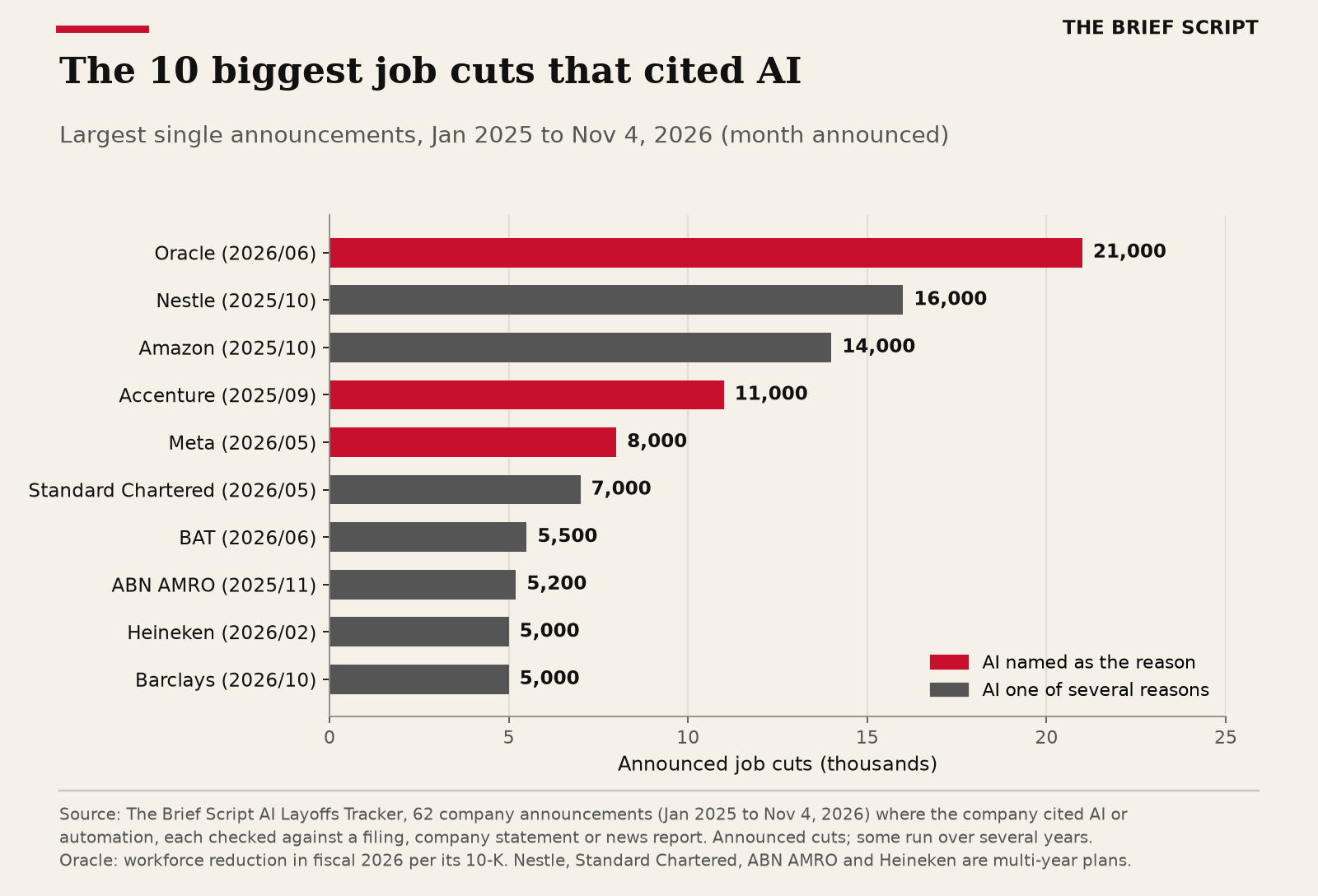
Ranked by announced jobs. “Named as reason” means the company said AI or automation is why the roles are going. “One of several” means AI was cited alongside other reasons. The full CSV has all 67 announcements, including five without a headcount, plus the AI quote or summary and the timeframe for each.
| # | Company | Announced | Jobs cut | Share of staff | Sector | AI link | Source |
|---|---|---|---|---|---|---|---|
| 1 | Oracle | Jun 2026 | 21,000 | ~13% | Technology | Named as reason | forbes.com |
| 2 | Nestle | Oct 2025 | 16,000 | ~6% | Consumer goods & retail | One of several | cnn.com |
| 3 | Amazon | Oct 2025 | 14,000 | ~4% of corporate | Technology | One of several | aboutamazon.com |
| 4 | Accenture | Sep 2025 | 11,000 | ~1.4% | Technology | Named as reason | irishtimes.com |
| 5 | Meta | May 2026 | 8,000 | ~10% | Technology | Named as reason | aljazeera.com |
| 6 | Standard Chartered | May 2026 | 7,000 | — | Financial services | One of several | outlookbusiness.com |
| 7 | British American Tobacco | Jun 2026 | 5,500 | ~12% (20% incl. outsourcing) | Consumer goods & retail | One of several | bnnbloomberg.ca |
| 8 | ABN AMRO | Nov 2025 | 5,200 | >20% | Financial services | One of several | nltimes.nl |
| 9 | Heineken | Feb 2026 | 5,000 | up to 7% | Consumer goods & retail | One of several | cnbc.com |
| 10 | Barclays | Oct 2026 | 5,000 | ~5% | Financial services | One of several | bbc.com |
| 11 | Microsoft | Jul 2026 | 4,800 | 2.1% | Technology | One of several | abcnews.com |
| 12 | Dow | Jan 2026 | 4,500 | 13% | Industrials & chemicals | One of several | cbsnews.com |
| 13 | PayPal | May 2026 | 4,500 | ~20% | Financial services | One of several | techcrunch.com |
| 14 | DBS Bank | Feb 2025 | 4,000 | ~10% | Financial services | Named as reason | bbc.com |
| 15 | Salesforce | Sep 2025 | 4,000 | — | Technology | Named as reason | cnbc.com |
| 16 | Lufthansa Group | Sep 2025 | 4,000 | — | Transport | One of several | cnbc.com |
| 17 | HP Inc. | Nov 2025 | 4,000 | — | Technology | Named as reason | finance.yahoo.com |
| 18 | Block | Feb 2026 | 4,000 | ~40% | Financial services | Named as reason | cnbc.com |
| 19 | Cisco | May 2026 | 4,000 | <5% | Technology | One of several | lightreading.com |
| 20 | Commerzbank | May 2026 | 3,000 | ~8% | Financial services | One of several | computerweekly.com |
| 21 | Kroger | Oct 2026 | 3,000 | ~37% of corporate | Consumer goods & retail | One of several | fortune.com |
| 22 | Visa | Jul 2026 | 2,600 | ~7% | Financial services | One of several | cnbc.com |
| 23 | Groupe SEB | Feb 2026 | 2,100 | ~7% | Consumer goods & retail | One of several | rtl.fr |
| 24 | WiseTech Global | Feb 2026 | 2,000 | ~30% | Technology | Named as reason | abc.net.au |
| 25 | Workday | Feb 2025 | 1,750 | 8.5% | Technology | One of several | engadget.com |
The rest of the list runs from Danske Bank’s 420 automation-driven redundancies to SUSE’s 10% cut, announced on November 2 in a memo that said “automation and AI are fundamentally shifting how software companies operate,” per The Register.
AI layoffs by sector
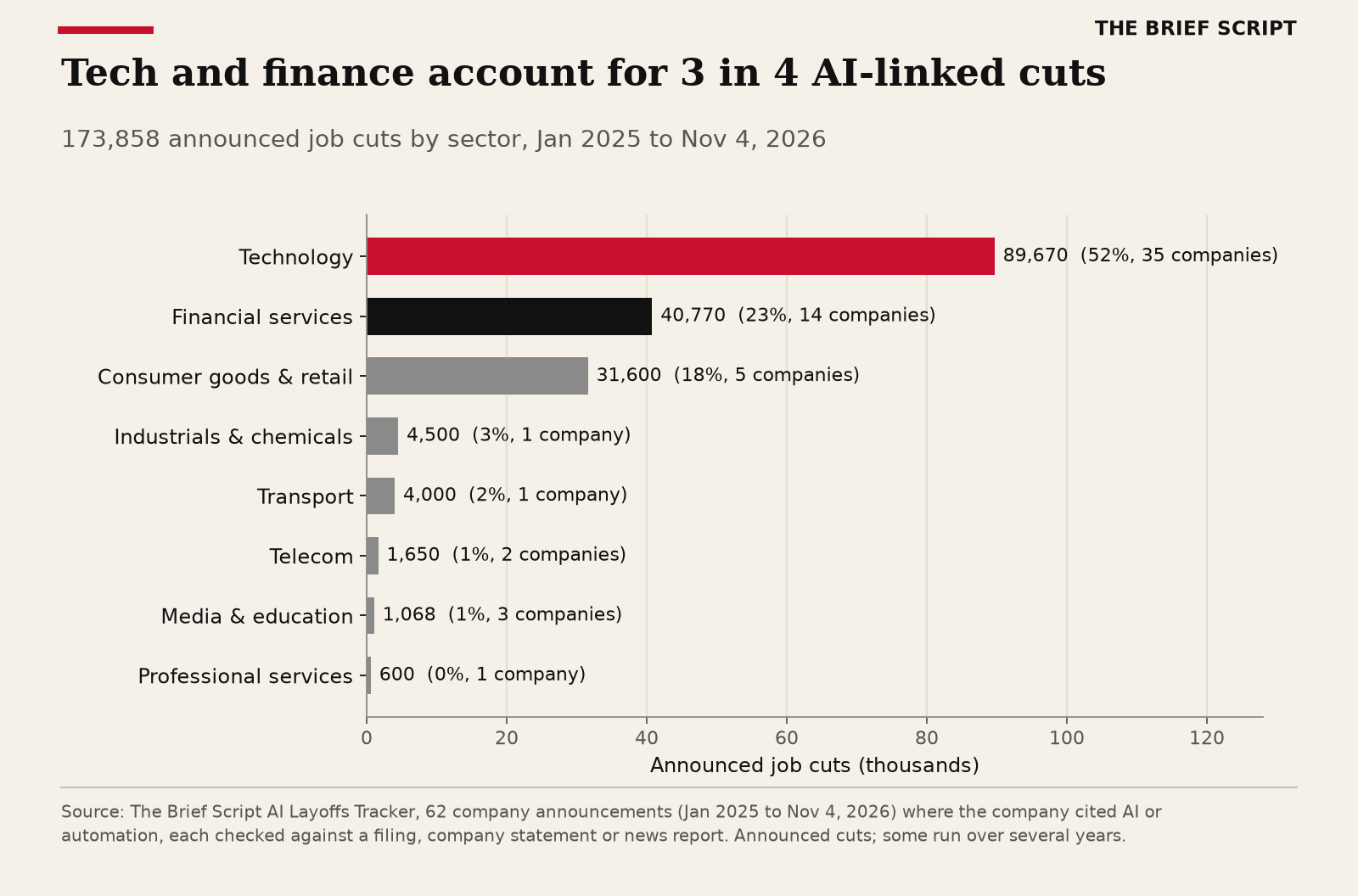
Technology (89,670 jobs, 35 announcements). Software and internet companies dominate the count. They also cite AI more directly than anyone else. Salesforce CEO Marc Benioff said AI agents let him cut support from 9,000 heads to about 5,000, “because I need less heads.” Smaller software firms cut deepest: WiseTech, Cloudflare, Wix, Monday.com, ClickUp, DeepL and Sprout Social each cut 20% to 30% of staff. Seventeen announcements in the tracker cut, or plan to cut, at least a fifth of a company’s staff or of the affected division.
Financial services (40,770 jobs, 14 announcements). Banks talk about AI in multi-year terms. Nordea said that with “the impact of AI and process optimisation” it expects fewer employees, and about 1,500 roles will go across 2026 and 2027. Standard Chartered (7,000 by 2030), ABN AMRO (5,200 by 2028), Barclays (5,000) and Commerzbank (3,000) follow the same pattern. Fintechs moved faster: Block cut about 4,000 of its 10,000-plus staff in one go. We cover the role-level risk in our analysis of AI and finance jobs.
Consumer goods and retail (31,600 jobs, 5 announcements). A few very large plans: Nestlé (16,000, including 12,000 white-collar roles), British American Tobacco (5,500, plus 3,500 roles moved to outsourcing partners), Heineken (5,000 to 6,000), Kroger (3,000 corporate jobs) and Groupe SEB (up to 2,100). Heineken’s CEO told CNBC AI was “partly” behind the cut. That is typical of this group.
Everything else (11,818 jobs). Dow (4,500), Lufthansa (4,000 admin roles by 2030), telecoms Proximus and Sunrise, media groups E.W. Scripps, Chegg and Business Insider, and law firm Baker McKenzie.
AI layoffs by month
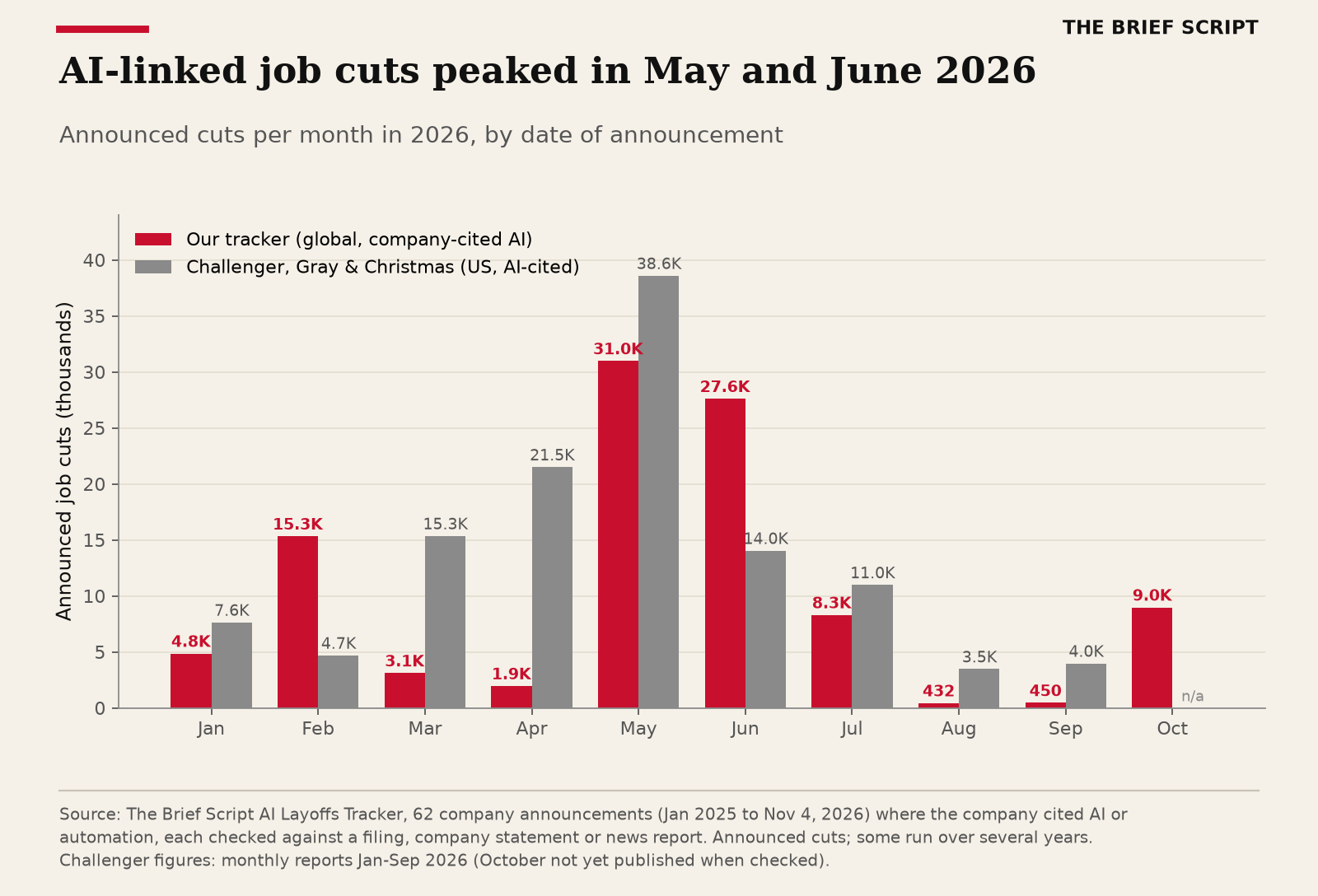
AI-linked cuts in 2026 came in two waves. February brought Block, Heineken, WiseTech and Groupe SEB. May and June were the peak: Meta (8,000), Standard Chartered (7,000), PayPal (about 4,500), Cisco (4,000), Cloudflare and Coinbase in May, then Oracle’s 21,000 and BAT’s 5,500 in June. Those two months account for 57% of the jobs we logged in 2026.
That timing matches the best US count. Outplacement firm Challenger, Gray & Christmas records the reasons US employers give for announced cuts. Its AI-cited total peaked at 38,579 in May 2026 (40% of all cuts that month), then fell to 3,462 in August and 3,961 in September, per its monthly reports. January to September 2026, Challenger counted 120,136 AI-cited US cuts, up from 54,836 in all of 2025.
Our US rows for the same nine months add up to 61,312, about half of Challenger’s figure. The gap is expected. Challenger counts announcements we can’t attribute to a named company and source, and it counts many small cuts. We include non-US companies it leaves out. October picked up again in our data (Barclays, Kroger, FICO and DNB). Challenger’s October report wasn’t out when we checked.
Which roles are most affected
Customer support is the clearest target. Salesforce (4,000 support roles), Allianz Partners (1,500 to 1,800 call-centre jobs), Paycom (about 500 “non-client-facing roles that have been automated,” per KOSU) and Uber (10% of its customer service team) all point to AI handling customer contacts.
Back-office and operations work in banks comes next: Danske Bank said many activities that “previously required extensive manual work are now automated,” and DNB pointed to Know Your Customer (KYC) checks and coding as areas where AI is already doing the work. Then come management layers: Amazon said it was removing layers and bureaucracy, and SUSE’s CEO cited “flatter reporting lines.” Software engineering is the newest group. WiseTech said AI ends the era of “manually writing code.”
These are the jobs that score highest in our AI exposure study of 813 occupations. Customer service representatives, 2.6 million US workers, score 81.8 on our 0 to 100 AI Exposure Score, and software developers score 71.4. Overall, 38.4 million US workers (24.8%) are in high-exposure jobs. Exposure measures how much of a job AI can do, not whether the job disappears, but the layoffs so far are landing where the exposure is.
The AI-proof end of that study, hands-on care and skilled trades, is almost absent from this tracker. The few non-office cuts we logged (factories at Nestlé, Heineken and BAT) were tied to closures and restructuring more than to AI.
AI or cover story?
Plenty of skeptics argue that “AI” is a better story for investors than “we over-hired.” The evidence supports some of that.
The same company tells two stories. Amazon’s October 2025 memo framed its 14,000 corporate cuts around AI as “the most transformative technology we’ve seen since the Internet.” Two days later, CEO Andy Jassy said the cuts were “not really financially driven, and it’s not even really AI-driven, not right now,” but about culture, per CNN. We kept Amazon in the tracker, as “one of several.” Microsoft said AI is changing how work gets done, then added that none of its 4,800 roles would be replaced by AI.
Some “AI cuts” aren’t cuts. Cisco’s CFO said its 4,000-job restructuring “was really not a savings-driven restructure” but a move of resources toward AI, per Light Reading. Mizuho’s plan to shift 5,000 clerical jobs to AI is “not a headcount reduction,” the bank said. We excluded it.
Some get reversed. Commonwealth Bank of Australia replaced 45 call-centre roles with an AI voice bot, then apologised and reversed it when call volumes rose. Gartner predicts half of companies that cut customer service staff because of AI will rehire for similar work by 2027.
Legal filings say less than press releases. New York added an automation checkbox to layoff (WARN) notices in March 2025. By the end of January 2026, after more than 750 notices covering about 28,300 workers, no employer had ticked it, WIRED reported.
Our read: AI is real in these decisions but rarely the only driver. That is why we tag every row and let you filter. The 68,066 jobs where companies named AI as the reason are the firmest number in this tracker.
What it means for workers and employers
For workers. The risk is concentrated in repeatable office work: support queues, back-office processing, first-draft content, routine code and management layers whose main job is passing information along. If your role is mostly that, the useful move is to own the AI tools that do it rather than compete with them. The jobs companies say they are adding, such as AI platform work, data roles, client-facing and specialist positions, ask for exactly that. Check where your occupation sits in our AI-proof jobs rankings.
For employers. Announcing AI layoffs before the AI works is expensive. CBA’s reversal and Gartner’s rehiring forecast show the risk. Measure real automation of real tasks first. Our review of 250 enterprise AI case studies found the strongest returns in narrow, measurable workflows. Our AI ROI guide covers how to measure it before a headcount decision, and our guide to enterprise AI agents covers which support and back-office tasks agents can handle today. Be precise in public, too. A vague “AI” line in a layoff memo now draws scrutiny from staff, regulators and, from January 2027, California’s new technology-displacement notice rules.
Methodology
What counts. An announcement made between January 1, 2025 and November 4, 2026, in which the company, its filing, or an executive on record linked job cuts to AI or automation. Press speculation alone does not count.
Sources. Each row has one source: an SEC filing, company press release or memo, or a news report quoting one. We fetched every source page on November 4, 2026 and checked that it named the company and the number. Pages that blocked automated checks were read manually.
Numbers. We use the announced headcount. Where a company gave a range (HP 4,000 to 6,000, Heineken 5,000 to 6,000, Allianz Partners 1,500 to 1,800) we use the low end. “Up to” figures are taken as stated. Baker McKenzie gave no number, so we use the roughly 600 reported by Legal Cheek. Oracle’s 21,000 is the drop in headcount in fiscal 2026 (about 162,000 to 141,000) in an annual report that says AI adoption has resulted in workforce reductions. Five announcements with no headcount (Pinterest, Uber, BILL, Business Insider) or a reversal (CBA) stay in the CSV but not the totals.
Confidence. “Named as reason” means the company said AI or automation is why the roles go. “One of several” means AI was listed with other reasons such as cost, restructuring or reinvestment in AI.
Role type. “White-collar” covers corporate, engineering, sales, support and call-centre roles. Mixed plans count only the white-collar share the company stated (Nestlé’s 12,000), which gives our 87% lower bound.
Exclusions. We logged 19 widely reported cuts that we left out, totalling about 105,000 jobs, with the reason for each. Examples: Amazon’s January 2026 cut of 16,000 (memo cited layers, not AI), Intuit (CEO said the cut had “nothing to do with AI”), TCS (company denied AI was the reason) and LinkedIn. You can download the exclusions list with the reason and source for each.
Limits. Announced cuts are plans. Some will shrink, stretch out or reverse, and many companies cut jobs without naming AI. This tracker counts what companies say, not what AI actually caused.
Updates. We add new announcements and correct changed figures monthly. The date at the top shows the last update.
FAQ
How many jobs have been lost to AI in 2026?
Our tracker counts 102,122 announced job cuts in 2026 (through November 4) where the company cited AI or automation, across 41 announcements worldwide. Challenger, Gray & Christmas counted 120,136 AI-cited US cuts from January to September 2026. Both are announced cuts, not confirmed job losses.
Which company has made the biggest AI layoff?
Oracle. Its headcount fell by about 21,000 in fiscal 2026, and its annual report says AI adoption has resulted in workforce reductions. The largest announced plan is Nestlé’s cut of 16,000 roles over two years, which cited automation among other reasons.
Which jobs are most at risk from AI layoffs?
Customer support, back-office operations, middle management and routine software work have been hit hardest. They match the occupations with the highest scores in our AI exposure data, led by customer service representatives. Hands-on care and skilled trades barely appear in the tracker.
Are companies really replacing workers with AI, or using it as an excuse?
Both happen. In 39% of the jobs we track, companies said AI now does the work. In the rest, AI was one reason among several, and some executives later played it down. Amazon’s CEO said its 14,000 cuts were “not really AI-driven.” Some companies, such as CBA, have reversed AI cuts.