AI Policy News 2026: Regulation and Business Impact

The Brief
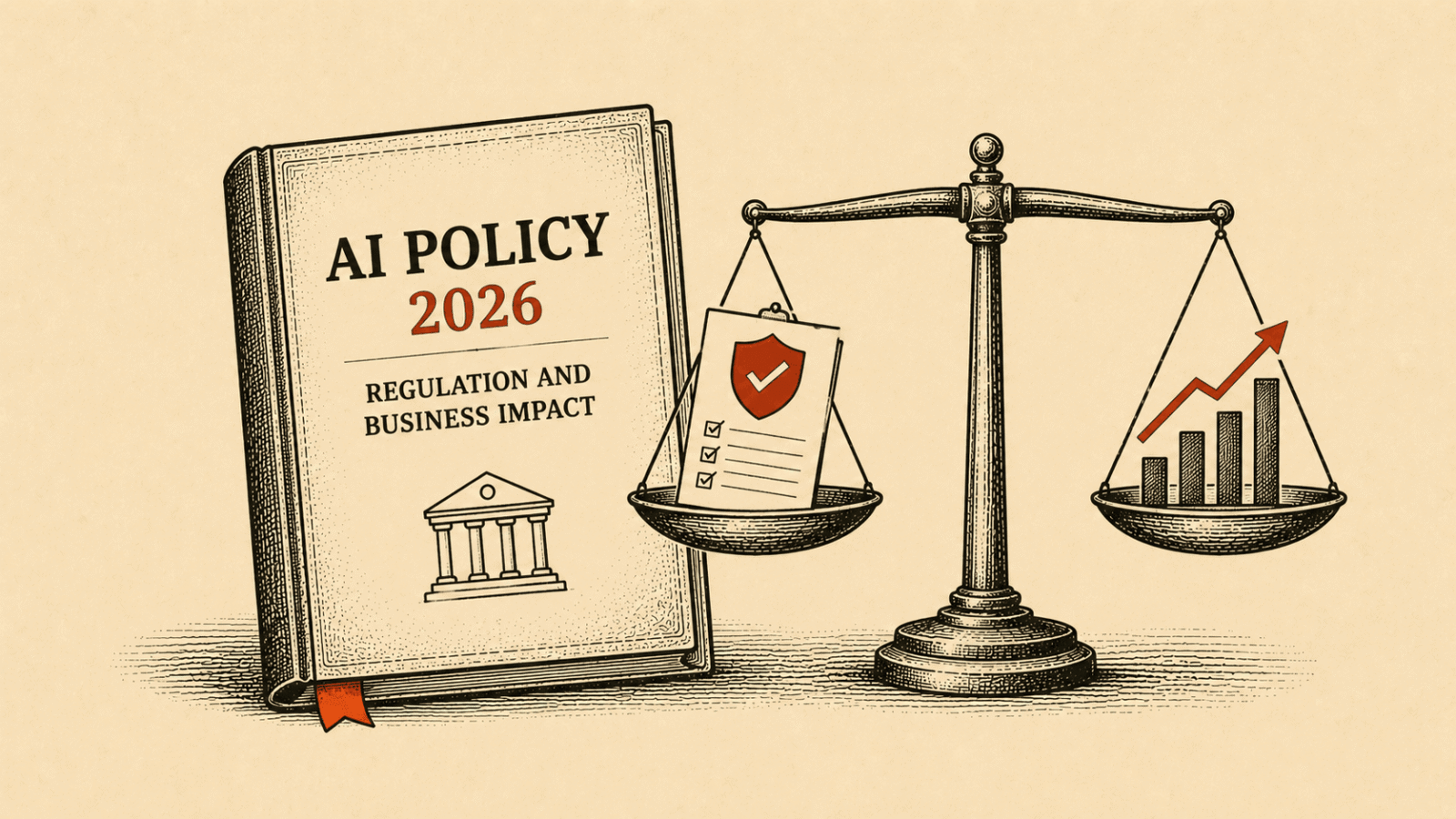
AI policy in 2026 is moving from broad principles into operational rules around transparency, synthetic media, high-risk systems, training data and enterprise governance.
Why It Matters
Companies now need to prove where AI is used, what data it touches, what users are told, and how risks are monitored after deployment.
Watch Next
Watch EU AI Act transparency enforcement, US state AI laws, copyright lawsuits over training data, and provenance systems for AI-generated media.
The Pulse
AI policy news 2026 is entering a new phase. The debate is no longer only about whether artificial intelligence should be regulated. It is about which AI systems must be labelled, which companies must disclose training data, which high-risk deployments need governance, and which AI products can survive legal scrutiny once regulators, courts and enterprise buyers start asking harder questions.
The clearest shift is coming from Europe. The European Commission has published transparency guidelines for providers and deployers of AI systems, with obligations under Article 50 of the EU AI Act applying from 2 August 2026. These rules cover cases where people interact directly with AI systems, are exposed to deepfakes, or encounter AI-generated content on matters of public interest without human review or editorial control. [European Commission AI Act transparency guidelines]
In the United States, the story is more fragmented. Federal policy is moving through executive action, standards and agency guidance, while states such as California and Colorado are building their own disclosure, transparency and high-risk AI rules. At the same time, lawsuits over scraping, training data and licensing are turning AI policy into a boardroom issue rather than a public-policy side debate. [California AI Transparency Act] [Colorado AI consumer protections law]
Core Significance
Why it matters:
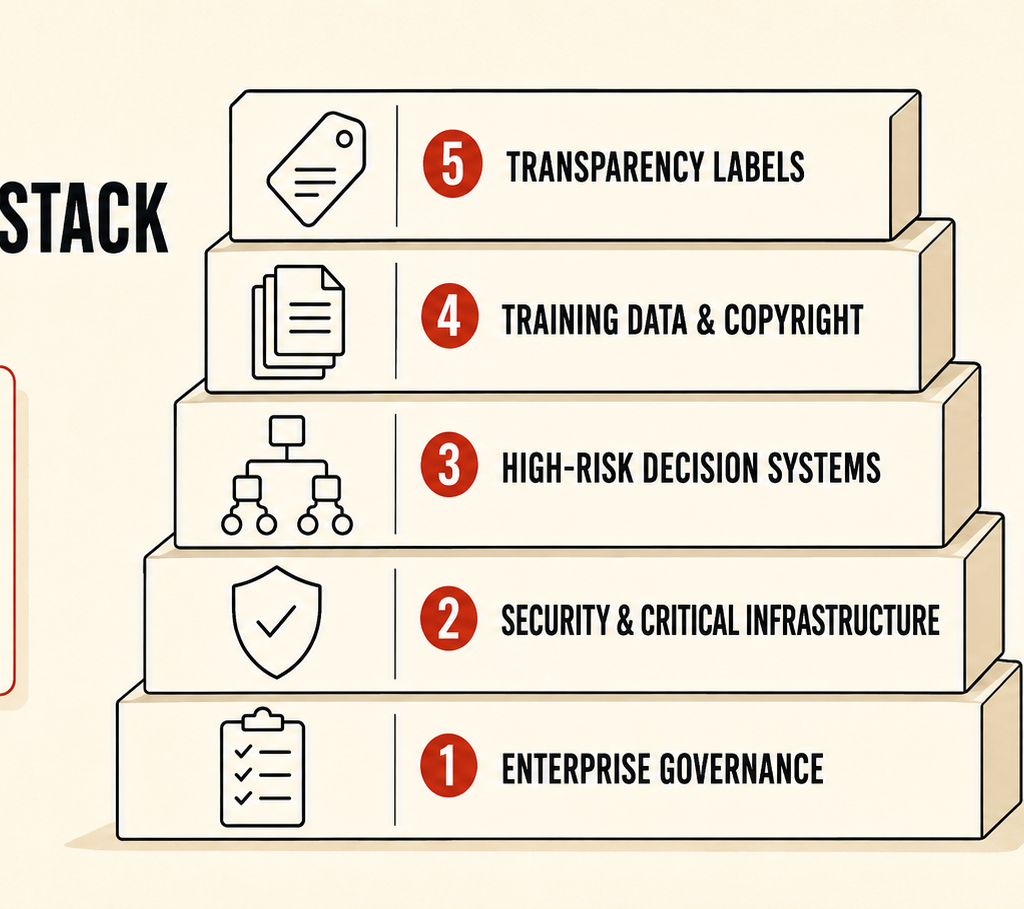
- AI policy is moving from principles to operating rules: Companies are no longer being asked only to publish responsible AI principles. They are being asked to label AI-generated content, inform users when they interact with AI, assess high-risk systems, manage training-data questions, and prove that governance exists inside real workflows.
- Transparency is becoming the first enforcement layer: The EU AI Act transparency obligations require providers and deployers to help people recognise when they are interacting with AI or when content has been generated or manipulated by AI. That makes disclosure, marking and labelling the practical first step in AI compliance. [European Commission code of practice on AI-generated content]
- Legal risk is shifting from model labs to every business using AI: Copyright, scraping, privacy, discrimination, deepfakes, biometric categorisation and automated decision systems are now part of the same policy conversation. That means AI governance is not only a concern for OpenAI, Google, Anthropic, Meta or xAI. It is becoming a requirement for banks, media companies, employers, retailers, schools, healthcare companies and government contractors.
Deep Context: What changed in AI policy in 2026
The EU is setting the pace because its AI Act is now moving from text into implementation. The Commission’s July 2026 transparency guidelines clarify which providers and deployers must comply, what counts as an interactive AI system, and when AI-generated or manipulated content must be marked. The practical message is simple: companies cannot rely on vague disclaimers once their AI systems touch users, media, public-interest content or deepfake-like outputs. [European Commission transparency obligations]
The voluntary Code of Practice on marking and labelling AI-generated content is also important because it gives companies a pathway to prepare before enforcement pressure rises. The Commission says the code supports compliance with the transparency obligations that apply from 2 August 2026, including cases involving deepfakes and AI-generated or manipulated public-interest text. [European Commission AI-generated content code]
Meta’s decision to sign the EU AI Act Code of Practice on Transparency of AI-Generated Content shows how the policy pressure is already affecting large platforms. Meta framed the move around identifying photorealistic AI-generated media and building interoperable approaches through groups such as C2PA, while also warning that too many labels could create confusion rather than clarity. [Meta EU AI Act transparency code]
In the United States, California has become one of the clearest examples of state-level AI transparency policy. The California AI Transparency Act applies to certain publicly accessible generative AI systems with more than 1 million monthly visitors or users in the state, and requires covered providers to make an AI detection tool available at no cost for covered image, video and audio content. [California AI Transparency Act text]
Colorado is important for a different reason. Its AI consumer-protection law focuses on high-risk artificial intelligence systems and algorithmic discrimination, making it one of the most watched state attempts to regulate AI used in consequential decisions. Even where timelines or amendments shift, the policy signal is clear: employment, credit, education, housing and similar decision systems are moving into the regulatory spotlight. [Colorado SB24-205 AI consumer protections]
Federal policy is less centralized, but NIST remains a core reference point for enterprise AI governance. The NIST AI Risk Management Framework is still the most important US voluntary AI governance baseline, and NIST has continued extending the framework into generative AI and critical infrastructure contexts. [NIST AI Risk Management Framework]
The courts are becoming the other major AI policy venue. Reuters reported on 31 July 2026 that a Manhattan federal judge largely rejected Perplexity’s attempt to dismiss Reddit’s lawsuit over alleged data scraping, allowing core claims to proceed. Reddit has licensed content to OpenAI and Google, which makes the dispute part of a broader policy question: when does AI data access need a license, and when is open-web scraping legally defensible. [Reuters Reddit Perplexity lawsuit]
As covered in our AI copyright lawsuits tracker, training-data disputes are now one of the most important forces shaping AI business strategy. A model can be technically strong, but if its data supply chain creates litigation, licensing or platform-access risk, the business case changes quickly.
The policy fight is becoming a business architecture problem
The biggest misunderstanding about AI policy is that it sits outside the product. In practice, policy is now becoming part of product architecture. A chatbot may need interaction disclosure. A video model may need watermarking or provenance. A hiring tool may need bias-risk controls. A financial AI system may need model governance, audit trails and explainability.
That is why AI policy now overlaps with security, product management, legal, data engineering and marketing. A company cannot solve the problem with a single compliance memo. It needs an inventory of where AI is used, what data it touches, what outputs it creates, who sees those outputs, and which jurisdiction’s rules apply.
As covered in our AI governance gap analysis, the core risk is not only that regulation is moving slowly. It is that companies are deploying AI faster than their internal controls can track.
Data Insights
By the numbers:
All figures below come from official policy documents, government sources, company announcements and named reporting. AI policy deadlines can shift, so businesses should verify final obligations by jurisdiction before making compliance decisions.
- 2 August 2026 is the key EU AI transparency date: The European Commission says Article 50 transparency obligations under the AI Act apply from 2 August 2026, covering direct AI interactions, deepfakes, certain AI-generated public-interest content, emotion recognition and biometric categorisation disclosures. [European Commission Article 50 transparency guidelines]
- 27 July 2026 was the initial EU code signatory deadline: The AI Office encouraged providers and deployers to submit signature forms by 27 July 2026 to be included in the initial list of signatories before the 2 August 2026 application date. [European Commission code signature FAQ]
- California’s transparency threshold targets large public generative AI systems: The California AI Transparency Act applies to certain public GenAI systems with more than 1 million monthly visitors or users in California and requires a free AI detection tool for covered media outputs. [California AI Transparency Act]
- NIST is moving AI governance into critical infrastructure: NIST’s AI Risk Management Framework remains the core US voluntary framework, and NIST released a concept note in April 2026 for an AI RMF profile focused on trustworthy AI in critical infrastructure. [NIST AI RMF]
Table 1: Major AI policy signals in 2026
| Policy signal | Jurisdiction | What changed | Business impact |
| AI Act transparency obligations | European Union | Article 50 obligations apply from 2 August 2026 | Chatbots, deepfakes and public-interest AI content need clearer disclosure workflows |
| AI-generated content code | European Union | Voluntary code gives providers and deployers a practical path to marking and labelling | Large platforms and AI vendors need interoperable labelling standards |
| California AI Transparency Act | California | Large public GenAI systems face detection-tool and provenance obligations | Consumer-facing AI media systems need traceability and detection planning |
| Colorado high-risk AI law | Colorado | High-risk AI systems and algorithmic discrimination move into state consumer protection law | Employment, credit, housing and education tools face governance pressure |
| NIST AI RMF and critical infrastructure profile | United States | Voluntary risk framework expands into generative AI and infrastructure contexts | Enterprises get a practical governance baseline even without one federal AI law |
| Reddit versus Perplexity data-scraping case | United States | Core data access and scraping claims were allowed to proceed | AI companies face rising pressure to license or justify training and retrieval data access |
Table 2: AI policy impact by business function
| Business function | Main AI policy risk | Required response | Why it matters |
| Marketing and media | AI-generated images, video, audio and public-interest content | Labels, provenance, editorial review and deepfake controls | Unlabelled synthetic content creates trust and regulatory risk |
| Product teams | Chatbots, agents and user-facing AI features | User notices, logs, fallback paths and human escalation | AI disclosure becomes part of user experience design |
| Legal and compliance | Training data, copyright, scraping and licensing | Vendor diligence, source tracking and contract review | Model access can become a litigation or procurement risk |
| HR and finance | High-risk AI decisions involving people | Bias testing, explainability, audit trails and appeal paths | Automated decisions can trigger discrimination and consumer protection rules |
| Security teams | AI-enabled cyber misuse and model vulnerabilities | Threat modelling, red teaming and AI incident response | AI can strengthen security while also scaling attacks |
| Data teams | Personal data, residency and AI system records | Data maps, retention controls and model-use inventories | AI governance fails when nobody knows where data travels |
The Business Case: How companies should respond to AI policy news
The starting point should not be a legal memo. It should be an AI inventory. Companies need to know where AI is used, which teams own it, which vendors supply it, what data flows through it, what outputs it creates, and whether those outputs reach customers, employees, regulators or the public.
The second step is separating low-risk productivity use from higher-risk deployment. A private summarisation tool for internal notes does not create the same policy exposure as an AI hiring screener, credit model, medical triage assistant, customer-service chatbot or synthetic video tool used in public campaigns.
The third step is building disclosure into product design. If a user is directly interacting with an AI system, or if a company publishes synthetic media, the disclosure should not be an afterthought pasted into a footer. It should be part of the product experience, content workflow and approval checklist.
The fourth step is vendor diligence. Enterprises should ask AI vendors which laws they support, how they handle training data, whether outputs include provenance signals, whether they support audit logs, how they respond to takedown claims, and whether they can document model updates that affect compliance.
For regulated industries, the policy issue is even sharper. Banks, insurers, healthcare providers and government contractors need to treat AI governance as part of risk management, not as a marketing or innovation project. As covered in our AI finance regulation analysis, the question is not whether AI is useful in financial services. It is whether the institution can explain, monitor and defend the system once it affects real decisions.
Expert Nuance: The real AI policy gap is deployment visibility
The hardest AI policy problem in 2026 is not that companies lack principles. Most large firms already have responsible AI principles, acceptable-use policies and internal review committees. The harder problem is that many companies still do not have a live map of where AI is actually being used.
This matters because AI risk changes with context. The same model that is low-risk when drafting an internal email can become high-risk when screening job applicants, generating financial advice, creating synthetic political content, summarising medical records or controlling access to essential services.
Policy therefore shifts the burden from model capability to deployment accountability. Regulators are less interested in whether a company calls its system generative AI, machine learning, automation or an agent. They are interested in what the system does, who it affects, what data it uses, and whether the company can prove reasonable controls existed before harm occurred.
This is why AI agents will become the next compliance test. Agentic systems can plan, call tools, access files, send messages and trigger workflows. A chatbot that answers a question is one kind of policy object. An agent that takes action across systems is another. As covered in our agentic AI enterprise analysis, the governance problem becomes harder once AI moves from output generation to operational execution.
Strategic Outlook
- Watch EU transparency enforcement first: The EU AI Act’s Article 50 obligations are the most immediate policy event because they turn labels, notices and deepfake disclosures into operational requirements for providers and deployers.
- Watch US state laws fill the federal gap: California, Colorado and other states are creating practical rules around transparency, discrimination, automated decisions and synthetic content while federal policy remains more fragmented.
- Watch copyright cases become AI policy by litigation: Training data lawsuits, scraping disputes and licensing deals are shaping the commercial rules of AI even before lawmakers settle the broader copyright question. As covered in our AI content licensing deals tracker, publishers and platforms are already creating a paid-data layer around AI.
- Watch provenance become infrastructure: Watermarking, C2PA-style credentials, AI labels and detection tools will not solve every problem, but they are becoming the compliance layer companies need before synthetic media can be used at scale.
- Watch AI security policy accelerate: The European Commission’s July 2026 plan on advanced AI and cybersecurity shows that policy is now moving beyond content and bias into model evaluation, cyber misuse, vulnerability discovery and incident resilience. [European Commission AI cybersecurity plan]
Key Question Answered
What is the biggest AI policy news in 2026?
The biggest AI policy news in 2026 is that AI regulation is moving from broad principles into operational compliance. The EU AI Act’s transparency rules are becoming active. US states are creating their own AI disclosure and high-risk system laws. NIST is extending AI risk management into generative AI and critical infrastructure. Courts are testing whether AI data scraping and training practices can continue without licenses or stronger consent.
For businesses, the main lesson is that AI policy is no longer only a legal department issue. It affects product design, marketing claims, security reviews, vendor contracts, data governance, hiring systems, customer support, content workflows and executive risk management.
The companies best positioned for this phase will not be the ones with the longest responsible AI statement. They will be the ones that can show where AI is used, what data it touches, what users are told, how outputs are reviewed, and how risks are monitored after deployment.
FAQ
What does AI policy news mean in 2026?
AI policy news in 2026 refers to regulatory, legal and governance developments affecting artificial intelligence, including the EU AI Act, US state AI laws, federal AI guidance, copyright lawsuits, training-data transparency, synthetic media labels and high-risk AI system controls.
What AI rules start in 2026?
The most important 2026 rule is the EU AI Act’s transparency obligations, which apply from 2 August 2026. These cover direct AI interactions, deepfakes, certain AI-generated public-interest content, emotion recognition and biometric categorisation disclosures. California also has AI transparency requirements for certain large public generative AI systems.
Why does the EU AI Act matter for US companies?
The EU AI Act matters for US companies because many AI providers, platforms and enterprise software companies serve European users or customers. If an AI system is placed on the EU market or affects EU users, companies may need to evaluate whether transparency, risk-management or deployment obligations apply.
Why are AI copyright lawsuits part of AI policy?
AI copyright lawsuits are part of AI policy because they help define how companies can collect, train on and reuse online content. If courts require more licensing, provenance or compensation, the cost structure of AI models and AI search products could change significantly.
How should companies prepare for AI policy changes?
Companies should start with an AI inventory, classify use cases by risk, add disclosure where users interact with AI, review vendor data practices, build audit logs for high-impact systems, and connect AI governance to legal, security, product and data teams.
The Takeaway
AI policy in 2026 is becoming practical, visible and operational.
The early AI policy debate focused on abstract questions: whether AI is dangerous, whether models should be open or closed, whether training on internet data is fair, and whether governments should regulate before the technology matures. Those questions still matter, but the center of gravity has moved.
The real 2026 question is whether companies can prove control. Can they show users when AI is involved. Can they identify AI-generated media. Can they explain high-risk decisions. Can they document data sources. Can they manage agentic workflows. Can they show regulators, courts and customers that AI systems are not running invisibly across the business.
That is why AI policy is now a business infrastructure story. The winners will not simply be companies that move fastest with AI. They will be companies that move fast while keeping enough visibility, governance and evidence to survive the policy layer now forming around the technology.