ChatGPT Enterprise (2026): Pricing, Features and 30 Deployments
What ChatGPT Enterprise really costs in public contracts, what it adds over ChatGPT Business, the security controls IT should check, and 30 named deployments.

What is ChatGPT Enterprise? ChatGPT Enterprise is OpenAI’s sales-negotiated version of ChatGPT for large organizations. It adds identity, security and compliance controls (SCIM, enterprise key management, role-based access, a Compliance API, data residency) on top of the ChatGPT Business plan, with longer context for everyday chat, an account team and custom legal terms. In 2026 it also bundles the ChatGPT Work agent and Codex, and it is billed as seats plus metered usage rather than a flat fee.
Our finding: OpenAI publishes no ChatGPT Enterprise price. The only firm prices on the public record come from government paperwork: OpenAI’s bid to Massachusetts priced seats at $13 falling to $7 per month by volume, Pennsylvania pays $25 per user per month, California State University’s Edu deal works out near $2 per user per month, and US agencies paid $1 per agency before moving to usage-only pricing at 50% off. The widely repeated “$60 per user, 150-seat minimum” has never been confirmed by OpenAI.
IT and procurement teams get asked three questions about enterprise ChatGPT: what does it cost, what do we get over the cheaper Business plan, and who has actually rolled it out at scale? OpenAI’s sales page answers none of them with a number, so we went to the documents that do: public contracts, procurement filings, university price lists, OpenAI’s help center and 30 named deployments. This guide is for buyers who have to defend a ChatGPT Enterprise contract to a CFO or a security review board.
Key findings
- No list price, but public contracts set a range. Massachusetts’ OpenAI bid runs $13 to $7 per concurrent seat per month (the Boston Globe reports $13 falling to $9); Pennsylvania pays $25; CSU’s Edu deal is about $2. The commercial “$60 per user” figure is vendor-reported only †.
- Enterprise is now seats plus credits. Advanced models, agents and Codex burn metered credits or tokens on top of the seat. Since April 2026, Enterprise can add Codex-only seats with no fixed fee.
- The Business plan caps at 200 seats for workspaces created since August 24, 2026. Past that, or if you need SCIM, residency or a Compliance API, you are an Enterprise buyer.
- Education dominates disclosed seats. 18 of our 30 named deployments disclose a count, totaling about 1.39 million seats or eligible users; education accounts for 66% of them.
- Licensed is not used. CSU had activated about 48% of eligible accounts after more than a year; San Francisco State about 22%.
What ChatGPT Enterprise is in 2026
ChatGPT Enterprise launched in August 2023 as OpenAI’s first business tier (VentureBeat). By 2026 it sits at the top of a ladder of work plans: Business (formerly Team, renamed on August 29, 2025), Enterprise, and Edu, a near-identical variant for universities and school systems (OpenAI help center).
An Enterprise seat now goes well past a chat window: OpenAI sells it as one workspace bringing together ChatGPT, the ChatGPT Work agent, Codex and dots (OpenAI). Practically, that means three seat types an IT team can mix:
- Standard ChatGPT seats, with “virtually unlimited” messages on base models and metered credits for advanced models, agents and deep research (OpenAI help center).
- Codex-only seats, added on April 2, 2026, with no fixed per-user fee and usage billed on tokens (OpenAI).
- Edu seats for institutions, which moved to subscription plus credits on July 1, 2026 (University of Maryland).
Most organizations contract directly with OpenAI. Since November 9, 2026, ChatGPT Enterprise is also listed in AWS Marketplace, where eligible spend counts toward an organization’s AWS commitments (OpenAI). One trade-off: AWS-bought workspaces currently get inference residency in the US only (OpenAI help center).
ChatGPT Enterprise pricing: what organizations actually pay
What OpenAI publishes
Very little. The ChatGPT Enterprise pricing page says “custom pricing” and asks buyers to contact sales. It does confirm that Enterprise can be billed on credits or on tokens in US dollars, that invoicing and volume discounts are available, and that nonprofits can get up to 75% off Business or Enterprise (OpenAI pricing). Token-based billing is not offered for Edu or ChatGPT for Healthcare (OpenAI help center).
The cheaper tier is fully public. ChatGPT Business Standard costs $20 per user per month billed annually or $25 monthly, after OpenAI cut the annual price from $25 on April 2, 2026. Business Premium, with five times the usage and no five-hour limit, costs $100 annually or $125 monthly (OpenAI).
The public-sector price record
Government buyers publish what they pay, which makes them the best ChatGPT Enterprise pricing benchmarks available.
| Buyer | Plan | What they pay | Term and notes |
|---|---|---|---|
| Massachusetts (OpenAI bid) | Enterprise (“Enterprise Core”) | $13 per seat per month at 10,000 seats, $11 at 20,000, $9 at 30,000, $7 at 40,000 | Concurrent seats; advanced models metered in credits |
| Massachusetts (as reported) | Enterprise | $13 per worker per month, falling to $9 as agencies join | Three-year contract, billed on workers using it |
| Pennsylvania | Enterprise | $25 per user per month for 721 users (about $216,000 a year) | Grew from a 175-person pilot |
| California State University | Edu | About $17 million for the first term for about 523,000 users; renewed for three years at $13 million a year | Works out near $2 per user per month on renewal |
| University of Maryland | Edu (internal chargeback) | $30, $100, $200 or $400 per seat per month with 500, 2,250, 4,750 or 9,750 credits | Credit billing from July 1, 2026 |
| US federal agencies (GSA OneGov) | Enterprise | $1 per agency for one year, plus 60 days of unlimited advanced models | Announced August 6, 2025 |
| US government (OneGov 2.0) | Enterprise | No seat or platform fee; 50% off token-based usage | From October 1, 2026, for 27 months; federal, state, local and tribal |
| Nonprofits | Business or Enterprise | Up to 75% off | OpenAI list discount |
Sources: Massachusetts bid document published by WBUR; Boston Globe; Philadelphia Inquirer; GovTech; University of Maryland; GSA, 2025; GSA, 2026.
Two conflicts are worth stating plainly. In Massachusetts, OpenAI’s best-and-final bid table runs down to $7 at 40,000 seats, while the Boston Globe reported the contract as $13 falling to $9. The signed rate may differ from the bid, so treat $7 as the bid floor and $9 as the reported contract floor. At CSU, GovTech describes the roughly $17 million first term as one year, while a CSU student association paper says it covered 18 months (February 2025 to July 2026). That puts first-term cost between about $1.80 and $2.70 per user per month; the renewal, at about $2, is the cleaner number.
The “$60 per user, 150 seats” figure
Search for ChatGPT Enterprise pricing and you will find the same numbers repeated: about $60 per user per month, a $45 to $75 range, a 150-seat minimum and annual prepayment, which implies a floor near $108,000 a year. A recent cost-management vendor guide repeats them and says plainly that OpenAI has never confirmed any of them (CloudZero) †. We found no OpenAI document that states a seat price or a seat minimum for Enterprise.
For a broader benchmark, Vendr’s purchase data puts the median OpenAI buyer at $108,600 a year across 186 purchases, but that covers API and ChatGPT contracts together, not Enterprise seats alone (Vendr).
Credits: where the second half of the bill comes from
The Massachusetts bid is the clearest public look at how usage is metered. Base chat sits inside the seat; advanced work burns credits (OpenAI calls them AMUs in that document): 10 per Thinking message, 50 per Pro message, 30 per agent task, 50 per deep research task, 5 per image and 5 per voice minute. OpenAI offered 60 days of unlimited credits at launch and estimated a typical policy analyst would use 3,500 to 5,000 a year (WBUR).
University price lists suggest what a credit is worth. Duke caps funded Premium Edu users at 5,000 credits, “approximately $200,” a month (Duke OIT), which implies about 4 cents a credit. Codex usage on credit-based Enterprise and Edu workspaces moved to a token-based rate card from April 23, 2026 (OpenAI help center). On token-billed agreements, even the fast Instant model is billable (OpenAI help center).
What this means: the seat price is now only half of the negotiation. Ask for the credit or token rate card that governs your workspace, an included-usage allowance, overage caps and admin spend limits in writing. Our breakdown of enterprise AI deployment cost covers the training, integration and governance costs that sit on top.
ChatGPT Enterprise vs Business: what the extra money buys
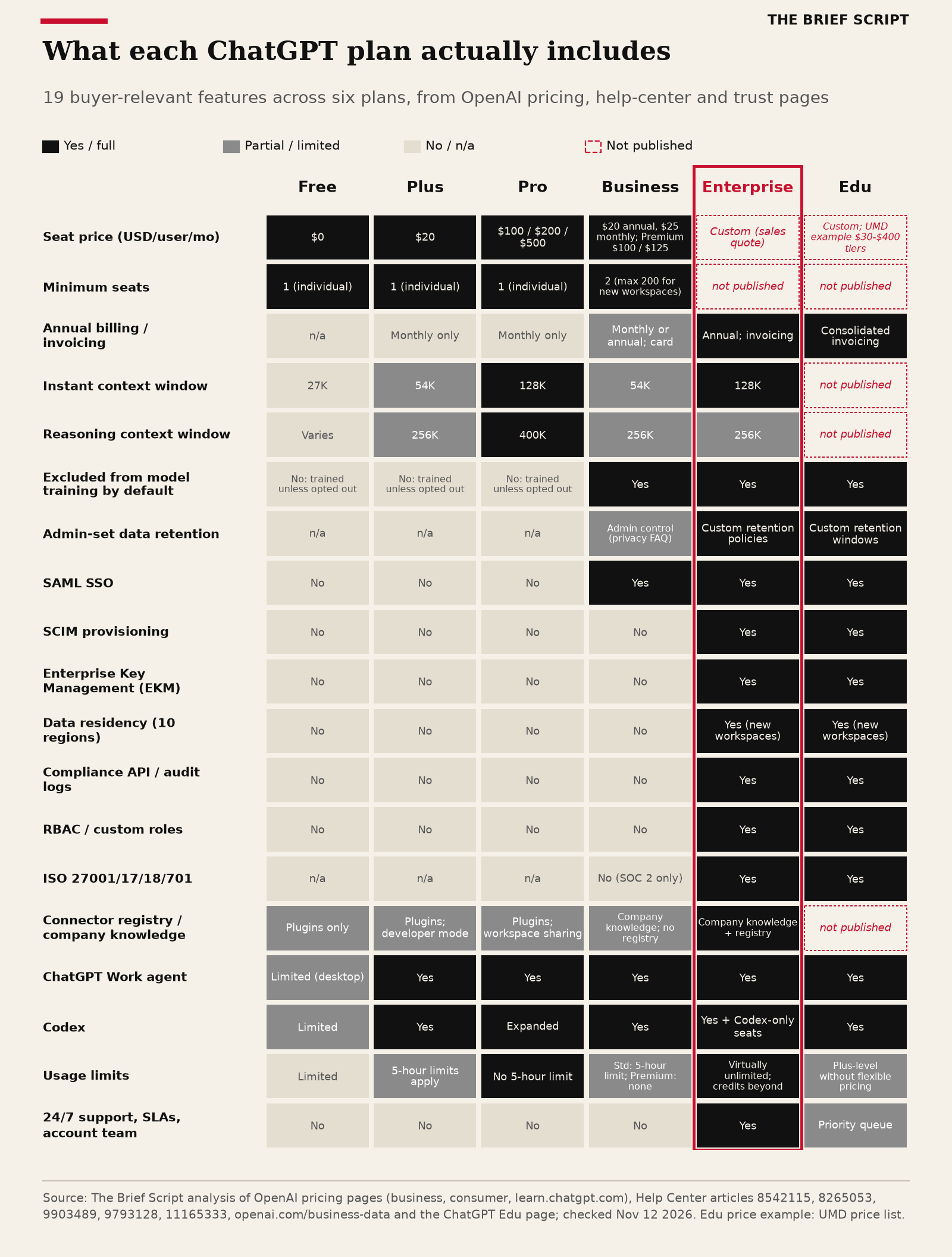
The comparison most buyers actually face is ChatGPT Enterprise vs Business, and most of the ChatGPT Enterprise features that matter to IT are administrative rather than visible to end users. On OpenAI’s own comparison table, both plans exclude business data from model training by default, support SAML SSO, carry SOC 2 Type 2, and include ChatGPT Work, Codex, company knowledge and deep research (OpenAI pricing). The differences are concentrated in five areas.
Scale. Business needs at least two seats and, for workspaces created from August 24, 2026, allows at most 200 paid seats; older workspaces keep their previous cap (OpenAI help center). That cap is the most common reason a growing company is forced into the Enterprise conversation.
Context. Enterprise gives the Instant model a 128,000-token context window against 54,000 on Business. Reasoning models get 256,000 tokens on both, so long-document analysis with Thinking is not an Enterprise-only advantage (OpenAI pricing).
Identity and access. SCIM provisioning, role-based access control with granular GPT permissions, IP allowlisting, a global admin console, Microsoft Intune support for iOS and a connector registry are listed as Enterprise only.
Security and compliance. Enterprise key management, the Compliance API for audit logs, data residency and the ISO 27001, 27017, 27018 and 27701 certifications are Enterprise only.
Support and contract. Enterprise adds 24/7 priority support, SLAs, custom legal terms and, for eligible customers, OpenAI AI advisors.
| Requirement | Business | Enterprise |
|---|---|---|
| Fewer than 200 users, self-serve | Yes | Not needed |
| Over 200 users (new workspaces) | No | Yes |
| SCIM user provisioning | No | Yes |
| Customer-managed keys (EKM) | No | Yes |
| Data stored in a specific region | No | Yes (10 regions) |
| Audit logs to a SIEM (Compliance API) | No | Yes |
| ISO 27001 family certification | No (SOC 2 only) | Yes |
| Contractual SLAs | No | Yes |
One grey area: OpenAI’s pricing page lists custom data retention as an Enterprise feature, while its privacy FAQ says Business workspace admins can also control retention (OpenAI). If retention policy is your deciding factor, get the answer in writing.
What this means: stay on Business if you have under 200 users, manage accounts by hand and have no residency or audit-log requirement. Move to Enterprise when any one of SCIM, EKM, residency, the Compliance API or SLAs is a hard requirement, because none of them can be bolted onto Business.
ChatGPT Enterprise security and compliance
ChatGPT Enterprise security reviews usually turn on five questions.
Is our data used for training? No. Business, Enterprise and Edu data is excluded from model training by default (OpenAI pricing).
Where is it stored and processed? Enterprise and Edu customers can store data at rest in 10 regions: Australia, Canada, Europe (EEA and Switzerland), India, Japan, Singapore, South Korea, the UAE, the UK and the US. Inference residency, which keeps processing in-region, is offered in three: the EU, the US and the UAE. UAE inference does not yet support ChatGPT Work or image generation. Residency is available to new Enterprise and Edu customers at no extra cost, and some metadata, billing, login and integration data can sit outside the chosen region (OpenAI help center). The UK Ministry of Justice was the first user of UK data residency (The Register).
How long is it kept? Enterprise admins set retention, and deleted conversations are removed within 30 days unless the law requires otherwise (OpenAI).
Can we monitor it? The Compliance API gives security teams programmatic access to workspace logs for their own monitoring and audit tools; it is available on Enterprise and Edu only (OpenAI learn).
Is it HIPAA compliant? OpenAI’s business data page offers a business associate agreement for ChatGPT for Healthcare and the API platform; standard Enterprise is not listed, so confirm BAA coverage before any patient data goes in (OpenAI).
Three gotchas surface late in most rollouts. There is no self-service data export in Enterprise workspaces. Users on a verified company domain must merge or export their personal ChatGPT workspace within seven days. And a ChatGPT Enterprise workspace is a separate membership from your OpenAI API organization, so the two are governed and billed apart (OpenAI help center). Admins should also know that the top Pro model (GPT-6 Astra) is off by default in Enterprise and Edu and must be switched on through model access controls (OpenAI help center).
Enterprise ChatGPT security is also defensive, because staff already use consumer AI tools. OpenAI’s BBVA case study says the bank gave employees secure enterprise-grade access “rather than allowing unauthorized experimentation with consumer AI tools” (OpenAI). Our guide to shadow AI covers how to find and govern that usage.
Who has deployed ChatGPT Enterprise: 30 named deployments
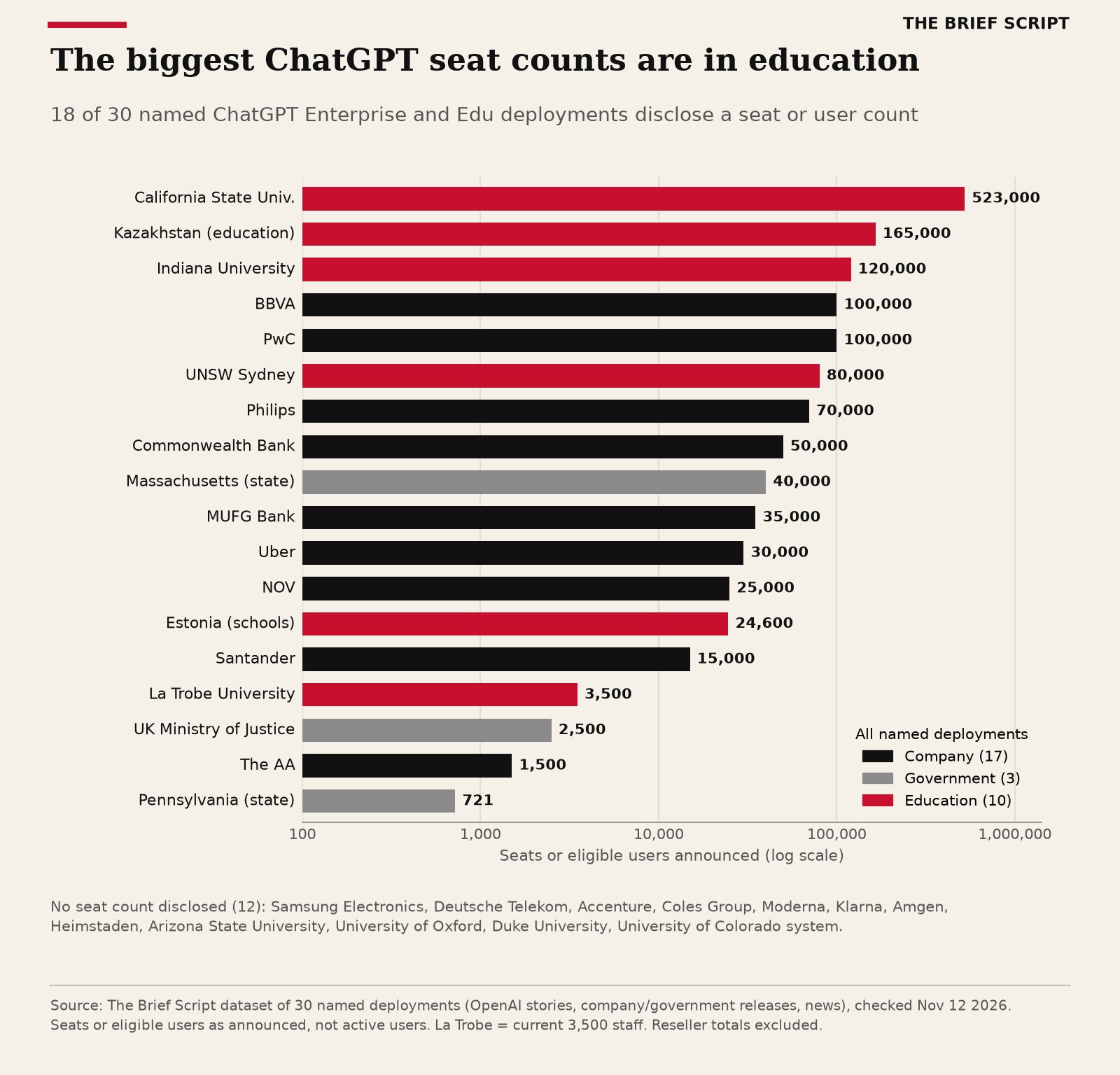
We collected 30 named ChatGPT Enterprise and Edu deployments: 17 companies, 3 governments and 10 education systems. Eighteen disclose a seat or eligible-user count, totaling about 1.39 million, with a median of 37,500. Education accounts for 916,100 of those seats, or 66%, largely because one customer, CSU, covers about 523,000 students and staff.
| Organization | Sector | Plan | Seats or users announced | Source |
|---|---|---|---|---|
| California State University | Higher education | Edu | 460,000+ students and 63,000+ staff | OpenAI |
| Kazakhstan education system | National education | Edu | 165,000 free licences | DKNews |
| Indiana University | Higher education | Edu | 120,000 | WRTV |
| BBVA | Banking | Enterprise | About 100,000 using | OpenAI |
| PwC | Professional services | Enterprise | 100,000+ licences | TechCrunch |
| UNSW Sydney | Higher education | Edu | 80,000+ (staged) | OpenAI |
| Commonwealth Bank of Australia | Banking | Enterprise | Nearly 50,000 | OpenAI |
| Massachusetts | State government | Enterprise | Nearly 40,000 (phased) | Mass.gov |
| MUFG Bank | Banking | Enterprise | About 35,000 | OpenAI |
| Uber | Technology | Enterprise (ChatGPT Work) | 30,000+ | OpenAI |
| NOV | Energy | Enterprise | 25,000+ | NOV |
| UK Ministry of Justice | Government | Enterprise | 2,500 | The Register |
| Pennsylvania | State government | Enterprise | 721 | Inquirer |
The remaining disclosed counts are Philips (70,000 employees in an AI-literacy programme, not a stated licence count) (OpenAI), Estonia’s schools (20,000 students and 4,600 teachers) (OpenAI), Santander (nearly 15,000, with a target of 30,000) (Santander), La Trobe University (3,500 staff now, 45,000 planned) and The AA (1,500 licences) (The AA).
Twelve deployments give no count. Samsung Electronics made ChatGPT Enterprise and Codex available to all employees in Korea and its global Device eXperience division, which OpenAI calls one of its largest enterprise deployments to date (OpenAI). Accenture is equipping “tens of thousands” of IT professionals (CNA/Reuters). Deutsche Telekom, Coles, Moderna, Klarna, Amgen, Heimstaden, Arizona State, Oxford, Duke and the University of Colorado system complete the list. Separately, Korean reseller LG CNS says about 30,000 employees at its client companies use ChatGPT Enterprise through it (Edaily); we exclude that aggregate from the totals.
How fast is enterprise ChatGPT growing?
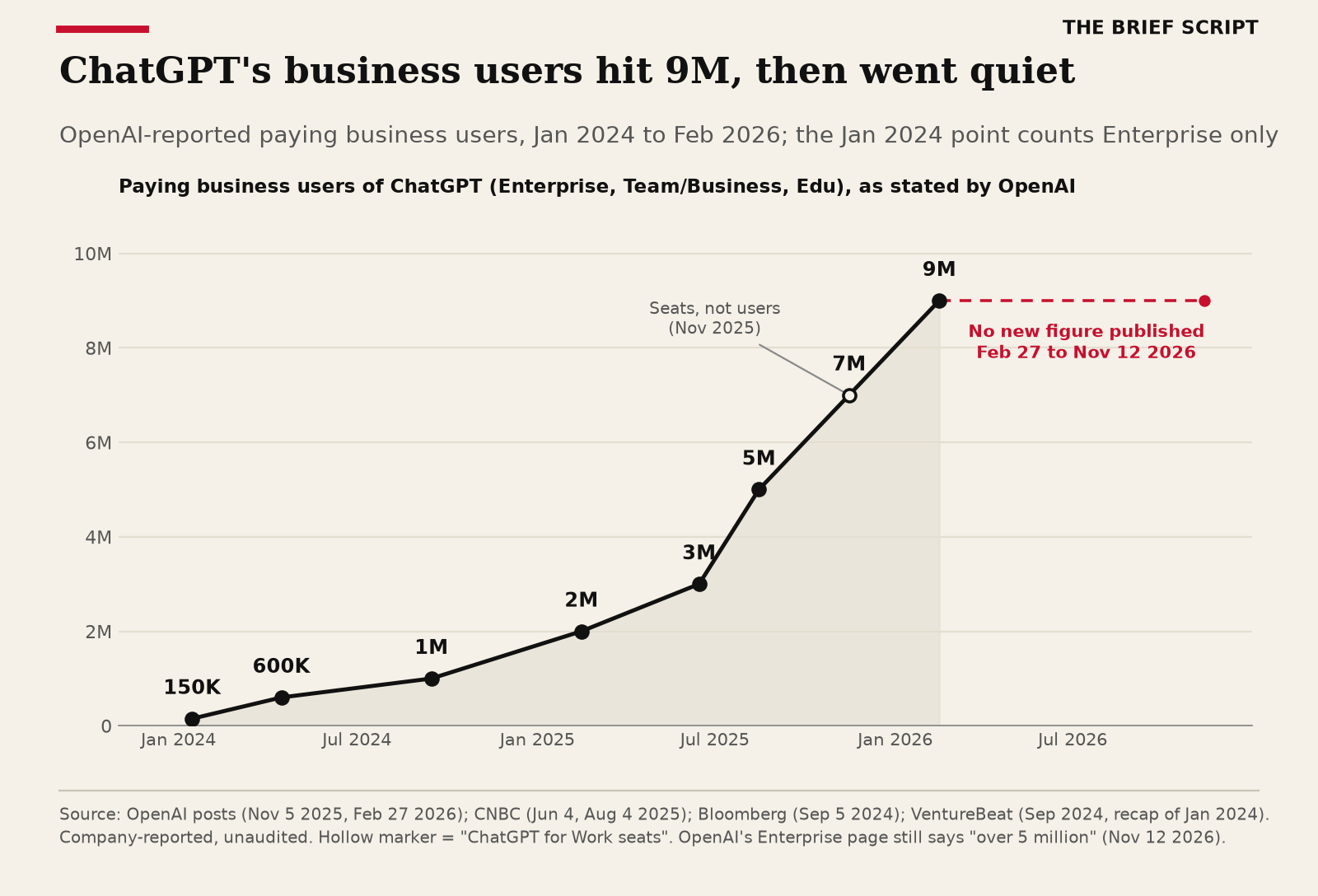
OpenAI’s stated business user count rose from 150,000 ChatGPT Enterprise users across 260 organizations in January 2024 (VentureBeat) to more than 9 million paying business users by February 27, 2026 (OpenAI). In November 2025 OpenAI said Enterprise seats had grown ninefold in a year (OpenAI). The series mixes metrics, and OpenAI has repeated the 9 million figure since February without publishing a higher one. Its own Enterprise page still says “over 5 million” (OpenAI).
Licensed vs used: the activation gap
Seat announcements count licences or eligible people, not active users, and the few organizations that report usage show a real gap.
- California State University: about 250,000 accounts activated by the end of the spring 2026 semester, out of about 523,000 eligible, or roughly 48% (GovTech).
- San Francisco State, one CSU campus: about 22% activation (same source).
- Arizona State: about 10,000 students and 6,400 employees had taken up licences by late November 2025, against an enrollment of roughly 180,000 (Business Times/Bloomberg).
- Heimstaden: half of employees were using ChatGPT Enterprise two to three months after launch (OpenAI).
Enablement helps. OpenAI’s BBVA story reports active usage above 70% among deployed employees, though the page labels the metric both monthly and weekly (OpenAI). MUFG made training mandatory before anyone got an account and reports 100% training completion (OpenAI).
What this means: do not buy seats for everyone on day one. Massachusetts negotiated a model where it pays for workers who actually use the assistant. Ask for concurrent or active-user pricing, a ramp schedule, or true-down rights at renewal, and tie expansion to measured adoption.
2026 changes buyers should know
| Date (2026) | Change |
|---|---|
| Feb 13 | Massachusetts announces ChatGPT for its executive branch, the first statewide deployment |
| Feb 27 | OpenAI reports more than 9 million paying business users |
| Apr 2 | Business annual price cut from $25 to $20; Codex-only pay-as-you-go seats on Business and Enterprise |
| Apr 23 | Token-based Codex rate card applies to all credit-based Enterprise and Edu workspaces |
| Jun 24 | New pay-as-you-go Codex seats no longer available on Business |
| Jul 1 | Edu moves to subscription plus credits |
| Aug 24 | New Business workspaces capped at 200 paid seats; Premium seats go live the next day |
| Oct 1 | GSA OneGov 2.0: no seat fee, 50% off token usage for government buyers |
| Nov 9 | ChatGPT Enterprise available in AWS Marketplace |
| Dec | Business plan usage shares one limit across ChatGPT and Codex |
Sources: OpenAI, OpenAI help center, OpenAI pricing and sources above.
How to buy and negotiate ChatGPT Enterprise: a checklist
- Benchmark with public prices. Bring the Massachusetts, Pennsylvania and CSU figures; they are the only verified numbers in the market.
- Pick the seat model. Named, concurrent or active-user billing; Massachusetts shows concurrent is negotiable.
- Get the rate card in writing. Confirm whether your workspace bills on credits or tokens, the price per unit, what is included and what triggers overage.
- Cap spend. Require admin-level and per-user spend limits and alerts before launch.
- Decide residency at signing. Residency is offered to new workspaces only, and AWS Marketplace workspaces are limited to US inference.
- Pin down retention and logging. Set retention windows and connect the Compliance API to your SIEM and DLP tools.
- Set model defaults. Decide which advanced models and agents are on by default, since they drive credit burn.
- Plan for exit. With no self-service export, negotiate export assistance.
- Check for discounts. Nonprofits can get up to 75% off; government buyers should start from OneGov terms.
- Use your cloud commit. If you have an AWS commitment, compare a Marketplace private offer against a direct contract.
Alternatives to compare
ChatGPT Enterprise is not the only enterprise assistant priced on seats plus usage. Claude Enterprise lists a public price of $20 per seat per month billed annually, with a 20-seat minimum and usage billed at API rates (Anthropic), which makes it the easiest competitor to model. Microsoft 365 Copilot is the default comparison for organizations already standardized on Microsoft.
We cover those head-to-heads separately: ChatGPT vs Claude for business, Microsoft Copilot vs ChatGPT, and our guide to choosing an enterprise AI platform.
Methodology
Pricing evidence. Every ChatGPT Enterprise or Edu price we could tie to a public document: procurement filings, government releases, news on public contracts and university price lists. Vendor estimates appear only as reported figures, marked †.
Features. Plan features come from OpenAI’s pricing page, help center and education pages. Where Edu details are not published separately, we mark them “not published” rather than assume Enterprise values.
Deployments. Each of the 30 has a named organization and a public source: 14 OpenAI stories or announcements, 9 from the organizations themselves and 7 independent news reports. Seat counts are as announced, not active users. The LG CNS reseller aggregate is excluded from totals.
Verification. Every source was opened and checked on November 12, 2026. One deployment, Heimstaden, previously carried an unconfirmed headcount from a single low-authority site; OpenAI’s own case study confirms the deployment but gives no headcount, so we list it without one. We did not use three widely circulated figures that lack a primary source: a 200,000-employee count for Deutsche Telekom, a 270,000 figure for Samsung and a 500,000-licence figure for India.
Caveats. OpenAI changes plans often, its user series mixes metrics, and published deployments favor success stories.
FAQ: ChatGPT Enterprise
How much does ChatGPT Enterprise cost?
OpenAI does not publish a price. Public contracts show $13 to $7 per seat per month in OpenAI’s Massachusetts bid ($13 to $9 as reported), $25 in Pennsylvania and about $2 for CSU’s Edu deal. The commercial “$60 per user” estimate is unconfirmed †. Advanced usage is billed on top in credits or tokens.
Is there a minimum number of seats for ChatGPT Enterprise?
OpenAI does not publish one. A 150-seat minimum is widely reported but unconfirmed. ChatGPT Business, by contrast, requires at least 2 seats and allows at most 200 for workspaces created since August 24, 2026.
What is the difference between ChatGPT Enterprise vs Business?
Business is self-serve, costs $20 per user per month billed annually and caps new workspaces at 200 seats. Enterprise is negotiated and adds SCIM, key management, role-based access, the Compliance API, data residency, ISO 27001-family certifications, a 128K Instant context window (54K on Business) and SLAs.
Does OpenAI train on ChatGPT Enterprise data?
No. Business, Enterprise and Edu data is excluded from model training by default, and Enterprise admins control retention, with deleted chats removed within 30 days.
Is ChatGPT Enterprise HIPAA compliant?
OpenAI offers a business associate agreement for ChatGPT for Healthcare and its API platform. Standard ChatGPT Enterprise is not listed, so confirm BAA coverage with OpenAI before using patient data.
Where is ChatGPT Enterprise data stored?
New Enterprise and Edu customers can choose data residency in 10 regions (including the US, EU, UK, Japan, India and Australia) and inference residency in the EU, US or UAE, at no extra cost.