Robotic Process Automation in Healthcare (2026): 38 Deployments
What robotic process automation in healthcare actually delivers, from 38 named deployments: prior authorization, claims and denials, coding and GenAI results, vendor versus independent numbers, CMS-0057-F deadlines, costs and a CIO checklist.

What is robotic process automation in healthcare? Robotic process automation (RPA) in healthcare is software that performs rule-based administrative work the way a staff member would: logging in to payer portals, checking claim and authorization status, copying data between the EHR and other systems, and filling forms. Most hospital programs now pair those bots with machine learning, language models or AI agents that read documents and make narrow judgments, so the line between RPA and AI is blurring. The money sits in the revenue cycle: prior authorization, claims, denials, coding and patient access.
Our finding: we analyzed 38 named healthcare automation deployments published between 2020 and 2026. Results are real but uneven, and they shrink when someone other than the vendor reports them: the median headline improvement is 50% in vendor case studies (7 deployments) against 36% in independent sources (12).
Hospitals have plenty of automation pitches and little evidence they can take to a finance committee. The CAQH Index puts medical-industry administrative spend at $75.3 billion in 2025, with a further $21 billion still to save through more automation (CAQH). At the same time, federal prior authorization rules took effect on January 1, 2026, and payers are using automation of their own.
So instead of another list of things bots could do, we collected what health systems actually report: 38 deployments, the process each one targets, the tool behind it, the outcome claimed and, crucially, who published the number. This guide is written for hospital CIOs and revenue-cycle leaders deciding where to automate next.
Key findings (38 named deployments, sources checked November 11, 2026)
- Claims and prior auth lead: 10 deployments target claims, denials and appeals, and 8 target prior authorization. Back-office work (8), patient access (5), generative AI (3), coding (2) and utilization management (2) follow.
- Who says so matters: 23 results come from independent sources (health systems on record in trade press, associations or a peer-reviewed journal) and 15 from vendor case studies. Five of the 23 independent rows are trade press repeating a vendor’s own figure, which we flag.
- Vendor numbers run higher: among deployments that report a percentage improvement, the vendor median is 50% (n=7) and the independent median is 36% (n=12). The samples are small and the metrics differ, so treat the gap as directional.
- The biggest dollar claims are system-wide: CommonSpirit’s CIO says AI and RPA are “probably generating north of $100 million” a year across 242 applications, while single-process wins tend to land between hundreds of thousands and a few million dollars.
- Hybrid is now the default: most recent deployments combine classic bots with machine learning, language models or agents. Pure screen-scraping RPA appears mainly in older back-office cases.
What RPA in healthcare is, and how it differs from AI and agents
Classic RPA follows fixed rules. A bot opens a payer portal, enters a member ID, reads the authorization status and writes it back to an Epic work queue. It decides nothing; it repeats what a person would click, around the clock. Mayo Clinic’s revenue-cycle team describes exactly this: bots that go out to websites “to status the claim or prior authorization request and bring that information back into Epic” (HFMA).
AI adds judgment on top. Machine learning can predict which denials are worth appealing; natural language processing can read a chart to suggest codes; a language model can draft an appeal letter. AI agents go one step further and carry a task across several steps with limited supervision, such as working a prior authorization through a payer portal and only escalating the hard cases. Our explainer on AI agents vs agentic AI covers that distinction in more depth.
| Classic RPA | AI / machine learning | AI agents | |
|---|---|---|---|
| What it does | Repeats fixed clicks and keystrokes | Classifies, predicts, reads or drafts | Plans and completes multi-step tasks |
| Typical healthcare job | Claim and auth status checks, data entry | Coding suggestions, denial triage, appeal drafts | End-to-end prior auth submission, patient calls |
| Breaks when | A portal or screen changes | Data drifts or a case is unusual | Goals, permissions or escalation rules are vague |
| Example in our dataset | Mayo Clinic in-house bots | WellSpan appeal-triage model | MUSC Health prior auth agents |
In practice the labels overlap. Luminis Health combined RPA and machine learning for clean claims and work queues; Auburn Community Hospital combined RPA, NLP and machine learning for coding (HFMA). That is why our dataset counts any named automation deployment in healthcare administration, not just pure RPA.
RPA use cases in healthcare, by process
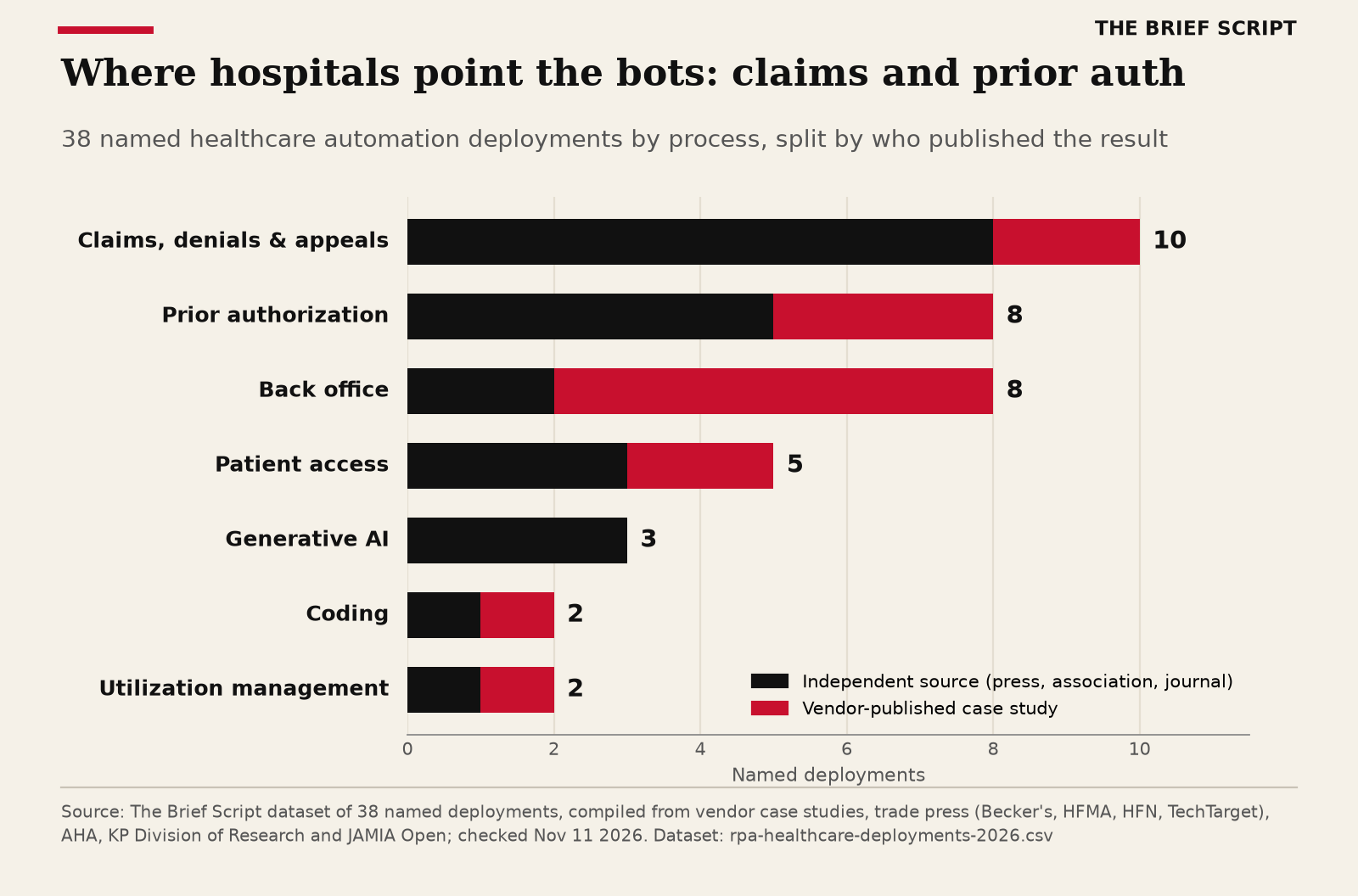
Back-office results come mostly from vendor case studies; claims and denials results come mostly from health systems speaking on the record.
Prior authorization
Prior authorization is the most crowded target, and for good reason. In the AMA’s latest survey, physicians report completing 40 prior authorizations a week on average, consuming 13 hours of physician and staff time, and 26% say prior authorization has led to a serious adverse event for a patient (AMA).
- Care New England used bots, built with Notable, to handle payer notifications when patients are admitted and to automate radiology prior authorization. Its revenue-cycle VP told HFMA the system cut authorization-related denials by 55% and turnaround times by 80%, saving 2,841 hours and $644,000 in avoided write-offs and expense (HFMA).
- MUSC Health said 40% of prior authorizations handled by its AI agents need no human involvement, and that a task that took about 30 minutes now takes about one (Becker’s).
- UNC Health‘s CIO reported $3 million to $4 million in savings and revenue from automated prior authorization (Becker’s).
- MultiCare Health System took a different route: a direct FHIR connection with Regence BlueShield, which answered 94% of requests in real time (TechTarget).
Claims, denials and appeals
This is where health systems speak most often on the record. Northwestern Medicine runs about 30 revenue-cycle automations on Microsoft Power Automate and Epic, processing roughly 400,000 tasks in fiscal 2026, work it equates to about 24 FTEs and roughly $1 million, with a three-person automation team (Becker’s). Mayo Clinic cut about 30 positions through attrition over two years and saved $700,000 in vendor costs using bots for claim statusing, duplicate denials and appeal letters (HFMA).
Appeals are the newest front. In HFMA’s January 2026 reporting, Nebraska Medicine cut staff time per appeal letter from 15 minutes to 8 to 10 minutes with AI drafting, while its overturn rate edged up from between 68% and 70% to between 71% and 72%. Kaiser Permanente reported a recovery rate about 15% higher with AI appeal writing, and Rush reduced some medical-necessity requests by 25% with an in-house bot (HFMA).
The only peer-reviewed result in our set comes from WellSpan Health, which used an in-house machine-learning model to triage admission denials for appeal. Appeals and overturned denials nearly doubled, but the authors note that a two-midnight rule change and process changes happened at the same time, so the gain cannot be credited to the model alone (JAMIA Open).
Coding
Auburn Community Hospital combined RPA, NLP and machine learning on coding and discharged-not-final-billed cases. It reported 50% fewer DNFB cases, 40% higher coder productivity, a 4.6% rise in case mix index and about $1 million in impact (HFMA). On the vendor side, AKASA reports a 40% improvement in present-on-admission capture at one Cleveland Clinic hospital (AKASA).
Patient access
Banner Health says its 22 bots for insurance and record updates saved about 1.73 million staff hours between mid-2020 and 2021, as reported in 2022 (HealthLeaders). Contact centers are the newer use case: Becker’s, relaying Hyro’s figures, reports that Tampa General cut daily call abandonment from 34% to 14.9% and that Intermountain automated 44% of repetitive calls (Becker’s). North Kansas City Hospital says, in a Notable case study, that digital check-in fell from 4 minutes to about 10 seconds and that it avoided filling 80 open roles (Notable).
Utilization management
Xsolis reports that Beacon Health System cut time per initial medical-necessity review from 15 minutes to 4.7 (Xsolis). Becker’s lists Providence at $33.6 million in observation-stay costs freed over eight months and a 32% shorter observation length of stay, a figure that originates from the Xsolis deployment (Becker’s).
Back office
Back-office automation is the oldest RPA territory and still the most vendor-documented. CommonSpirit Health is the outlier on scale, with its CIO estimating more than $100 million in annual value from AI and RPA across 242 applications in fiscal 2025 (Becker’s, link above). Corewell Health reported $2.5 million in redirected-labor savings in 2023 from an RPA tool supporting authorization, registration, credentialing and billing (HFMA). Outside the US, vendor case studies cover NHS trusts, Ireland’s HSE, Australia’s St John of God Health Care and Germany’s Asklepios, mostly measured in hours saved.
Generative AI in healthcare: examples from the dataset
Three deployments are generative AI rather than classic automation, and they show where the hours are moving:
- The Permanente Medical Group: 7,260 physicians used an ambient AI scribe more than 2.5 million times between October 2023 and December 2024, saving nearly 16,000 hours of documentation (KP Division of Research).
- Stanford Health Care: AI-drafted replies saved 17 hours per 1,000 billing messages in a pilot with 10 billing representatives (CIO.com).
- Boston Children’s Hospital: about 60,000 hours saved and more than $7 million in redeployed labor from enterprise ChatGPT and 50+ automations, per an OpenAI customer story relayed by Becker’s (Becker’s).
What this means: start where the work is high-volume, rule-heavy and already measured. Auth and claim status checks, payer notifications and appeal drafting have the clearest independent evidence. Back-office and contact-center wins may be just as real, but the public proof is mostly vendor-published, so plan to verify them in your own pilot.
Selected deployments at a glance
| Organization | Process | Tool | Reported result | Source type |
|---|---|---|---|---|
| Care New England | Prior auth, admission notices | Notable | Auth-related denials down 55%; turnaround down 80% | Independent |
| MUSC Health | Prior auth in payer portals | Notable (AI agents) | 40% of prior auths with no human involvement | Independent |
| MultiCare | FHIR prior auth with Regence | Payer FHIR API | 94% answered in real time | Independent |
| Community Medical Centers (Fresno) | Pre-submission claim review | AI claim-review tool | Commercial prior-auth denials down 22%; 30 to 35 hrs/week saved | Independent |
| Northwestern Medicine | ~30 revenue-cycle automations | Power Automate + Epic | ~400,000 tasks in FY2026 (~24 FTEs) | Independent |
| Mayo Clinic | Statusing, duplicate denials, appeals | In-house bots | ~30 positions via attrition; $700K vendor costs saved | Independent |
| Nebraska Medicine | Appeal letters | AI tools | 15 min to 8 to 10 min per letter | Independent |
| Auburn Community Hospital | Coding and DNFB | RPA + NLP + ML | DNFB down 50%; coder productivity up 40% | Independent |
| Banner Health | Insurance and record updates | 22 RPA bots + ML | ~1.73M hours, mid-2020 to 2021 (Banner says) | Independent |
| Providence | Observation stays | Xsolis | $33.6M freed in 8 months | Independent, vendor figure |
| OHSU | Professional billing claims | UiPath (via Huron) | 12,000-claim backlog cleared in 15 days | Vendor |
| St. Luke’s Health System | Pharmacy prior auth review | Latent Health | Review time 18 to 5 min | Vendor |
Community Medical Centers’ result comes from an AHA market scan (AHA); OHSU’s from its implementation partner (Huron); St. Luke’s from the vendor (Latent Health). The full 38 rows, with links, are in the dataset. For results across other industries, see our enterprise AI case studies and ROI roundup.
Prior authorization automation and CMS-0057-F
Prior authorization automation now has a regulatory clock behind it. Under the CMS Interoperability and Prior Authorization Final Rule (CMS-0057-F), impacted payers (excluding QHP issuers on the federally facilitated exchanges) must send prior authorization decisions “within 72 hours for expedited (i.e., urgent) requests and seven calendar days for standard (i.e., non-urgent) requests,” with a compliance date starting January 1, 2026 (CMS fact sheet).
The same rule requires payers to give a specific reason for denials from 2026 and to post prior authorization metrics publicly, with the initial set due by March 31, 2026. The Prior Authorization API and related FHIR APIs follow, generally from January 1, 2027, with exact dates varying by payer type.
Three other moves shape the market:
- The AHIP pledge. Health plans committed to reduce the services subject to prior authorization from January 1, 2026, and to answer at least 80% of electronic prior authorization approvals (with all needed clinical documentation) in real time in 2027 (AHIP). It is a commitment, not a measured result.
- CMS WISeR. Traditional Medicare is testing AI-assisted prior authorization in six states (New Jersey, Ohio, Oklahoma, Texas, Arizona and Washington) from January 1, 2026 to December 31, 2031 (CMS).
- Physicians are not yet feeling it. The AMA’s survey says the payer reform pledge falls short for physicians, who still report 13 hours of prior authorization work a week (AMA).
MultiCare’s FHIR result is the clearest preview of where this goes: when the payer exposes a real-time API, the bot that scrapes portals becomes unnecessary. Until most payers get there, providers will run both.
What this means: design prior authorization automation for a mixed world. Keep portal bots for payers without APIs, build FHIR connections where payers offer them, and track the payer metrics CMS now requires to be public. Those numbers are leverage in contract talks, much as Mayo uses payer scorecards today.
AI in revenue cycle management
AI in revenue cycle management has moved from pilot talk to budget line. An AKASA-HFMA survey found 80% of health systems exploring, piloting or implementing generative AI for the revenue cycle (AKASA). Actual use on claims is lower: Experian Health’s State of Claims 2025 found 14% of respondents using AI in claims and the revenue cycle, and 69% of those users said it reduced denials or improved resubmission success (Experian). Both surveys come from RCM vendors, so read them as direction rather than census.
Vendors are building for scale. Waystar says its AI can create hundreds of appeal packages simultaneously, cutting the work for a mid-size system from 38 hours to two (Waystar). HFMA’s reporting frames the backdrop bluntly as a “battle of the bots,” with payers and providers both automating (HFMA).
The independent results in our dataset suggest the best returns come from three places: preventing denials before submission (Community Medical Centers), triaging which denials to fight (WellSpan), and cutting the time to write each appeal (Nebraska Medicine). For a framework to put those gains in financial terms, see our guide to measuring AI ROI.
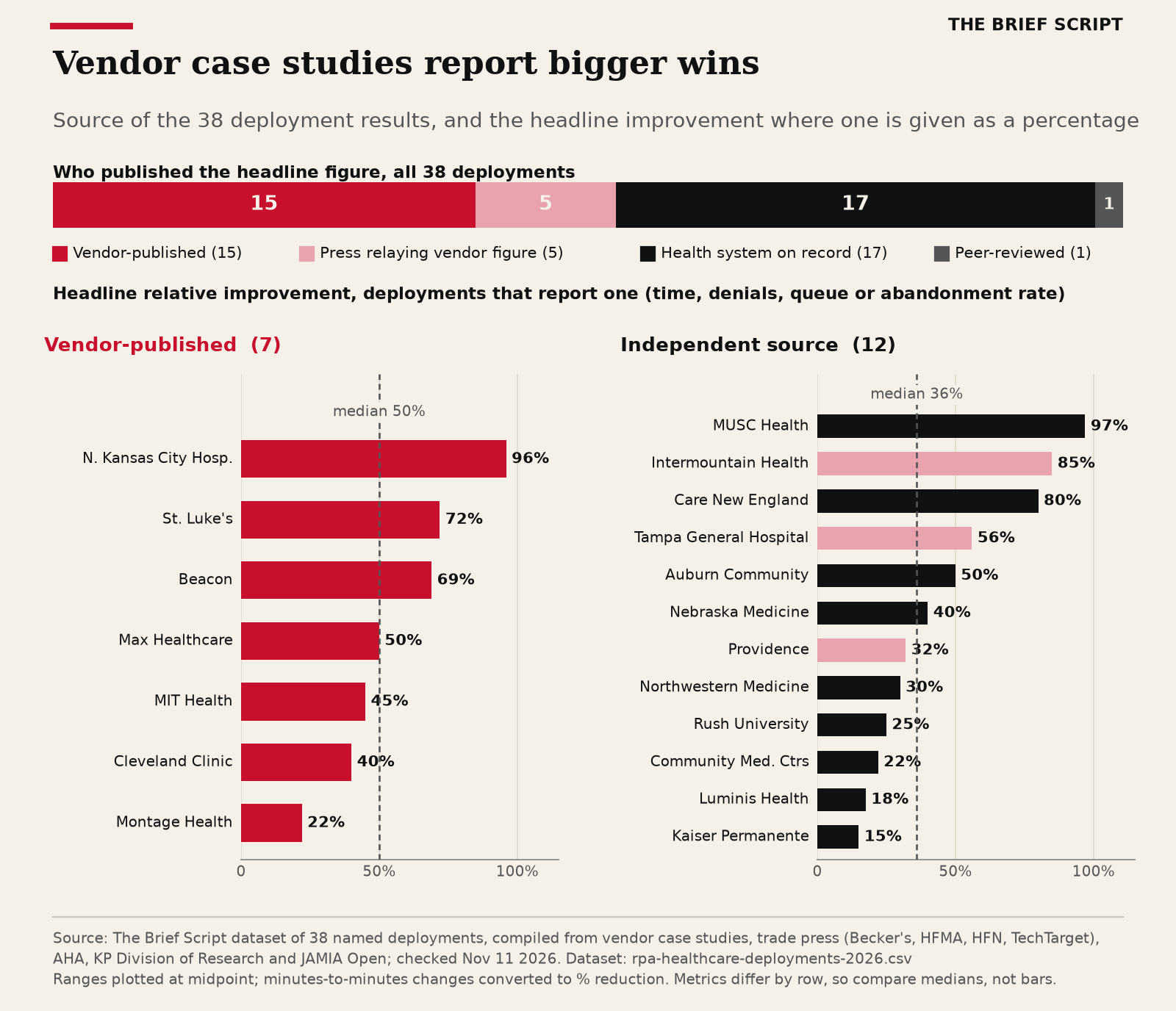
What this means: when a vendor quotes a 50% or larger gain, ask what the independent comparables show. In our data the typical independently reported improvement is closer to a third. That is still a strong business case for most revenue-cycle processes, and it is a safer number to put in a budget.
What RPA costs, and why projects fail
Healthcare buyers rarely see public pricing, and the figures that exist are rough. One UK public-sector price list shows a UiPath unattended robot at £9,000 each, on a reseller’s G-Cloud 14 sheet that does not state the billing period † (G-Cloud price list). Vendr’s purchase data, in a guide last updated February 2026, puts the median UiPath contract at $45,338 a year across 42 purchases, with unattended robots listed around $8,000 to $10,000 per robot per year (Vendr). Vendr’s own figures drift between page sections, so treat them as a range.
The bigger cost is usually people and maintenance. Northwestern runs its program with three people; Mayo built its own bots. Both are large systems with mature Epic teams.
Failure is real, though the most-quoted rate is old. In 2016, EY wrote that it had “seen as many as 30 to 50% of initial RPA projects fail” †. That was a consultancy’s observation of early projects, largely in financial services, not a current healthcare failure rate (EY).
The clearest recent warning is Olive AI. After a 2021 funding round at a reported $4 billion valuation, and $832 million raised since March 2020 (about $902 million in total), Olive shut down on October 31, 2023. Its clearinghouse and patient access units went to Waystar, and its prior authorization unit to Humata Health (Fierce Healthcare; Healthcare Dive).
What this means: budget for the operating model, not the license. The common thread in failed programs is bots built on unstable screens, with no owner when a payer portal changes. Ask every vendor what happens to your automations, and your data, if the company is sold or shut down.
Vendor landscape: who shows up in the evidence
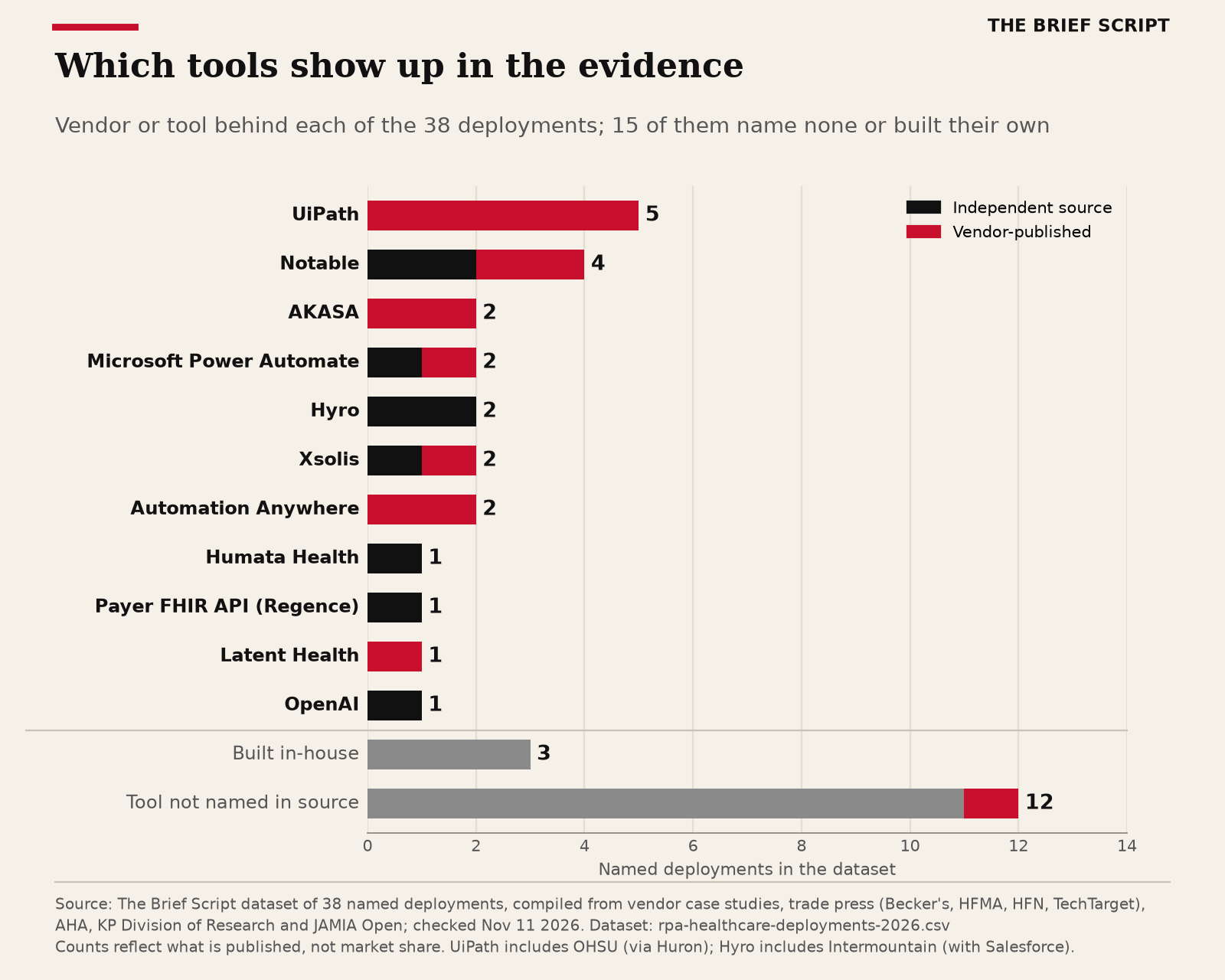
This is a count of published evidence, not a market-share ranking or a recommendation. UiPath appears most often, mainly through its own case studies and the OHSU project with Huron. Notable shows up in four prior auth and patient access deployments, two of them reported independently. AKASA, Xsolis, Hyro, Automation Anywhere and Microsoft Power Automate each appear twice.
Two patterns stand out. First, 12 deployments name no tool at all, and three were built in-house (Mayo, Rush and WellSpan). Second, the specialist healthcare vendors (Notable, AKASA, Humata, Xsolis, Hyro, Latent) cluster around revenue-cycle and access tasks, while the horizontal platforms (UiPath, Automation Anywhere, Power Automate) dominate back-office cases.
Note one relationship disclosed in the press: Healthcare Finance News attributes Allegheny Health Network’s results (70% of CPT requests approved in the first month, 96% first-pass) to Humata, and AHN is a Humata investor (Healthcare Finance News).
Implementation checklist for CIOs and revenue-cycle leaders
- Pick the process by volume and rule density. Status checks, payer notifications, eligibility updates and appeal drafting are the best-evidenced starting points.
- Baseline before you build. Record touches per item, minutes per task, denial rate and days in A/R for at least one quarter. Most weak case studies lack a clean baseline.
- Choose the right layer. Use a FHIR or payer API where it exists, bots where it does not, and AI only where a judgment is genuinely needed.
- Keep humans on judgment calls. Care New England automated notification work because “there’s no decision-making or clinical review involved,” and kept staff on complex cases.
- Name an owner for every bot. Portals change. Someone has to monitor failures, fix scripts and retire automations that no longer pay.
- Govern AI that touches PHI. Log what each bot and model can access, require business associate agreements, and review agent permissions. Our roundup of AI governance tools covers the options. HHS proposed updates to the HIPAA Security Rule in January 2025, and the regulatory agenda lists a final action targeted for July 2027, a projection rather than a deadline (reginfo.gov).
- Measure net, not gross. Count license, build, maintenance and change-management costs against hours saved, denials avoided and cash accelerated.
- Plan for vendor exit. Contract for data export and script ownership, given what happened with Olive AI.
- Bring payers in. Share denial analytics and push for API connections; the CMS metrics give you public numbers to cite.
Methodology
Sample. 38 named healthcare automation deployments in administrative and revenue-cycle work, each with a named organization, a process, a reported outcome and a public source. We included classic RPA, machine learning, generative AI and agent deployments, since most programs now mix them.
Sources. Vendor case studies, trade press (Becker’s, HFMA, Healthcare Finance News, TechTarget, HealthLeaders, CIO.com), the AHA, the Kaiser Permanente Division of Research and one peer-reviewed paper (JAMIA Open). Every source was opened and checked between November 6 and November 11, 2026.
Classification. We labeled each result by who published it: 15 vendor-published and 23 independent. Of the 23 independent results, 17 are health systems speaking on the record, one is peer-reviewed, and five are trade-press articles repeating a vendor’s own figure (Allegheny Health Network, Intermountain, Tampa General, Providence and Boston Children’s). We disclose those five rather than reclassify them.
Improvement comparison. For the 19 deployments that report a relative improvement in time, denials, queue size or abandonment, we took the headline figure, used the midpoint of ranges, and converted before-and-after times to a percentage reduction. The medians (50% vendor, n=7; 36% independent, n=12) compare different metrics across different processes and are directional only.
Caveats. Published case studies favor successes, so this sample over-represents wins in every category. Dates range from 2020 to 2026, and several vendor pages carry no date. Figures marked † rest on a single secondary or dated source. UT Southwestern’s reported ~$4.5 million in FTE savings over six years is included in the dataset but comes only from an RCM vendor’s blog † (Getix Health). Montage Health’s 300 hours a month and 13% fewer A/R days come from its earlier claim-status automation, not its auth-status project (AKASA).
FAQ: robotic process automation in healthcare
What are examples of RPA in healthcare?
Common examples include bots that check claim and prior authorization status in payer portals (Mayo Clinic), send admission notifications to payers (Care New England), update insurance records (Banner Health), clear claim backlogs (OHSU cleared 12,000 claims in 15 days with UiPath via Huron) and process billing (St John of God Health Care, per Automation Anywhere).
What are the main RPA use cases in healthcare?
In our 38 deployments, the most common are claims, denials and appeals (10), prior authorization (8) and back-office work such as HR, credentialing and records (8), followed by patient access, generative AI, coding and utilization management.
What are examples of generative AI in healthcare?
Ambient scribes that draft clinical notes (The Permanente Medical Group, nearly 16,000 hours saved), AI-drafted replies to billing messages (Stanford Health Care, 17 hours saved per 1,000 messages), AI-written appeal letters (Nebraska Medicine and Kaiser Permanente) and enterprise ChatGPT for administrative tasks (Boston Children’s Hospital).
Is RPA the same as AI in healthcare?
No. RPA repeats fixed, rule-based steps; AI makes predictions or drafts content; AI agents carry multi-step tasks with limited supervision. Most hospital programs now combine all three, which is why buyers should ask exactly which parts of a product use rules and which use models. See our guide to enterprise AI agents for how agents are being deployed more broadly.
Does CMS-0057-F require prior authorization automation?
It does not mandate automation by providers. It requires impacted payers to decide prior authorization requests within 72 hours for expedited and seven calendar days for standard requests from January 1, 2026, and to stand up FHIR prior authorization APIs generally from January 1, 2027. Those timelines make automation on both sides far more practical.
How much does RPA cost for a hospital?
Public figures are thin. Vendr’s purchase data puts the median UiPath contract at about $45,000 a year, and one UK public-sector price list shows £9,000 per unattended robot. Build, maintenance and governance usually cost more than licenses, so model the full operating cost before comparing vendors.