Enterprise AI Platform Index 2026: We Scored 22 Platforms on 29 Sourced Fields
We scored 22 enterprise AI platforms on model choice, pricing, security, data control, agents and market proof. See the 2026 index and dataset.

The Brief Script Enterprise AI Platform Index 2026. Original research by The Brief Script. Data as of November 1, 2026.
Most “best enterprise AI platforms” lists rank a dozen products on opinion. We collected 29 scoreable facts for each of 22 enterprise AI platforms, cited a source for every one, and built a 100-point index across six pillars: model choice, pricing transparency, security and compliance, data control, agent capability, and ecosystem and market proof.
The headline: Microsoft Foundry scores 93.0 out of 100, just ahead of Google’s Gemini Enterprise Agent Platform (formerly Vertex AI) at 92.0 and Amazon Bedrock at 89.8. Those three stay in the top three under every weighting we tested. Below them, the field is closer, and the biggest gaps aren’t in AI features at all. They’re in pricing you can read and control over where your data runs.
Unverified facts score zero, and we show how much of each record we could verify. Facts from secondary sources are marked †.
Key findings
- The three hyperscaler build platforms lead: Microsoft Foundry 93.0, Google Agent Platform 92.0, Amazon Bedrock 89.8. They hold the top three in all 10 sensitivity scenarios we ran: baseline, equal weights, six leave-one-pillar-out runs and two robustness checks.
- MCP support is universal: all 22 platforms document it. A2A is native on 14. Agent capability averages 88% of its maximum, the least differentiating pillar in the index.
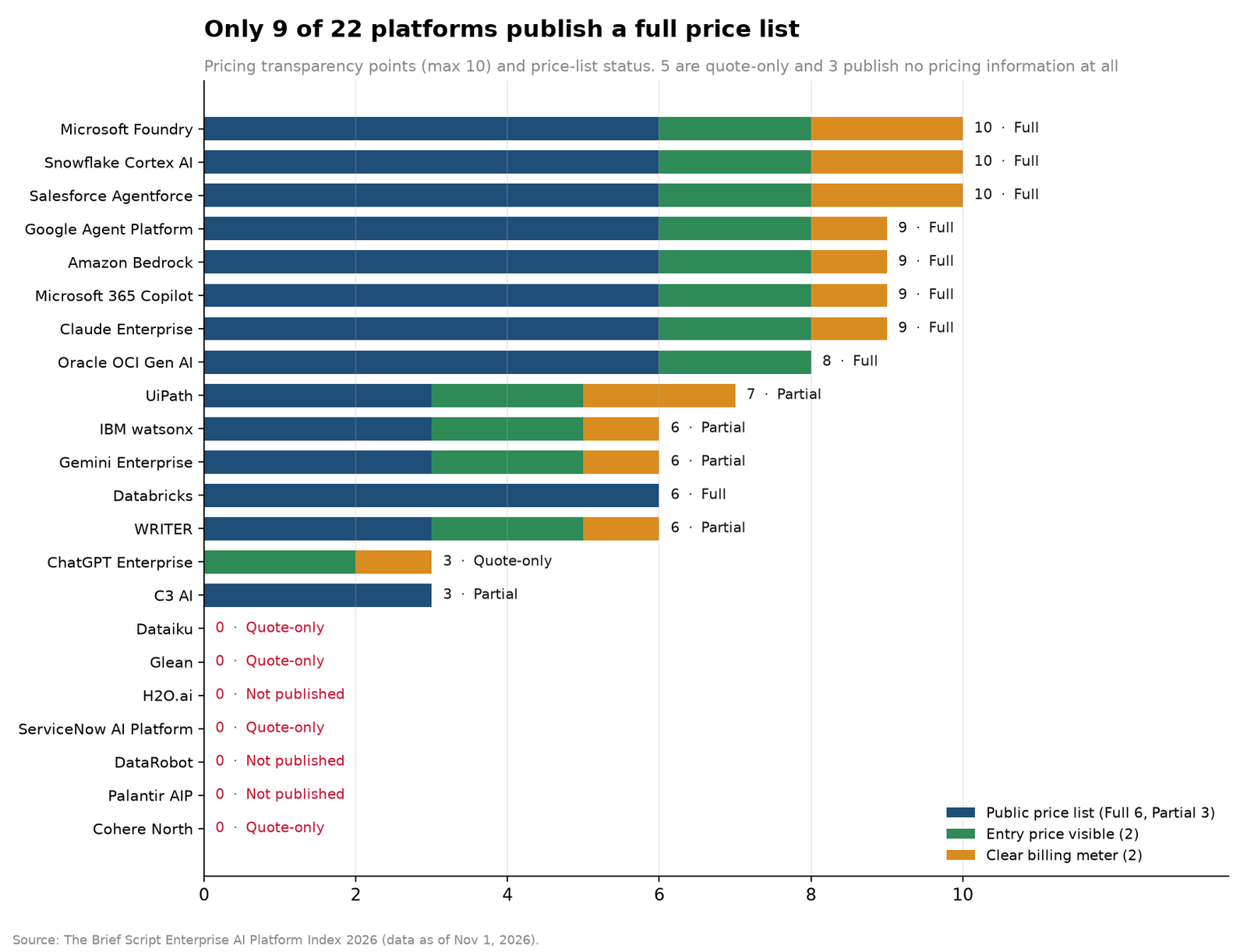
- Only 9 of 22 platforms publish a full price list. Five are quote-only and three publish no pricing at all. Pricing transparency averages 51% of its maximum, the lowest of the six pillars.
- SOC 2 and ISO 27001 are verified for 21 of 22 platforms, but only 6 hold all five headline credentials we tracked: SOC 2, ISO 27001, ISO 42001, a HIPAA BAA and FedRAMP High.
- Just 6 of 22 document an air-gapped deployment option. Ten offer on-prem or hybrid. Google is the only hyperscaler in the air-gapped group.
- ChatGPT Enterprise and Claude Enterprise run only their makers’ models, so each scores 2 of 15 on model choice. ChatGPT Enterprise has the index’s only perfect market-proof score (15 of 15). Microsoft 365 Copilot leads the workplace category at 81.0.
- Gartner and Forrester don’t agree on a single data platform. Of the seven data and ML platforms, none is a Leader in both Gartner’s 2026 data science and ML Magic Quadrant and Forrester’s Q3 2026 AI Platforms Wave.
- Average verified-field coverage is 86.1%. 89 of the 638 scored cells are blank. Palantir AIP and C3 AI have the thinnest public record at 69.0% each.
What is an enterprise AI platform?
An enterprise AI platform is software that lets an organization build, deploy and govern AI (models, agents and assistants) on its own data, with the security, compliance and administrative controls a large company needs. It usually bundles model access, agent-building tools, connectors to business systems, guardrails, monitoring and contract terms such as no training on customer data.
The label covers products that do very different jobs. We grouped the 22 into four types:
| Type | What it does | Platforms in this index |
|---|---|---|
| Cloud AI build platforms | Developer platforms for building AI apps and agents on a public cloud, with a model catalog | Microsoft Foundry, Amazon Bedrock (+ AgentCore), Google Gemini Enterprise Agent Platform, IBM watsonx, Oracle OCI Generative AI |
| Data & ML platforms | AI built where the data already sits, from lakehouses to ontology-based operational platforms | Databricks, Snowflake Cortex AI, Dataiku, DataRobot, Palantir AIP, C3 AI, H2O.ai |
| Workplace AI assistants | Chat, search and agents for every employee, priced per seat | ChatGPT Enterprise, Claude Enterprise, Microsoft 365 Copilot, Gemini Enterprise, Glean |
| Enterprise app & agent platforms | Agents built into a system of record or an automation suite | Salesforce Agentforce, ServiceNow AI Platform, UiPath, WRITER, Cohere North |
If you’re still sorting out the vocabulary, our explainer on AI agents vs agentic AI covers the difference between a single agent and an agentic system.
The Enterprise AI Platform Index 2026: full results
Each pillar is scored from field-level rules (full rubric in the methodology). Blank fields score zero. “Coverage” is the share of the 29 scored fields we could verify for that platform.
| # | Platform | Category | Model choice (15) | Pricing (10) | Security (20) | Data control (20) | Agents (20) | Market proof (15) | Index | Coverage |
|---|---|---|---|---|---|---|---|---|---|---|
| 1 | Microsoft Foundry | Cloud build | 15 | 10 | 20 | 17 | 20 | 11 | 93.0 | 93% |
| 2 | Google Agent Platform (Vertex AI) | Cloud build | 15 | 9 | 20 | 20 | 20 | 8 | 92.0 | 97% |
| 3 | Amazon Bedrock | Cloud build | 15 | 9 | 20 | 14 | 20 | 11.75 | 89.8 | 93% |
| 4 | Microsoft 365 Copilot | Workplace | 9 | 9 | 20 | 9 | 20 | 14 | 81.0 | 90% |
| 5= | Salesforce Agentforce | App/agent | 9 | 10 | 20 | 9 | 20 | 12 | 80.0 | 90% |
| 5= | Snowflake Cortex AI | Data & ML | 13 | 10 | 20 | 14 | 14.5 | 8.5 | 80.0 | 97% |
| 7 | UiPath | App/agent | 11 | 7 | 15 | 13 | 20 | 11 | 77.0 | 90% |
| 8 | IBM watsonx | Cloud build | 13 | 6 | 17 | 7 | 20 | 11 | 74.0 | 90% |
| 9= | Databricks | Data & ML | 11 | 6 | 14 | 12 | 17.5 | 12 | 72.5 | 93% |
| 9= | Gemini Enterprise | Workplace | 5.5 | 6 | 16 | 14 | 20 | 11 | 72.5 | 93% |
| 11 | Dataiku | Data & ML | 13 | 0 | 14 | 13 | 20 | 10.5 | 70.5 | 83% |
| 12 | Glean | Workplace | 9 | 0 | 16 | 10.5 | 18.5 | 10.5 | 64.5 | 97% |
| 13 | H2O.ai | Data & ML | 13 | 0 | 14 | 13 | 20 | 4 | 64.0 | 76% |
| 14 | ServiceNow AI Platform | App/agent | 9 | 0 | 14 | 7 | 20 | 13.5 | 63.5 | 83% |
| 15 | DataRobot | Data & ML | 11 | 0 | 13 | 13 | 19 | 6.75 | 62.8 | 72% |
| 16 | ChatGPT Enterprise | Workplace | 2 | 3 | 19 | 12.5 | 10.5 | 15 | 62.0 | 93% |
| 17 | Claude Enterprise | Workplace | 2 | 9 | 17 | 9.5 | 10.5 | 13 | 61.0 | 93% |
| 18 | Oracle OCI Generative AI | Cloud build | 11 | 8 | 10 | 14 | 16.5 | 1 | 60.5 | 79% |
| 19 | Palantir AIP | Data & ML | 11 | 0 | 16 | 7 | 17 | 9 | 60.0 | 69% |
| 20 | WRITER | App/agent | 7 | 6 | 16 | 7 | 17 | 3.5 | 56.5 | 79% |
| 21 | C3 AI | Data & ML | 13 | 3 | 9 | 6 | 14 | 10 | 55.0 | 69% |
| 22 | Cohere North | App/agent | 7 | 0 | 14 | 15 | 13 | 5 | 54.0 | 76% |
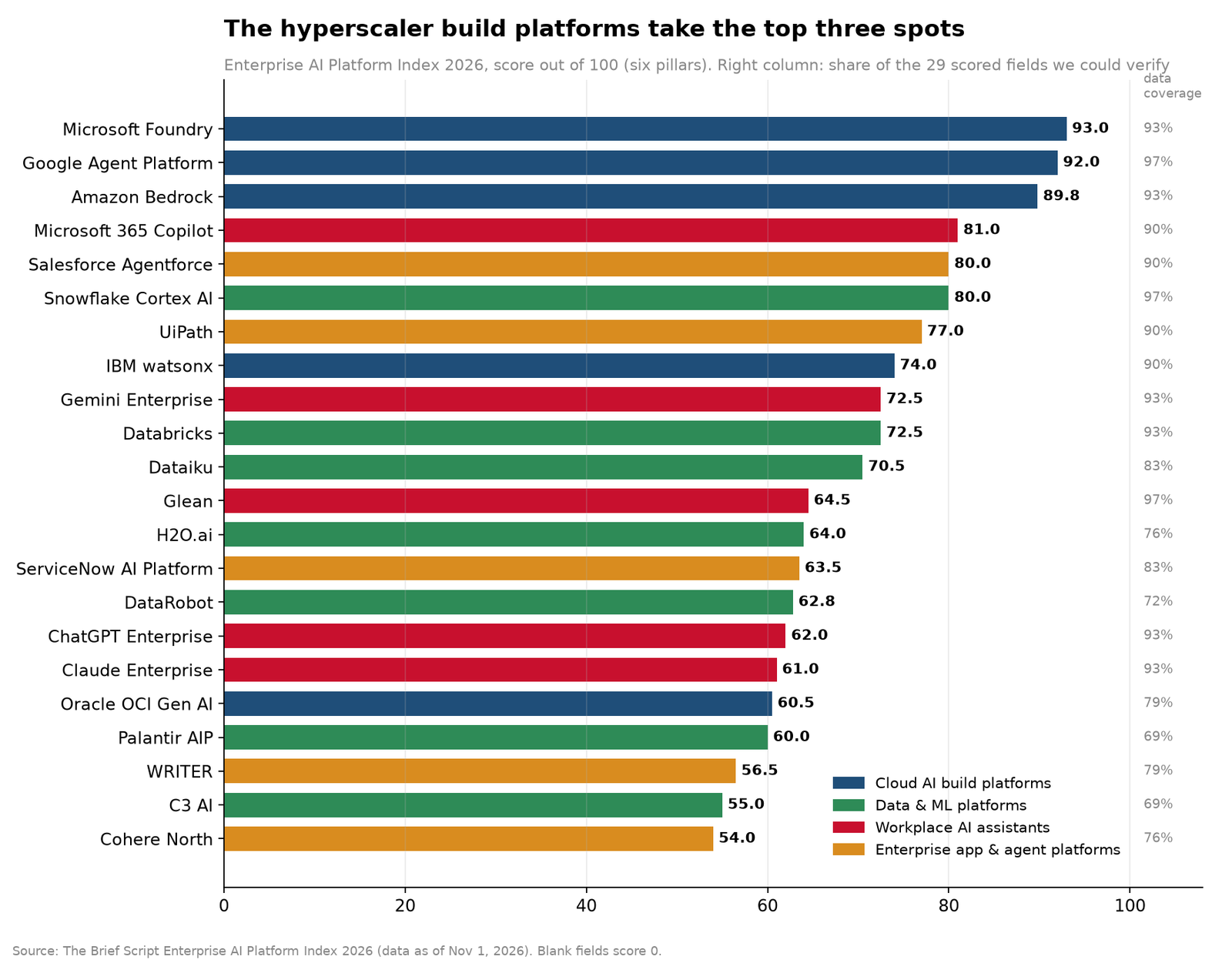
The median score is 67.5. The index rewards breadth (models, deployment options, certifications), which favors general-purpose build platforms. A focused assistant or CRM agent platform can be the right buy while ranking lower, so compare within a category first. Category averages: cloud build platforms 81.9, workplace assistants 68.2, data and ML platforms 66.4, app and agent platforms 66.2.
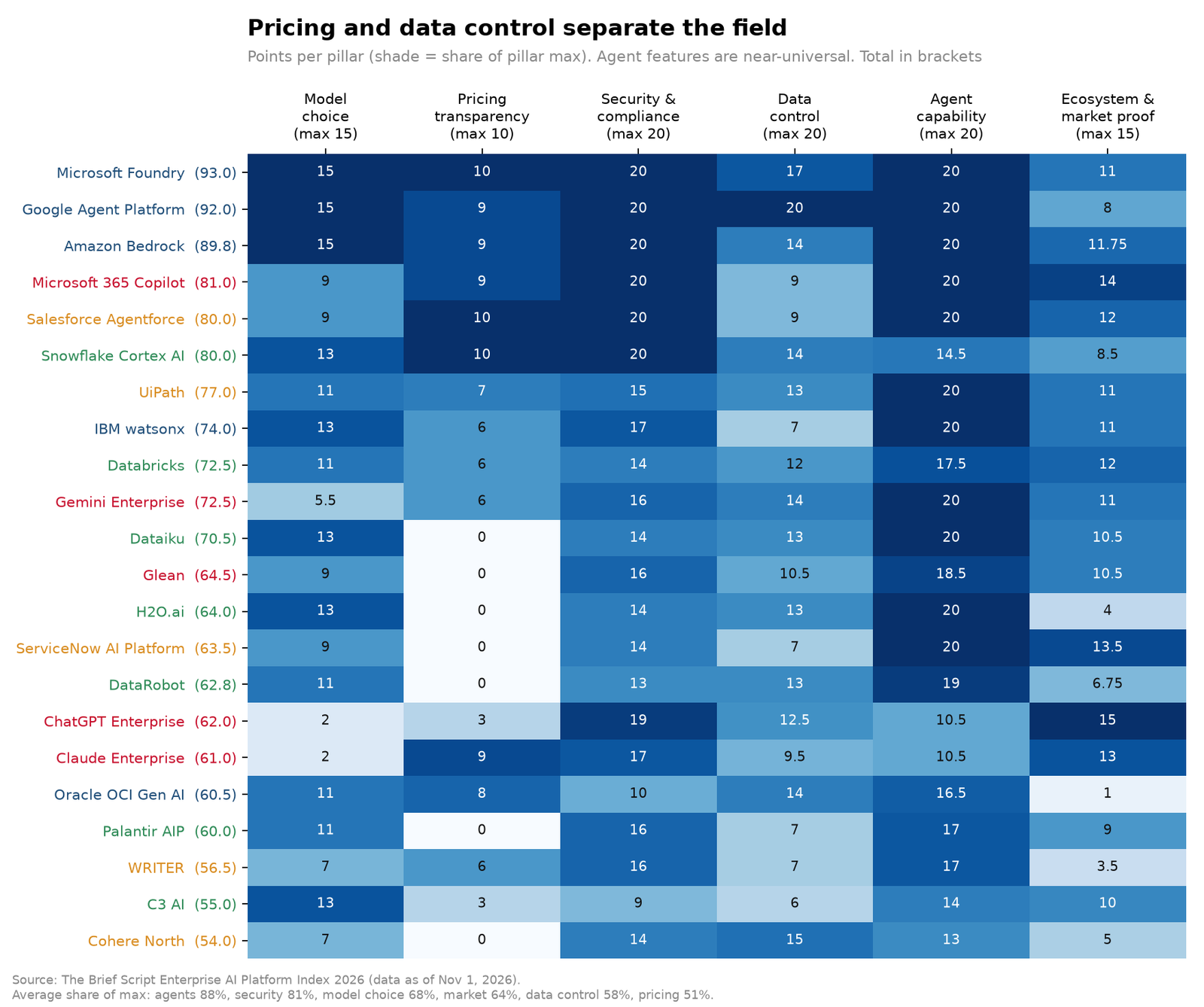
What this means: Agent features no longer separate vendors. Eleven platforms score a perfect 20 on agent capability. The useful questions in a 2026 evaluation are what it costs, where it runs and who can see your data.
Is the ranking stable?
We re-ran the index ten ways: equal pillar weights, each of the six pillars removed in turn, analyst placements from secondary sources scored zero, and the weak signals (G2 ratings and connector counts) removed.
The top three never changed as a group. Microsoft Foundry ranked first or second in every scenario, Google first to third, and Bedrock second or third. Google moves to first when market proof is dropped. Bedrock moves to second when data control is dropped.
Below them, ranks move more: Microsoft 365 Copilot ranges from 3rd to 7th, Dataiku from 5th (without pricing) to 13th, and ChatGPT Enterprise from 11th (without model choice) to 21st (without market proof). Treat small mid-table gaps as ties.
Cloud AI build platforms
Average score: 81.9. Custom agents and apps on a hyperscaler, with the widest model catalogs.
1. Microsoft Foundry: 93.0 (coverage 93%) – Best for: Azure estates that want the broadest catalog plus Microsoft’s governance stack. – Pricing as published: The platform is free to use; models and features bill at normal per-token rates. – Standout: A catalog of 10,000+ models, and 120,000+ Foundry customers, with Foundry revenue more than tripling year over year (FY27 Q1). ISO 42001 explicitly covers Foundry, it holds FedRAMP High, and Foundry Local runs on-prem on Azure Local. – Watch-out: Renamed twice (most recently to Microsoft Foundry on January 1, 2026). Per-service SOC 2 and ISO 27001 lists sit behind a Service Trust Portal login.
2. Google Gemini Enterprise Agent Platform (formerly Vertex AI): 92.0 (coverage 97%) – Best for: Teams that need the strongest data controls, including fully air-gapped deployment. – Pricing as published: Per token by model. Agent compute costs $0.085 per vCPU-hour plus $0.009 per GiB-hour, and idle time between turns isn’t billed. – Standout: The only perfect data-control score in the index (20 of 20): 23 regions for agent infrastructure, CMEK, VPC Service Controls and air-gapped Gemini on Google Distributed Cloud. It offers 11 third-party model providers and 200+ models in Model Garden. Google says it was a Leader with the highest Ability to Execute in Gartner’s April 2026 update for AI application development platforms. – Watch-out: Market proof is the weakest of the top three (8 of 15): Google reports only Cloud-wide figures ($30.7B quarterly revenue, up 103%), which we count as weak evidence.
3. Amazon Bedrock (+ AgentCore): 89.8 (coverage 93%) – Best for: AWS estates that want the widest choice of third-party models. – Pricing as published: Pay-per-token with no platform fee, and batch inference is 50% cheaper. AgentCore Runtime starts at $0.0895 per vCPU-hour plus $0.00945 per GB-hour, with no minimums. – Standout: 18 third-party providers across 138 model cards, 35 regions (including 2 GovCloud), and “more than 100,000 organizations” using it. Bedrock was the first hyperscaler AI service with an accredited ISO 42001 certificate (November 2024). – Watch-out: We found no on-prem option. Classic Bedrock Agents is closed to new customers.
8. IBM watsonx: 74.0 (coverage 90%) – Best for: Hybrid estates that want AI software in their own data center and a cross-vendor agent control plane. – Pricing as published: Granite 4 H Small costs $0.0636 per 1M input tokens. Orchestrate Essentials starts at $530 a month and Standard at $6,360 a month. – Standout: Orchestrate’s supervisor agents can delegate to A2A, LangGraph and even Bedrock AgentCore agents. – Watch-out: The catalog has no Claude, GPT-5/6 or Gemini. Data control scores 7 of 20 because no-training, customer-managed key and private-networking terms for watsonx SaaS weren’t confirmed. FedRAMP is Moderate, not High: the FedRAMP Marketplace lists IBM Data Services for Government (watsonx.ai and Orchestrate) at Class C (Moderate).
18. Oracle OCI Generative AI / OCI Enterprise AI: 60.5 (coverage 79%) – Best for: Oracle and sovereign-cloud customers, including US government (FedRAMP High, DISA IL5). – Pricing as published: Per 1M tokens (Google, xAI, OpenAI models) or per 10,000 characters (Cohere, Meta). Dedicated clusters carry a 744 unit-hour minimum. – Standout: An ISO 42001 certificate, 11 commercial regions with local processing plus UK Gov and EU Sovereign, and deployment in OCI Dedicated Cloud and Alloy. – Watch-out: Oracle has no first-party LLMs, and Gemini and Grok are called externally. SOC 2, ISO 27001 and HIPAA scope for Gen AI weren’t confirmed on an official page. There’s no analyst placement and no Gen AI-specific scale figure, so market proof is 1 of 15.
What this means: On features and certifications the three hyperscalers are close to interchangeable, so your cloud contract and data gravity should decide. Oracle’s low score is mostly unverified compliance scope, not missing features.
Data & ML platforms
Average score: 66.4. AI built where your data already lives.
5=. Snowflake Cortex AI: 80.0 (coverage 97%) – Best for: Snowflake estates that want governed AI in SQL and agents without moving data. – Pricing as published: An AI Credit costs $2.00 (global) or $2.20 (regional) on demand, with per-model token rates published. – Standout: One of six platforms with all five headline credentials, including ISO 42001 and FedRAMP High. Q2 FY27 revenue was $1.55B (+35%) across 14,554 customers, with net revenue retention of 126%. – Watch-out: SaaS only, with no on-prem option. A2A is available only through an open-source wrapper, and native multi-agent orchestration isn’t documented. The HIPAA BAA requires Business Critical edition. Gartner rates it a Visionary, not a Leader, in its 2026 data science and ML MQ.
9=. Databricks: 72.5 (coverage 93%) – Best for: Lakehouse estates that want the widest open model menu. – Pricing as published: Usage-based in DBUs, with no separate fee for Agent Bricks tooling. – Standout: 11 LLM families, a >$7B revenue run-rate growing >80% a year, and 1,401 G2 reviews at 4.6. A Leader in Gartner’s 2026 data science and ML MQ, with the highest Execution and furthest Vision. – Watch-out: Not ISO 42001 certified as of February 2026. Knowledge Assistant and Supervisor Agent are no longer sold to new customers. A2A is a community pattern only.
11. Dataiku: 70.5 (coverage 83%) – Best for: A model-neutral orchestration layer across clouds, on-prem or air-gapped. – Pricing as published: None. Quote-only, with a 14-day free trial. – Standout: 14 hosted LLM connection types, a native MCP server and an A2A endpoint (DSS 15, August 14, 2026), and ISO 42001. A Gartner data science and ML Leader for the 5th consecutive year. – Watch-out: Pricing scores 0 of 10. We found no FedRAMP authorization. The >$350M ARR figure comes from an undated vendor statement.
13. H2O.ai: 64.0 (coverage 76%) – Best for: Sovereign, on-prem and air-gapped deployments. – Pricing as published: Not published. – Standout: The only data and ML platform shipping its own open-weight models (Danube and Mississippi, Apache 2.0). H2O.ai Cloud for Government is FedRAMP High certified (April 2026, per the FedRAMP Marketplace). – Watch-out: Market proof is 4 of 15 ($256M funding, one named deployment), and Gartner rates it a Visionary in data science and ML.
15. DataRobot: 62.8 (coverage 72%) – Best for: Agent lifecycle management outside public cloud, built with NVIDIA. – Pricing as published: Not published. – Standout: Native A2A (agent cards, servers and clients), NVIDIA NeMo Guardrails, and on-prem, air-gapped and multi-cloud deployment. A Gartner data science and ML Leader for the 3rd year. – Watch-out: FedRAMP status is Legacy FedRAMP Ready at the High level (FedRAMP Marketplace), which we score as in process, not authorized. No ISO 42001, no official revenue disclosure, and the LLM gateway is unavailable in government regions.
19. Palantir AIP: 60.0 (coverage 69%) – Best for: Ontology-driven operational AI in government, defense and industry. – Pricing as published: Not published. – Standout: FedRAMP High covering AIP, plus DoD IL5 and IL6. It offers 10 model families. Q2 2026 revenue was $1.935B (+93%), across 1,049 customers (+24%). Forrester Leader†. – Watch-out: It’s tied for the thinnest public record in the index. Pricing, ISO 42001, data residency, private networking and A2A are unverified. It’s absent from Gartner’s data science and ML MQ. Palantir reports Q3 2026 results on November 2, after our data cutoff.
21. C3 AI: 55.0 (coverage 69%) – Best for: Prebuilt enterprise AI applications in government and industrial settings. – Pricing as published: A paid initial deployment, then a monthly fee plus vCPU/vGPU-hour consumption. There’s no public price list. – Standout: The highest Current Offering score of all 15 vendors in Forrester’s Q3 2026 AI Platforms Wave. It holds FedRAMP Moderate plus IL5 and IL6, and ships a first-party code LLM. – Watch-out: Q1 FY27 revenue was $52.4M, down from $70.3M a year earlier. A2A, guardrails, no-training terms and customer-managed keys couldn’t be verified.
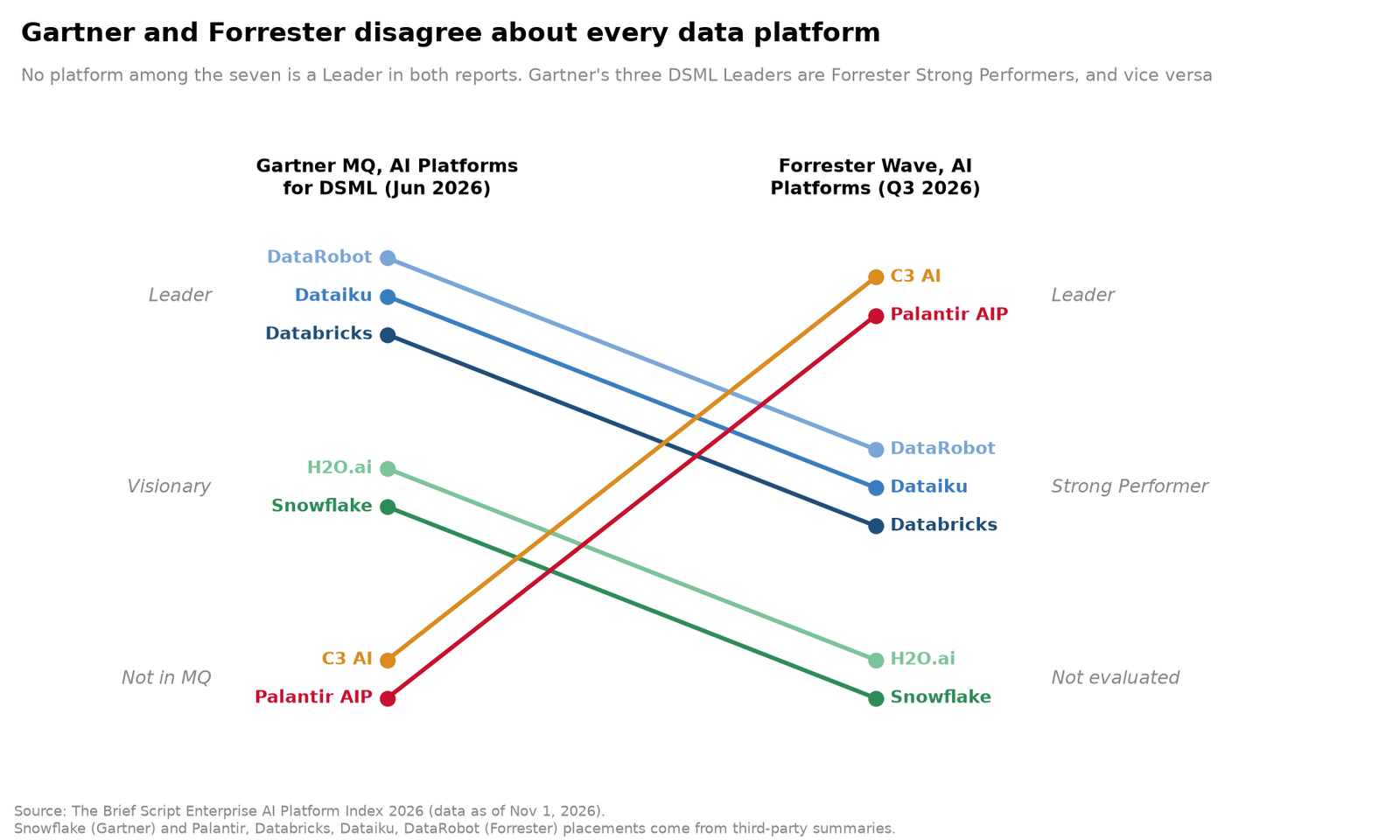
The analyst split is stark. Gartner’s 2026 data science and ML Leaders (Databricks, Dataiku, DataRobot) are Strong Performers in Forrester’s Q3 2026 Wave†. Forrester’s Leaders (C3 AI, and Palantir†) aren’t in Gartner’s Magic Quadrant at all. Snowflake and H2O.ai are Gartner Visionaries that Forrester didn’t evaluate.
What this means: “Named a Leader” depends on the report. Ask which one, which year and which quadrant, and weight it below your own proof of concept.
Workplace AI assistants
Average score: 68.2. Seat-priced assistants that trail on model choice and deployment by design, but lead on adoption.
4. Microsoft 365 Copilot (+ Copilot Studio, Agent 365): 81.0 (coverage 90%) – Best for: Microsoft 365 organizations. – Pricing as published: $30 per user per month (yearly). Copilot Business is $21, Agent 365 is $15, and M365 E7 is $99 per user per month. – Standout: 30M+ paid seats (FY26 Q4), the only paid-seat count in the group. It has four model families in Copilot Studio, GA multi-agent orchestration, and an ISO 42001 recertification with zero non-conformities. – Watch-out: It requires a qualifying M365 license. Anthropic models are excluded from the EU Data Boundary, and Copilot features vary in government clouds. Gartner Leader†.
9=. Gemini Enterprise: 72.5 (coverage 93%) – Best for: Google Workspace and Google Cloud organizations that want residency choice. – Pricing as published: Business edition from $21 per seat (up to 300 seats); Standard and Plus from $30 per seat. – Standout: Data stays at rest in 8 locations, with CMEK and VPC Service Controls. Claude Opus 5.5 and Sonnet 5.5 became GA in the app on October 15, 2026. Google says nearly 90% of the Fortune 100 use it. – Watch-out: Compliance controls apply to Standard and Plus, not Business. ISO 42001 isn’t listed for the product. Google removed seat prices from the product page in October 2026.
12. Glean: 64.5 (coverage 97%) – Best for: Enterprise search and agents across many SaaS tools, with any model. – Pricing as published: Quote-only (a seat fee plus Model Hub usage). – Standout: The only model-neutral, customer-hostable assistant (in your own AWS or GCP), with 275+ connectors, A2A as both server and client, and >$350M ARR. It has the joint-highest G2 rating in the index (4.7 from 337 reviews). – Watch-out: No FedRAMP authorization. Gartner placed it as a Challenger†.
16. ChatGPT Enterprise: 62.0 (coverage 93%) – Best for: Broad employee adoption with the widest residency menu among assistants. – Pricing as published: Enterprise is custom (credit- or token-based contracts). The Business tier is $20 per user per month annually or $25 monthly. – Standout: The only perfect market-proof score (15 of 15): >1B weekly users and 2.5M businesses. It has 10 data-residency regions, Enterprise Key Management, FedRAMP Moderate (20x) and ISO 42001. – Watch-out: It runs OpenAI models only. We found no A2A or multi-agent claim, and network control is IP allowlisting rather than private link. The HIPAA BAA requires Regulated Workspace.
17. Claude Enterprise: 61.0 (coverage 93%) – Best for: Teams that want published per-seat economics and deep connector reach. – Pricing as published: $20 per seat per month billed annually (20-seat minimum, 50 if sales-assisted), plus all usage at API rates (for example, Opus 5.5 at $4 in and $20 out per million tokens). – Standout: The only workplace assistant with a published Enterprise seat price. It has 2,000+ connectors and plugins, and Anthropic created MCP. Anthropic’s S-1 reports 11,900+ customers paying ≥$100K a year (company-wide, not Enterprise-plan only). – Watch-out: Residency is a single US-only inference option. FedRAMP is in process (the separate Claude for Government is FedRAMP High). It runs Anthropic models only. Gartner Leader†.
What this means: For an assistant, residency, keys and connectors matter more than model choice. For agent use cases, see our guide to enterprise AI agents.
Enterprise app & agent platforms
Average score: 66.2. Agents inside the systems you already run, plus two independents.
5=. Salesforce Agentforce: 80.0 (coverage 90%) – Best for: CRM-centered service, sales and marketing agents. – Pricing as published: Foundations is $0. Flex Credits cost $500 per 100,000 (a standard action is 20 credits, about $0.10), or $2 per conversation. User licenses are $5 per user per month, add-ons $125, and Max Edition starts at $550. – Standout: Agentforce ARR above $1.5B (+>240%), and 7.0B agentic work units delivered. ISO 42001 covers Agentforce, Agentforce is a HIPAA Covered Service under Salesforce’s BAA, and it is FedRAMP High in Government Cloud Plus. It has inbound and outbound A2A plus native multi-agent orchestration. – Watch-out: The ARR definition widened in Q2 FY27 to include Slackbot and Headless 360. BYOK and Hyperforce Operating Zone are paid add-ons. Private networking and on-prem weren’t verified.
7. UiPath: 77.0 (coverage 90%) – Best for: Processes that mix robots, agents and people. – Pricing as published: Community is free and Basic starts at $25 a month; Standard and Enterprise are contact-sales. – Standout: Leader in Gartner’s 2026 automation (BOAT) and document processing MQs and in Forrester’s Q3 2026 Adaptive Process Orchestration Wave. It holds ISO 42001 and AIUC-1, FedRAMP Moderate, and an air-gapped self-hosted option. – Watch-out: It’s the only platform coded “N” on no-training: the opt-out from UiPath data collection is only on Standard+. MCP and A2A are in preview. Its 7,735 G2 reviews include years of RPA reviews.
14. ServiceNow AI Platform: 63.5 (coverage 83%) – Best for: IT, HR and service workflows already on ServiceNow. – Pricing as published: No list prices. AI is metered in “assists” (25, 50 or 150 per agentic workflow), and Prime is required to build custom agents. – Standout: FedRAMP High plus ISO 42001. AI net new ACV is up 65%, and the 2026 target was raised to $1.7B. – Watch-out: HIPAA BAA wording, the DPA, private networking and on-prem AI weren’t confirmed. Data sharing for ServiceNow’s own model improvement is a configurable toggle.
20. WRITER: 56.5 (coverage 79%) – Best for: Marketing and content agents on a vendor-built model. – Pricing as published: Palmyra X6 API costs $2.00 in and $8.00 out per 1M tokens; enterprise is contact-sales. – Standout: ISO 42001, SOC 2, a HIPAA BAA, and open Palmyra models on Hugging Face. – Watch-out: Palmyra X6 is reportedly post-trained on Z.ai’s GLM-5.2†. There’s no FedRAMP, and data residency, CMK and self-hosting are unverified.
22. Cohere North: 54.0 (coverage 76%) – Best for: Private, on-prem or air-gapped assistants where the vendor never sees prompts. – Pricing as published: Quote-only (Model Vault hosting is $4.00 an hour or $2,500 a month per instance). – Standout: In private deployments, Cohere receives no prompts or outputs. ARR grew 165% year over year in Q3 2026. – Watch-out: Its last place comes largely from blanks: third-party model count, CMK, A2A, multi-agent and G2. There’s no FedRAMP, and the HIPAA BAA is limited to custom-model engagements.
What this means: Choose these for the system of record, not the leaderboard. Salesforce and UiPath publish enough to price a pilot; ServiceNow and Cohere need a sales cycle first.
Security, data control and agents: the cross-platform view
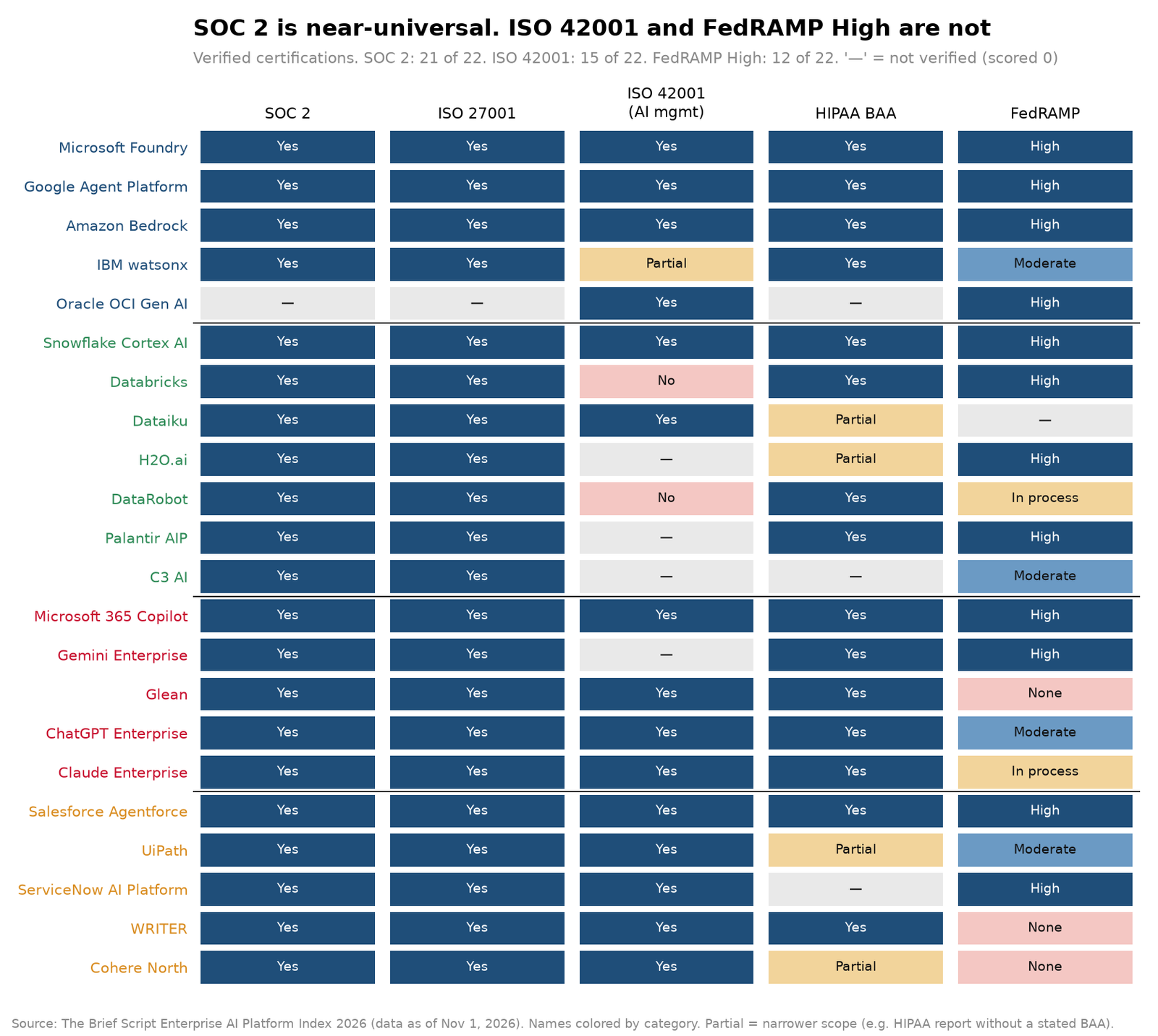
ISO 42001, the AI management-system standard, is now verified on 15 of 22 platforms, and FedRAMP High on 12. The six that clear all five credentials are Microsoft Foundry, Amazon Bedrock, Google Agent Platform, Snowflake Cortex AI, Microsoft 365 Copilot and Salesforce Agentforce. For how these standards map to the EU AI Act and US rules, see our AI regulation tracker.
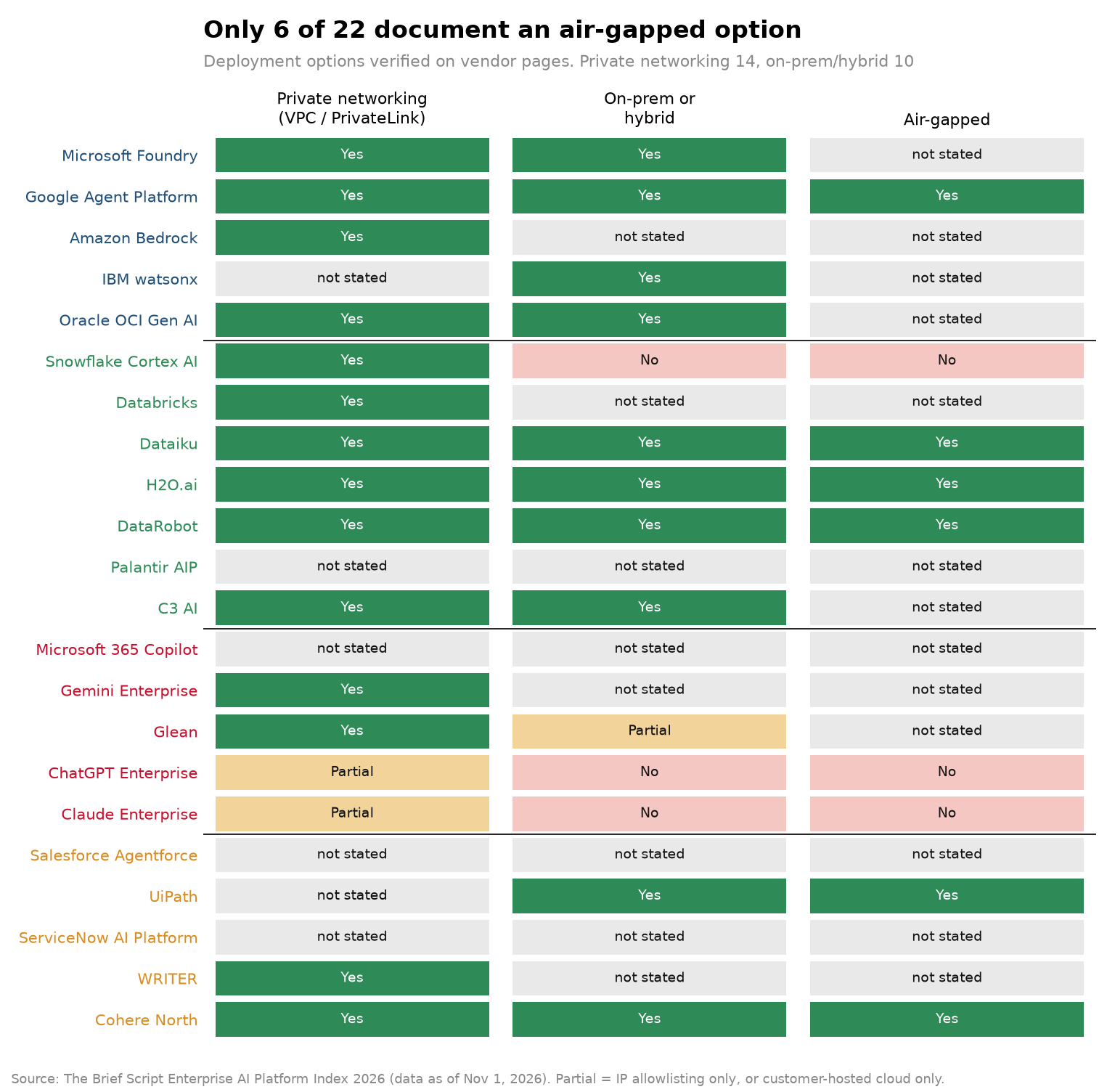
Private networking is verified on 14 platforms, and customer-managed keys on 13. Air-gapped options are rarer: Google Agent Platform, Dataiku, DataRobot, H2O.ai, UiPath and Cohere North.
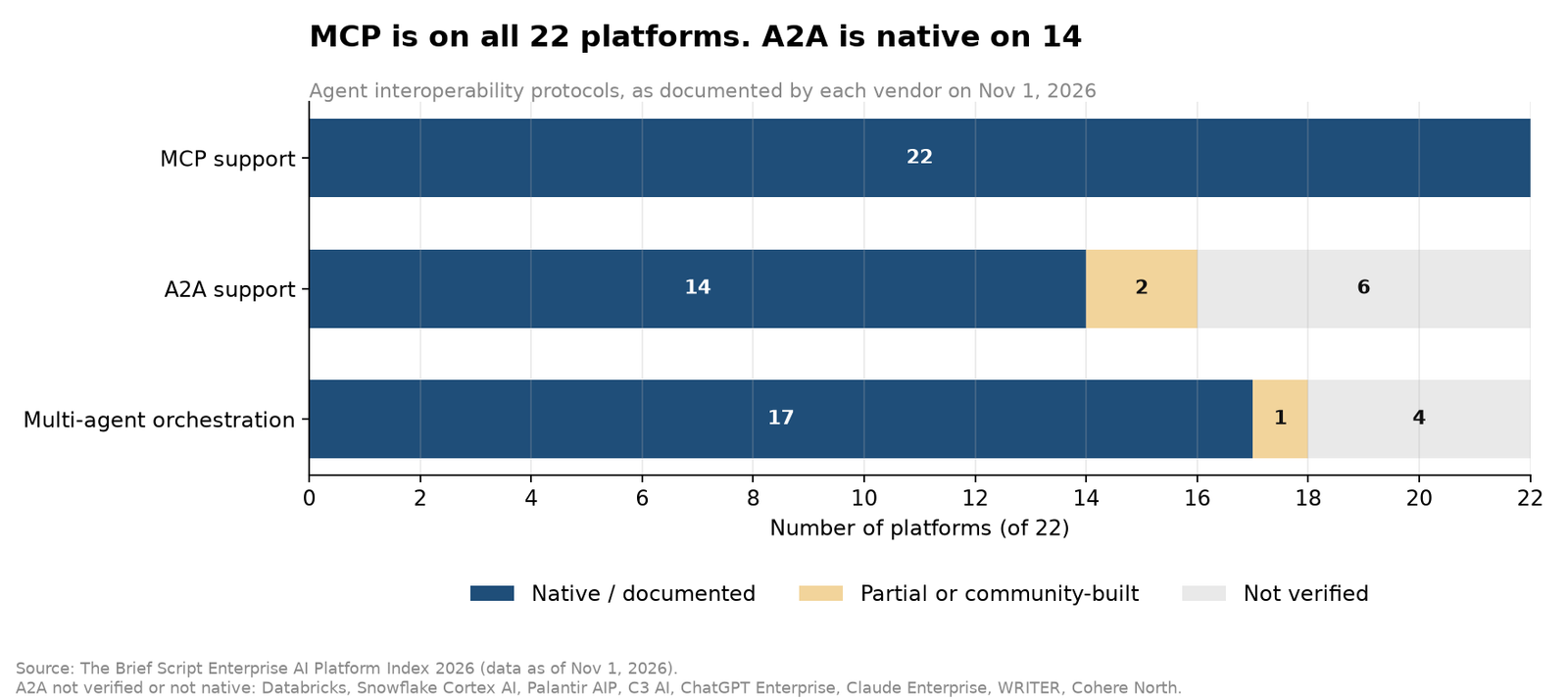
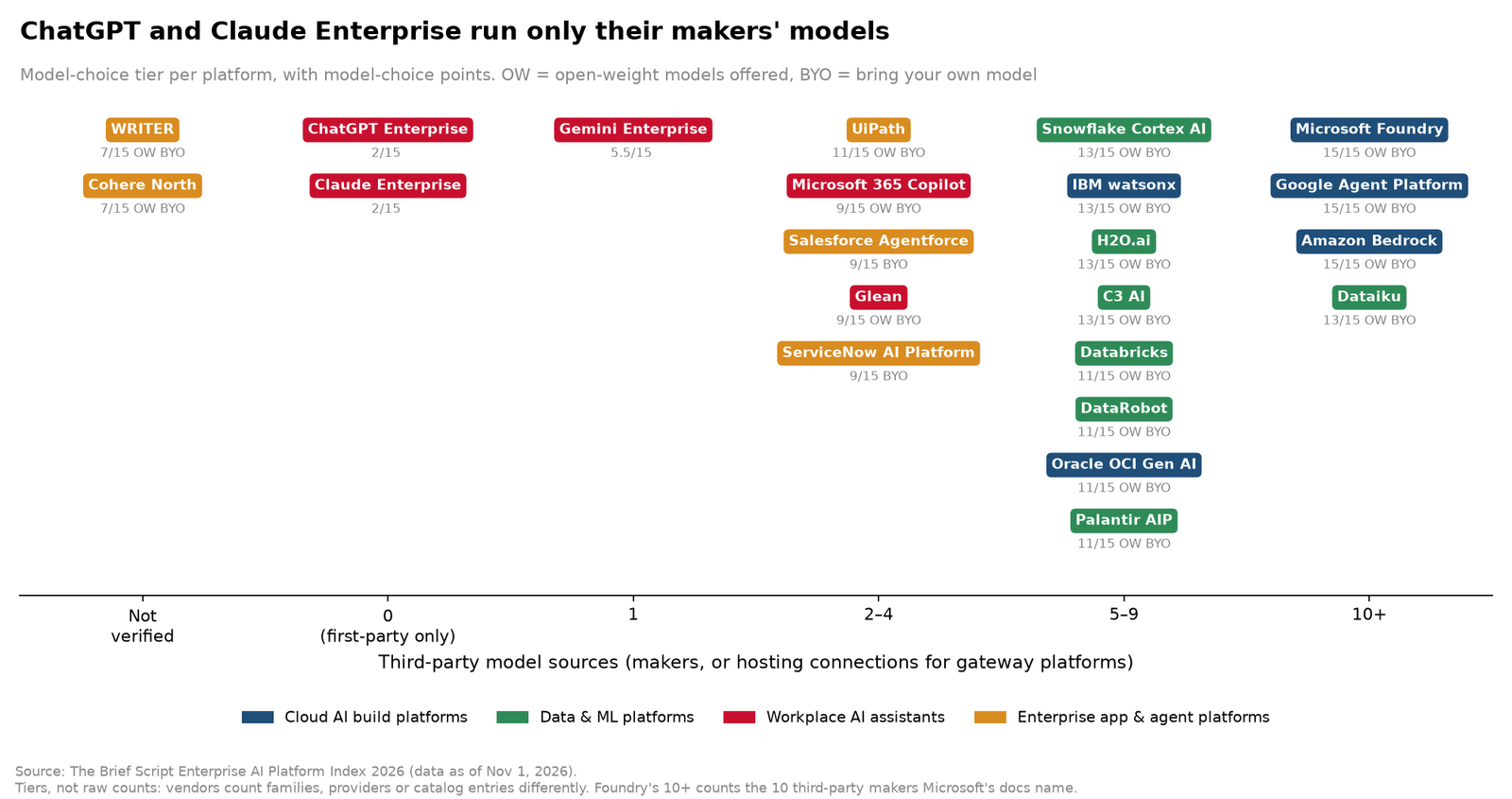
Open-weight models are offered on 17 platforms, and bring-your-own-model on 19.
Buyer playbook: which enterprise AI platform fits your stack?
- AWS: Start with Amazon Bedrock (89.8): 18 third-party model providers and 35 regions. If you need on-prem, add a self-hosted layer (Dataiku, DataRobot or H2O.ai), because Bedrock has none.
- Azure / Microsoft 365: Microsoft Foundry (93.0) for builders, Microsoft 365 Copilot (81.0) for employees. Check gov-cloud feature parity and the EU Data Boundary exclusion for Anthropic models before rollout.
- Google Cloud / Workspace: Google Agent Platform (92.0) for builders and Gemini Enterprise (72.5) for employees. Buy Standard or Plus if you need the compliance controls.
- Snowflake or Databricks data estates: Keep AI next to the data. Snowflake Cortex AI (80.0) leads on compliance and pricing clarity. Databricks (72.5) leads on open-model breadth and scale. Add Dataiku (70.5) if you need one orchestration layer across both.
- Salesforce / ServiceNow: Use the native platform for in-workflow agents: Agentforce (80.0) has the clearest published price list in its category. ServiceNow (63.5) pairs FedRAMP High with ISO 42001 but needs a quote. Use A2A (supported by both) to connect them to your build platform.
- Regulated and air-gapped: Shortlist the six air-gapped options. For US federal work, Google Agent Platform, H2O.ai (FedRAMP High) and Palantir AIP (FedRAMP High, IL5/IL6) stand out. Cohere North and Dataiku suit private deployments without FedRAMP requirements.
Pricing reality: seat vs token vs credit vs quote
Enterprise AI pricing comes in four shapes, and most platforms mix two:
- Seats suit assistants: Claude Enterprise at $20, Microsoft 365 Copilot at $30, and Gemini Enterprise from $21. Watch for usage billed on top. Claude Enterprise includes no usage in the seat.
- Tokens suit build platforms (Foundry, Bedrock, Google, IBM, Oracle, the WRITER API). To compare per-token list prices across providers, use our AI API Price Index. To estimate your volume, try the AI token counter.
- Credits abstract both: Salesforce Flex Credits ($500 per 100,000), Snowflake AI Credits ($2.00), Microsoft Copilot Credits and ServiceNow “assists.” Ask for the credit-to-action table in writing.
- Quotes: Dataiku, Glean, ServiceNow, Cohere North and ChatGPT Enterprise are quote-only. DataRobot, Palantir AIP and H2O.ai publish nothing. Budget for a procurement cycle before you can compare.
Methodology
Universe and date. 22 platforms in four categories, covering the products most often compared in “enterprise AI platform” searches. Data as of November 1, 2026.
Sources. Each of the 29 scored fields has its own source URL: vendor product pages, docs, pricing pages, trust centers, SEC filings and investor materials, analyst abstracts and vendor releases, and G2. Secondary sources (press coverage, trackers, third-party summaries) are used only where nothing official exists, and marked †.
Blanks policy. A blank means we couldn’t verify the fact. It scores 0 and is never imputed. Each platform’s verified-field coverage is published (mean 86.1%, range 69.0% to 96.6%). Low coverage can mean missing features or just thin documentation, so check the blank fields in the dataset before drawing conclusions.
Scoring rubric (100 points).
- Model choice (15): third-party model sources in tiers (0/1/2–4/5–9/10+ = 0/2/4/6/8 points), plus open-weight models (2), bring-your-own model (3) and first-party models (2). We use tiers because vendors count model families, providers or catalog entries differently. Microsoft’s 10+ tier counts the 10 third-party model makers named in its Foundry Models documentation.
- Pricing transparency (10): price list Full 6 / Partial 3 / Quote 0; entry price visible (2); clear billing meter (2, only when a rate is published).
- Security & compliance (20): SOC 2 (3), ISO 27001 (3), ISO 42001 (4), HIPAA BAA (4), FedRAMP (High 4, Moderate 3, In process 1) and GDPR DPA (2).
- Data control (20): no training on customer data by default (4), customer-managed keys (3), private networking (3), data residency (0–4), on-prem/hybrid (3) and air-gapped (3).
- Agent capability (20): builder (both low- and pro-code 4, one of them 3), MCP (3), A2A (3), multi-agent orchestration (4), evals/observability (3) and guardrails (3).
- Ecosystem & market proof (15): analyst placement (Leader 6, Strong Performer/Challenger/Visionary 3, other listing 1), disclosed scale (0–5; whole-cloud or whole-company revenue such as Google Cloud’s or Oracle OCI’s counts as 1), G2 (up to 2, zero below 50 reviews, half credit at 50–99) and connectors (up to 2).
- “Partial” earns half points.
Sensitivity. Equal weights, six leave-one-pillar-out runs, no secondary-sourced analyst placements, and no G2 or connectors. The top three held in all ten.
Limitations. – Analyst reports aren’t comparable. Placements come from different Magic Quadrants and Waves with different market definitions (AI app development, data science and ML, enterprise assistants, conversational AI, ITSM, automation). The Microsoft, Anthropic and Glean placements in Gartner’s Enterprise AI Assistants MQ come from press coverage†. Most Forrester AI Platforms placements (all but C3 AI’s) come from third-party summaries†. Gartner’s April 2026 midcycle update kept AWS, Google, IBM and Microsoft as Leaders in AI application development platforms. – Checklists measure availability, not quality. A “Y” for multi-agent orchestration doesn’t say how well it works. Preview features (UiPath’s MCP/A2A gateway) count as Y. – Scale figures differ in scope (product, platform or whole company), and G2 profiles often cover more than the scored product. – This is a snapshot. At least eight of these products were renamed, repriced or repackaged during 2026.
FAQ
What is the best enterprise AI platform in 2026? Overall, Microsoft Foundry (93.0), narrowly ahead of Google Agent Platform (92.0) and Amazon Bedrock (89.8); that top three holds under every weighting we tested. Your best choice usually follows your cloud and data estate.
What are the main types of enterprise AI platforms? Cloud AI build platforms, data and ML platforms, workplace AI assistants, and enterprise app and agent platforms. Compare within a type first.
Which enterprise AI platforms publish their pricing? Nine of 22 publish a full price list: Microsoft Foundry, Amazon Bedrock, Google Agent Platform, Oracle, Databricks, Snowflake, Claude Enterprise, Microsoft 365 Copilot and Salesforce Agentforce. Claude Enterprise is the only workplace assistant with a published Enterprise seat price ($20 per seat per month plus usage).
Which enterprise AI platforms can run on-prem or air-gapped? Ten document on-prem or hybrid deployment. Six document air-gapped: Google Agent Platform, Dataiku, DataRobot, H2O.ai, UiPath and Cohere North.
Do enterprise AI platforms train on my data? Of the 22, 14 state no training on customer data by default, 2 do so only for some deployments (ServiceNow, Cohere North), UiPath allows an opt-out only on Standard+ plans, and 5 weren’t verified.
Do all enterprise AI platforms support MCP and A2A? All 22 document MCP support. A2A is native on 14, partial on 2 (Databricks, Snowflake) and unverified on 6.
Download the data
The dataset is free to reuse with attribution (CC-BY 4.0):
- briefscript_enterprise_ai_platform_index_2026.csv: one row per platform with category, pillar scores, total, rank, coverage, key fields (normalized), and a source URL for each field.
- briefscript_enterprise_ai_platform_index_2026_sensitivity.csv: ranks under all ten scenarios.
- The field-by-field scoring rubric: see the methodology above.
Cite this report: The Brief Script, “Enterprise AI Platform Index 2026,” November 2026. thebriefscript.com/enterprise-ai-platform/
† Secondary source (press coverage, tracker or third-party summary), not confirmed by the vendor or analyst firm.