What Is Physical AI? (2026 Guide)
Physical AI explained: how it differs from generative and agentic AI, the Nvidia stack, the humanoid and robot-brain companies, real deployments, market forecasts and what enterprises should do now.

Physical AI is artificial intelligence that senses the real world, reasons about it and acts in it through a machine, such as a robot, a robotaxi or a factory arm. Instead of producing text or images, it produces movement. It is trained largely on sensor data, simulation and synthetic data.
Nvidia, which has made the term its own, describes physical AI as the technology that lets “autonomous machines, such as robots in factories and robotaxis, perceive, understand, and perform complex actions in the physical world,” according to its physical AI glossary. BMW uses a plainer version in its June 2026 press release: physical AI “connects digital AI with real machines and robots.”
The idea is not new: warehouse robots and self-driving cars have used AI for years. What changed in 2025 and 2026 is that the foundation-model approach behind ChatGPT reached robots. Companies now train general “robot brains” that learn many tasks instead of programming one at a time, and that shift pulled in record funding.
Every company fact below comes from a company announcement, filing or credible news report checked on November 1, 2026. Where a number is a report or forecast rather than a disclosed fact, we say so.
Physical AI vs generative AI vs agentic AI vs robotics
Physical AI sits next to three terms it is often confused with. The short version: generative AI makes content, agentic AI takes actions in software, traditional robotics follows fixed programs, and physical AI takes actions in the real world using learned models.
| Generative AI | Agentic AI | Traditional robotics | Physical AI | |
|---|---|---|---|---|
| What it produces | Text, images, code, video | Multi-step actions in software | Pre-programmed motions | Movement and physical actions |
| Main inputs | Prompts and documents | Goals, tools, APIs | Fixed coordinates and rules | Cameras, lidar, touch, force and language |
| Where it runs | Cloud data centers | Cloud and business apps | Factory controllers | On the machine (edge) plus cloud training |
| How it learns | Internet-scale text and media | Language models plus tool use | Hand-coded by engineers | Real demonstrations, simulation, synthetic data |
| Handles new situations | Yes, in content | Yes, in software workflows | Poorly, needs reprogramming | Increasingly, the core goal |
| Cost of a mistake | A wrong answer | A wrong transaction | A stopped line | Physical damage or injury |
| Examples | ChatGPT, Gemini | Coding and service agents | Welding arms, fixed AGVs | Waymo, Digit, Figure 03, Atlas |
Nvidia draws the core line in its own FAQ: “Generative AI creates content such as text, images, and code, while physical AI helps autonomous machines perceive, reason about, and act in the real world.” Agentic AI is closer, because it also acts, but its actions stay inside software. If you are still sorting out that distinction, our explainer on AI agents vs agentic AI and our guide to agentic AI cover it in depth.
The line with traditional robotics is flexibility. A classic industrial robot repeats exact motions in a caged cell. A physical AI system is meant to see a messy bin, decide what to pick and adjust its grip.
People also use the term embodied AI. In practice it means the same thing: AI that has a body and learns through interacting with the world. “Embodied AI” is the older research term. “Physical AI” is the industry and marketing term Nvidia popularized.
How physical AI works: the stack
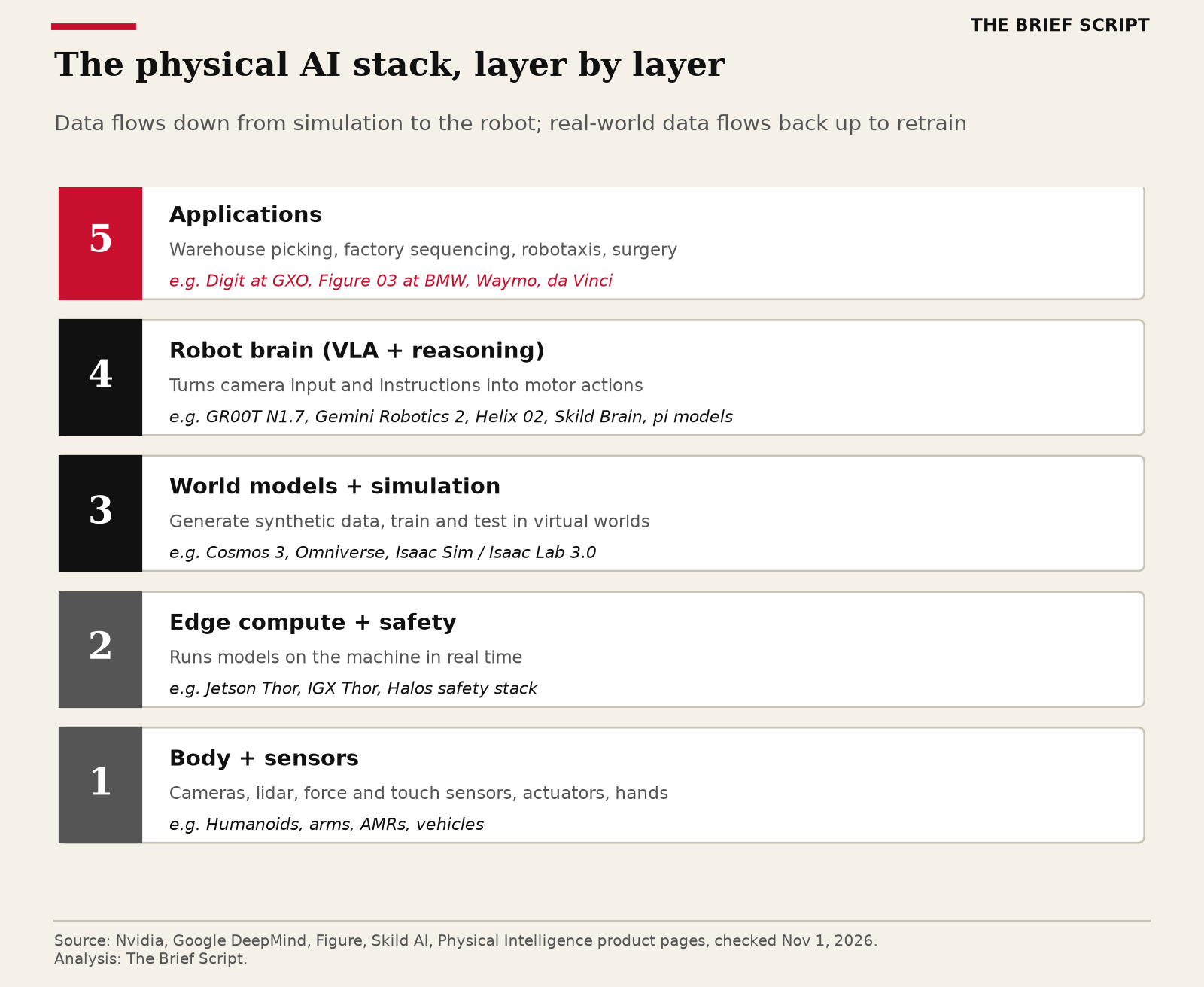
Nvidia describes physical AI development as a “three-computer” loop: one computer to train models, one to simulate and validate them, and one on the machine to run them, with safety across all three. That maps to five layers.
1. Body and sensors
The machine itself: cameras, lidar, force and touch sensors, motors and hands. Hands are the hard part. Tesla CEO Elon Musk said on the company’s Q3 2026 call that Optimus hands, durability and AI still need work before customer deliveries, as Electrek reported.
2. Edge compute and safety
Robots cannot wait for a cloud round trip, so models run on board. Nvidia’s Jetson Thor is the reference chip for humanoids. In the spec for the Agile ONE SN reference humanoid, Nvidia lists Jetson Thor at 2,070 FP4 teraflops with 128GB of unified memory, per its October 2026 Isaac announcement. The same release covers Halos, Nvidia’s safety stack built on the industrial IGX Thor platform, which became generally available in March. For the wider chip picture, see our AI chip news tracker and our edge AI news roundup.
3. World models and simulation
This is the layer that makes physical AI practical. Real robot data is slow and expensive to collect, so developers train and test in simulation and generate synthetic data. World models are AI models that predict how a scene will change, which lets them create realistic training video and test scenarios.
- Nvidia Cosmos 3, launched June 1, 2026, is an open world foundation model family. Nvidia’s press release also announced a Cosmos Coalition that includes Skild AI, Agile Robots and Runway. The family comes in Super (64B parameters), Nano (16B) and Edge (4B) sizes, and Edge runs on Jetson Thor, according to the Nvidia blog.
- Omniverse and Isaac Sim build physically accurate digital twins of factories and robots. Isaac Lab 3.0, Nvidia’s robot learning framework, became generally available in October 2026.
- Synthetic data pipelines, such as Nvidia’s Physical AI Data Factory Blueprint from GTC 2026, turn compute into training data.
The payoff can be concrete. Toyota Material Handling Europe and SoftServe use Omniverse and Isaac Sim to cut deployment time for autonomous material-handling systems by up to 50%, Nvidia says.
4. The robot brain: VLA models
Vision-language-action (VLA) models are the core breakthrough. They take in camera images and a plain-language instruction (“put the red part in bin three”) and output motor commands. Most leaders pair a VLA with a slower reasoning model that plans multi-step tasks.
- Nvidia Isaac GR00T: open humanoid foundation models. GR00T N1.7 shipped at GTC in March 2026, and Nvidia previewed GR00T N2, which it says helps robots succeed at new tasks in new environments “more than twice as often as leading vision language action models.” N2 is slated for the end of 2026, per Nvidia.
- Google DeepMind Gemini Robotics 2: launched July 30, 2026 as three models, a VLA, an embodied reasoning model (ER 2) and an on-device version, per DeepMind. ER 2 entered public preview on Google Cloud on October 27.
- Figure Helix 02, Skild Brain and Physical Intelligence’s pi models are the main independent brains, covered below.
5. Applications
The top layer is the job: picking totes, sequencing car parts, driving passengers. Real-world data from those jobs flows back to retrain the models, which is why Tesla and 1X want large fleets early, even before the robots are fully autonomous.
Physical AI companies to know in 2026
The market splits into four groups: the platform supplier (Nvidia), humanoid makers, robot-brain developers, and companies already running physical AI at scale in vehicles and warehouses.
| Company | Focus | Flagship product | Latest funding / valuation | Deployment status (Nov 2026) |
|---|---|---|---|---|
| Nvidia | Platform: chips, simulation, models | Jetson Thor, Cosmos 3, Isaac GR00T | Public; Q2 FY27 revenue $96.2B | Supplies most of the ecosystem |
| Tesla | Humanoid | Optimus | Public | Early production in Fremont; outside deliveries targeted for late 2027 |
| Figure AI | Humanoid | Figure 03, Helix 02 | $39B post-money (Series C, Sept 2025) | Figure 03 at BMW Spartanburg on sequencing |
| Agility Robotics | Humanoid | Digit (Digit 5 unveiled) | $2.5B pre-money SPAC deal | Commercial at GXO; two more GXO sites from early 2027 |
| Boston Dynamics (Hyundai) | Humanoid | Atlas | Hyundai subsidiary | Training at Hyundai’s Georgia plant; line work from 2028 |
| 1X | Home humanoid | NEO | Reported SoftBank talks at ~$6B (not closed) | Factory running; customer deliveries promised in 2026 |
| Apptronik | Humanoid | Apollo 2 | $520M extension; ~$5.3B to $5.5B+ reported | Working in designated areas at Mercedes-Benz, GXO, Jabil |
| Physical Intelligence | Robot brain | pi models | $11.5B (2026); talks at ~$20B reported | Pre-revenue; beta access for developers |
| Skild AI | Robot brain | Skild Brain | >$14B (Series C, Jan 2026) | Commercial; about $30M revenue as of January |
| Google DeepMind | Robot brain | Gemini Robotics 2 | Alphabet unit | ER 2 in public preview; VLA with partners |
| Unitree | Humanoid and quadruped | G1, R1, H2 | IPO at ~$9B; ~$50B after day one | Best-selling humanoid maker; profitable |
| Waymo | Autonomous vehicles | Waymo Driver | $126B (Feb 2026) | ~500,000 paid rides a week in 15 US cities |
| Amazon | Warehouse robotics | Proteus, Vulcan, DeepFleet | Public | 1 million+ robots deployed since 2012 |
Nvidia: the platform under almost everyone
Its March 2026 GTC partner list for physical AI included ABB, Agility, CMR Surgical, FANUC, Figure, KUKA, Medtronic, Skild AI and Universal Robots. On the Q2 fiscal 2027 call in August, Nvidia said Amazon would adopt its full physical AI stack (Omniverse, Cosmos, Isaac and Jetson) for its warehouse robots. Keep the scale in proportion: Nvidia reported $96.2 billion in Q2 revenue, and $89.0 billion of that was data center. Robots are a strategic bet, not yet a large revenue line; the AI infrastructure that trains these models is where Nvidia’s money comes from.
Tesla Optimus
Tesla’s Q3 2026 update says Optimus production began on high-volume lines in Fremont and calls the units “the first production-quality bots that we have manufactured.” Its capacity table lists California Optimus as “Early Ramp” and Texas as “Construction.” Musk called it early production and said deliveries to outside companies are likely toward the end of 2027, with a goal of 20,000 robots a week after “at least a year,” per TechCrunch. Tesla did not disclose how many robots it has built or what they can do on their own, The Verge noted.
Figure AI
Figure is the most highly valued humanoid startup. It raised more than $1 billion at a $39 billion post-money valuation in September 2025, per CNBC, and about $1.9 billion in total, according to Forbes. Forbes also reported a $3.5 billion compute commitment with Nscale, larger than everything Figure has raised. At BMW’s Spartanburg plant, Figure 02 contributed to the assembly of 30,000 cars in 2025, and Figure 03 has moved to a harder logistics sequencing job, Figure says.
Agility Robotics
Agility has the clearest commercial track record among humanoid makers. Digit runs under a robots-as-a-service deal at GXO’s Flowery Branch, Georgia site, where it has moved more than 100,000 totes, and GXO is adding sites in North Carolina and Tennessee from early 2027, per GXO. Agility is going public through a merger with Churchill Capital Corp XI at a $2.5 billion pre-money equity value and reports more than $300 million in multi-year Digit 5 orders, according to its announcement.
Boston Dynamics and Hyundai
Boston Dynamics unveiled the product version of Atlas at CES in January and said all 2026 units were committed to Hyundai’s training center and Google DeepMind, per Boston Dynamics. Hyundai’s plan is deliberate: Atlas starts on parts sequencing at its Georgia Metaplant in 2028 and moves to component assembly by 2030, per Hyundai Motor Group. Hyundai has also said it plans to deploy more than 25,000 Atlas units across Hyundai and Kia plants.
1X, Apptronik and Unitree
1X sells NEO, a home humanoid, for $20,000 or $499 a month. Its Hayward, California factory went live in April and is ramping toward 10,000 units a year, but 1X said early units would go to internal testing first, per 1X. Apptronik raised a $520 million extension in February, bringing its Series A to more than $935 million, with Google, Mercedes-Benz and John Deere among investors, per Apptronik. Unitree is the volume leader. Its prospectus says it shipped more than 5,500 humanoids in 2025 for a 32.4% global share, as Xinhua reported. Its Shanghai IPO priced at a roughly $9 billion valuation, per Reuters, and the company is profitable.
Robot brains: Physical Intelligence, Skild AI and Gemini Robotics
Skild AI raised $1.4 billion at a valuation above $14 billion in January, led by SoftBank, per Skild. Its “omni-bodied” Skild Brain is designed to control any robot. Physical Intelligence, founded in 2024, was valued at $11.5 billion earlier this year and is in talks to raise at least $1 billion at about $20 billion with no current revenue, Bloomberg reported. Google DeepMind’s Gemini Robotics 2 lineup gives Google a direct path to enterprises through Google Cloud.
Physical AI examples by industry
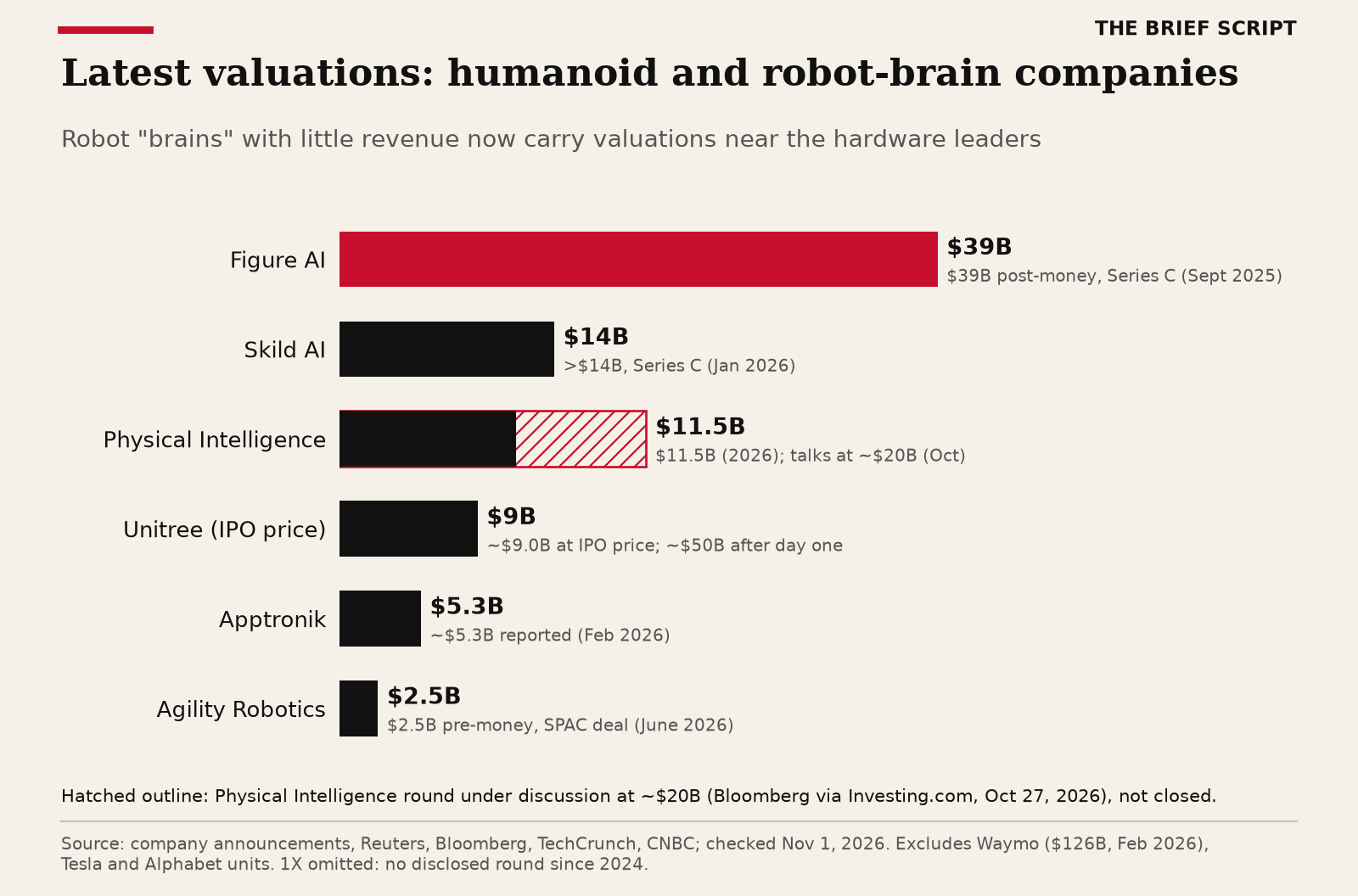
Ranked roughly from most to least mature:
Warehouses and logistics
This is the most mature use. Amazon says it has deployed more than 1 million robots across its operations network since 2012, coordinated by a generative AI foundation model called DeepFleet, per Amazon. Its Vulcan robot uses touch sensors to pick and stow items. Not every project survives, though. Amazon halted its Blue Jay multi-arm robot less than six months after unveiling it, TechCrunch reported. Humanoids are entering through logistics: Agility’s Digit at GXO and Apptronik’s Apollo at GXO are the leading examples.
Factories and automotive
Carmakers are the first big humanoid customers because their plants are structured. Figure 03 is sequencing parts at BMW Spartanburg. Hyundai’s Robotics Metaplant Application Center opened in September 2026 to train Atlas on the same kind of work, per Boston Dynamics. Toyota Motor Manufacturing Canada and Schaeffler are Agility customers. Most factory humanoid work is still a small group of robots on one task, under evaluation.
Autonomous driving
Robotaxis are the largest physical AI deployment by revenue and miles. Waymo provides about 500,000 paid rides a week across 15 US cities with roughly 4,000 vehicles, according to TechCrunch. It raised $16 billion at a $126 billion valuation in February and closed its first $5 billion debt financing in October. Waymo says more than 249 million autonomous miles show 95% fewer crashes involving serious injury or worse than human drivers, per a Reuters report. The economics are still early. Alphabet’s Other Bets segment, which holds Waymo, posted $372 million in Q3 revenue and a $2.05 billion operating loss, per Fortune.
Healthcare
Surgical robotics is mature, and AI features are being layered onto it. Intuitive Surgical had 12,094 da Vinci systems installed as of September 30, 2026, and procedures grew about 15% year over year in Q3, per Intuitive. CMR Surgical and Medtronic are building on Nvidia’s physical AI tools. The EU AI Act lists AI safety components in robot-assisted surgery as an example of high-risk AI, per the European Commission.
Homes and hospitality
This is the least mature segment. 1X has taken 10,000 NEO preorders, the company says, but we could not find independent confirmation of customer deliveries as of late October. In hotels, Bellboy’s Billie robot, built on Nvidia Jetson and GR00T, is deployed at properties run by Marriott, Hilton, IHG and OYO, Nvidia says.
Physical AI market size and funding
Forecasts vary because each firm measures something different. Treat them as scenarios, not facts.
| Forecaster | Horizon | Forecast | What it measures |
|---|---|---|---|
| Goldman Sachs (Aug 2026) | 2035 | 6.48 million units, $138 billion | Humanoid robot sales |
| BofA Global Research (Mar 2026) | 2030 / 2035 | 1.2 million / 10 million units a year | Humanoid shipments |
| UBS (via Deloitte) | 2035 / 2050 | 2 million / 300 million in workplaces | Humanoids in use |
| Morgan Stanley | 2050 | About $5 trillion, 1 billion+ in use | Humanoid market |
| Morgan Stanley Robot Almanac (Sept 2026) | 2050 | $25 trillion a year | All AI robotics product revenue |
Goldman Sachs raised its 2035 humanoid forecast from 1.38 million to 6.48 million units, Investing.com reported. BofA projects shipments rising from 20,000 in 2025 to 90,000 in 2026, per the Bank of America Institute. Morgan Stanley’s long-range numbers are in its humanoid outlook. For context, Unitree, the leader, shipped about 5,500 humanoids last year.
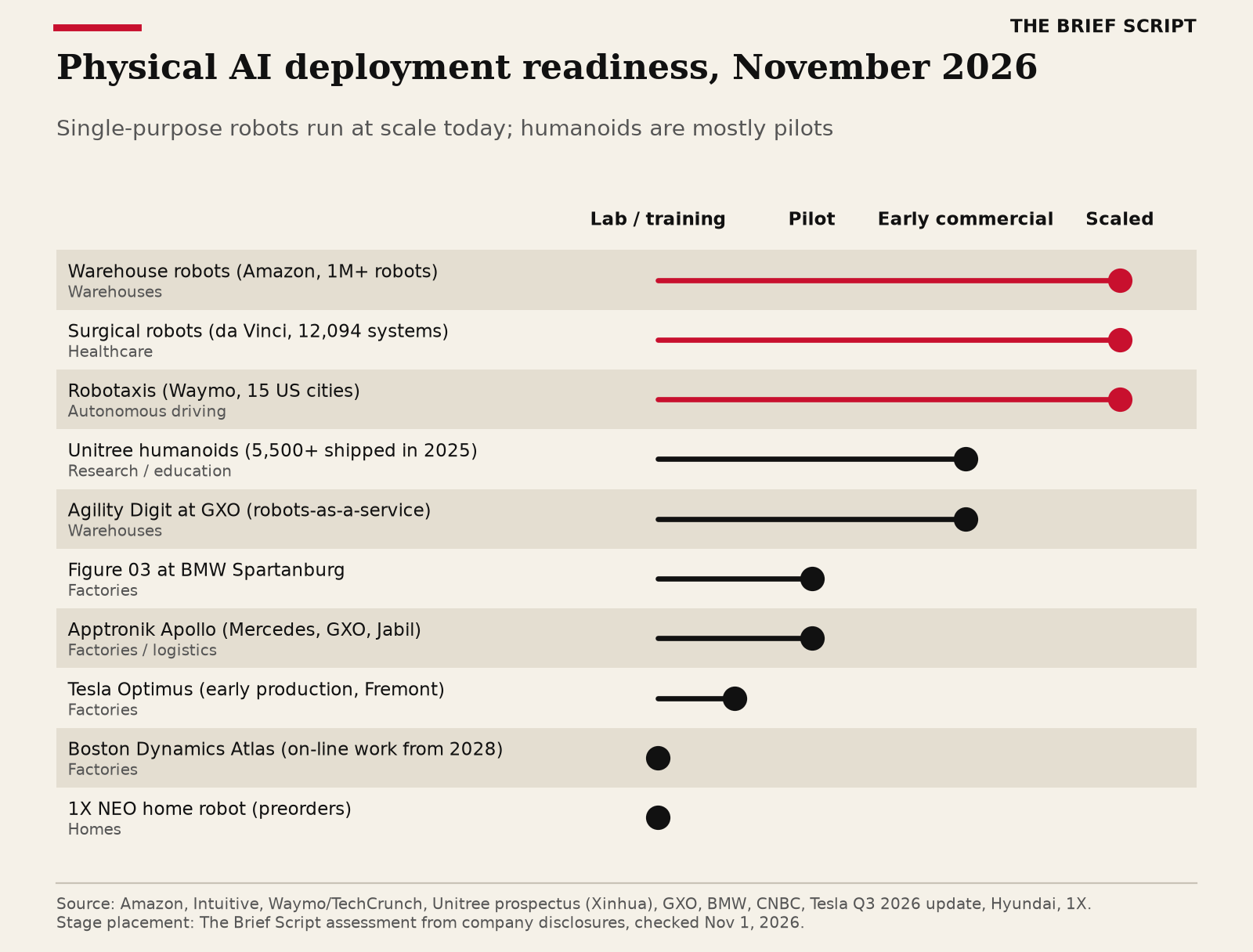
Funding is outrunning deployments. Crunchbase counted $47.4 billion of venture funding into physical AI in the first half of 2026, across 521 deals, more than the $41.9 billion raised in 2022 through 2024 combined, per Crunchbase News. That definition includes robotics, autonomous vehicles, aerospace and drones. PitchBook, using a narrower robotics and physical AI category, recorded a record $18.6 billion in Q2 2026, per PitchBook.
Challenges holding physical AI back
Safety and standards
A wrong answer from a chatbot is an annoyance. A wrong move by a full-size humanoid near a person can be an injury. Standards are behind the hardware. ISO 25785-1, the safety standard for dynamically stable industrial mobile robots such as humanoids, was still a committee draft as of July 2026, per ISO project records. The revised US industrial robot standard, ANSI/A3 R15.06-2025, does not specifically cover humanoids, according to A3. That is one reason humanoids mostly work in fenced or designated zones today, and why “cooperatively safe” design is Agility’s main pitch for Digit 5.
Regulation
In Europe, the new Machinery Regulation applies from January 20, 2027. It requires third-party conformity assessment for safety components that use machine learning, per Safety Tech Review’s summary of the text. Under the EU’s Digital Omnibus agreement, machinery is being moved out of the AI Act’s own high-risk product list so the Machinery Regulation becomes the main safety baseline, per the EU Machinery and Advanced Manufacturing Platform. Robotaxis face separate city, state and national approvals, which is why Waymo expands one city at a time.
Data
There is no internet of robot motion to train on. That is why simulation, synthetic data and teleoperation dominate. 1X has robots steered remotely by staff for tasks they have not learned yet, and Apptronik runs “Robot Park” sites to collect data with Google DeepMind. Simulated results also do not always carry over. Nvidia’s own guidance warns that “performance in simulation may not fully predict behavior after deployment.”
Cost and proof of value
Prices are falling. Unitree lists its G1 humanoid at $13,500 and 1X lists NEO at $20,000. But for a factory, reliability, uptime and speed matter more than sticker price, and few vendors publish those numbers. Tesla has not disclosed Optimus output, and Physical Intelligence has no revenue. Investors are paying for future capability. Buyers should not.
What physical AI means for enterprises
Single-purpose systems such as warehouse robots, surgical robots and robotaxis already work at scale. General-purpose humanoids are in pilots. Here is a practical plan.
- Start with structured, repetitive, measurable work. Tote moving, parts sequencing, machine tending and palletizing are where humanoids and mobile manipulators are proving out. Avoid tasks that need fine dexterity or close contact with people for now.
- Buy outcomes, not robots. Agility’s deal with GXO is robots-as-a-service. Ask vendors for pricing tied to throughput and uptime, and include exit clauses.
- Demand hard numbers in pilots. Ask for autonomous success rate, interventions per hour, mean time between failures and the share of work done by teleoperation. If a vendor will not share them, assume the robot is not ready.
- Build a digital twin first. Simulating a cell in Omniverse or a similar tool is cheaper than rearranging a plant floor, and it gives you the layout and data you will need anyway.
- Plan the data and compute. Physical AI needs on-device compute, clean sensor data pipelines and cloud capacity for retraining. Tie it to your existing enterprise AI platform rather than creating a separate robotics island.
- Treat safety and compliance as design inputs. If you sell into or operate in the EU, map robots against the Machinery Regulation before January 2027. Involve safety committees and worker representatives early.
- Avoid lock-in on the brain. The robot-brain layer is changing fast. Gemini Robotics, GR00T, Skild and Physical Intelligence are competing to work across many robot bodies. Favor hardware that supports more than one model stack.
The bottom line: physical AI will reward companies that run disciplined pilots now, not those that sign large humanoid orders based on demo videos.
FAQ
What is physical AI in simple terms?
Physical AI is AI that controls a machine in the real world. It uses sensors such as cameras to understand its surroundings, decides what to do, and then moves, for example a robot picking up a box or a car steering through traffic.
What are some physical AI examples?
The most mature examples are Waymo’s robotaxis, Amazon’s warehouse robots and Intuitive’s da Vinci surgical systems. Newer examples include Agility’s Digit humanoid moving totes at GXO, Figure 03 sequencing parts at BMW and Boston Dynamics’ Atlas training at Hyundai’s Georgia plant.
What is the difference between physical AI and generative AI?
Generative AI creates content such as text, images and code. Physical AI creates actions in the physical world. Many physical AI systems use generative techniques inside them, such as world models that generate synthetic training video, but their output is movement.
Is physical AI the same as embodied AI?
Mostly, yes. Embodied AI is the older research term; physical AI is the industry term Nvidia popularized. Both describe AI that perceives and acts in physical space.
What is Nvidia’s role in physical AI?
Nvidia supplies much of the stack: Jetson Thor chips that run on robots, Omniverse and Isaac for simulation, Cosmos world models for synthetic data, and Isaac GR00T foundation models for humanoids. Its partners include Figure, Agility, Skild AI, ABB, FANUC and KUKA.
Which physical AI companies are worth watching?
Figure AI, Agility Robotics, Boston Dynamics, Tesla, Apptronik, 1X and Unitree lead on humanoid hardware. Physical Intelligence, Skild AI and Google DeepMind lead on robot brains. Nvidia is the platform supplier, and Waymo and Amazon run the largest deployments today.