AI Agents vs Agentic AI: What’s the Real Difference?
An AI agent handles one goal with its own steps and tools. Agentic AI is the system that plans, coordinates and governs one or more agents toward a bigger outcome. Here is how they differ, real enterprise examples of each, and how to choose.

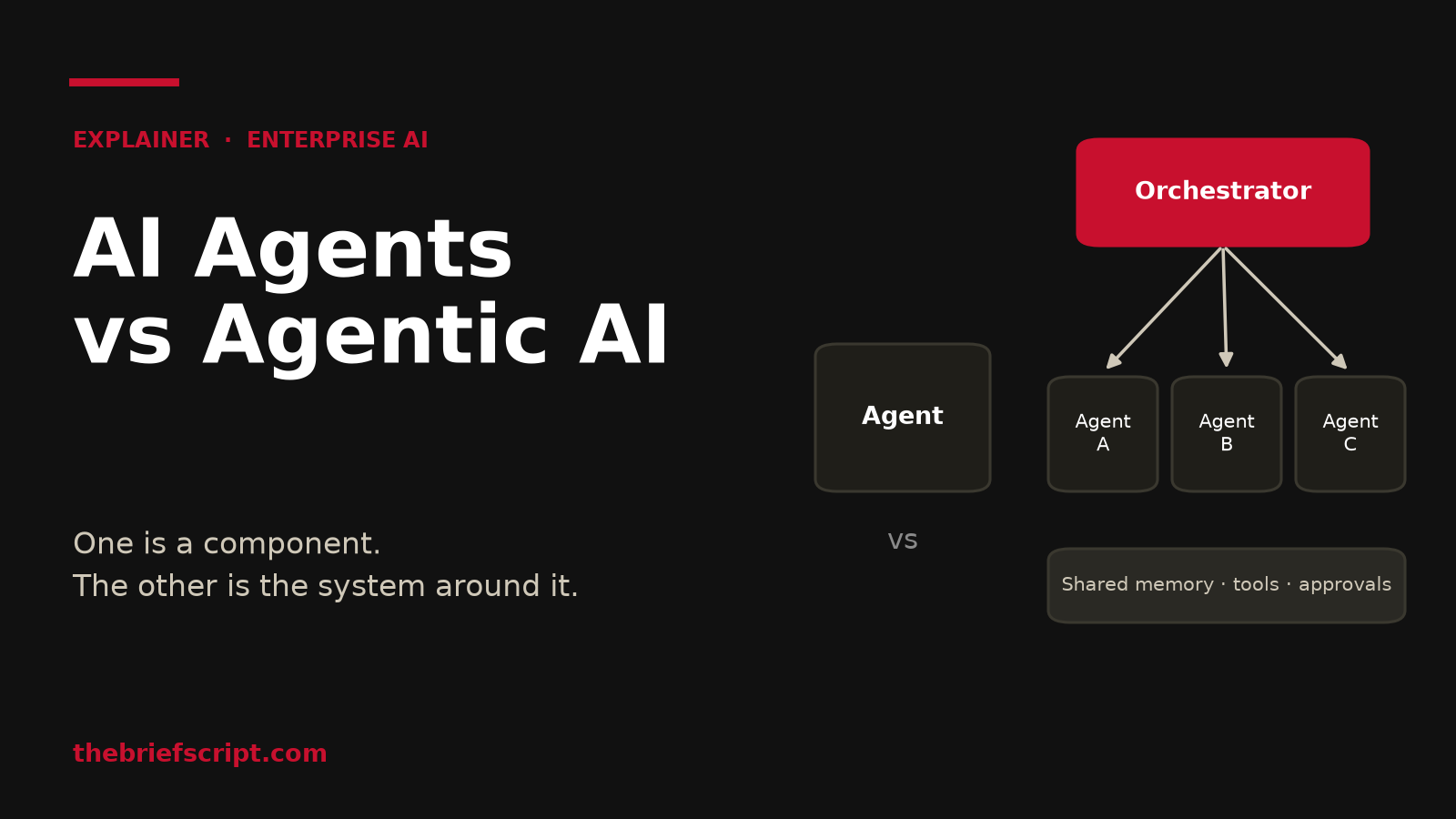
An AI agent is a single software system that uses a model to pursue one goal, choosing its own steps and calling tools to finish a bounded task. Agentic AI is the broader system design in which one or more agents plan, coordinate, remember, and act toward a larger goal with limited supervision, usually through orchestration across several tools, systems, and teams.
Put simply, an AI agent is a component and agentic AI is the architecture and operating model built around it. Cost, risk, and governance effort all rise as you move from one to the other, which is a big reason Gartner expects more than 40% of agentic AI projects to be canceled by the end of 2027.
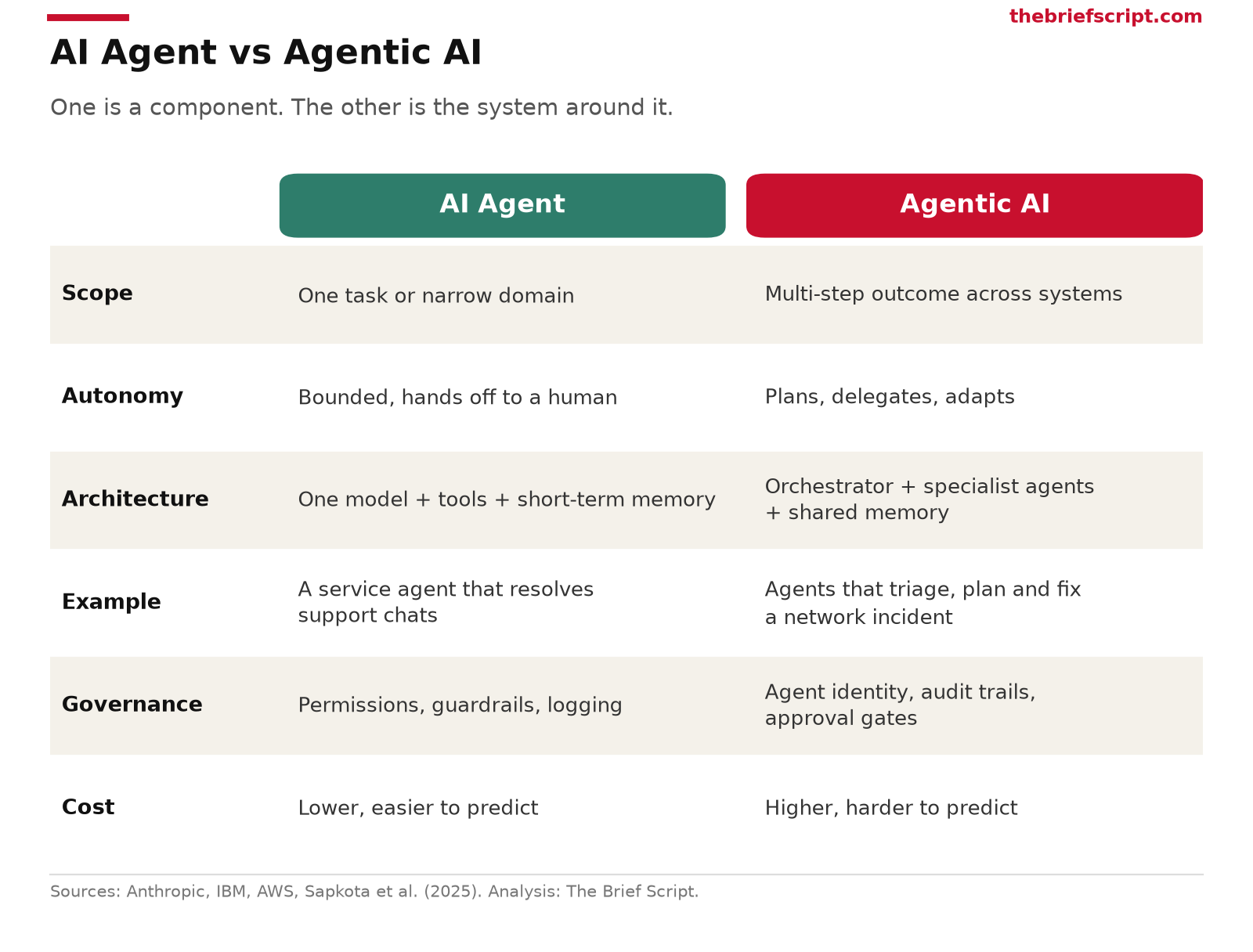
AI agent vs agentic AI at a glance
| Dimension | AI agent | Agentic AI |
|---|---|---|
| Definition | A model-driven system that pursues a goal by deciding its own steps and calling tools in a loop | A system of one or more agents that plans, coordinates, and acts toward a broader goal with limited supervision |
| Scope | One task or a narrow domain, such as resolving a support chat | A multi-step business outcome that spans systems or departments, such as onboarding a customer |
| Autonomy | Bounded: acts within one session or task, often hands off to a human | Higher and longer-running: decomposes goals, delegates subtasks, and adapts the plan as it goes |
| Architecture | One model plus tools, retrieval, and short-term memory | Orchestrator or supervisor, specialist agents, shared or persistent memory, and inter-agent communication |
| Examples | A service agent that answers and resolves chats; an internal procedures agent for staff | ServiceNow AI Agent Orchestrator; multi-agent orchestration in Microsoft Copilot Studio and Salesforce Agentforce |
| Governance needs | Tool permissions, guardrails, logging, escalation rules | All of that plus agent identity, cross-agent audit trails, approval gates, stopping conditions, and sprawl control |
| Cost | Lower and easier to predict | Higher and harder to predict: more model calls, more integration work, more oversight |
What is an AI agent?
Google Cloud defines AI agents as “software systems that use AI to pursue goals and complete tasks on behalf of users,” with reasoning, planning, memory, and “a level of autonomy” (Google Cloud). Anthropic draws the line more sharply: agents are systems “where LLMs dynamically direct their own processes and tool usage,” as opposed to workflows that follow predefined code paths. In practice, Anthropic notes, agents “are typically just LLMs using tools based on environmental feedback in a loop” (Anthropic, Building effective agents).
The academic framing lands in the same place. Sapkota, Roumeliotis, and Karkee describe AI agents as “modular systems driven and enabled by LLMs and LIMs for task-specific automation,” and map them to applications such as customer support, scheduling, and data summarization (Sapkota et al., arXiv 2505.10468).
The defining traits of an AI agent:
- It works toward one goal at a time.
- It picks its own next step rather than following a fixed script.
- It uses tools: APIs, databases, search, or a browser.
- It usually runs inside one product or workflow and hands off to a human when stuck.
What is agentic AI?
IBM defines agentic AI as “an artificial intelligence system that can accomplish a specific goal with limited supervision,” made up of AI agents. “In a multiagent system, each agent performs a specific subtask required to reach the goal and their efforts are coordinated through AI orchestration” (IBM). AWS adds that agentic AI “typically builds upon multiple hyperspecialized agents,” and that while single-agent setups exist, most agentic deployments are multi-agent (AWS).
Sapkota et al. call agentic AI “a paradigm shift marked by multi-agent collaboration, dynamic task decomposition, persistent memory, and coordinated autonomy,” with deployments in research automation, robotic coordination, and medical decision support (arXiv 2505.10468).
One caution on vocabulary: vendors do not use these terms identically. Anthropic uses “agentic systems” as an umbrella that covers both fixed workflows and autonomous agents. The most useful reading for buyers is that “agentic” describes how much of the plan the system controls, not a product category. We cover the broader concept in our agentic AI explainer.
Key differences between AI agents and agentic AI
- Unit of design. An AI agent is a building block. Agentic AI is the system that composes those blocks, decides who does what, and keeps state between steps.
- Planning horizon. An agent plans within a task. An agentic system decomposes a goal into tasks it did not know in advance, then reassigns work as results come back.
- Coordination. Agentic systems need an orchestration layer: a supervisor agent, a router, or a platform service that passes context between agents.
- Memory. Agents mostly rely on session context. Agentic systems add shared or persistent memory so specialists can build on each other’s work.
- Failure modes. Sapkota et al. list hallucination and brittleness for single agents, and add emergent behavior and coordination failure for agentic systems. IBM warns that in multi-agent setups, “traffic jams, bottlenecks, resource conflicts” can cascade (IBM).
Is agentic AI just multi-agent systems?
Not quite. Multi-agent collaboration is the most common form of agentic AI, but it is not the definition. AWS explicitly describes single-agent agentic systems that handle a well-defined process end to end (AWS). And several agents wired into a fixed pipeline, where each step is hard-coded, behave more like workflow automation than agentic AI.
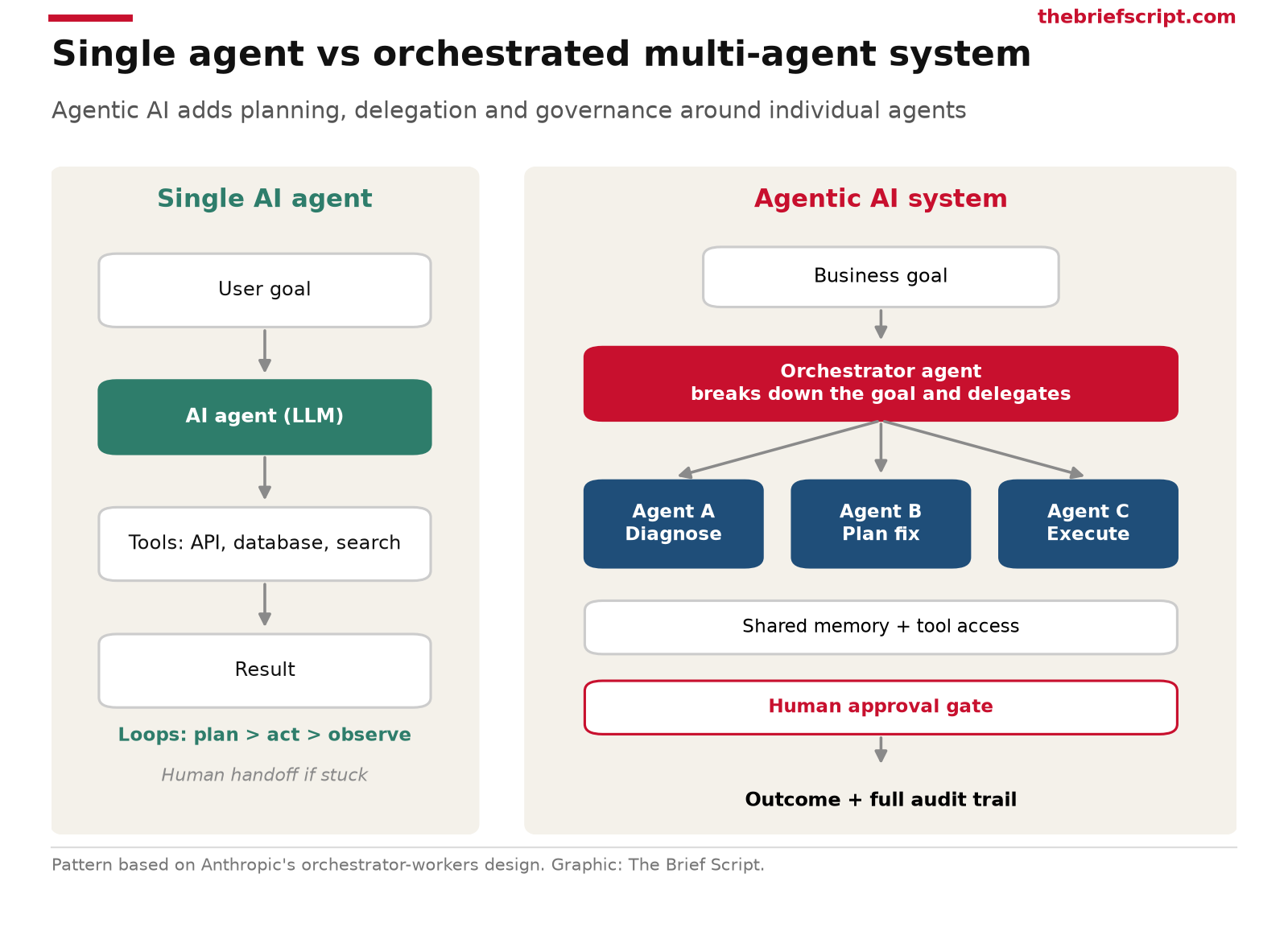
The better test is who decides the next step. Anthropic’s “orchestrator-workers” pattern is the clearest example of an agentic design: “a central LLM dynamically breaks down tasks, delegates them to worker LLMs, and synthesizes their results.” What separates it from simple parallel processing is that the subtasks “aren’t pre-defined, but determined by the orchestrator based on the specific input” (Anthropic).
Enterprise examples of each
The examples below come from vendor announcements. They show what each pattern looks like in production, not independent proof of results. For deployments verified against adopter, regulatory, and independent sources, see our study of 150 enterprise AI agent deployments.
Single AI agents
- 1-800Accountant on Salesforce Agentforce. Salesforce says Agentforce autonomously resolved 70% of the firm’s administrative chat engagements during critical tax weeks in 2025 (Salesforce, June 23, 2025).
- Wells Fargo’s procedures agent. Microsoft reported that a Wells Fargo agent supports 35,000 bankers with access to 1,700 procedures, cutting search time from 10 minutes to 30 seconds (Microsoft, May 19, 2025).
Agentic AI systems
- ServiceNow AI Agent Orchestrator. Announced in January 2025 for March availability, it “enables inter-agent communication and centralized coordination.” In ServiceNow’s network incident example, agents draw on network management, SIEM, and application monitoring tools to identify the issue, build a resolution plan, and execute it “once approved by a human network operator” (ServiceNow, Jan. 29, 2025).
- Microsoft Copilot Studio multi-agent orchestration. Introduced at Build 2025, it lets agents “exchange data, collaborate on tasks, and divide their work based on each agent’s expertise,” for example across HR, IT, and marketing to onboard a new employee, “with human oversight and direction” (Microsoft).
- Salesforce Agentforce multi-agent orchestration. A primary agent acts as the single entry point, reads intent, and routes work to specialized secondary agents without losing context (Salesforce).
When do you need agentic AI vs a single agent?
Start simple. Anthropic’s advice is to find “the simplest solution possible” and add complexity only when needed, because “agentic systems often trade latency and cost for better task performance” (Anthropic). Gartner’s Anushree Verma offers a similar rule of thumb: use “AI agents when decisions are needed, automation for routine workflows and assistants for simple retrieval” (Gartner).
A single agent is usually enough when:
- The task lives in one system or channel.
- Success is easy to measure, such as a resolved ticket or a found document.
- A human can review or take over the hard cases.
Agentic AI earns its cost when:
- The goal spans several systems, each needing its own permissions or expertise.
- The steps cannot be known in advance and depend on intermediate results.
- The process is valuable enough to fund orchestration, monitoring, and oversight.
Every extra agent adds model calls, integration work, and review time. Our breakdown of what an enterprise AI deployment costs layer by layer shows where that spend lands.
Risks and governance
Gartner predicts that over 40% of agentic AI projects will be canceled by the end of 2027 “due to escalating costs, unclear business value or inadequate risk controls.” It also flags “agent washing,” the rebranding of existing AI assistants, robotic process automation, and chatbots “without substantial agentic capabilities,” and estimates that only about 130 of the thousands of agentic AI vendors are real (Gartner, June 25, 2025). In the same release, Gartner still predicts that at least 15% of day-to-day work decisions will be made autonomously through agentic AI by 2028, and that 33% of enterprise software applications will include agentic AI by then.
Production deployments already reflect the risk. In our study of 150 enterprise agent deployments, 118 described approval steps, exception handling, governance and accountability structures, or active human review (evidence cutoff Sept. 2, 2026) (The Brief Script).
The controls scale with autonomy:
- Identity and access. Give each agent its own identity and least-privilege permissions. Microsoft, for example, introduced Microsoft Entra Agent ID to automatically assign an identity to agents built in Copilot Studio (Microsoft).
- Observability. Log every tool call and handoff. Salesforce built its Agentforce Command Center around this gap, saying teams “can’t see what agents are doing” (Salesforce).
- Approval gates. Require human sign-off before irreversible actions, as in ServiceNow’s network example.
- Stopping conditions and testing. Anthropic recommends limits such as a maximum number of iterations, plus “extensive testing in sandboxed environments.”
For a fuller control set, see our guides to enterprise AI security and AI governance.
A 3-question decision checklist
- Can you write the steps down in advance? If yes, use a workflow or a single agent. If the path depends on what the system finds along the way, you may need agentic AI.
- Does the goal cross systems or teams that need separate permissions or expertise? If yes, an orchestrated set of specialist agents is easier to secure and audit than one agent with broad access.
- Can you measure success and fund the oversight? If you cannot define a clear outcome, log every action, and staff human checkpoints, you are not ready for agentic AI. Start with one agent and earn the next step.
FAQ
Is a chatbot an AI agent?
Usually not. Google Cloud separates bots, which follow predefined rules, from AI assistants, which respond to requests while the user makes decisions, and from AI agents, which can act and make decisions independently toward a goal (Google Cloud).
Is agentic AI the same as generative AI?
No. IBM describes agentic AI as building on generative AI: a generative model creates content, while an agentic system applies those outputs toward goals by calling external tools (IBM).
Can a single agent be agentic?
Yes. AWS describes single-agent agentic systems that handle a well-defined process on their own (AWS). “Agentic” describes how much control the system has over its own plan, not how many agents it contains.
What is agent washing?
Gartner’s term for vendors relabeling assistants, RPA bots, or chatbots as agentic without real agentic capabilities. Ask any vendor to show where its system plans, chooses tools, and recovers from errors without a scripted path.
Which is more expensive, an AI agent or agentic AI?
Agentic AI, in almost every case. More agents mean more model calls, more integrations, and more oversight, and Gartner names escalating costs as a leading reason agentic projects get canceled.