The Pulse
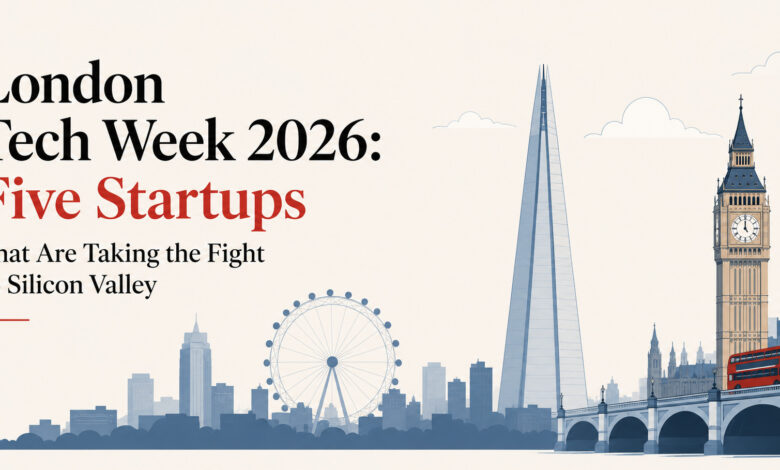
On June 8, the world’s technology press will watch Apple’s WWDC keynote from Cupertino. On the same day, 30,000 founders, investors, enterprise leaders, and policymakers will converge on Olympia London for London Tech Week 2026, the largest technology festival in Europe. Whether or not the overlap was intentional, it is a useful data point about the technology industry in 2026: the centre of gravity is no longer exclusively in California.
London Tech Week 2026 runs June 8-12, with the main conference at Olympia London and a wider week of fringe events across the city. The event is not only a UK technology showcase. It is increasingly Europe’s AI deal-flow stage, bringing together UK startups, European founders, US investors, enterprise buyers, and sovereign AI policymakers in one place.
This article covers five European AI companies appearing in the London Tech Week 2026 conversation that US investors and founders should watch: ElevenLabs, Wayve, Isomorphic Labs, Synthesia, and Lovable. Four have deep London or UK roots. Lovable is a European, not London-headquartered, company, but its presence around London Tech Week matters because it shows how the event has become a regional stage for Europe’s AI challengers.
Core Significance
Why it matters:
- The UK AI ecosystem has crossed the credibility threshold: UK AI investment reached a record £8.3 billion in 2025, according to Barclays Eagle Labs’ The Ones to Watch: AI 100 report. ElevenLabs raised at an $11 billion valuation. Wayve reached an $8.6 billion post-money valuation after its 2026 Series D. Synthesia raised at a $4 billion valuation. These are not seed-stage experiments. They are scaled companies competing in frontier markets. IT Pro — UK AI scale-ups 2026
- London Tech Week is where European AI deal flow becomes visible: The event brings together global founders, enterprise buyers, policymakers, and investors at a density few European events can match. For US VCs making one annual trip to understand European technology, London Tech Week is one of the most efficient signals of where the next category leaders are forming.
- Sovereign AI is the strategic backdrop: London Tech Week 2026 is framed around Europe’s decisive decade and sovereign AI. The central question is whether Europe can build and govern more of its own AI infrastructure, models, and applied AI companies rather than depending entirely on US hyperscalers and foundation-model vendors.
Selection Criteria: Why These Five Companies
The five companies were selected using three filters: global category relevance, evidence of commercial traction, and direct overlap with markets where US companies currently dominate. This is not a complete ranking of every promising UK or European AI startup. It is a focused list of companies whose technology, capitalisation, or London Tech Week visibility makes them relevant to US investors and Silicon Valley operators in 2026.
Deep Context: Why London Became an AI Powerhouse
London’s emergence as a serious AI hub is not accidental. Three structural advantages created the conditions for world-class AI company formation in a city 5,400 miles from Silicon Valley.
The first advantage is academic density. UCL, Imperial College London, King’s College London, Cambridge, and Oxford collectively supply the UK AI labour market with world-class technical talent. DeepMind, founded in London in 2010 and acquired by Google in 2014, seeded the ecosystem with a research and alumni network that continues to shape UK AI company formation.
The second advantage is enterprise proximity. London remains one of the world’s deepest financial and professional-services markets. AI companies building for risk, compliance, fraud detection, insurance, legal services, media production, and enterprise workflows can sell into large customers without leaving the city. That proximity accelerates product-market fit in markets where trust and compliance matter.
The third advantage is regulatory positioning. The UK’s post-Brexit regulatory environment, combined with the EU AI Act’s influence across Europe, has created conditions where companies that build governance, safety, and compliance architecture from day one can win enterprise trust. As covered in our AWS vs Azure vs Google Cloud AI analysis, European AI procurement is increasingly shaped by data residency, transparency, and risk-management requirements.
The balancing point is that London still has structural disadvantages versus Silicon Valley. Late-stage capital pools are smaller, the public market path is less predictable, and the UK has a history of promising startups selling before they become independent global platforms. London Tech Week 2026 matters because it tests whether the ecosystem can move from strong private companies to durable public-market leaders.
Data Insights
By the numbers:
All figures sourced to primary company announcements or official event data. £8.3B from Barclays Eagle Labs via IT Pro. $50B+ presented as estimate based on publicly reported individual valuations.
- £8.3 Billion: UK AI investment in 2025 reached a record level, according to Barclays Eagle Labs’ The Ones to Watch: AI 100 report. This figure refers specifically to UK AI investment, not total UK tech equity. IT Pro — UK AI scale-up report 2026
- $50 Billion+: Estimated combined valuation of leading UK AI startups, based on publicly reported individual valuations for ElevenLabs ($11B), Wayve ($8.6B), Synthesia ($4B), Isomorphic Labs, Quantexa ($2.6B), and others. Presented as an estimate, not a primary-source confirmed total.
- $11 Billion: ElevenLabs’ valuation after its $500 million Series D round, led by Sequoia. The company closed 2025 with more than $330 million in annual recurring revenue and later reported crossing $500 million ARR in early 2026. ElevenLabs — Series D official announcement
- $500 Million: ElevenLabs’ Series D funding round led by Sequoia, valuing the company at $11 billion. The round closed in early 2026. ElevenLabs — Series D official announcement
- $330 Million+: ElevenLabs’ annual recurring revenue at the end of 2025, confirmed in the company’s Series D announcement. The company subsequently reported crossing $500 million ARR in early 2026. ElevenLabs — Series D official announcement
- $8.6 Billion: Wayve’s post-money valuation after its $1.2 billion Series D announced in February 2026. Backers include Microsoft, NVIDIA, Uber, Mercedes-Benz, Nissan, and Stellantis. Wayve — Series D official press release
- $1.5 Billion: Total capital Wayve secured in 2026 to support commercial rollout, comprising a $1.2 billion Series D plus additional milestone-based capital tied to deployment performance. Wayve — Series D official press release
- $4 Billion: Synthesia’s valuation after its $200 million Series E in January 2026, led by Google Ventures, which nearly doubled its previous valuation. The Guardian — Synthesia $4B valuation January 2026
- $200 Million: Synthesia’s Series E round in January 2026, led by Google Ventures. The company previously crossed the $100 million ARR milestone before this round. The Guardian — Synthesia $4B valuation January 2026
- June 8-12, 2026: London Tech Week 2026 dates. The main conference and expo stages run June 8-10 at Olympia London. Fringe events run across London June 8-12. London Tech Week official site
- 30,000+: Attendees at London Tech Week’s most recent event cycle, confirming its role as Europe’s flagship technology festival and a major global meeting point for founders, investors, and enterprises. LTW 2026 registration announcement — official press release
- 128 Countries: Countries represented at London Tech Week in its most recent edition, confirming international reach beyond the UK and Europe. LTW 2026 registration announcement — official press release
- 12,500: Enterprise leaders who attended London Tech Week in its most recent edition, making it one of the highest concentrations of senior enterprise technology buyers at any European event. LTW 2026 registration announcement — official press release
- 5,500: Startup attendees at the most recent London Tech Week, reflecting the event’s role as a startup-investor connection platform. LTW 2026 registration announcement — official press release
- 1,000+: Investors attending London Tech Week in its most recent edition. LTW 2026 registration announcement — official press release
- 1,140+: Speakers expected across London Tech Week 2026 stages and events, per event-guide reporting. Label as event-guide estimate unless confirmed directly by the official LTW programme. MyLondonTransfer — London Tech Week 2026 complete guide
Table 1: Five European AI Startups to Watch at London Tech Week 2026
| Company | Base / LTW relevance | Sector | Valuation / traction | US disruption target |
|---|---|---|---|---|
| ElevenLabs | London-founded / UK AI leader | Voice AI and audio agents | $11B valuation; $500M Series D; $330M+ ARR 2025; $500M+ ARR early 2026 | US-dominated voice, dubbing, entertainment, customer-service markets |
| Wayve | London / UK | Autonomous driving | $8.6B valuation; $1.2B Series D; up to $1.5B secured for deployment | Waymo, Tesla FSD, and map-dependent AV strategies |
| Isomorphic Labs | London / Alphabet-backed | AI drug discovery | $600M 2025 raise; $2.1B 2026 round reported; major pharma partnerships | US big pharma discovery timelines and AI drug-design platforms |
| Synthesia | London / UK | AI video generation | $4B valuation; $200M Series E; $100M+ ARR milestone | Corporate video, training, and digital-avatar production |
| Lovable | European, not London-HQ; LTW-relevant | AI coding and app building | Fast-growing; public valuation not consistently disclosed | GitHub Copilot, Cursor, and developer-tool incumbents |
Table 2: London Tech Week 2026: Key Speakers and Sessions
| Speaker | Organisation | Session focus |
|---|---|---|
| Aravind Srinivas | Perplexity AI | AI search and information discovery |
| Max Jaderberg | Isomorphic Labs | AI-accelerated drug discovery |
| Rt Hon Liz Kendall MP | UK Government | UK AI policy and sovereign AI strategy |
| Dr Jan Goetz | IQM Quantum Computers | Quantum computing and AI security |
| Darren Hardman | Microsoft UK & Ireland | AI and the future of work in the UK |
| Dr Hermann Hauser KBE | ARM co-founder, Amadeus Capital | European tech competitiveness |
| Ioannis Antonoglou | Reflection AI | Foundation models and AI reasoning |
| Dan Cobley | Former MD Google UK | AI and enterprise transformation |
The Five Startups: Why Each One Matters
1. ElevenLabs: The Voice AI Company Scaling Faster Than Most Media Platforms
ElevenLabs was founded in 2022 by Mati Staniszewski and Piotr Dabkowski, two Polish ex-Google engineers, in London. By early 2026 it had raised a $500 million Series D at an $11 billion valuation, led by Sequoia. The company said it closed 2025 with more than $330 million in annual recurring revenue, and later reported crossing $500 million ARR in early 2026. ElevenLabs — Series D official announcement
ElevenLabs’ competitive position is specific and defensible: highly realistic AI-generated voice across dozens of languages, used for audiobooks, dubbing, video games, content localisation, and enterprise voice agents. It has expanded beyond text-to-speech into a broader audio platform covering speech-to-text, dubbing, sound effects, voice agents, and conversational interfaces.
The US relevance is direct. ElevenLabs competes in markets historically dominated by US studios, customer-service vendors, and audio platforms. The strongest version of the argument is not that US companies cannot replicate its technology. It is that ElevenLabs has built one of the strongest commercial positions in AI voice and is now operating at a revenue scale that forces US competitors to respond.
2. Wayve: The Autonomous Driving Company Betting Against Maps
Wayve was founded in 2017 by Cambridge University machine learning PhDs Alex Kendall and Amar Shah. In February 2026, the company announced a $1.2 billion Series D, reaching an $8.6 billion post-money valuation and securing additional capital tied to commercial deployment milestones. Its backers include Microsoft, NVIDIA, Uber, Mercedes-Benz, Nissan, and Stellantis. Wayve — Series D official press release
Wayve’s differentiated technical bet is end-to-end embodied AI for autonomous driving that does not depend on high-definition maps in the same way as traditional autonomous-vehicle systems. A mapless, vehicle-agnostic approach could make global deployment easier if the technology proves reliable in complex urban environments.
The Silicon Valley relevance is straightforward. Waymo has built one of the strongest autonomous-driving systems in the world, but its geographic expansion remains operationally intensive. Wayve’s mapless approach gives it a different path from Waymo and Tesla. The 2026 London robotaxi and commercial deployment milestones will determine whether that architectural bet becomes a real market advantage.
3. Isomorphic Labs: AI Drug Discovery at Pharma Scale
Isomorphic Labs is not a conventional independent startup. It is a London-based Alphabet and Google DeepMind spinout founded by Nobel laureate Demis Hassabis to commercialise AI drug-discovery technology built around the AlphaFold legacy. That distinction matters because the company combines startup speed with access to one of the most important AI research ecosystems in the world.
The company raised $600 million in its first external funding round in 2025 and, according to Reuters reporting, secured a much larger $2.1 billion round in 2026 led by Thrive Capital with participation from Alphabet-linked and global investors. It has also built major pharmaceutical partnerships with companies including Eli Lilly and Novartis.
The significance for US investors is the size of the market. Drug discovery can take more than a decade and cost billions before a successful therapy reaches approval. Isomorphic Labs is one of the most commercially advanced AI drug-discovery companies, with major pharmaceutical partnerships already in place and a clear path to testing whether AI-designed drugs can move from research promise to clinical reality. Reuters — Isomorphic Labs $2.1B round
4. Synthesia: AI Video Generation at Enterprise Scale
Synthesia has become one of London’s most commercially advanced AI companies. In January 2026, it raised a $200 million Series E at a $4 billion valuation, led by Google Ventures. The Guardian — Synthesia $4B valuation January 2026 The company previously crossed the $100 million ARR milestone, making it one of the few European AI companies with clear enterprise revenue scale.
Synthesia’s product generates professional AI video from text scripts without traditional cameras, actors, studios, or production crews. Enterprise customers use it to create training videos, product demonstrations, onboarding content, and corporate communications in multiple languages at lower cost and faster turnaround than traditional production.
The US disruption target is corporate video and enterprise learning. This market has not yet experienced the same level of AI disruption that text, code, and images have already seen. Synthesia’s opportunity is not replacing Hollywood. It is automating the huge volume of internal and external video that companies need but cannot afford to produce through traditional workflows.
5. Lovable: The European AI App Builder Using London Tech Week as a Stage
Lovable is the inclusion that requires the clearest caveat: it is not a London-headquartered startup. It is better described as a European AI app-building platform that is relevant to London Tech Week because the event has become a stage for Europe’s broader AI ecosystem, not only UK-founded companies.
Lovable converts natural-language prompts into working applications, targeting non-developers and fast-moving product teams that want to build software without starting from a traditional codebase. That places it near the AI coding and app-building market where GitHub Copilot, Cursor, Replit, and other US-linked tools already compete.
The strategic relevance is that Lovable attacks a different user segment. Copilot and Cursor are primarily developer productivity tools. Lovable is closer to a product-creation layer for non-developers, founders, designers, and operators. Whether it becomes a durable enterprise platform or remains a fast-growing builder tool will depend on governance, security, code quality, and integration depth.
Between the lines: The five companies in this analysis are not interesting because they are European versions of American ideas. They are interesting because each represents a vertical where Europe has produced either a global leader or a credible challenger: voice AI, autonomous driving, drug discovery, enterprise video, and AI app building. London Tech Week matters because it turns those companies into a visible market narrative for US investors.
Expert Nuance: The Sovereign AI Agenda and What It Means for US Companies
The central theme of London Tech Week 2026, Europe’s decisive decade and sovereign AI, deserves more attention from US technology companies than it usually receives. As IT Brief’s February 2026 analysis confirmed, the event has explicitly positioned sovereign AI as its organising strategic question.
Sovereign AI refers to the principle that nations and regions should control more of their own AI infrastructure, data governance, compute access, and applied AI capabilities rather than depending entirely on US hyperscalers and US-developed foundation models. The UK, EU, Gulf states, and multiple Asian governments are all pursuing some version of this agenda.
For US technology companies, this creates a commercial risk. Enterprise customers in Europe, the Middle East, and Asia-Pacific increasingly evaluate whether their AI infrastructure dependencies on US companies are strategically acceptable. Procurement decisions that once defaulted to AWS, Azure, or US-headquartered AI vendors are now shaped by data residency, domestic capability, security review, and political considerations.
The London and European AI companies in this analysis benefit from that trend. A European enterprise choosing a UK or European AI vendor may be making a commercial decision, but it is also sometimes making a sovereignty, compliance, and trust decision. US companies should not dismiss that shift as policy noise. It is becoming part of enterprise procurement.
Not Included, But Worth Tracking
Other UK and European AI companies worth tracking include Quantexa, Nscale, Stability AI, and Darktrace. They were excluded from the main five either because their 2026 London Tech Week link is less central, their ownership status is different, their category overlap with Silicon Valley is less direct, or their current public traction is harder to compare cleanly. Quantexa in particular remains one of London’s most important enterprise AI companies because of its strength in financial crime, risk, and decision intelligence.
Strategic Outlook: What Happens After London Tech Week
- IPO Pipeline Becomes the Real Test: Multiple London AI companies are now large enough to evaluate public-market or late-stage liquidity options. ElevenLabs, Wayve, Synthesia, and other UK AI leaders are operating at valuations where the next phase is no longer only venture funding. The question is whether London can keep these companies independent long enough to build public-market anchors, rather than selling them into US technology platforms.
- US Acquisition Interest Accelerates: Several companies in the London Tech Week orbit are now large enough to attract US acquisition interest. Microsoft is already connected to Wayve. Alphabet is structurally tied to Isomorphic Labs. US investors and acquirers attending London Tech Week should assume that the strongest European AI companies are evaluating multiple paths: IPO, strategic partnership, late-stage funding, and acquisition conversations.
- The London-US Talent Bridge Tightens: The most consequential long-term outcome may be talent. The historical flow ran from Europe to Silicon Valley. That is beginning to balance as London offers frontier AI roles, credible funding, and proximity to enterprise customers. For US founders, the opportunity is not simply to find cheaper European versions of US startups. It is to identify category leaders in verticals where London has an unfair advantage: fintech, AI safety, audio, drug discovery, enterprise compliance, and regulated-market AI.
Key Question Answered
Which London Tech Week 2026 startups are most likely to disrupt Silicon Valley?
The five London Tech Week 2026 companies with the highest Silicon Valley relevance are ElevenLabs, Wayve, Isomorphic Labs, Synthesia, and Lovable. ElevenLabs is scaling AI voice and audio agents at an $11 billion valuation with $330 million-plus ARR at end 2025. Wayve is building mapless autonomous-driving technology at an $8.6 billion valuation with $1.5 billion in total 2026 capital secured. Isomorphic Labs is applying AlphaFold-linked AI to drug discovery with major pharma partnerships and a $2.1 billion 2026 funding round. Synthesia is building enterprise AI video at a $4 billion valuation after a $200 million Series E. Lovable, while not London-headquartered, represents Europe’s fast-growing AI app-building layer. UK AI investment reached a record £8.3 billion in 2025. London Tech Week runs June 8-12, 2026 at Olympia London with 30,000-plus attendees from 128 countries including 12,500 enterprise leaders and 1,000-plus investors.
The Takeaway
On June 8, the technology world will watch Apple’s WWDC keynote in California. The smarter move is to watch both California and London. London Tech Week 2026 opens the same morning with a speaker line-up, investor base, and startup ecosystem that confirms Europe’s AI moment is no longer only a future possibility.
The lesson is not that London has replaced Silicon Valley. It has not. Silicon Valley still has deeper late-stage capital, bigger acquirers, more hyperscale infrastructure, and unmatched founder density. The lesson is that Silicon Valley no longer has a monopoly on frontier AI company formation. In specific verticals, European companies are now building category leadership from London and using London Tech Week as the place to make that visible.
For US investors who still treat European tech as a secondary market, London Tech Week 2026 is the week that argument becomes harder to defend. For US founders who assume the best AI companies must be built in California, the 2026 London and European AI ecosystem is the data that corrects that assumption. For more on monetising AI in 2026, see our How to Monetize AI 2026 guide.