The Pulse
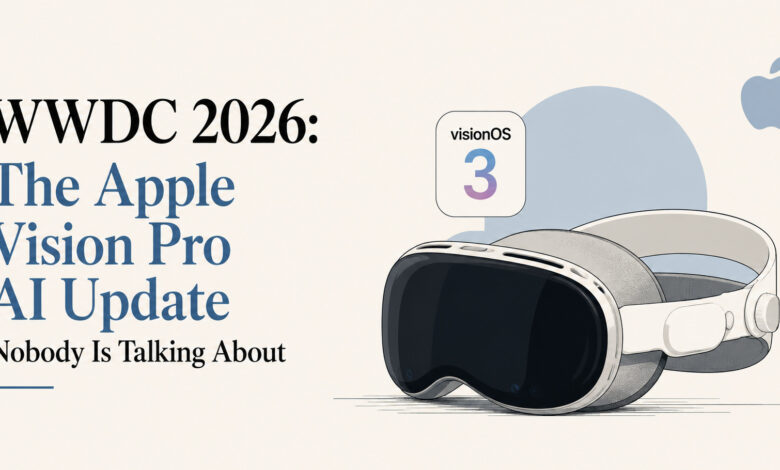
While the technology world watches Apple announce Siri 2.0 today, a quieter and more strategically significant story is playing out on a different part of the WWDC stage. Apple Vision Pro AI features in visionOS 27 are not the headline. They are not even the subheadline. They are the announcement that will matter most in two years when Apple’s most controversial product either finds its market or doesn’t.
visionOS 27 is a light update by Bloomberg’s Mark Gurman’s own characterisation: performance improvements, bug fixes, and parity with iOS 27’s AI features. No new hardware. No major interface redesign. What it does include is something Gurman and most technology press have treated as a footnote: Apple Intelligence is coming to Vision Pro in full, and Apple has quietly been building the accessibility and enterprise use cases that justify the $3,499 price tag in ways the consumer market has not yet rewarded.
Core Significance
Why it matters:
- Apple Is Repositioning Vision Pro While Nobody Is Watching: Apple pre-announced eight-plus Apple Intelligence-powered accessibility features for visionOS 27 weeks before WWDC, skipping the keynote entirely. The headline capability is wheelchair control via eye-tracking, the first time Vision Pro’s most precise input method has been repurposed for mobility assistance. That is not a consumer feature. That is an enterprise and healthcare feature that justifies the device’s price point in markets where $3,499 is a procurement line item rather than a personal purchase.[Memeburn — Apple Intelligence accessibility leap before WWDC 2026]
- visionOS 27 Gets Every iOS 27 AI Feature: Siri 2.0, Writing Tools, Image Playground, Visual Intelligence, AI photo editing tools including Extend, Enhance, and Reframe, and the full Apple Intelligence suite all arrive on Vision Pro through visionOS 27. The device that launched in February 2024 as a spatial computing platform is becoming an AI platform. That repositioning has implications for every enterprise that evaluated Vision Pro as a productivity device and found it lacking.[9to5Mac — visionOS 27 Vision Pro upgrades report]
- Tim Cook’s Last Major Keynote Has a Vision Pro Subtext: Today’s WWDC keynote is widely expected to be Tim Cook’s final major product launch as CEO, with John Ternus taking the role on September 1. Cook introduced Vision Pro at WWDC 2023. If visionOS 27 begins to establish the device’s enterprise and healthcare identity before Cook departs, it bookends his tenure with both the launch and the first credible path to commercial viability for Apple’s most ambitious and most polarising product.
Deep Context: What Apple Has Been Building for Vision Pro Since Launch
The Apple Vision Pro launched in February 2024 at $3,499 with impressive technology, a limited application library, and a consumer positioning that never fully cohered. Wearing a spatial computing headset while sitting alone on a couch generated more mockery than sales. Apple sold somewhere between 300,000 and 500,000 units in the first year, dramatically below original projections.
What has been happening in the background while the consumer narrative stalled is more interesting. Apple has been building Vision Pro’s case in the markets where the price is not an obstacle: healthcare, enterprise productivity, accessibility, scientific visualisation, and design. Accessibility is where the strategic shift is most visible. Wheelchair control via eye-tracking is a capability that changes someone’s daily life in a way that spatial video or gaming never could. When Apple announced it through a press release rather than a keynote, it signalled a deliberate repositioning away from consumer spectacle toward use-case specificity.
As covered in our WWDC 2026 Apple Intelligence preview, today’s keynote centres on Siri 2.0 and iOS 27. But the version of Apple Intelligence arriving on Vision Pro through visionOS 27 is arguably more consequential for the device’s survival as a product category than any consumer use case Apple demonstrates today.
Data Insights
By the numbers:
All visionOS 27 features confirmed by Bloomberg/Gurman via 9to5Mac. Accessibility features confirmed by Apple official press release. No new hardware confirmed.
- $3,499: Apple Vision Pro starting price. The device has found its strongest market not among consumers but among enterprise buyers, healthcare institutions, and accessibility users where the price is a procurement decision rather than a personal purchase.
- 1: Number of new Vision Pro hardware announcements expected at WWDC 2026. Zero. Gurman confirmed no new Vision Pro hardware. The next hardware refresh is at least a year away. visionOS 27 is the only Vision Pro news today.[9to5Mac — visionOS 27 light update confirmed]
- 1,000x: The reliability improvement of Majorana 2 quantum qubits over its predecessor, announced at Microsoft Build the same week. Apple’s Vision Pro eye-tracking repurposed for wheelchair control uses a different technology entirely but represents the same principle: precision hardware repurposed for accessibility transforms the device’s market.
- 8+: Apple Intelligence accessibility features pre-announced for visionOS 27 ahead of WWDC, including wheelchair control, VoiceOver Image Explorer, automatic closed captions, and Accessibility Reader. All confirmed for September 2026 release.[Memeburn — Apple AI accessibility features visionOS 27]
- September 1, 2026: Tim Cook’s last day as Apple CEO. John Ternus, current SVP of Hardware Engineering, becomes CEO. Cook introduced Vision Pro. Ternus will inherit both the device and the responsibility of finding its commercial identity.
- September 2026: visionOS 27 public release date alongside iOS 27, iPadOS 27, macOS 27, and watchOS 27. All ship together as Apple’s largest annual software release.
Table 1: visionOS 27 Confirmed AI Features: What Vision Pro Gets From Apple Intelligence
| Feature | Platform | What It Does | Market It Serves |
| Wheelchair control | Vision Pro exclusive | Eye-tracking steers compatible powered wheelchairs | Healthcare and accessibility |
| Siri 2.0 standalone app | All platforms including VP | Full chatbot, voice mode, cross-app execution | Enterprise and consumer |
| Writing Tools | All platforms | AI writing assistance in every text field | Enterprise productivity |
| VoiceOver Image Explorer | iOS 27 and visionOS 27 | Describes photos, receipts, docs aloud on-device | Accessibility |
| Automatic closed captions | All platforms | Generates subtitles for uncaptioned video privately | Accessibility and enterprise |
| Accessibility Reader | All platforms | Reads complex article layouts aloud including tables | Accessibility |
| AI photo editing: Extend, Enhance, Reframe | iOS and visionOS | Generative photo editing tools | Consumer and creative |
| Visual Intelligence | iOS and visionOS | Camera-based AI object and document analysis | Enterprise and consumer |
| Image Playground | All platforms | AI image generation from descriptions | Creative and consumer |
Table 2: Vision Pro Market Positioning — Before and After visionOS 27
| Market | Before visionOS 27 | After visionOS 27 |
| Healthcare | Eye-tracking for navigation | Eye-tracking for wheelchair mobility control |
| Accessibility | Basic VoiceOver support | AI-powered image description, caption generation, document reading |
| Enterprise productivity | Limited Apple Intelligence | Full Siri 2.0, Writing Tools, Visual Intelligence |
| Consumer | Spatial video, games | Same — no new consumer-facing features added |
| Scientific / design | 3D spatial computing | Unchanged — remains strong use case |
| Education | Limited | Accessibility Reader and on-device captions add value |
The Business Case: Why Apple Intelligence Changes Vision Pro’s Market
The Vision Pro’s consumer positioning problem has been well documented. The device is too heavy for extended wear, too expensive for casual use, and too isolated from the social context that makes consumer technology enjoyable. Those problems are not solved by visionOS 27.
What visionOS 27 does solve is the enterprise and institutional buyer’s objection: that Vision Pro is powerful hardware without a compelling software case for its price. Bringing the full Apple Intelligence suite to Vision Pro removes that objection. A hospital system evaluating Vision Pro for surgical visualisation or rehabilitation now gets Siri 2.0, AI writing assistance, and the full iOS 27 AI feature set on the same device. A design studio evaluating Vision Pro for spatial prototyping now gets AI image editing, Visual Intelligence, and Writing Tools built in.
The wheelchair control announcement is the clearest expression of Apple’s repositioning strategy. Assistive mobility is a market where the $3,499 price is explicitly within procurement parameters for government programmes, insurance coverage, and institutional budgets. A device that was priced out of the consumer market is priced correctly for the institutional accessibility market. Apple understands this. The fact that wheelchair control was announced through a press release rather than a keynote confirms it is a market development, not a marketing move.
Between the lines:
The most significant Apple Intelligence feature for Vision Pro is the one least discussed: on-device processing. Apple’s Private Cloud Compute architecture means that everything Vision Pro’s AI does, whether Siri queries, image analysis, or document reading, is processed either on the M2 chip inside the headset or on Apple’s own servers rather than on third-party cloud infrastructure. For a healthcare provider deploying Vision Pro with patient data, that is not a nice-to-have. It is a HIPAA compliance requirement. Apple built the privacy architecture before it built the clinical use case. That sequencing gives Vision Pro a head start in regulated industries that competitors building on third-party cloud AI cannot easily replicate.
Expert Nuance: The Enterprise Vision Pro Nobody Covers
The technology press coverage of Vision Pro has been dominated by two narratives: the impressive demo at launch and the disappointing consumer sales since. Both narratives miss the more structurally interesting story: Apple is deliberately building a B2B and institutional device market for Vision Pro that the consumer narrative has never accurately described.
Enterprise Vision Pro deployments include surgical planning at major hospital systems, architectural and product design visualisation at engineering firms, training simulations at airlines and logistics companies, and financial data visualisation at investment banks. None of these deployments makes the technology news cycle because they happen inside procurement processes rather than in public demonstrations. But they represent a sustained and growing market for the device at price points where $3,499 is a rounding error on a departmental budget.
visionOS 27 serves this market by closing the AI capability gap between Vision Pro and the devices employees use alongside it. A surgeon who uses Vision Pro for pre-operative planning and an iPhone for everything else has previously needed to context-switch between different AI experiences on different devices. visionOS 27 brings the same Siri 2.0, the same Writing Tools, and the same Visual Intelligence to both devices. That unification matters for enterprise adoption in ways that consumer feature comparisons never capture.
Strategic Outlook: Three Things to Watch After Today
- Whether the Keynote Gives Vision Pro Meaningful Stage Time: Apple has not given Vision Pro a major keynote moment since its original announcement. If today’s WWDC keynote includes a dedicated Vision Pro segment beyond a brief mention, it signals Apple is recommitting to the device’s commercial future. If Vision Pro gets thirty seconds at the end of the software section, it signals the opposite. Watch the allocation of keynote time as the clearest indicator of Apple’s internal confidence in Vision Pro’s trajectory.
- Enterprise Adoption Data in Q3 2026: The real test of whether Apple Intelligence on Vision Pro changes the device’s commercial trajectory will not be visible until Q3 2026 earnings, when Apple typically reports wearables and accessories revenue. An acceleration in that category following visionOS 27’s September launch would confirm that the enterprise and accessibility repositioning is working. A continuation of flat post-launch sales patterns would suggest the AI features alone are not sufficient to change Vision Pro’s market position.
- John Ternus’s First Major Vision Pro Decision: John Ternus becomes CEO on September 1, 2026, the same month visionOS 27 and the full Apple Intelligence suite arrive on Vision Pro. His first major product decision as CEO will likely involve Vision Pro’s hardware roadmap for 2027. A device refresh announcement at the March 2027 event would signal continuity. No announcement would raise questions about whether the Vision Pro product line has a path forward under new leadership.
Key Question Answered
What are the Apple Vision Pro AI features in visionOS 27?
visionOS 27 brings the full Apple Intelligence suite to Apple Vision Pro AI features including Siri 2.0 with cross-app execution, Writing Tools, Image Playground, AI photo editing tools Extend and Enhance and Reframe, Visual Intelligence camera analysis, and VoiceOver Image Explorer. Apple pre-confirmed specific accessibility features including wheelchair control via Vision Pro eye-tracking, automatic closed captions generated privately on-device, and Accessibility Reader for complex document layouts. visionOS 27 is a light update focused on performance, parity with iOS 27, and bug fixes. No new Vision Pro hardware ships with visionOS 27. All features arrive in September 2026 alongside iOS 27 public release. Vision Pro requires the M2 chip.
The Takeaway
visionOS 27 does not save the Apple Vision Pro consumer product. The price is still $3,499. The weight and comfort problems are unchanged. The social isolation of wearing a spatial computing headset in public is unchanged. Apple knows all of this.
What visionOS 27 does is give the enterprise and institutional Vision Pro market the software parity it has been waiting for since launch. A hospital can now deploy Vision Pro with the confidence that its AI capabilities match the institutional standard. An enterprise running iOS 27 on employee iPhones can add Vision Pro to specific workflows without managing a separate AI experience. An accessibility programme can now access wheelchair control, on-device document reading, and AI caption generation from a single device.
That is not the story WWDC 2026 will be told as. The story will be Siri 2.0, iOS 27, and whether Apple finally delivered on its 2024 promises. But the Vision Pro story happening quietly behind that headline is the one that determines whether Apple’s most ambitious hardware bet survives to become a mature product category or remains a footnote. Watch the keynote today for Siri. Then watch the enterprise channel for the next twelve months for Vision Pro.