The pulse
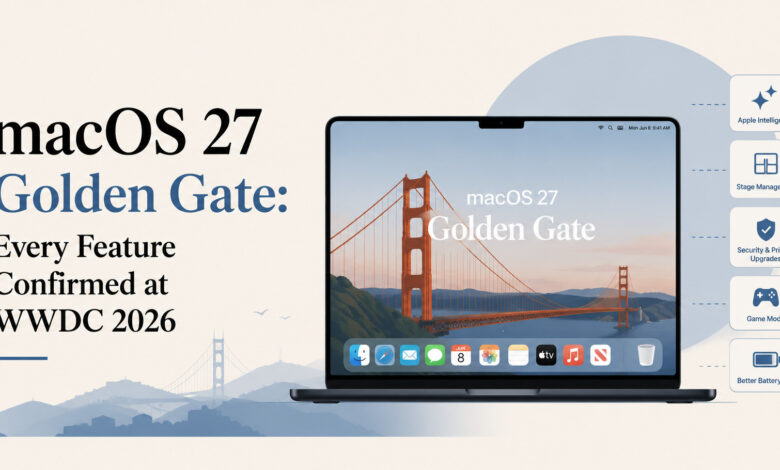
Apple named its next Mac operating system after the Golden Gate strait connecting San Francisco Bay to the Pacific Ocean. macOS 27 Golden Gate was announced at WWDC 2026 on June 8 as the successor to macOS Tahoe. It brings Siri AI, Visual Intelligence, a refined Liquid Glass design, Safari AI tools, and the first Mac operating system to run exclusively on Apple Silicon. If your Mac has an Intel chip, macOS Golden Gate is not for you. Apple Silicon is now mandatory.
The Intel Mac transition is complete. Every Mac made before 2020 is officially left behind. The upside for Apple Silicon Mac users is a more coherent, faster, AI-native operating system that finally delivers the Apple Intelligence features promised two years ago. The developer beta is available today. Public beta arrives in July. The general release follows in fall 2026.
Core significance
Why it matters:
- Intel Macs are done: macOS Golden Gate is the first Mac operating system that runs exclusively on Apple Silicon. M1 or later is required. No Mac made before November 2020 can install it. Apple had previously indicated this transition was coming with macOS Tahoe. Golden Gate makes it final. It is also the last version with full Rosetta 2 functionality, meaning apps built for Intel processors still run on Apple Silicon through emulation, but that compatibility layer will not survive indefinitely into future macOS versions. [MacOS 27 Apple]
- Siri AI comes to Mac, including in the EU: Unlike iOS 27 and iPadOS 27, where Siri AI is blocked in the European Union due to Digital Markets Act requirements, macOS 27 Golden Gate ships Siri AI in the EU at launch. European Mac users get the full Siri AI experience including personal context awareness, on-screen awareness, and the new Search or Ask interface in Spotlight. European iPhone users do not. That asymmetry is both unusual and commercially significant for Apple in Europe.[TechRadar — macOS 27 Golden Gate everything you need to know]
- Liquid Glass is being walked back: macOS Tahoe’s Liquid Glass design was controversial. Consistent window border radiuses are restored. Colour returns to sidebar icons. A global opacity slider lets users set the interface anywhere from fully transparent to fully tinted. Apple explicitly acknowledged user feedback drove the Liquid Glass revisions in Golden Gate. That acknowledgement is rare and confirms the Tahoe design received enough negative response internally to change the direction for the following year.[SQ Magazine — macOS 27 Golden Gate WWDC 2026]
Deep context: the end of the Intel era
Apple began transitioning Macs from Intel chips to its own Apple Silicon in November 2020 with the M1. The transition took three years to complete across the entire product line. In 2023, Apple shipped the last Intel Mac, the Mac Pro with Xeon chips. In 2024, the Mac Pro transitioned to M2 Ultra. The hardware transition has been complete for two years. macOS Golden Gate is the software transition completing the same journey.
For the approximately 80 million active Mac users worldwide, the Intel end-of-support question is the most practically important thing about Golden Gate. Macs with M1 chips and later are compatible. MacBook Air models from 2020 onward are in. MacBook Pro models from November 2020 onward are in. iMac models from 2021 onward. Mac mini from November 2020. Mac Studio from 2022. Mac Pro from 2023. Every Mac made with Intel chips is now permanently on macOS Tahoe.
The Rosetta 2 caveat deserves specific attention. Rosetta 2 is Apple’s translation layer that allows apps built for Intel chips to run on Apple Silicon. macOS Golden Gate is confirmed as the last version with full Rosetta 2 functionality. The next macOS after Golden Gate may reduce or remove Rosetta 2 support. Any organisation running legacy Intel-architecture software that has not yet been updated by its developer needs to factor that into their Mac roadmap planning now.
As covered in our iOS 27 features WWDC 2026 guide, the broader Apple software story from WWDC 2026 is the full Apple Intelligence rollout across every platform. macOS Golden Gate is the Mac chapter of that story.
Data insights
By the numbers:
All confirmed from WWDC 2026 keynote and Apple official statements June 8, 2026.
- 2020: The cut-off year. Macs made before 2020 cannot install macOS Golden Gate. M1 was introduced in November 2020.[TechRadar — macOS 27 Golden Gate compatibility]
- 23rd: macOS Golden Gate is the 23rd major release of macOS, named after a California landmark as is tradition.
- M3 or later: Required for the most advanced Apple Intelligence and AI features in macOS Golden Gate. M1 and M2 Macs get the standard feature set. M3 unlocks additional capabilities per Macworld’s compatibility breakdown.[Macworld — macOS 27 Golden Gate complete guide]
- July 2026: Expected public beta. Developer beta available June 8.
- Fall 2026: General release. Apple typically ships macOS in September or October alongside iOS. September 14 is Macworld’s estimated date based on Apple’s usual release pattern.
- 5K at 120Hz: New ultrawide display support added in macOS Golden Gate, the highest resolution and refresh rate Apple has brought to Mac displays through a software update.
Table 1: macOS 27 Golden Gate: Complete confirmed feature list
| Feature | What it does | Chip requirement |
| Siri AI | Full Siri AI with personal context, on-screen awareness, dedicated app | M1 or later |
| Spotlight Search or Ask | New interface combining traditional search with AI question-answering | M1 or later |
| Visual Intelligence | Keyboard shortcut to select screen content and get contextual AI answers | M1 or later |
| Liquid Glass opacity slider | Global slider from Ultra Clear to Tinted Glass | M1 or later |
| Unified toolbar | Consistent toolbar layout across all apps | M1 or later |
| Sidebar color icons | Color restored to sidebar icons (reversed from Tahoe) | M1 or later |
| Tighter window corners | Consistent border radius across all apps (reversed Tahoe change) | M1 or later |
| Safari AI — tab groups | Automatically groups related open tabs | M1 or later |
| Safari AI — site monitoring | Alerts when websites change content such as price drops | M1 or later |
| Pull to refresh | Safari, Mail, News, Calendar | M1 or later |
| Natural language calendar events | Describe an event in plain language, Calendar creates it | M1 or later |
| Context-aware quick actions | Smart suggestions in Messages and Mail based on conversation context | M1 or later |
| AI photo editing | Extend, Enhance, Reframe tools for generative photo editing | M3 or later |
| 5K at 120Hz ultrawide support | Higher resolution for ultrawide displays | M1 or later |
| Seamless podcast switching | Switch between audio and video podcast formats without interruption | M1 or later |
| Parental controls | Expanded child safety and screen time management | M1 or later |
Table 2: macOS Golden Gate compatibility: Which Macs are in
| Mac model | Minimum compatible version | Notes |
| MacBook Air | MacBook Air (M1, late 2020) or later | All Intel MacBook Air excluded |
| MacBook Pro | MacBook Pro (M1, late 2020) or later | All Intel MacBook Pro excluded |
| iMac | iMac (M1, 2021) or later | All Intel iMac excluded |
| Mac mini | Mac mini (M1, late 2020) or later | Intel Mac mini excluded |
| Mac Studio | Mac Studio (M1 Ultra, 2022) or later | All Mac Studio models compatible |
| Mac Pro | Mac Pro (M2 Ultra, 2023) or later | Intel Mac Pro excluded |
| Advanced AI features (M3+) | MacBook Pro M3, MacBook Air M3, iMac M3, Mac mini M4 or later | M1/M2 get standard features, M3+ unlock advanced AI |
The business case: what Golden Gate changes for Mac users
The practical upgrade decision for Mac users splits into three groups.
Apple Silicon Mac users on M1 or M2 get the full macOS Golden Gate feature set including Siri AI, Visual Intelligence, Safari AI tools, and the Liquid Glass revisions. The upgrade is straightforward and free. The most valuable features are Visual Intelligence, which brings the camera-based AI analysis from iPhone to Mac through a keyboard shortcut, and the Safari tab grouping and monitoring tools that reduce the cognitive overhead of managing large numbers of browser tabs.
Apple Silicon Mac users on M3 or later get everything above plus the advanced AI photo editing tools. The differentiation between M1/M2 and M3/M4 for AI features follows the same pattern Apple used with iOS, where older Apple Silicon gets most features but the most computationally intensive capabilities require newer chips.
Intel Mac users are at a decision point. macOS Tahoe, the current operating system, will receive security updates from Apple for some period after Golden Gate releases, but the timeline is not indefinite. The typical Apple support window for a superseded macOS is two to three years of security patches after the new version ships. Intel Mac users who need the latest features, most importantly Siri AI and Visual Intelligence, face a hardware upgrade decision rather than a software one.
The Spotlight redesign is more significant than it sounds
The new Search or Ask interface in Spotlight is the feature most Mac power users will notice most immediately. The current Spotlight is a file and app launcher that can answer basic questions. The new Spotlight with Siri AI integration is a query interface that understands natural language, searches your documents and emails, and answers questions with context from your entire Mac. The distinction matters because Spotlight is triggered by a single keyboard shortcut that most Mac users already have muscle memory for. Adding Siri AI to that existing habit rather than requiring users to open a new app is the kind of seamless integration that tends to drive actual adoption rather than demo appreciation.
Expert nuance: Rosetta 2’s final chapter
The confirmation that macOS Golden Gate is the last version with full Rosetta 2 functionality deserves more attention than WWDC coverage gave it. Rosetta 2 has been transparently running Intel-architecture applications on Apple Silicon Macs since November 2020. The transition has been so smooth that many Mac users do not know which of their applications are running natively and which are being translated by Rosetta 2.
When Rosetta 2 support is reduced or removed in a future macOS, any application that has not been updated by its developer to support Apple Silicon natively will stop working. For consumer applications, most popular software has been updated by now. The higher-risk category is enterprise and professional software, particularly legacy line-of-business applications, specialist scientific tools, older creative software, and any application that has been discontinued by its developer and cannot receive an Apple Silicon update.
Organisations running Macs should audit their critical applications for Apple Silicon compatibility now. The transition window is not closed yet. macOS Golden Gate will still run Rosetta 2 applications. The question is what macOS 28 does. Starting that audit in 2026 rather than in response to a compatibility break in 2027 or 2028 is the correct enterprise planning timeline.
Strategic outlook
- The EU Siri AI exception sets a precedent: Apple shipping Siri AI on macOS in the EU while blocking it on iOS and iPadOS creates a two-tier experience within the same Apple ecosystem for European users. An iPhone user in London cannot use Siri AI. Their MacBook Pro can. That inconsistency is commercially awkward and legally complex. Apple’s negotiation with the European Commission over the DMA will determine whether the iOS and iPadOS restriction is temporary or permanent. Watch for any EU regulatory announcements in Q3 2026 about Apple DMA compliance.
- John Ternus inherits the Mac AI roadmap: Ternus becomes CEO on September 1, the same month macOS Golden Gate reaches the public. As Apple’s hardware engineering chief for many years, he oversaw the Apple Silicon transition. Golden Gate is the software layer completing that hardware transition. His first Mac decision as CEO will be the hardware announcement expected at the March 2027 event, likely M4 Pro and Max MacBook Pros and potentially new iMac configurations. The question is whether he accelerates the AI hardware differentiation between chip generations or maintains the current M1 minimum floor.
- The Rosetta 2 deprecation timeline matters: Apple has not announced when Rosetta 2 support will end beyond confirming that Golden Gate is the last version with full support. Enterprise IT teams should treat macOS 28, expected to be announced at WWDC 2027, as the likely first macOS without Rosetta 2. That gives organisations one more full software cycle to complete their application compatibility audit and migration. Waiting for macOS 28 to reveal the Rosetta 2 status before starting the audit is the wrong sequence.
Key question answered
What is macOS 27 Golden Gate and what are its new features?
macOS 27 Golden Gate is Apple’s next major Mac operating system, announced at WWDC 2026 on June 8. It is the first macOS to run exclusively on Apple Silicon, ending support for all Intel Macs and requiring M1 chip or later. Key features include Siri AI with personal context and on-screen awareness, a redesigned Spotlight Search or Ask interface, Visual Intelligence via keyboard shortcut, Liquid Glass design revisions including a global opacity slider and restored sidebar color icons, Safari AI tools for tab grouping and site monitoring, pull to refresh across Safari and Mail, natural language calendar event creation, context-aware quick actions in Messages, 5K at 120Hz ultrawide display support, and expanded parental controls. Advanced AI photo editing requires M3 or later. Siri AI is available in the EU on macOS Golden Gate, unlike iOS 27 where it is blocked by the Digital Markets Act. Developer beta is available June 8. Public beta arrives July 2026. General release is fall 2026.
The takeaway
macOS Golden Gate is the operating system Apple Silicon has been waiting for. The Intel transition is complete. The AI features are finally aligned across Mac, iPhone, iPad, and Apple Watch. The Liquid Glass design controversy has been addressed. The search experience has been rebuilt around AI. For M1 and later Mac users, the fall 2026 upgrade is the most substantive macOS release in several years.
The Intel Mac end-of-support is the story that will generate the most reader response. Millions of Mac users are still running Intel hardware that performed perfectly well until now and will find themselves permanently excluded from the operating system their Apple ecosystem is moving toward. That is not a flaw in Apple’s strategy. It is the cost of the silicon transition. But it is a cost that lands on individual users and enterprises who have not yet upgraded their hardware.
If your Mac runs Apple Silicon, install the developer beta now if you are technically comfortable doing so. Wait for the public beta in July if you prefer stability. Upgrade to the general release in fall 2026 when it ships. If your Mac runs Intel, the upgrade decision is not a software question. It is a hardware question about how long your current Mac serves your needs before an Apple Silicon replacement makes sense.