Databricks News 2026: $175B Valuation Talks, Lakebase Growth, and IPO Signals

The Pulse
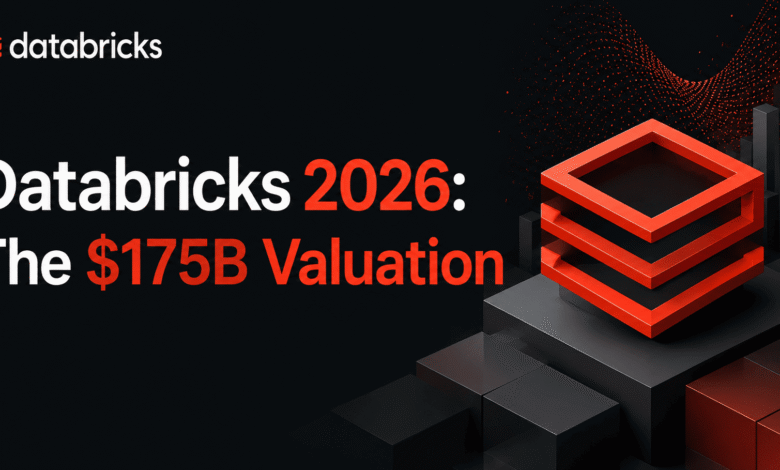
Databricks is in discussions to raise new capital at a valuation of $165 billion to $175 billion, according to The Information, in a round that could begin as soon as next month. That would mark a significant jump from the $134 billion valuation the company secured in February 2026. The discussions are happening the same week Databricks prepares to host its Data and AI Summit, the largest data and AI conference in the world, at the Moscone Center in San Francisco from June 15 to 18.
The timing is not coincidental. Databricks news 2026 has followed a consistent pattern: major product announcements, financial milestones, and valuation events clustered around the annual summit. This year the stakes are higher than any previous edition. Databricks has surpassed Snowflake on revenue, growth rate, and private market valuation simultaneously for the first time. Its Lakebase product, which became generally available in February 2026, is growing faster than its core data warehousing business. And CEO Ali Ghodsi has told investors the company is IPO-bound as soon as 2027, making the summit a pre-IPO product showcase as much as a developer conference.
Core significance
Why it matters:
- The $175B number is the most important Databricks story today: A $175 billion valuation on $5.4 billion in annualized revenue implies a multiple above 30 times sales. That multiple reflects something specific: investors are not pricing Databricks as an enterprise software company. They are pricing it as AI infrastructure. The distinction matters because AI infrastructure companies, like Nvidia at the chip layer, command valuation multiples that pure software companies never reach. If private markets accept the $175 billion figure, Databricks enters the public markets at a valuation that would make it one of the largest technology listings in history.[TechFundingNews — Databricks $175B valuation round June 9 2026]
- Databricks has overtaken Snowflake on every key metric: Databricks reported $5.4 billion in annualized revenue in February 2026, growing 65% year over year. Snowflake’s full-year revenue for the same period was approximately $4.7 billion, growing 29%. Databricks’ private market valuation of $134 billion already exceeded Snowflake’s public market capitalisation. The two companies compete directly for enterprise data platform contracts. Databricks is now winning that competition on revenue size, growth rate, and investor confidence simultaneously.[CNBC — Databricks $5B round $134B valuation February 2026]
- The Data and AI Summit is where the enterprise product roadmap gets revealed: The June 15 to 18 summit at Moscone Center brings together 30,000-plus data and AI professionals from 150-plus countries with speakers including Databricks co-founders Ali Ghodsi, Matei Zaharia, Arsalan Tavakoli-Shiraji, and Reynold Xin, alongside Satya Nadella in a pre-recorded fireside chat and OpenAI co-founder Greg Brockman. Every major Databricks product announcement in recent years has debuted at this summit. Watch the keynotes on June 15 for what comes after Lakebase.[Databricks — Data and AI Summit 2026 official keynote announcement]
Deep context: what Databricks has built since its last summit
The twelve months between the 2025 and 2026 Data and AI Summits have been the most consequential in Databricks’ history. The company crossed $100 billion in valuation, then $134 billion. It launched and scaled Lakebase, a product that did not exist a year ago and is already growing faster than its core analytics business. It closed the largest private technology funding round in recent memory. And it quietly surpassed Snowflake, its most direct enterprise competitor, on the metrics that institutional investors use to compare the two companies.
The Lakebase launch is the most strategically significant of these developments because it changes what Databricks is. Until 2025, Databricks was a data analytics and machine learning platform. Lakebase makes it a transactional database platform as well. The $100 billion-plus operational database market, dominated by Oracle, PostgreSQL-based cloud services, and legacy relational databases, is now in Databricks’ addressable market. The combination of analytics, AI, and transactional data in a single platform is the architecture enterprise AI applications require but have historically had to stitch together from multiple vendors.
As covered in our AWS vs Azure vs Google Cloud AI analysis, the enterprise data platform market is consolidating around a small number of full-stack providers. Databricks’ lakehouse architecture, which combines the flexibility of data lakes with the performance of data warehouses on a single open-source foundation, has become the dominant enterprise data architecture for organisations building AI applications. The question the 2026 summit will answer is what that architecture looks like in 2028.
Data insights
By the numbers:
All financial figures from official company announcements. $165B-$175B valuation from The Information June 9, 2026 discussions only, not a closed round.
- $5.4 billion: Databricks annualized revenue run rate as of February 2026, confirmed by the company at the time of its funding round close. Up 65% year over year.[CNBC — Databricks $5.4B ARR confirmed February 2026]
- 65%: Databricks year-over-year revenue growth rate. For context, Snowflake’s growth rate over the same period was 29%. Databricks is growing at more than twice the pace of its primary competitor.
- $1.4 billion: AI product revenue run rate as of February 2026, representing approximately 26% of total company revenue. Databricks’ AI-specific products, primarily the Mosaic AI suite, are growing faster than the overall business.[TechFundingNews — Databricks AI products $1.4B run rate]
- $134 billion: Databricks valuation from its February 2026 funding round, which raised $5 billion in equity and $2 billion in debt led by JPMorgan, with Goldman Sachs, Morgan Stanley, the Qatar Investment Authority, and Neuberger Berman among equity participants.
- $165 billion to $175 billion: Reported new funding round valuation range under discussion as of June 9, 2026, per The Information. No close date confirmed. Not yet a completed transaction.[Cryptobriefing — Databricks $175B valuation talks June 2026]
- 20,000+: Enterprise customers relying on Databricks globally, including adidas, AT&T, Bayer, Block, Mastercard, Rivian, Unilever, and 70% of the Fortune 500.
- 30,000+: Attendees expected at the Data and AI Summit 2026, June 15 to 18 at Moscone Center, San Francisco. 150-plus countries represented in person and virtually.
- February 3, 2026: Date Lakebase reached general availability, four months after its public preview launch in June 2025. AI agents are now creating approximately four times more Lakebase databases than human users.[Databricks official blog — Lakebase generally available]
Table 1: Databricks vs Snowflake: Key metrics compared 2026
| Metric | Databricks | Snowflake |
| Revenue (annualised) | $5.4B run rate (Feb 2026) | ~$4.7B full-year |
| Revenue growth (YoY) | 65% | 29% |
| AI product revenue | $1.4B run rate | Not separately disclosed |
| Valuation | $134B private (Feb 2026); $165-175B discussed | ~$55B public market cap |
| Free cash flow | Positive | Positive |
| Primary architecture | Lakehouse (open source Delta Lake) | Data warehouse (proprietary) |
| AI agent database | Lakebase (GA Feb 2026) | Snowflake Cortex (separate product) |
| IPO status | Private; IPO target 2027 | Already public (NYSE: SNOW) |
Table 2: Databricks product suite: What each product does for enterprise AI
| Product | What it does | Relevance for enterprise AI |
| Lakebase (GA Feb 2026) | Managed serverless PostgreSQL directly inside the Databricks Lakehouse | Gives AI agents stateful memory and transactional data without external databases |
| Mosaic AI | Suite for training, fine-tuning, and serving LLMs on enterprise data | $1.4B ARR; the revenue engine behind Databricks’ AI growth |
| Unity Catalog | Governance layer: model registries, lineage, access control | EU AI Act compliance and enterprise data governance for AI models |
| Genie | AI assistant for data analytics; Genie Code for agentic data engineering | Natural language queries on enterprise data; agentic data pipeline management |
| Lakeflow | Data ingestion from enterprise SaaS apps into the Lakehouse | Free tier available; unifies operational and analytical data for AI workloads |
| Delta Lake (open source) | Open table format for analytical workloads | Foundation of the Lakehouse architecture; avoids vendor lock-in |
Lakebase: the product changing Databricks’ market
Lakebase is the product that most enterprise data architects have underestimated and that Databricks will put at the centre of the June 15 summit keynote. Understanding what it is and why it matters requires understanding a structural problem in enterprise AI application development.
Every AI agent needs state. When an AI agent is helping a user plan a trip, draft a contract, or manage a supply chain, it needs to store what it has done, remember prior decisions, and retrieve current information to take the next action. Traditional AI applications solved this by connecting a foundation model to an external PostgreSQL database, an external vector database, and an external analytics system. Three systems, three sets of credentials, three failure points, three billing relationships.
Lakebase brings the PostgreSQL layer directly inside the Databricks Lakehouse. An AI agent built on Databricks can now access transactional data, analytical data, and AI model serving from a single platform with a single governance layer. Databricks confirmed in March 2026 that AI agents are creating approximately four times more Lakebase databases than human users, which tells you exactly who the product was built for and exactly how fast the agentic AI market is adopting it.
The enterprise implication is specific: organisations that have standardised on Databricks for data analytics now have a path to using the same platform for AI application databases without introducing new vendor relationships, security reviews, or compliance frameworks. That consolidation story is what Accenture is selling to clients with its 25,000-plus Databricks-trained professionals in the Accenture Databricks Business Group announced in March 2026.
Expert nuance: the IPO question and why 2027 matters
Databricks’ IPO timing is the most important unresolved question for enterprise technology investors in 2026. Ali Ghodsi told investors explicitly that 2026 would be the worst year to go public, citing the SpaceX listing and other high-profile tech IPOs competing for institutional attention. The company’s target is 2027, pending market conditions.
The $1.8 billion debt facility Databricks secured from JPMorgan in January 2026 is the clearest signal of IPO preparation. Companies raise pre-IPO debt for two reasons: to fund operations without further equity dilution, and to establish relationships with the banks most likely to lead their public offering. JPMorgan leading the debt facility and participating in the equity round positions it as a likely lead underwriter for a 2027 listing.
The valuation math creates a specific challenge. A $175 billion private valuation at 30-plus times revenue leaves limited room for the multiple expansion that generates strong IPO-day returns. Institutional investors buying into a Databricks IPO at $175 billion need the company to reach $250 to $300 billion in market cap within 12 to 18 months to generate acceptable returns. That requires sustained 65-plus percent revenue growth through 2027 and 2028. The growth rate is the only variable that makes the IPO math work at these valuations.
Strategic outlook: what to watch at the summit June 15 to 18
- The Lakebase next chapter: Lakebase reached general availability in February. The summit keynote on June 15 will reveal what comes next: likely expanded vector database integration for AI retrieval-augmented generation, deeper agent orchestration primitives, and the architectural patterns for building production-grade agentic applications on a single platform. Any announcement that makes Lakebase the default memory and state layer for major AI agent frameworks including LangChain, CrewAI, and LlamaIndex would be the most commercially significant product announcement Databricks has made since launching the Lakehouse concept.
- The Satya Nadella conversation signals: A pre-recorded Satya Nadella fireside chat at a Databricks summit is not a standard vendor partnership announcement. Microsoft Azure Databricks is a core enterprise product. The content of the Nadella conversation will signal whether the Microsoft-Databricks relationship deepens toward tighter Copilot integration, whether Azure is becoming the preferred cloud for Databricks workloads, and whether any competitive tension with Microsoft Fabric is being managed or escalating. Watch the specific language around data portability and open standards.
- Greg Brockman’s presence is strategically interesting: OpenAI co-founder Greg Brockman speaking at the Databricks summit is the clearest signal yet that enterprise AI application development and enterprise data infrastructure are converging into a single architectural conversation. OpenAI’s enterprise customers need their models to operate on proprietary data. Databricks is the platform that most of those customers use to manage that data. A deeper Databricks and OpenAI integration announced at the summit would complete an infrastructure story that neither company can tell alone.
Key question answered
What is the latest Databricks news in 2026?
The most significant Databricks news 2026 is the reported discussions for a new funding round valuing the company at $165 billion to $175 billion, per The Information on June 9, 2026. This follows the February 2026 close of a $7 billion-plus combined equity and debt round at $134 billion. Databricks reported $5.4 billion in annualized revenue in February 2026, growing 65% year over year, with AI products generating $1.4 billion in run rate revenue. Lakebase, the company’s managed serverless PostgreSQL product for AI agents, reached general availability on February 3, 2026 and is growing faster than the core analytics business. The Data and AI Summit runs June 15 to 18 at Moscone Center with 30,000-plus attendees and keynotes from co-founders Ali Ghodsi, Matei Zaharia, Arsalan Tavakoli-Shiraji, and Reynold Xin alongside Satya Nadella and Greg Brockman. CEO Ali Ghodsi has targeted a 2027 IPO. Databricks has surpassed Snowflake on revenue size, growth rate, and private market valuation.
The takeaway
Databricks enters its 2026 Data and AI Summit as the most valuable private enterprise software company in the world, with the largest data and AI conference on the calendar and a product in Lakebase that is redefining what a data platform is. The $175 billion valuation discussions are the market telling you that AI infrastructure, not just AI models, is where the enterprise AI economy is concentrating.
The competitive story against Snowflake is largely settled at the metrics level. Databricks is bigger, faster-growing, and more richly valued. The open question is whether Databricks can translate its private market dominance into a successful public listing in 2027 at valuations that require 65-plus percent growth to be sustained through a market cycle.
For enterprise data and AI teams, the summit is the most important event of the year for understanding where the Databricks platform is heading. Lakebase, Genie, Unity Catalog, and the AI agent framework integrations will all be updated on the keynote stage June 15. If you are evaluating Databricks as the data foundation for your enterprise AI applications, June 15 is the day to watch.