AI Agent Platforms Compared (2026): 12 Platforms for Building Enterprise Agents
AI agent platforms compared for 2026: Microsoft Foundry and Copilot Studio, Google Gemini Enterprise Agent Platform, Amazon Bedrock AgentCore, Agentforce, ServiceNow, OpenAI Frontier, Claude Managed Agents, watsonx Orchestrate, UiPath, CrewAI, LangGraph and n8n, with pricing, deployment and governance.

AI agent platforms are the tools enterprises use to build, run and govern AI agents. Most shortlists start with the cloud you already use (Microsoft Foundry, Google’s Gemini Enterprise Agent Platform or Amazon Bedrock AgentCore) or your system of record (Agentforce, ServiceNow), then add a model-vendor or open-source option such as Claude Managed Agents, LangGraph or CrewAI.
This guide compares 12 of them on what each is best for, which models it runs, what it costs, where it can be deployed and how it is governed. It is a guide to the tools you build and run agents with, not a league table of finished agents. For what happens once agents are live, our study of 150 real enterprise AI agent deployments covers approvals, failure modes and outcomes.
Prices and product status were checked November 1-3, 2026 on vendor pages. Where a platform also appears in our Enterprise AI Platform Index, we quote its score out of 100. Unpublished pricing is marked “Not stated”. This is a documentation review, not a hands-on benchmark.
AI agent platforms compared
Use the table to pick two candidates for one defined workflow. “Best for” describes the buying situation where a platform deserves a look, not proof that it beats the others.
| Platform | Best for | Models | Published pricing | Deployment | Governance highlights |
|---|---|---|---|---|---|
| Microsoft Foundry + Copilot Studio | Microsoft 365 and Azure shops; low-code and pro-code on one stack | OpenAI, Anthropic, Microsoft and 10,000+ catalog models | Foundry: no platform fee, models per token. Copilot Studio: $200/month per 25,000 credits, or pay-as-you-go | Azure (30 regions for Agent Service); Foundry Local on Azure Local | BYO VNet, MCP and A2A, evaluations, FedRAMP High |
| Google Gemini Enterprise Agent Platform | Google Cloud teams that want managed runtime, memory and gateway | Gemini plus 11 third-party providers, incl. Anthropic | Runtime $0.085/vCPU-hour + $0.009/GiB-hour; idle time between turns not billed; models per token | Google Cloud (23 agent regions); Google Distributed Cloud | Agent Gateway, MCP and A2A, evaluations, FedRAMP High |
| Amazon Bedrock AgentCore | AWS teams running any framework and any model in production | Amazon Nova plus 18 third-party providers, incl. Anthropic and OpenAI | Runtime from $0.0895/vCPU-hour + $0.00945/GB-hour; Gateway $0.005 per 1,000 calls; no minimums | AWS (35 Bedrock regions incl. GovCloud); VPC/PrivateLink | Cedar-based Policy, Identity, Evaluations, FedRAMP High |
| Salesforce Agentforce | Sales, service and commerce work that lives in Salesforce | Salesforce Koa plus OpenAI, Anthropic and Gemini | Flex Credits $500 per 100,000 (one action = 20 credits); $2 per conversation; $5/user/month license + credits | Salesforce cloud (Hyperforce) | Trust Layer, MCP and A2A, Digital Wallet usage tracking |
| ServiceNow AI Agents | IT, HR and employee service already run on ServiceNow | Now LLM plus Azure OpenAI, Gemini and Claude | Not stated in dollars; metered in “assists” (agentic workflow: 25, 50 or 150 assists) | ServiceNow cloud | AI Control Tower, MCP and A2A, FedRAMP High |
| OpenAI Frontier + Agents SDK | OpenAI-first companies that want a vendor-run agent layer | OpenAI models | Frontier: Not stated (sales-led). Agents SDK: no platform fee, standard API rates | OpenAI-hosted; self-hosted sandboxes for the Agents API | Agent identity and access management, audit logs, SOC 2 Type II |
| Anthropic Claude Managed Agents + Agent SDK | Long-running agents on Claude without building the harness | Claude models | Token rates + $0.08 per session-hour of active runtime; Agent SDK: tokens only | Anthropic cloud or self-hosted sandbox; Claude also on AWS, Google Cloud and Azure | Scoped permissions, credential vaults, session tracing |
| IBM watsonx Orchestrate | Regulated firms orchestrating agents across HR, finance and procurement | IBM Granite plus Llama, Mistral, gpt-oss and others | Listed from $6,360/month (Essentials and Standard); Premium on request | IBM Cloud, AWS or on-premises | Control plane, agent catalog, HIPAA-ready Premium option |
| UiPath Agentic Automation | Document-heavy processes that mix agents, robots and people | OpenAI, Anthropic, Google, Meta; bring your own on Enterprise | Community free; Basic from $25/month (limited agents); Standard and Enterprise: Not stated | UiPath cloud or self-hosted, incl. air-gapped | AI Trust Layer, audit, customer-managed keys on Enterprise |
| CrewAI | Engineering teams building multi-agent “crews” in Python | Any model via your own keys | Basic free (50 executions/month); Enterprise: Not stated | CrewAI cloud, your VPC or your own infrastructure | SSO, RBAC, PII redaction, tracing on Enterprise |
| LangGraph + LangSmith | Developers who want low-level control plus tracing and evals | Any model | Developer $0; Plus $39/seat/month + usage; Enterprise: Not stated | LangChain cloud (US or EU); hybrid or self-hosted on Enterprise | Tracing, evaluations, LLM gateway, custom SSO and RBAC on Enterprise |
| n8n | Workflow automation with AI agent steps, often self-hosted | Any model; Assistant credits included on cloud plans | €20/month (2,500 executions) to €667/month (40,000, self-hosted); Enterprise: Not stated | n8n cloud (Frankfurt) or self-hosted; free Community Edition | Human approval for tool calls; SSO from Business; audit logs on Enterprise |
What counts as an AI agent platform?
An AI agent platform gives you the parts needed to build an agent and keep it running: a way to define the agent and its tools, a runtime that executes it, connectors to your systems, identity and permission controls, and tracing and evaluation. A packaged agent, such as a support bot you switch on, is a product built on top of one.
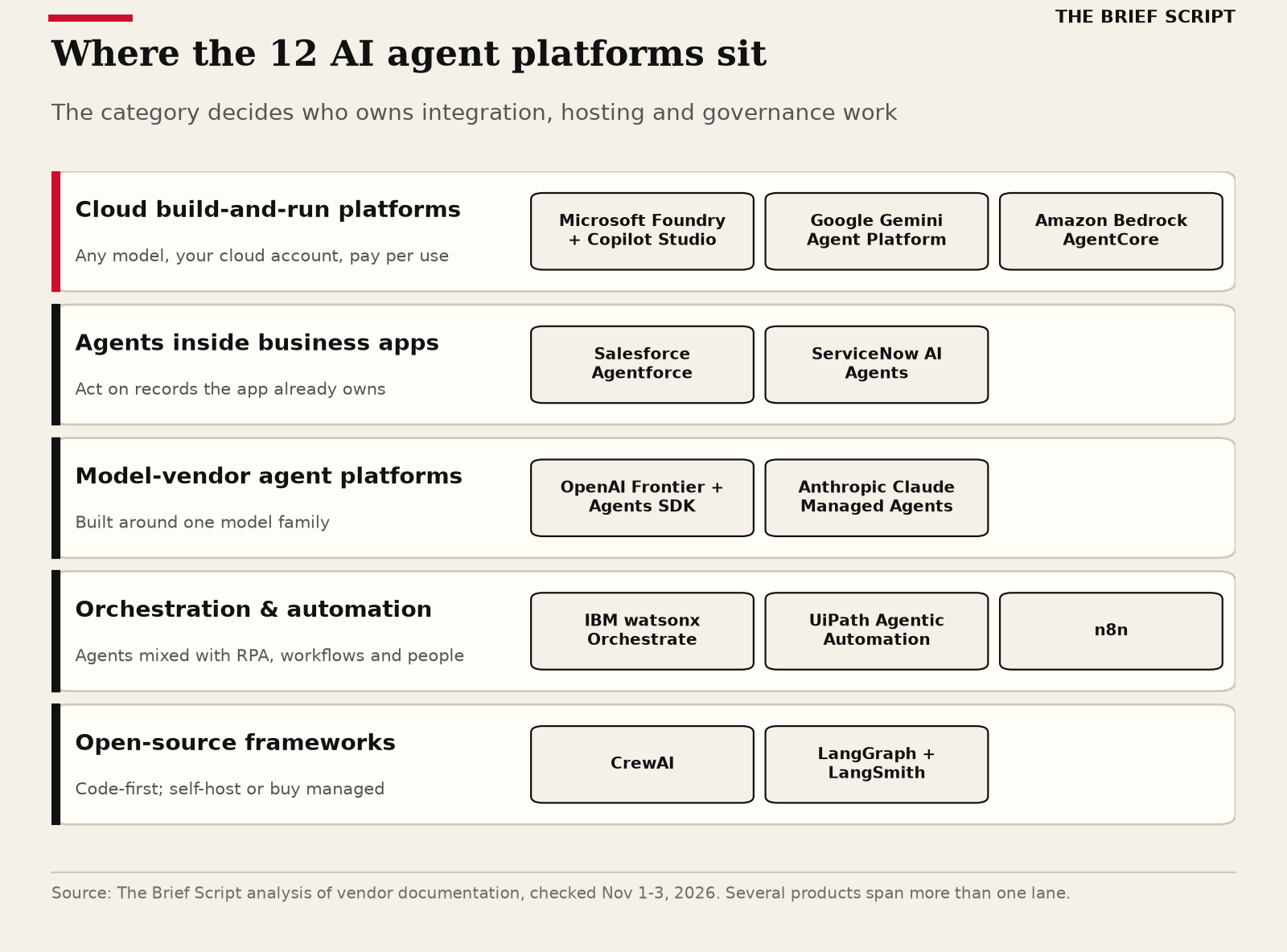
The 12 platforms here fall into five groups. Cloud platforms rent you runtime and models. Business-app platforms put agents next to the records they change. Model vendors sell a harness tuned for their own models. Orchestration tools mix agents with robotic process automation and people. Open-source frameworks give you code you can run anywhere, with a paid hosted tier if you want one.
The 12 platforms, profiled
1. Microsoft Foundry and Copilot Studio
Microsoft sells two layers. Foundry (renamed from Azure AI Foundry in January 2026) is the pro-code platform: Microsoft says the platform is free to use, and you pay published rates for the models and features you call. Its catalog lists more than 10,000 models from Microsoft and 10 named third-party makers, including OpenAI and Anthropic. Copilot Studio is the low-code builder. Internal agents are included with Microsoft 365 Copilot ($30 per user per month); agents for external channels need a standalone plan, sold as 25,000 Copilot Credits for $200 per month or on a pay-as-you-go meter. Foundry scored 93 in our index, the highest of 22 platforms; Microsoft 365 Copilot with Copilot Studio scored 81.
Watch for: credits are not tasks. Different operations use different numbers of credits, so price a real workflow before you compare.
2. Google Gemini Enterprise Agent Platform
Google launched the Gemini Enterprise Agent Platform in April 2026 as the next version of Vertex AI. It bundles Agent Studio, a managed runtime, sessions, Memory Bank and an Agent Gateway that handles MCP and agent-to-agent (A2A) traffic. Runtime and sandboxes cost $0.085 per vCPU-hour and $0.009 per GiB-hour, and idle time between turns is not billed. Beyond Gemini, it offers 11 third-party model providers, including Anthropic. Index score: 92.
Watch for: gateway, memory and session operations are billed separately, so the runtime rate is only part of the bill.
3. Amazon Bedrock AgentCore
AgentCore is AWS’s managed runtime for production agents. You deploy your own agent code or containers, and it adds Gateway, Identity, Memory, Policy and Evaluations as separate modules. Runtime starts at $0.0895 per vCPU-hour plus memory, CPU is not charged while the agent waits on a model or tool, and there are no minimums. Bedrock offers Amazon Nova plus models from 18 other providers. The older Bedrock Agents product is now “Agents Classic” and closed to new customers. Index score: 89.8.
Watch for: each module bills separately. AWS’s own example of a 10-minute support session works out to about $0.0067 in runtime, before model tokens.
4. Salesforce Agentforce
Agentforce is the default choice when the accounts, cases and orders already live in Salesforce. Pricing is the most transparent of the business-app vendors: Flex Credits cost $500 per 100,000, and a standard action uses 20 credits (about $0.10). Customer-facing agents can instead be billed at $2 per conversation, and a $5-per-user license opens agents to every employee, with credits on top. Salesforce added its own Koa reasoning model in September 2026 alongside OpenAI, Anthropic and Gemini models. Index score: 80.
Watch for: one request can trigger several actions. Salesforce’s own case-management example (three actions per case, 100 users) comes to $1,800 a month, excluding Data 360 and other services.
5. ServiceNow AI Agents
ServiceNow’s AI Agent Studio and Orchestrator suit IT, HR and customer service work that already runs on its platform. There is no dollar list price. Usage is counted in “assists”: under the rate card effective August 24, 2026, a small agentic workflow (fewer than four tool calls) uses 25 assists, a medium one 50 and a large one (9-20 tool calls) 150. The dollar value of an assist depends on your contract. Index score: 63.5, held back by pricing transparency (0 of 10) and data control (7 of 20).
Watch for: assist entitlements reset yearly and overages can be invoiced, so model volume before you sign.
6. OpenAI Frontier and the Agents SDK
Frontier is OpenAI’s enterprise platform for building and managing agents. It connects business systems for shared context, runs agents in production, adds evaluation loops and gives each agent its own identity and scoped permissions. Pricing is Not stated; every route goes through sales. For developers, the Agents SDK has no separate platform fee: you pay standard model and tool rates. AgentKit’s visual Agent Builder and Evals shut down on November 30, 2026, so new work should start on the SDK or Workspace Agents in ChatGPT.
Watch for: you are tied to OpenAI models, and Frontier’s commercial terms are only available through a sales process.
7. Anthropic Claude Managed Agents and Agent SDK
Anthropic launched Claude Managed Agents in April 2026: a hosted harness that handles sandboxing, long-running sessions, credentials and tracing. It costs standard Claude token rates plus $0.08 per session-hour of active runtime, and it can run inside your perimeter through self-hosted sandboxes and MCP tunnels. Multi-agent coordination is still in research preview. The Claude Agent SDK is the do-it-yourself option: the same agent loop as Claude Code, run as a library on your own infrastructure, with token costs only. Claude models are also sold through Bedrock, Google Cloud and Foundry.
Watch for: Managed Agents is new and Claude-only. Our index scores Claude Enterprise as a workplace assistant, not this developer platform.
8. IBM watsonx Orchestrate
Orchestrate is built to coordinate many agents, including third-party ones, across HR, procurement, finance and service, with a control plane and a catalog of tools. It runs on IBM Cloud, on AWS or on-premises. IBM’s pricing page lists Essentials and Standard from $6,360 a month, with Premium (data isolation, HIPAA-ready option) on request. Our November 1 index recorded a lower Essentials entry price, so confirm the current figure with IBM. watsonx scored 74 in the index.
Watch for: another orchestration layer only pays off if it cuts integration work you would otherwise do yourself.
9. UiPath Agentic Automation
UiPath combines agents, its robots and human tasks in one orchestrated process (Maestro). That makes it a strong fit for invoices, claims and other document-heavy work with legacy screens. The Community plan is free and Basic starts at $25 a month with limited agent use; Standard and Enterprise are quote-only. Standard can be self-hosted, including air-gapped, and Enterprise adds customer-managed keys and bring-your-own-model. Index score: 77.
Watch for: agents, robots and users are licensed separately, so a pilot quote can understate the cost at scale.
10. CrewAI
CrewAI’s open-source framework organizes agents into role-based “crews”, and its hosted platform adds a visual Studio, tracing, guardrails and human-in-the-loop steps. The Basic plan is free with 50 workflow executions and two automations a month. Enterprise is custom-priced and can run on CrewAI’s cloud, in your VPC or on your own infrastructure, with SSO, role-based access and PII redaction.
Watch for: model tokens are billed by your model provider on top of any CrewAI fee.
11. LangGraph and LangSmith
LangGraph is LangChain’s low-level framework for stateful agents. LangSmith adds tracing, evaluations, managed deployment, sandboxes and an LLM gateway. Plus costs $39 per seat per month and includes 10,000 base traces and one small serverless deployment; extra usage is metered at $1 per LangChain Standard Unit. Enterprise adds hybrid and self-hosted options, custom SSO and an SLA. LangChain says LangSmith does not train models on your data.
Watch for: trace volume and deployment compute grow with traffic, so watch usage after launch.
12. n8n
n8n is a workflow automation tool with AI agent nodes, MCP support and human approval for tool calls on every plan. It bills per full workflow run, however many steps it has: Starter is €20 a month for 2,500 executions and Pro €50 for 10,000 (billed annually), while the €667-a-month Business plan is self-hosted only. The Community Edition is free to self-host, which is why many teams prototype here first.
Watch for: SSO starts at Business, and audit logs and log streaming are Enterprise-only.
How to choose an AI agent platform
Start with where the work and the data already sit, not with the demo. Four questions narrow the field quickly:
- Which system does the agent change? If the answer is a CRM or service desk, test that vendor’s native agents first. If it spans many systems, a cloud platform or an orchestration tool is the better base.
- Who will build and maintain it? Business teams need a low-code builder such as Copilot Studio, Agentforce Builder or n8n. Engineering teams will want LangGraph, CrewAI or an SDK on a managed runtime.
- How many models do you need? Cloud platforms offer dozens. OpenAI and Anthropic platforms lock you to one family, which is fine if that is your standard.
- Where must it run? If you need on-premises or air-gapped deployment, the realistic options are Microsoft (Foundry Local), Google Distributed Cloud, IBM, UiPath, or a self-hosted open-source stack.
Then make the controls pass-or-fail before you compare features. Ask each finalist to show whose permissions every action uses, that blocked actions stay blocked, that an approver sees the exact change before it runs, and that a reviewer can rebuild the full trail of sources, tool calls and approvals. Our enterprise AI security guide covers these controls in more depth. In our deployment study, 118 of 150 deployments described approvals, exception handling, governance or active human review, so plan for oversight from day one.
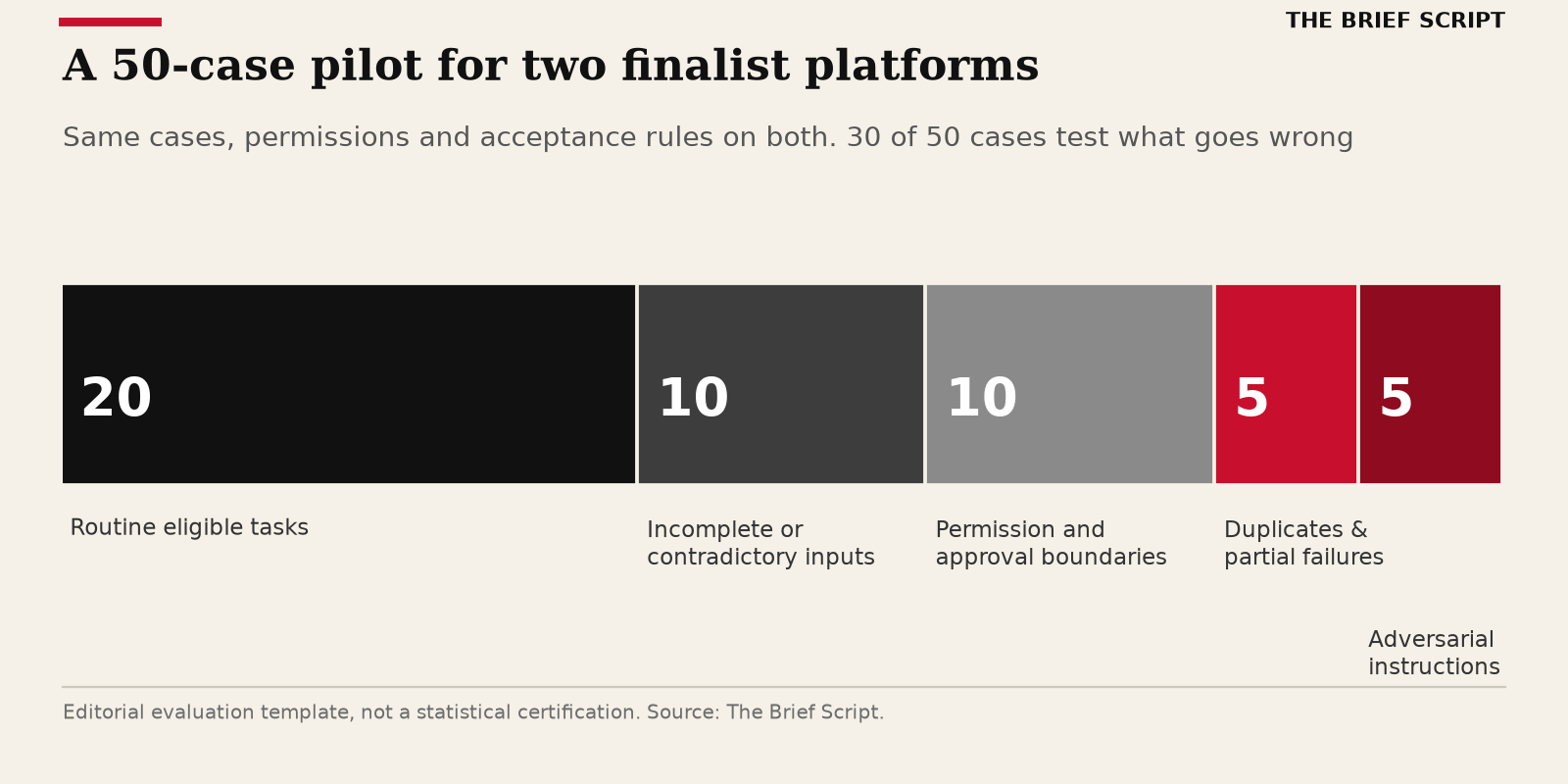
A practical pilot compares two finalists on one workflow using the same 50 cases: 20 routine tasks, 10 with incomplete or contradictory inputs, 10 that hit permission or approval limits, 5 duplicates or partial failures, and 5 with hostile instructions hidden in retrieved content. Use test data, check the resulting business record rather than the chat transcript, and keep a few cases back for a final run after tuning.
What AI agent platforms cost
No two vendors bill the same unit. Microsoft sells credits, Salesforce sells actions or conversations, AWS and Google bill runtime hours, Anthropic bills session-hours, LangSmith bills seats and usage, and n8n bills workflow runs. ServiceNow, OpenAI Frontier and the enterprise tiers of UiPath and CrewAI do not publish a dollar rate at all. And all of these figures exclude model tokens, which are often the largest line.
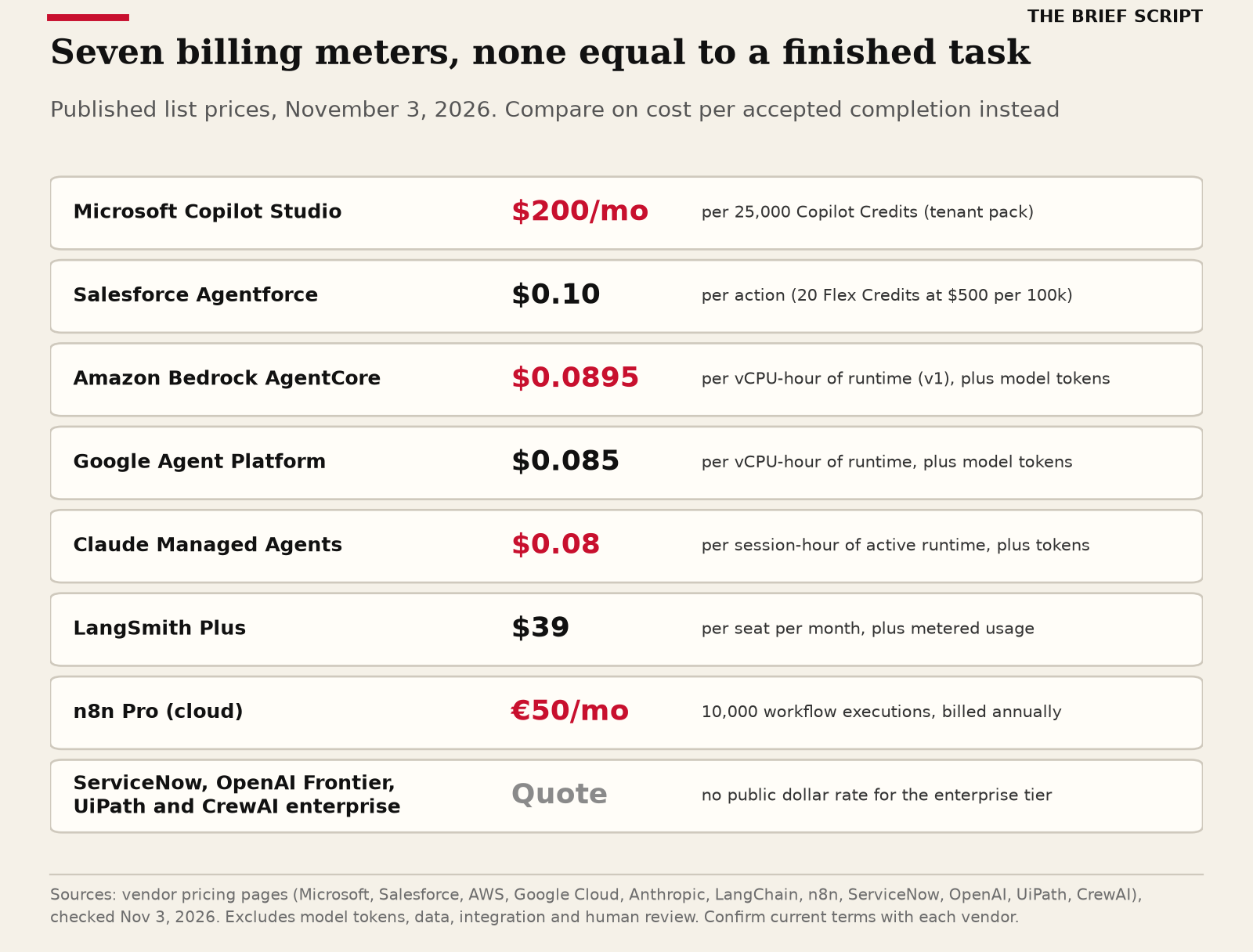
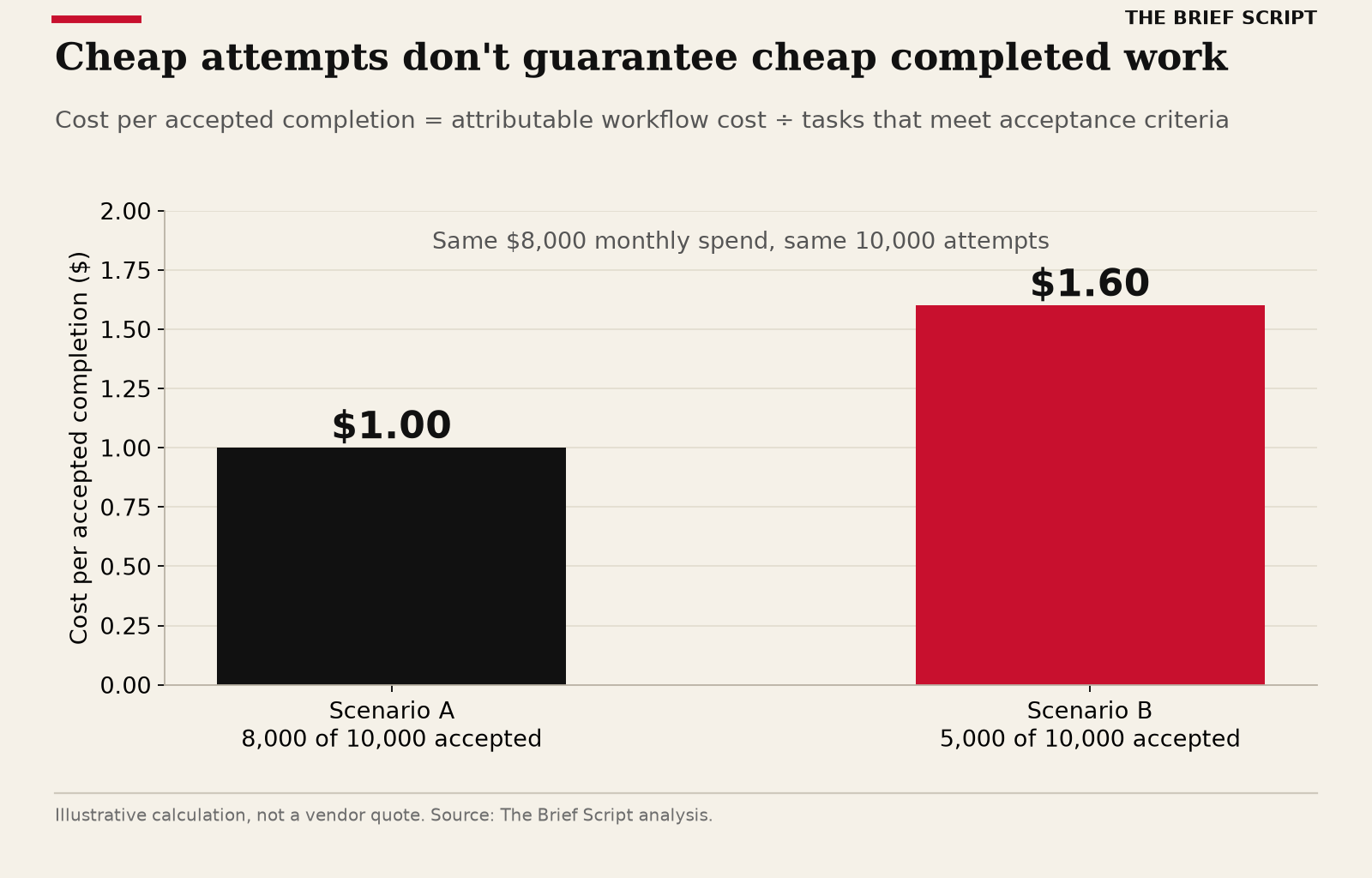
To compare fairly, translate each bill into one number: cost per accepted completion, which is the total attributable cost divided by the tasks that meet your acceptance criteria. Include licenses and usage, model tokens, integration, evaluation, human review and exception handling. For example, if 10,000 attempts cost $8,000 a month and 8,000 are accepted, each accepted task costs $1.00. If only 5,000 pass at the same spend, the cost is $1.60. That is an illustration, not a quote, but it shows why a cheap meter can still produce expensive work.
Our enterprise AI deployment cost breakdown lists the cost layers that sit outside a platform’s headline rate, from data preparation to ongoing monitoring.
Frequently asked questions
What is an AI agent platform?
It is software for building, running and governing AI agents. It typically includes an agent builder or SDK, a runtime, connectors and tool access (often through MCP), identity and permission controls, and tracing and evaluation. Examples include Microsoft Foundry, Amazon Bedrock AgentCore, Salesforce Agentforce and LangGraph with LangSmith.
Which AI agent platform should an enterprise pick?
There is no single winner. Start with the platform attached to the system the agent will change, such as Agentforce for Salesforce data or ServiceNow for IT tickets. Use a cloud platform when work spans systems, and an open-source framework when engineers need full control. Then test two finalists on the same workflow.
How much do AI agent platforms cost?
Published entry points range from free tiers (CrewAI, n8n Community, LangSmith Developer, UiPath Community) to usage meters such as $0.085 per vCPU-hour on Google, $0.10 per Agentforce action or $200 per 25,000 Copilot Studio credits. Model tokens, integration and human review come on top, and several enterprise tiers are quote-only.
Is an open-source framework enough, or do we need a platform?
A framework such as LangGraph or CrewAI is enough to build an agent, but you still need hosting, identity, monitoring and evaluation. You can run those yourself, buy them from the framework vendor (LangSmith, CrewAI Enterprise) or host the framework on a managed runtime such as AgentCore or Google’s Agent Runtime.
The right AI agent platform is the one that completes a valuable, permitted workflow reliably enough to justify its full cost. Shortlist from your systems, prove it with your own cases, and compare on cost per accepted completion.