What Is Enterprise AI and How Does It Work?
Pillar defining enterprise AI in operational terms, scope, use cases, buying and deployment pathway.

Enterprise AI is the use of artificial intelligence within an organization’s applications, decisions and workflows, supported by appropriate data access, security, oversight and performance measurement. It includes predictive models, computer vision, generative AI and AI agents. A chatbot is one possible interface, not the entire category.
Think of a customer refund. AI might summarize the complaint, check the policy, recommend a decision or issue the refund. Those are different levels of responsibility, even when the same model powers them.
The practical question is which part of that workflow should use AI, what it may access or change, and how the company will know it helped.
What makes AI enterprise-ready?
Enterprise AI combines a useful capability with the operating conditions a business requires. A paid account or an impressive demonstration alone does not establish that a system is suitable for a particular workflow.
Google Cloud’s enterprise AI overview describes applications ranging from forecasting and maintenance to fraud detection. The common requirement is a defined business task, not a particular interface or model family.
An enterprise application can use the same underlying model as a consumer product. What changes is the surrounding configuration, contractual terms, integrations and accountability.
| Requirement | Personal use might allow | A business deployment should establish |
|---|---|---|
| Data access | A user pastes information into a prompt | Which sources and records each user or service may access |
| Data handling | Individual account settings | Approved retention, training-use and deletion terms |
| Quality | The user decides whether an answer seems useful | Task-specific evaluation, failure handling and review criteria |
| Actions | A person copies the result elsewhere | Explicit authority to read, draft, update or transact |
| Reliability | Occasional inconvenience may be acceptable | Monitoring, support expectations and a fallback process |
| Accountability | The individual owns the decision | Named business and technical owners, with an evidence trail |
These are deployment requirements, not claims that every product labeled enterprise already satisfies them. The necessary controls should reflect the consequences of the task.
The Brief Script view: Enterprise readiness is a property of the whole workflow. Evaluate the model, its access, the surrounding software and the people responsible for the result together.
How is enterprise AI different from generative AI?
Enterprise AI describes where and how AI is used. Generative AI describes a capability: producing new content such as text, images or code. Generative AI can be part of an enterprise system, but enterprise AI also includes systems that predict, classify or inspect.
| Approach | What it does | Business example | What to evaluate |
|---|---|---|---|
| Predictive machine learning | Estimates an outcome or classifies a record | Forecast demand or flag suspicious transactions | Error rates, calibration and business impact |
| Computer vision | Interprets images or video | Detect possible defects on a production line | Missed defects, false alarms and inspection conditions |
| Generative AI | Produces or transforms content | Draft a response using approved support material | Factual support, completeness and review effort |
| Agentic AI | Uses models and tools to work through a task | Investigate a ticket and update permitted records | Task completion, tool use, permissions and exceptions |
These categories overlap. Computer vision can use machine learning, and an agent can use a generative model alongside predictive models and conventional software.
A fixed rule that routes an invoice above a threshold is ordinary automation. AI becomes useful when the task also requires interpreting a messy document, classifying an unfamiliar request or handling variation that fixed rules cannot efficiently cover.
How does enterprise AI work in practice?
A useful way to understand the system is to follow one request from its business purpose to its verified result. The model is one component in that path.
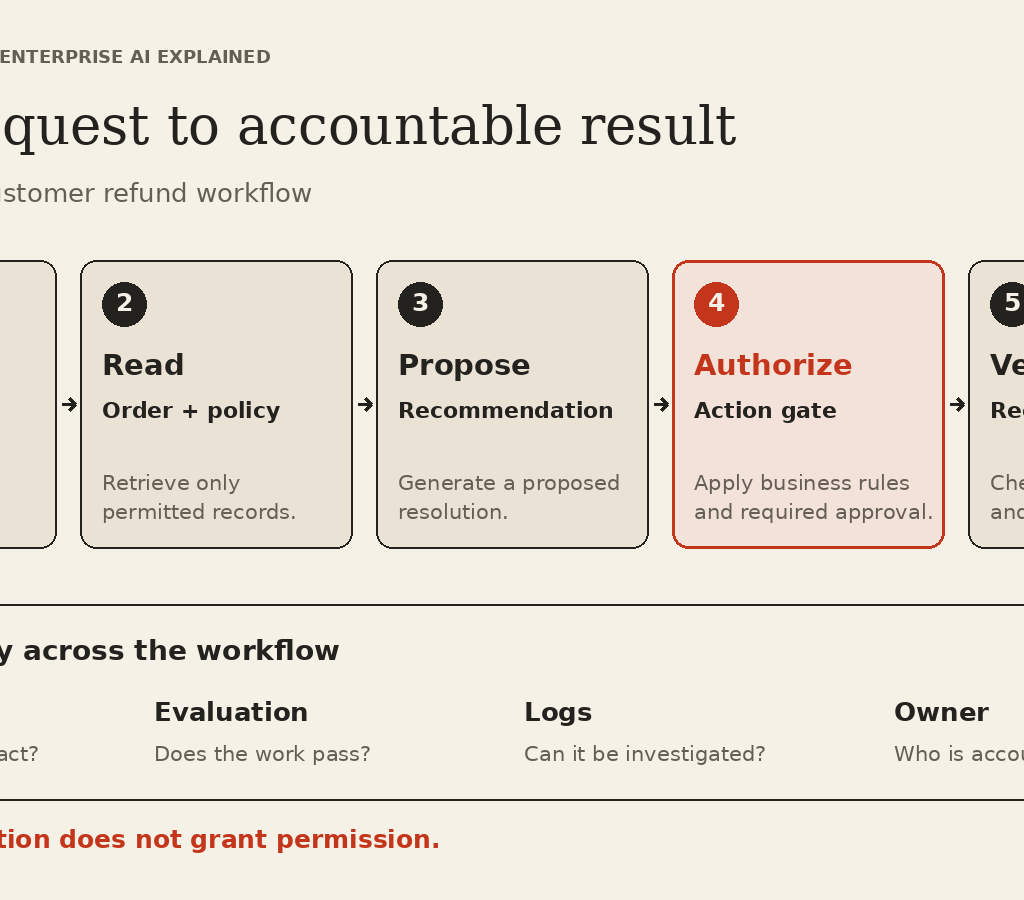
Illustrative refund workflow. The action gate sits outside the model’s recommendation. The organization decides which actions require rules, approval or escalation.
1. Define the task and permitted outcome
Specify whether the system should explain a policy, recommend a refund, prepare it for review or execute it. Avoid a vague instruction such as handle customer service when the actual authority is much narrower.
2. Supply relevant data within access limits
The application may retrieve an order, the applicable policy and previous correspondence. It should enforce the permissions of the user and the service performing the task, rather than treating connected data as universally available.
Retrieval-augmented generation, or RAG, supplies relevant material to a model at request time. It differs from changing the model through training or fine-tuning. Retrieval can improve grounding, but an incorrect source or missed document can still produce a poor answer.
This is why enterprise AI search should be evaluated for access boundaries and source freshness alongside answer quality.
3. Generate a prediction, explanation or proposed action
The AI component interprets the request and produces its output. A forecast might be a number; a vision model might flag an image region; a generative model might draft a response.
An agent can also choose tools and work through intermediate steps. Anthropic’s guidance on effective agents distinguishes predefined workflows from systems in which a model directs tool use. It recommends starting with a simpler solution when that meets the task.
4. Apply the action gate
A recommendation is not permission. Conventional application logic, authorization checks and designated reviewers should enforce what happens next. A model’s confidence score should not replace those controls. In the refund example, the system might draft a response automatically while sending a disputed claim to a person. Any permitted transaction still needs identity checks, applicable business rules and protection against duplicate execution.
5. Verify the result and preserve evidence
Record the outcome and enough context to investigate it, subject to data minimization and retention requirements. Measure whether the case was resolved correctly, whether it reopened, how much review it required and what the workflow cost. Demand forecasting follows the same general logic without a chat interface. Historical data enters a model; a forecast informs a replenishment decision; the business measures forecast error, stockouts and inventory consequences.
Where can enterprise AI create value?
Start with a recurring business task whose inputs and results can be inspected. A use case becomes easier to evaluate when the organization can define a completed unit of work and identify the cost of an incorrect result.
| Workflow | Possible AI contribution | Useful outcome measure | Boundary to establish |
|---|---|---|---|
| Customer service | Find policy information and draft or execute permitted resolutions | Correct resolution rate, repeat contacts and cost per resolved case | Refund authority and escalation conditions |
| Finance operations | Extract invoice details and identify mismatches | Accepted invoices per hour, correction rate and processing cost | Payment approval and exception ownership |
| IT support | Diagnose a request and carry out approved remediation | Resolution time, recurrence and unsuccessful changes | System access and rollback requirements |
| Sales operations | Summarize account history and prepare follow-up work | Preparation time, record accuracy and qualified progression | Customer data access and external communication approval |
| Manufacturing | Inspect images or predict equipment issues | Missed defects, unnecessary interventions and downtime | Human confirmation and operational safety limits |
| Internal knowledge | Retrieve and summarize approved information | Supported answers, search time and access-control failures | Document permissions and source currency |
Treat these as starting hypotheses, not guaranteed benefits. For example, faster support replies can coexist with more repeat contacts. Evaluate the whole task before declaring an improvement.
The selection of enterprise AI use cases should distinguish between a capability that looks useful and a workflow whose value can be demonstrated. A task-level baseline makes that distinction easier to test.
What do real deployments tell us?
The Brief Script’s analysis of 250 enterprise AI cases found quantified outcomes in 90% of the selected cases. Only 11.6% explicitly disclosed money, ROI, payback, breakeven or total cost of ownership in the primary published result.
Those figures describe an evidence-screened sample, not the success rate of enterprise AI. They show why a published productivity improvement should not automatically be read as proven financial return.
Our separate research on 150 enterprise AI agent deployments found that 118 described approval, exception handling, governance, accountability or active human review. That study also uses a selected sample rather than a representative market survey.
The practical implication is to examine the operating boundary alongside the technology. Ask what the system does independently, what people still approve and which outcomes have actually been measured.
What is an enterprise AI platform?
An enterprise AI platform provides shared capabilities for using, building, operating or governing AI applications. The term covers different product categories, so two platforms may solve quite different problems.
| Platform category | Main job | First evaluation question |
|---|---|---|
| Employee-facing AI applications | Help people search, analyze, draft or complete a particular workflow | Does it improve the actual task with approved data? |
| Development and runtime platforms | Provide model access, integration, evaluation and deployment capabilities | Can the team build and operate the required application reliably? |
| Governance and control tools | Help inventory, monitor and oversee AI systems | Can the organization establish ownership and investigate behavior across its estate? |
The categories can overlap within a product. Compare specific capabilities and plan restrictions instead of assuming that every enterprise AI platform provides the same scope. An enterprise AI platform comparison should separate these buying decisions. For execution-heavy workflows, an enterprise AI agent comparison should focus on task fit, tool permissions and supervision.
A company does not need to train a foundation model or buy GPUs simply to use enterprise AI. It may start with an approved application or hosted model service. Custom infrastructure is a workload and control decision, not a prerequisite implied by the word enterprise.
How should a company choose its first AI use case?
Choose a task with a visible bottleneck, accessible evidence and manageable consequences. The most impressive demonstration is not necessarily the best first deployment.
Our practical selection test has five questions:
- Can the task be defined? Name the input, expected output, volume and person who accepts the work.
- Is the necessary data usable and permitted? Check quality, ownership, access and retention before connecting sources.
- Can quality be tested? Use representative normal cases, difficult cases and examples the system should refuse or escalate.
- Can failure be contained? Define action limits, a fallback route and a way to reverse changes where possible.
- Does someone own the outcome? Assign a business owner and an explicit decision to continue, revise or stop.
If the answer to a question is no, address that gap before expanding access. This is an editorial decision framework, not a validated scoring model or a promise of success.
An enterprise AI strategy should explain why the chosen task deserves investment. An enterprise AI adoption plan should explain how people will use the system, handle exceptions and change the surrounding workflow.
Start with observation or drafting when appropriate, then expand authority only after task quality and controls have been tested. Some workflows may appropriately remain advisory.
How much does enterprise AI cost?
The full cost includes more than a subscription or model call. Budget for data preparation, integrations, evaluation, security review, implementation, training, human checking, monitoring and ongoing changes.
Buying an application can reduce development work while leaving configuration, rollout and supervision costs. Building a custom application can provide more control while increasing the operating responsibilities the company must fund.
Our enterprise AI deployment cost guide explores those budget layers. For initial decisions, estimate the total workflow cost at realistic volume and include work created by rejected or incorrect outputs.
A cheaper model is not automatically a cheaper business process. Savings on generation can disappear if people spend more time correcting results or if a higher exception rate moves work elsewhere.
How should enterprise AI value be measured?
Measure three things separately: usage, accepted work and business outcomes. Generating more answers establishes activity. Producing more verified work establishes operational value. A financial claim needs evidence of what changed in costs, capacity, revenue or losses.
One useful diagnostic is cost per accepted result. Define acceptance before the pilot, including quality and policy requirements, then include unsuccessful attempts in the cost calculation.
Cost per accepted result = total workflow cost for the period ÷ results meeting the acceptance criteria.
The following example is illustrative. It is not a vendor benchmark, market price or finding from our research.
| Pilot measure | Scenario A | Scenario B |
|---|---|---|
| Outputs attempted | 10,000 | 10,000 |
| Outputs passing the same acceptance criteria | 8,000 | 6,000 |
| Acceptance rate | 80% | 60% |
| Total cost, including allocated setup, operation, review and failed attempts | $8,000 | $8,000 |
| Cost per accepted result | $1.00 | $1.33 |
Both scenarios generate the same number of outputs at the same cost. Scenario B costs about one-third more per accepted result. Output volume hides the difference.
The metric also has limits. It cannot capture every rare, severe error, and it does not prove ROI. Compare results with an appropriate baseline and track important harms separately.
Time saved can create capacity, improve service or reduce overtime. It becomes a cash saving only when an actual expense changes. Avoid valuing the same improvement once as time saved and again as a separate cost reduction without checking for double counting.
What risks need attention before rollout?
An AI system can produce convincing but incorrect content, retrieve information the user should not see or take an action outside its intended authority. Testing should cover these failure modes as well as normal task performance.
The NIST AI Risk Management Framework provides a voluntary approach to managing AI risk throughout a system’s lifecycle. Following a framework does not by itself establish legal compliance or prove that an individual application is safe.
| Risk | Control to consider | Observable test |
|---|---|---|
| Unsupported answer | Approved sources, evidence checks and escalation | Give the system a question its sources cannot answer |
| Inappropriate data access | Permission enforcement at retrieval and tool layers | Repeat a request using accounts with different entitlements |
| Unauthorized action | Scoped tools, business-rule validation and approval gates | Request an action outside the permitted scope |
| Instructions hidden in retrieved content | Treat source material as untrusted input and constrain tool execution | Insert a conflicting instruction in a controlled test document |
| Changed behavior after an update | Version records, repeatable evaluations and rollback procedures | Re-run the agreed test set before expanding the update |
These tests are examples, not an exhaustive security assessment. Apply them to the actual application and the consequences of its decisions. Enterprise AI governance assigns responsibility for those controls. Enterprise AI security addresses technical protections, while the AI audit checklist helps identify evidence that controls operate in practice.
The common thread in enterprise AI project failure is the distance between a promising pilot and a dependable operating process. Data, integration, adoption, economics and accountability all deserve an explicit test.
Frequently asked questions
Is enterprise AI only for large companies?
No. The term often describes deployment across large organizations, but smaller companies also need appropriate data handling, integration and accountability. The controls should match the workflow’s consequences and complexity, rather than headcount alone.
Does enterprise AI require a company to train its own model?
No. Companies can use pretrained models through approved applications or APIs. Training or fine-tuning is an option when justified by the task, data, evaluation results and operating resources.
Is retrieval-augmented generation the same as fine-tuning?
No. RAG supplies external information when a request is processed. Fine-tuning changes a model through additional training. They solve different problems and can be combined; neither removes the need to evaluate task performance and data access.
Can enterprise AI work with existing business software?
Yes, through supported integrations, APIs and other access methods. Connector availability is only the starting point. Check which records can be read or changed, how identity is handled and what happens when the connection fails.
Does enterprise AI have to run on premises?
No. It can use hosted services, private infrastructure, on-device processing or a combination. Choose based on data handling, security, performance, cost and operational requirements. On-premises hosting alone does not establish that the application is secure.
What should leaders take away?
Enterprise AI becomes useful when a company connects the right capability to a defined task, approved data, controlled authority and an observable result. Start with one workflow whose inputs, acceptance criteria and owner are clear. Establish the baseline, test failure conditions and measure the cost of accepted work before expanding authority or access.
The strongest starting question is practical: What should this system help us do, and what evidence will show that it did it well?