Secure Enterprise Browser (2027): Agentic Browser Security Risks, Controls and 8 Vendors
What a secure enterprise browser is, how it differs from browser isolation and SSE, the new risks AI browser agents bring (prompt injection, session abuse, data leaks, shadow AI), eight vendors compared from their own documentation, and an 11-step control checklist. Checked November 2026.

In short: A secure enterprise browser (SEB) puts security policy inside the browser itself, as a managed extension or a full custom browser, so IT can control data, extensions and access on any device without decrypting traffic. AI agents that click, type and log in on a user’s behalf make that control point more important, because prompt injection can turn the user’s own sessions against them.
Browsers used to be a window onto apps. In 2026 they became the place where AI agents act: Chrome, Edge and add-ons such as Claude in Chrome can now navigate, fill forms and submit work inside logged-in sessions. This guide explains what a secure enterprise browser is, what agentic browsing adds to the threat model, and how eight vendors compare on what they publicly document as of November 14, 2026. It ends with a control checklist for letting browser agents into the workplace.
What is a secure enterprise browser?
Gartner, which published its first Market Guide for Secure Enterprise Browsers on February 11, 2026, defines an SEB as a solution that delivers enterprise security policies through a centrally managed browser extension and, optionally, a full-stack custom browser. It enforces policy for web, SaaS and private apps “without the need for in-line decryption of web traffic”, on managed, lightly managed or unmanaged devices.
In practice, an SEB does six jobs:
- Access: conditional access to SaaS and internal web apps based on identity and device posture.
- Data loss prevention (DLP): rules for copy and paste, upload, download, print and screenshots, plus masking and watermarking.
- Extension control: an inventory and risk score for every browser extension, with block or allow rules.
- Threat defense: URL filtering, anti-phishing and protection of session tokens and cookies.
- Visibility: session logs of user, device, destination and activity, sent to your SIEM.
- AI governance: discovery and policy for AI tools, AI browsers and browser agents. Gartner lists this as a common feature, not yet a mandatory one.
There are two form factors. A full-stack SEB (Island, Prisma Browser, Chrome, Edge for Business) replaces the browser. An extension (Menlo IRIS, Akamai’s LayerX-based product, CrowdStrike’s Seraphic) adds controls to the browsers people already use. Gartner’s advice is to use extensions on managed endpoints and full-stack browsers for contractors, personal devices and kiosks.
Secure enterprise browser vs browser isolation vs SSE
| Approach | Where control sits | Strength | Gap |
|---|---|---|---|
| Secure enterprise browser | Inside the browser (extension or custom browser) | Sees clicks, pastes, uploads and agent actions on the page; works on unmanaged devices | Only covers the browser; can be bypassed on a compromised device |
| Remote browser isolation (RBI) | A cloud browser; the user receives a safe rendering | Keeps page code off the endpoint | Latency and cost; usually reserved for risky sites |
| Security service edge (SSE) | The network path (SWG, CASB, ZTNA) | All ports and protocols, central policy | Needs TLS decryption; blind to in-page actions and personal accounts |
Gartner’s position is that an SEB complements SSE and endpoint tools rather than replacing them, unless you are a cloud-only, remote-first company with few offices.
What agentic browsers add to the threat model
An agentic browser, or a browser with an agent built in or bolted on, reads a page and then acts on it with the user’s cookies, single sign-on sessions and sometimes saved passwords. That breaks a basic assumption of web security: that content from one site cannot command the user’s session on another. Some browsers now also hand the session to outside agents: Opera Neon’s free MCP connector and command-line tool let Claude, ChatGPT or another agent drive a logged-in browser, as our Opera Neon review explains.
1. Indirect prompt injection
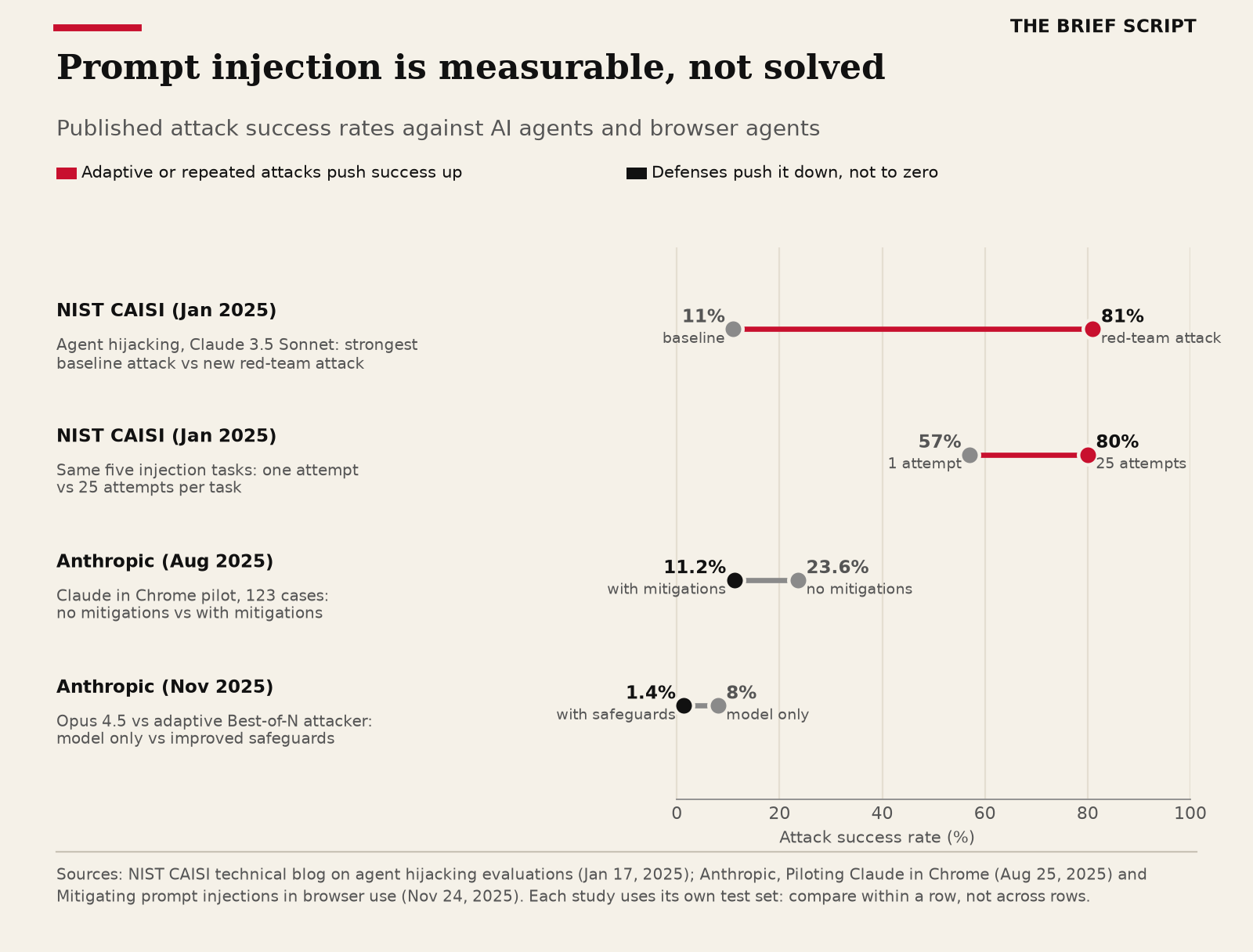
Text hidden on a page, in an email or in a document can carry instructions the agent follows. The OWASP Top 10 for LLM Applications 2026 keeps prompt injection at number one and states the root cause plainly in LLM01:2026: models make “no architectural distinction between instructions and data”. The measured numbers back that up:
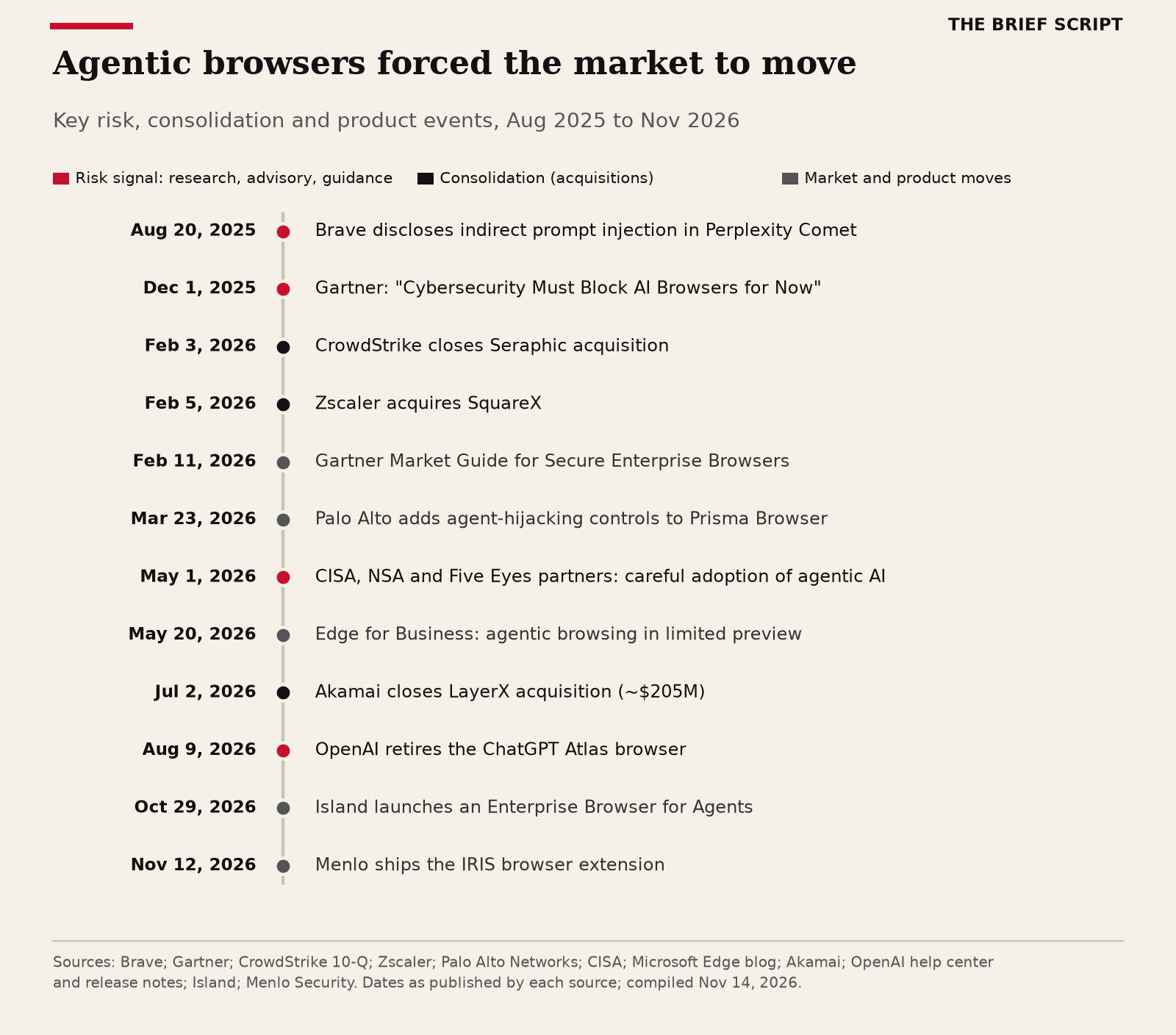
- Brave’s August 2025 research showed Perplexity’s Comet passing page content to its model without separating it from the user’s request, so hidden text in one tab could reach the user’s email in another.
- Anthropic’s own Claude in Chrome pilot recorded a 23.6% attack success rate across 123 test cases without mitigations and 11.2% with them. By November 2025, with Claude Opus 4.5 and new safeguards, its adaptive test fell to 1.4%, which Anthropic still called “meaningful risk”.
- The US government’s AI standards center showed how fast numbers move against a determined attacker. In the NIST CAISI agent hijacking tests, new red-team attacks lifted success from 11% to 81%, and 25 attempts per task lifted the average from 57% to 80%.
2. Credential and session abuse
The agent works inside authenticated sessions, so a successful injection inherits the user’s access. University of Washington researchers who tested seven agentic browsers in early 2026 found that the browser’s same-origin policy was reduced to the strength of the agent’s prompt-injection defenses in several of them. They demonstrated cross-origin data theft on ChatGPT Atlas in Agent Mode and found the preconditions in Chrome with Gemini, Claude for Chrome and Comet. Gartner’s December 2025 advisory, “Cybersecurity Must Block AI Browsers for Now”, also flagged credential loss if an agent is steered to a phishing page.
3. Data exfiltration
An agent can be told to paste, upload or submit data to a site the attacker controls, and agent traffic looks like normal user traffic to a network proxy. The leak channel already exists without agents: LayerX’s browser telemetry found that 77% of employees who use generative AI paste data into prompts, and 82% of those pastes come from personal accounts (vendor data from its own customers).
4. Shadow AI
Employees install AI browsers and AI extensions on their own. These tools change fast, too: OpenAI’s ChatGPT Atlas has been retired and no longer receives updates (it stopped working on August 9, 2026), and OpenAI tells admins to move members to “an approved, supported browser”. An unpatched AI browser left on laptops is its own risk. Our guide to shadow AI covers discovery methods beyond the browser.
The common thread is that agents act with delegated authority. It is the same problem we cover for tool-calling agents in MCP security: what the agent is allowed to reach matters more than how well its model resists persuasion.
Secure enterprise browser vendors compared (November 2026)
The table lists what each vendor documents publicly. We did not test the products. “Not public” means we found no per-user price on the vendor’s site on November 14, 2026.
| Vendor / product | Form factor | AI and agent controls (documented) | DLP | Public pricing | Note |
|---|---|---|---|---|---|
| Island Enterprise Browser | Full browser and extension | Enterprise Browser for Agents (Oct 29, 2026) governs agent sessions: credential isolation, data boundaries, attribution; AI Protect logs prompts and responses | Yes | Not public | $400M Series F at $6.4B (Sep 2026) |
| Palo Alto Networks Prisma Browser | Browser, extension, mobile app | Discovers AI activity, keeps agents in scope, blocks prompt injection hidden in sites (Mar 23, 2026) | Yes | Not public | Part of Prisma SASE |
| Google Chrome Enterprise Premium | Full browser (Chrome) | Gemini auto browse off by default for managed users; allow and block URL lists for where it can act | Yes (Premium) | Core $0; Premium $6/user/month | Auto browse needs a qualifying Workspace edition |
| Microsoft Edge for Business | Full browser (Edge) | Browsing with Copilot: only IT-authorized domains, honors DLP, asks the user for sign-in and final submit, no saved passwords or payments | Yes | Agent needs a Microsoft 365 Copilot licence (Business add-on $21/user/month list) | Limited preview; not in the EEA |
| Menlo Security | Extension (IRIS) plus cloud browser | MARS runs agent sessions in the cloud and strips prompt injection from pages and files agents read | Yes | Not public (estimate tool) | IRIS launched Nov 12, 2026 |
| Akamai Workforce Protector (formerly LayerX) | Extension | AI usage control; visibility into prompts and file uploads in existing browsers | Yes (prompts, uploads) | Not public | Akamai closed the ~$205M deal Jul 2, 2026 |
| CrowdStrike Falcon Seraphic Enterprise Browser | Runtime module for Chrome, Edge, Safari, Firefox | Discovers shadow AI, blocks risky AI extensions, governs agentic browsers | Yes | Not public | Acquisition closed Feb 3, 2026; in Falcon since Nov 4, 2026 |
| Zscaler (SquareX) | Extension | Browser detection and response; agent-specific controls not detailed in the acquisition release† | Not detailed† | Not public | Acquired Feb 5, 2026 |
† Not confirmed on a product page we could read. Pricing for Microsoft is the published add-on price, with an $18 promotion running to December 31, 2026; enterprise agreements differ.
Three patterns stand out. First, consolidation: CrowdStrike, Zscaler and Akamai each bought a browser-security startup within six months, so most buyers will meet SEB features inside a platform they already license. Second, the browser makers now ship their own agent controls, and both Google and Microsoft leave agents switched off until an admin enables them for managed users. Third, only Google publishes an SEB price.
How to choose
- You already run Chrome or Edge everywhere: start with the native agent policies (they are free to configure) and add an extension SEB for DLP and extension control.
- You need contractor or personal-device access: a full-stack browser such as Island or Prisma Browser gives deeper posture checks.
- You are consolidating vendors: check whether your endpoint or SSE provider (CrowdStrike, Zscaler, Akamai, Palo Alto) already includes browser controls.
- You plan to run agents headless in the cloud: look at Island’s agent browser and Menlo’s MARS, which govern agent sessions rather than human ones.
A control checklist for allowing agentic browsers at work
The joint CISA, NSA and Five Eyes guidance of May 1, 2026 sets the tone: avoid broad access, start with low-risk tasks, and fold agents into your existing security model. Turned into browser controls:
- Inventory first. Find every AI browser, AI extension and built-in agent in use, sanctioned or not. Remove retired products such as Atlas.
- Default agents to off. Enable browser agents for a named pilot group only, using the vendor policy (for Chrome, the Gemini auto browse policies; for Edge, the browsing with Copilot settings).
- Allowlist sites. Let agents act only on named domains. Block finance, HR, admin consoles and identity provider pages by default.
- Keep credentials away from agents. No access to the password manager or payment methods; the user signs in.
- Require a human for consequential steps. Submitting, sending, purchasing, deleting and changing permissions need a user click.
- Apply the same DLP to agents as to people. Copy, paste, upload and form-fill rules should fire whether a human or an agent acts.
- Separate work and personal. Block agents in personal profiles and personal AI accounts on managed devices.
- Control extensions. Allow AI extensions only from a reviewed list, and re-review on permission changes.
- Log agent actions separately. Tag agent-initiated navigation and form submissions so the SOC can tell them from user actions.
- Red-team before widening access. Test with adaptive and repeated prompt-injection attacks, as NIST recommends, not a single pass.
- Review quarterly. Agent features ship monthly. Re-check defaults, policies and vendor status every quarter.
These controls slot into a wider programme: map them to your generative AI governance risk register, and add the evidence (policy exports, logs, red-team results) to your AI audit checklist.
FAQ
What is the difference between a secure enterprise browser and an enterprise browser?
Vendors use the terms interchangeably. “Secure enterprise browser” is Gartner’s market name and covers both full custom browsers and extensions. A managed consumer browser such as Chrome with Chrome Enterprise Core gives policy control but fewer data-protection features than a dedicated SEB.
Should we block AI browsers?
Gartner told clients in December 2025 to block them until enterprise-ready versions reach general availability. Since then Chrome and Edge have shipped agent features that are off by default for managed users with admin allowlists. A reasonable 2027 position is to block unmanaged AI browsers and allow managed browser agents for a pilot group under the checklist above.
Can a secure enterprise browser stop AI browser prompt injection?
Partly. Some vendors (Palo Alto, Menlo, Island) say they detect or strip injected instructions, but no vendor has published independent test results we could find. The more reliable controls limit what a hijacked agent can do: site allowlists, no credential access, human approval and DLP.
How much does a secure enterprise browser cost?
Chrome Enterprise Premium is $6 per user per month. Microsoft’s agent feature in Edge needs a Microsoft 365 Copilot licence. Island, Palo Alto, Menlo, Akamai, CrowdStrike and Zscaler quote on request.
Methodology
This is desk research. Between November 13 and 14, 2026, we read vendor product pages, documentation and press releases, Gartner’s Market Guide reprint, and primary research from NIST, Anthropic, Brave, the University of Washington and OWASP. We did not test any product. Vendor capabilities are as described by each vendor; vendor-reported security results are labelled as such. Figures we could not confirm on a primary page are marked †. For the wider governance programme these controls sit in, see our enterprise AI governance playbook.
Sources
- Gartner: Market Guide for Secure Enterprise Browsers (Feb 11, 2026, reprint): https://www.gartner.com/doc/reprints?ct=260504&id=1-2NASDZYL&st=sb
- Gartner: Cybersecurity Must Block AI Browsers for Now (Dec 1, 2025, abstract): https://www.gartner.com/en/documents/7211030
- OWASP: LLM01:2026 Prompt Injection: https://github.com/GenAI-Security-Project/GenAI-LLM-Top10/blob/main/2026/final/LLM01_PromptInjection.md
- Brave: Agentic Browser Security: Indirect Prompt Injection in Perplexity Comet: https://brave.com/blog/comet-prompt-injection/
- Anthropic: Piloting Claude in Chrome: https://claude.com/blog/claude-for-chrome
- Anthropic: Mitigating the risk of prompt injections in browser use: https://www.anthropic.com/research/prompt-injection-defenses
- NIST CAISI: Technical Blog: Strengthening AI Agent Hijacking Evaluations: https://www.nist.gov/news-events/news/2025/01/technical-blog-strengthening-ai-agent-hijacking-evaluations
- University of Washington: Agentic Browsers and the Same-Origin Policy: https://agent-security.cs.washington.edu/agentic_browsers_sop.html
- LayerX: AI Is Now the #1 Data Exfiltration Vector in the Enterprise: https://layerxsecurity.com/blog/ai-is-now-the-1-data-exfiltration-vector-in-the-enterprise-and-nobodys-watching
- OpenAI Help Center: ChatGPT Atlas retirement: https://help.openai.com/en/articles/20001371-chatgpt-atlas-retirement
- CISA: CISA, US and International Partners Release Guide to Secure Adoption of Agentic AI: https://www.cisa.gov/news-events/news/cisa-us-and-international-partners-release-guide-secure-adoption-agentic-ai
- Google: Gemini in Chrome, Chrome Enterprise and Education Help: https://support.google.com/chrome/a/answer/16291696?hl=en
- Google: Chrome for business pricing: https://chromeenterprise.google/pricing/
- Microsoft Learn: Configure browsing with Copilot: https://learn.microsoft.com/en-us/deployedge/microsoft-edge-management-browsing-with-copilot
- Microsoft: Safe AI at work, Edge for Business: https://explore.microsoft.com/en-us/edge/business/ai-browsing
- Microsoft Edge Blog: New in Edge for Business, AI for work, safe from day one (May 20, 2026): https://blogs.windows.com/msedgedev/2026/05/20/new-in-edge-for-business-ai-for-work-safe-from-day-one
- Microsoft: Microsoft 365 Copilot plans and pricing: https://www.microsoft.com/en-us/microsoft-365-copilot/pricing
- Island: Island Brings the Enterprise Browser to AI Agents: https://www.island.io/press/island-brings-the-enterprise-browser-to-ai-agents
- Island: Island Makes AI Work for the Enterprise: https://www.island.io/press/island-makes-ai-work-for-the-enterprise
- Island: $400 Million Series F at a $6.4 Billion Valuation: https://www.island.io/press/island-announces-400-million-series-f-bringing-valuation-to-6-4-billion
- Palo Alto Networks: Prisma Browser built for agentic AI (Mar 23, 2026): https://www.paloaltonetworks.com/company/press/2026/palo-alto-networks-unveils-the-industry-s-most-secure-browser-built-for-agentic-ai
- Palo Alto Networks: Prisma Browser documentation: https://docs.paloaltonetworks.com/prisma-browser
- Menlo Security: Menlo IRIS Browser Extension (Nov 12, 2026): https://www.menlosecurity.com/press-releases/menlo-security-iris-browser-extension-lets-security-teams-rein-in-shadow-ai-and-risky-extensions-without-a-browser-swap
- Menlo Security: Menlo Agent Runtime Security (MARS) expansion: https://www.menlosecurity.com/press-releases/menlo-security-extends-mars-to-secure-ai-assistants-and-coding-agents-like-microsoft-copilot-gemini-in-chrome-and-claude-code-against-prompt-injection-and-data-exfiltration
- Menlo Security: Pricing: https://www.menlosecurity.com/pricing
- Akamai: Akamai Completes Acquisition of Secure Enterprise Browser Provider LayerX: https://www.akamai.com/newsroom/press-release/akamai-completes-acquisition-of-secure-enterprise-browser-provider-layerx
- CrowdStrike: Form 10-Q acquisitions note (Seraphic): https://www.sec.gov/Archives/edgar/data/1535527/000153552726000025/R18.htm
- CrowdStrike: Falcon Seraphic Enterprise Browser: https://www.crowdstrike.com/en-us/platform/falcon-seraphic-enterprise-browser/
- CrowdStrike: CrowdStrike Brings Enterprise Browser Security to the Falcon Platform (Nov 4, 2026): https://www.crowdstrike.com/en-us/blog/crowdstrike-brings-enterprise-browser-security-to-falcon-platform/
- Zscaler: Zscaler Acquires SquareX: https://www.zscaler.com/press/zscaler-acquires-squarex