What Is an AI Data Center? (2027): How It Differs, Who Builds It
What makes a data center an AI data center: rack power, liquid cooling, GPU networks and gigawatt campuses, plus who builds them and what they cost.

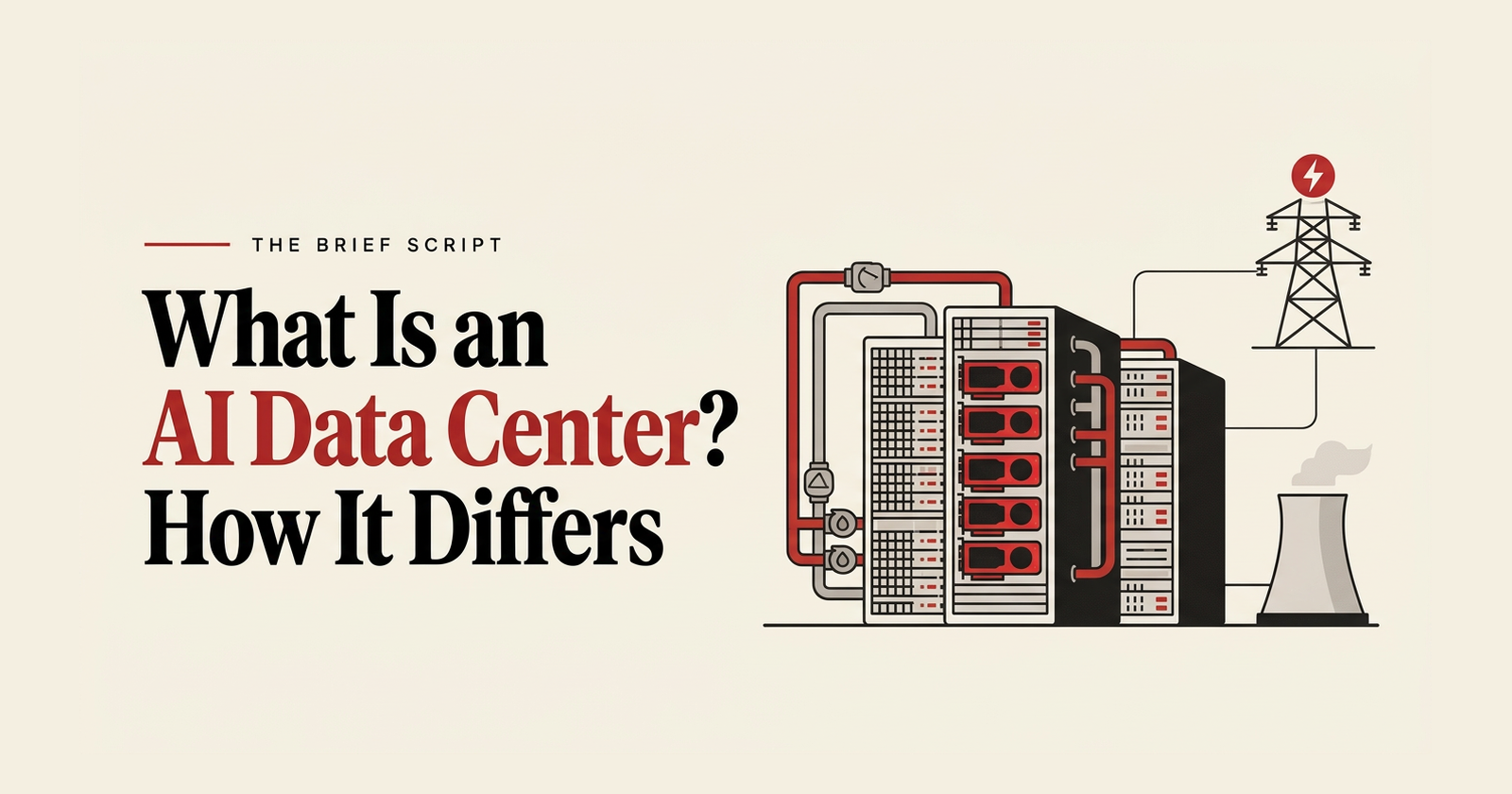
What is an AI data center? An AI data center is a facility built to train and run artificial intelligence models on thousands of GPUs or other accelerators. Compared with a traditional data center, it packs racks drawing 120 kW or more, cools them with liquid, wires the chips into one high-speed network and is often sized in gigawatts rather than megawatts.
Most explainers stop at “a data center full of GPUs.” That misses what changes when a building is designed for AI: power per rack, cooling, networking, site size and who pays. This guide covers each with current numbers, explains Nvidia’s “AI factory” label, and maps the campuses and builders behind the 2026 build-out.
Key findings
- Rack power is the clearest dividing line. The average modal rack in Uptime Institute’s 2026 survey is 7.8 kW excluding high-density sites (just over 11 kW with them). A GB200 rack draws about 120 to 140 kW, Vera Rubin 187 to 227 kW, and Nvidia’s planned Kyber rack about 600 kW.
- Only 24% of operators run any rack at 30 kW or more, the lower bound of “high density.”
- Sites jumped from megawatts to gigawatts. A conventional data center is 10 to 25 MW (IEA). Our dataset of 18 named AI campuses adds up to about 28.7 GW planned, while Epoch AI estimates about 4.6 GW of IT power is running at the 7 of them that are live.
- Chips are most of the bill. Shell and core costs $11.3 million per MW (JLL) and an all-in facility $17.6 million per MW before chips (Cushman & Wakefield), against roughly $50 to 60 billion per GW once computing is included.
- Builders beyond Big Tech will own most new US capacity. BloombergNEF projects 138 GW of non-hyperscaler capacity versus 57 GW for the four hyperscalers by 2035.
What is an AI data center?
An AI data center is a data center whose design starts from accelerated servers rather than general-purpose ones. The International Energy Agency defines accelerated servers as servers with GPUs or similar accelerators, and calls them particularly important for AI training and deployment (IEA). Everything else in the building, from the power feed to the plumbing, is then sized around those chips.
The “AI factory” idea
Nvidia’s term for the same thing is an AI factory: specialized infrastructure that manages the whole AI life cycle, from data ingestion through training, fine-tuning and high-volume inference. Its “primary product is intelligence, measured by token throughput,” while traditional data centers handle general-purpose computing (Nvidia). At GTC in March 2026, then-Nvidia CEO Jensen Huang described data centers as factories that turn electricity into tokens, calling tokens “the new commodity” and tokens per watt the metric that matters (Data Center Frontier).
The label is marketing, but the point stands: an AI data center is judged by output per watt, not floor space.
Training sites vs inference sites
AI data centers do two jobs. Training builds a model and favors one huge, tightly linked cluster that can run for weeks, often in a remote location with cheap power. Inference serves the finished model to users, so it values being near customers and running efficiently at volume. JLL expects inference to overtake training as the dominant AI requirement in 2027, and AI could make up half of all data center workloads by 2030 (JLL). BloombergNEF expects AI training and inference to account for more than half of total US data center capacity in its base case (BloombergNEF).
AI data center vs traditional data center
The differences are easiest to see side by side.
| Dimension | Traditional data center | AI data center |
|---|---|---|
| Typical rack power | About 7.8 kW average modal rack excluding high-density sites; 11+ kW including them | GB200 NVL72 about 120 to 140 kW; Vera Rubin NVL72 187 to 227 kW; Kyber planned at about 600 kW |
| High-density racks | 24% of operators have any racks at 30 kW or more (19% in 2025) | 30 kW is the floor; AI racks run 4 to 20 times that |
| Cooling | Mostly air; cooling uses about 7% of power at efficient hyperscale sites and more than 30% at less efficient enterprise sites | Direct-to-chip liquid; GB300 NVL72 and Vera Rubin NVL72 are fully liquid-cooled |
| Facility size | About 10 to 25 MW | 100 MW and up; largest campuses planned at 1 to 5 GW |
| Core silicon | General-purpose CPU servers | GPUs and other accelerators (TPU, Trainium) |
| Networking | Ethernet; servers run independent jobs | NVLink inside the rack plus InfiniBand or AI Ethernet linking 100,000+ GPUs as one machine |
| Facility cost before chips | $11.3M per MW shell and core (JLL) | $17.6M per MW all-in for modern US and Canada sites (Cushman & Wakefield) |
| Cost including compute | n/a | About $50 to 60B per GW |
| Build speed | Hyperscaler projects about 5.3 years end to end, 8.4 years for others | Colossus 1 built in 122 days; Crusoe energized two 100 MW buildings in under a year |
| Output metric | Uptime, utilization, cost per VM | Tokens per second and tokens per watt |
| Power backup | UPS and diesel generators standard | Some training halls drop them: Fairwater Atlanta has no UPS or gensets |
Sources: Uptime Institute 2026 survey, IEA, Nvidia GB300 NVL72, Meta, JLL, Cushman & Wakefield, BloombergNEF, Nvidia on Colossus, DatacenterDynamics.
Rack density: the number that changes everything
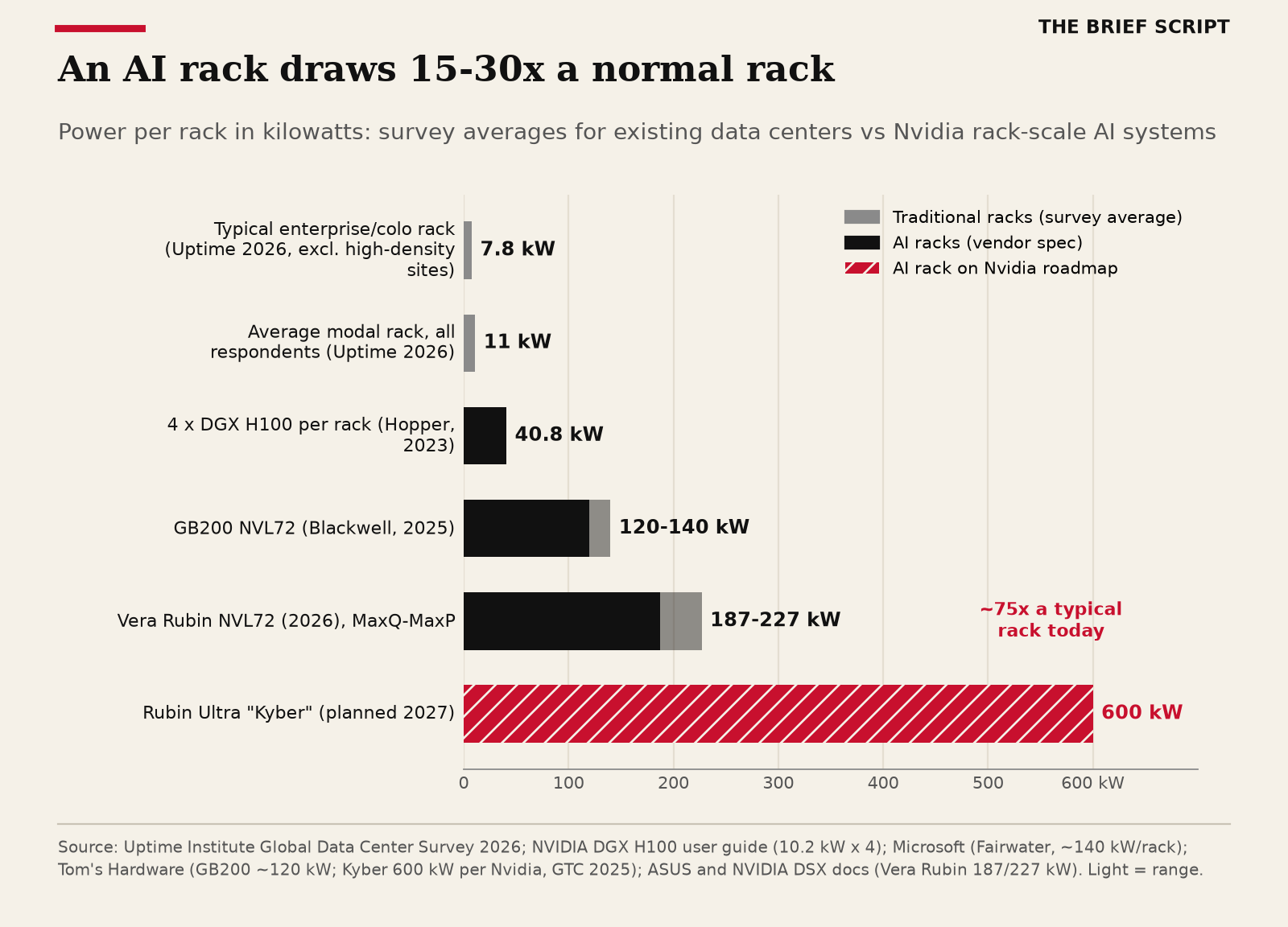
Uptime Institute’s 2026 global survey puts the average modal rack above 11 kW for the first time, or 7.8 kW if facilities with 30 kW+ racks are excluded, up from 7.5 kW in 2025. Only 24% of respondents have any racks at 30 kW or above (Uptime Institute).
AI hardware has moved far past that. A DGX H100 system draws up to 10.2 kW, so four in a rack come to about 40.8 kW (Nvidia). A Blackwell GB200 NVL72 rack uses roughly 120 kW (Tom’s Hardware), and Microsoft says liquid cooling lets its Fairwater sites run about 140 kW per rack and 1,360 kW per row (Microsoft). Vera Rubin NVL72 is rated at 227 kW (MaxP) or 187 kW (MaxQ) and is 100% liquid-cooled (ASUS; Nvidia DSX); its rack carries four 110 kW power shelves on a 54 V DC busbar (Nvidia). Our deep dive on Nvidia Rubin covers the chip itself.
Next is Rubin Ultra in Nvidia’s “Kyber” rack, which Nvidia said at GTC 2025 would arrive in the second half of 2027 at up to 600 kW per rack (Tom’s Hardware). That date is Nvidia’s own stated plan.
What this means: a building designed for 10 kW racks cannot simply be filled with AI servers. Above roughly 30 kW, the power distribution, floor loading and cooling all have to be redesigned, which is why most AI capacity is new construction rather than retrofits.
Inside the stack: the components of AI data center infrastructure
Accelerators. The compute is GPUs from Nvidia or AMD, or custom chips such as Google’s TPUs and AWS Trainium. Anthropic alone uses more than 1 million Trainium2 chips (Anthropic). For the trade-offs between chip types, see TPU vs GPU.
Rack-scale systems. The unit of purchase is now a whole rack. A GB200 NVL72 joins 72 Blackwell GPUs and 36 Grace CPUs in one NVLink domain, with 130 TB/s of NVLink bandwidth per rack and 1.8 TB/s GPU to GPU (Nvidia). Vera Rubin NVL72 doubles total NVLink bandwidth to 260 TB/s per rack (QCT, citing Nvidia).
Networking. Inside the rack, NVLink makes 72 GPUs behave like one. Across racks, a scale-out fabric of InfiniBand or AI-tuned Ethernet ties tens of thousands together. xAI’s original Colossus linked 100,000 Hopper GPUs over Nvidia Spectrum-X Ethernet rather than InfiniBand (Nvidia). Microsoft runs each Fairwater site as one cluster on a single flat network, with 14 TB of pooled memory per rack (Microsoft), and laid more than 120,000 miles of new fiber in a year for a dedicated AI WAN between sites (Microsoft).
Cooling. At 100 kW+ per rack, air cannot carry the heat away. GB300 NVL72 is a fully liquid-cooled design (Nvidia), and Microsoft’s Fairwater uses a closed loop that is filled once and continually reused (Microsoft). Efficient hyperscale sites spend about 7% of their electricity on cooling versus more than 30% at less efficient enterprise sites (IEA). Water use is its own debate; our AI data center water usage guide covers it.
Power. AI sites need their own substations and, increasingly, their own generation. BloombergNEF counts 181 GW of on-site gas proposed alongside data centers, more than 90% of it in the US (BloombergNEF). Some training designs drop traditional backup entirely: Microsoft’s Fairwater Atlanta launched with no UPS or generator sets (DatacenterDynamics).
How big are hyperscale AI data centers?
The IEA puts a conventional data center at roughly 10 to 25 MW. A hyperscale AI-focused site starts at 100 MW, about the electricity of 100,000 households, and the largest under construction reach around 2 GW, the equivalent of 2 million households (IEA). Several announced campuses already exceed that.
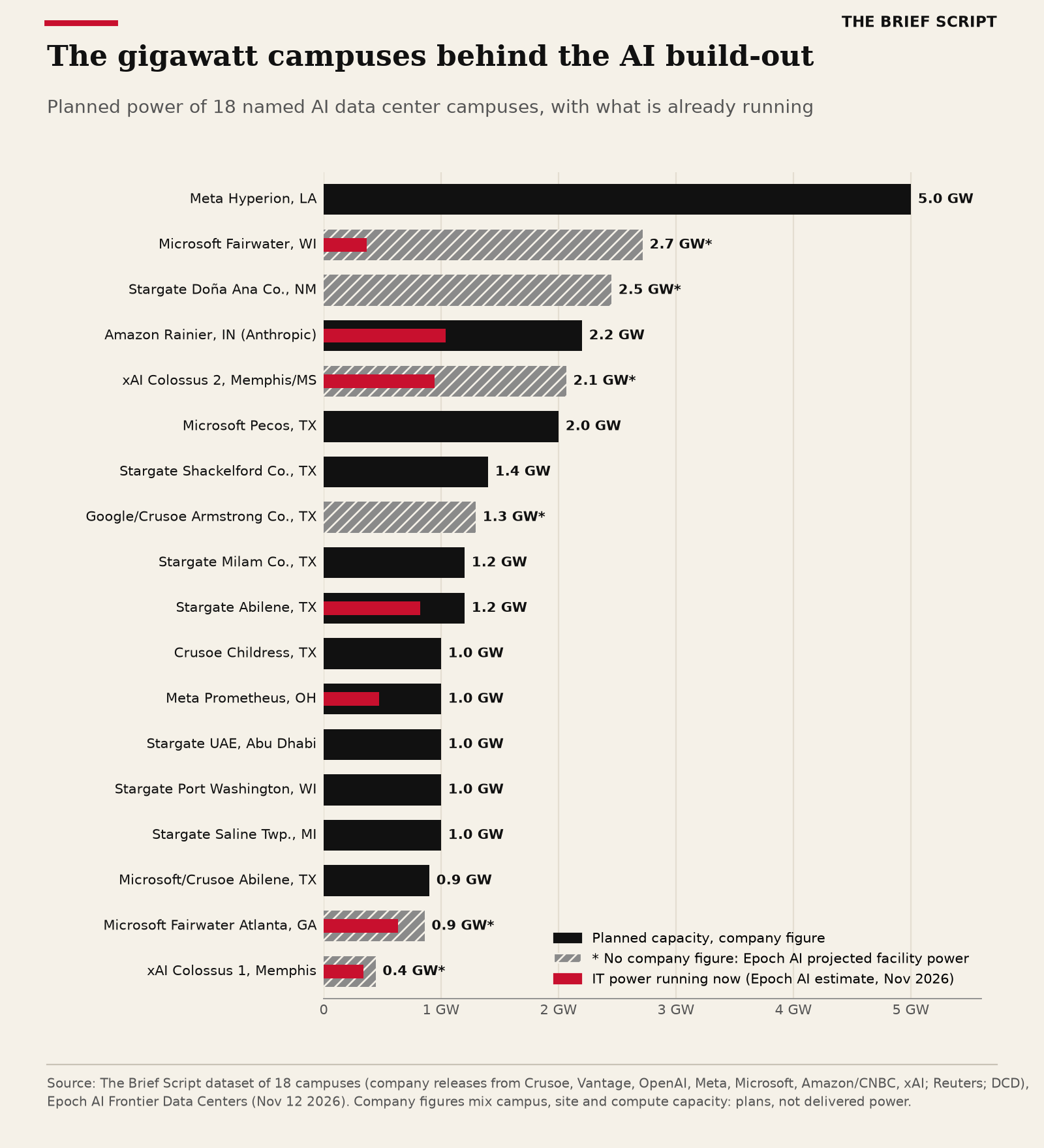
We compiled 18 named campuses from company announcements and Epoch AI’s satellite and permit-based estimates. Planned capacity totals about 28.7 GW (company figures, or Epoch’s projected facility power where no company figure exists). Running capacity is far smaller: Epoch estimates about 4.6 GW of IT power live across the 7 operating sites (Epoch AI). Announced is not delivered.
A few of the campuses that define the category:
- Meta Hyperion, Louisiana: expanded to 5 GW of compute capacity and more than $50 billion, the largest in Meta’s fleet (Meta).
- Amazon Project Rainier, Indiana: about 500,000 Trainium2 chips at launch in October 2025 and more than 2.2 GW at full build across about 30 buildings (CNBC). Epoch counts it as the largest operating US AI site, at 1,037 MW of IT power.
- Stargate Abilene, Texas: Oracle had delivered 6 of 8 buildings, or 618 MW, by its September 2026 earnings call (Oracle call transcript). Crusoe is building a separate 900 MW campus nearby for Microsoft (Crusoe).
- Microsoft Fairwater and Pecos: the first Fairwater facility in Mount Pleasant, Wisconsin became fully operational in June 2026 (Microsoft); the planned Pecos, Texas campus adds about 2 GW (Microsoft).
- Colossus, Memphis: Colossus 1 holds more than 220,000 Nvidia GPUs, now used by Anthropic (xAI). Elon Musk claims about 1.2 million Blackwell GPUs at Colossus 2 by the end of 2026 (DatacenterDynamics), more than Epoch’s 946 MW estimate would suggest.
Outside the US, Stargate UAE is planned as a 1 GW cluster in Abu Dhabi, though Reuters reported in September 2026 that the UAE is revising its AI data center plan (Reuters).
What does an AI data center cost?
There are three price tiers, and mixing them up is the most common error in coverage.
| What is counted | Cost | Source |
|---|---|---|
| Shell and core (2026 global average) | $11.3M per MW, up from $7.7M in 2020 | JLL |
| All-in facility, US and Canada, excluding chips | $17.6M per MW; power infrastructure is 21% of cost | Cushman & Wakefield |
| Everything, including computing | About $50 to 60B per GW (about $50 to 60M per MW) | CNBC transcript |
The third figure comes from then-Nvidia CEO Jensen Huang, who told CNBC in August 2026 that each gigawatt costs “something like $50, $60 billion,” including land, power, shell and computing. On Nvidia’s August earnings call he put about $40 billion of a roughly $60 billion gigawatt in Nvidia’s own products, up from about $30 billion for a whole gigawatt five years earlier (R40, quoting the call). On those figures, chips and networking are roughly two-thirds of the bill. JLL estimates about 100 GW of new capacity from 2026 to 2030 needing up to $3 trillion, plus $1 to 2 trillion of tenant fit-out (JLL).
Speed varies just as widely. BloombergNEF finds hyperscaler projects take about 5.3 years from pre-construction to completion versus 8.4 years for other developers (BloombergNEF). At the fast end, Colossus 1 went up in 122 days, with 19 days from first rack to training (Nvidia), and Crusoe energized two 100 MW Abilene buildings in under a year (Crusoe).
Who builds AI data centers?
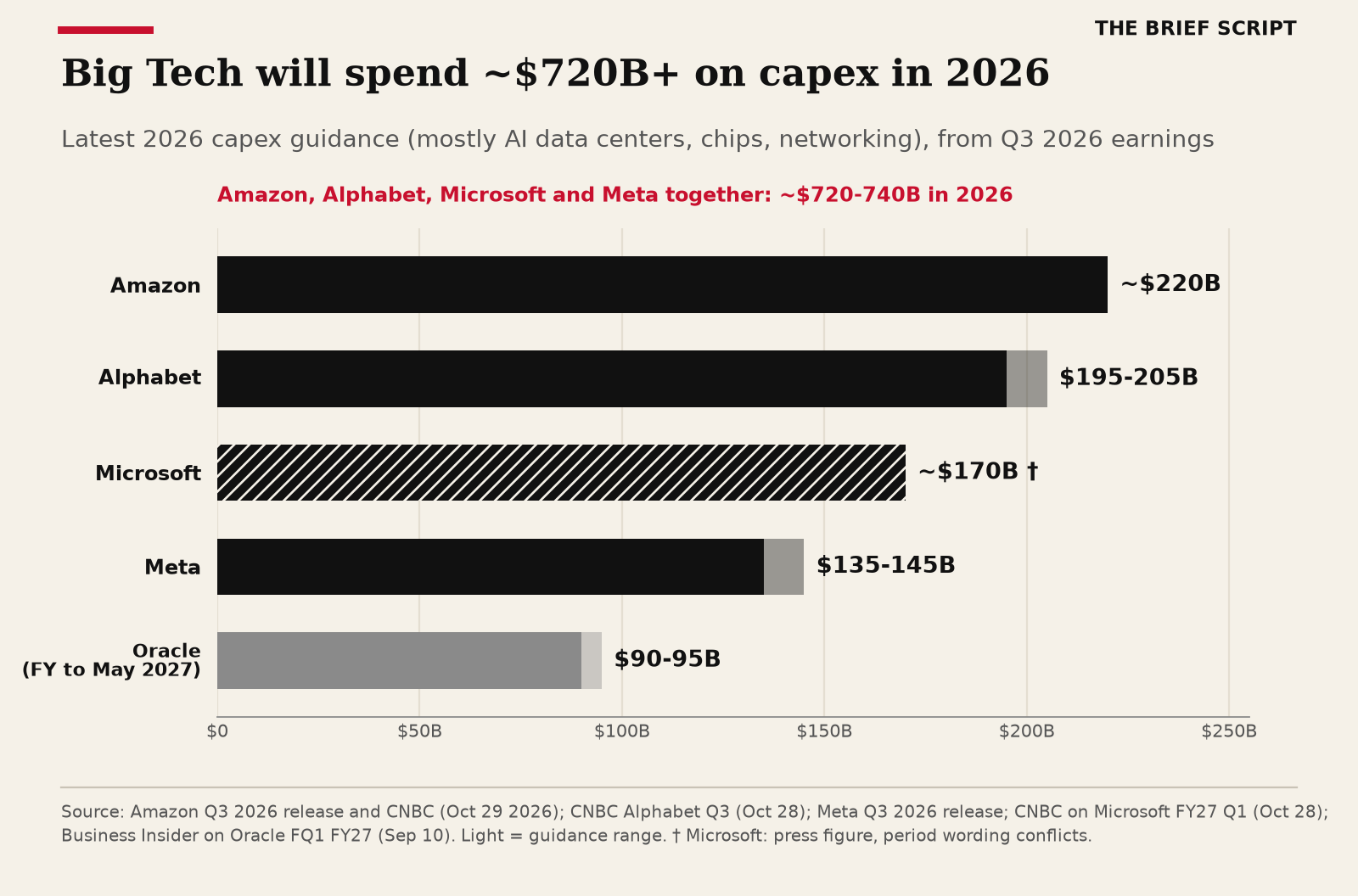
Hyperscalers. Amazon held its 2026 capex forecast at about $220 billion (CNBC), Alphabet at $195 to 205 billion (CNBC) and Meta at $135 to 145 billion (Meta). Microsoft’s annual figure was reported at about $170 billion, but coverage conflicts on whether it covers calendar 2026 or 2027 (CNBC); counting it for 2026 puts the big four at roughly $720 to 740 billion. Oracle guides to $90 to 95 billion for the fiscal year ending May 2027 (Business Insider). For the deals and financing behind these numbers, see our AI data center acquisitions and investment tracker.
Neoclouds. GPU cloud specialists rent capacity to labs and enterprises. CoreWeave reported more than 1.7 GW of active power and more than 4.6 GW contracted in Q3 2026, with a revenue backlog of about $132.5 billion (CoreWeave).
Developers. Firms such as Crusoe and Vantage build campuses for others. Crusoe reported 4.9 GW of contracted AI infrastructure and a pipeline above 40 GW (Crusoe); Vantage’s Frontier campus in Texas is a $25 billion+, 1.4 GW project (Vantage).
AI labs. OpenAI’s Stargate passed 8 GW of planned capacity and more than $450 billion with its Michigan site, toward a 10 GW goal (OpenAI). Anthropic’s deal with Amazon covers up to 5 GW of new capacity (Anthropic).
The balance is shifting away from Big Tech. BloombergNEF expects hyperscaler capacity in the US to triple over the next decade while non-hyperscaler capacity nearly quintuples, reaching 57 GW versus 138 GW by 2035. It also found that 52 of the 100 largest US projects, totaling 87 GW, were announced by companies that have never built a data center (BloombergNEF). Our AI infrastructure news roundup tracks new entrants as they announce.
What this means: first-time builders bring capital and speed, but also execution risk. When you read about a new gigawatt campus, check who the tenant is, whether power is contracted, and whether the developer has delivered a site before.
How much power will AI data centers need?
BloombergNEF’s latest US outlook, published July 21, 2026, forecasts 118 GW of installed data center capacity by 2030 and 194 GW by 2035, up 83% on its December 2025 forecast (BloombergNEF). It restated the path from 47 GW in 2025 to 194 GW in 2035 in November (BloombergNEF). That would make data centers about 20% of US electricity use by 2035, up from 5.9% today (DatacenterDynamics).
Globally, BloombergNEF said on November 11, 2026 that data center demand will almost quadruple to 2,354 TWh by 2035, or 7% of world electricity (BloombergNEF). The IEA’s base case has consumption rising from 415 TWh in 2024, about 1.5% of world electricity, to about 945 TWh by 2030, with accelerated servers growing about 30% a year versus 9% for conventional servers (IEA). For the full picture by region and source, see our guide to AI data center power consumption.
Methodology
We checked every figure against its source on November 12, 2026. The campus dataset combines company announcements with Epoch AI’s Frontier Data Centers estimates. Company figures mix campus power, critical IT and “compute capacity,” and Epoch’s running figures are IT power, so the planned and running totals are not like for like. Figures marked as reported or claimed were not independently confirmed.
FAQ: AI data centers
Is an AI data center the same as an AI factory?
Mostly. “AI factory” is Nvidia’s term for an AI data center built to run the whole AI life cycle, measured by tokens produced rather than servers hosted. The physical building is the same thing: dense accelerator racks, liquid cooling and a high-speed network.
What is the difference between an AI data center vs a traditional data center?
Power density is the core difference. A typical rack averages about 8 to 11 kW, while AI racks draw 120 to 227 kW today. That forces liquid cooling, much bigger power feeds, a dedicated GPU network and, at the top end, gigawatt-scale campuses.
Why do AI data centers need liquid cooling?
Air cannot remove the heat from racks drawing 100 kW or more. Rack-scale systems such as GB300 NVL72 and Vera Rubin NVL72 are fully liquid-cooled, usually through cold plates on the chips connected to a closed water loop.
How much power does an AI data center use?
A hyperscale AI site starts around 100 MW, roughly the electricity of 100,000 households. The largest campuses are planned at 1 to 5 GW. Across the US, BloombergNEF expects data center capacity to reach 194 GW by 2035.
How many GPUs are in an AI data center?
Large AI sites hold 100,000 to more than 1 million accelerators. Colossus 1 has more than 220,000 Nvidia GPUs, Anthropic uses more than 1 million Trainium2 chips on AWS, and Musk claims about 1.2 million GPUs at Colossus 2.
Who owns the biggest AI data centers?
Meta, Microsoft, Amazon and Google own the largest single campuses, often built with developers such as Crusoe and Vantage. OpenAI’s Stargate sites are owned or operated by partners including Oracle and SoftBank, and neoclouds like CoreWeave run gigawatts of rented capacity.