AI Data Center Water Usage in 2026: How Much Water AI Really Uses, per Prompt, per Day and per Year
How much water AI data centers use in 2026: the latest Google, Microsoft, AWS and Meta water figures in one unit, per-prompt estimates from 0.26 mL to 519 mL and why they differ, a MWh-to-liters worked example, and the Arizona, Texas, Virginia and Georgia water fights.

AI data center water usage is now a planning issue, not just a headline. In 2026 Google, Microsoft and Amazon all published new water figures. Lawrence Berkeley National Laboratory updated its US electricity outlook. And Texas, Virginia, Arizona and Georgia all moved on data center water reporting or permits within a few months of each other. This guide puts the numbers on one page, converts them to the same units and explains why estimates for the same “AI prompt” range from a fraction of a drop to a full bottle.
The short answer (as of November 2026)
- Per prompt: Google puts a median Gemini text prompt at 0.26 mL of on-site cooling water, about five drops (Google Cloud). Sam Altman puts an average ChatGPT query at about 0.32 mL (Altman). Once you add the water used at power plants or in making the chips, estimates rise to roughly 1 to 50 mL per response. The widely quoted “bottle per email” figure is 519 mL for a 100-word GPT-4 email.
- Per day: US data centers consumed about 48 million gallons a day directly in 2023. That comes from 17.4 billion gallons a year in the LBNL 2024 report. Google’s data center fleet averaged 28.8 million gallons a day in 2025. A typical 100 MW hyperscale site uses about 2 million liters a day in total, according to the IEA, and more than 60% of that is indirect.
- Per year: Google’s data centers consumed 10.5 billion gallons (39.8 billion liters) in 2025, up 34%. Microsoft consumed 8.2 billion liters company-wide in FY25. AWS withdrew 9.4 billion liters and does not report consumption.
How much water does AI use? Three numbers people mix up
Most arguments about AI water consumption are really about three different quantities.
- Withdrawal is the water a facility takes in from a utility, river or aquifer.
- Consumption is the part that never goes back, mostly water evaporated in cooling towers. Google’s data centers consumed 78% of what they withdrew in 2025. Microsoft’s company-wide figure was 62%.
- Indirect (or “scope 2”) water is the water evaporated at the power plants that generate the electricity. LBNL estimates this at 4.52 liters per kWh for US data center electricity. That is roughly 12 times the direct water use of the US data center sector.
A fourth layer, embodied water, covers chip fabrication, server manufacturing and construction. Only lifecycle studies such as Mistral’s include it.
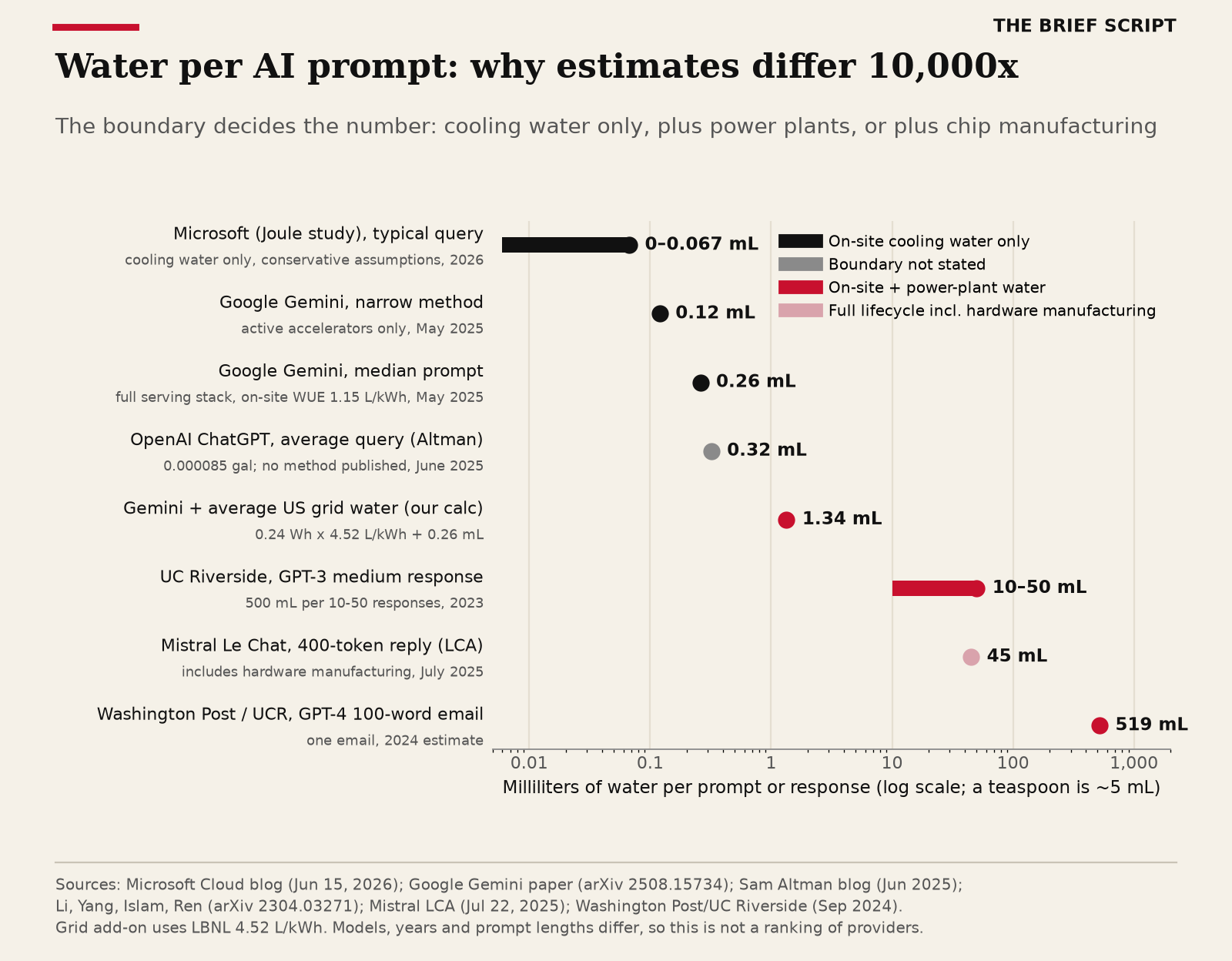
The boundary matters more than the model. The same Gemini prompt is 0.26 mL if you count only on-site cooling. In our calculation it is about 1.3 mL if the electricity came from an average US data center grid mix. Mistral’s lifecycle method gives 45 mL for a similar-length chat reply because it also counts hardware manufacturing.
What this means: before quoting any “AI water” number, ask three things. Is it withdrawal or consumption? Is it on-site only or does it include power generation? Is it one company, one site or a modeled national total? Most viral disagreements disappear once those three answers are written down.
AI water consumption by company: the 2026 dataset
We pulled the latest water tables from each operator’s own report and converted everything to billion liters per year (1 billion liters = 264 million US gallons). The scopes are not identical, so read the scope column before comparing rows.
| Company | Period | Scope | Withdrawal (bn L) | Consumption (bn L) | Consumed share | WUE (L/kWh) and basis | Water-stress exposure | Replenishment |
|---|---|---|---|---|---|---|---|---|
| 2025 | Data centers | 51.3 | 39.8 | 78% | 0.94 consumed per kWh of DC electricity (our calc); 1.15 consumptive WUE cited in its Gemini paper | 13% of freshwater withdrawals from high-risk sources | 7.7 bn gal, 78% of freshwater consumption | |
| Microsoft | FY2025 | Whole company | 13.3 | 8.2 | 62% | 0.27 (cooling + humidification water per kWh, owned DCs) | 50% of withdrawals from water-stressed areas | More than it withdrew (company claim) |
| AWS | 2025 | Data centers (leased, owned, shared) | 9.4 | not reported | n/a | 0.12 (withdrawal per kWh of IT load) | 22% of withdrawals in high or extremely high stress | 75% of the way to “water positive” |
| Meta | 2024 (latest published) | Data centers | 4.1 | 3.0 | 72% | 0.19 (withdrawal per kWh of IT load) | 1.7 bn L company withdrawal from high-stress areas | 6.0 bn L restored |
| Equinix | 2025 | Colocation portfolio | 6.0 | 4.6 | 76% | 0.91 overall, 1.41 at evaporative sites | n/a | 21% reclaimed water |
Sources: Google 2026 Environmental Report (pp. 96–97), Microsoft 2026 Environmental Data Fact Sheet and 2026 report, 2025 AWS Summary, Meta 2025 Environmental Data Index, and Equinix 2025 Sustainability Report. Read November 4, 2026.
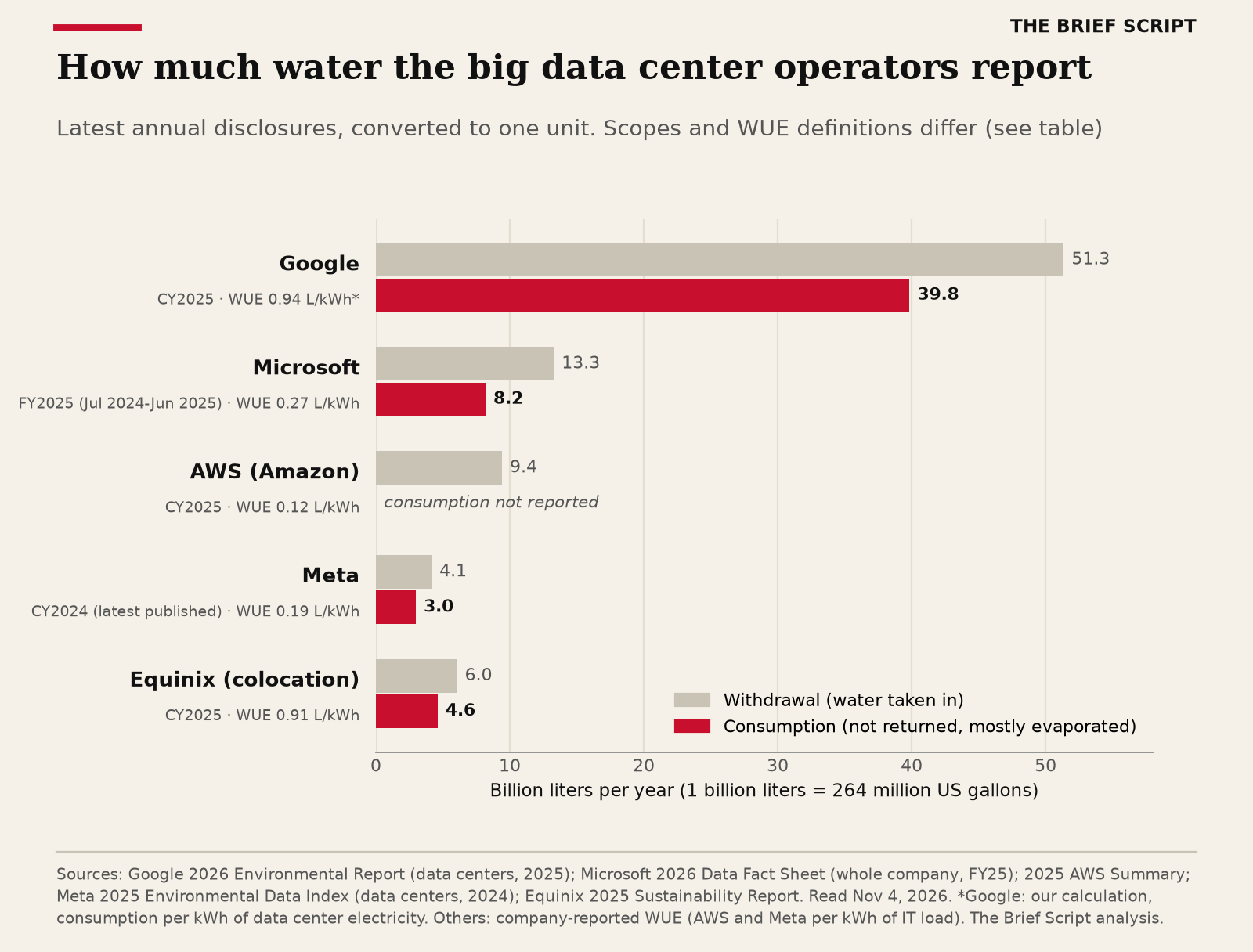
Four things stand out.
- Google is by far the largest disclosed user, and it is growing fast. Data center consumption reached 10,523 million gallons in 2025. Company-wide consumption rose 34% year on year while data center electricity grew about 38%. Google is also the most transparent operator: it publishes withdrawal, discharge and consumption for every data center location. Its largest site, Council Bluffs, Iowa, consumed 1,346 million gallons, or about 3.7 million gallons a day.
- WUE figures are not comparable as published. AWS (0.12) and Meta (0.19) divide water withdrawn by IT energy. Microsoft (0.27) divides cooling and humidification water by energy use. Google’s 1.15 L/kWh, cited in its Gemini paper, is a consumptive figure for freshwater. A low WUE also says nothing about the water used at the power plant.
- “Water positive” claims measure something else. Replenishment projects such as leak repair, wetland restoration and irrigation upgrades are credited against use, but usually in other places and on other timelines. Google replenished 78% of its freshwater consumption in 2025, up from 63%. Microsoft says it replenished more than it withdrew in FY25 (Microsoft). Neither changes how much water was evaporated at a given site.
- The AI labs themselves publish no totals. OpenAI, Anthropic and xAI do not release company water reports. Their models run in partners’ facilities or in new campuses whose figures are not yet public.
For the capital spending behind these numbers, see our AI infrastructure news tracker.
ChatGPT water usage and other per-prompt estimates, compared
Here is every widely cited per-prompt figure we could trace to a primary source, plotted on one log scale and colored by what each one counts.
| Estimate | Water per prompt | What it counts | Why it differs |
|---|---|---|---|
| Microsoft, Joule study (June 2026) | 0.0–0.067 mL | On-site cooling only, typical query to a large production model | Zero-water and air-cooled sites pull the low end to zero |
| Google Gemini, median text prompt (Aug 2025) | 0.26 mL (0.12 mL narrow) | On-site consumption: serving energy excluding overhead × WUE 1.15 L/kWh | Measured in production, but excludes power plant water (paper) |
| OpenAI ChatGPT, average query (June 2025) | ~0.32 mL (0.000085 gal) | Not stated | No published method, model or date range |
| Gemini + average US grid (our calc) | ~1.3 mL | 0.24 Wh × 4.52 L/kWh + 0.26 mL | Shows the effect of adding indirect water |
| UC Riverside, GPT-3 (2023) | 10–50 mL per medium response | On-site + electricity water, location-dependent | Older model and hardware, US average grid mix (Li et al.) |
| Mistral Le Chat, 400-token reply (July 2025) | 45 mL | Full lifecycle, including server manufacturing | Embodied water is a large share (Mistral) |
| Washington Post / UC Riverside, GPT-4 email (2024) | 519 mL per 100-word email | On-site + electricity, state-level | GPT-4-era energy estimate and a whole email, not a single prompt (WaPo) |
- Company figures count the cooling water at their own sites. Google’s paper explicitly calculates water from energy excluding overhead multiplied by its fleet WUE. It does not add the water consumed at power plants. Experts criticized that omission when the paper came out (The Verge).
- Academic figures count the grid. The UC Riverside work adds “scope 2” water, so the number depends on the electricity mix where the model runs.
- Lifecycle figures count manufacturing. Mistral’s 45 mL includes water used to build GPUs and servers, spread across their lifetime use.
- The models themselves got more efficient. Google reports that energy per median Gemini prompt fell 33-fold between May 2024 and May 2025. Microsoft’s Joule study puts a typical query to a large model at 0.16–0.60 Wh.
- Long reasoning and agent tasks cost more. A short chat reply and a multi-step agent run can differ by an order of magnitude in energy, and water scales with energy. Our training vs. inference power explainer covers why.
What this means: a single ChatGPT or Gemini prompt uses a trivial amount of water, a few drops on-site. At scale it adds up: one billion prompts at Altman’s 0.32 mL is about 320,000 liters (roughly 85,000 gallons). Most of the footprint sits at the power plant, so where and on what grid a model is served matters more than the prompt itself.
Data center water usage per day: a worked example from MWh to liters
You can estimate a facility’s water from two published ratios: its WUE (on-site liters per kWh) and the water intensity of its electricity (liters per kWh at the power plant). Take a 100 MW AI campus running at full IT load for one day:
- IT energy: 100 MW × 24 h = 2,400 MWh (2.4 million kWh).
- On-site water = IT kWh × WUE. At AWS’s fleet WUE of 0.12 L/kWh this is 288,000 L (76,000 gal). At Microsoft’s 0.27 it is 648,000 L (171,000 gal). At the US average site WUE of about 0.36 (LBNL) it is 864,000 L (228,000 gal). At Google’s consumptive 1.15 it is 2.76 million L (729,000 gal).
- Indirect water = IT kWh × PUE × grid water intensity. With a PUE of 1.15 and LBNL’s 4.52 L/kWh: 2.4 million × 1.15 × 4.52 = 12.5 million L (3.3 million gal) per day.
That puts direct cooling at about 6% of the total on an average US grid. A site powered by wind and solar would see the indirect share shrink sharply, since those sources use little water. The IEA’s own estimate for a typical 100 MW US hyperscale site is lower, about 2 million liters a day in total with more than 60% indirect (IEA Energy and AI). The difference comes from assumed load, cooling mix and grid water factors.
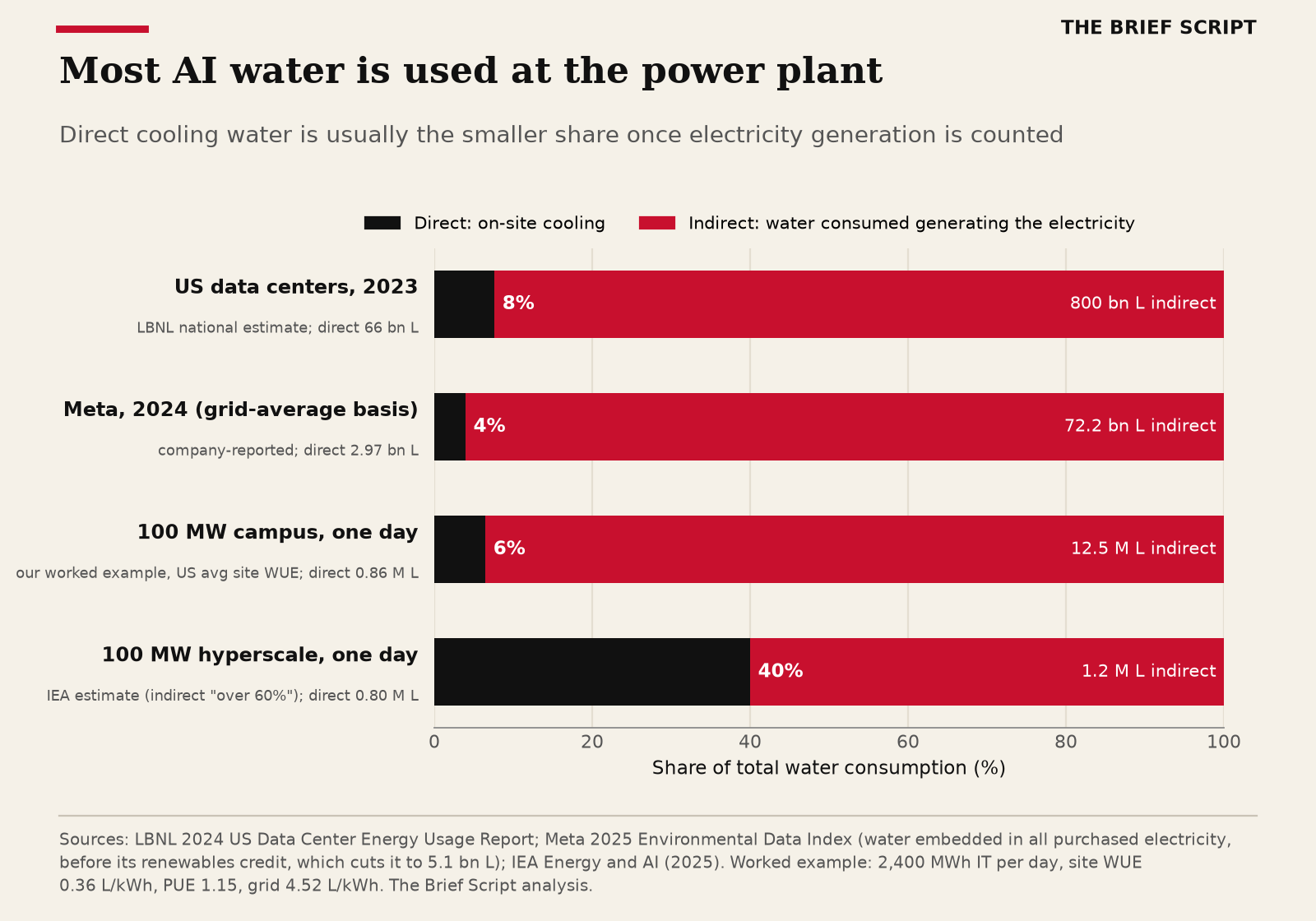
Meta’s own disclosure tells the same story. Its data centers consumed 2,974 megaliters directly in 2024. Meta estimates 72,207 ML of water embedded in its purchased electricity on a grid-average basis, falling to 5,075 ML after crediting its contracted renewables (Meta). Energy strategy is water strategy. Our AI data center power consumption guide has the electricity side.
The US baseline: what LBNL says
The LBNL 2024 United States Data Center Energy Usage Report is still the only federal estimate of data center water.
- Direct water: about 66 billion liters (17.4 billion gallons) in 2023, up from 21.2 billion liters in 2014. Hyperscale and colocation facilities account for 84%.
- 2028 projection: hyperscale data centers alone could consume 60–124 billion liters directly.
- Indirect water: nearly 800 billion liters in 2023, which is 4.52 L/kWh against 4.35 L/kWh for US electricity overall.
- Site WUE: the US average was about 0.36 L/kWh through 2023 and is modeled at 0.45–0.48 afterward. Hyperscalers report 0.1–0.3 for similar systems.
LBNL’s 2025 Update, published June 2026, revised electricity to 192 TWh in 2024 (4.7% of US use). Its Reference Case reaches 649 TWh in 2030 (11.8%), within a 9.5–15.3% range. It does not publish a new water estimate. If water scales with electricity, the 2024 report’s water figures probably understate 2030 demand. That is our inference, not an LBNL projection.
What this means: the sector’s direct water use is small next to agriculture or power generation nationally. Data centers use less than 1% of the water Americans spend on lawns, by Google’s own comparison. But the growth rate is steep and the use is concentrated in a few counties. That concentration is where the conflicts are.
US regional water stress: Arizona, Texas, Virginia and Georgia
Water is local. A gallon evaporated in Iowa in spring is not the same as a gallon pumped from a declining aquifer in Arizona in July. The four states below show how the debate moved in 2025–2026.
Arizona: groundwater and the Project Blue fight
- Tucson said no. The city council voted unanimously on August 6, 2025, not to proceed with the Project Blue data center. On August 19, 2025, it adopted a Large Quantity Water User ordinance. Users above about 7.5 million gallons a month must file conservation plans and offset at least 30% of their use with recycled water (City of Tucson; AZPM).
- The project moved to the county and to groundwater. In May 2026 the Arizona Department of Water Resources approved two wells for a Beale-linked entity under grandfathered rights totaling 96.5 acre-feet a year (about 31 million gallons). The developer says the redesigned closed-loop, air-cooled campus will use only 15,000–20,000 gallons a day (AZPM).
- Nearby Marana took a different line. It rezoned 661 acres for a data center in January 2026. Its ordinance bars the town from supplying potable water for data center cooling† (Tucson Spotlight).
- Operators are using little water in the Phoenix area. Google’s Mesa campus consumed just 9.7 million gallons in 2025. Microsoft’s Phoenix datacenters withdrew 981 ML in FY25 but cut WUE by 23% year on year there.
Texas: no data, then a crackdown
- The 2027 State Water Plan left data centers out. The Texas Water Development Board adopted the plan on July 23, 2026, without data center demand projections (E&E News).
- Most data centers ignored the state’s water survey. Of 329 data centers surveyed for 2025, only about 30% responded, reporting 1.4 billion gallons between them (Texas Tribune).
- The state then cracked down. Gov. Greg Abbott ordered a PUC/ERCOT audit on August 3, 2026. On September 14 he directed the TWDB to enforce survey compliance (letter). On September 21 he paused TCEQ data center permits (Texas Tribune). Attorney General Ken Paxton opened an investigation covering 18 counties on September 24 (Texas OAG).
- The penalties are small. The fine for not filing the survey is $500. Abbott lost his re-election bid on November 3 (Texas Tribune), so how these directives continue is an open question for the 2027 session.
Virginia: reporting rules and “cooling water scarcity areas”
- Monthly reporting starts January 1, 2027. Under amended regulation 9VAC25-200, water suppliers must report the potable and reclaimed water they deliver each month to data centers that hold DEQ air permits (Virginia Register).
- Executive Order 22 tightened the rules. Signed September 18, 2026, it bans new state nondisclosure agreements on data center deals and directs DEQ to set criteria for “cooling water scarcity areas” (EO 22). Law-firm summaries say it immediately designates the region east of I-95† (Greenberg Traurig).
- Current use in the Potomac basin is modest. Data centers in the Washington metro area consumed about 4 million gallons a day on average in 2025, with peak days near 15 MGD. About 40% of facilities are air-cooled only (ICPRB).
- Reclaimed water is already common in Loudoun. Loudoun Water’s reclaimed system delivered more than 750 million gallons in 2025 (Loudoun County).
Georgia: meters, wells and moratoriums
- QTS Fayetteville drew water through unbilled connections. Fayette County found two connections at the campus and back-billed $147,474 for about 29 million gallons. QTS paid, and says the water was for construction (E&E News; Fayette County).
- Newton County paused new applications. The county, home to Meta’s Stanton Springs campus, extended its moratorium on data center applications to December 16, 2026 (resolution). Families nearby have sued Meta over well-water sediment, which Meta disputes† (AJC).
- Reclaimed water can carry most of the load. Google’s Douglas County site drew 394 of its 441 million gallons from reclaimed wastewater in 2025.
What this means: the regulatory trend is disclosure first: utility reporting in Virginia, survey enforcement in Texas and local ordinances in Arizona. Hard caps come after. Operators that can show audited site-level numbers, as Google now does, will clear permitting faster than those relying on NDAs.
Heat is the other variable. Evaporative cooling peaks on the same hot afternoons as grid demand, as our summer peak demand analysis shows.
Cooling methods and how much water each uses
- Evaporative cooling (cooling towers, direct evaporative or adiabatic). This is the most water-intensive approach and the most energy-efficient in dry heat. Equinix’s evaporative sites run at a WUE of 1.41 against 0.91 for its whole portfolio. AWS says it uses evaporative cooling only on the hottest days, and air cooling about 90% of the time (Amazon).
- Air-cooled chillers and dry coolers. These use close to zero water on-site but more electricity in hot weather. Because grid water is about 4.5 L/kWh on average, a design can save on-site water and still raise total water use. LBNL makes this point about the trade-off between low PUE and low WUE.
- Closed-loop liquid and direct-to-chip cooling. Coolant circulates through cold plates on the chips and is filled once. AWS’s in-row heat exchanger for AI racks is expected to cut water use about 9% compared with evaporative air-cooled sites (AWS). Our TPU vs GPU comparison covers the hardware.
- “Zero-water” designs. Microsoft’s design, announced in 2024, uses closed-loop chip-level cooling with no evaporation. Microsoft says it avoids more than 125 million liters a year per datacenter, while acknowledging a higher PUE (Microsoft). Its Fairwater campus in Mount Pleasant, Wisconsin, became fully operational in June 2026 (Microsoft). About 90% of Microsoft’s 2025 owned fleet runs on low- or zero-water cooling.
- Reclaimed and non-potable water. AWS has contracts for reclaimed cooling water at 130 data centers. Google drew 918 million gallons of reclaimed wastewater in 2025. Microsoft’s San Antonio sites use 79% non-potable water. Reclaimed water protects drinking supplies but is still consumed when it evaporates.
What this means: “zero-water” means zero water evaporated for cooling on-site. It does not mean zero water footprint. Ask for the PUE and the grid mix alongside the WUE.
What enterprises should ask their AI and cloud providers
If AI workloads are part of your sustainability reporting, add these to procurement. They also help explain the costs in our enterprise AI deployment cost guide.
- Which regions will serve the workload, and what are the site WUE, PUE and water source (potable, reclaimed, groundwater) there?
- Is the reported water withdrawal or consumption, and is it market-based or location-based for electricity water?
- Will the provider notify you when a workload moves to a region in a higher water-stress band?
- Can you get per-request energy figures? Water follows energy, so model choice, context length and retries are your main levers.
Methodology note
- Sources and dates. All company figures come from each company’s latest report as published by November 4, 2026. That is Google’s 2026 Environmental Report (2025 data), Microsoft’s 2026 report (FY25), the 2025 AWS Summary and Equinix’s 2025 report. Meta’s latest is its 2025 Environmental Data Index (2024 data). We found no Meta 2025-year water data at our check.
- Unit conversion. We converted to billion liters using 1 US gallon = 3.78541 liters and 1 megaliter = 0.001 billion liters.
- Google’s 0.94 L/kWh is our calculation. It is data center consumption divided by data center electricity, not a Google-published WUE.
- The 1.3 mL “Gemini + grid” figure and the 100 MW worked example are illustrative. They apply LBNL’s 2023 national average of 4.52 L/kWh and an assumed PUE of 1.15. Real sites vary with load, climate and power contracts.
- The per-prompt figures are not a provider ranking. They come from different models, years and prompt lengths.
- The dagger (†) marks claims we could only confirm through secondary reporting.
- Our research file lists one source URL per fact. It is available on request.
FAQ
How much water does AI use per prompt?
On-site, a few drops. Google measured 0.26 mL for a median Gemini text prompt, and OpenAI’s CEO cites about 0.32 mL for an average ChatGPT query. Microsoft’s 2026 study puts a typical query at 0–0.067 mL of cooling water. Including the water used to generate the electricity raises this to about 1 mL or more. Lifecycle studies that add hardware manufacturing reach 45 mL, as in Mistral’s assessment.
How much water does ChatGPT use?
OpenAI has published only one figure: Sam Altman’s June 2025 estimate of about 0.000085 gallons (0.32 mL) per average query, with no methodology. The 519 mL “bottle per email” figure is a 2024 UC Riverside and Washington Post estimate for a 100-word GPT-4 email. It includes power plant water and an older, less efficient model.
How much water does a data center use per day?
It depends on size, cooling and climate. US data centers together consumed about 48 million gallons a day directly in 2023. Google’s largest site, Council Bluffs, averaged about 3.7 million gallons a day in 2025. A 100 MW AI campus uses roughly 76,000–730,000 gallons a day on-site, depending on cooling. Add several million more at the power plant on an average US grid.
Which company uses the most water for data centers?
Among companies that publish full figures, Google is the largest. Its data centers withdrew 51.3 billion liters and consumed 39.8 billion liters in 2025. Microsoft reported 8.2 billion liters of company-wide consumption in FY25. AWS reported 9.4 billion liters of withdrawal but not consumption, so the two cannot be ranked on the same basis.
Do zero-water data centers really use no water?
They evaporate no water for cooling. The closed loop is filled once, and staff and offices still use water. These designs usually need more electricity, so total water can still rise if the power comes from thermal plants. Microsoft’s first sites of this design came online in 2026.
Is AI making the water problem worse?
Nationally, data center water is a small share of US use. Locally, rapid growth in dry or groundwater-dependent areas such as Tucson, West Texas and parts of Georgia has led to moratoriums, well permits and new reporting rules.