AI Cloud Platform (2027): What It Is and the Top Providers Compared
What an AI cloud platform is (GPU compute, ML platform, managed models), hyperscalers vs neoclouds, a vendor-documented comparison of nine AI cloud providers and our check of published H100, H200 and B200 prices per GPU-hour. Checked November 2026.

In short: An AI cloud platform is a cloud service built to train, run and serve AI models. It has three layers: rented GPU or TPU compute, an ML platform for training and serving, and managed model APIs such as Amazon Bedrock. Hyperscalers sell all three layers; neoclouds such as CoreWeave, Nebius and Crusoe sell cheaper GPUs and a thinner software layer.
“AI cloud” now covers everything from a single rented H100 to a fully managed agent platform, so the term confuses buyers. This guide defines it, lists the main AI cloud providers, and compares them using only what each vendor publishes. We also checked nine official pricing pages on November 13, 2026, to see what one GPU-hour costs and how many prices are public at all. For the physical side (the buildings, power and racks behind these services), see our explainer on what an AI data center is.
What is an AI cloud platform?
An AI cloud platform, also called an artificial intelligence cloud platform or cloud-based AI platform, is a set of cloud services that gives you the compute, software and models to build AI without owning hardware. It differs from a general cloud in what it puts first: dense accelerator clusters, fast networks between them, and tools for models rather than for web apps and databases.
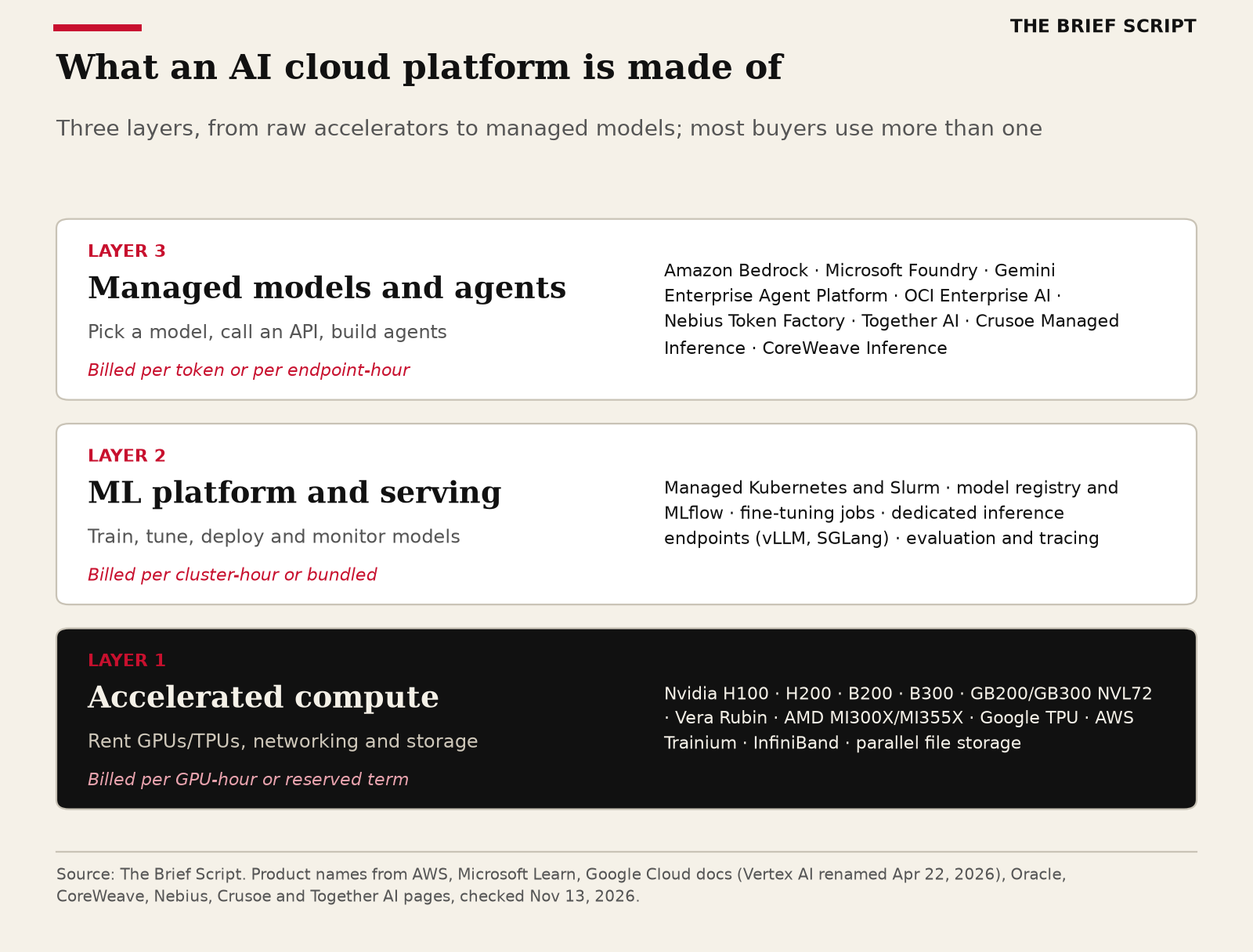
Most platforms stack three layers:
- Accelerated compute. Nvidia GPUs (H100, H200, B200, B300 and the rack-scale GB200 and GB300 NVL72), AMD Instinct chips and in-house chips such as Google’s TPU and AWS Trainium, joined by InfiniBand or similar networks and fast shared storage. You pay per GPU-hour or for a reserved term.
- ML platform and serving. Managed Kubernetes or Slurm to schedule jobs, fine-tuning, model registries and dedicated inference endpoints running engines such as vLLM or SGLang.
- Managed models and agents. An API in front of hosted models, billed per token, plus agent tooling. Amazon Bedrock, Microsoft Foundry and Google’s Gemini Enterprise Agent Platform are the best-known examples.
Two renames matter when you read older guides. Azure AI Foundry is now Microsoft Foundry, which Microsoft says gives access to “more than 10,000 models from Microsoft, OpenAI, Anthropic, Meta, and others.” Google renamed Vertex AI to Gemini Enterprise Agent Platform on April 22, 2026; Model Garden and the rest moved with it.
Hyperscalers vs neoclouds: the two kinds of AI cloud providers
Hyperscalers are the general-purpose clouds: AWS, Microsoft Azure, Google Cloud and Oracle Cloud Infrastructure (OCI). They sell all three layers and wrap them in the identity, networking, compliance and data services your company probably already uses. AWS says Bedrock serves more than 100,000 organizations. Oracle now sells its managed-model layer as OCI Enterprise AI, with dedicated AI clusters for reserved inference. We group Oracle with the hyperscalers because it runs a full general-purpose cloud, although it rents GPUs aggressively.
Neoclouds are GPU-first clouds built for AI: CoreWeave, Lambda, Nebius, Crusoe and Together AI, among others. They mostly sell layer 1 and a growing slice of layer 2 and 3. CoreWeave made its inference service generally available on March 31, 2026, with serverless and dedicated options. Nebius sells managed open-model inference as Token Factory. Crusoe and Together AI price serverless inference per million tokens on the same page as their GPUs. Lambda’s pricing page lists GPU instances and clusters only. For CoreWeave’s contracts and results, see our CoreWeave news tracker.
The split is not about quality. Hyperscalers win on integration and breadth; neoclouds win on GPU price and speed of access to new Nvidia generations. Many companies use both: a hyperscaler for data and model APIs, a neocloud for training or bulk inference.
AI cloud providers compared
The cloud AI platforms list below uses only vendor-published facts. Prices are on-demand list prices per GPU-hour from each provider’s own pricing page or price API, checked November 13, 2026. “Not listed” means the GPU has no on-demand price on that page, not that the provider cannot supply it.
| Provider | Type | Nvidia GPUs with a public on-demand price | Managed model service | H100 $/GPU-hr | B200 $/GPU-hr |
|---|---|---|---|---|---|
| AWS | Hyperscaler | H100, H200, B200, B300 | Amazon Bedrock, Bedrock AgentCore | $6.88 | $14.24 |
| Microsoft Azure | Hyperscaler | H100, H200, GB200 | Microsoft Foundry | $12.29 | Not listed |
| Google Cloud | Hyperscaler | H100, H200 (B200 via Flex-start only) | Gemini Enterprise Agent Platform | $11.06 | Flex-start $8.06 |
| Oracle OCI | Hyperscaler | H100, H200, B200, B300, GB200, GB300 | OCI Enterprise AI | $10.00 | $14.00 |
| CoreWeave | Neocloud | H100, H200, B200, GB200 | CoreWeave Inference | $6.16 | $8.60 |
| Lambda | Neocloud | H100, B200 | None listed | $4.59 | $7.69 |
| Nebius | Neocloud | H100, H200, B200, B300 | Nebius Token Factory | $4.50 | $8.50 |
| Crusoe | Neocloud | H100, H200, B300 | Crusoe Managed Inference | $3.90† | Contact sales ($8.50 from Dec 1) |
| Together AI | Neocloud | H100, H200, B200, B300 | Serverless and dedicated inference | $3.99 | $9.29 |
Sources: AWS EC2 on-demand pricing (us-east-1), Azure Retail Prices API (East US), Google Cloud GPU pricing, OCI compute pricing, CoreWeave, Lambda (8x instance prices that take effect November 16, 2026), Nebius, Crusoe and Together AI (GPU Clusters). Instance prices are divided by the number of GPUs. † Crusoe shows current and December 1 prices side by side; we read the columns in page order.
What our price check found
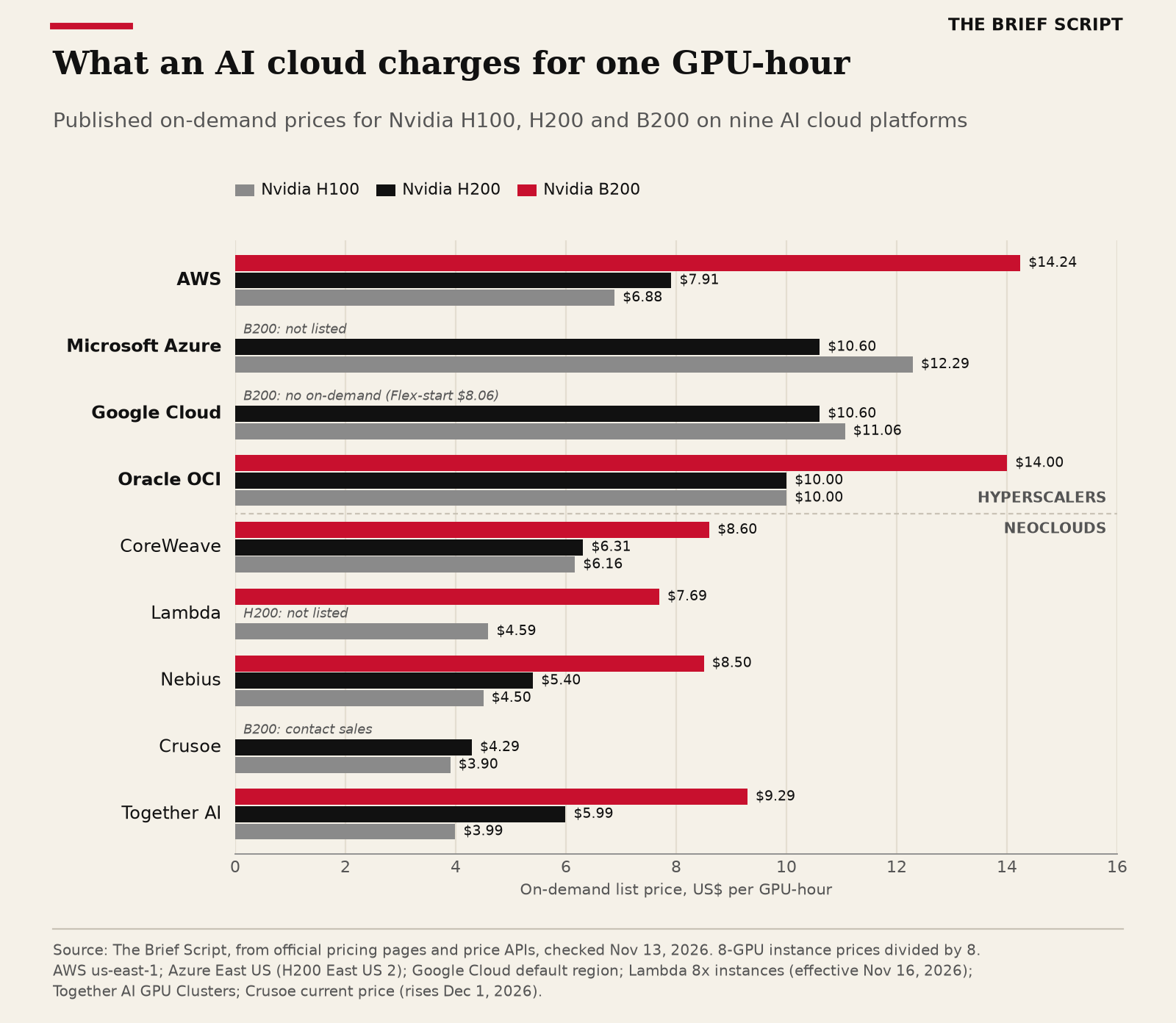
We built a small index: nine providers, six Nvidia data-center GPUs, 54 provider-GPU pairs. For each, we recorded whether the official pricing page shows a public on-demand price, says “contact sales”, offers another buying model only, or does not list the chip. The full table is in the chart below.
Four findings stand out:
- Hyperscalers charge about 2.3 times more for an on-demand H100. The median list price across AWS, Azure, Google Cloud and OCI is $10.53 per GPU-hour, against $4.50 across the five neoclouds. The gap narrows on newer chips: 1.8x for H200 ($10.30 vs $5.70) and 1.65x for B200 ($14.12 vs $8.55, from only two hyperscaler prices). List prices overstate what large buyers pay; committed-use discounts on every platform cut them sharply.
- AWS is the cheap hyperscaler for Hopper, not for Blackwell. Its H100 at $6.88 sits close to CoreWeave’s $6.16, but its B200 at $14.24 is the highest B200 price in the index.
- Rack-scale systems are mostly sold by quote. Only 32 of the 54 pairs (59%) carry a public on-demand price. For GB200 and GB300 NVL72, just 4 of 18 do: OCI ($16 and $18), Azure GB200 ($27.04) and CoreWeave GB200 ($10.50).
- Neocloud list prices are rising. Crusoe’s page shows its H100 going from $3.90 to $4.50 and its H200 from $4.29 to $5.40 on December 1, 2026, which lands exactly on Nebius’s current prices. Lambda’s page posts new prices from November 16, 2026.
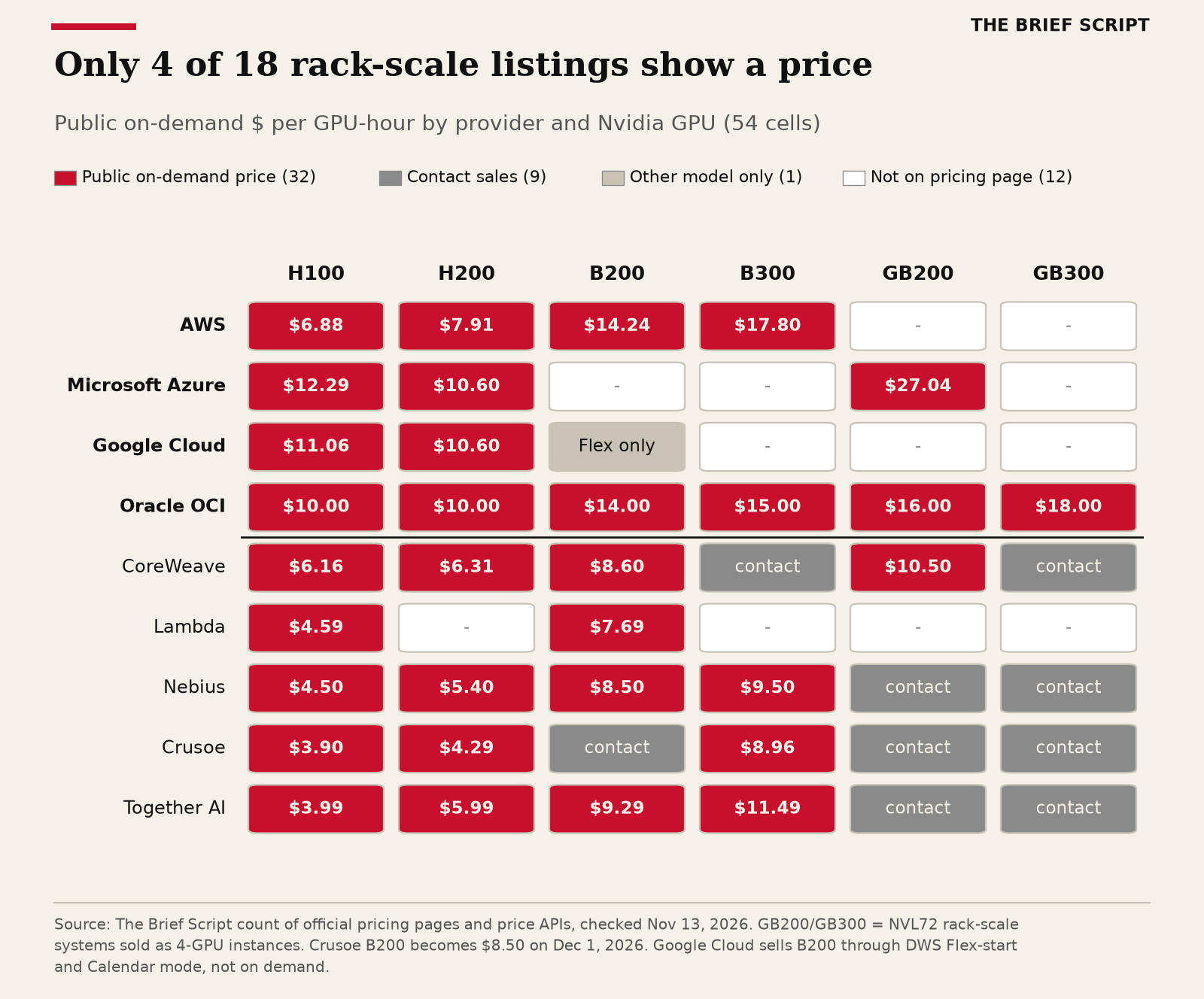
Oracle is the only provider that publishes a price for all six GPUs. Google Cloud sells B200 only through its Dynamic Workload Scheduler (Flex-start and Calendar mode), so there is no on-demand rate to compare.
How to choose an AI cloud platform
Start from the job, not the brand:
- Calling models through an API? Use the managed model layer of the cloud that already holds your data and identity. Bedrock, Foundry and Google’s platform now overlap heavily on models, so contracts, data residency and agent tooling decide it. Our Azure OpenAI vs Bedrock vs Vertex comparison covers that layer in detail.
- Serving open models at volume? Price per token or per dedicated endpoint-hour on Nebius, Together AI, Crusoe or CoreWeave against a hyperscaler endpoint. Neocloud GPU-hours are cheaper, but you may give up integrated security tooling.
- Training or fine-tuning large models? You need many GPUs on one fast network, usually on a reserved contract. Ask each provider for cluster size, interconnect, storage throughput and delivery date, not just the hourly rate.
- Price-sensitive and flexible on chips? Google’s TPUs and AWS Trainium can beat Nvidia on cost for some workloads; see our TPU vs GPU guide.
- Check the full bill. Egress, storage and managed Kubernetes fees vary widely. Nebius and Crusoe, for example, list free network egress; Crusoe charges $0.10 per cluster-hour for managed Kubernetes while Nebius lists it as free.
- Plan for lock-in and capacity. Keep workloads containerised and models portable so you can move when prices shift; Crusoe and Lambda both posted new list prices in November 2026.
FAQ
What is the best AI cloud platform?
There is no single best one. For managed model APIs inside an existing cloud, AWS, Azure and Google Cloud lead. For the lowest published H100 and H200 prices, the neoclouds (Crusoe, Together AI, Nebius, Lambda and CoreWeave) were cheapest in our November 2026 check. Oracle publishes the widest set of Nvidia GPU prices.
What are the main AI infrastructure providers?
At the cloud level: AWS, Microsoft Azure, Google Cloud and Oracle among hyperscalers, and CoreWeave, Lambda, Nebius, Crusoe and Together AI among neoclouds. Underneath them sit chip makers (Nvidia, AMD) and data-center builders. Our AI infrastructure news hub tracks their spending and deals.
How much does an H100 cost per hour in the cloud?
From $3.90 to $12.29 per GPU-hour on demand across the nine official pricing pages we checked on November 13, 2026. Crusoe was lowest (rising to $4.50 on December 1) and Azure highest. Reserved and committed-use contracts cost less.
Is an AI cloud platform the same as an AI data center?
No. The data center is the building, power and hardware. The AI cloud platform is the service layer that rents that hardware and adds software and models on top. A neocloud may run its own data centers or lease space from others.
Sources
- AWS: Amazon EC2 On-Demand pricing (us-east-1 price data): https://aws.amazon.com/ec2/pricing/on-demand/
- Microsoft: Azure Retail Prices API: https://prices.azure.com/api/retail/prices
- Google Cloud: GPU (accelerator-optimized) pricing: https://cloud.google.com/products/compute/pricing/accelerator-optimized
- Oracle: OCI compute pricing: https://www.oracle.com/cloud/compute/pricing/
- CoreWeave: Pricing: https://www.coreweave.com/pricing
- Lambda: AI cloud pricing: https://lambda.ai/pricing
- Nebius: AI Cloud pricing: https://nebius.com/prices
- Crusoe: Cloud pricing: https://www.crusoe.ai/cloud/pricing
- Together AI: Pricing: https://www.together.ai/pricing
- AWS: Amazon Bedrock: https://aws.amazon.com/bedrock/
- Microsoft Learn: What is Microsoft Foundry?: https://learn.microsoft.com/en-us/azure/foundry/what-is-foundry
- Google Cloud: Gemini Enterprise Agent Platform name changes: https://docs.cloud.google.com/gemini-enterprise-agent-platform/vertex-ai-name-changes
- Oracle: OCI Enterprise AI: https://www.oracle.com/artificial-intelligence/enterprise-ai/
- CoreWeave: Inference release notes (March 31, 2026): https://docs.coreweave.com/release-notes/inference
- Nebius: Token Factory: https://nebius.com/services/token-factory