The Pulse
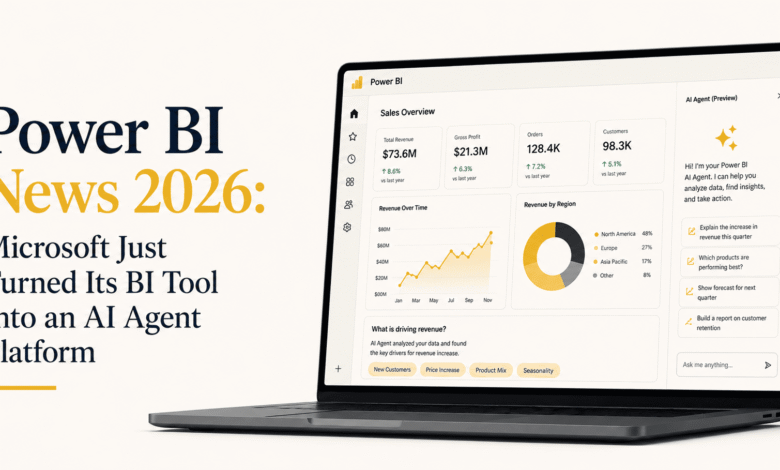
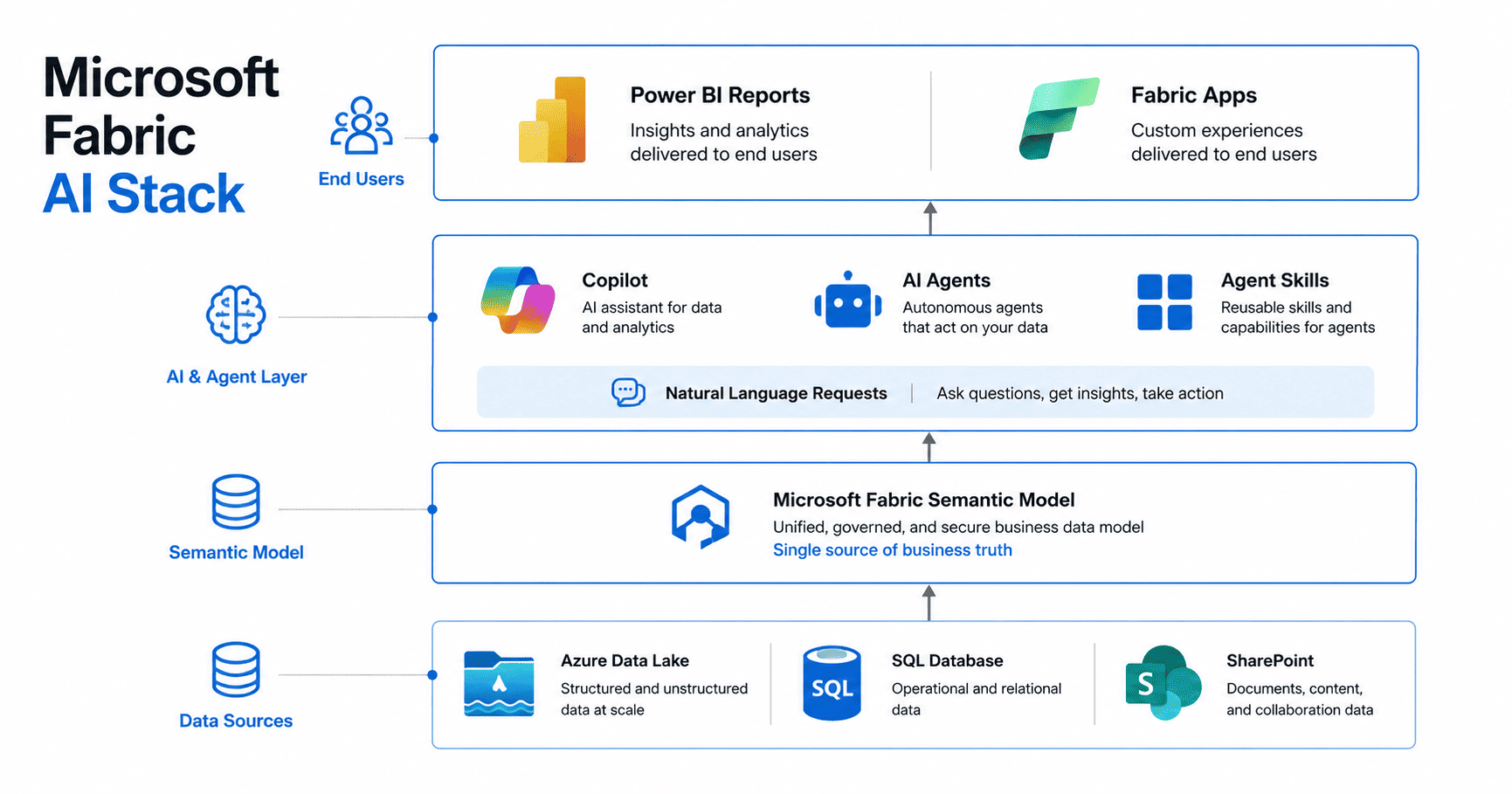
At Microsoft Build 2026 on June 3, Microsoft announced that Power BI can now be built by AI agents. Agent Skills for Power BI allow developers to prompt an AI agent to design semantic models and reports from scratch using natural language. Fabric Apps for Semantic Models allow those same agents to deploy finished analytics applications directly to business users without human involvement in the build cycle. The June 2026 feature summary, released June 11, adds Copilot in web modeling, giving analysts the ability to rename tables, create relationships, and generate DAX measures through conversation rather than manual configuration.
The cumulative weight of these announcements is more significant than any individual feature. Power BI news in 2026 is the story of Microsoft reorienting its most widely deployed enterprise analytics platform from a human-operated reporting tool into an AI-native analytics infrastructure where agents build, Copilot assists, and human analysts review and govern.
For enterprise data teams running Power BI across tens of thousands of organisations, that reorientation changes how the product is staffed, budgeted, and evaluated.
Core significance
Why it matters:
- Agent Skills for Power BI changes who can build analytics: Before Build 2026, creating a Power BI semantic model required a data analyst or BI developer with DAX knowledge and schema design experience. Agent Skills for Power BI allows an AI agent to receive a natural language description of the analytics requirement and produce the semantic model and report without human technical involvement in the build.
- The implication for enterprise data teams is direct: the backlog of analytics requests that currently waits for developer capacity can increasingly be addressed by agents. The role of the human analyst shifts from building to reviewing and governing what agents produce.[Microsoft Fabric Community — Power BI at Build 2026 the agentic era]
- Fabric Apps for Semantic Models changes how analytics reaches business users: Fabric Apps allow AI agents to build and deploy Fabric-native web applications directly on top of semantic models. A business user who previously needed a BI developer to create a custom dashboard for their specific workflow can now have an agent build and deploy that application without IT involvement.
- Microsoft describes this as the delivery platform that gets insights to every user, accelerating the gap between data availability and business user access to derived analytics.[D365Hub — Power BI Build 2026 Agent Skills Fabric Apps summary]
- Copilot in web modeling closes the last major manual gap: The June 2026 update, released June 11, introduces Copilot in web modeling currently in preview. Analysts can now prompt Copilot to analyse a semantic model, identify inconsistencies, rename tables and columns, create relationships, and generate DAX measures through natural language conversation. DAX user-defined functions also reached general availability in the same update, following community feedback since 2022. This removes the DAX expertise barrier from semantic model maintenance entirely.[Microsoft Fabric Community — Power BI June 2026 feature summary official]
Deep context: how Power BI became the centre of Microsoft Fabric
Power BI was acquired by Microsoft in 2015 as a relatively simple self-service BI tool competing with Tableau and Qlik. The strategic decision to make Power BI the user-facing layer of Microsoft Fabric, the unified data analytics platform Microsoft announced in 2023, transformed it from a standalone product into the semantic and reporting layer of a full-stack enterprise data platform.
Microsoft Fabric integrates Power BI’s semantic layer, Azure Data Factory’s data integration, Synapse Analytics’ data engineering, and real-time intelligence into a single platform with unified governance through Microsoft Purview. Power BI’s semantic models have become the foundation layer for AI experiences across Microsoft 365, Copilot Studio, and now autonomous agents. Every time a Copilot user in Teams asks a question about business performance, that question routes through a Power BI semantic model.
That architectural positioning is what makes the Build 2026 agent announcements significant beyond their immediate feature scope. Agent Skills for Power BI are not just a feature for BI developers. They are the mechanism by which any agent in the Microsoft ecosystem can build, maintain, and deliver analytics without human intermediation. The semantic model is the trusted data layer that makes agent-generated analytics reliable. Power BI owns that layer.
As covered in our AWS vs Azure vs Google Cloud AI 2026 analysis, Microsoft’s enterprise AI strategy is built around keeping AI workloads inside the Azure and Microsoft 365 ecosystem. Power BI as an agentic analytics platform is the data intelligence layer that makes that strategy coherent.
Data insights
By the numbers:
All feature data from official Microsoft Fabric Community monthly update blogs (primary source). Pricing from Microsoft official pricing pages.
- 6 consecutive months of major AI updates: Microsoft has shipped AI capability improvements to Power BI every month from January through June 2026, covering Copilot in mobile, Copilot in web modeling, Agent Skills, Fabric Apps, and DAX user-defined functions. The pace of AI feature delivery in 2026 is materially faster than any prior year.[Microsoft Fabric Community — Power BI Updates Blog full index]
- 4 Build 2026 announcements: Microsoft made four Power BI-specific announcements at Build 2026 on June 3: Agent Skills for Power BI, Fabric Apps for Semantic Models, expanded Copilot capabilities, and new developer tooling, all positioning Power BI as a platform for analysts, developers, business users, and the agents that support them.[Releasebot — Power BI June 2026 updates tracker]
- $20 per user per month: Power BI Pro pricing, the entry point for enterprise collaboration and sharing. Power BI Premium Per User is also $20 per user per month. Power BI Premium Per Capacity starts at $4,995 per month, giving access to the full Microsoft Fabric platform including all AI agent capabilities.
- Production-ready DAX user-defined functions: DAX user-defined functions reached general availability in the June 2026 update following community feedback and internal validation. This resolves a long-standing DAX modelling limitation that enterprise customers have been requesting since 2022.
- Mobile Copilot fully conversational: The April 2026 update delivered full back-and-forth chat with Power BI reports on mobile devices. Enterprise users can now maintain a persistent analytical conversation with a Power BI report from a phone or tablet, a capability that previously required desktop access.[Microsoft Fabric Community — Power BI April 2026 feature summary official]
Table 1: Power BI AI feature timeline : 2026 month by month
| Month | Headline AI feature | Status | Enterprise impact |
| February 2026 | Smarter Copilot; improved AI report summaries | GA | Faster insight generation in existing reports |
| April 2026 | Full conversational Copilot on Power BI Mobile | GA | Field workers and executives get Copilot on any device |
| May 2026 | Redesigned Get Data workflow; Copilot improvements | GA | Faster data onboarding; reduced friction for new users |
| June 3 (Build 2026) | Agent Skills for Power BI; Fabric Apps for Semantic Models | Preview/GA | Agents build reports and deploy apps without developer involvement |
| June 11 (June update) | Copilot in web modeling; DAX user-defined functions GA; Report Authoring agent skills | Preview/GA | Natural language semantic model editing; eliminates DAX expertise barrier |
Table 2: Power BI vs competing enterprise BI platforms 2026
| Dimension | Power BI / Microsoft Fabric | Tableau / Salesforce | Looker / Google |
| AI capability | Agent Skills build reports; Copilot in modeling; mobile conversational AI | Tableau Pulse AI summaries; Looker Conversational Analytics in preview |
| Platform integration | Native Microsoft 365, Teams, Azure, Copilot Studio, SharePoint | Salesforce Einstein; Google Cloud data stack; limited cross-platform |
| Semantic layer | Power BI semantic model as enterprise-wide governed metric layer | Tableau Data Model; Looker LookML (separate language required) |
| Agentic analytics | Agent Skills + Fabric Apps: agents build and deploy — GA/preview June 2026 | No comparable agent-build-and-deploy capability announced as of June 2026 |
| Pricing entry point | $20/user/month (Pro); $4,995/month (Premium capacity) | Tableau: $75/user/month (Creator); Looker: $30/user/month (standard) |
| On-premises option | Power BI Report Server available | Tableau Server; no on-premises Looker |
The business case: What agentic Power BI means for enterprise data teams
The standard enterprise BI workflow in 2025 looked like this: a business stakeholder identifies a data question, submits a request to the analytics team, waits one to three weeks for developer availability, receives a report, requests modifications, waits again. That cycle is the primary reason enterprise BI backlog has been a persistent problem since business intelligence became mainstream in the 2000s.
Agent Skills for Power BI does not eliminate this problem entirely, but it changes the constraint from developer availability to data governance and semantic model quality. An agent can now receive the stakeholder’s request in natural language and produce a report in minutes rather than weeks, provided the semantic model that the report draws from is well-governed and accurate. The remaining human work is reviewing what the agent produced and validating that the underlying semantic model correctly reflects business definitions.
That shift has specific staffing implications. Enterprise data teams that extract the most value from agentic Power BI in 2026 and 2027 are those that invest in semantic model quality and governance infrastructure now. A well-governed semantic model with clearly defined measures, consistent naming conventions, and accurate relationships produces trustworthy agent-generated reports. A poorly governed semantic model produces agent-generated reports that embed incorrect assumptions into analytics that business stakeholders trust because they look polished.
Copilot in web modeling, currently in preview, directly addresses the governance problem. Asking Copilot to analyse a semantic model and identify areas for improvement is the first time Power BI has provided a systematic AI-driven quality audit of the semantic layer itself. For enterprise data teams inheriting complex Power BI environments built over years without consistent conventions, this is genuinely useful before the agentic era fully arrives.
Expert nuance: the semantic model as competitive infrastructure
The most strategically significant aspect of Microsoft’s Power BI direction in 2026 is not the individual features. It is the architectural bet that the enterprise semantic model is the foundation layer for all enterprise AI. Every AI feature Microsoft has added to Power BI in 2026 depends on the semantic model. Copilot answers questions by querying semantic models. Agent Skills build reports by drawing from semantic models. Fabric Apps deliver analytics by surfacing semantic model data.
The semantic model is not a data storage layer. It is the governed definition of business reality that makes AI outputs trustworthy rather than plausible-sounding. The enterprise that invests in a well-governed Power BI semantic model in 2026 is building the foundation for every AI analytical application it deploys in 2027 and 2028. Competitors building on Tableau or Looker are building equivalent semantic layers in those environments, but neither has announced an agent-build-and-deploy capability comparable to Agent Skills and Fabric Apps as of June 2026. Microsoft has a 12 to 18 month lead in this specific architecture.
Strategic outlook
- The September 2026 European Fabric conference signals the next announcement wave: The European Microsoft Fabric and SQL Community Conference runs September 28 to October 1 in Barcelona with over 130 sessions and live demos. Microsoft uses its Fabric community conferences to announce features reaching general availability. Watch for Agent Skills moving from preview to GA, Copilot in web modeling GA, and expanded Fabric Apps capabilities at Barcelona. This will confirm which Build 2026 preview features Microsoft considers production-ready for enterprise deployment.[Microsoft Fabric Community — May 2026 summary European conference announcement]
- Gartner’s 2026 Magic Quadrant will test whether the market follows Microsoft’s vision: Microsoft has been a Leader in Gartner’s Magic Quadrant for Analytics and Business Intelligence Platforms for multiple consecutive years. The 2026 edition, expected in H2 2026, will be the first assessment following the Build 2026 agentic analytics announcements. Watch whether the completeness of vision score reflects agent-build-and-deploy as genuine market differentiation or as a roadmap capability pending real enterprise adoption data.
- The governance investment determines who wins with agentic Power BI: Microsoft’s agentic analytics vision is technically coherent and well-resourced. The enterprises that will capture value earliest are those that treat the period from now to end 2026 as a semantic model investment cycle rather than a feature adoption cycle. Build the governed semantic model now. Adopt the agents when they reach GA. Enterprises that wait to build the semantic foundation until after agents arrive will have the technology without the foundation that makes it trustworthy.
Key question answered
What is the latest Power BI news in 2026?
The most significant Power BI news in 2026 is Agent Skills for Power BI and Fabric Apps for Semantic Models, announced at Microsoft Build 2026 on June 3. Agent Skills allow AI agents to build semantic models and reports from natural language prompts. Fabric Apps allow agents to deploy analytics applications directly to business users. The June 2026 update adds Copilot in web modeling in preview for natural language semantic model editing, and DAX user-defined functions reaching general availability. Copilot in Power BI Mobile reached full conversational capability in April 2026. Power BI is part of Microsoft Fabric. Power BI Pro starts at $20 per user per month. The European Fabric conference runs September 28 to October 1 in Barcelona for the next major announcement cycle.
The takeaway
Power BI in 2026 is a different product from Power BI in 2024. The monthly feature delivery pace, the Build 2026 agent announcements, and the architectural positioning within Microsoft Fabric all point to a platform Microsoft is investing in at a rate its enterprise BI competitors are not currently matching.
The practical message for enterprise data teams is straightforward: the semantic model quality you build or inherit today determines the value you capture from agentic analytics in 2027. Agent Skills and Copilot in web modeling make it faster to build and maintain semantic models. They do not substitute for the governance discipline that makes semantic models trustworthy. The teams that understand this distinction will adopt agentic Power BI in a way that improves analytics quality. The teams that do not will use agents to produce polished but unreliable reports faster than ever.
For enterprises evaluating their BI platform strategy in 2026, the question is not whether Power BI has caught up with Tableau on visualisation or Looker on semantic modelling. It is whether any competing platform is delivering an agent-build-and-deploy architecture comparable to what Microsoft announced at Build 2026. As of June 12, none are. That 12 to 18 month lead is the most important competitive data point in enterprise BI right now.