Warehouse Robotics News 2026: Deployments, Funding, Costs and Who’s Winning
Warehouse robotics news hub, updated Nov 5, 2026: 12 dated stories (AutoStore Q3 and Logiqs deal, Agility AGLT Nasdaq debut, Walmart-Symbotic $6B, Amazon 1M robots), a 2025-26 funding tracker, market size, robot types, top companies, RaaS costs with a worked payback example, and humanoids hype vs reality.

Last updated: Nov 5, 2026. We refresh this page every week.
Short answer: Warehouse robotics news in late 2026 is about scale and money. Amazon now runs more than 1 million robots. Walmart has committed an initial $6 billion to Symbotic automation, and AutoStore has raised its 2026 sales forecast to about $750 million. Humanoid maker Agility began trading on Nasdaq on Nov 5. Proven robots are paying back. Humanoids are still in pilots.
This hub tracks warehouse robots specifically: who is deploying them, who is funding them, what they cost and who is ahead. For the wider picture (factory robots, robotaxis, the AI models behind them), see our physical AI guide. Every fact below links to its source. Every date is the date of the event.
Warehouse robotics news: September to November 2026
The 12 stories that mattered most this autumn, newest first.
- Nov 5: AutoStore posts record Q3 orders, raises its forecast and buys Logiqs. Revenue rose 38% to $192.1 million. Order intake rose 17% to $177.6 million, its highest ever for a third quarter. AutoStore now expects about $750 million in 2026 revenue, up from about $700 million. It is also buying Logiqs, a Dutch maker of roaming pallet storage robots used at about 30 sites, for up to €30 million. (AutoStore Q3 report)
- Nov 5: Agility Robotics starts trading on Nasdaq as AGLT. Its merger with Churchill Capital Corp XI closed on Nov 4, after more than 84% of votes cast backed it. The deal raised about $465 million before expenses, down from the $620 million-plus expected in June. Shares opened at $11.26, above the $10 deal price. (The Robot Report)
- Nov 3: Boston Dynamics launches Stretch Gen 2. The trailer-unloading robot now handles up to 1,000 cases an hour, depending on the load. The redesign drew on data from more than 100,000 operating hours and cuts 81% of the internal cabling, a common cause of breakdowns. (Boston Dynamics)
- Oct 29: Walmart widens its Symbotic deal. Symbotic systems will go into 25 Walmart regional distribution centers under an initial $6 billion commitment spread over several years. Walmart is also putting $125 million into racking and picking R&D. (Supply Chain Dive)
- Oct 29: Amazon passes 1 million robots. On the Q3 earnings call, the CFO said Amazon doubled its fleet of robotic arms, such as Cardinal and Sparrow, in 2026. CEO Andy Jassy said many of the more repetitive jobs “will be done by robots.” (PYMNTS)
- Oct 26: GXO expands Agility’s Digit humanoid to two more sites. Statesville, North Carolina and Lebanon, Tennessee get the robots from early 2027 on a robots-as-a-service (RaaS) contract. Neither company disclosed the robot count or the fee. (Beri.net)
- Oct 22: Ocado opens a second automated grocery site with AEON in Tokyo. The Hachioji center’s Auto-Freezer handles frozen orders 2.7 times faster than AEON’s first site. It also cuts staff time spent in freezer conditions to under 5% of working hours. (Ocado Group)
- Oct 22: Figure says its humanoids now work in three US states. It has not named the customers. Figure has built its 1,000th Figure 03 and holds more than $2 billion in cash. (Humanoids Daily)
- Oct 13: Symbotic buys cellumation. The Bremen company makes a software-controlled sorting surface that replaces conventional conveyors. Terms were not disclosed. (Symbotic)
- Oct 8: GreyOrange buys Site Bionics. It adds camera-based store “digital twins” to its warehouse and store orchestration software. (GlobeNewswire)
- Oct 6: Locus is ranked the top AMR vendor in the Americas by revenue. The ranking comes from Interact Analysis. Locus now runs more than 22,000 robots at 360+ sites, and they have made more than 8.5 billion picks. (Business Wire)
- Oct 2: AutoStore offers its grid as a service through THG Fulfil. Customers can now rent the system (AutoStore-as-a-Service) instead of buying it. THG already runs more than 700 AutoStore robots. (AutoStore)
The pattern: big buyers are signing long, multi-site commitments, vendors are buying software and sortation to fill gaps, and rental models are spreading.
Warehouse robotics funding and M&A tracker, 2025 to 2026
| Date | Company | Deal | Amount | Source |
|---|---|---|---|---|
| Jan 2025 | Symbotic / Walmart | Symbotic buys Walmart’s robotics unit; Walmart funds development | $200M base + up to $350M milestones; $520M dev funding | The Robot Report |
| Mar 2025 | Dexterity | Venture round | $95M at $1.65B valuation | TechCrunch |
| Sep 2025 | Figure AI | Series C | Over $1B at $39B valuation | Humanoids Daily |
| Jan 2026 | Skild AI | Series C (robot “brain” software) | $1.4B, valuation over $14B | Skild AI |
| Jan 2026 | Mytra | Series C (pallet storage robots) | $120M | Mytra |
| Feb 2026 | Apptronik | Series A-X (humanoid) | $520M | Apptronik |
| Apr 2026 | Skild AI / Zebra | Buys Zebra’s robotics unit (ex-Fetch) | Not disclosed by buyer | Zebra |
| Sep 2026 | Locus Robotics | Series G (still open) | $41.6M | Material Handling 24/7 |
| Sep 2026 | Vecna Robotics | Venture round | $31M | The Robotics Media |
| Oct 2026 | Ultra Robotics | Series A | $50M | Gunderson Dettmer |
| Oct 2026 | Symbotic | Buys cellumation | Not disclosed | Symbotic |
| Oct 2026 | GreyOrange | Buys Site Bionics | Not disclosed | GlobeNewswire |
| Nov 2026 | Agility Robotics | SPAC merger closed Nov 4, $2.5B pre-money; trades as AGLT | About $465M gross | The Robot Report |
| Nov 2026 | AutoStore | Buys Logiqs (roaming pallet storage robots); closing expected Q4 2026 | Up to €30M (about $34M) | AutoStore |
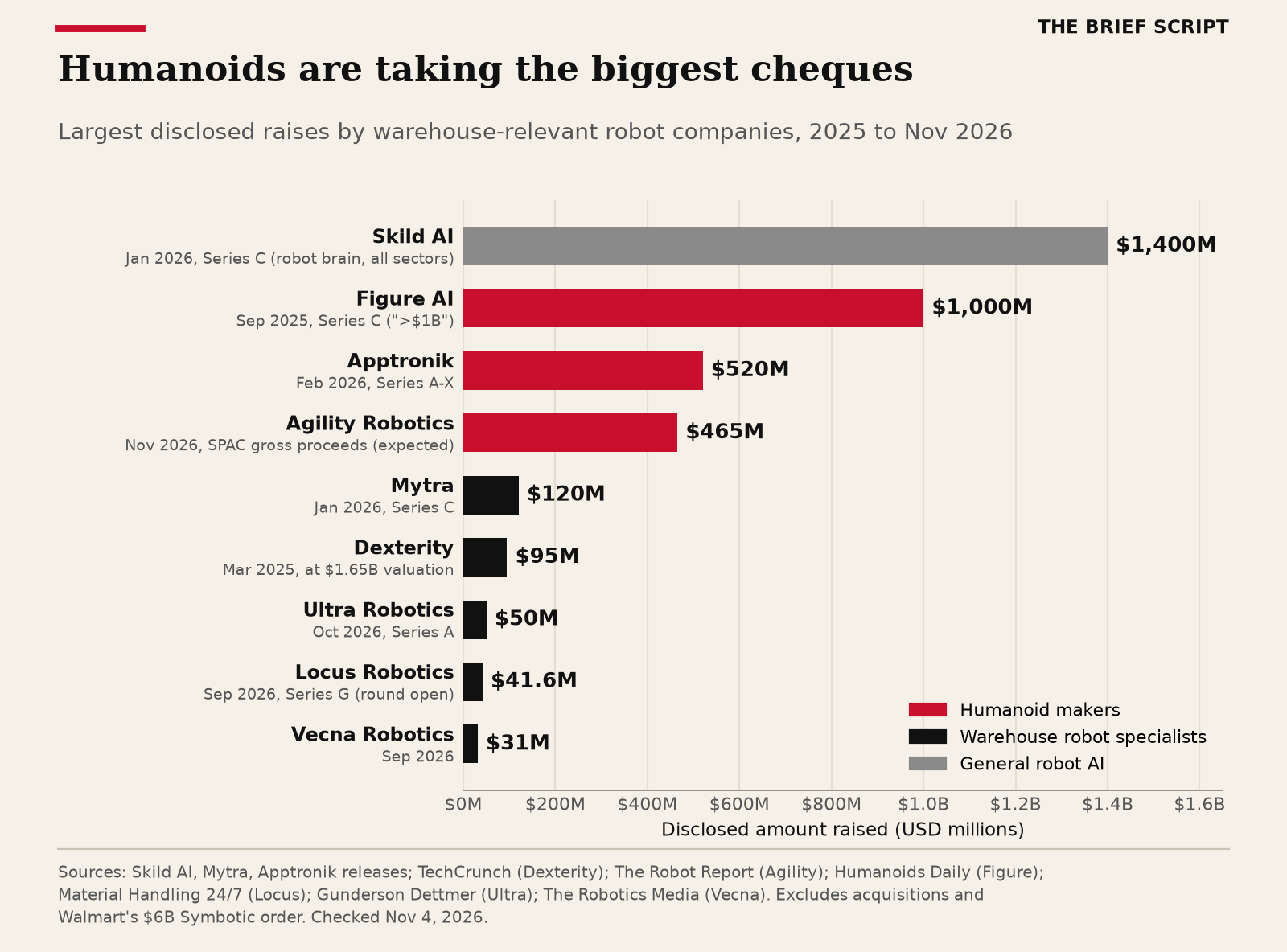
Two things stand out. First, the three humanoid makers in the table (Figure, Apptronik and Agility) raised close to $2 billion between them. The warehouse specialists that already have fleets in the field raised much less. Locus, the Americas revenue leader, raised $41.6 million from existing investors. Second, the biggest money in warehouse automation is customer money, not venture money. Walmart’s $6 billion Symbotic commitment is larger than every round in the table combined.
How big is the warehouse robotics market?
Estimates differ by firm because each one defines the market differently. Treat these figures as ranges, not facts.
| Source | Scope | Size | Forecast | Growth |
|---|---|---|---|---|
| Grand View Research | Warehouse robots, global | $7.5B (2025) | $24.2B by 2033 | 15.9% a year |
| Fortune Business Insights | Warehouse robots, global | $6.5B (2025) | $25.4B by 2034 | 16.8% a year |
| MarketsandMarkets | Autonomous mobile robots, all uses | $2.75B (2026) | $7.07B by 2032 | 14.4% a year |
The two warehouse-wide estimates land close together, at roughly $6.5 to $7.5 billion today and growing about 16% a year. For a harder number, the Association for Advancing Automation counts actual orders. North American companies across all industries ordered nearly 18,000 robots worth about $1.2 billion in the first half of 2026, as cited by The Washington Times.
Types of warehouse robots
| Type | What it does | Examples | Where it stands (Nov 2026) |
|---|---|---|---|
| Goods-to-person drives | Carry shelving pods to a picker so workers stop walking | Amazon Hercules (Kiva lineage) | Mature; the backbone of Amazon’s 1M+ fleet |
| Collaborative AMRs | Ride alongside pickers and carry totes to packing | Locus, Brightpick | Mature; usually rented on RaaS |
| Cube and grid storage | Robots run on top of a dense storage grid and lift bins to ports | AutoStore, Ocado | Mature; about 2,000 AutoStore systems in 68 countries |
| Case and pallet storage | Store and retrieve cases or pallets at high density | Symbotic, Mytra | Scaling, led by Walmart’s rollout |
| Picking and sorting arms | Pick items or parcels and sort them | Amazon Sparrow, Robin, Cardinal; Ocado robotic pick; Locus Array | Scaling; still struggle with irregular, fragile and floppy items |
| Truck unloading | Unload boxes from trailers | Boston Dynamics Stretch, Dexterity | Early scaling; Stretch Gen 2 launched Nov 3 |
| Autonomous forklifts and pallet movers | Move pallets from dock to rack | Vecna | Scaling |
| Humanoids | General tasks in buildings designed for people; today, mostly moving totes | Agility Digit, Figure, Apptronik Apollo | Pilots and first paid fleets |
The Washington Times’ review of the evidence sums up what robots still can’t do: reliably pick any object from a cluttered bin, and handle exceptions such as damaged goods, mislabeled totes and jams. Those tasks still route to people. This is why even the most automated buildings still need large crews.
Who’s winning: top warehouse robotics companies
| Company | What it does | Customers and scale | Funding or finances |
|---|---|---|---|
| Amazon Robotics | Builds its own drives, arms (Sparrow, Cardinal, Robin) and mobile robots (Proteus) | Amazon only; 1M+ robots | Internal; adding robot plants in Austin and Indiana (A3) |
| Symbotic | AI-run case storage and retrieval systems | Walmart is 90.5% of revenue (The Robot Report); also Walmex, Medline | Public; $22.5B backlog (Jun 2026) |
| AutoStore | Cube storage grid and robots, sold through partners | About 2,000 systems; THG Fulfil runs 700+ robots | Public (Oslo); Q3 2026 revenue $192.1M, 2026 guidance about $750M |
| Ocado | Grid-based grocery fulfillment centers and robotic picking | AEON (Japan), Lotte (Korea) and other grocers | Public (London) |
| Locus Robotics | Collaborative AMRs plus the autonomous Locus Array | DHL (5,000-robot commitment), GEODIS, CEVA, FedEx; 22,000+ robots | $41.6M Series G (2026) |
| GreyOrange | Orchestration software for robots and stores | 3,800+ locations | Private; acquiring software |
| Boston Dynamics | Stretch truck-unloading robot | Says Stretch has more deployments than any rival | Not disclosed here |
| Dexterity | AI arms for truck loading and parcel handling | Backed by Lightspeed and Sumitomo | $95M at $1.65B (2025) |
| Agility Robotics | Digit humanoid, rented on RaaS | GXO; Digit in 9 customer sites | Public since Nov 5 (Nasdaq: AGLT); about $465M via SPAC |
| Figure AI | Figure 03 humanoid | Robots in three states (customers unnamed) | Over $1B Series C at $39B |
| Apptronik | Apollo humanoid | GXO, Mercedes-Benz, Jabil | $520M Series A-X |
Who’s winning: Amazon on scale, Symbotic on order book and AutoStore and Locus on installed base outside Amazon. Among the humanoid makers, the money has gone to Figure, but only Agility has published named, paid warehouse deployments.
What warehouse robots cost, and when they pay back
Few vendors publish prices. These are the clearest public reference points we found:
- Rented picking robots: Brightpick lists $1,900 to $2,200 per robot per month, including software, support and maintenance. There is also an upfront fee of $1,000 per robot, with a $70,000 minimum, and a three-year minimum term (Brightpick).
- Rented humanoids: Agility’s investor deck uses an illustrative price of about $8,500 a month, or roughly $100,000 a year, per Digit. It sets that against about $200,000 a year of labor that Agility says one robot replaces. Both are company estimates (Agility investor deck, SEC filing).
- Labor: US warehousing pays an average of $26.74 an hour (August 2026, preliminary). The sector employs 1.83 million people, down from 1.85 million in June (BLS).
- Productivity: Amazon says its newest fulfillment centers are about 25% more productive (Business Insider).
Worked example: 40 rented AMRs in a mid-size DC
Assumptions (ours, labelled; not a vendor quote):
- 60 pickers across two shifts. Loaded cost is BLS’s $26.74 an hour × 1.3 for benefits and overtime × 2,080 hours, or about $72,300 per worker a year.
- 40 robots at $2,000 per robot per month, the middle of Brightpick’s range. That comes to $960,000 a year.
- One-time cost of $220,000: the $70,000 upfront minimum plus an assumed $150,000 for integration and change work.
- One extra full-time worker to monitor the robots and clear faults.
- Order volume stays the same. The robots raise picks per labor hour, and the hours saved are valued at loaded cost, whether they come from attrition, fewer temps or redeployment.
Result:
| Productivity gain | Hours saved (FTE) | Net saving a year | Payback |
|---|---|---|---|
| +25% | 12 | -$165,000 | Never |
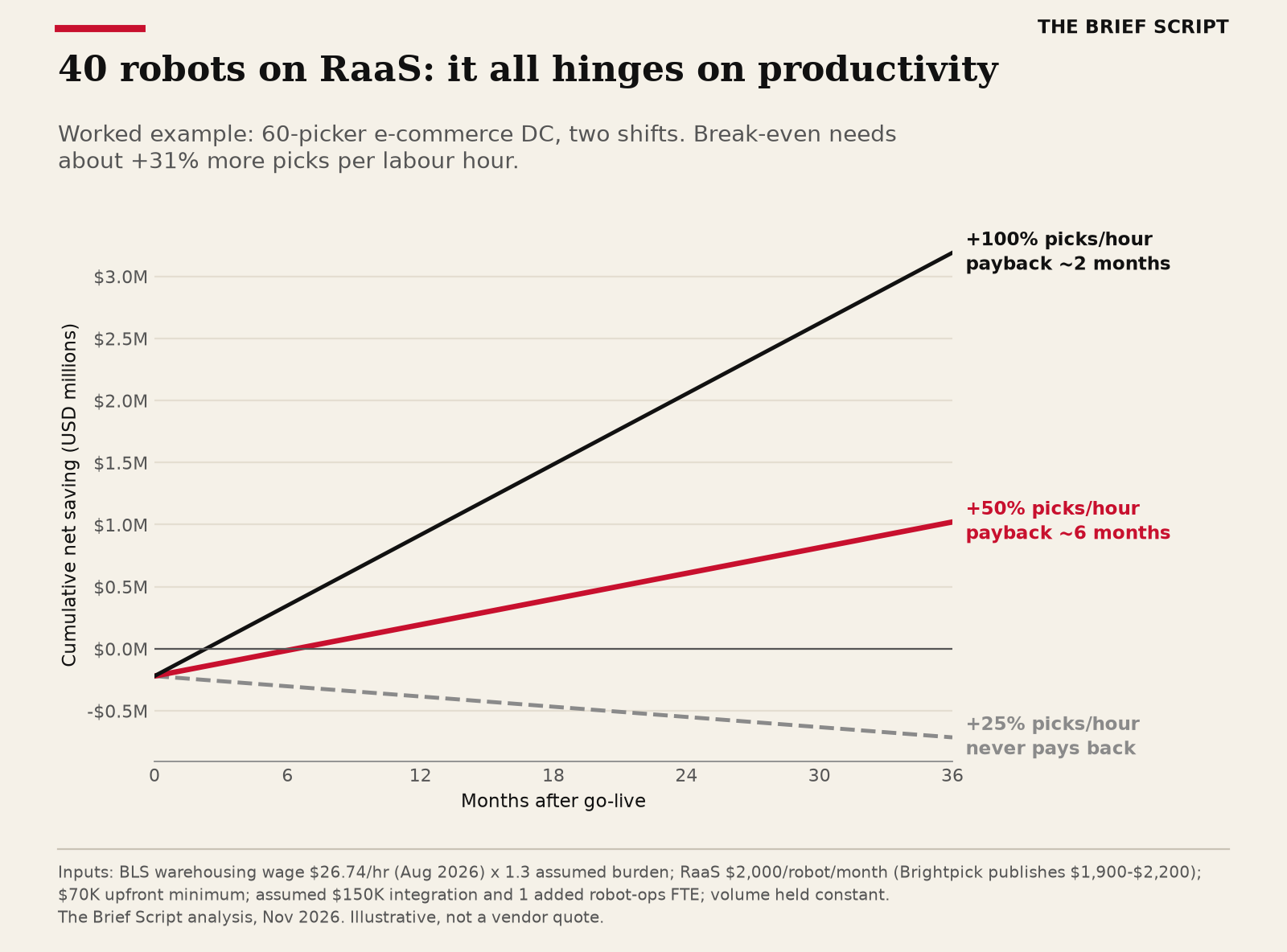
| +50% (base case) | 20 | +$414,000 | About 6 months |
| +100% | 30 | +$1.14M | About 2 months |
The break-even point is about +31% more picks per labor hour. That is the number to test in a pilot. Rental fees are high enough that a modest gain loses money, and a strong gain pays back fast. Ask vendors for site-level before-and-after data, not fleet-wide averages.
The same math explains the humanoid problem. At our loaded rate, a $102,000-a-year Digit has to do the work of about 1.4 full-time shifts just to break even. That depends on uptime and charging that, per Beri.net, Digit 4 deployments have not shown publicly.
Humanoid robots in warehouses: hype vs reality
The hype: Humanoids took most of 2025 to 2026’s big robotics rounds. Agility says it has more than $300 million in committed multi-year Digit 5 orders and a factory built for up to 10,000 robots a year (The Robot Report). Figure says it has built 1,000 Figure 03s.
The reality:
- GXO, the most active buyer, has run 45 humanoid pilots. In August its CEO said, “We have not achieved ROI on humanoids yet. I think we are a couple of years away” (Beri.net, citing FreightWaves).
- The flagship job is narrow. Digit picks up totes and puts them on conveyors, the same task it has done in Georgia since 2023.
- Agility’s order book is “subject to contractual milestones” and is not revenue. Digit 5 only reaches early access in the first half of 2027.
- Figure has not named its customers. Its 200-hour logistics demo kept running by swapping robots out to charge.
- Even Amazon’s in-house work stalls. It halted its Blue Jay multi-arm robot in February, less than six months after unveiling it.
Our read: Humanoids are a real option on future flexibility, priced like a sure thing. For 2027 budgets, treat them as a structured pilot with a stop date, rented on RaaS so the vendor carries hardware and obsolescence risk.
Amazon warehouse robots and the workforce
Amazon is the test case for jobs. Internal documents reported by The New York Times describe plans to automate up to 75% of operations by 2033. That would avoid about 600,000 US hires and save $12.6 billion by 2027. Amazon says the documents reflect one team’s view, not company strategy (The Washington Times).
On the ground, the picture is mixed. Amazon’s robotic site in Tracy, California employs more than 3,000 people, up from about 1,000 when it opened in 2023. It handles more volume than a nearby, less automated site with about the same headcount (Business Insider). The site manager estimates one Robin arm does the work of two to seven people on its task. Workers move into robot monitoring, fault clearing and maintenance roles, and Amazon says its newest sites have about 30% more skilled jobs.
So the headcount effect shows up mainly as hiring that never happens, not as layoffs. Our AI layoffs tracker logs the companies that have explicitly tied job cuts to AI. The national data is starting to move too: US warehousing employment dipped from 1.85 million in June to 1.83 million in September (BLS). That change is too small, and too recent, to blame on robots yet.
What it means for warehouse operators
- Start with the boring robots. Mobile robots, storage grids and case handling have public deployment records and rental options. Humanoids don’t yet.
- Prefer rental for anything new. RaaS, AutoStore-as-a-Service and Agility’s RaaS all shift hardware risk to the vendor. Negotiate uptime guarantees, a hardware-upgrade clause and data export.
- Pilot against a measured baseline. Record picks per labor hour, error rates and cost per unit before the robots arrive. Set your expand-or-stop threshold (around +30% in our example) up front.
- Check vendor health. Agility only just went public, by SPAC. Symbotic depends on one customer for about 90% of revenue. Covariant’s tech went to Amazon and the company is down to about 20 people. Add change-of-control terms to every contract.
- Budget for people. Every deployment adds monitoring and maintenance roles. Amazon’s Tracy site runs a dedicated “quarterback” role that dispatches staff to stalled robots.
- Plan for resilience, not just cost. Automation changes how you handle peaks and disruptions. Our guide to AI in supply chains covers planning and forecasting. Our edge AI news hub covers the on-robot chips and models these fleets run on, and our AI infrastructure news hub covers the data centers behind the training.
What to watch next
- Q4 2026: AutoStore expects to close its Logiqs purchase, its first step into pallet storage robots.
- Nov 23: Symbotic reports fiscal Q4 2026, its first results since the $6 billion Walmart expansion (Symbotic).
- Early 2027: GXO’s two new Digit sites go live.
- First half of 2027: Digit 5 early access begins.
- May 2027: The 180-day lock-up on shares held by Agility’s existing investors and the SPAC sponsor ends, unless the share price triggers an early release.
FAQ
What is the latest warehouse robotics news?
As of Nov 5, 2026, the biggest stories are AutoStore’s record third-quarter orders, raised 2026 forecast of about $750 million and Logiqs purchase (Nov 5), Agility Robotics’ Nasdaq debut as AGLT (Nov 5), Boston Dynamics’ Stretch Gen 2 launch (Nov 3), Walmart’s initial $6 billion commitment to Symbotic for 25 distribution centers (Oct 29) and Amazon passing 1 million robots (Oct 29).
How much do warehouse robots cost?
Rented picking robots run about $1,900 to $2,200 per robot per month at Brightpick, plus setup fees. Agility’s illustrative humanoid price is about $8,500 a month. Large fixed systems such as Symbotic’s are priced per project, and Walmart’s latest commitment alone is an initial $6 billion over several years.
How many robots does Amazon use in its warehouses?
More than 1 million, according to Amazon’s Q3 2026 earnings call. Amazon also says it doubled its fleet of robotic arms, such as Cardinal and Sparrow, in 2026, and it is building its own robot plants in Texas and Indiana.
Are humanoid robots used in warehouses yet?
Yes, but only in small numbers. GXO runs Agility’s Digit humanoids at a Georgia site and will add two more sites in 2027. Figure says its robots work in three US states. GXO’s CEO says the company has not yet achieved a return on its 45 humanoid pilots.
How we built this page: every fact is logged with its source URL and date in our research file. All sources were opened on Nov 4 or Nov 5, 2026. The worked example uses public prices and BLS wages plus the assumptions shown. We update this hub weekly.