Natural Language Processing in Customer Service (2027): Uses, Costs and 24 Real Deployments
What natural language processing does in customer service (intent, sentiment, summarization, agent assist, autonomous AI agents), use cases, pricing models with a worked cost example, risks and a checklist, plus our analysis of 24 named deployments: median headline automation 70%, stricter figures up to 66 points lower.

In short: Natural language processing (NLP) in customer service is AI that reads and writes human language so software can detect intent, gauge sentiment, route and summarize contacts, assist agents and, with large language models, resolve requests itself. Named deployments report median automation of 70%, but stricter figures in the same sources run up to 66 points lower.
Every customer contact starts as language: a chat, an email, a call transcript. Natural language processing turns that language into something a system can act on, and in 2026 it moved from tagging tickets to answering them, with AI customer service agents priced per resolution.
The question for an enterprise CX or support leader is what the published numbers actually measure. This guide explains what NLP does in customer service, where it is used, what it costs and where it fails. It also includes an original analysis: we collected 24 named, dated customer-service AI deployments with disclosed outcomes and checked how each one defines “resolved.” The short answer is that most do not.
What is natural language processing in customer service?
Natural language processing is the branch of AI that lets software understand and generate human language. In a contact center it sits between the customer’s words and the business’s systems. It decides what a customer wants, how they feel, what account or order they mean, who should handle the request, and what to say back.
Older customer-service NLP relied on intent classifiers and decision trees: a bot matched a message to one of a few hundred intents, then followed a scripted path. Large language models (LLMs) changed two things. They understand requests phrased in the customer’s own words without someone scripting every variation, and they generate answers grounded in a knowledge base. TelevisaUnivision’s director of customer care described the shift from a scripted bot to a generative agent in exactly those terms on Ada’s case study: viewers can now “explain an issue in their own words” and raise more than one issue in a conversation.
The result is a stack with three layers: NLP that classifies and summarizes (analytics), NLP that helps human agents (assist), and NLP that talks to customers directly (autonomous agents). Most enterprises run all three.
What NLP does in customer service: six jobs
| Job | What the NLP does | Typical metric it moves |
|---|---|---|
| Intent detection and routing | Classifies a message by topic, language and urgency, then sends it to the right queue, bot flow or specialist | Misroutes, transfer rate, time to first response |
| Sentiment analysis | Scores how the customer feels, in real time or after the contact | Escalations, churn saves, QA coverage |
| Entity extraction and redaction | Pulls out order numbers, product names and account details; masks personal data in transcripts | Handle time, compliance |
| Summarization | Writes after-contact notes and handoff summaries | After-call work, repeat questions |
| Agent assist | Suggests answers, knowledge articles and next steps to a human agent during a live contact | Average handle time (AHT), ramp time for new hires |
| Autonomous resolution | An LLM-based agent answers the customer and takes actions (refunds, rebooking, password resets) through APIs | Resolution or containment rate, cost per contact |
Intent detection, routing and triage
Intent detection is the oldest job and still the foundation. Zendesk’s intelligent triage documentation describes the standard pattern: AI classifies each new ticket by topic, sentiment, language and entities such as product names, and those fields drive routing, prioritization and automation rules. Clean intent data is what lets an AI agent be scoped, measured and priced by topic.
Sentiment analysis and conversation analytics
Sentiment models score customer mood across voice, chat and email. Amazon’s Contact Lens conversational analytics is a representative example: it runs sentiment analysis, categorizes contacts, redacts sensitive data such as names and card numbers from transcripts, and can alert a manager in real time when a chat turns negative so they can step in.
Summarization and agent assist
Summarization removes minutes of after-call typing and gives the next agent context. Agent assist goes further, putting suggested answers next to the live conversation. In our dataset, Kotsovolos (Greece’s electronics retailer) reports average handle time falling from 6 minutes 40 seconds to about 4 minutes 45 seconds after moving to an AI-assisted contact center with transcription and summarization, and Genesys reports a five-minute AHT cut in its own support team using its agent copilot. Verizon put a Gemini-based research assistant in front of 28,000 care representatives; Google’s announcement says it can comprehensively answer 95% of customer inquiries.
Autonomous resolution with LLMs
The newest job is letting an LLM agent close the conversation. Modern agents are grounded in an approved knowledge base, call APIs to look up orders or change bookings, and hand off to a human with a summary when they cannot finish. 24 Hour Fitness, for example, says its Copilot Studio agent resolved 65.8% of 26,267 conversations without a case being created as of August 17, 2026, and escalated the other 34.2% with the transcript attached, per Microsoft’s customer story.
NLP vs conversational AI vs AI agents
The terms overlap, and vendors use them loosely. NLP is the underlying capability: understanding and generating language. Conversational AI customer service is NLP applied to a dialogue, usually a chatbot or voice bot. AI customer service agents are conversational systems that can also act, calling tools and completing tasks, which is why the market now prices them per resolution instead of per seat. If you are evaluating agents across the enterprise rather than only in support, our analysis of 150 enterprise AI agent deployments covers the wider picture.
NLP use cases by function
| Function | Use case | NLP tasks involved | Example from our dataset |
|---|---|---|---|
| Frontline chat and messaging | Answer and resolve routine requests 24/7 | Intent, retrieval, generation, actions | Neo Financial, Personio, Chime |
| Voice and IVR | Replace menu trees with natural speech; route or resolve | Speech-to-text, intent, generation | Siemens (routing), New Castle County, Commonwealth Bank |
| Email and ticket queues | Triage, draft replies, clear backlogs | Classification, summarization, drafting | Trustpilot, New Look |
| Agent assist | Suggest answers and next steps during live calls | Retrieval, summarization | Verizon, Kotsovolos, Genesys |
| Quality assurance and analytics | Score every conversation, detect issues and sentiment | Sentiment, categorization | Amazon Connect Contact Lens users |
| Peak and event surges | Absorb spikes without temporary staff | All of the above | TelevisaUnivision (World Cup), Canada Goose (holiday peak) |
| Internal help desks | HR, IT and payroll questions | Intent, retrieval | TTEC |
Two patterns stand out. First, the strongest automation numbers come from narrow, well-documented topics: TelevisaUnivision reports about 80% automated resolution on login and account recovery, a clear task with defined steps. Second, companies increasingly route high-value conversations to people on purpose. Canada Goose sends any conversation with purchase intent straight to a human style expert, even though its agent could deflect more.
Original analysis: 24 customer-service AI deployments, and what their numbers mean
To see what enterprises actually get from NLP-based customer service, we built a dataset of 24 named, dated deployments with a disclosed outcome, across 14 named platforms, from February 2024 to November 2026. Each row was read on its source page on November 24, 2026. We recorded the headline automation figure exactly as published, any stricter figure the same source also discloses, and whether the source reports satisfaction, time, cost, a definition of “resolution” and any independent check. Twenty-two rows come from vendor or company publications; two are independent records of failures.
What we found:
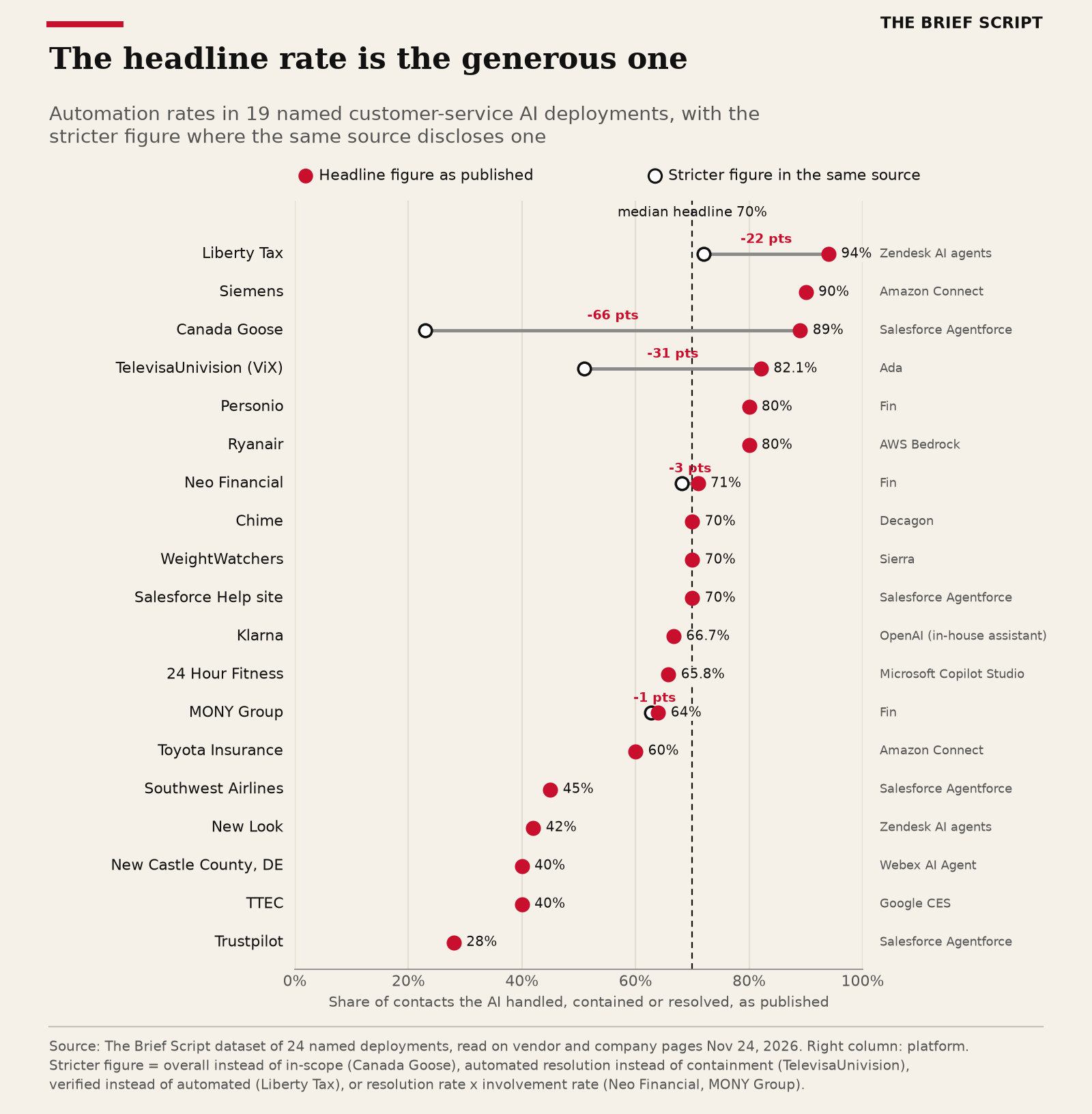
- The median headline automation rate is 70% across the 19 deployments that publish one, with a range of 28% (Trustpilot, overall deflection) to 94% (Liberty Tax, automated resolution during tax season). Ten of 19 report 70% or more.
- The headline is the generous number. Five deployments also disclose a stricter figure in the same source, and the gap is up to 66 points (median 22). Canada Goose resolved 89% of the targeted interactions but 23% overall. TelevisaUnivision reported 82.1% containment during the World Cup but 51% automated resolution. Liberty Tax reported 94% automated resolution and 72% verified resolution.
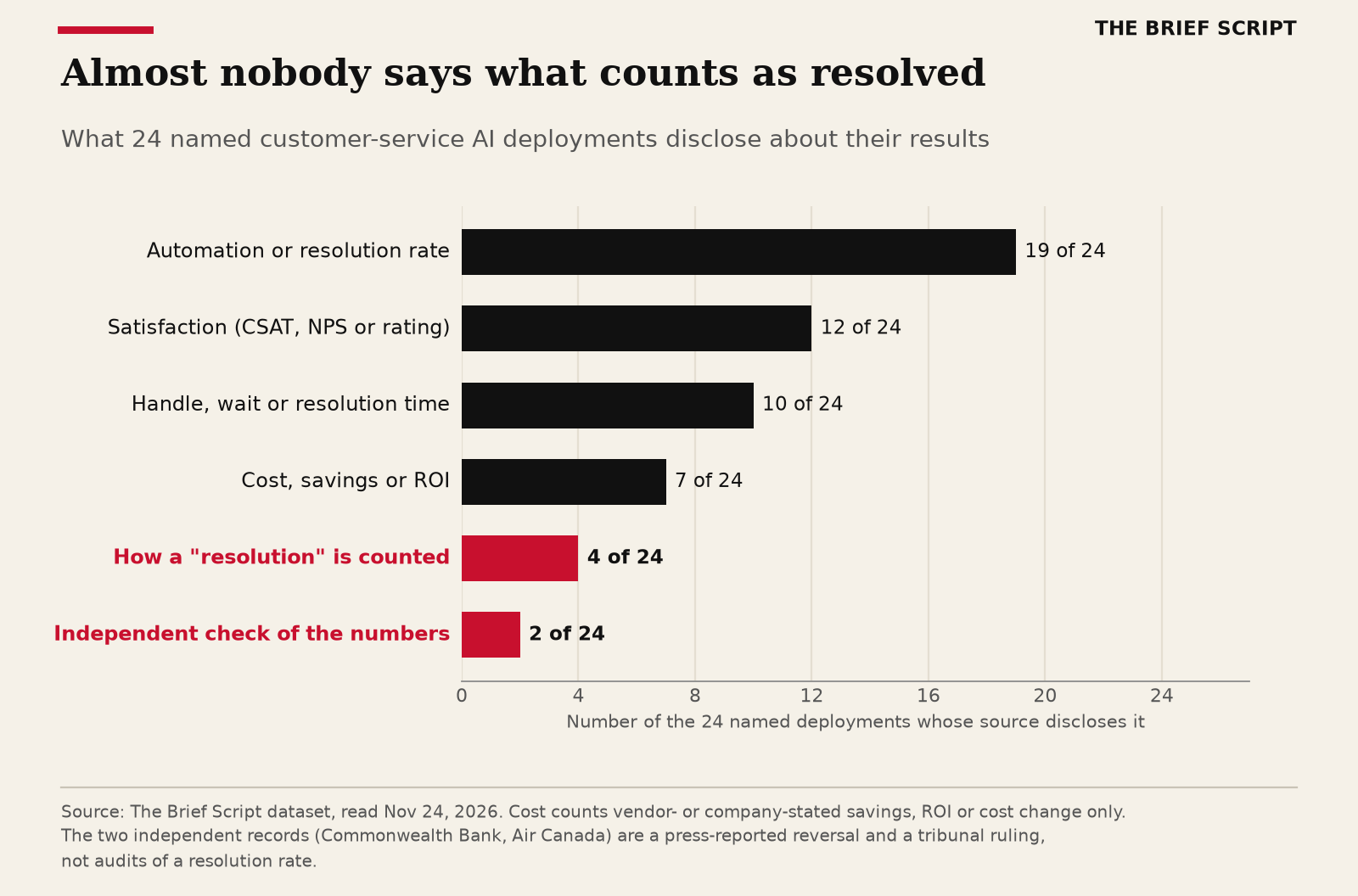
- Only 4 of 24 say how a resolution is counted. “Contained,” “deflected,” “handled,” “resolved without a case” and “resolved, of the conversations the AI was involved in” are different measures that get reported under the same word.
- The same deployment moves. Salesforce’s own help site reported resolving more than 84% of questions in April 2025, about 76% on a customer story page, and 70% of 4.3 million inquiries in June 2026. All three are true for their dates and definitions; none is comparable without them.
- Cost is rarely disclosed. Only 7 of 24 give a savings, ROI or cost figure, and only 5 of the 19 with an automation rate also give a cost number.
- Independent verification is almost absent. The only two independent records in the set are failures: Commonwealth Bank’s reversed job cuts and Air Canada’s tribunal loss. No independent party has audited a vendor-published resolution rate in our sample.
Vendor numbers are not false, but “resolution rate” is not a standard metric, and the definition decides the answer. Pricing makes the definitions concrete. Fin, the AI agent company formerly called Intercom, counts a billable outcome when a customer confirms the issue is resolved, when they do not ask for more help after Fin responds, or when Fin completes a workflow, including handoffs, according to Fin’s pricing page. Zendesk, since May 18, 2026, bills only “verified resolutions” that pass an LLM review of the conversation; “contained resolutions,” where the customer simply stopped asking, do not count. Salesforce’s pay-per-resolution Help Agent charges nothing if the customer asks for a human or leaves negative feedback.
| Organization | Platform | Mode | Headline (as published) | Stricter figure, same source | Other disclosed outcomes |
|---|---|---|---|---|---|
| Liberty Tax | Zendesk AI agents | Autonomous | 94% automated resolution | 72% verified resolution | Tech-support satisfaction 44% to 97% over five years |
| Siemens | Amazon Connect | Autonomous (routing) | 90% of inbound calls resolved or routed | none | |
| Canada Goose | Salesforce Agentforce | Autonomous | 89% of targeted interactions | 23% overall deflection | CSAT 3.3 to 4.0; peak wait -13.9% |
| TelevisaUnivision | Ada | Autonomous | 82.1% containment (World Cup) | 51% automated resolution | Overall CSAT 40% to 62% |
| Personio | Fin | Autonomous | ~80% of conversations | none | CX score 54% to ~80% |
| Ryanair | AWS Bedrock AgentCore | Autonomous | 80% chat containment | none | Agents per passenger -70% |
| Neo Financial | Fin | Autonomous | 71% of conversations Fin is in | 68.2% of all chats | Fin CSAT 75% to 86% |
| Chime | Decagon | Autonomous | ~70% chat and voice resolution | none | Support costs -60% |
| WeightWatchers | Sierra | Autonomous | ~70% contained (first week) | none | CSAT 4.6/5 |
| Salesforce Help | Salesforce Agentforce | Autonomous | 70% of 4.3M inquiries | none | Support headcount 9,000 to ~5,000 (CEO) |
| Klarna | OpenAI | Autonomous | Two-thirds of chats handled | none | 11 to <2 min; est. $40M profit gain |
| 24 Hour Fitness | Microsoft Copilot Studio | Autonomous | 65.8% without a case | none | Replies from weeks to instant |
| MONY Group | Fin | Autonomous | 64% of conversations Fin is in | 62.7% of all | |
| Toyota Insurance | Amazon Connect | Autonomous | 60% of inquiries self-served | none | Infrastructure cost -98.5% |
| Southwest Airlines | Salesforce Agentforce | Autonomous | 45% of eligible inquiries | none | $6M projected annual savings |
| New Look | Zendesk AI agents | Autonomous | 42% resolved independently | none | First reply time -99.5% |
| New Castle County, DE | Webex AI Agent | Autonomous | 40%+ of calls without an agent | none | Queue wait 7+ to ~2 min |
| TTEC | Google CES | Both | Up to 40% automated | none | AHT -11% with knowledge assist |
| Trustpilot | Salesforce Agentforce | Autonomous | 28% overall deflection | none | Escalated-case AHT -45% |
| Verizon | Google CES | Assist | not reported | 95% answerability; 28,000 reps | |
| Kotsovolos | Microsoft Dynamics 365 | Assist | not reported | AHT -30%; CSAT +6 points | |
| Genesys (own support) | Genesys Cloud | Assist | not reported | AHT -5 min; escalations -43% | |
| Commonwealth Bank | Voice bot | Autonomous | not reported | 45 roles cut, then reinstated | |
| Air Canada | Website chatbot | Autonomous | not reported | Ordered to pay C$812.02 |
Headline and stricter figures are as published by each source. Sources are listed below; dataset read November 24, 2026.
What the independent evidence says
Independent evidence on NLP in customer service is thinner than the vendor literature, but it is consistent. The best-known study, by Erik Brynjolfsson, Danielle Li and Lindsey Raymond, followed 5,179 support agents at one software firm as a generative AI assistant was rolled out in stages. In the NBER working paper, access raised issues resolved per hour by 14% on average and by 34% for novice and low-skilled agents, with minimal effect on the most experienced. The published version in the Quarterly Journal of Economics (May 2025, 5,172 agents) reports a 15% average gain. Note what that measures: agent assist, not autonomous resolution.
A randomized field experiment at a meal delivery company, published in Management Science, found that AI-suggested replies made agents faster and improved customer sentiment, with the biggest gains for less experienced agents and the smallest in repeat complaints caused by problems the AI could not fix, according to the article’s abstract.
On workforce effects, Gartner’s survey of 275 service and support leaders (July to August 2026) found only 21% had reduced human agent headcount because of AI. Those that did cut an average of 16.7% over 18 months, 7% had already rehired after earlier reductions, and 11% planned to rehire within 18 months. Gartner has also forecast that agentic AI will autonomously resolve 80% of common customer service issues by 2029; for now, that remains a forecast, not a measured result. For how this compares with AI results in other functions, see our study of 250 enterprise AI case studies, where customer service is both a value cluster and a failure cluster.
How much does AI customer service software cost?
AI customer service software is sold on four pricing models, and the model matters as much as the price. Prices below were checked on vendor pages on November 24, 2026.
| Vendor | Pricing model | Published rate | What counts as billable |
|---|---|---|---|
| Fin (owned by Salesforce since Sep 10, 2026) | Per outcome | $0.99 per outcome; $1.99 for Fin Voice; $49/month minimum incl. 50 outcomes | Customer confirms resolution, or does not ask for more help, or Fin completes a workflow incl. handoffs; once per conversation |
| Zendesk | Seats + per automated resolution | Suite Team $55, Professional $115 per agent/month (annual); per-resolution rate not on pricing page | Only verified resolutions (LLM-reviewed) draw down the allowance since May 18, 2026 |
| Salesforce Agentforce | Per conversation, per action or per resolution | $2 per conversation; Flex Credits $500 per 100,000; Help Agent pay-per-resolution (rate not stated) | Help Agent: no charge if the customer asks for a human or gives negative feedback |
| Sierra | Outcome-based | Not published | Outcome criteria agreed upfront; escalations usually not charged |
| Amazon Connect | Usage-based channels | Chat $0.010 per message; voice $0.038 per minute; email $0.080 per email | Channel usage; AI features priced separately |
Decagon and Ada did not publish a rate we could verify. Our B2B SaaS AI pricing study found customer service is the category where outcome-based pricing has gone furthest.
Worked example: 100,000 contacts a month
This is an illustration with labeled assumptions, not a quote. Assumptions: 100,000 chat and email contacts a month; a fully loaded human cost of $6.00 per contact (assumption; substitute your own); the AI agent is the first point of contact for all of them; it truly resolves 50% (assumption, below the 65.8% median of the strictest figures in our dataset); and 60% of conversations are billable outcomes under a definition that also counts “no further question” and handoff workflows (assumption).
| Per outcome ($0.99) | Per conversation ($2.00) | |
|---|---|---|
| Human cost avoided (50,000 x $6) | $300,000 | $300,000 |
| AI fee | 60,000 x $0.99 = $59,400 | 100,000 x $2 = $200,000 |
| Net monthly saving | $240,600 | $100,000 |
| Break-even human cost per contact | $1.19 | $4.00 |
Two lessons follow. The per-conversation model only pays off when human contacts cost more than $4, and at a true resolution rate of 23% (Canada Goose’s overall figure) it loses $62,000 a month while per-outcome still saves about $105,000. And under per-outcome pricing, every point of gap between billable outcomes and true resolutions is money paid for nothing, which is why the definition belongs in the contract. Neither model includes helpdesk seats, integration work or the team that tunes the agent: 24 Hour Fitness says tuning tone, accuracy and consistency took two to two and a half months, followed by three to four months to build internal confidence. Our guide to measuring AI ROI shows how to account for those costs.
Risks: hallucination, escalation, disclosure and reversals
Hallucination and liability. An NLP agent that invents a policy creates a liability, not just a bad answer. In Moffatt v. Air Canada, 2024 BCCRT 149, the airline’s website chatbot told a customer whose grandmother had just died that they could claim a bereavement fare retroactively, which contradicted the airline’s own policy page. The tribunal decision called Air Canada’s argument that the chatbot was responsible for its own actions “a remarkable submission,” held that a company is responsible for all the information on its website, and ordered it to pay C$812.02. Grounding answers in approved knowledge and testing them before launch is the control.
Escalation and the human option. Klarna’s February 2024 press release said its AI assistant handled two-thirds of customer service chats, did the work of 700 full-time agents and matched humans on satisfaction. In May 2025 its CEO told Bloomberg that cost had been “a too predominant evaluation factor” and the result was “lower quality,” and that customers should always be able to reach a person, as Fortune reported. A Klarna spokesperson told Fortune the company was “very much still AI-first” and was hiring freelance agents rather than reversing course. Either way, the lesson is the same: design the handoff first.
Klarna-style reversals. Commonwealth Bank of Australia cut 45 customer service roles in July 2025 after introducing a voice bot, telling the union it had reduced calls by 2,000 a week. The union said volumes were rising. On August 21, 2025 the bank reversed the decision and apologized for an “error,” as the ABC reported. Gartner calls this the “cut fast, rehire later” trap. Our AI layoffs tracker follows how often AI-attributed cuts hold.
EU AI Act chatbot disclosure (Article 50). Under Article 50(1), providers must design AI systems that interact directly with people so those people are informed they are dealing with an AI system, unless that is obvious from context. The European Commission’s transparency fact page confirms the rules apply from August 2, 2026; the grace period to December 2026 covers only the marking of AI-generated content by generative systems already on the market, not the chatbot disclosure. Any customer-facing agent serving EU users needs a clear “you are talking to an AI” notice. Our generative AI governance guide covers the wider control set.
Data protection. Transcripts contain names, addresses and card numbers. Redaction at ingestion, retention limits and a clear view of which model provider processes which data should be settled before launch.
How to implement NLP in customer service: a checklist
- Pick topics, not channels. Start with three to five high-volume, low-risk intents with clear steps, such as order status, password resets or warranty status.
- Fix intent labels first. Clean topic tagging is what lets you scope, measure and price the agent.
- Write the resolution definition into the contract. Decide whether you pay for confirmed, verified, contained or “no further question” outcomes, and how a handoff is billed.
- Measure two numbers, always. Report the automation rate on in-scope topics and the overall rate across all contacts, plus repeat contacts within 7 days.
- Ground the agent in approved knowledge. Curate a policy and FAQ set instead of crawling the website; 24 Hour Fitness rebuilt its knowledge base for this reason.
- Connect systems for actions. Resolution rates rise when the agent can look up accounts and complete tasks, not just answer questions.
- Design the handoff. A visible route to a human, with the transcript and summary passed along, protects satisfaction and reduces handle time on escalations.
- Ramp traffic gradually. Start with 10% of traffic or one channel; Canada Goose proved chat for six weeks before voice.
- Test adversarially before launch. Write questions designed to trip the agent, including policy edge cases like the Air Canada bereavement fare.
- Disclose the AI. Add an AI notice for EU users under Article 50, and consider it everywhere.
- Redact and retain carefully. Mask personal data in transcripts and set retention periods.
- Make headcount decisions last. Change staffing only after sustained, verified results, not on projected ones.
Frequently asked questions
How is NLP used in customer service?
NLP is used to detect what a customer wants, score their sentiment, extract details like order numbers, route contacts, summarize conversations, suggest answers to human agents and, with large language models, resolve routine requests autonomously across chat, email and voice.
What is a good AI resolution rate for customer service?
Published headline rates in our 24-deployment dataset have a median of 70%, but stricter measures run lower, with a median of 65.8% when the strictest disclosed figure is used. Compare rates only when you know the definition: verified resolutions, containment and deflection are different measures, and in-scope rates can be far higher than overall rates.
Is conversational AI the same as NLP?
No. NLP is the underlying capability to understand and generate language. Conversational AI applies NLP to a back-and-forth dialogue, such as a chatbot or voice bot. AI customer service agents add the ability to take actions in business systems.
Do companies have to tell customers they are talking to AI?
In the EU, yes. Article 50 of the AI Act, applicable from August 2, 2026, requires AI systems that interact directly with people to be designed so users know they are interacting with AI, unless it is obvious. Outside the EU, rules vary, but disclosure is good practice.
Methodology
The deployment dataset covers 24 named organizations with a dated, publicly disclosed outcome from a customer-service AI deployment, published between February 2024 and November 2026, chosen to span 14 named platforms, autonomous and agent-assist modes, voice and digital channels, and both success and failure cases. We read every source page on November 24, 2026 and recorded figures exactly as published. “Headline” is the automation figure the source leads with; “stricter figure” is a second figure in the same source that measures a narrower outcome (overall instead of in-scope, verified instead of automated, resolution instead of containment) or, for Neo Financial and MONY Group, our calculation of the resolution rate multiplied by the involvement rate. We counted a definition as stated only when the source explains how a resolution is counted. Twenty-two sources are vendor or company publications and were not independently audited by us or anyone else. The sample is not random; vendors publish their best results, so the true distribution is likely lower. Prices were checked on vendor pages the same day. The cost example uses labeled assumptions.
Sources
The 24 deployments, with a source link on every row, are in our dataset: download the CSV (24 rows). Sources linked in the text above are not repeated here.
- Salesforce, “Lessons from 500,000 Agentforce Customer Conversations,” Apr 22, 2025: https://www.salesforce.com/news/stories/agentforce-customer-support-lessons-learned/
- Salesforce, “Agentforce resolves over 75% of visitor issues on the Salesforce Help site.”: https://www.salesforce.com/customer-stories/agentforce-for-customer-support/
- Business Insider, “Marc Benioff says Salesforce has cut 4,000 roles because of AI agents,” Sep 2025: https://www.businessinsider.com/marc-benioff-says-salesforce-cut-4000-roles-because-of-agents-2025-9
- Gartner, “Gartner Predicts Agentic AI Will Autonomously Resolve 80% of Common Customer Service Issues Without Human Intervention by 2029,” Mar 5, 2025: https://www.gartner.com/en/newsroom/press-releases/2025-03-05-gartner-predicts-agentic-ai-will-autonomously-resolve-80-percent-of-common-customer-service-issues-without-human-intervention-by-20290
- Salesforce, “Salesforce Completes Acquisition of Fin,” Sep 10, 2026: https://www.salesforce.com/news/press-releases/2026/09/10/salesforce-completes-acquisition-of-fin/
- Zendesk, pricing: https://www.zendesk.com/pricing/
- Zendesk, “About automated resolution tiers.”: https://support.zendesk.com/hc/en-us/articles/9570369117338-About-automated-resolution-tiers
- Salesforce, Agentforce pricing: https://www.salesforce.com/agentforce/pricing/
- Sierra, “Outcome-based pricing for AI agents,” Dec 10, 2024: https://sierra.ai/blog/outcome-based-pricing-for-ai-agents
- AWS, Amazon Connect pricing: https://aws.amazon.com/connect/pricing/